What Is the Liposuction Average Cost in 2026?
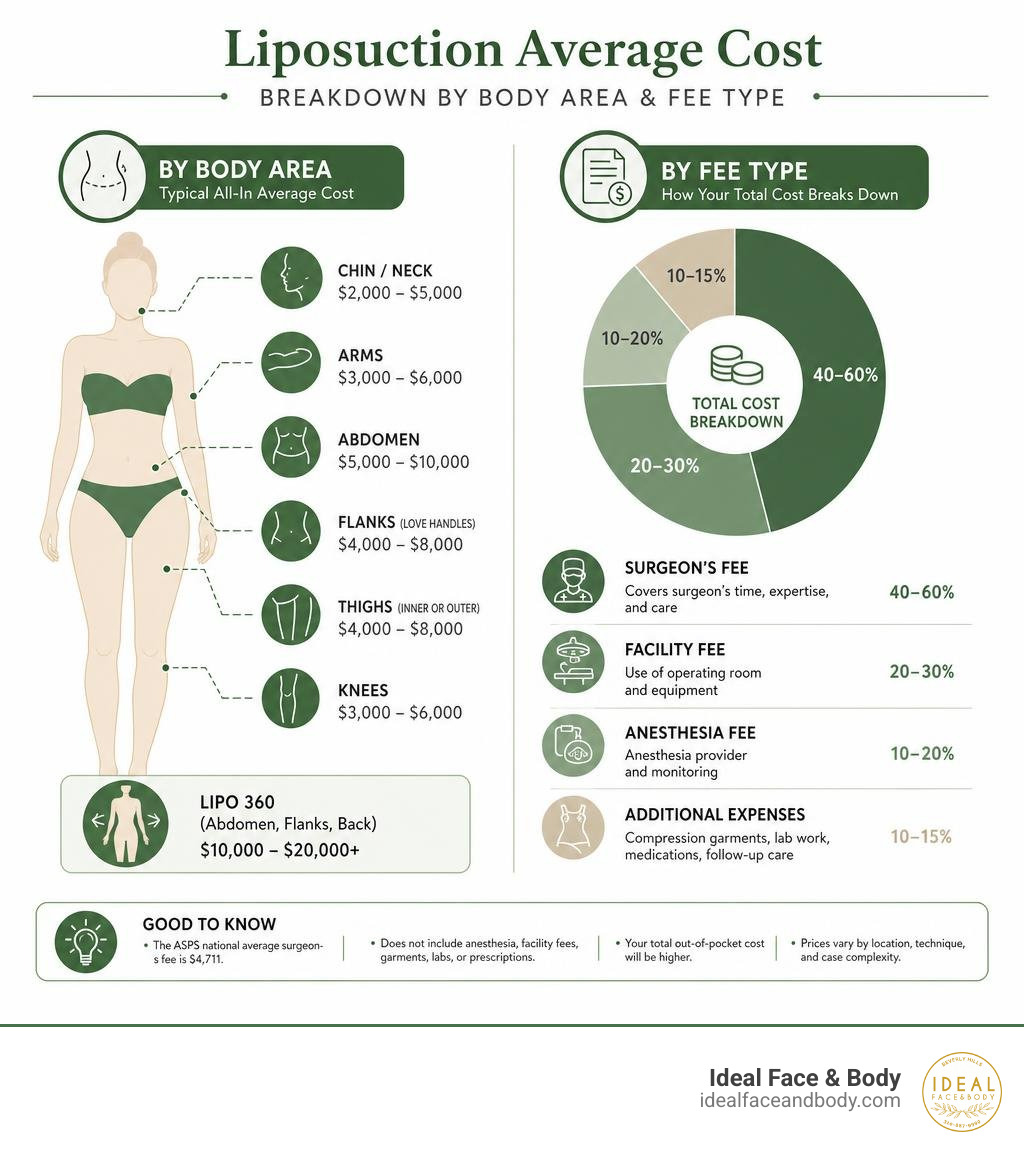
The liposuction average cost varies depending on the body area, technique, and where you have it done — but here’s a quick snapshot to orient you:
| Cost Factor | Typical Range |
|---|---|
| Surgeon’s fee (ASPS national average) | Varies |
| Single treatment area (all-in) | Varies widely |
| Multiple areas or Lipo 360 | Varies |
| Additional fees (anesthesia, facility, garments) | Added on top of surgeon’s fee |
A few things to know right away:
- The national average surgeon’s fee varies, according to the American Society of Plastic Surgeons.
- This fee does not include anesthesia, facility fees, compression garments, labs, or prescriptions.
- Your total out-of-pocket cost will almost always be higher than any single baseline fee you see advertised.
- Costs vary based on body area, technique, surgeon experience, and location.
Liposuction is consistently one of the most popular cosmetic surgical procedures in the United States — and for good reason. It targets stubborn fat that won’t budge with diet and exercise, sculpting areas like the abdomen, chin, arms, and thighs with long-lasting results.
But pricing can feel confusing, even overwhelming. You might see one clinic advertising a low per-area rate, while another quotes a number that’s several times higher. That gap isn’t random — it reflects real differences in what’s included, who’s performing the procedure, and how complex your case is.
This guide breaks it all down clearly so you can compare quotes with confidence and know exactly what you’re paying for.
I’m Dr. Sarah Yovino, MD, a double board-certified specialist at Ideal Face & Body in Beverly Hills, CA, where I work alongside Dr. Justin Yovino to help patients understand every aspect of their aesthetic investment — including the liposuction average cost and what drives it. My background in pain management and minimally invasive procedures gives me a unique perspective on helping patients navigate both the clinical and financial sides of body contouring.
Important liposuction average cost terms:
Understanding the Liposuction Average Cost and What It Includes
When researching the liposuction average cost, it is incredibly common to experience a bit of sticker shock when transitioning from initial online research to your first in-person consultation. The primary reason for this confusion is how surgical fees are tracked and reported.
The baseline fee reported by national organizations like the American Society of Plastic Surgeons represents the surgeon’s fee alone. This is the cost for the surgeon’s time, skill, and artistic expertise. However, a safe and successful surgical procedure requires a complete team, a sterile environment, and specialized medical supplies.
To understand your total out-of-pocket investment, you must look at the complete picture. A comprehensive surgical quote typically includes several distinct cost components:
- The Surgeon’s Fee: This covers the actual performance of the surgery. Highly experienced, board-certified surgeons command a higher fee due to their refined aesthetic judgment and safety track record.
- Anesthesia Fees: Whether you undergo general anesthesia or deep sedation, a qualified anesthesia provider (such as a board-certified anesthesiologist or CRNA) must administer and monitor your vitals. Their time and medications are billed separately.
- Operating Room and Facility Fees: Performing surgery in a state-of-the-art, accredited surgical center or hospital incurs overhead costs. This covers the specialized equipment, sterile tools, and the nursing staff who assist during and after your procedure.
- Pre-Operative Medical Tests: To ensure you are a safe candidate for surgery, we often require blood work, lab tests, or medical clearance from your primary care physician.
- Post-Operative Compression Garments: You will need to wear specialized medical-grade compression garments for several weeks following surgery to minimize swelling, support healing tissues, and optimize your final contour.
- Prescription Medications: This includes antibiotics to prevent infection and pain management medications to keep you comfortable during your initial recovery.
When you review national databases, such as the 2024 Plastic Surgery Statistics | Average Surgeon Fees, those numbers are only one piece of the puzzle. To get an accurate estimate of what your complete journey will entail, we recommend reading our comprehensive Lipo Cost Guide which breaks down these individual line items in detail.
How Treatment Areas and Complexity Affect Your Quote
No two human bodies are identical, which means liposuction is never a one-size-fits-all procedure. The specific areas you want to target, the volume of fat to be removed, and the unique characteristics of your tissues will directly dictate the complexity of your surgery.
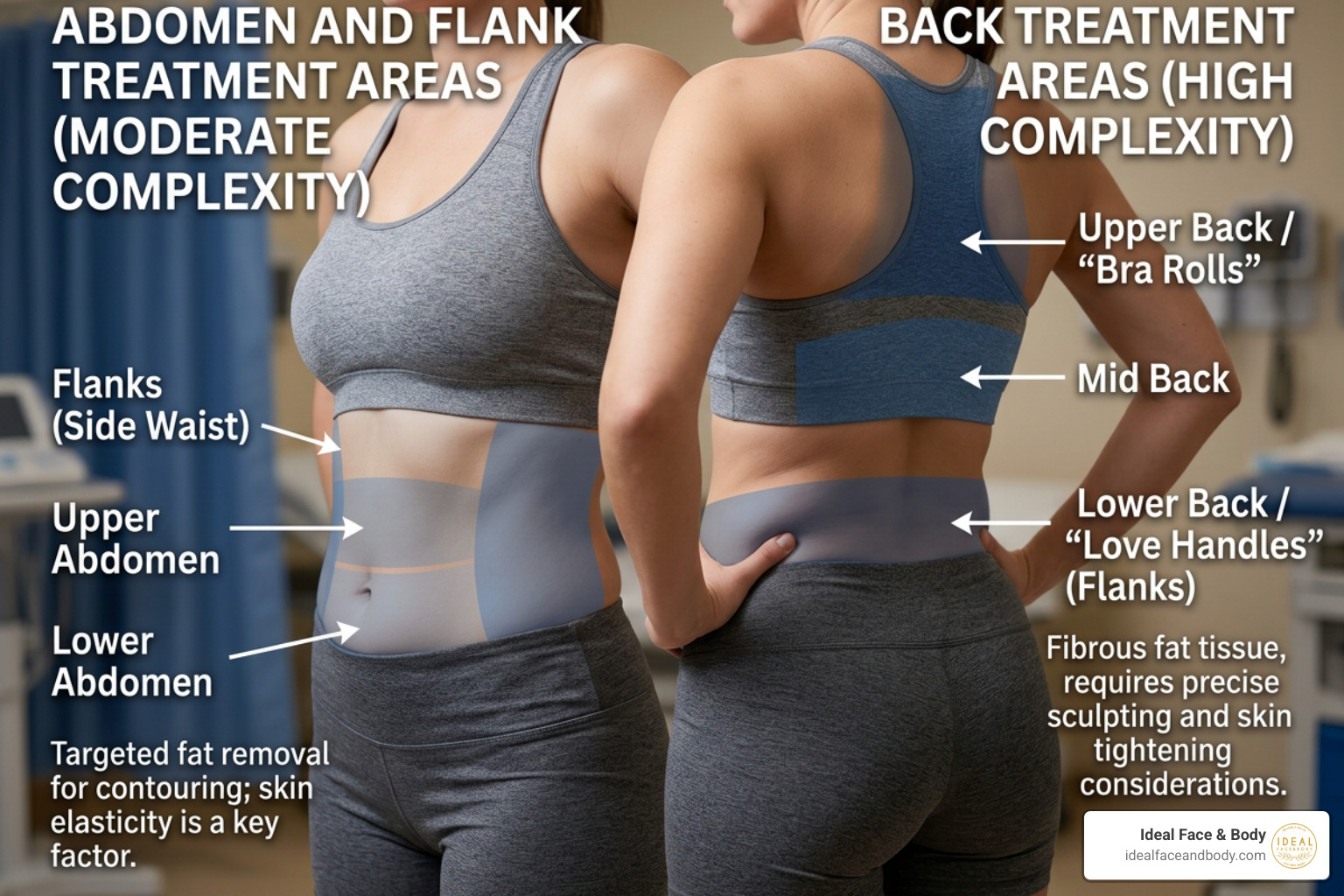
When a surgeon evaluates your body, they do not just look at a generalized region like “the stomach.” Instead, they evaluate the area in terms of “sub-zones.” For example, the midsection actually consists of multiple sub-zones: the upper abdomen, the lower abdomen, the left flank, and the right flank.
The number of zones treated, the overall session time, and the volume of fat to be removed safely are the primary drivers of your custom quote. Fortunately, many practices offer multi-area discounts. Because the facility and anesthesia overhead are already established for the first area, adding secondary zones during the same session is often highly cost-effective. To learn more about how these zones are calculated, you can read our guide on How Much Is It For Lipo?.
Facial and Small Area Contouring
Smaller, highly visible areas like the chin, neck, and jawline require an incredibly delicate touch. While these procedures typically take less operating room time than a major abdominal contouring session, they demand a high level of precision.
Meticulous sculpting in the submental (under-chin) region can completely redefine a patient’s profile, making it a highly sought-after treatment. Because these areas are smaller, they can often be performed comfortably under local anesthesia, which helps keep the overall facility and anesthesia fees minimal. For a deeper look into the value of these smaller treatments, explore How Much Is A Liposuction And Is It Worth The Investment?.
Midsection and Large Area Procedures
The midsection is the most common area treated with liposuction. Procedures can range from targeting a single stubborn pocket on the lower stomach to comprehensive circumferential sculpting, commonly known as Lipo 360.
Lipo 360 involves treating the entire midsection, including the upper and lower abdomen, the flanks (love handles), and the mid-to-lower back. This approach provides a seamless, balanced transition from every angle. Because of the sheer surface area and the need to turn the patient during surgery to access the back, these procedures require more time, effort, and advanced surgical planning. To understand the nuances of midsection contouring, you can review our Stomach Liposuction Cost Complete Guide.
Lower Body and Extremities
Sculpting the lower body and extremities—such as the thighs, knees, calves, and arms—presents its own unique anatomical challenges. Symmetry is the absolute key to success here.
When treating the arms, a surgeon must carefully sculpt around the delicate curves of the shoulder and elbow to ensure a natural, toned appearance without creating irregularities. For detailed insights on this specific area, see our Arm Liposuction Cost Complete Guide. Similarly, contouring the legs requires specialized techniques, which you can read about in our resource on Inner Thigh Lipo Cost.
Key Factors Influencing the Final Price of Liposuction
When you receive a customized quote for body contouring, several background factors influence that final number. Understanding these variables will help you make an informed decision when selecting your provider.
- Surgeon Experience and Board Certification: Surgeons who have dedicated decades to perfecting their craft and who hold board certifications from accredited boards typically charge a premium. This investment reflects their advanced training, artistic skill, and ability to minimize complications.
- Facility Accreditation: Having your procedure performed in a fully accredited ambulatory surgery center (ASC) or a hospital ensures the highest standards of safety, sterile technique, and emergency preparedness. Operating in these certified environments carries a higher overhead than unaccredited office settings, but safety should never be compromised.
- Anesthesia Type: The choice between general anesthesia (where you are completely asleep) and local or “awake” anesthesia (where the area is numbed, but you remain conscious) significantly impacts the cost. Awake procedures eliminate the need for a separate anesthesiologist and reduce facility fees.
For an exhaustive breakdown of how these factors interact, check out our Lipo Cost Guide.
How Surgical Techniques Impact the Liposuction Average Cost
The technology used during your procedure can also play a major role in your total investment. Traditional tumescent liposuction remains the gold standard for many, but advanced energy-assisted technologies have evolved to offer enhanced results, skin tightening, and smoother recoveries.
- Tumescent Liposuction: The foundational technique where a sterile liquid solution containing numbing lidocaine and epinephrine is injected into the fat layer before removal. This minimizes bleeding and bruising.
- VASER Liposuction: Uses ultrasound energy to gently break apart and liquefy fat cells before they are suctioned out. This is highly effective for dense, fibrous areas like the male chest or upper back.
- Laser-Assisted Liposuction (SmartLipo): Incorporates laser energy to melt fat and stimulate collagen production in the overlying skin, promoting post-operative skin tightening. To compare these options, read our guide on Laser Fat Removal Cost.
- Power-Assisted Liposuction (PAL): Uses a rapidly vibrating cannula to break up fat cells, allowing the surgeon to remove fat more efficiently with less physical trauma to surrounding tissues.
For patients looking to avoid the risks and costs of general anesthesia, “awake” liposuction is an exceptional alternative. By performing the procedure under local tumescent anesthesia, we can achieve stunning, precise results with a quicker recovery. You can learn more about this approach in our guide to Awake Liposuction Cost.
Regional Variations in the Liposuction Average Cost
Where your surgeon’s office is located plays a massive role in pricing. Just like real estate and the general cost of living, medical overhead varies dramatically by geography.
In premium cosmetic hubs like Beverly Hills, CA, the cost of operating a high-end, accredited surgical facility, employing specialized medical staff, and maintaining cutting-edge technology is naturally higher than in smaller suburban markets. However, these premium markets also attract the world’s leading aesthetic specialists, offering patients access to unparalleled expertise and advanced techniques. To understand how location shapes your investment, consult our Beverly Hills Liposuction Guide.
Evaluating Your Quote and Avoiding Hidden Fees
One of the most important steps in your cosmetic journey is carefully evaluating your written quote. Unfortunately, some clinics utilize misleading marketing tactics, advertising extremely low “per-area” prices to get patients through the door.

To avoid unexpected out-of-pocket expenses, always ask for a fully itemized, all-inclusive quote. A transparent quote should clearly outline whether the price includes the surgeon’s fee, anesthesia, operating room time, garments, and all of your post-operative follow-up appointments. If a price seems too good to be true, it likely means there are hidden fees waiting to be added later. To learn how to spot these discrepancies, read our advice on How Much Is It For Lipo?.
Combining Procedures for Value and Recovery
If you are considering multiple aesthetic improvements, combining them into a single surgical session is often the most practical and cost-effective route. For example, pairing liposuction with a tummy tuck (abdominoplasty) or a Brazilian Butt Lift (BBL) allows you to address multiple concerns at once.
By combining procedures, you only pay for the facility overhead and the anesthesia team once, rather than paying those substantial fees multiple times for separate surgeries. Additionally, you only have to go through a single recovery period, saving you valuable time off from work and daily responsibilities. To explore the clinical and financial benefits of combined surgeries, view our Awake Surgery Cost Complete Guide.
Insurance Coverage and Financing Options
Because liposuction is almost always classified as an elective cosmetic procedure, traditional health insurance plans do not cover the surgery or its associated recovery costs.
There are very rare exceptions where liposuction may be deemed medically necessary. These include the treatment of lipedema (a painful, chronic fat distribution disorder) or reconstructive gynecomastia (reducing male breast tissue). In these specific instances, extensive documentation and pre-authorization are required.
For the vast majority of patients paying out-of-pocket, flexible financing options make achieving your goals highly manageable. Many practices partner with reputable healthcare lending platforms like CareCredit or Alphaeon, which offer low-interest or interest-free promotional payment plans. To learn more about navigating these payment avenues, check out our Lipo Cost Guide.
Frequently Asked Questions About Liposuction Costs
Is liposuction covered by health insurance?
Generally, no. Because it is performed to enhance your body contour and is considered elective, health insurance plans exclude it from coverage. Rare exceptions exist for documented medical conditions like lipedema or severe gynecomastia.
How many areas can be treated in one session?
While multiple areas can be combined to save on facility and anesthesia fees, patient safety is always our absolute priority. Most outpatient surgical guidelines recommend a safe fat removal limit of approximately five liters of total fluid (aspirate) per session to ensure a safe, smooth recovery.
What is the difference between awake and traditional liposuction?
Traditional liposuction is performed under general anesthesia, meaning you are completely asleep. Awake liposuction utilizes local tumescent anesthesia to numb the target areas while you remain conscious. Awake procedures eliminate the risks and costs associated with general anesthesia, often resulting in less downtime and a more comfortable recovery.
Conclusion
Investing in your body and your self-confidence is a deeply personal decision. While understanding the liposuction average cost is an essential part of your planning, choosing the right surgical team is what ultimately guarantees a safe, beautiful, and natural-looking outcome.
At Ideal Face & Body in Beverly Hills, CA, Dr. Sarah Yovino and Dr. Justin Yovino are dedicated to providing transparent pricing, state-of-the-art safety standards, and stunning aesthetic results. Our signature “Precision Sculpt” awake liposuction technique allows us to beautifully contour your silhouette under local anesthesia, minimizing downtime and maximizing your comfort.
Ready to take the next step toward your aesthetic goals? Schedule a Consultation with us today to receive a personalized, all-inclusive quote tailored to your unique anatomy.