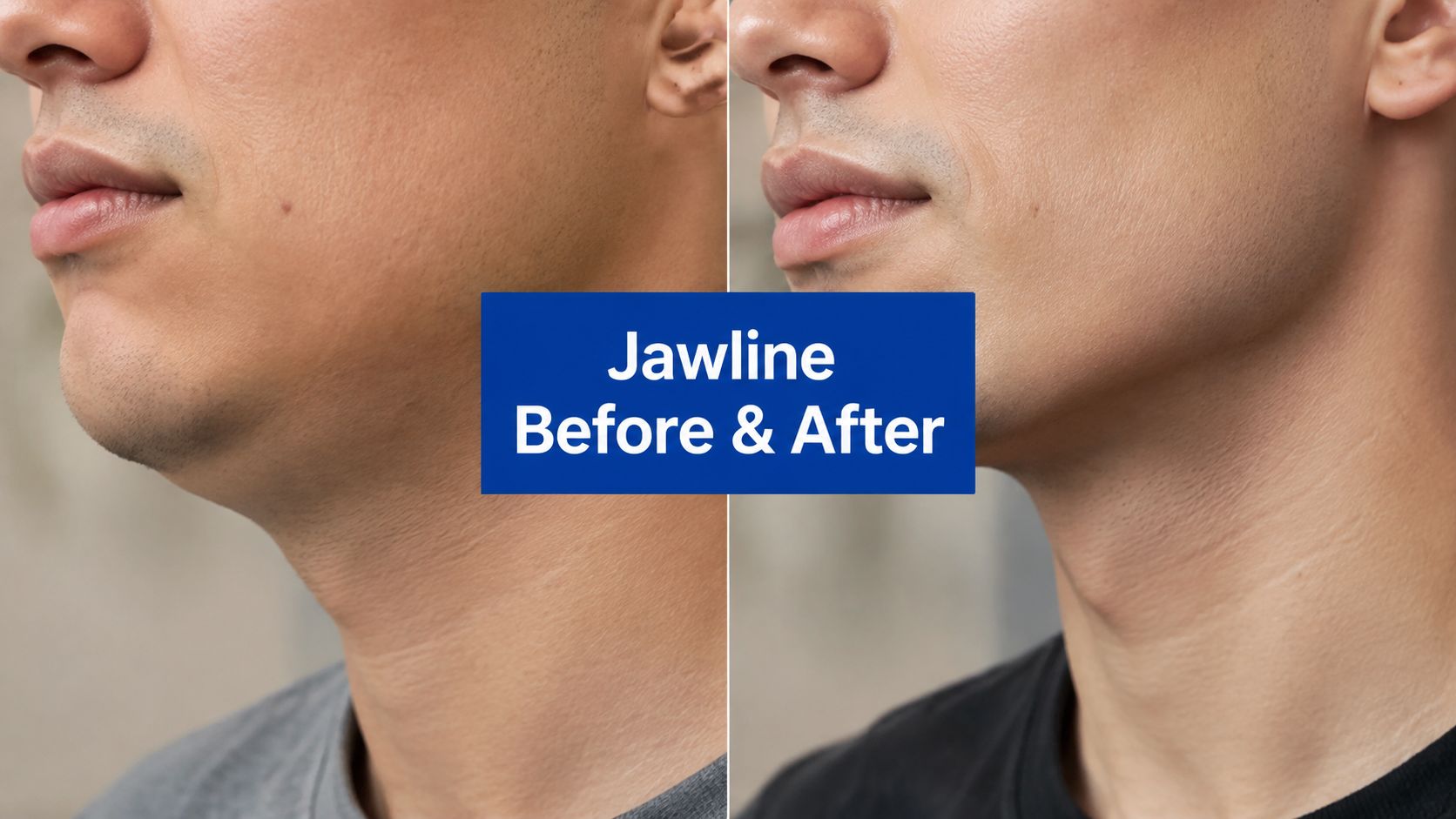
You're probably looking at jawline liposuction before and after photos and trying to decide whether your own profile could change in the same way. One patient's side view may show a crisp line beneath the jaw, while another's result looks softer even after the same procedure. The difference usually isn't the quality of the photograph. It's the underlying anatomy, skin elasticity, amount of localized fat, and whether fat removal was performed alone or as part of a broader contouring plan.
A before-and-after gallery can help you understand possibilities, but it can't replace an assessment of your neck, chin, jawline, and skin behavior. The most useful comparison is one that shows the healing process realistically, not just the most flattering final image.
Table of Contents
- What Before and After Photos Really Tell You
- Measurable Results From Jawline Fat Reduction
- When Liposuction Alone Is Not Enough
- The Real Recovery Timeline Week by Week
- Who Gets the Best Jawline Liposuction Results
- How to Evaluate a Before and After Gallery
What Before and After Photos Really Tell You
A prospective patient often scrolls through several galleries late at night, stopping at a profile that seems close to their own. They compare the fullness beneath the chin, the angle from the neck to the jaw, and the apparent sharpness of the lower face. That comparison is understandable, but a photograph captures only one frame in a recovery process that unfolds gradually.
Early images can be especially deceptive. Swelling may temporarily obscure the contour, create uneven fullness, or make the neck look tighter than it will once tissues settle. Conversely, a carefully selected early image may show dramatic improvement while leaving out bruising, compression wear, or the temporary firmness that patients commonly notice during healing.

Read the photograph, not just the transformation
A credible gallery should let you compare more than a front-facing portrait. Look for:
- Consistent positioning: The head, neck, shoulders, and camera distance should remain similar in both images.
- Multiple viewpoints: A front view shows width, but the side profile reveals the relationship between the chin, neck, and jawline.
- Natural lighting: Strong overhead lighting or deep shadows can exaggerate a groove beneath the jaw.
- Relaxed expression: Smiling, extending the neck, or pushing the chin forward can change the apparent contour.
- Healing context: Dates or time points help you understand whether an image represents an early change or a settled result.
Practical rule: A sharp jawline should remain convincing when the patient turns, speaks, relaxes the neck, and appears in ordinary lighting.
The most dramatic image in a gallery may also represent a combination procedure rather than liposuction alone. Skin tightening, a neck lift, chin support, or another contouring treatment can affect the result substantially. If the gallery doesn't identify what was performed, you can't fairly use that image as a prediction for isolated fat removal.
The right question isn't, “Can my result look exactly like this?” It's, “Does this patient have a similar fat pattern, skin quality, chin projection, and neck structure?” That shift makes jawline liposuction before and after images useful for discussion rather than misleading as promises.
Measurable Results From Jawline Fat Reduction
Photographs communicate shape, but quantitative assessment gives us another way to understand what fat reduction can accomplish. In a 35-patient three-dimensional quantitative study of submental contouring, pretreatment volume averaged 104.12 cm³ and decreased to 81.55 cm³ at six weeks, producing a mean reduction of 22.46 cm³, approximately 20%. The findings are reported in the published 3D submental contouring study.
That result is best understood as a practical counseling benchmark, not a guarantee for every patient. A volume change can produce visible slimming beneath the chin, but the way it appears depends on where the fat sits, how the skin contracts, and how the chin and jaw are proportioned. A modest change in a strategically important area may look more significant than a larger change spread across a broader region.
Durability matters as much as early improvement
A separate registration study followed jawline restoration outcomes through 12 months. Patient-reported and objective results remained strong during follow-up, with strong aesthetic improvement commonly rated as very much improved at three, six, and nine months, and still mostly much improved at 12 months. The study also found that the surface-volume coefficient declined from 1.10 at 14 days to 0.63 at 12 months, demonstrating that contour gains can remain durable as healing progresses. These findings appear in the 12-month jawline restoration study.
The surface-volume measurement matters because a photograph doesn't tell you whether a contour is just swollen and tight or whether the tissues have settled into a lasting shape. At two weeks, the jaw may look different for reasons that have little to do with the final result. Later measurements provide a better view of how the surface adapts over time.
For consultation purposes, I use quantitative evidence to frame expectations, not to replace examination. The key questions remain anatomical:
- Where is the fullness located? Localized submental fat responds differently from diffuse neck fullness.
- How does the skin recoil? Good elasticity helps the skin follow the reduced contour.
- What defines the jawline? Fat removal can't create skeletal projection or correct every structural issue.
- What is the goal? Subtle slimming and a highly angular contour require different planning.
Clinical data can make the conversation more honest. It shows that measurable improvement is realistic, while also reminding us that a percentage or volume change doesn't predict the exact appearance of your face.
When Liposuction Alone Is Not Enough
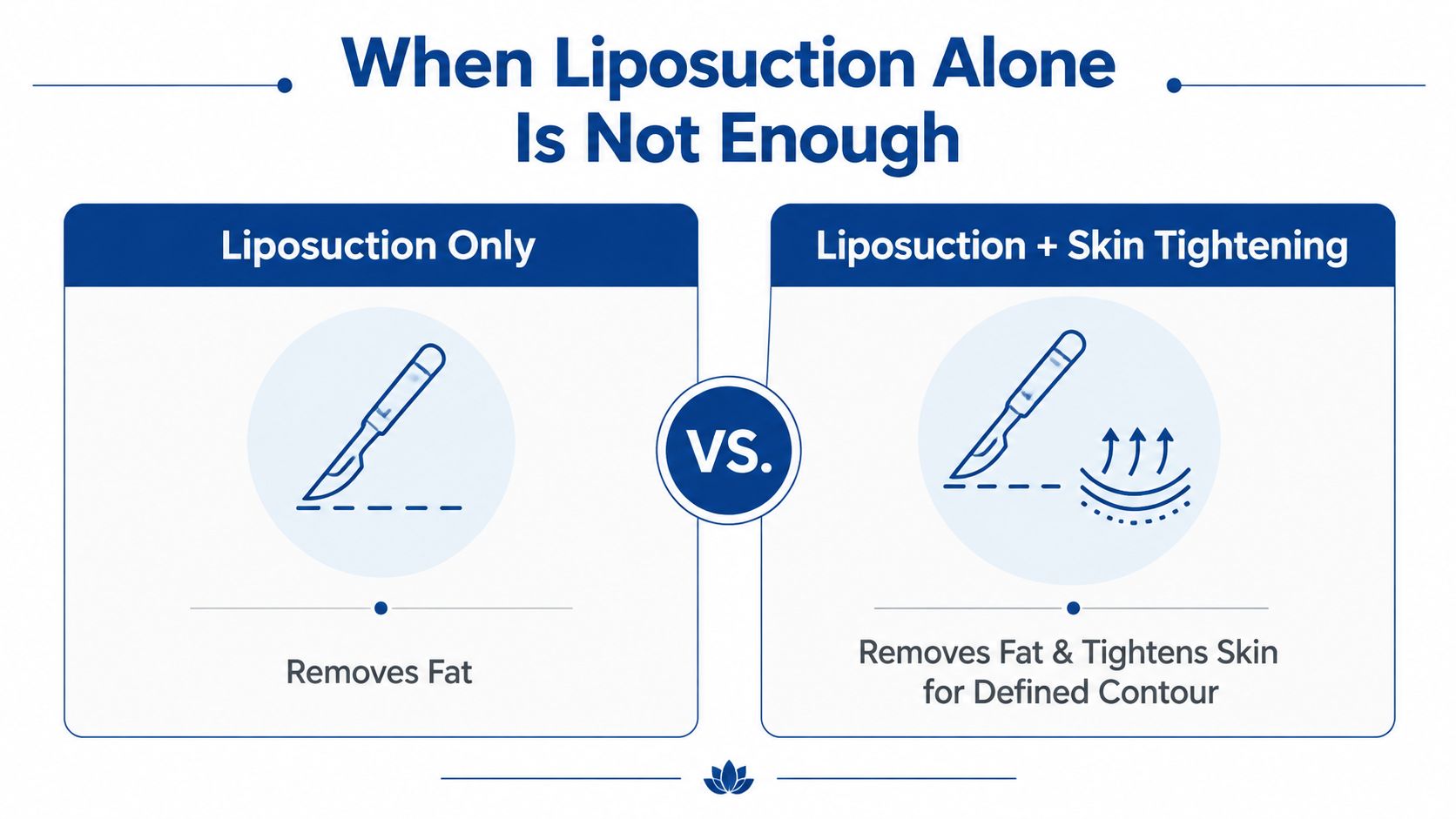
Liposuction removes targeted fat. It doesn't directly remove loose skin, reposition neck muscles, or create a stronger chin. That distinction explains why two people with similar under-chin fullness may receive different recommendations.
Independent clinical research found that submental liposuction improved perceived age, but the effect was more pronounced when liposuction was performed with a neck lift. The same research area also found higher satisfaction for the jawline and under-chin region when lower-face volume reduction was performed concurrently with another treatment. The findings are discussed in this clinical comparison of submental contouring approaches.
The choice depends on what is creating the blur
For a patient with localized fat and firm skin, liposuction alone may produce a clean improvement. The skin can contract around the smaller volume, and the jawline becomes more visible without adding an incision-based lift.
For a patient with lax skin, a heavier neck, visible platysmal changes, or limited skin recoil, removing fat alone may leave a softer border. In that setting, skin tightening or a neck lift may be considered. The right adjunct depends on the cause of the contour problem, not on the desire to make the procedure more dramatic.
| Approach | What it addresses | Main limitation |
|---|---|---|
| Liposuction alone | Localized fat beneath the chin or along the jawline | Doesn't correct substantial laxity or deeper neck structure |
| Liposuction with skin tightening | Fat plus selected degrees of skin contraction | Tightening capacity varies with tissue quality and technique |
| Liposuction with a neck lift | Fat, excess skin, and selected neck structures | More involved recovery and a different surgical plan |
Online galleries increasingly feature combination strategies because patients often want definition that holds up in motion and side profile, not merely a slimmer still image. That doesn't mean combination treatment is automatically better. It means the procedure must match the anatomy producing the fullness.
A good consultation should identify whether your desired result depends on removing fat, tightening skin, improving chin support, or addressing several factors at once. If a surgeon recommends more than liposuction, ask what specific anatomical problem the additional procedure is solving.
The Real Recovery Timeline Week by Week
The first postoperative photograph can be the least representative image in the entire sequence. Bruising, swelling, firmness, numbness, and compression can temporarily make the neck appear irregular or fuller. Patients need to plan around that phase rather than assuming the immediate postoperative appearance reflects the final jawline.
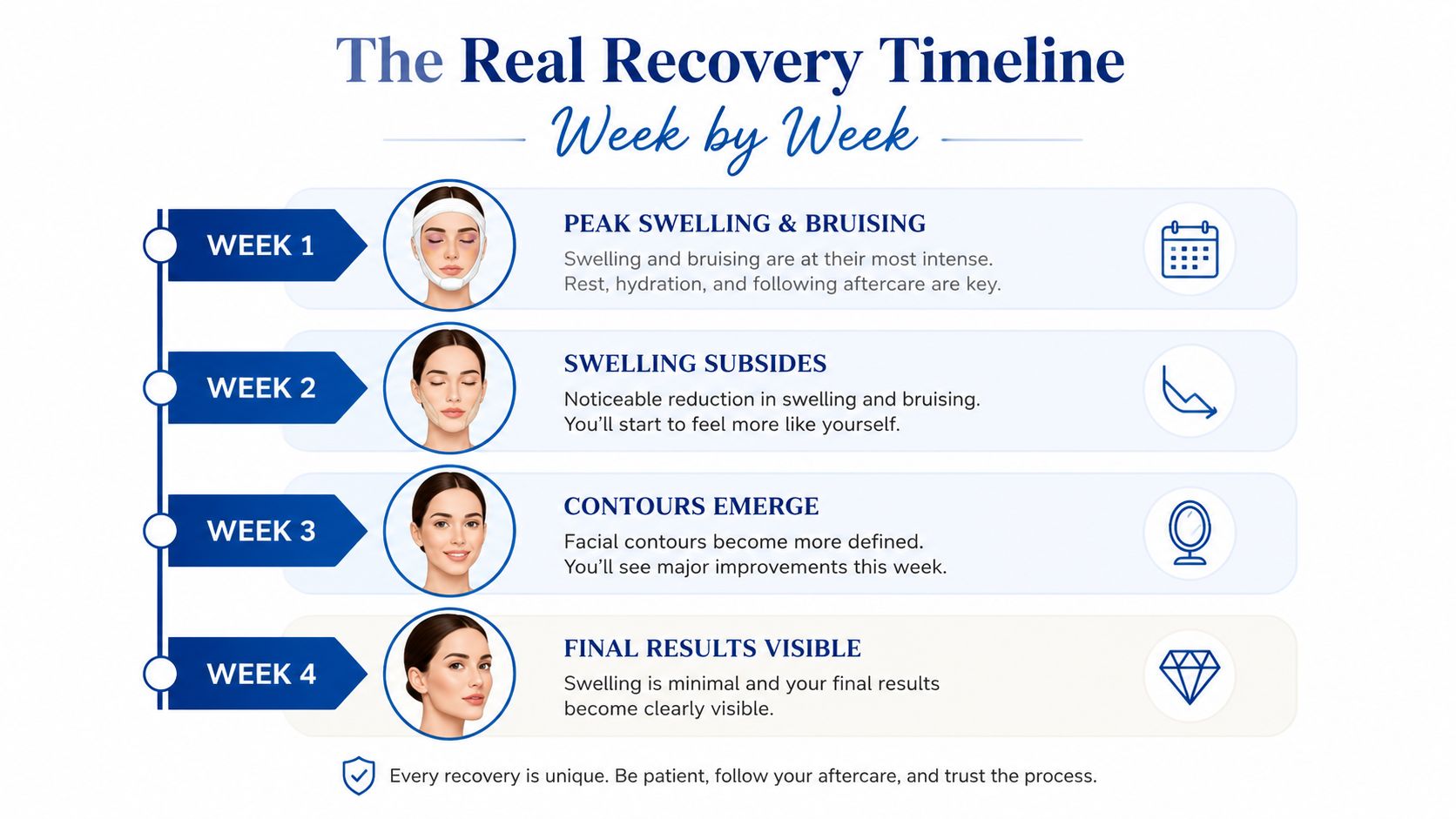
The first days and first weeks
During the first week, bruising and swelling are expected. One hospital's postoperative guidance states that patients may return to work after 5 to 7 days, while exercise should be avoided for 2 weeks. The same guidance emphasizes that early changes are not definitive, and hospital guidance on submental liposuction recovery describes visible improvement after the second week as swelling begins to resolve.
Compression is commonly worn for 1 to 2 weeks, depending on the surgeon's protocol and the patient's healing. It supports the treated area while swelling settles, but it can affect social visibility and sleep, so patients should understand the instructions before scheduling the procedure.
A practical timeline looks like this:
- First week: Expect bruising, swelling, tightness, and a need to protect the area. Keep your head raised as directed and avoid strenuous activity.
- Second week: Bruising often begins to fade, while swelling remains variable. Some patients feel comfortable returning to ordinary work, but the contour is still developing.
- Third week: The jawline may look more refined, although firmness, numbness, or uneven swelling can persist.
- Fourth week and beyond: The visible contour is clearer, but healing isn't finished. Swelling can continue for weeks to months.
Months, scars, and the final contour
Independent postoperative instructions note that bruising may last about 2 to 3 weeks, compression is commonly used for 1 to 2 weeks, and final contour improvement can continue for 3 to 6 months, sometimes extending to 6 to 9 months. The submental liposuction postoperative instructions also explain that small scars are usually hidden, though they can take months to settle.
The important distinction is between “visible improvement” and “final result.” You may notice a slimmer profile before the tissue has softened or the skin has fully adapted. Don't judge a small firm area or mild asymmetry too early, but contact your surgical team promptly if you develop concerning symptoms or a change that doesn't fit your instructions.
For a more detailed patient-planning resource, review this guide to chin liposuction recovery. Your own surgeon's instructions should always take priority because treatment extent, technique, and medical history affect recovery.
Who Gets the Best Jawline Liposuction Results
The strongest candidates usually have a specific problem that liposuction can solve: localized submental fat beneath otherwise healthy, sufficiently elastic skin. A review of submental contouring identifies younger patients with normal-quality skin and localized excess fat as typical candidates, while other clinical guidance emphasizes good elasticity, stable weight, and overall health. The criteria are summarized in this review of submental liposuction patient selection.
Age alone doesn't determine candidacy, but skin behavior matters greatly. If the skin can contract after the fat is removed, the new contour tends to look cleaner. If the skin hangs or folds independently of the fat pocket, suctioning may reduce fullness without creating the sharp edge the patient expects.
Selection is more predictive than the gallery
A published series selected patients with subcutaneous fat and good skin quality for liposuction alone. The investigators excluded patients with prior neck surgery, a history of keloids, severe medical conditions that contraindicated anesthesia, or unrealistic expectations. In that series, 19 of 20 patients reported marked improvement, as reported in the published submental liposuction series.
That outcome reflects careful selection, not a promise that every patient will experience the same result. During consultation, I'm looking for the source of the fullness and the likely behavior of the remaining skin.
Patients should also disclose prior procedures, medication use, smoking status, medical conditions, and any tendency toward abnormal scarring. A stable weight helps make the result easier to assess, while unrealistic expectations can make a technically good outcome feel disappointing.
Use the neck liposuction candidate guide to prepare questions, but let an in-person evaluation determine whether liposuction alone is appropriate. A patient who needs skin tightening or a lift isn't a failure of liposuction. They have a different anatomical problem.
How to Evaluate a Before and After Gallery
Start with the basics. The before and after images should use comparable lighting, camera distance, head position, and facial expression. If the patient's chin is lifted in the after photograph, the neck will look longer and tighter even before accounting for the procedure.
Use a gallery checklist
Look for these details before treating an image as a prediction:
- Review several angles. Front, oblique, and side-profile views reveal different aspects of contour.
- Check the timing. An early image can show change, but it may not represent settled tissue.
- Identify the procedure. Ask whether the case involved liposuction alone, skin tightening, a neck lift, or another adjunct.
- Assess real-world definition. Look for relaxed posture and ordinary lighting rather than only studio images.
- Compare similar anatomy. A patient with firm skin and a small fat pocket isn't a useful match for someone with lax skin or a recessed chin.
Retouching can also affect what you think you're seeing. Understanding professional retouching explained can help you recognize why smoothing, contrast, cropping, and selective editing may make a contour appear more uniform than it looks in person. That doesn't mean every gallery is manipulated, but it does mean photographs deserve careful questions.
Ask questions that change the treatment plan
Bring your own photos and ask the surgeon to explain what creates your fullness. Useful questions include:
- Could liposuction alone produce the definition I want?
- Would my skin quality benefit from tightening or a neck lift?
- What will my profile look like while swelling is present?
- When can I reasonably return to work and exercise?
- Do you offer an awake local-anesthesia approach, such as PRECISION SCULPT laser liposculpting, when clinically appropriate?
- Which follow-up time points will document my healing?
Ideal Face & Body offers chin, neck, and jawline contouring through its awake, office-based practice model, including PRECISION SCULPT laser liposculpting. To understand how to compare images and plan a consultation, review this complete liposuction before and after guide.
Ideal Face & Body evaluates whether localized fat, skin quality, or deeper neck anatomy is driving your jawline concern, then discusses liposuction alone versus an appropriate combination approach. Visit Ideal Face & Body to review chin, neck, and jawline contouring options and request a consultation with Dr. Justin Yovino or Dr. Sarah Yovino.