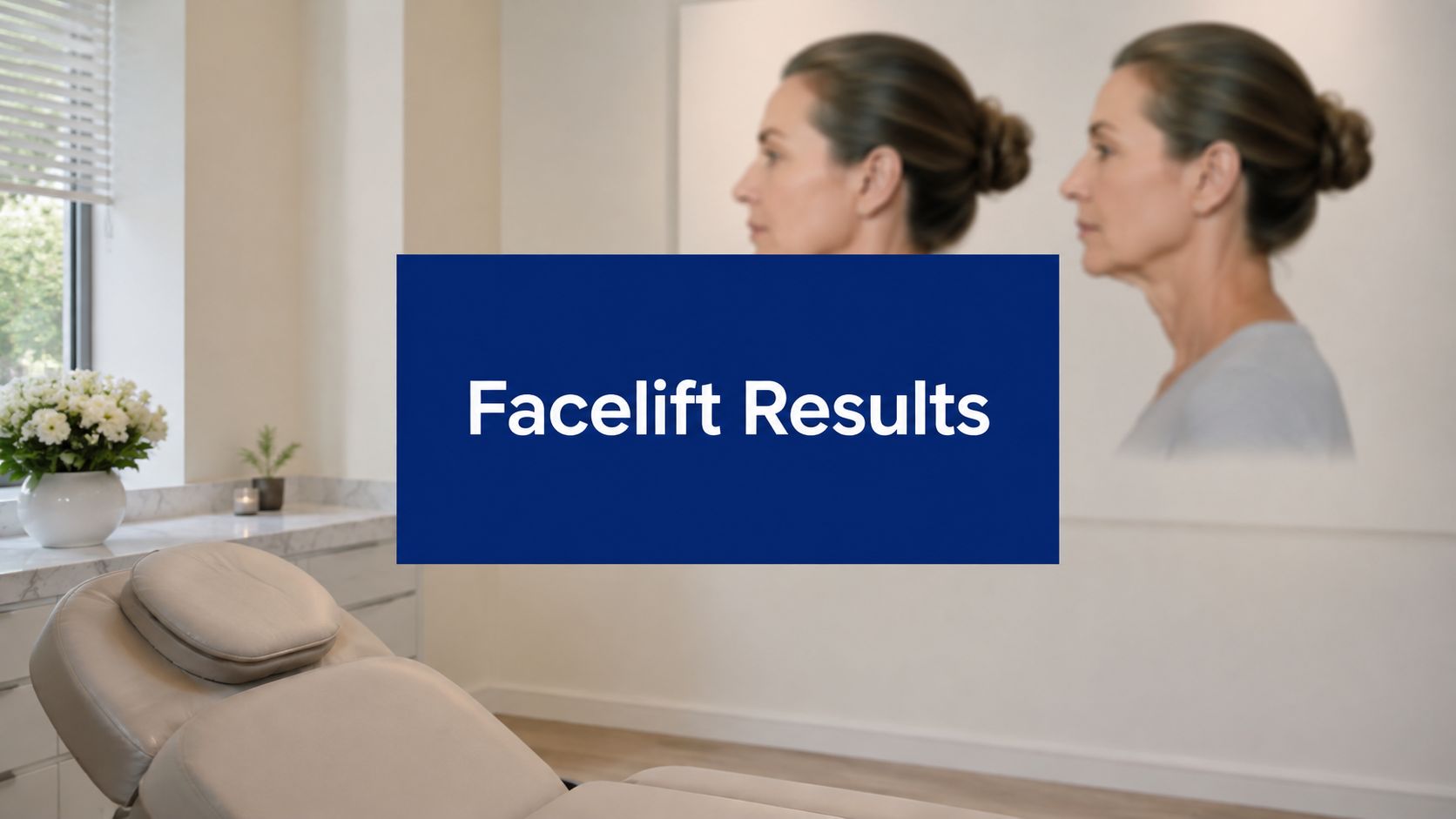
Facelift surgery reduces perceived age by an average of 4.61 years and raises attractiveness scores by 6.72 points on a 100-point scale in blinded observer studies. Those changes are statistically detectable by independent reviewers, not just impressions formed by the patient or surgeon.
That finding changes how facelift before-and-after photos should be read. A credible result isn't a younger-looking face placed beside an older-looking one. It's a controlled visual comparison shaped by surgical technique, lighting, facial expression, camera angle, healing stage, and the specific areas treated.
I've reviewed enough galleries to know where patients commonly go wrong. They focus on the apparent age difference, overlook the neck and jawline, accept inconsistent photography as proof of surgical skill, and assume the first attractive postoperative image represents the final result. A better evaluation asks what changed, what remains, and whether the photographs show a fair comparison.
Table of Contents
- Why Facelift Before and After Research Matters
- How to Interpret Facelift Before and After Photos Correctly
- Understanding Different Facelift Techniques and Their Visual Outcomes
- The Recovery Timeline Behind Facelift Before and After Photos
- How to Choose a Surgeon Based on Before and After Evidence
- Real Case Context and Clinician Perspectives on Facelift Results
- Making Informed Decisions About Facelift Before and After Results
Why Facelift Before and After Research Matters
Before-and-after photography has clinical value when it's collected and presented responsibly. In a large U.S. social-perception study, 483 observers reviewed blinded images of patients before and after facelift surgery. Average perceived age fell from 59.60 years before surgery to 55.85 years afterward, while attractiveness increased from 48.82 to 57.10 on a 100-point scale (the observer study published in the medical literature).
A separate analysis in the same research discussion found an average perceived age reduction of 4.61 years, with attractiveness improving by 6.72 points (facial rejuvenation outcome data). The important point isn't that every patient will receive the same visual change. The point is that independent viewers can identify a measurable difference when the surgical result is photographed and assessed systematically.
What the images can prove
A useful gallery can help you evaluate:
- Contour change: Has the jawline become more defined, or has the skin been pulled tighter?
- Neck improvement: Does the image show reduced laxity, improved definition, or a persistent fullness beneath the chin?
- Facial balance: Does the lower face still look proportionate to the cheeks, eyes, and lips?
- Natural expression: Does the patient still look like the same person when smiling, turning, or speaking?
- Consistency: Does the surgeon show comparable views and lighting across patients?
Those questions matter because a facelift is generally designed to reposition lax lower-face and neck tissues, not to erase every sign of aging. Skin texture, pigmentation, fine lines, and volume loss may remain unless another treatment addresses them.
Why skepticism improves decisions
A polished image can show a real result and still provide incomplete information. The photograph may hide swelling, omit the profile, exclude the neck, or use a different facial expression that makes the result appear more dramatic.
Research validates the visual impact of facelift surgery, but it doesn't remove the need for judgment. Before-and-after evidence works best when you treat it as one part of a clinical assessment, alongside examination, medical history, technique selection, and a direct discussion of what you want changed.
Practical rule: Trust a gallery more when it makes comparison easy, not when it makes the result look impossibly perfect.
How to Interpret Facelift Before and After Photos Correctly
Start with the photograph itself, not the caption. A caption may identify the procedure, but the image tells you whether the comparison is fair.
Use a consistent photo checklist
Check these features in order:
- Lighting: Look for similar brightness, shadow direction, and background. Strong overhead lighting can deepen folds in one image and soften them in another.
- Camera angle: The head should be positioned similarly. A lowered chin can exaggerate neck laxity before surgery, while an extended neck can make the after image look more defined.
- Facial expression: A relaxed preoperative face compared with a smiling postoperative face isn't a neutral test. Expression changes the cheeks, mouth corners, and neck.
- Viewpoint: You need front, oblique, and profile views to judge the lower face and neck. A front view alone can conceal residual jowling or submental fullness.
- Healing stage: Identify whether the after photograph shows early swelling, visible incisions, settled contours, or a mature result.
- Treatment zones: Confirm that the procedure matches the area being judged. A neck lift won't answer a question about cheek descent, and eyelid surgery won't explain a sharper jawline.
The Ideal Face & Body facelift gallery can serve as a useful reference point, but you should apply the same standards to every gallery you review.
Separate genuine limitations from presentation problems
Some differences are expected. Patients may gain or lose weight, change hairstyles, alter makeup, or age between photographs. Those factors don't invalidate the result, but a responsible surgeon should make them apparent rather than use them to create a misleading comparison.
Be cautious when the gallery repeatedly shows only one angle, hides the ears and hairline, uses heavy filters, or presents a very early image as the final outcome. Retouching is especially concerning when skin texture disappears or facial boundaries look artificially smooth.
The best photo evidence doesn't promise perfection. It shows a recognizable patient with improved structure, honest healing information, and enough views to judge whether the result fits your concerns.
Understanding Different Facelift Techniques and Their Visual Outcomes
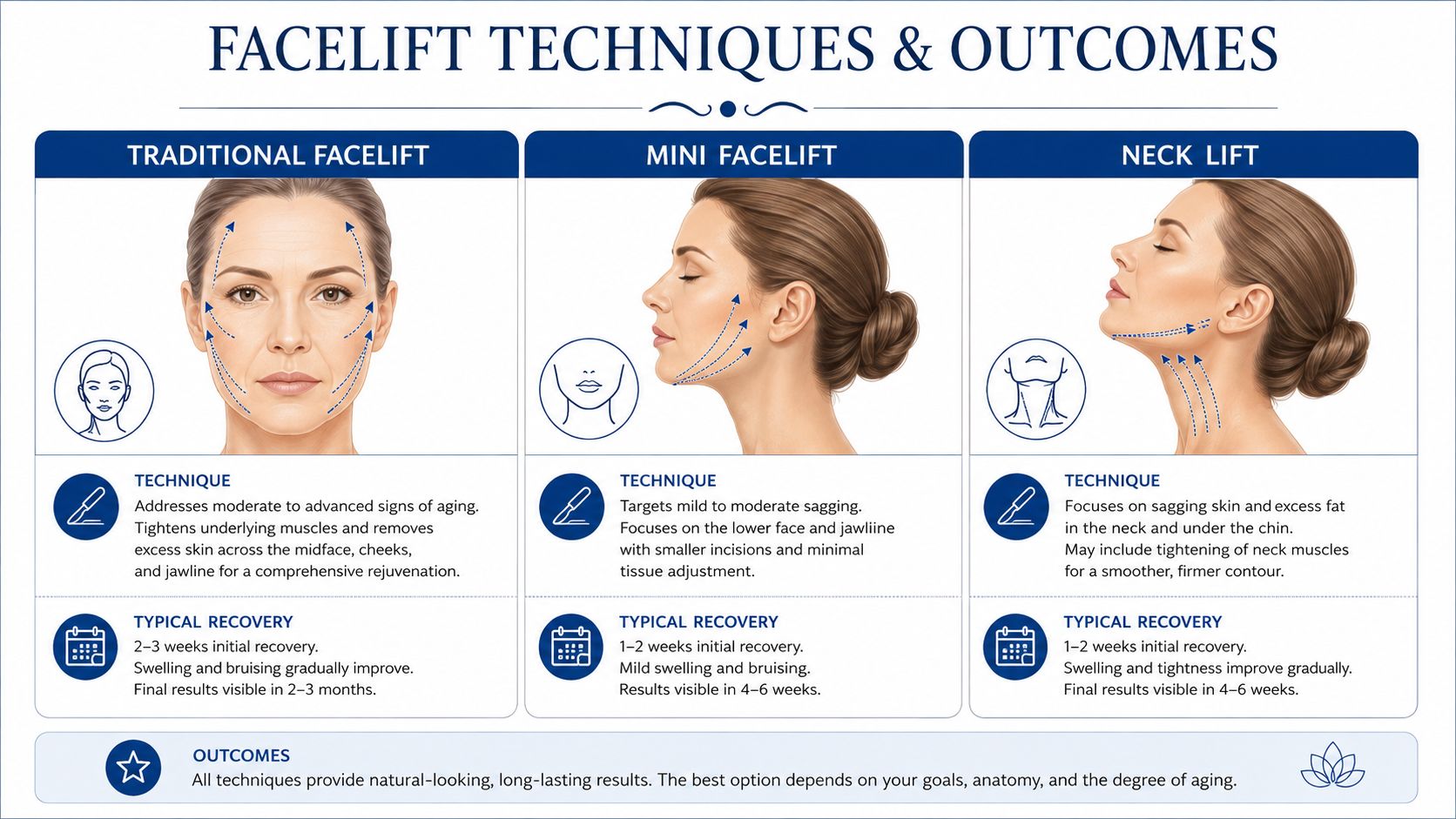
Without knowing the procedure behind a photograph, its visual result is difficult to evaluate accurately. A full facelift, mini lift, neck lift, and eyelid procedure may all be described as facial rejuvenation, but they address different tissues and produce different visible changes. Compare like with like before judging a gallery.
Full facelift
A full facelift generally addresses the lower face, jowls, and neck. The most informative changes appear along the jawline, beside the mouth, and where the chin meets the neck. Look for improved support and contour, while checking that the skin does not appear excessively tight.
The operation beneath the skin matters. Some techniques work through superficial muscular and connective tissue layers, while others reposition deeper structures. A photograph cannot reliably identify that difference. Ask which layers were treated, which areas were included, and whether the neck formed part of the operation.
Mini lift
A mini lift is commonly chosen for milder laxity and a narrower treatment goal. Smaller incisions or less extensive dissection may mean a shorter surgical scope, but the visible improvement is usually more restrained. Early jowling or modest lower-face looseness may improve, while substantial neck laxity or broader tissue descent may require a different plan.
A dramatic photograph does not necessarily represent a dramatic operation. Limited baseline aging, a favorable angle, or selective framing can magnify a modest change. Compare patients with concerns resembling yours and examine several views before drawing conclusions.
Neck lift
A neck lift focuses on the neck profile, platysmal bands, and fullness beneath the chin. Profile and oblique photographs often provide the clearest evidence because they show the cervicomental contour. A front-facing image alone may leave neck definition impossible to judge.
Eyelid surgery
Blepharoplasty changes the upper or lower eyelids. It does not explain a sharper jawline or a tighter neck. The procedure can make the face appear more rested, but it should be assessed separately from facelift work. Combined procedures create a broader overall change, so the gallery should identify each treatment rather than present one photograph as evidence for every improvement.
Practice data indicate that facelifts are routinely performed across major facial plastic surgery practices. The American Academy of Facial Plastic and Reconstructive Surgery reported that 90% or more of its surgeons performed facelifts each year since 2019, and members averaged 48 facelifts or partial facelifts in 2023, a 60% increase from 2017 (AAFPS practice data).
The Recovery Timeline Behind Facelift Before and After Photos
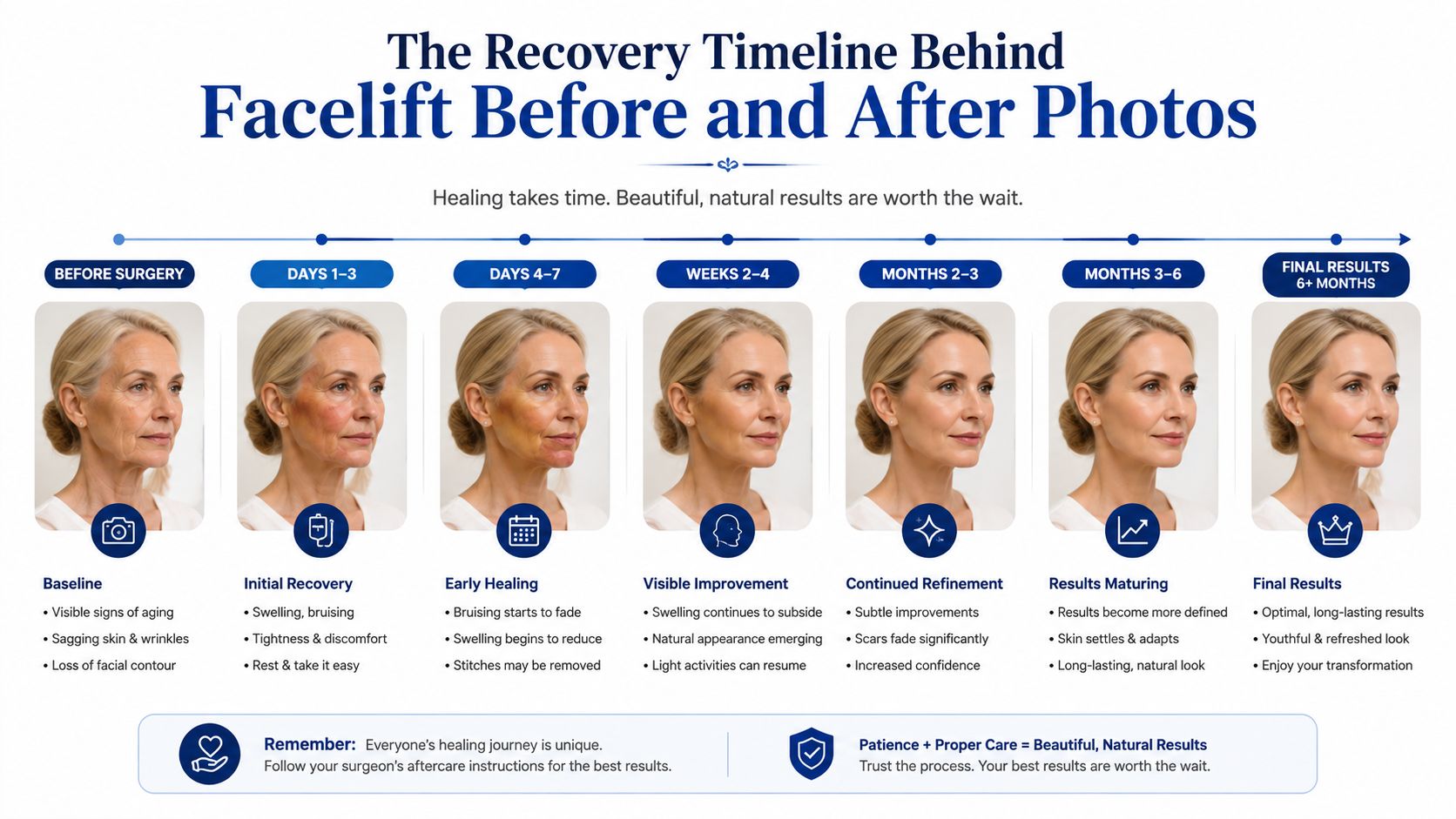
The first postoperative image often tells you more about healing than about the final facelift. Swelling, bruising, tightness, and numbness can temporarily distort the face and make the contours look either worse or more dramatic than they'll appear after recovery.
The early phase
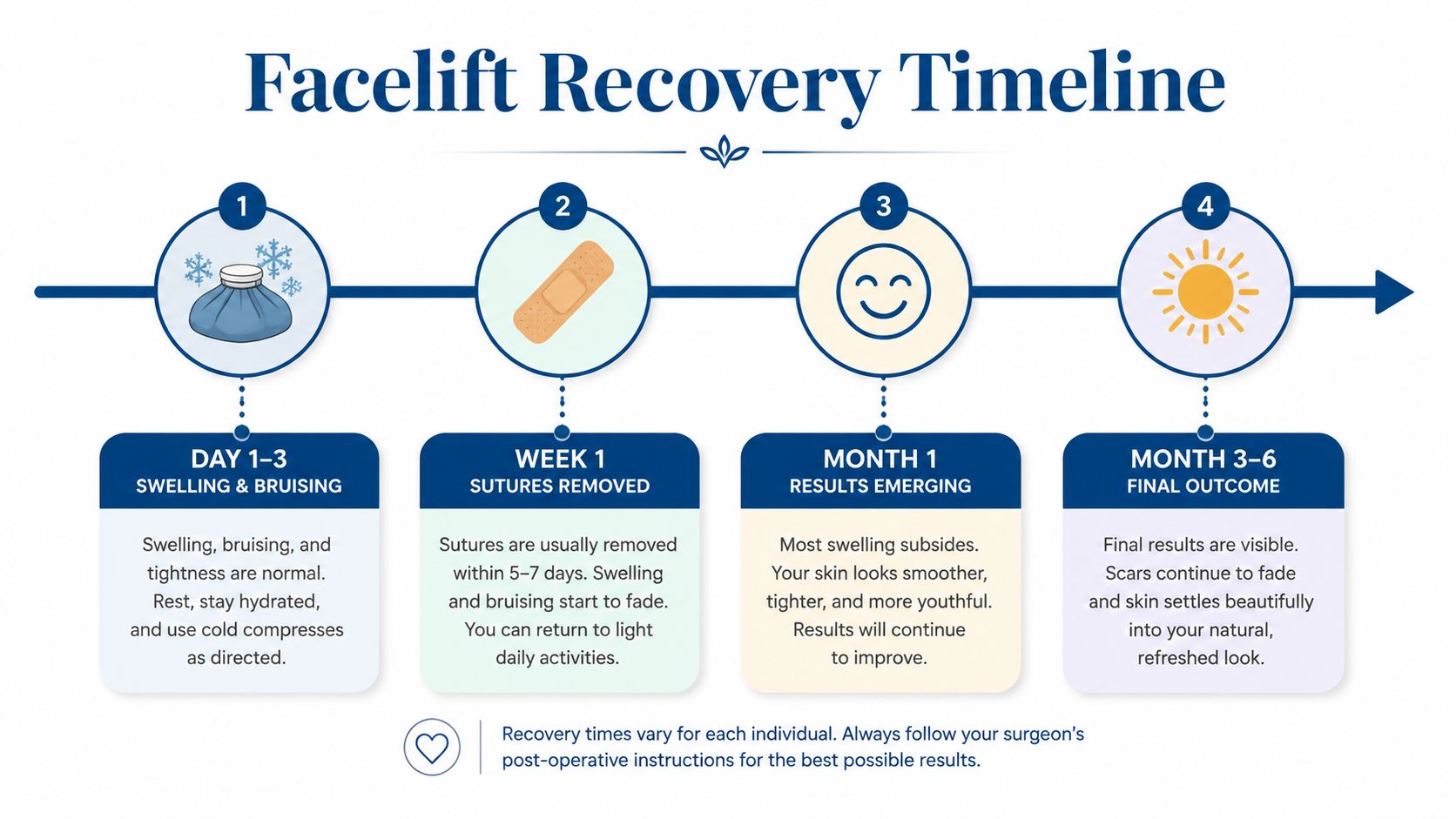
During the first few days, swelling and bruising are usually prominent. Independent medical guidance notes that swelling often peaks around days two through three and then improves over two to four weeks (facelift recovery guidance). Tightness and numbness around the incision lines can also affect expression and make the face appear unusually rigid.
By the end of the first week, some patients may feel presentable for limited activities, but “presentable” isn't the same as looking fully normal. At two weeks, bruising may have settled considerably, while residual swelling continues to blur fine contour changes. The answer to “Can I return to work?” depends on the procedure, healing pattern, occupation, and how closely people observe your face.
The settling period
At approximately the first month, the result becomes easier to judge, but the tissues may still be settling. Subtle swelling can persist for months, and early photographs may show a temporary contour rather than the mature outcome (medical guidance on cosmetic surgery recovery).
At three months, many patients see a more coherent improvement in the jawline and neck, but a surgeon should still interpret the image in context. Scar maturation, numbness, and skin quality continue to influence how the result looks and feels.
Durability and safety
Long-term results don't remain frozen at the first attractive postoperative photograph. In a study of SMAS-platysma facelift patients, 97.8% rated their improvement as very good or beyond expectations at one year, while 68.5% maintained that rating at an average of 12.6 years (long-term facelift outcomes). Continued aging, gravity, tissue laxity, and skin-quality changes explain why visible improvement gradually evolves.
Complications also affect the appearance and course of recovery. A systematic review reported hematoma as 27% of reported complications, followed by unfavorable scarring at 24%, neurapraxia at 22%, and seroma at 7% (systematic review of rhytidectomy complications). These figures describe the distribution of reported complications, not an individual patient's personal risk. Your surgeon should explain prevention, warning signs, and follow-up before surgery.
For a practical planning reference, review the facelift recovery timeline and ask exactly when the practice photographs patients for outcome documentation.
How to Choose a Surgeon Based on Before and After Evidence
A surgeon's gallery should help you judge clinical decisions before you schedule a consultation. Review patients with different degrees of laxity, facial proportions, skin quality, and treatment goals. A gallery limited to one favorable facial type cannot show how the surgeon handles anatomy that differs from yours.
Look for consistent photography, clearly identified procedures, and follow-up images taken after swelling has settled. A polished final image may show contour, but it cannot show how the result developed or whether a change came from a facelift, neck work, eyelid surgery, fat grafting, or another adjunct. Matching lighting, expression, camera distance, and angles make comparisons more credible. If those conditions change from case to case, presentation may be influencing your judgment.
Build your shortlist around evidence
Use the consultation to test what the gallery leaves unclear:
- Which areas were treated? Ask whether the case involved the face, neck, eyelids, fat grafting, or another adjunct.
- When were the after photographs taken? Early, intermediate, and mature images answer different questions about swelling, scars, and settled contour.
- What would you change in a patient like me? A specific answer shows whether the surgeon evaluates your anatomy and goals rather than promoting one named technique.
- How are complications managed? Ask about hematoma prevention, wound care, nerve symptoms, follow-up, and revision planning.
- Where is surgery performed? Office-based local-anesthesia pathways and operating-room procedures involve different logistics, monitoring, anesthesia options, and recovery considerations.
Ask whether the surgeon offers awake or office-based surgery, then request the eligibility criteria and trade-offs. The relevant questions include the planned extent of dissection, which areas can be treated safely, how discomfort is controlled, and what happens if the procedure must be extended or changed. A setting alone does not predict an easier recovery. Surgical extent, individual healing, medical history, and postoperative support remain important.
| Evaluation Factor | What to Look For | Why It Matters |
|---|---|---|
| Photographic consistency | Matching views, lighting, expression, and background | Makes visual comparison more credible |
| Case range | Patients with concerns similar to yours | Shows whether the surgeon treats your anatomy and degree of laxity |
| Procedure clarity | Named treatment areas and adjunct procedures | Prevents you from attributing every change to the facelift |
| Follow-up timing | More than one postoperative stage when available | Separates temporary healing from settled contour |
| Credentials and facility | Verifiable board certification and appropriate accreditation | Supports surgical planning and postoperative care |
Read cosmetic surgery reviews for Beverly Hills for context about communication and patient experience, then verify those impressions directly. Reviews cannot establish photographic consistency, technical judgment, facility standards, or the quality of follow-up. Use the gallery, consultation, credentials, and care plan together.
Real Case Context and Clinician Perspectives on Facelift Results
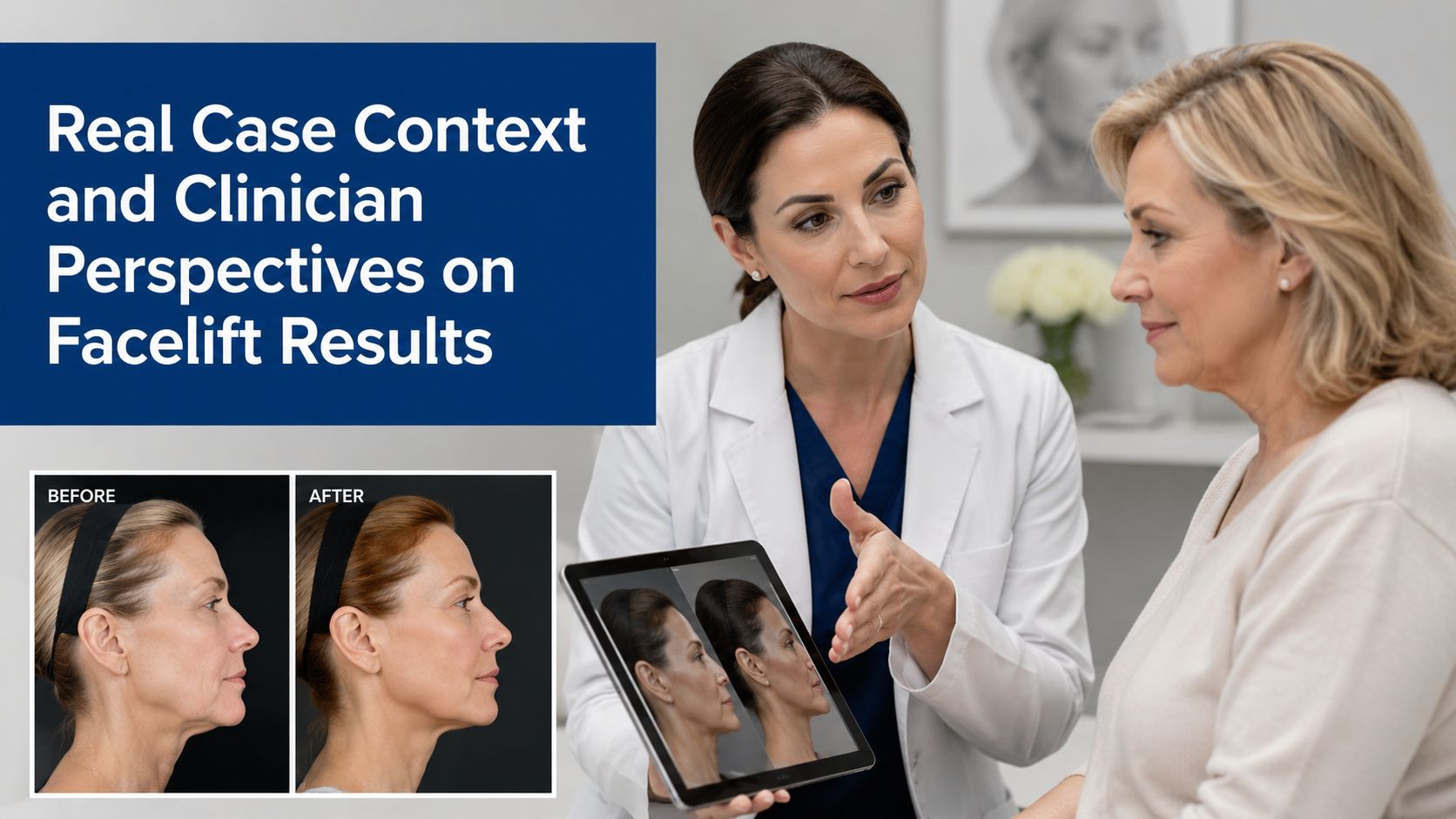
Patient experience adds information that photographs cannot show. In one facial rejuvenation series involving 93 patients, the average subjective reduction in apparent age was 11.9 years. The study also reported improved self-esteem in 82.8%, better quality of life in 69.6%, and a perception of looking more youthful in 96.7% of patients (patient-reported facial rejuvenation outcomes).
Those figures describe a study group, not a guaranteed result. They also show why evaluation should go beyond asking whether the after photo looks attractive. A patient may value a sharper lower face yet remain dissatisfied with the neck, skin texture, or area beneath the chin. Before-and-after galleries rarely reveal that difference unless the surgeon explains it.
Results vary by facial zone
Patient-reported assessments have found that satisfaction is not always uniform across the face. The neck and under-chin area may receive lower ratings than the cheeks and lower face. One operation can therefore produce several different patient experiences at once.
Clinical photographs should be read in the same zone-by-zone way. A patient may show a strong improvement in the jawline while retaining some neck fullness. Another may have a clearer neck profile but less change around the mouth. Good documentation identifies those limits instead of presenting the face as one undifferentiated result. Reviewers should ask which structure improved, which remained, and whether another procedure contributed to the visible change.
Revision isn't automatically evidence of failure
A long-term review reported that secondary facelifts became more common in its later period than its earlier period. The underlying reason is not visible in a single gallery image. Aging continues after surgery, and patients may later seek refinement, maintenance, or correction of a concern that was untreated or has since changed.
I assess a revision by asking what the first operation achieved, what changed with time, and what the patient wants now. A secondary procedure may reflect normal aging, evolving expectations, or a specific residual concern. Judge it through the timeline and operative context, not a simple success-or-failure label.
Making Informed Decisions About Facelift Before and After Results
A useful facelift before-and-after review ends with a decision, not endless scrolling. Start by identifying the change you want. Is it jowling, neck laxity, platysmal banding, cheek descent, eyelid heaviness, or a combination? The answer determines which photographs deserve your attention.
Use this final filter:
- Match the anatomy: Compare your lower face, jawline, and neck with patients who have similar concerns.
- Match the procedure: Confirm whether the image represents a full facelift, mini lift, neck lift, eyelid procedure, or combined treatment.
- Match the timing: Find out whether the after image shows early healing, an intermediate result, or a mature contour.
- Match the photography: Reject comparisons with clearly different lighting, angles, expressions, or head positions.
- Match the expectations: Seek improvement in structure and proportion, not a promise to stop future aging.
- Match the surgeon: Choose someone whose gallery demonstrates consistent technique, honest documentation, and clear discussion of limitations.
Photos show contour, symmetry, scars, and visible healing. They can't show numbness, pain, confidence, quality of life, or how a result behaves in ordinary conversation and movement. Patient-reported outcomes help fill that gap, but your own consultation remains essential because anatomy and goals vary.
The strongest evidence is consistent rather than spectacular. You should be able to understand what was done, why it was selected, when the image was taken, and what the surgeon would realistically expect in your case. If a gallery avoids those questions, its polish shouldn't compensate for its lack of context.
Ideal Face & Body offers facelift, neck lift, mini neck lift, and blepharoplasty consultations in Beverly Hills, CA, including awake, office-based options for appropriately selected patients. Review your goals and photographs with the clinical team, then visit Ideal Face & Body to arrange a consultation focused on realistic results, recovery planning, and the technique that fits your anatomy.