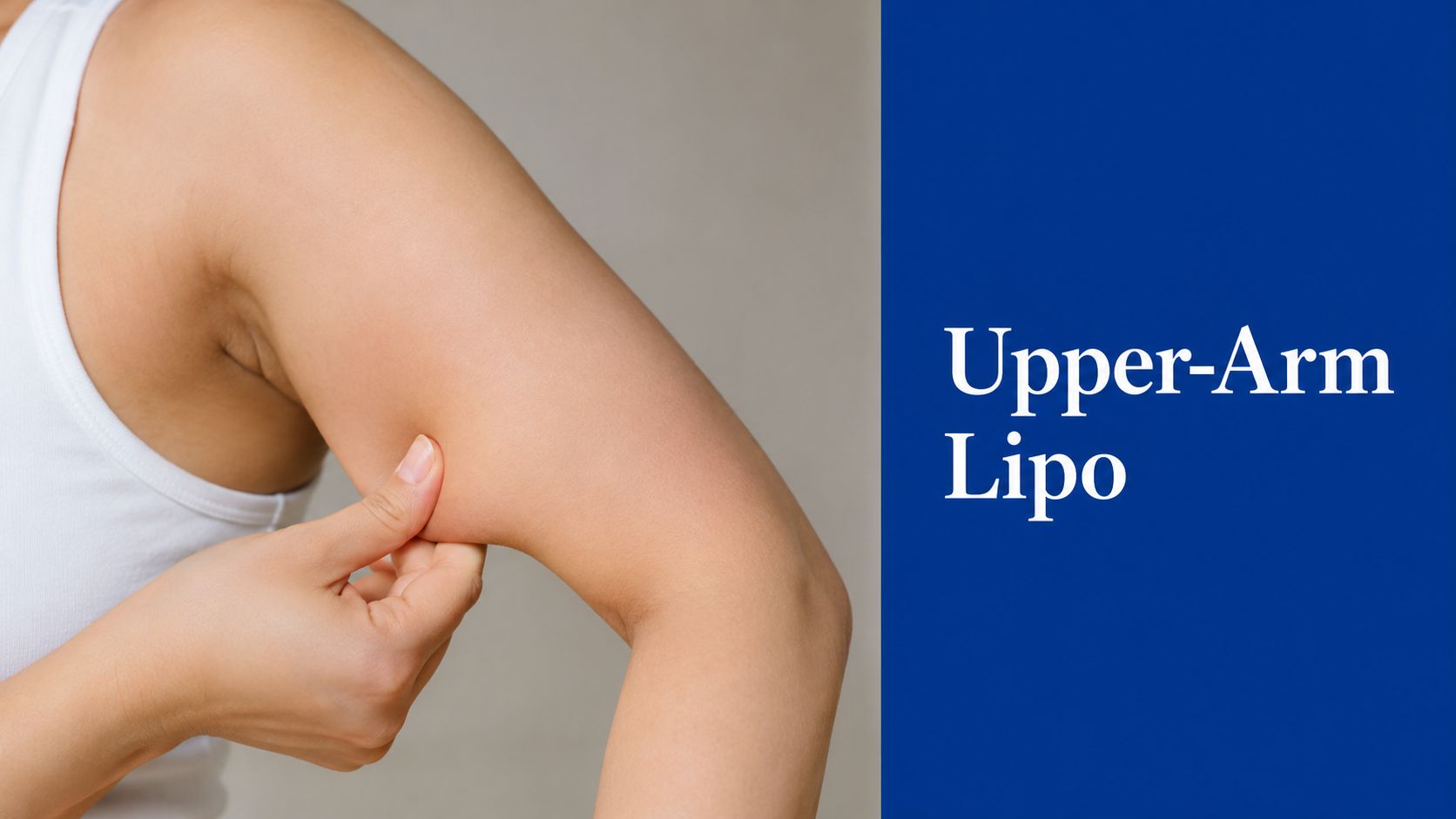
You keep pinching the same spot on your upper arm and nothing seems to change. The rest of your body may respond to workouts, but that little fold of fullness near the triceps stays put, and sleeves still feel tighter than they should. That's the moment many people start asking whether liposuction upper arms is really about fat removal, or whether the problem is the skin and shape of the arm itself.
The upper arm behaves differently from the abdomen or thighs. Its soft tissue is thinner, the contour is more visible, and even small irregularities can show through clothing, which is why surgeons treat this area with more precision than many patients expect. The long-term growth of upper-arm contouring reflects that shift, with the American Society of Plastic Surgeons reporting a 4,378% rise in women's upper arm lifts since 2000, from just over 300 procedures to more than 15,000 in the later reported year, and later summaries noting close to 20,000 upper arm lift procedures annually in the U.S. by 2019 (American Society of Plastic Surgeons press release). That growth helps explain why arm contouring is no longer treated as an afterthought.
Table of Contents
- Why Upper-Arm Fullness Feels So Hard to Change
- How Upper-Arm Liposuction Works
- What Real Results Look Like in Numbers
- Liposuction vs Lipo With Skin Tightening vs Arm Lift
- Who Is a Good Candidate for Arm Lipo
- What Recovery Feels Like
- Risks, Complications, and How Surgeons Minimize Them
- Booking a Consultation at Ideal Face and Body
Why Upper-Arm Fullness Feels So Hard to Change
A woman can lose weight, build muscle, and still find that the back of her upper arm doesn't look the way she wants. She pinches the area, lifts it in the mirror, flexes, and sees that the fullness hasn't budged much. That's not a failure of effort. It's a sign that the arm's fat and skin behave differently from other body areas.
Why exercise doesn't always solve it
The upper arm has a relatively thin fat layer, and in many people that fat sits close to the skin, which makes contour changes harder to camouflage. When fullness is localized, exercise can improve muscle tone underneath, but it can't selectively remove the subcutaneous fat that sits on top. That's why people often feel stronger without feeling slimmer in sleeveless clothes.
Practical rule: if the arm still feels bulky when you're already at a stable weight, the issue may be contour, not conditioning.
That's also why upper-arm contouring has become such a familiar part of modern cosmetic surgery. The demand didn't appear out of nowhere, it followed a real shift in how people think about elective refinement of the arms, especially when the goal is shape rather than major weight reduction. In other words, the procedure answers a different question than diet and exercise do.
Why the arms are treated as a special zone
The upper arm doesn't give much forgiveness. A small amount of excess tissue can look more obvious here than it would on a broader area like the abdomen. That's why surgeons are cautious about how they remove fat, and why arm contouring has developed into its own technique rather than being treated like just another liposuction site.
If you want a broader primer on stubborn fat and why it can resist exercise, this overview on remove exercise-resistant fat with liposuction is a useful companion.
The key takeaway is simple. Upper-arm fullness is often a contour problem, not a discipline problem. Once that clicks, the rest of the decision becomes easier. You're not asking whether you worked hard enough, you're asking what kind of arm shaping your anatomy needs.
How Upper-Arm Liposuction Works
Upper-arm liposuction is selective sculpting, not a “vacuum the whole arm” procedure. The surgeon works within a thin soft-tissue envelope, much like a tailor shaping delicate fabric, because the arm shows contour mistakes quickly. Remove too much, and the surface can look uneven. Remove too little, and the arm can still read as bulky in sleeveless clothes.
The treatment plane is deliberate
A surgical textbook on arm liposuction describes treating about 75%, or roughly 270 degrees, of the brachial circumference while sparing the inner or volar aspect of the arm to reduce contour irregularity and preserve a smoother medial profile. That detail matters because the arm is not treated like a cylinder with uniform suction everywhere. The goal is a controlled change in shape, not identical thinning all the way around.
A useful way to read that approach is to separate circumference reduction from simple fat removal. Circumference reduction asks how much the arm measures after contouring, and it also reflects where volume is left in place so the arm still looks balanced from the front, side, and when it hangs at rest. The older posterolateral-only style focused more narrowly on one side of the arm, while circumferential planning gives the surgeon a broader map for smoothing the outline without making the medial arm look hollow.
The common mistake is to assume more suction always gives a better result. In the arm, overresection can create grooves or an over-sculpted look that becomes obvious when the patient raises the arm. Selective debulking with feathered edges is safer than aggressive circumferential aspiration.
What the small-incision approach looks like
Published technical protocols for energy-assisted arm contouring place incision points near the elbow and axilla, then use small cannulas for final contouring. In one radiofrequency-assisted technique, the device was set to 38 to 40°C with 35 W power, and residual fat was refined with 2.7-, 3-, and 4-mm cannulas. A separate VASER arm-contouring report used 60 to 70% settings for emulsification and pre-tunneling in deep and superficial layers (NCBI clinical technique report).
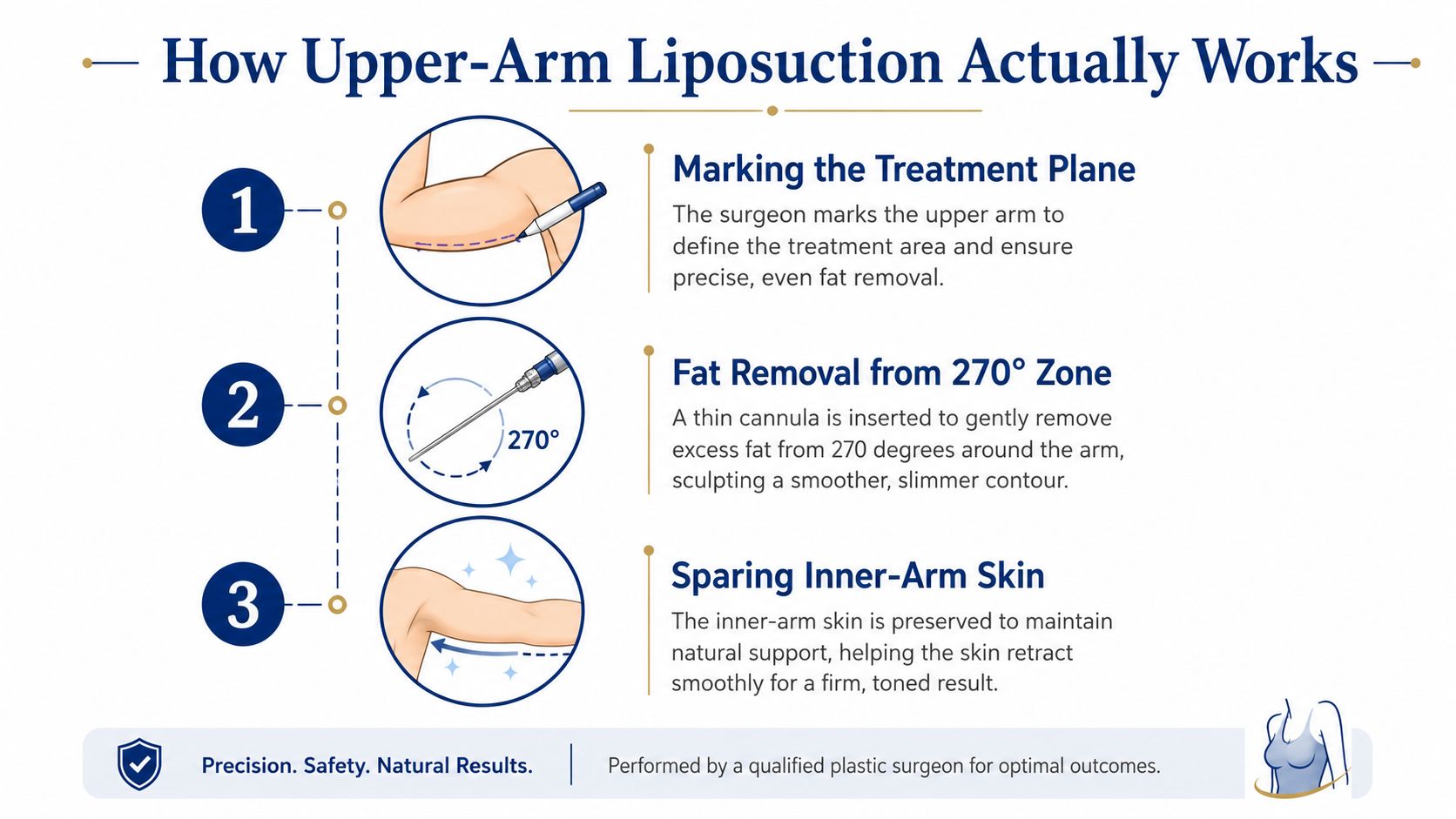
That is why arm liposuction is often more precise than patients expect. The surgeon is not just removing fat. The most critical work is deciding where to leave volume in place so the arm still looks natural from the front, side, and when the arm is relaxed. The change has to fit the arm's anatomy, the skin quality, and the treatment plane chosen during surgery.
For a look at one awake, office-based approach to arm contouring, see the PRECISION SCULPT awake liposuction arm and bra-roll gallery. In practice, awake local-anesthesia treatment is one way to keep the process focused and controlled while preserving the patient's ability to cooperate with positioning.
What Real Results Look Like in Numbers
Upper-arm liposuction is easy to misunderstand if you expect the kind of dramatic change people associate with weight loss. The research points to something more specific. The goal is measurable contour improvement, often expressed as a few centimeters of circumference change or a meaningful percentage shift in arm shape, and that can still be visible in sleeves and in photos.
What studies actually measured
A 2025 systematic review and meta-analysis pooling 7 studies and 199 patients found an average arm circumference reduction of 2.95 cm overall, with 3.39 cm in suction-assisted studies and 2.04 cm without suction (PubMed meta-analysis). That gives a useful benchmark because it shows the outcome is not just something the eye notices, it can be measured directly.
A separate 2024 retrospective study of 50 female patients aged 21 to 49 years reported circumference reduction rates of 6.8% in mild cases, 15.1% in moderate cases, and 17.3% in severe cases, with average follow-up of 7.5 months (ASJ study). The same study found BODY-Q upper-arm satisfaction scores increased by 0.9 points, 2.1 points, and 2.9 points across those severity groups.
These results are easier to understand if you compare them to how a sleeve fits. The upper arm is a narrow, visible cylinder, so even modest reduction can change how fabric hangs, especially near the short-sleeve line and around the side profile. A patient does not need a large numerical drop to notice that shirts feel cleaner across the arm or that the arm looks less heavy when relaxed.
| Study Type | Patient Group | Avg. Reduction | Notes |
|---|---|---|---|
| Systematic review and meta-analysis | 199 patients across 7 studies | 2.95 cm | Pooled arm circumference reduction, with higher reduction in suction-assisted cases (PubMed meta-analysis) |
| Retrospective clinical series | 50 female patients | 6.8% | Mild deformity group, average follow-up 7.5 months (ASJ study) |
| Retrospective clinical series | 50 female patients | 15.1% | Moderate deformity group, average follow-up 7.5 months (ASJ study) |
| Retrospective clinical series | 50 female patients | 17.3% | Severe deformity group, average follow-up 7.5 months (ASJ study) |
Read the data this way: the result you get depends on what the arm looks like before surgery. A fat-dominant arm and a laxity-dominant arm do not respond the same way.
That is why before-and-after photos can mislead when they are shown without any discussion of anatomy. The number that matters most is not someone else's result, it is how much reduction your own tissue quality can support. For patients trying to understand whether tighter skin matters as much as fat removal, resources on the skin tightening benefits of aloe can help frame the basic idea of skin quality, but they do not replace a surgical exam.
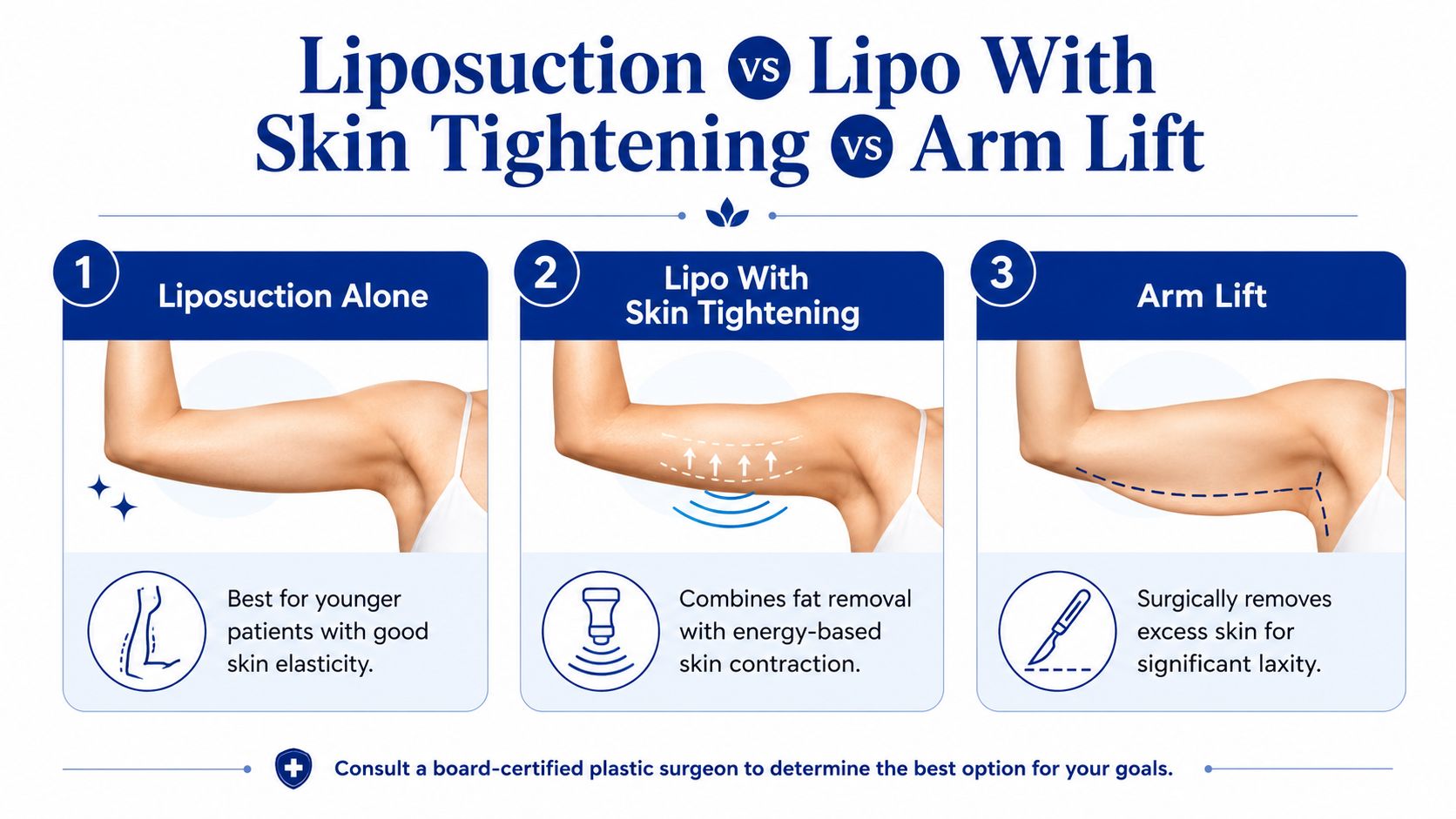
Liposuction vs Lipo With Skin Tightening vs Arm Lift
A patient may come in asking for “arm lipo,” but the primary goal is often simpler to describe: a slimmer upper arm that still looks smooth afterward. That is why the decision is not just about removing fat. It is about matching the operation to the tissue problem in front of you, whether that problem is fat, loose skin, or both.
Three paths, three different problems
Liposuction alone works best when the fullness is mostly localized fat and the skin still has enough recoil to contract after the fat is removed. In practical terms, the skin behaves like a sleeve with a little stretch left in it. Once the padding inside is reduced, the sleeve can settle back without showing folds.
Liposuction with skin tightening adds an energy-assisted tightening step, which can help when the arm has mild to moderate laxity. Recent literature supports that idea. A PubMed-indexed clinical series on circumferential upper-arm liposuction reported 458 cases with 92.3% significant improvement, 99.0% overall satisfaction, and 68.3% improved skin laxity, while serious complications were not reported in the study summary (PubMed clinical series). A PMC study of argon plasma-assisted arm contouring also found statistically significant improvement in ptosis, diameter, thickness, and skin elasticity, with mean reductions of 29% for ptosis, 15% for diameter, and 42.7% for tissue thickness, and no major complications (PMC study).
Brachioplasty, or arm lift surgery, removes excess skin when the skin envelope itself has become the main problem. That choice addresses a different anatomy, and the tradeoff is a scar by design.
Some patients also look for ways to support skin quality in a general sense, including educational resources on skin tightening benefits of aloe. Topicals do not replace surgery, but the conversation helps people separate skin quality from fat removal, which is often the main source of confusion.
The decision question to ask
The better question is, “What does my skin need after the fat is reduced?” If the skin redrapes well, liposuction may be enough. If the skin is mildly loose, skin tightening can help the contour settle more smoothly. If there is true hanging skin, an arm lift is usually the more direct answer.
That question keeps the plan honest. It lowers the chance of under-treating an arm that still bothers you, and it also reduces the risk of choosing a scar when a less invasive option would have been enough.
Who Is a Good Candidate for Arm Lipo
A good candidate usually has one thing in common, the concern is localized, not diffuse. They can pinch the upper arm and feel a pocket of tissue, but the skin still has enough snap to settle back reasonably well afterward. That combination matters more than any single number.
The practical checklist
- Localized fat: The fullness is concentrated in the upper arm rather than being a broad upper-body weight issue.
- Skin elasticity that isn't poor: The skin can contract after volume reduction instead of hanging more obviously.
- Stable weight: Big swings in weight make contour planning less predictable.
- Realistic expectations: The goal is a slimmer, smoother arm, not a completely different anatomy.
- Healing capacity: Patients need to be well enough for surgery and follow-up, without major concerns that would make recovery risky.
These are the same decision filters experienced surgeons use when deciding whether to remove fat alone or add tightening. If the problem is mostly fat, liposuction can be a good fit. If skin excess is the issue, lipo alone may disappoint.
Who should think about alternatives
People with more obvious loose skin, especially after major weight loss or with age-related laxity, often need a different strategy. In those cases, fat removal can expose looseness rather than solve it. That's why circumferential contouring and skin-tightening adjuncts matter in the middle ground, while brachioplasty remains the more direct answer for true excess skin.
A useful self-check: if you can already see a loose fold before surgery, you should ask whether the skin will look better, worse, or unchanged after fat is removed.
Broader fullness also affects candidacy. A patient with fullness around the visible upper arm, the area near the axilla, or the side of the arm may benefit from a more complete contour plan than someone whose concern is limited to a small posterolateral pocket. That's where circumferential treatment can make more sense than older partial approaches.
The main point is simple. Good candidacy is about tissue behavior, not wishful thinking. If the skin can redrape and the fat is the main complaint, arm lipo may fit well. If not, another procedure may give a cleaner result.
What Recovery Feels Like
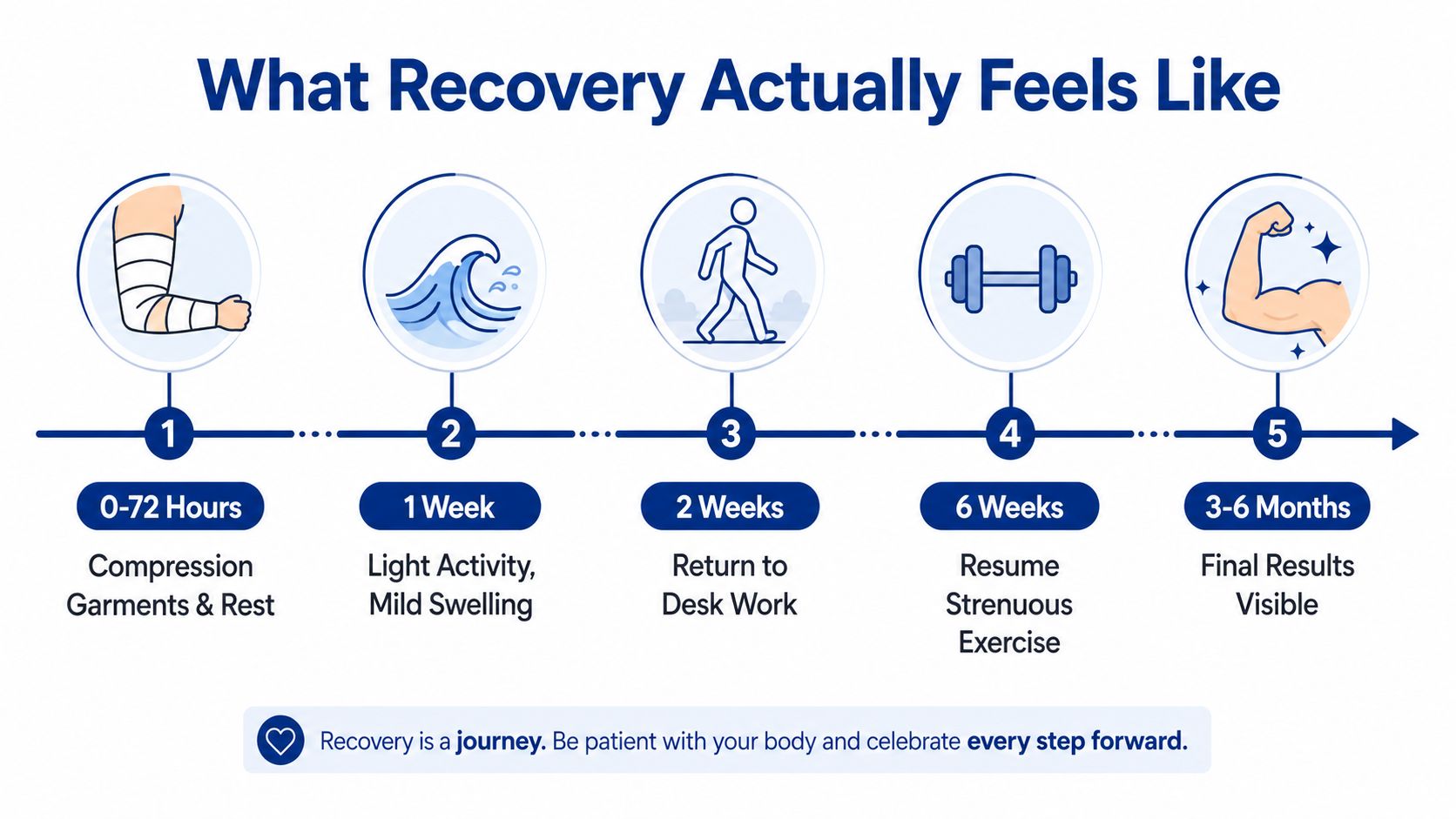
The first few days after arm liposuction are usually more about heaviness and swelling than sharp pain. Many patients describe the arms as tight, bruised, and sore, similar to how a hard workout leaves a muscle group feeling overloaded, except the compression garment keeps reminding you to stay still. That is normal, and it is why the early plan centers on compression and rest.
A realistic recovery arc
During the first 72 hours, the focus is compression garments, swelling control, and protecting the tiny incision sites. By the first week, light activity usually feels more manageable, although swelling and bruising can still be visible. Around two weeks, many patients are back to desk work and routine daily tasks, while the arms still look fuller than the final result will show.
By about six weeks, strenuous exercise is often easier to resume, and arm motion feels less guarded. The contour keeps settling for 3 to 6 months, which is when the final shape becomes more obvious and the small access points continue to mature.
For garment wear, this guide to how long to wear a compression garment after arm liposuction is the right place to start because the early support phase affects comfort and contour.
What the published complication profile suggests
A clinical series helps set expectations for what recovery usually feels like. The main pattern is that minor issues were uncommon, and the concerns that did appear were generally temporary and manageable, rather than dramatic setbacks.
If the incision edges stay overly red, swelling gets worse instead of better, or arm motion suddenly becomes more limited rather than slowly improving, that is when the surgeon should hear from you. Recovery should trend in the right direction week by week, even if the pace feels slow.
For people who like to plan ahead, scar-care routines can also matter once the skin has closed. A practical resource on browse Swiss scar treatments may help patients think through long-term incision care without overcomplicating the process.
The easiest mistake after arm lipo is judging too early. The arm often looks more swollen before it looks refined, and patience is part of the procedure.
Risks, Complications, and How Surgeons Minimize Them
Upper-arm liposuction carries a short list of risks that matter more here than they do in larger body areas. The arm is narrow, visible, and less forgiving, so even small irregularities can show. That is why technique matters as much as the decision to operate.
A helpful way to understand the arm is to separate it into zones. The older posterolateral approach focused on the back and outer side, while a more circumferential plan treats most of the arm, often around the 75 percent, or roughly 270-degree, plane. That broader treatment can improve shaping when fullness wraps around the arm, but it also demands more judgment about where to stay conservative so the contour does not look overdone.
What can go wrong
The most common concerns are minor, things like temporary pigmentation changes, localized hard nodules, mild asymmetry, or contour irregularity. The more serious risks are less common, but they matter, especially thermal injury when energy is used too aggressively or poor redraping when the skin cannot contract well.
The published clinical series helps put those concerns in scale. In the clinical report, localized hard nodules, pain or numbness, mild pigmentation change, and temporary limitation of arm movement were reported at low rates, which suggests that the visible, day-to-day issues are usually minor, even though they still deserve planning and follow-up.
How careful surgeons lower the odds
- Controlled energy delivery: One radiofrequency-assisted technique used 38 to 40°C and 35 W to balance emulsification with thermal safety.
- Small cannulas: Final contouring with 2.7-, 3-, and 4-mm cannulas helps precision in a tight anatomic zone.
- Selective treatment zones: The arm is not treated as a uniform 360-degree cylinder.
- Careful pass planning: Repeated aggressive passes increase the chance of surface irregularity.
The published technique report describes a restrained approach that uses energy carefully and keeps the finishing instruments small. That matters because the upper arm behaves more like a tapered sleeve than a flat sheet of fat. Remove too much in one area, and the eye picks up the transition right away.
The bigger point is restraint. The upper arm looks best when fat is removed with attention to smooth transitions, not maximal debulking. That is the difference between a refined arm and one that looks hollow or uneven.
Booking a Consultation at Ideal Face and Body
A good consultation is less about hearing a sales pitch and more about proving that the plan matches your arm. Bring a list of your current medications, a few photos of your arms at their fullest, and a clear statement of what bothers you most, whether that's outer-arm fullness, loose skin, or both. The surgeon should look at skin quality, where the fullness sits, and whether the arm needs selective or circumferential treatment.
Questions worth asking
- How many arm-lipo cases do you do regularly?
- Would you recommend liposuction alone, liposuction with tightening, or an arm lift for my skin quality?
- Do you treat the arm selectively or circumferentially when needed?
- What is the expected recovery timeline in my case?
- How do you handle awake, local-anesthesia procedures in the office?
Ideal Face & Body offers awake, office-based body contouring under local anesthesia, including PRECISION SCULPT laser liposculpting for the arms. For some patients, that fits the conversation well because it keeps the procedure focused and avoids unnecessary anesthesia steps. Virtual and out-of-town consultations can also be part of the planning process when travel makes an in-person first visit harder.
If you're comparing options, ask for a recommendation based on what your arm needs, not just what sounds least invasive. That keeps the discussion honest and helps you avoid a mismatch between your anatomy and the operation chosen.
If you're ready to talk through your arms with a surgeon who works in awake, office-based contouring, visit Ideal Face & Body and request a consultation. Bring your questions, your goals, and a few clear photos, and use the visit to find out whether your skin and fat pattern fit liposuction upper arms, lipo with tightening, or a different plan altogether.