
$8,174 is the average surgeon fee for an abdominoplasty, and ASPS also lists a broader surgeon-fee range of $8,000 to $13,500. That's the number people chase, but it's only part of the bill, and by itself it can be misleading when you're trying to understand men tummy tuck cost.
If you're weighing surgery right now, you're probably trying to separate real pricing from polished marketing. That's the right instinct. The true investment depends on the procedure plan, the setting, anesthesia, recovery needs, and whether your case is a straightforward tuck or a more complex contouring operation.
Table of Contents
- What Men Actually Pay for a Tummy Tuck
- What's Actually Inside the Quote
- Awake and Office-Based Versus Traditional OR Pricing
- What Drives the Price Up or Down
- Recovery Costs and Downtime You Should Budget For
- How a Tummy Tuck Compares to Liposuction and Other Alternatives
- Financing Options and How Patients Typically Pay
- Planning Your Consultation in Beverly Hills
What Men Actually Pay for a Tummy Tuck
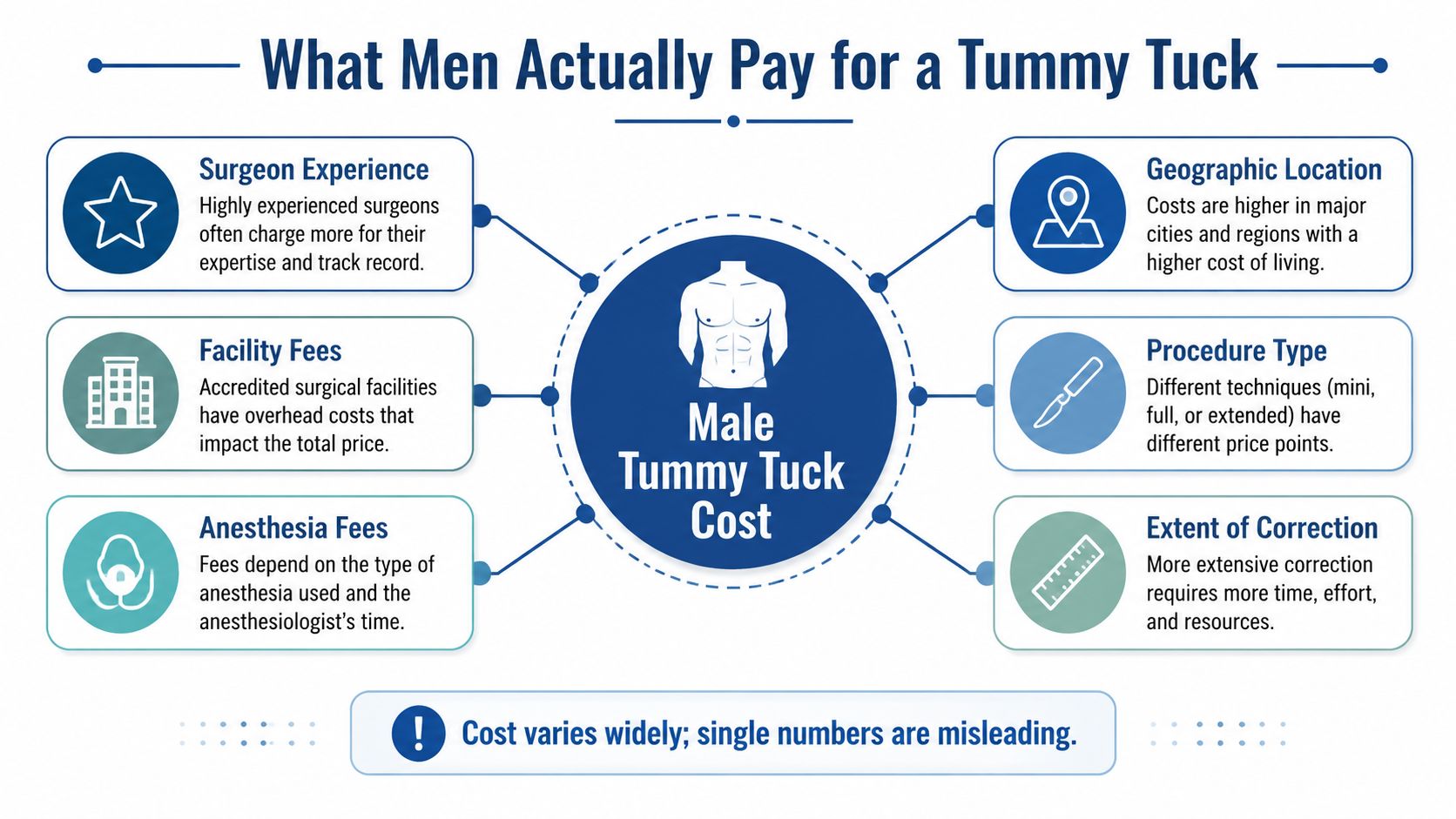
The honest answer is simple, men tummy tuck cost varies a lot, and any single number quoted without context is a weak anchor. A surgeon-only figure is not the same thing as the price a patient pays, because it leaves out the rest of the surgical chain. The better question is not, “What's the price?” It's, “What's included, and what kind of operation am I buying?”
Think in terms of scope, not sticker price
A male abdominoplasty is not a menu item. One man may need skin removal and tightening in a focused area, while another needs a broader abdominal correction with muscle repair and contour refinement. That difference changes the time, complexity, and facility use, which changes the economic picture.
The ASPS surgeon-fee data make the point clearly. $8,174 is the average surgeon fee in the latest overview, and the 2024 sheet lists a broader $8,000 to $13,500 range for abdominoplasty, while older ASPS statistics reported $5,992 in 2017, showing how quoted surgical fees have climbed over time. That history matters, but it still doesn't represent the full bill because anesthesia, operating room, and other facility costs sit outside the headline number. See the ASPS tummy tuck cost overview for the underlying surgeon-fee data and context around what's excluded from that figure: ASPS tummy tuck cost overview.
The right mental model
Practical rule: if a quote sounds neat and simple, it probably isn't complete.
For men, the purchase is a package, not a single operation line. The package includes the surgeon's work, the setting, the anesthesia plan, and the surrounding services that make the case run safely. In a market like Beverly Hills, CA, that package usually sits in a mid- to high-thousands context, because the market prices the whole experience, not just the cut and closure.
That's why serious buyers compare all-in structure, not just the first number they hear. If you don't do that, you're comparing apples to a bill that hasn't arrived yet.
What's Actually Inside the Quote
A proper quote should break the operation into parts you can understand. If it doesn't, you're being asked to trust a number that hides too much. The line items matter because each one reflects a different resource, and every resource has a cost attached to it. A quote should read like a package deal, not a mystery charge.
The standard components you should expect
At minimum, a serious quote should identify the surgeon fee, anesthesia, facility or operating-room time, compression garments, post-operative medications, and follow-up visits. Those are the practical building blocks of a tummy tuck quote, and they each affect the final total in a different way. A quote that bundles everything without explanation may be convenient, but it isn't transparent.
The surgeon fee pays for the operative skill and planning. Anesthesia covers the comfort and monitoring plan. Facility fees pay for the space, staffing, instruments, and readiness around the case. Garments, medications, and follow-up visits are not cosmetic extras. They are part of the recovery system that helps the result hold together.
Why awake and office-based quotes can look different
Awake, office-based practices often structure those costs differently. Local anesthesia can remove the need for a separate anesthesiologist in the billing model, and an in-office suite can replace a hospital-style operating room. Garments and recovery protocols are sometimes bundled more tightly too, which is one reason quotes can look very different from one practice to the next. For a clear overview of that model, see awake surgery cost and pricing structure.
That does not automatically make one quote better. It means you need to ask what the number includes before you compare it with another practice's estimate.
Ask for an itemized quote, then read it like a contract. If you can't tell who is doing what, and where, the quote is incomplete.
The safest move is to treat the quote as a map. If the map leaves out roads, tolls, or the destination, it isn't helping you plan. It is just giving you a false sense of certainty.
Awake and Office-Based Versus Traditional OR Pricing
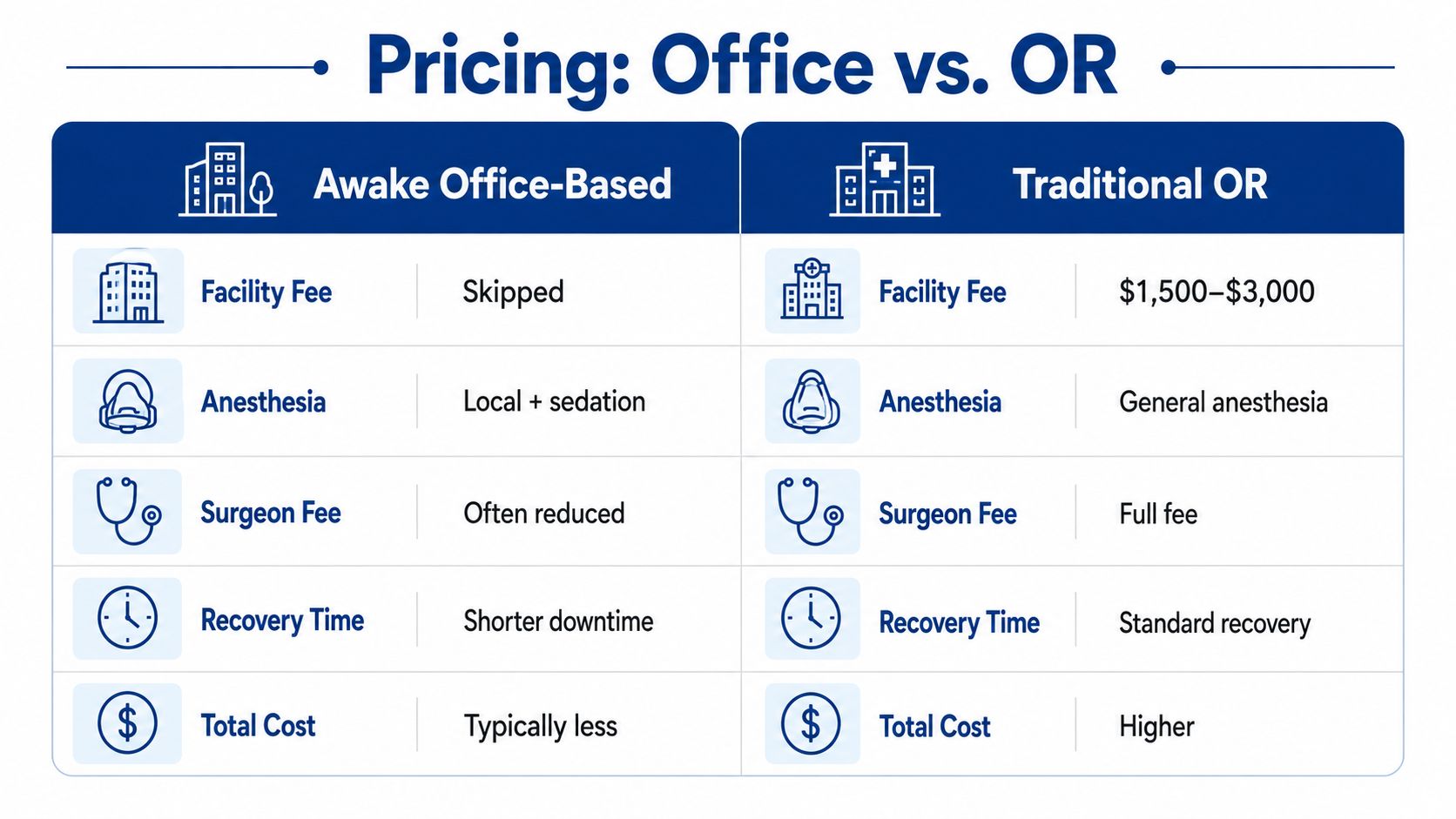
Awake, office-based surgery is not a marketing slogan. It's a different economic model, and that model changes how a tummy tuck gets priced. If you understand the structure, you'll understand why two quotes for similar-looking cases can land in very different places.
What changes when surgery is awake
The biggest difference is anesthesia. With an awake, office-based approach, the procedure uses local anesthesia and may avoid the separate overhead of general anesthesia. That changes staffing, monitoring, and recovery-room demand. It also often changes the pace of the day, because the immediate post-op footprint can be lighter than in a traditional operating room setting.
Traditional OR pricing usually carries more structure around the anesthesia team and facility. That overhead becomes part of the package, and patients feel it in the quote. Awake surgery isn't automatically cheaper in every case, but it often follows a leaner cost model because fewer institutional layers are involved.
How the pricing path differs
In practical terms, office-based pricing can look simpler because the practice controls more of the setting. That can reduce fragmentation in the bill and make the quote easier to understand. A traditional OR case may offer a broader safety infrastructure, but it also tends to bring a larger facility component into the total.
For readers who want a deeper look at that model, this awake surgery cost guide is the most direct way to understand how office-based pricing is built.
The awake model is a structural choice. It changes overhead, staffing, and the anesthesia footprint, so it changes the economics even before the surgical details are considered.
That distinction matters because too many guides treat “awake” like a side note. It isn't. It's one of the main reasons pricing separates in the first place.
What Drives the Price Up or Down
The biggest price swings come from what the surgeon has to correct, not from the label attached to the procedure. Two men can both ask for a tummy tuck and end up with completely different operations. The more complex the anatomy and the more correction needed, the more involved the case becomes.
The anatomy and technique question
A mini tuck is not the same as a full abdominoplasty, and neither is the same as an extended case. Skin excess, muscle separation, and the need for broader contour refinement all push the operation in different directions. If the abdominal wall needs more repair, the surgery becomes more technical and more time-intensive.
Liposuction changes the equation too. If the flanks or upper abdomen need simultaneous contouring, the plan becomes a combined body-shaping case rather than a simple skin-tightening operation. That's exactly why some men get a tighter waistline from a combined approach instead of a tummy tuck alone.
Revision cases cost more work
Revision surgery is its own category. Once scar tissue, prior incisions, or altered anatomy enter the picture, the surgeon is no longer working in pristine tissue planes. That usually means slower dissection, more judgment, and a less predictable operative path.
For men comparing options, the most useful question is this, “What problem am I trying to solve?” If the answer is loose skin and laxity, the operation leans one way. If the answer is fat distribution with only mild skin looseness, the plan may lean another way. If the answer is a prior surgery that didn't hold up, the case becomes more complex again.
A simple way to think about price movement
- More skin to remove: more operative work, more planning, more closure detail.
- More muscle repair: more technical time and tighter attention to abdominal wall support.
- More contouring in the same session: a broader surgical plan and a broader bill.
- Prior surgery or scarring: a more difficult operative field.
Bottom line: the quote rises when the operation stops being one problem and becomes three or four.
That's the driver. Not the label. Not the brochure. The actual anatomy.
Recovery Costs and Downtime You Should Budget For
The surgical quote is only part of the financial picture. Recovery has its own budget, and men often underestimate it because those costs don't always show up in the first estimate. If you ignore them, the total investment gets distorted fast.

The expenses patients forget
The obvious costs are the surgery itself and the facility. The less obvious ones are time off work, childcare or household help, compression garments, and, for some patients, travel and temporary lodging if they're coming in from out of town. Those aren't luxuries. They're part of making recovery workable.
If you're traveling, it's smart to think about where you'll stay and how much support you'll need after surgery. A practical place to start is this guide to find budget-friendly medical stay housing, especially if you need to recover near the practice instead of heading straight home.
Why awake surgery changes the recovery budget
Awake, office-based surgery often shortens the immediate downtime arc because the anesthesia footprint is lighter. That can reduce the immediate recovery burden, especially in the first stretch after surgery. But don't fool yourself into thinking that means no recovery costs.
Meaningful swelling and activity restrictions still last long enough to affect work, caregiving, and daily logistics. Even when the first day is easier, the rest of the recovery still needs planning.
For a fuller recovery timeline, this tummy tuck recovery guide is the kind of resource you should read before you book anything.
Budget for the surgery, then budget for the week-to-week life around it. Most people only plan for one.
That's the gap that causes stress. Not the operation itself, but everything that has to keep moving while you heal.
How a Tummy Tuck Compares to Liposuction and Other Alternatives
A tummy tuck is not the only way to improve the midsection, and it's not always the right first choice. The honest comparison is about the problem, not the prestige of the procedure. Loose skin, fat distribution, and muscle separation are different issues, so they need different tools.
Matching the problem to the procedure
| Option | Best For | Addresses Loose Skin | Addresses Muscle Separation | Addresses Localized Fat |
|---|---|---|---|---|
| Tummy tuck | Men with skin laxity and abdominal wall looseness | Yes | Yes | Sometimes |
| Liposuction alone | Men with stubborn fat and decent skin tone | No | No | Yes |
| PRECISION SCULPT or similar laser liposculpting | Men who want fat reduction plus contour refinement | No | No | Yes |
| Non-surgical body contouring | Modest fat reduction with realistic expectations | No | No | Limited |
The key is candidacy. If the skin is loose and the abdominal wall needs tightening, liposuction alone won't solve it. If the skin is fairly tight and the issue is localized fat, surgery may be more than you need. Combined procedures make sense when both problems are present.
For a broader breakdown of that decision, the liposuction versus tummy tuck guide is the clearest way to compare the two paths.
Where combined contouring fits
Combined treatment is common because men often have more than one issue at once. A tummy tuck can handle the structure, while liposuction sharpens the outline. That pairing is especially relevant when the abdomen looks flat enough in one area but still lacks shape through the waist.
Non-surgical options deserve a realistic view. They can help modest fat pockets, but they don't replace skin removal or muscle repair. If your goal is a firmer, flatter abdomen with visible structural correction, non-surgical work won't get you there.
A frank consultation matters. The right procedure is the one that solves the actual problem, not the one that sounds least invasive on paper.
Financing Options and How Patients Typically Pay
Most men don't pay for abdominoplasty out of pocket all at once, and that's normal. The important thing is to understand how each financing path works before you sign anything. Monthly payment size matters, but structure matters more.
The common payment routes
Patients usually look at healthcare-specific lenders, in-house payment plans, credit cards, or personal loans. Healthcare lending can be appealing because it's designed for medical expenses, but you need to read the terms carefully. Promotional interest-free periods can be useful, while deferred-interest setups can become expensive if the balance isn't handled correctly.
Credit cards are flexible, but they can also become the most expensive route if the balance lingers. Personal loans can provide predictable terms, though approval depends on credit and income. In-house plans may be simpler, but they vary widely from practice to practice.
Ask the right questions before you apply
- What happens after the promotional period ends? That question matters more than the initial monthly figure.
- Is the price for one procedure or a bundled plan? Combined procedures can change the structure of the quote.
- What credit profile is required? Don't assume every financing path is available to every patient.
- Are there separate charges for the surgical setting and recovery supplies? A financing plan should cover the total, not just the surgeon fee.
For people trying to compare their options, this overview of medical bill loan options is a useful starting point before you commit to any lending structure.
The goal is simple. Match the payment plan to your cash flow, not your optimism. A manageable plan beats a flattering monthly number every time.
Planning Your Consultation in Beverly Hills
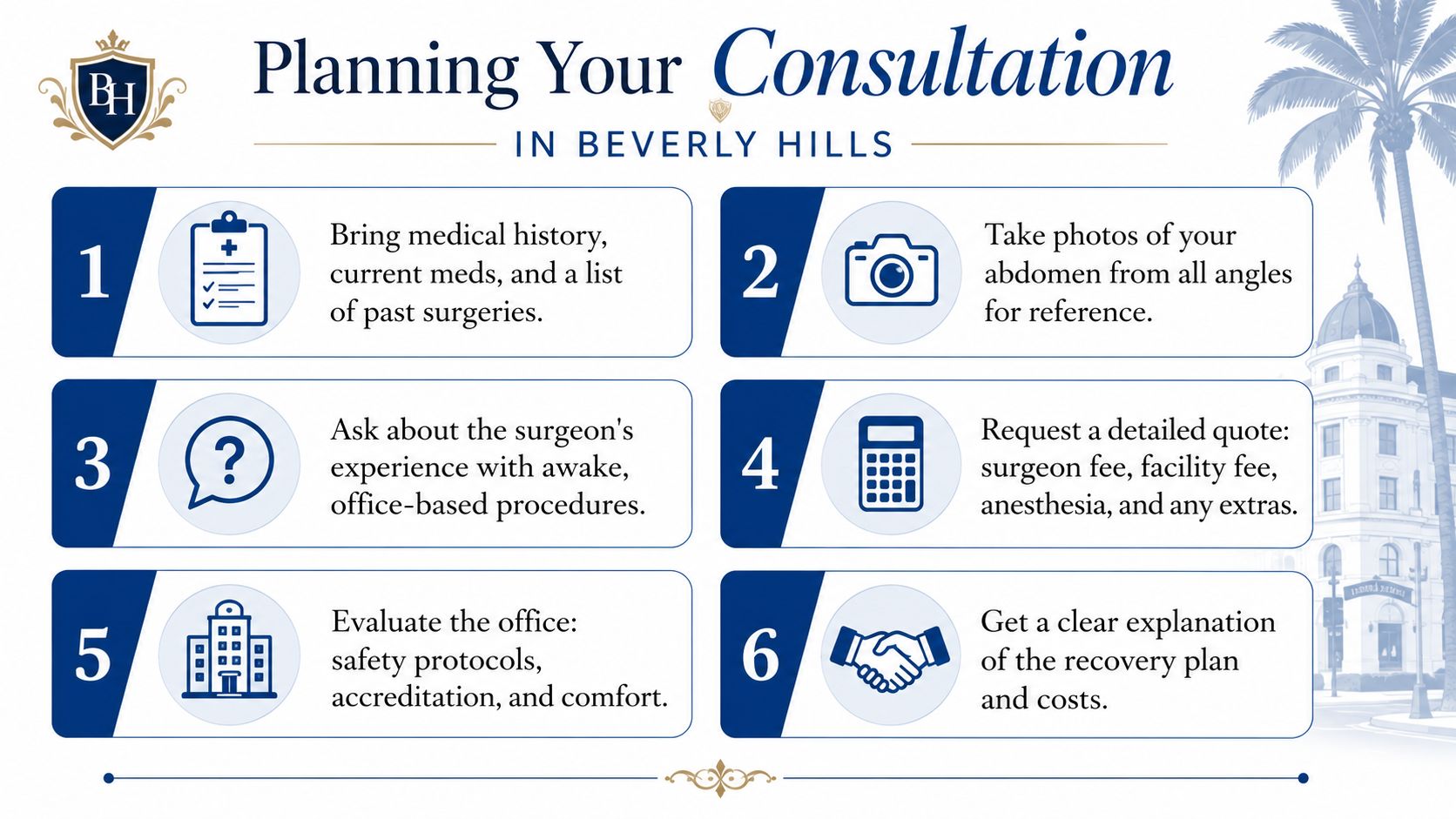
A good consultation should leave you with a clear procedure plan and a clean quote, not more confusion. Bring your medical history, your current medications, and photos if you already have them. Ask what the surgeon thinks you're buying, because that answer should include the setting, the anesthesia plan, and the expected recovery burden.
What to ask before you book
Ideal Face & Body in Beverly Hills' Golden Triangle performs many procedures under local anesthesia, and techniques such as PRECISION SCULPT can shape whether a patient is better suited to liposuction, a tummy tuck, or a combined plan. That matters because the quote follows the plan, not the other way around. For men evaluating abdominal contouring, the first discussion should always be about anatomy and candidacy, not just price.
Ask these questions directly:
- What exactly is included in the quote? You want surgeon fee, facility, anesthesia, garments, and follow-up explained plainly.
- Do you recommend a tummy tuck, liposuction, or both? The right answer should match your anatomy, not your assumption.
- Is awake, office-based surgery appropriate for me? That changes the cost structure in a real way.
- How is recovery handled, and what does it cost me outside the procedure itself? Don't wait until after booking to ask.
Bring a planning checklist to the visit
- Medical history and medications.
- Abdomen photos from multiple angles.
- Questions about awake, office-based experience.
- A request for an itemized quote.
- A safety review of the office setting.
- A clear recovery plan with costs attached.
That's the consultation you want. Clear, direct, and free of guesswork.
If you're ready to compare your options in a serious way, visit Ideal Face & Body and ask for a consultation that spells out the procedure, the setting, and the full economic picture. If you're a man trying to understand real tummy tuck pricing in Beverly Hills, start with an itemized plan and make the quote do the talking.