Two percent of 665 treated subjects developed brow ptosis in the clinical-trial safety dataset for the forehead-line regimen, while the 315-person placebo group reported none (FDA labeling for onabotulinumtoxinA). A procedure sold as a non invasive forehead lift lists a lowered brow among its measured adverse events, and the reason is mechanical. The muscle that smooths the forehead is the same muscle that holds the brow up.
That contradiction runs through every option in this category. Botulinum toxin relaxes muscle. Ultrasound and radiofrequency heat or contract tissue. Surgery removes skin. Four mechanisms, four very different sizes of result, one shared marketing word.
The useful translation of "lift" is into units you can check: millimeters of brow height, degrees of brow angle, the percentage of trial participants who improved, and how many months the change held. Judge every claim against those four and the field stops looking like a menu of equals.
Table of Contents
- Non-Invasive Forehead Lift Options Compared
- Matching Your Brow Concern to the Right Treatment
- How Botulinum Toxin Creates a Subtle Brow Lift
- What Energy-Based Brow Lifts Measured in Studies
- Non-Invasive Versus Surgical Forehead Lift
- Risks, Limits and Booking Preparation
Non-Invasive Forehead Lift Options Compared
Five mechanisms get marketed under the phrase non invasive forehead lift, and the table below is the honest comparison: what each one acts on, what studies measured, and how long the change was observed to last.
| Option | Mechanism | What it changes | Reported duration | Evidence |
|---|---|---|---|---|
| Botulinum toxin | Relaxes frontalis and brow-depressor muscles | Forehead lines; slight brow elevation | Up to about 3 months | Multicenter, FDA-reviewed trials |
| High-intensity focused ultrasound | Focused ultrasound beneath the skin | Brow height by about 1 to 3 mm | Measured to 12 weeks | Small prospective studies |
| Synchronized radiofrequency plus electromagnetic stimulation | Tissue heating with muscle contraction | Brow position and forehead wrinkles | Measured to 24 weeks | Small nonrandomized study |
| Radiofrequency alone | Dermal heating | Skin texture; brow lift not consistently shown | Measured to 6 months | Mixed; academic analysis reports limited forehead efficacy |
| Surgical forehead lift | Removes or repositions tissue | Larger, longer-lasting elevation | Long-lasting; no repeat-treatment cycle | Established surgical outcomes |
Read the table column by column. The mechanism explains the result, and the evidence column tells you how much weight that result can carry. A small case series supports a different level of confidence than a multicenter randomized trial, and a study that measured to 12 weeks cannot speak for month 18.
What the word non-invasive describes
The term describes how a treatment is delivered and says nothing about how large the change will be. An injection and a surgical brow lift both change how the upper face reads at conversation distance. One works by quieting a muscle for a few months; the other removes and re-drapes tissue. Filing them under one label hides the only question that matters: whether your concern is muscle activity or tissue position.
The American Society of Plastic Surgeons reported that forehead lifts increased by 1% in 2024, while neuromodulator treatments such as Botox increased by 4% year over year. The faster-growing category is also the one with the smallest measured effect on brow position.
The practical read: ask which tissue a treatment acts on. Muscle, dermis, deep fascia, or skin. If that layer isn't the one causing your concern, the treatment won't produce the change you want, whatever it's called on the booking page.
Sort yourself before you sort treatments. Decide whether the goal is smoother dynamic lines, a slightly higher brow tail, better skin texture, or correction of a brow that has dropped. Each answer points to a different row.
Matching Your Brow Concern to the Right Treatment
Horizontal lines that stay visible when the face is at rest are the reason many people start researching a non invasive forehead lift, and they are also the most straightforward item on the list to treat. Lines that persist at rest mean repeated frontalis contraction has etched into the skin, so the fix is partly muscular and partly surface-level.
| Main concern | Likely fit | Why |
|---|---|---|
| Horizontal forehead lines with normal brow height | Botulinum toxin | Targets frontalis muscle activity that creates the lines |
| Forehead lines plus a slightly heavy brow | Botulinum toxin, after brow assessment | Excess frontalis weakening can cause brow descent instead of lift |
| Mild skin laxity or texture loss | Radiofrequency or other energy device | Dermal effect; evidence for brow position is limited |
| Measurable brow drop in the mild-to-moderate range | HIFU or synchronized radiofrequency with stimulation | Small measured elevation; the energy-device section gives the millimeter values |
| Hooded upper-eyelid skin or true tissue descent | Surgical evaluation | Non-invasive options are unlikely to substitute for surgery |
A brow that looks higher is not always higher. Weakening the muscles that pull the brow down can raise its tail in some patients, which changes how open the eye area appears without moving the brow's head at all. That is a shape change, and it matters when you compare your result against a photograph of someone else.
Texture and position are separate problems
Energy devices handle the first reliably and the second inconsistently. A review in Aesthetic Surgery Journal reported that radiofrequency devices had not been efficacious in the forehead region in the authors' experience, possibly because those devices act mainly on the dermis. One trial pairing radiofrequency with facial-muscle exercise did report cosmetic improvement, but a smoother surface and better contour are appearance results, not proof of a repositioned brow.
If texture and tolerance are the main problem, start with the routine rather than the device. This anti-aging advice for sensitive skin covers layering and active ingredients for skin that reacts easily, which is worth settling before you add heat to a compromised barrier.
Three checks you can do in a mirror before any consultation:
- Lines at rest or only in motion. Raise your brows, then relax. Lines that vanish are muscle-driven; lines that stay have a skin component that a toxin alone won't erase.
- Brow position against the orbital rim. Rest a finger along the bony ridge above the eye. A brow sitting at or below that ridge has descended; one comfortably above it has not.
- Skin resting on the lashes. If upper-lid skin touches the lash line when your eyes are open, the issue is excess skin, and no injectable removes it.
An in-person exam outranks any self-check, because a provider can see how your frontalis compensates for eyelid weight, which is the variable that decides whether treatment lifts or drops the brow. Combining approaches is common, and it usually works as a sequence rather than a stack on the same day.
How Botulinum Toxin Creates a Subtle Brow Lift
The forehead runs on opposing muscles. The frontalis lifts the brow and creates horizontal lines when it contracts, while the procerus, corrugator, and fibers at the brow tail pull downward. Botulinum toxin quiets whichever side of that balance is overactive, and the visible outcome depends on where the dose lands.
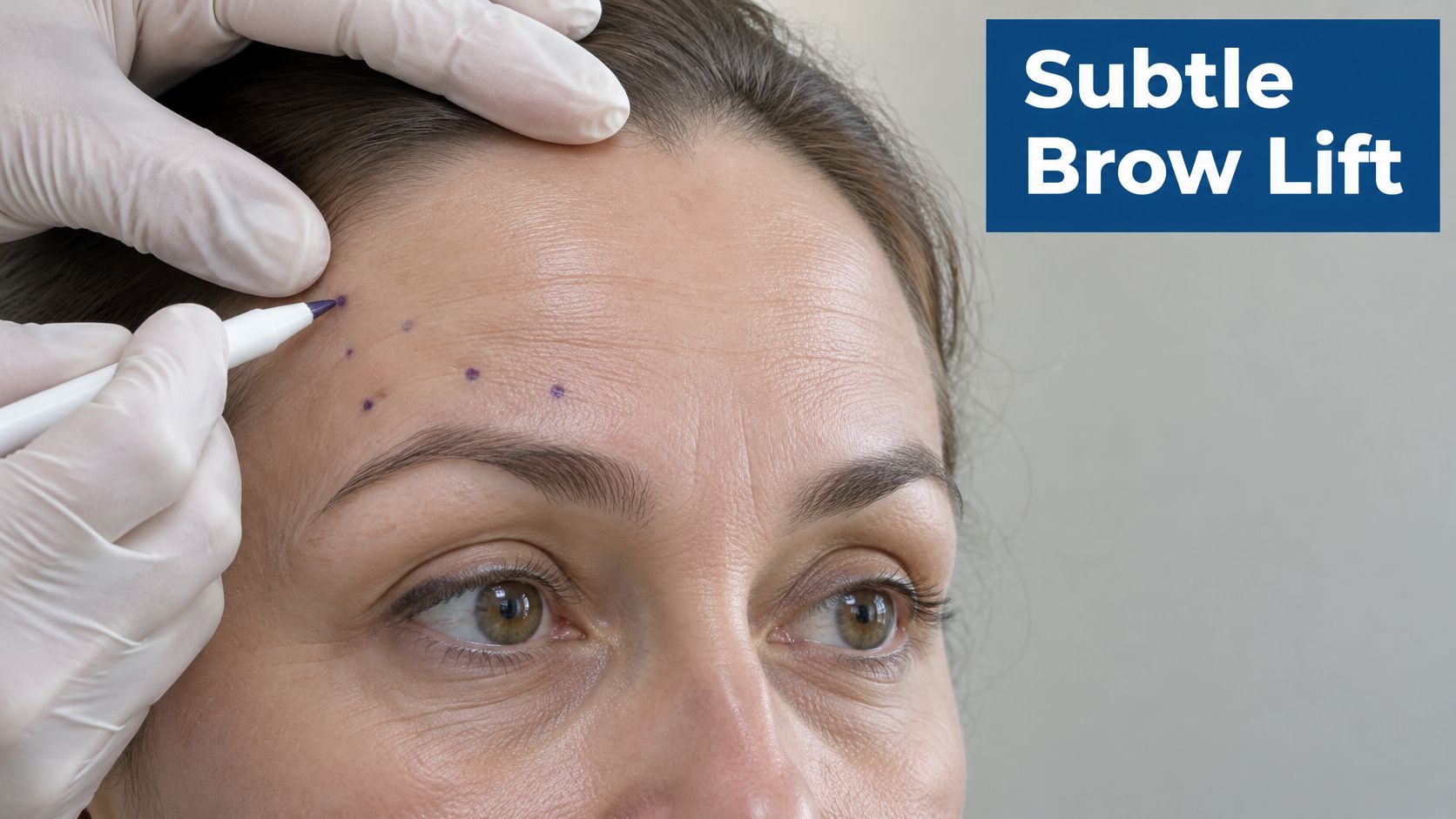
Treat the frontalis and horizontal lines soften. Treat the depressors and the brow tail can rise slightly, because less is pulling it down. Both effects are temporary, and both depend on dose and placement far more than on which brand fills the syringe.
The FDA reviewed this use in two multicenter, randomized, double-blind, placebo-controlled studies with 1,178 participants, of whom 921 received active treatment and 257 received placebo (FDA prescribing information). The same prescribing information describes a 12-month study regimen of 20 units in the frontalis plus 20 units in the glabellar region, 40 units total, for moderate-to-severe forehead lines treated alongside glabellar lines.
According to that FDA review, 61% of treated participants had improved by at least two grades on both investigator and subject assessments at day 30, against 0% of placebo recipients. The label records improvement first observed at day 7 and still evident through day 120.
The 120-day ceiling is the whole story. The change is a temporary pause in muscle activity; the brow's position stays the same, so the calendar sets the return date.
The failure mode is over-treatment. Patients with heavier eyelids often recruit the frontalis to hold the brow up; silence that muscle completely and the brow drops, the lid feels heavier, and the eyes look smaller. That's how a treatment marketed as a lift produces a descent, and it's why eyelid and brow assessment outranks unit count when a provider plans a dose.
The same logic explains how Dysport can lift the brows while also softening the lip border, since both depend on relaxing the right muscle rather than the most muscle. What this option suits is lines and a modest change in brow shape. It doesn't tighten skin, restore volume, or raise a brow that has fallen with tissue descent, and no dose changes that.
What Energy-Based Brow Lifts Measured in Studies
Energy devices are the only non-invasive category with published millimeter measurements of brow position, and the numbers are small enough to be credible.
High-intensity focused ultrasound delivers acoustic energy through intact skin to a chosen depth, heating tissue so it contracts. In a study of 30 patients, mean eyebrow height rose from 29.08 mm immediately after one treatment to 30.22 mm at 4 weeks and 30.64 mm at 12 weeks, with the follow-up increases statistically significant against baseline at p<0.0001 (published HIFU measurements). Earlier reports of forehead elevation with the same technology land in a similar millimeter-scale range.
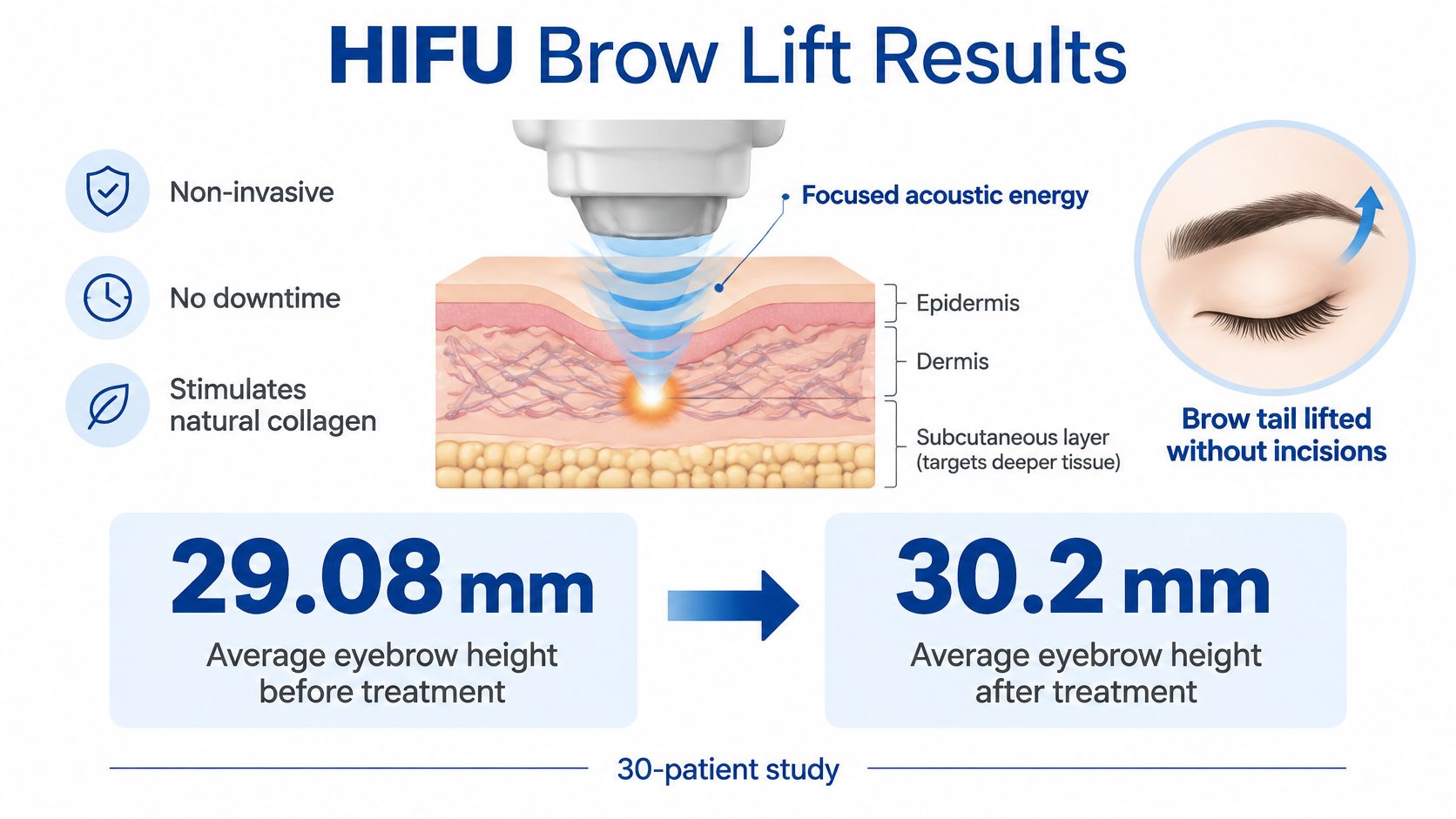
That's roughly a millimeter and a half. Enough to notice in a mirror, nowhere near enough to replicate surgery, and exactly the scale the word lift should imply.
Different devices, same direction
A prospective study of 12 participants found the average eyebrow-peak angle increased by 2 degrees at 90 days while the pupil-to-eyebrow-peak angle decreased by 1 degree, significant at p<0.0005 and p<0.0001, alongside forehead-tissue contraction and medial movement of tissue above the orbit (prospective study data). A focused-ultrasound study of 40 participants reported a mean brow-height increase of 2.16 mm at 90 days after treating the forehead and temple areas (Journal of Cosmetic Dermatology).
Synchronized radiofrequency with electromagnetic stimulation adds a second mechanism, pairing heat for collagen remodeling with contraction of underlying muscle. In a nonrandomized study of 37 patients receiving four treatments seven days apart, brow position improved by 3.18 mm medially, 3.02 mm centrally, and 2.27 mm laterally at week 24, all significant at p<0.001, with reduced forehead and lateral-canthal wrinkles (synchronized radiofrequency study). A separate study of 21 subjects given four 20-minute treatments to the forehead and cheeks reported a 22.2% average eyebrow lift at three months (Journal of Cosmetic Dermatology report).
Radiofrequency on its own produced less. A 2025 study measured an eyebrow lift of 1.39 mm at three months and 1.31 mm at six months (Lasers in Surgery and Medicine).
| Treatment | Study | Measured change | Follow-up |
|---|---|---|---|
| HIFU, single treatment | 12-participant prospective study | Eyebrow-peak angle up 2 degrees | 90 days |
| HIFU, single treatment | 30-patient study | Eyebrow height 29.08 mm to 30.64 mm | 12 weeks |
| HIFU, forehead and temple treatment | Journal of Cosmetic Dermatology, 40 participants | Brow height up 2.16 mm | 90 days |
| Synchronized radiofrequency plus electromagnetic stimulation | Journal of Cosmetic Dermatology, 21 subjects | 22.2% average eyebrow lift | 3 months |
| Synchronized radiofrequency plus electromagnetic stimulation, four sessions | 37-patient nonrandomized study | Medial 3.18 mm, central 3.02 mm, lateral 2.27 mm | 24 weeks |
| Radiofrequency alone | Lasers in Surgery and Medicine, 2025 | Eyebrow lift 1.39 mm, then 1.31 mm | 3 months, 6 months |
Read every row with its sample size attached. Twelve participants and a single session can show a statistically significant change without telling you what happens across a patient population, and the 37-patient radiofrequency study wasn't randomized, so its 3.18 mm carries less weight than a randomized result would. Percentages, degrees, and millimeters can't be ranked against each other, which is why each measure stays with the study that produced it.
Device-based tightening is a separate decision from brow position. Morpheus8 face and neck treatment addresses skin texture and laxity of the face and neck, a different target from the brow-height changes measured above, so the choice between them starts with which problem is present.
Non-Invasive Versus Surgical Forehead Lift
Surgery changes the tissue itself. Every non-invasive option changes how the muscle or skin behaves around it.
"There is no true non-surgical equivalent to a surgical forehead lift." That is the position of the American Academy of Facial Plastic and Reconstructive Surgery, which notes that non-invasive options may temporarily improve mild-to-moderate wrinkles or laxity but don't deliver the same degree or longevity of elevation (AAFPRS brow lift guidance).
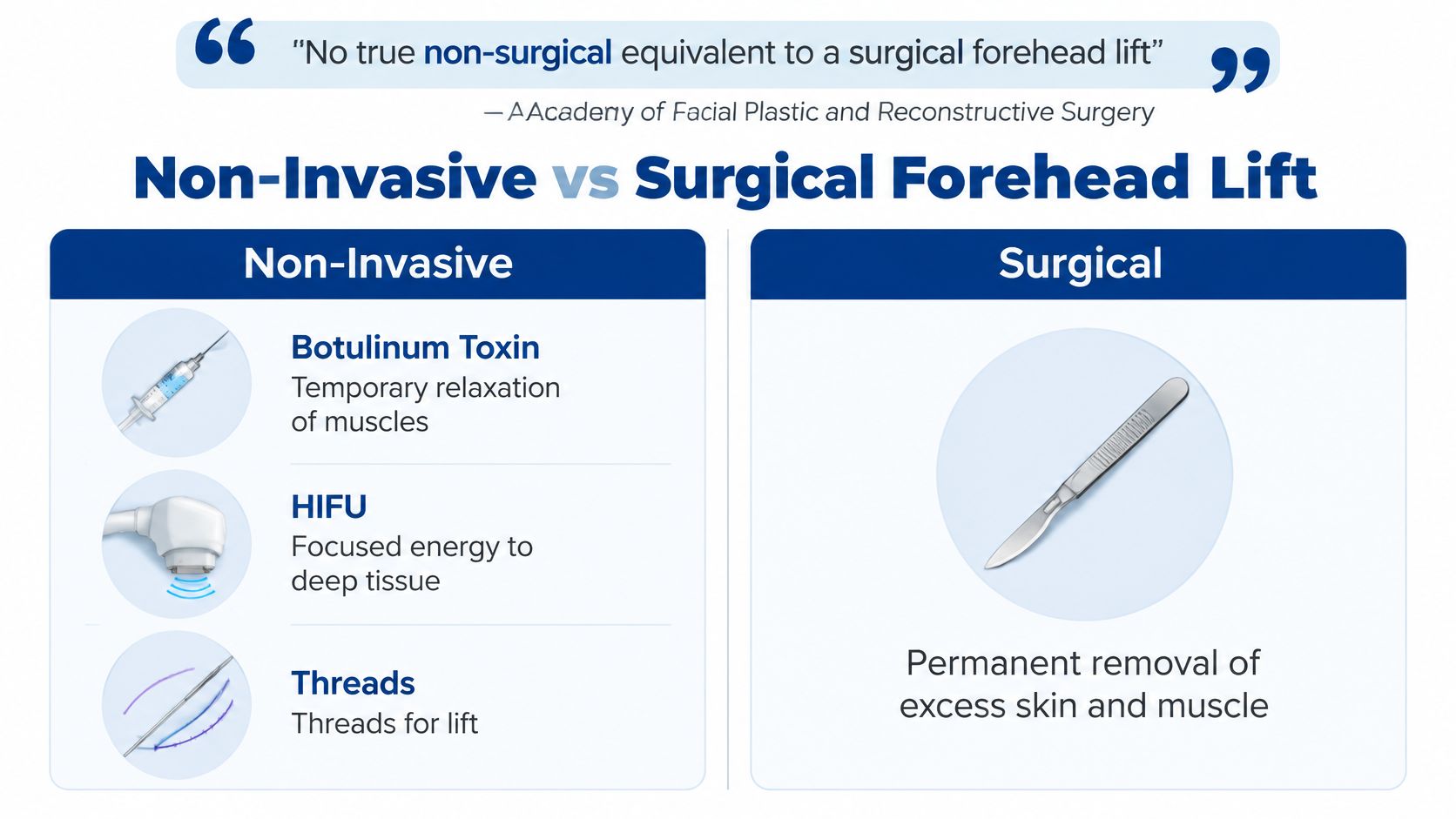
The consequence shows up in two places: scale and time. On scale, the largest measured gain in the device studies above is a few millimeters of elevation, which is a real change in position but not a reordering of anatomy. A brow that has descended with genuine laxity stays descended no matter how many sessions you book, because nothing in the non-invasive category removes skin.
On time, injectables reset on a calendar, and the energy-device studies stopped measuring at the end of their follow-up windows, so durability beyond those points is unproven rather than demonstrated. A surgical lift changes the structural starting point, which is why its result doesn't expire on a rebooking schedule.
When surgery is the honest answer
- Skin resting on the lashes. That's excess, and no injectable or device removes it.
- A hooded upper eyelid. Hooding is tissue, not muscle activity, and it needs a different operation entirely.
- A brow that has dropped with visible sagging across the temple. Descent at that scale needs repositioning, not relaxation.
- A result you don't want to rebook every few months. Maintenance schedules suit some people and exhaust others.
- A need for large repositioning. Nothing in the measured data reaches that range.
If two or more of those describe you, the consultation to book is a surgical one, and a non-invasive series will cost you time before arriving at the same answer.
The verdict by situation is short. Non-invasive treatment fits dynamic lines, early laxity, texture, and a brow tail that needs a few degrees. Surgery fits significant descent, excess skin, and anyone who wants the question settled rather than managed. Men weighing the surgical route can read about the forehead lift for men and how the assessment changes when hairline position and brow shape are part of the plan.
Risks, Limits and Booking Preparation
A systematic review of brow-lift literature found bruising to be the most common botulinum-toxin complication at 1.7%, with flu-like symptoms, persistent wrinkles, and trace eyelid droop each around 0.7%, and eyelid ptosis or excessive brow elevation around 0.3% (brow lift complication review). "Non-surgical" is a delivery detail, not a safety guarantee.

Wider pooled data put the same class of events higher. A review of 35 aesthetic botulinum-toxin papers covering 8,787 subjects reported upper-face adverse-event rates of about 2.5% for eyelid drooping, 3.1% for brow drooping, and 3% for sensory eye disorders (aesthetic botulinum toxin systematic review). Pooled rates move with which studies, doses, and definitions go in, so neither figure is your personal risk number. They're a reminder that placement and dose decide the outcome.
Energy devices carry a different risk set: bruising, swelling, infection, burns, lumps, and asymmetry, with results variable enough that repeat sessions are routine. On the forehead specifically, watch for prolonged redness, a brow that sits visibly higher or lower than before, and any treatment that runs close to the orbital rim, where energy and filler both put the eye area at risk.
The pre-booking checklist
- Name the goal. Brow elevation and smoother lines are different requests with different evidence behind them.
- Ask for the dose and the placement plan. A provider who can describe both in advance has thought about your anatomy.
- Ask whether eyelid and brow heaviness were checked. This is the variable that decides lift versus descent.
- Ask about downtime and the repeat schedule. Know what the next six months look like before you start.
- Ask what happens if the result is asymmetric. A correction policy matters more than a before-and-after gallery.
Bring photos taken at rest and with your brows raised, a list of past treatments including dates and products, and your goals in plain language. That combination lets a provider work out whether the heaviness comes from muscle activity, skin excess, or tissue position, which is the judgment the whole plan rests on.
At Ideal Face & Body in Beverly Hills, neurotoxins, dermal fillers, and Morpheus8 sit within the nonsurgical menu, and Dr. Sarah Yovino or Dr. Justin Yovino can assess which approach matches your brow position and skin. Cost varies by provider and treatment plan, so ask for a written estimate at the consultation rather than comparing advertised numbers. Whatever you book, the condition of your skin going in affects how well you tolerate it, and this guide to natural skincare prep for facelift recovery covers barrier repair and layering principles that apply just as well before an energy treatment.
The right option matches your anatomy and your goal. Not the biggest claimed lift.
Ideal Face & Body in Beverly Hills separates the two approaches this analysis keeps apart: neurotoxins for muscle-driven lines and Morpheus8 for skin quality and texture, with dermal fillers where volume rather than position is the issue. If you want your brow position, eyelid skin, and line pattern assessed before choosing between a muscle-based lift and an energy-based one, book a consultation with Dr. Sarah Yovino or Dr. Justin Yovino. Visit Ideal Face & Body to see the full nonsurgical menu and schedule your visit.