
A breast lift is usually worth it when your main concern is sagging, nipple position, or excess skin rather than missing volume, provided you accept permanent scars and surgical risks, including a reported overall complication rate of 10.4%. It's less likely to satisfy when your goal is fullness alone.
Are you hoping to move the breast you already have, or create volume that isn't there? That distinction matters more than whether someone else loved their result. A useful decision weighs the improvement you want against recovery, scar placement, and the possibility of another procedure later.
Table of Contents
- Which Goals a Breast Lift Actually Meets
- What a Lift Changes and What It Cannot
- Lift, Reduction and Fat Transfer Compared
- How Long the Results Really Last
- Scars, Recovery and Complications to Weigh
- Who Is a Good Candidate and Who Should Wait
- Confirm Your Fit Before You Book a Consultation
Which Goals a Breast Lift Actually Meets
A breast lift is a strong match for a position problem, but a weaker match for a volume problem. Before comparing techniques, name the specific change you want to see in the mirror.
The medical name for a lift is mastopexy. The FDA's breast-surgery patient materials explain the distinction between correcting sagging and adding fullness, along with trade-offs such as scarring, altered sensation, asymmetry, and dissatisfaction.
Breast lift fit by goal
| Your main goal | Lift alone fits? | Why |
|---|---|---|
| Breasts sit low and nipples point down | Strong fit | Mastopexy raises the breast and repositions the nipple |
| Loose or stretched skin after pregnancy or weight loss | Strong fit | Excess skin is removed and the rest is tightened |
| More upper-breast fullness | Weak fit | Lifting does not reliably add volume; fat transfer or a combined plan may be needed |
| Heavy breasts causing neck, back or shoulder strain | Often better as reduction | A lift removes skin, not much breast weight |
| Asymmetry in shape with acceptable volume | Good fit | Each side can be planned separately by the surgeon |
A common source of confusion is the word deflated. It can describe loose skin around an adequate amount of tissue, or an actual loss of breast volume. Those concerns can look similar in clothing but call for different surgical plans.
Shape asymmetry also deserves a precise description. Uneven nipple height, different amounts of loose skin, and unequal breast volume aren't interchangeable problems. A surgeon can tailor each side, but perfect symmetry isn't a realistic promise.
A short self-check
- Name the main problem. Is it low position, downward-facing nipples, loose skin, heaviness, or an empty-looking upper breast?
- Decide whether you want more volume. Would you be pleased with roughly your existing breast volume arranged into a higher, tighter shape?
- Identify your acceptable trade-offs. Can you accept permanent scars and the possibility of future revision?
Practical rule: Describe the change you want without naming an operation first.
For example, “I want my nipples higher without larger breasts” gives a surgeon a clearer target than “I want my breasts fixed.” Choose the table row that best describes you, then judge the operation against that goal rather than against an idealized photograph.
What a Lift Changes and What It Cannot
A breast lift works a little like re-hanging a stretched curtain. Extra fabric is removed and the hanging position is adjusted, but no fabric is added. Breast surgery is more complex than that analogy, yet the difference between rearranging tissue and adding volume is worth holding onto, because most disappointment after a lift traces back to confusing the two.
The FDA's mastopexy description explains that a surgeon removes skin beneath the breast or around the nipple to raise breast and nipple position. In practice, the surgeon reshapes existing tissue, raises the nipple while preserving its tissue attachments as planned, and closes the remaining skin around the new contour.

Reshaping isn't the same as adding
The visible changes can include a higher nipple position, a more compact breast contour, and less loose skin. Existing tissue may provide better projection after reshaping, but that doesn't mean a lift reliably creates substantial upper-breast fullness.
A patient whose breasts hang below the breast crease and look hollow at the top may want one of two different results. If the priority is higher nipples without greater size, a lift addresses the central concern. If the wish is a rounded, fuller upper breast, elevation alone is likely to disappoint, and that gap matters enough that it should change the surgical plan before anything is scheduled.
- Reshape means changing how existing tissue sits within the skin envelope.
- Add means introducing volume through a separate strategy.
- Preserve means planning for the forces that keep acting on the result: pregnancy, major weight change, and ordinary aging will keep stretching skin that surgery has already tightened, so a lift is a reset point rather than a finish line.
A lift-focused operation uses your own breast tissue rather than requiring a device, which keeps the central decision about skin, shape, and position instead of implant size.
The appropriate expectation is an improved breast contour that continues changing with your body. Some patients eventually choose a revision lift once enough stretching has returned, and treating that possibility as part of the cost of the result, rather than a sign the first operation failed, is a fairer way to judge whether a lift is worth it for you.
Lift, Reduction and Fat Transfer Compared
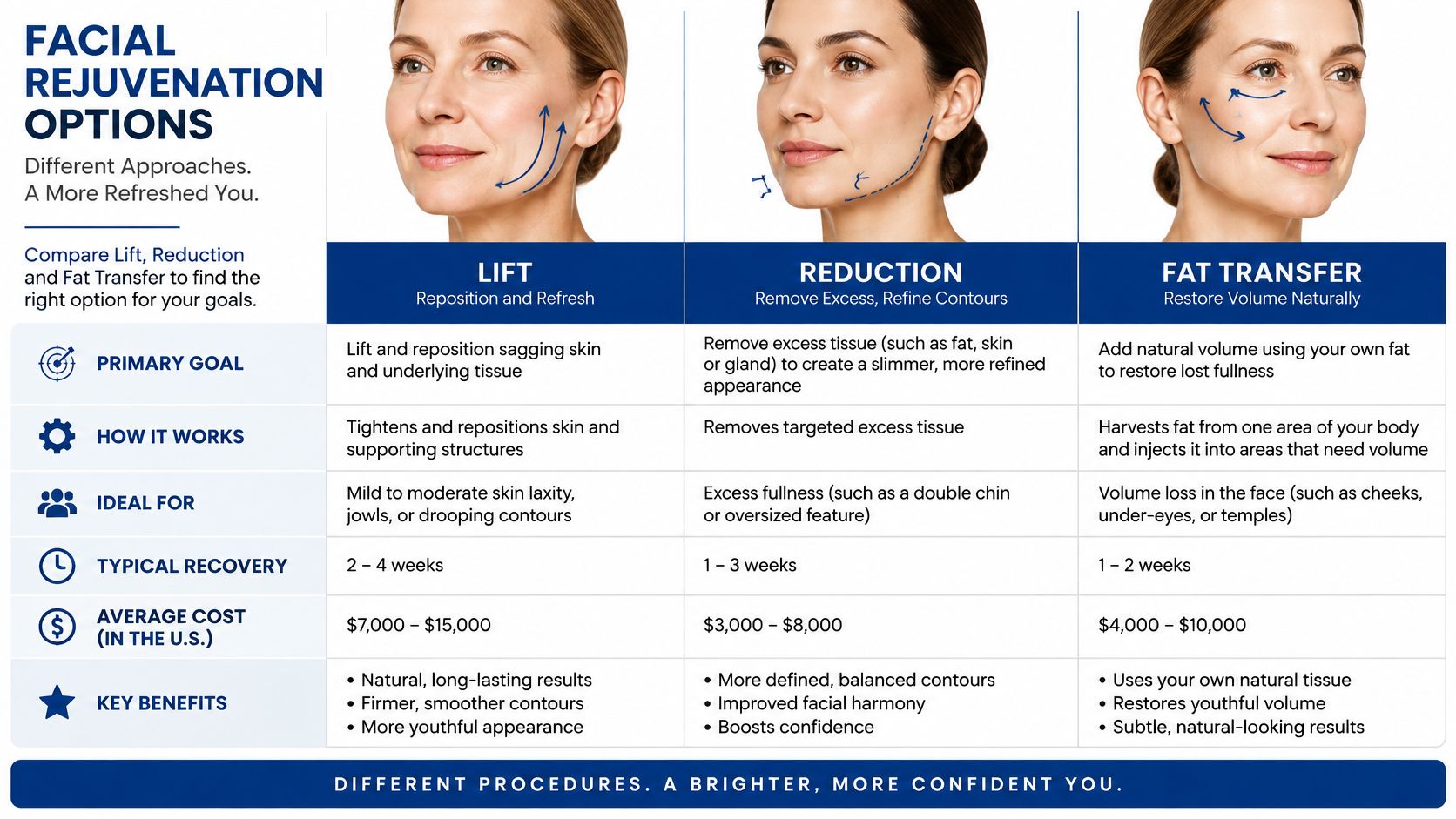
The most useful comparison starts with what each operation is designed to accomplish. A lift changes position, a reduction changes weight and size, and fat transfer adds volume using fat taken from another area of your body.
Breast lift, reduction and fat transfer compared
| Option | Main job | Adds volume? | Main trade-off |
|---|---|---|---|
| Breast lift (mastopexy) | Raises and reshapes existing breast tissue | No | Permanent scars; no added fullness |
| Breast reduction | Removes tissue and skin to reduce size and weight | No, reduces volume | Scars; sensation may change |
| Fat transfer | Adds volume using the patient's own fat | Yes, but variable | Results depend on how much fat survives |
| Lift with fat transfer | Raises the breast and adds upper fullness | Yes, moderate | Longer plan with more trade-offs |
The distinction between breast lift and reduction is especially important when a patient describes both drooping and heaviness. A higher breast isn't necessarily a substantially lighter breast, and reducing weight does nothing to raise a low nipple unless the operation also reshapes and repositions tissue.
How to choose between the options
Match the operation to the problem you can name. If the breast sits low but its size feels right, the problem is position, which is what a lift addresses. If breast weight contributes to neck, shoulder, or skin discomfort, the problem is volume, which points toward reduction and a discussion of what size would remain proportionate to your frame.
Fat transfer answers a different question entirely. It requires both a suitable donor area and a realistic volume goal, and some transferred fat may not survive, so the final volume is less predictable than removing a defined amount of tissue. It also adds recovery at the liposuction donor area, not just the breasts.
Combining a lift with fat transfer can address position and selective fullness in one plan, but it creates a broader procedure with additional healing considerations. Lifts and reductions leave breast incisions; fat transfer adds small access incisions at the donor area and breast.
Choose the smallest appropriate treatment plan that addresses your actual concern, not the largest combination available.
An implant-free plan also avoids device-specific obligations. The FDA's implant guidance states that implants aren't lifetime devices and may require additional surgery because of complications such as rupture, capsular contracture, or removal. Some implant-free lifts go further: Ideal Face & Body's Awake Breast Lift is a mastopexy performed with local anesthesia, without general anesthesia, an IV, or implants.
That doesn't make a lift risk-free. It separates the surgical risks every operation carries from the risks a permanent device introduces. At consultation, ask what each proposed component contributes and what would remain uncorrected if you chose the simpler operation.
How Long the Results Really Last
Durability matters as much as the initial photograph. A technically successful lift can gradually relax because the surgeon reshapes living skin and soft tissue, not rigid supports.
A prospective series of tissue-preserving mastopexy in 488 women reported a 2.5% overall complication rate; at 24 months, 47.1% of the initial lower-pole correction remained, while 52.9% represented relapse. Those measurements describe relaxation of one particular correction, not the share of patients whose entire operation failed. Some settling under gravity is expected. The question is how much.
That figure also needs context. The series reflects a single surgeon, one technique, and selected patients with mild to moderate ptosis, so its rate naturally sits below numbers from broad reviews that pool many surgeons, techniques, and complication types. Read it as a counseling benchmark, not a universal recurrence rate or a prediction for your breasts.
Life plans change the value equation
Breast weight, stretching skin, aging, pregnancy, and major weight fluctuation can place renewed tension on the reshaped breast. The same initial result may therefore hold differently in people with different tissue quality and future plans.
Timing often decides who keeps a result longest. A patient planning pregnancy within the next few years may reasonably defer surgery, because further stretching could change the outcome. A patient with stable weight and no pregnancy plans faces fewer foreseeable disruptions, although no one can be promised a fixed lifespan for a lift.
Ways to protect durability:
- Stable weight before surgery. Avoid planning a lift around an anticipated major body-size change.
- Pregnancy timing. Consider waiting when pregnancy is a near-term goal.
- Nicotine control. Follow the surgical team's cessation requirements rather than assuming occasional use is harmless.
- Appropriate technique. Match the operation to skin quality, breast weight, and degree of descent.
Satisfaction and revision can coexist
In a study of 266 patients undergoing combined lift-and-augmentation, more than 90% reported aesthetic satisfaction at an average 39-month follow-up, yet the reoperation rate was 16%, falling below 5% in later cases as technique and experience improved. These are not lift-alone revision rates, but they show that satisfaction and a later return to surgery often sit side by side.
A planned contour refinement differs from an operation needed to treat a complication. Ask the surgeon to distinguish them when discussing outcomes.
A later elective revision does not erase years of benefit. Accepting that possibility belongs in the original decision: a lift is a durable improvement, not a permanent suspension of the breast.
Scars, Recovery and Complications to Weigh
Reported complication rates after non-implant breast lifts
The following outcomes come from a systematic review of 34 studies involving 1,888 patients, which reported approximately 1.3% unsatisfactory breast shape, 3% scar-related abnormalities, 2.9% nipple–areola complications, and a 10.4% overall complication rate.
| Outcome | Reported rate | What it means for you |
|---|---|---|
| Unsatisfactory breast shape | About 1.3% | Shape may need a refinement procedure |
| Scar-related abnormalities | About 3% | Scars may be raised, wide or uneven and are permanent |
| Nipple and areola complications | About 2.9% | Possible distortion, asymmetry or reduced sensation |
| Overall complication rate | 10.4% | Across the studies and patients described above |
These categories aren't a prediction of your individual outcome. An unsatisfactory shape also doesn't necessarily mean a patient will choose another operation.
Every breast lift creates scars, but a scar-related complication means more than having a visible incision line. Ask to see the proposed pattern drawn on your body, including any incision around the areola, down the breast, or along the crease.
Recovery unfolds in stages
- The first days. Plan for rest, help at home, prescribed support garments, and dressing or drain care if applicable.
- The first weeks. Restrict lifting and strenuous activity. Resume desk work only when your surgical team clears you, and monitor swelling rather than judging the final shape.
- The following months. Scars may soften and sensation may settle, but neither process follows an identical schedule for everyone.
- Long-term care. Keep follow-up appointments and discuss significant pregnancy or weight changes with your clinician.
For practical preparation, our breast lift and augmentation recovery guide covers recovery considerations, although a combined operation isn't the same as a lift alone. If family members want useful ways to help, SunnyBay post-surgery gift ideas can support a conversation about comfort and assistance; clear any heat, cold, or compression products with your surgical team.
An awake setting still requires surgical recovery
Our Awake Breast Lift is performed in the office with the patient relaxed on oral medications and fully numbed with freshly mixed local anesthesia. No general anesthesia, intravenous catheter, or implants are used.
That anesthesia approach doesn't eliminate incisions, healing requirements, or surgical complications. Get written instructions identifying urgent concerns, including worsening redness, fever, drainage, sudden one-sided swelling, or escalating pain, and know whom to contact.
Before proceeding, write down which trade-offs you can accept. Permanent scars may feel reasonable to you; persistent sensory change or another recovery may carry more weight.
Who Is a Good Candidate and Who Should Wait
Not every breast concern is a lifting problem. If your main burden is neck, back, or shoulder pain, recurrent rashes, bra-strap pressure, or difficulty exercising, the evaluation should include breast weight and the possibility of reduction.
A lift isn't principally designed to remove substantial breast weight. A published analysis of plastic-surgery medical-tourism outcomes also illustrates why broad procedure labels and mixed patient groups don't provide a reliable personal risk estimate. Ask for a diagnosis-specific explanation rather than choosing surgery from an online average.
Signs you may be ready
- Clear, stable goals. You can describe the physical change you want.
- Steady weight. You aren't in the middle of substantial weight loss or gain.
- Suitable timing. Pregnancy isn't planned soon.
- Nicotine readiness. You don't smoke or can meet the team's requirements before and after surgery.
- Realistic fullness expectations. You understand the difference between elevation and added volume.
- Acceptance of scars. You've considered their location, not just the improved contour.
- Reliable follow-up. You can attend appointments and arrange help during recovery.
People planning major weight change or pregnancy should consider waiting. People hoping a lift alone will create a substantially fuller upper breast should reconsider the procedure choice, even if they're otherwise healthy.
Questions that deserve individual answers
Ask how the planned incision and tissue-handling technique could affect future breastfeeding. Our guide to breastfeeding after a breast lift can help you prepare, but no general explanation guarantees your future milk production.
Discuss nipple and breast sensation separately from breastfeeding. Temporary changes and persistent changes have different implications for comfort, intimacy, and satisfaction.
If you're still losing weight, Trim's discussion of strength training for sagging skin offers context for fitness planning. Strength training can support conditioning, but it shouldn't be treated as a substitute for removing excess breast skin or repositioning a nipple.
Your decision may be to proceed, wait, or explore reduction or a combined plan. Each can be reasonable when it matches the actual problem.
Confirm Your Fit Before You Book a Consultation
Book a consultation when your goal matches a strong-fit indication and you are willing to discuss the less appealing parts of surgery. The visit exists to test your plan before you commit to an operation.
Bring a ranked list of goals, your medical history, medication and supplement details, nicotine use, and pregnancy plans. Photographs taken in good light help explain changes over time. Mention any neck, shoulder, back, or skin symptoms too, because they shape how the surgeon weighs a lift against a reduction.
Questions worth bringing in writing
- How do you classify my droop? Ask what the examination shows about nipple position, skin quality, and breast weight.
- Can a lift alone meet my goal? Request a clear explanation of what would stay the same.
- Why this technique? Have the surgeon walk through the incision pattern and the alternatives they ruled out.
- What revisions do you track? Ask how often patients return for refinement, how long results are followed, and how the practice separates elective touch-ups from complication-related surgery.
- What might change functionally? Discuss breastfeeding, nipple sensation, and breast sensation as separate questions.
- What does recovery require? Clarify work restrictions, help at home, follow-up visits, and who to call in an emergency.
A useful consultation leaves you able to explain why the proposed operation fits your anatomy. Knowing the operation's name is the easy part.
At Ideal Face & Body in Beverly Hills, CA, Dr. Justin Yovino leads our surgical team. Our practice pioneered the Awake Breast Lift®, an implant-free mastopexy performed in the office under local anesthesia, and the technique is available only here. Because we also perform breast augmentation with implants, implant revision, and implant removal, your surgeon can weigh a lift against the alternatives in the same conversation.
Before deciding, compare at least one other surgeon's plan. Agreement about the underlying problem is reassuring. Where the recommendations differ, ask each surgeon to explain why.
The answer to "Is a breast lift worth it?" is ultimately specific to you: a meaningful improvement you want, achieved through trade-offs you understand and can accept. Count the chance of a future revision among those trade-offs, because a result you refine once is still a result worth having.
Ideal Face & Body offers the Awake Breast Lift®, an implant-free approach for patients seeking improved breast position and shape. Visit Ideal Face & Body to schedule a consultation, and bring your written goals, symptoms, and questions about scars, sensation, recovery, and future revision.