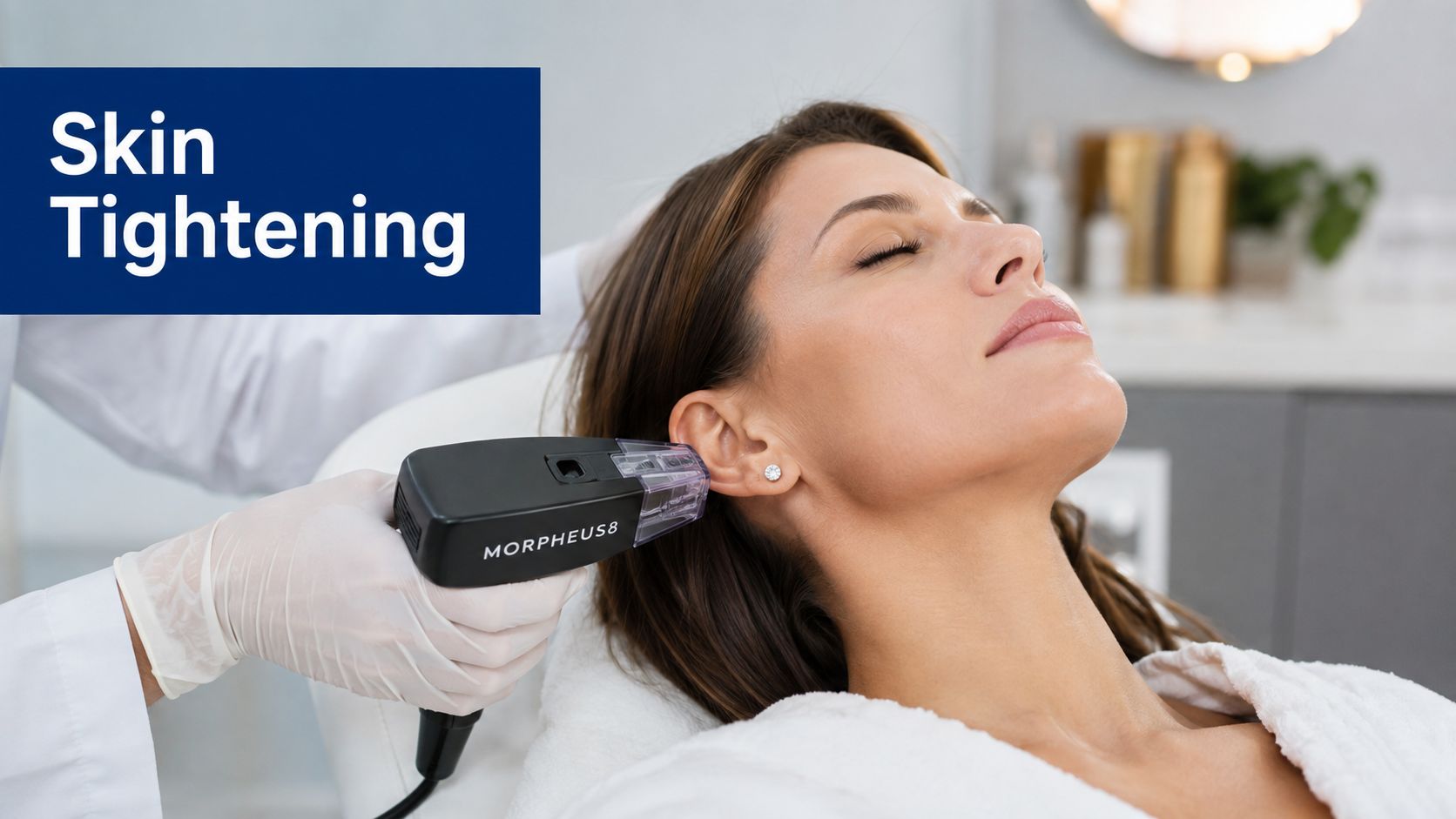
The most popular advice about Morpheus8 skin tightening is also the advice most likely to create unrealistic expectations: that it tightens loose skin. Morpheus8 is more complicated than that. It uses fractional radiofrequency microneedling to remodel collagen and, at deeper settings, affect subdermal tissue and fat. That can help with firmness and contouring, but it also means unintended fat loss, hollowness, burns, pigment changes, and contour irregularities belong in the consultation.
The treatment can be useful for selected patients with mild laxity, uneven texture, acne scarring, and early loss of definition. It isn't a facelift, and it isn't automatically appropriate for every face, skin tone, or treatment area. The result depends on the diagnosis, the depth and energy selected, and the person controlling the handpiece.
Table of Contents
- What Morpheus8 Does: Subdermal Remodeling Beyond Surface Tightening
- How Radiofrequency Microneedling Remodels Tissue
- Expected Results and the Timeline for Visible Change
- Risks and Complications Patients Rarely Hear About
- Comparing Morpheus8 to Other Skin Tightening Options
- Your Treatment Journey From Consultation to Recovery
- Why Provider Expertise Determines Your Outcome
What Morpheus8 Does: Subdermal Remodeling Beyond Surface Tightening
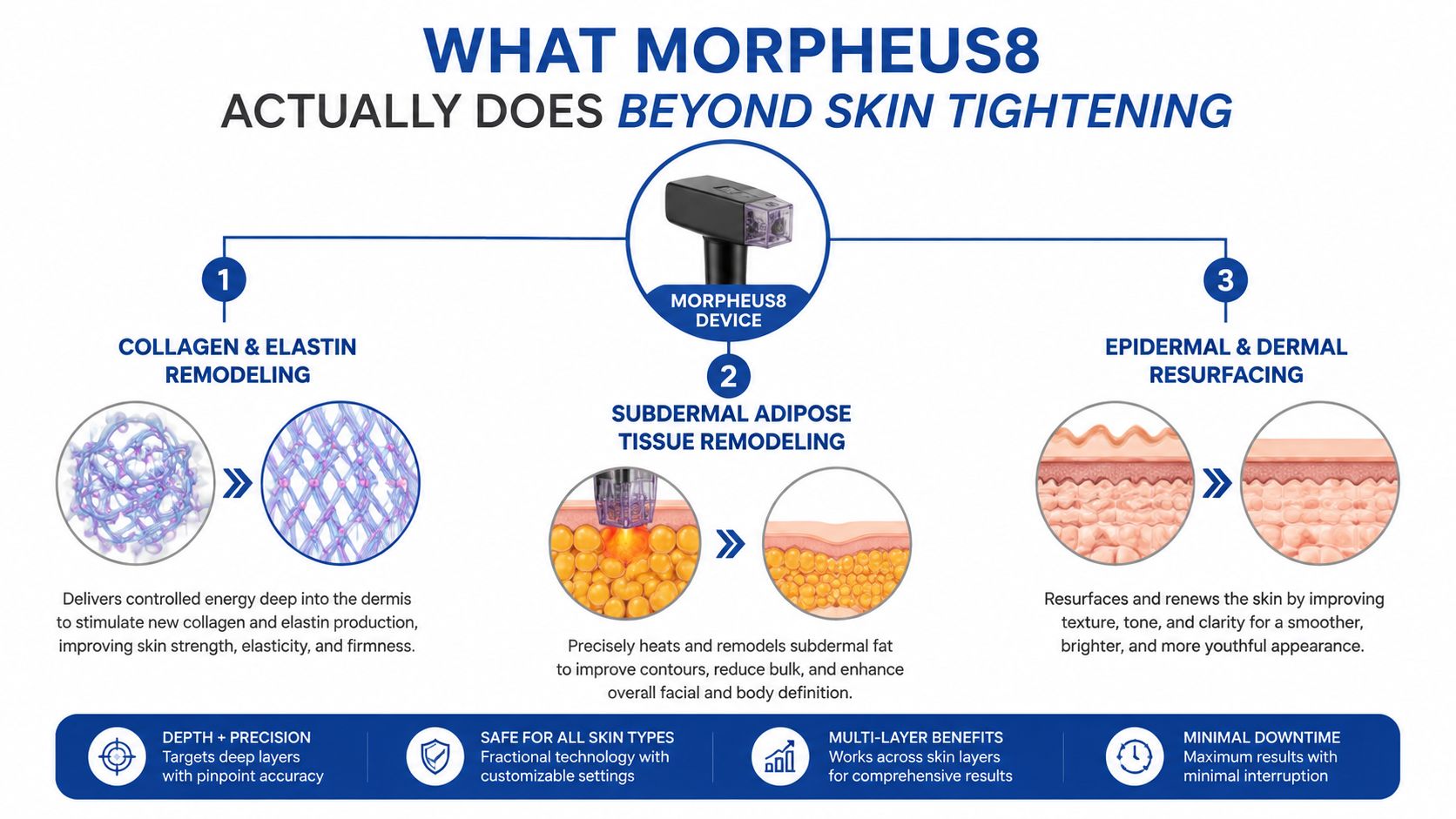
A tighter-looking face can sometimes come with less volume. Morpheus8 is a subdermal remodeling platform that affects the dermis, collagen structure, and, at deeper settings, the fatty layer beneath the skin. The same treatment plan that improves firmness may also influence facial volume and contour, so those goals must be separated during consultation.
Morpheus8 uses fractional radiofrequency microneedling with applicators designed for different tissue depths. Public device documentation describes tips reaching as deep as 7 mm, including a body tip, while other applicators are intended for more superficial facial or dermatologic work. Depth is not a universal prescription. It should correspond to tissue thickness, the treatment area, and the patient's objective. Independent device documentation describes the available Morpheus8 tip depths and treatment ranges.
Firmness and contour require different goals
At superficial or intermediate depths, RF microneedling creates controlled thermal injury that encourages collagen and elastin remodeling. Skin may feel firmer, and texture may improve. Deeper energy can reach subdermal tissue, where treatment may be used for adipose tissue remodeling and contour refinement.
That distinction matters in areas such as the submental region or thicker body tissue. It can create a problem on a thin face that already has limited volume. Someone seeking a sharper jawline may want better skin support, not less fat in the cheeks, temples, or lower face. If volume decreases more than intended, the face may appear hollow even when the skin feels tighter. Unintended fat loss and contour irregularities therefore deserve the same attention as the potential tightening benefit.
Morpheus8 reached an important regulatory milestone in the United States in 2024, when InMode announced an additional FDA 510(k) clearance for soft tissue contraction on July 17, 2024. The clearance concerned Morpheus8 applicators for fractional radiofrequency use. Its labeled indication addresses coagulation or contraction of soft tissue and hemostasis in dermatologic procedures, rather than a general promise of facial lifting. The clearance announcement explains the specific soft tissue contraction indication.
Traditional microneedling does not deliver the same deeper RF effect. A microneedling treatment overview can clarify how standard microneedling differs from RF microneedling.
How Radiofrequency Microneedling Remodels Tissue
Morpheus8 combines two actions in one handpiece. Tiny needles enter the skin, and radiofrequency energy travels from the needle tips into the surrounding tissue. The needles create the access points, while the RF energy creates a carefully controlled zone of heat below the surface.
The treatment in four steps
Precision puncture. The applicator places multiple microneedles into the skin at a selected depth. The depth determines which tissue plane receives the energy.
Controlled RF delivery. Once the needles reach their programmed position, bipolar RF energy is delivered around the tips. Because the energy is concentrated below the surface, the practitioner can target the dermis or deeper tissue without treating the entire skin surface in the same way.
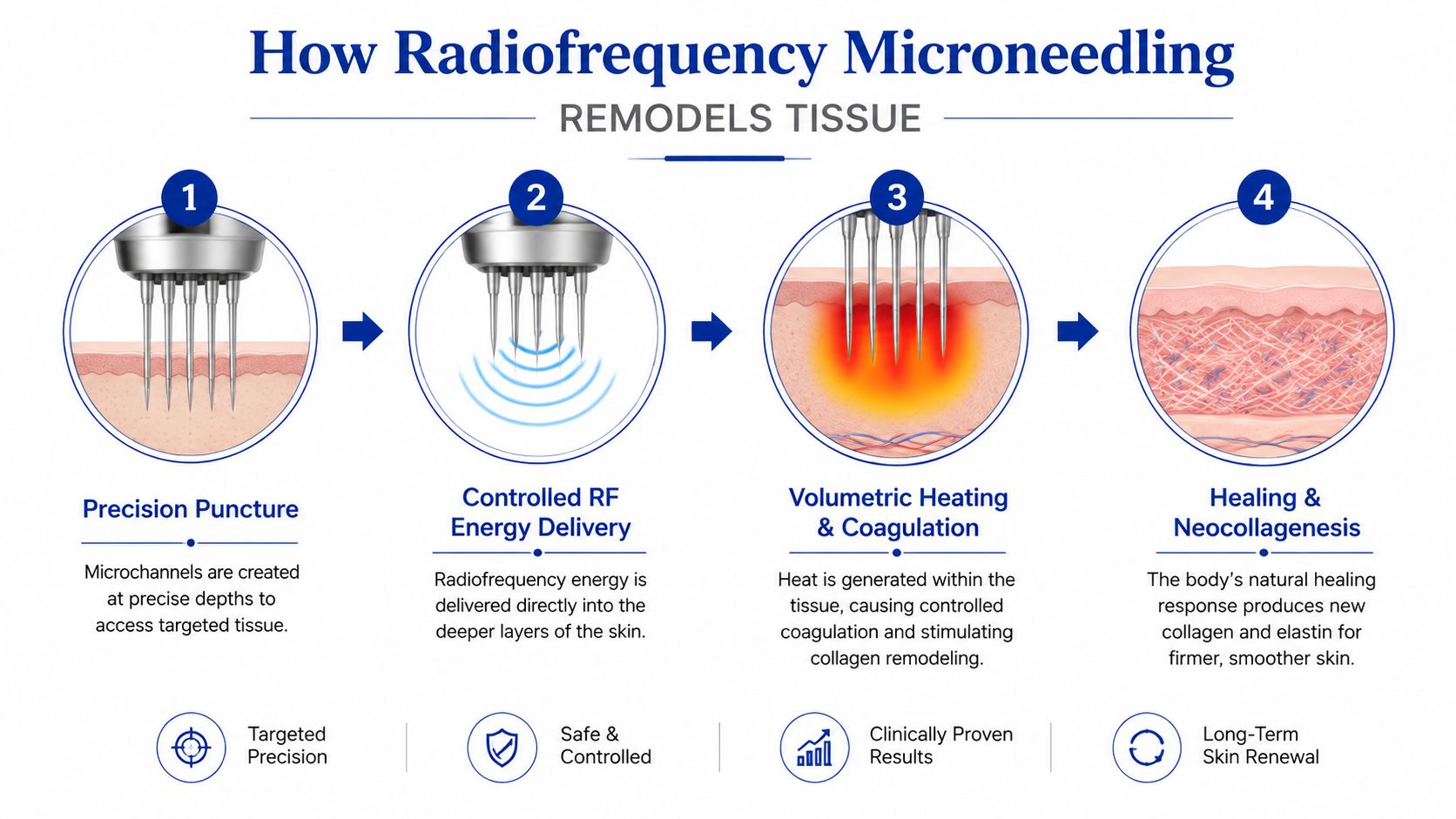
Volumetric heating and coagulation. The RF current heats a controlled area around each needle. Existing collagen can contract, while the thermal injury signals the body to begin a repair response. At deeper settings, the energy may also affect subdermal adipose tissue.
Healing and neocollagenesis. During healing, fibroblasts produce new collagen and elastin. Histologic evidence from controlled RF macroneedling has shown increased epidermal cells, collagen, elastin, fibroblasts, and vasculature, with fewer inflammatory cells 4 weeks after a single treatment. The published histologic study supports a wound-healing remodeling mechanism.
Why settings must be individualized
Three variables shape the treatment response:
- Needle depth determines whether the target is mainly superficial dermis, reticular dermis, or deeper tissue.
- Energy level influences the intensity of heating and the risk of excessive thermal injury.
- Pulse duration and passes affect how much cumulative energy a particular area receives.
The optimal depth for targeting the reticular dermis has been reported as 1.3 to 2 mm, while body treatment settings can vary by skin type and anatomical area. Clinical guidance on RF microneedling depth and treatment considerations illustrates why a face, neck, and body shouldn't receive an identical protocol.
A useful analogy is gardening. A shallow pass may work the surface soil, while a deeper pass reaches the roots. Going deeper isn't automatically better. It's only better when the target tissue needs to be reached and the surrounding anatomy can tolerate the energy.
Expected Results and the Timeline for Visible Change
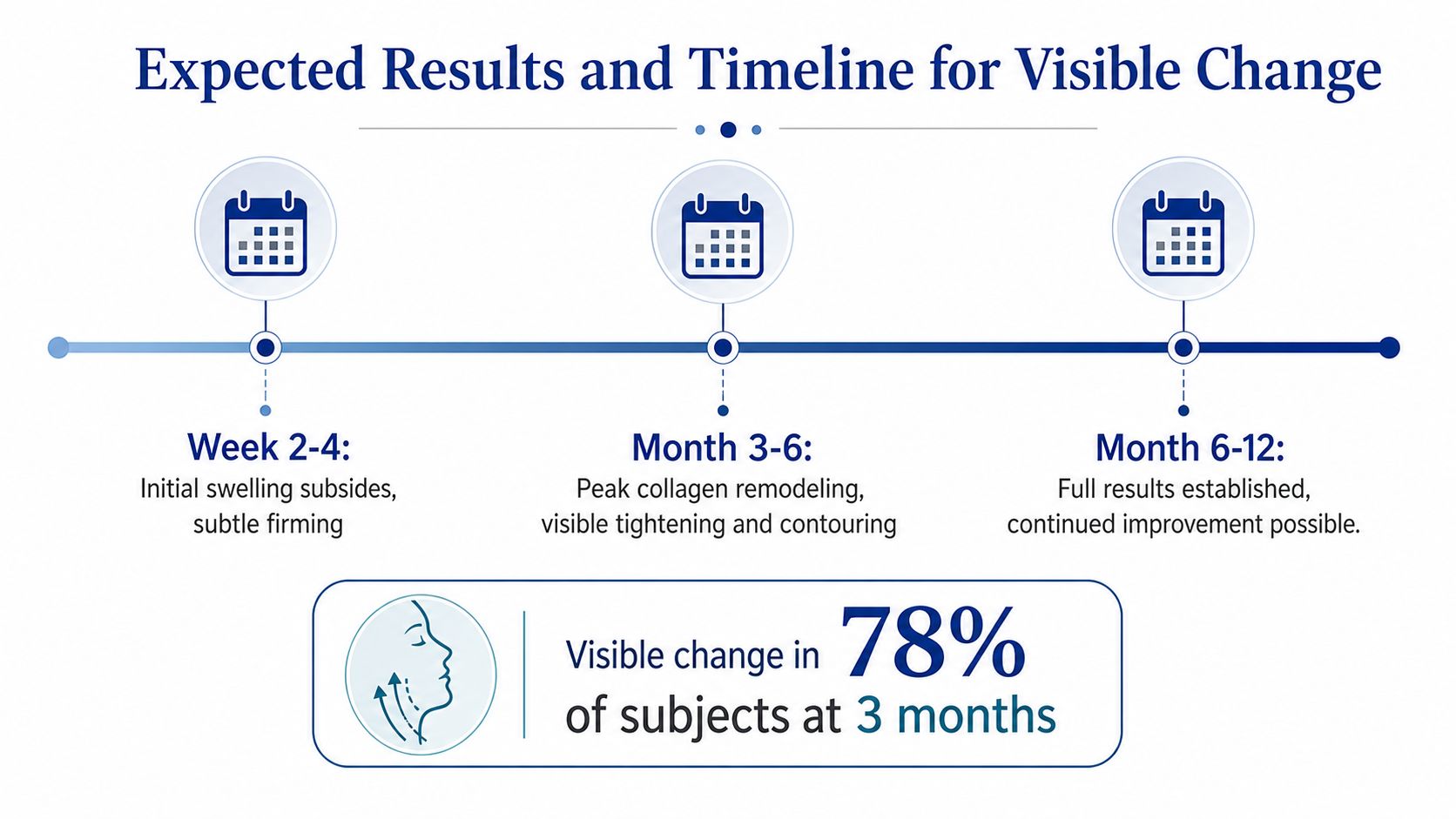
Morpheus8 results develop gradually because the main benefit comes from tissue remodeling, not from an instant lift. Some early firmness may reflect temporary collagen contraction or swelling, but the more meaningful change appears as the body builds and reorganizes new collagen.
Clinical evidence includes studies involving sizeable patient groups. A multicenter retrospective facial rejuvenation review included 247 patients, and a separate cellulite-focused application examined the use of Morpheus8 Body for subdermal tissue treatment. That literature helps explain why the device became relevant to both laxity and contouring, rather than treating it as a single-purpose resurfacing tool. The dermatology review summarizes the broader clinical literature and patient groups.
What the evidence can and can't promise
A lower-face and neck study involving 30 patients reported a mean submental volume reduction of -4.72 cm3, with a standard deviation of ±10.07 cm3. Physicians, blinded investigators, and subjects rated the outcomes as highly improved, while the reported downtime was relatively limited, mainly involving mild swelling and redness. The clinical study summary provides the submental volume finding and recovery observations.
That result should be interpreted carefully. A reduction in submental volume may be desirable for someone with fullness beneath the chin, but it isn't necessarily desirable across the cheeks, temples, or lower face. The same technology can support contour refinement in one area and create unwanted hollowness in another.
Most patients should expect a gradual refinement, not the dramatic repositioning produced by surgery. Skin may look smoother, pores and scars may become less prominent, and mild laxity may improve. Deep jowls, substantial excess skin, and prominent neck bands require a different diagnosis and may need a surgical discussion.
How long results may last
The durability of a result depends on age, sun exposure, baseline skin quality, weight changes, and the natural aging process. Maintenance may be considered as the skin changes, but no energy-based treatment stops aging permanently.
Patients often hear recommendations for a series of treatments spaced several weeks apart. That interval allows the skin to heal and begin remodeling before another treatment is considered. It shouldn't be treated as a fixed rule. The appropriate plan depends on whether the main concern is texture, mild laxity, scarring, or subdermal contouring.
Patients interested in combining regenerative approaches with microneedling can review the clinical considerations for microneedling with PRP, then discuss whether combination treatment is appropriate for their skin.
Risks and Complications Patients Rarely Hear About
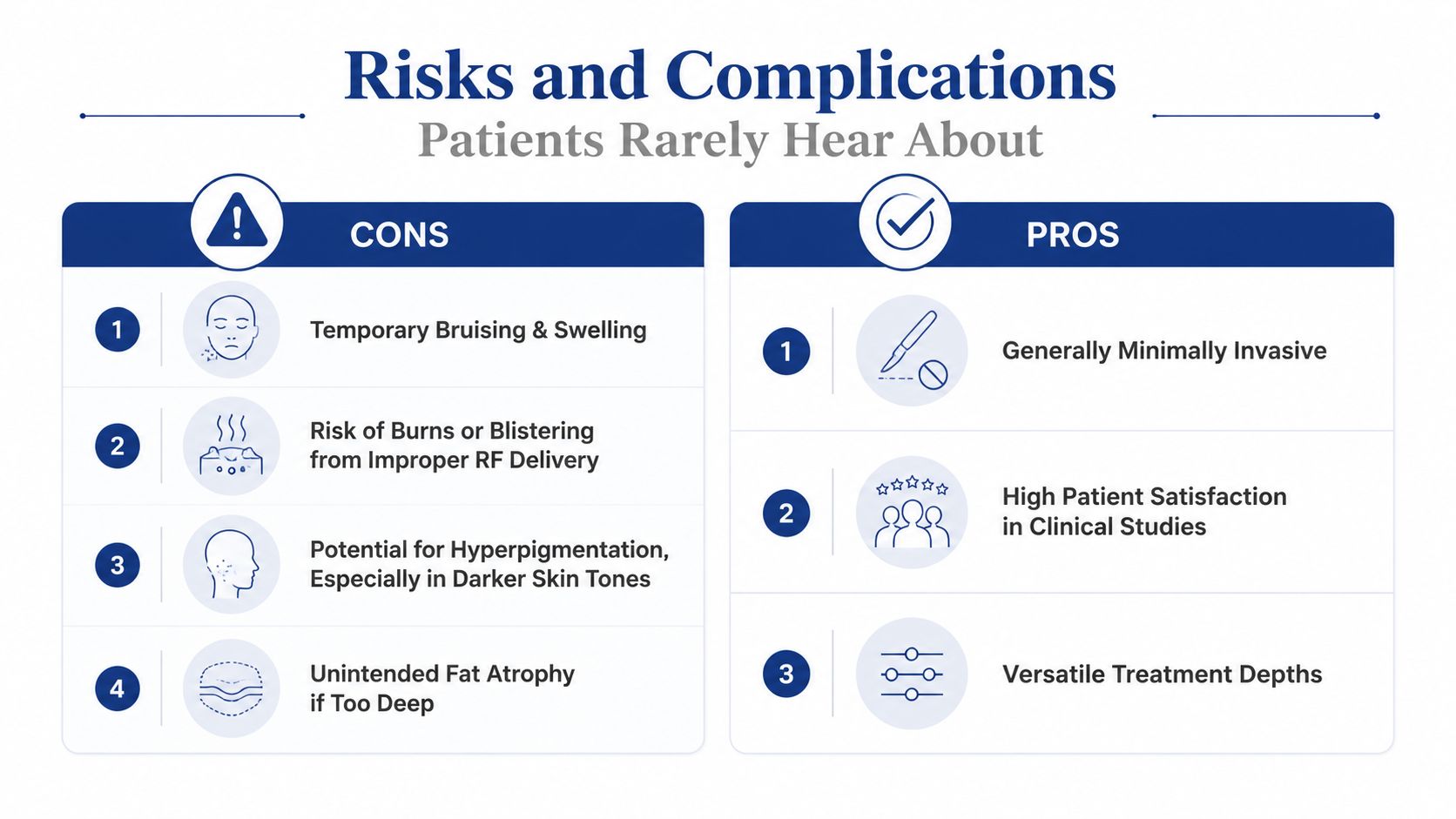
The most important risk conversation isn't limited to redness and swelling. RF microneedling can affect deeper tissue, so the potential complications include burns, scarring, fat loss, disfigurement, and nerve damage. In October 2025, an FDA safety communication reported these complications after certain uses of RF microneedling, including cases requiring surgical repair. The FDA-related safety reporting is summarized in this adverse-event analysis.
Fat loss deserves a direct discussion
An analysis of FDA adverse-event data found the most frequently reported problems were textural changes at 25.0%, pigmentary alteration at 18.3%, and fat loss at 11.6%. These figures describe reported adverse events, not the risk for every patient or the frequency of all treatments, but they show why “tightening” isn't the whole story.
Fat loss can create a hollowed cheek, a sunken temple, a sharper-than-intended jawline, or an uneven transition between treated and untreated areas. The risk becomes more concerning when a patient has thin skin, limited facial fat, or a treatment plan that uses deep penetration and high energy without a clear contouring indication.
Practical rule: If you want skin tightening but don't want facial volume reduction, ask exactly where the energy will be delivered and whether the plan intentionally targets subcutaneous fat.
Pigment and surface complications
Skin of color requires careful planning. Independent coverage of the FDA clearance notes that higher energies are restricted to Fitzpatrick skin types I to IV, with additional caution for deeper skin tones because hyperpigmentation and hypopigmentation remain recognized risks. Patient guidance on Morpheus8 selection and skin-tone considerations explains why controlled-study findings of mild redness and swelling don't eliminate real-world pigment concerns.
Temporary erythema, swelling, and pinpoint crusting can be part of normal healing. Increasing pain, blistering, spreading discoloration, persistent open areas, marked asymmetry, or progressive changes in contour deserve prompt medical assessment. A provider should explain who to contact after treatment and how complications are evaluated, not describe recovery as “minimal.”
Uneven energy delivery can also create textural irregularity or patchy contour change. These problems may be difficult to reverse because they involve tissue injury or volume loss, not merely a temporary surface reaction.
Comparing Morpheus8 to Other Skin Tightening Options
Morpheus8 occupies a specific place among tightening treatments. It combines controlled needle placement, fractional RF heating, and the possibility of subdermal remodeling. That makes it different from treatments that heat tissue without needles, treatments that use other forms of energy, and surgery that physically repositions tissue.
| Treatment | Mechanism | Depth | Downtime | Sessions Needed | Result Longevity |
|---|---|---|---|---|---|
| Morpheus8 | Fractional RF microneedling with dermal and possible subdermal remodeling | Adjustable, with applicators reported up to 7 mm | Usually limited, but redness, swelling, crusting, and pigment changes are possible | Depends on the diagnosis and response | Gradual improvement, with maintenance as aging continues |
| Non-invasive ultrasound tightening | Focused ultrasound heating of deeper support tissue | Targets deeper tissue planes without microneedles | Usually limited | Often planned around individual response | Gradual and variable |
| Non-invasive RF tightening | Broad RF heating without fractional needle channels | Primarily dermal or subdermal depending on the device | Usually limited | Often more than one treatment may be considered | Gradual and variable |
| Focused non-invasive heating | Controlled energy delivery intended to stimulate collagen | Designed for selected dermal layers | Usually limited | Depends on the treatment plan | Gradual and variable |
| Surgical facelift or neck lift | Physical repositioning of deeper tissue and removal of excess skin | Addresses structural laxity and skin redundancy | Greater recovery than device treatments | Usually a surgical procedure rather than a repeated device series | More substantial correction, with continued aging |
The table shows why no modality is universally superior. Morpheus8 may suit someone with textural changes and mild laxity who accepts gradual improvement. It won't remove excess skin or reposition descended facial structures. A surgical lift remains the more honest recommendation when significant laxity, heavy jowls, or prominent platysmal banding dominate the concern.
The comparison also helps during consultation. Ask whether your primary problem is skin quality, skin position, fat distribution, or a combination. A device can improve one category while leaving another largely unchanged.
Medical practices also need an organized way to collect health history, treatment goals, and contraindication information before consultations. Clinics reviewing patient intake automation may find it useful for making those conversations more consistent, but automation can't replace an anatomical examination or individualized medical judgment.
Your Treatment Journey From Consultation to Recovery
A responsible Morpheus8 plan starts before the numbing cream is applied. During consultation, the provider should examine skin thickness, laxity, fat distribution, scars, pigmentation history, and the difference between a volume problem and a skin-quality problem. Standardized photographs and, when appropriate, measurements create a baseline for judging gradual change rather than relying on memory.
What happens on treatment day
The treatment area is cleansed, and topical anesthetic is applied according to the provider's protocol. Patients commonly feel pressure, brief prickling, and heat as the insulated needles enter and deliver RF energy. The sensation varies by area and setting, so a provider should adjust comfort measures rather than assume every patient will tolerate the same approach.
For facial treatment, a session may take roughly 30 to 45 minutes, excluding preparation and numbing time. The appointment length changes with the size of the area, the number of passes, and whether the neck or body is included. The settings should be recorded by area because the cheek, eyelid region, neck, and submental tissue don't have identical anatomy.
Recovery has several phases
Immediately afterward, redness, warmth, swelling, and pinpoint crusting can occur. During the early healing period, gentle cleansing, sun avoidance, and strict adherence to the practice's skincare instructions matter more than adding aggressive products.
A typical recovery discussion should address:
- The first few days: redness and swelling may be visible, with a sensation similar to heat or a mild sunburn.
- The following days: micro-crusting, flaking, tightness, or sensitivity may become more noticeable as the surface heals.
- The next several weeks: collagen remodeling continues, so the final appearance shouldn't be judged immediately.
Retinoids, exfoliating acids, and other potentially irritating products are commonly paused until the provider confirms that the skin barrier has recovered. Patients should also avoid picking at crusts and should protect treated skin from direct sun exposure.
For readers who want a broader explanation of topical anesthetics and lidocaine, a complete numbing cream resource may help prepare questions for the treating clinician. It doesn't replace the provider's instructions, particularly for patients with allergies, medication sensitivities, or medical conditions.
A series may be appropriate, but it shouldn't be sold as an automatic package. The number and spacing of treatments should follow the condition being treated, the prior response, and the safety margin for the selected area.
Why Provider Expertise Determines Your Outcome
The brand name on the handpiece doesn't determine the result. The operator chooses the depth, energy, pulse duration, number of passes, and treatment pattern. Two people can receive a treatment called Morpheus8 and experience very different outcomes because their anatomy and settings are different.
A skilled assessment asks whether a patient has enough tissue to tolerate deeper energy. It also distinguishes thick submental fullness from a thin, volume-depleted lower face. Treating both with the same depth and energy would ignore the most important clinical variable, the tissue underneath the skin.
What experienced planning looks like
Before treatment, the provider should map the face and identify areas that need different approaches. Delicate regions near the eyes, temples, and thin cheek tissue require a different margin of safety than thicker submental or body tissue. The practitioner should also watch tissue response during treatment and avoid repeated passes that add heat without a clear benefit.
Important consultation questions include:
- Who performs the treatment? Ask about the individual's medical training, experience with RF microneedling, and familiarity with the specific applicators.
- Which areas will receive deeper energy? A clear answer should identify the target tissue and explain why that depth is necessary.
- How will facial volume be protected? The provider should discuss whether fat remodeling is intended and how settings change when volume preservation matters.
- What happens if a complication develops? Ask about follow-up, documentation, wound care, pigment management, and escalation to medical or surgical treatment when needed.
- What result is realistic? A responsible provider should distinguish gradual firming from a surgical lift and explain what the device can't correct.
Ideal Face & Body in Beverly Hills, CA offers Morpheus8 among its non-surgical skin and energy-based treatments. Its physician-led consultation model can include discussion of whether RF microneedling, another skin-quality treatment, or a surgical option better matches the patient's anatomy and goals. Ideal Face & Body no longer offers breast implant placement, implant-based breast augmentation, or breast implant revision procedures.
The safest decision is a diagnosis-first decision. If your concern is surface texture and mild laxity, Morpheus8 may be reasonable. If the concern is descended tissue, significant excess skin, or facial deflation, a different plan may protect both your expectations and your appearance.
Ideal Face & Body provides physician-led consultations for Morpheus8 skin tightening, facial rejuvenation, and surgical alternatives in Beverly Hills, CA. Visit Ideal Face & Body to discuss your skin quality, facial volume, treatment goals, and the safest path for your anatomy.