What to Know Before Getting Laser Tattoo Removal
Laser treatment for tattoo removal is the most effective, FDA-cleared method for eliminating unwanted ink from your skin — and it works for most tattoo types, colors, and skin tones.
Quick answers:
- How it works: A laser shatters ink particles into tiny fragments. Your immune system then flushes them out naturally.
- How many sessions: Typically 6–12 sessions, spaced 6–8 weeks apart. Some tattoos need more.
- Does it hurt? Most people describe it as a rubber band snapping against the skin. Numbing cream helps.
- Complete removal? Possible for many tattoos — especially black and dark blue ink. Some colors are harder to clear.
- Is it safe? Yes, when performed by a qualified provider. Side effects are usually mild and temporary.
Tattoos are designed to be permanent. Ink is deposited deep into the dermis — the second layer of skin — where your immune system can’t simply break it down on its own. The particles are too large for your body to process without help.
That’s exactly what laser technology provides.
About 24% of people with tattoos say they regret at least one. Whether your style has changed, a relationship has ended, or a tattoo just didn’t turn out as expected — you’re far from alone. And today’s laser technology makes removal more achievable than ever.
I’m Dr. Sarah Yovino, MD, a double board-certified physician specializing in advanced medical aesthetics, including laser treatment for tattoo removal and a full range of laser and energy-based skin treatments. Alongside Dr. Justin Yovino, I’ve helped countless patients at Ideal Face & Body in Beverly Hills, CA reclaim clear, confident skin.
How Laser Treatment for Tattoo Removal Works at the Cellular Level
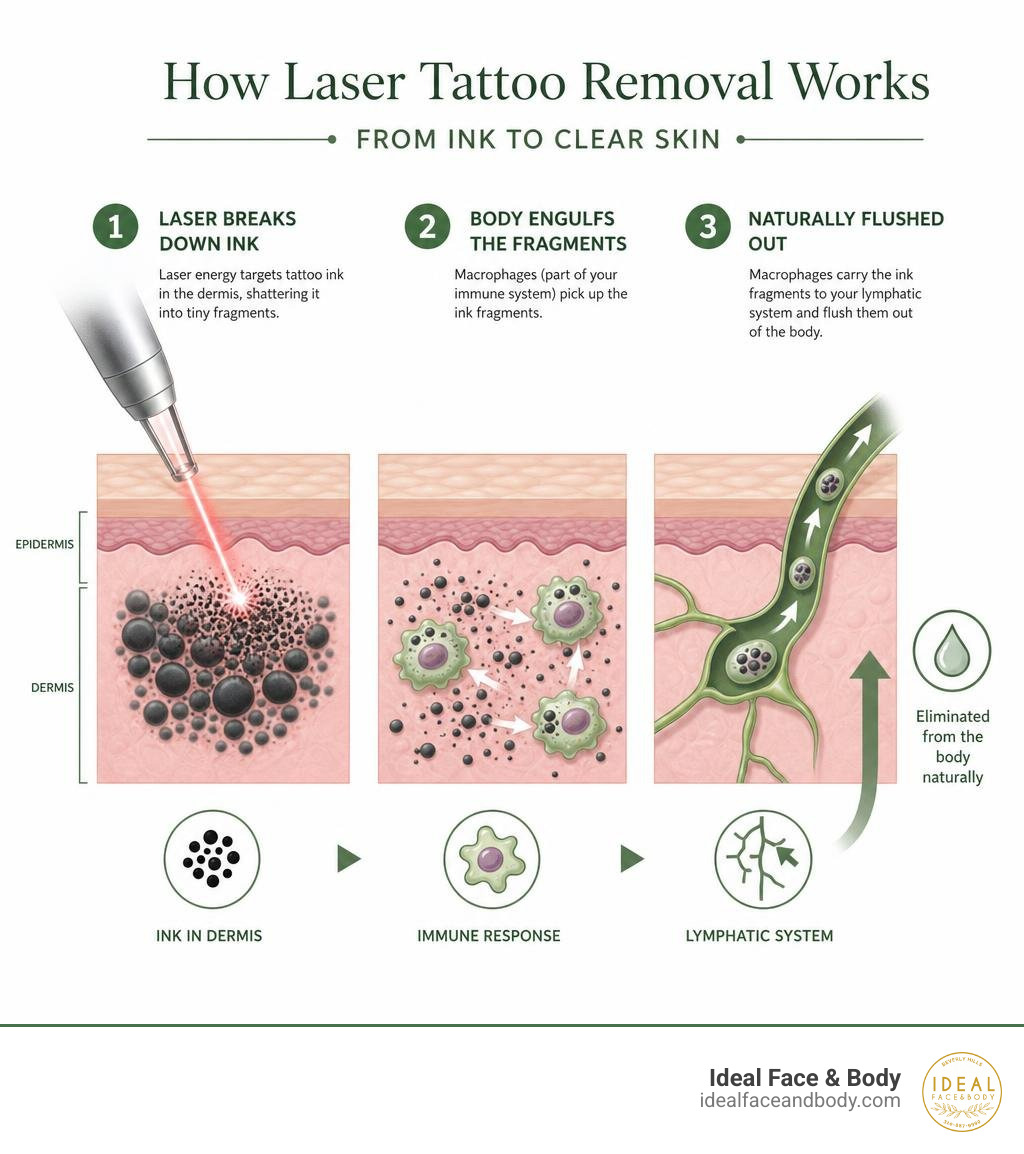
To understand why lasers are so successful, we have to look at what is happening beneath your skin. When you get a tattoo, the tattoo needle injects heavy ink pigment particles into your dermis. Your immune system immediately recognizes these particles as foreign invaders. It sends white blood cells called macrophages to engulf and remove them.
However, because tattoo ink particles are massive (often up to 970 nm in size), the macrophages simply cannot swallow them. Instead, the ink remains trapped in the dermis, visible through your translucent epidermis.
Laser technology changes this dynamic by utilizing two primary mechanisms: the photothermal effect and photomechanical breakdown. When we direct the laser at your skin, the ink pigments selectively absorb the light energy. This rapid absorption causes the ink to heat up in a fraction of a second (the photothermal effect) and expand.
Because the pulse of light is incredibly fast, it creates a powerful acoustic shockwave. This shockwave physically shatters the large ink particles into microscopic dust (photomechanical breakdown).
Once the ink is pulverized, your macrophages can finally do their job. They easily engulf the tiny fragments and carry them into your lymphatic system. From there, the shattered ink is safely processed and flushed out of your body.
According to scientific research on laser tattoo removal mechanisms, this biological clearing process takes time. This is why we space your appointments several weeks apart; your body needs time to sweep away the debris before we can target the next layer of ink. To dive deeper into this process, check out more details on how pico lasers shatter ink.
The Role of Wavelengths in Laser Treatment for Tattoo Removal
Not all laser light is the same. Laser systems use specific wavelengths of light measured in nanometers (nm). For a laser to destroy an ink particle, the ink must absorb the light. If the ink color reflects the wavelength, the treatment won’t work.
Furthermore, we must always consider the presence of melanin (the natural pigment in your skin). Melanin also absorbs laser light, which means we must carefully select wavelengths that target the ink while sparing your natural skin pigment to prevent complications.
| Laser Wavelength | Primary Target Ink Colors | Skin Safety Profile |
|---|---|---|
| 1064 nm (Nd:YAG) | Black, dark blue, dark brown | Safest for all skin types, including dark skin |
| 532 nm (Nd:YAG) | Red, orange, yellow, tan | Best for warm tones; higher melanin absorption |
| 755 nm (Alexandrite) | Green, sky blue, teal | Highly effective for stubborn cool tones |
| 650 nm / 585 nm | Green, light blue | Excellent for specialized, multi-colored tattoos |
By matching the correct wavelength to your specific ink colors, we ensure maximum ink destruction with minimal damage to the surrounding tissue.
Why Picosecond Laser Technology Outperforms Older Nanosecond Lasers
For decades, Q-switched (nanosecond) lasers were the gold standard for tattoo removal. These lasers deliver energy in nanoseconds (billionths of a second). While highly effective, they rely heavily on photothermal energy. This means they heat the ink to break it, which can sometimes lead to thermal damage in the surrounding skin.
As we look at the standards of June 2026, picosecond technology has completely revolutionized this field. Picosecond lasers deliver energy in trillionths of a second. This pulse duration is so incredibly short that the energy is delivered before the heat has a chance to transfer to the surrounding skin.
Instead of burning the ink, a picosecond laser creates a pure photoacoustic effect. The ink is shattered photomechanically into a fine dust, rather than the pebble-like fragments left by nanosecond lasers.
A clinical study on picosecond laser efficacy highlights that picosecond systems lead to faster clearing, fewer overall sessions, and a significantly reduced risk of thermal injury or scarring. If you want to compare your options, you can discover the best tattoo removal laser options to see which technology fits your goals.
Key Factors Influencing Your Tattoo Removal Timeline
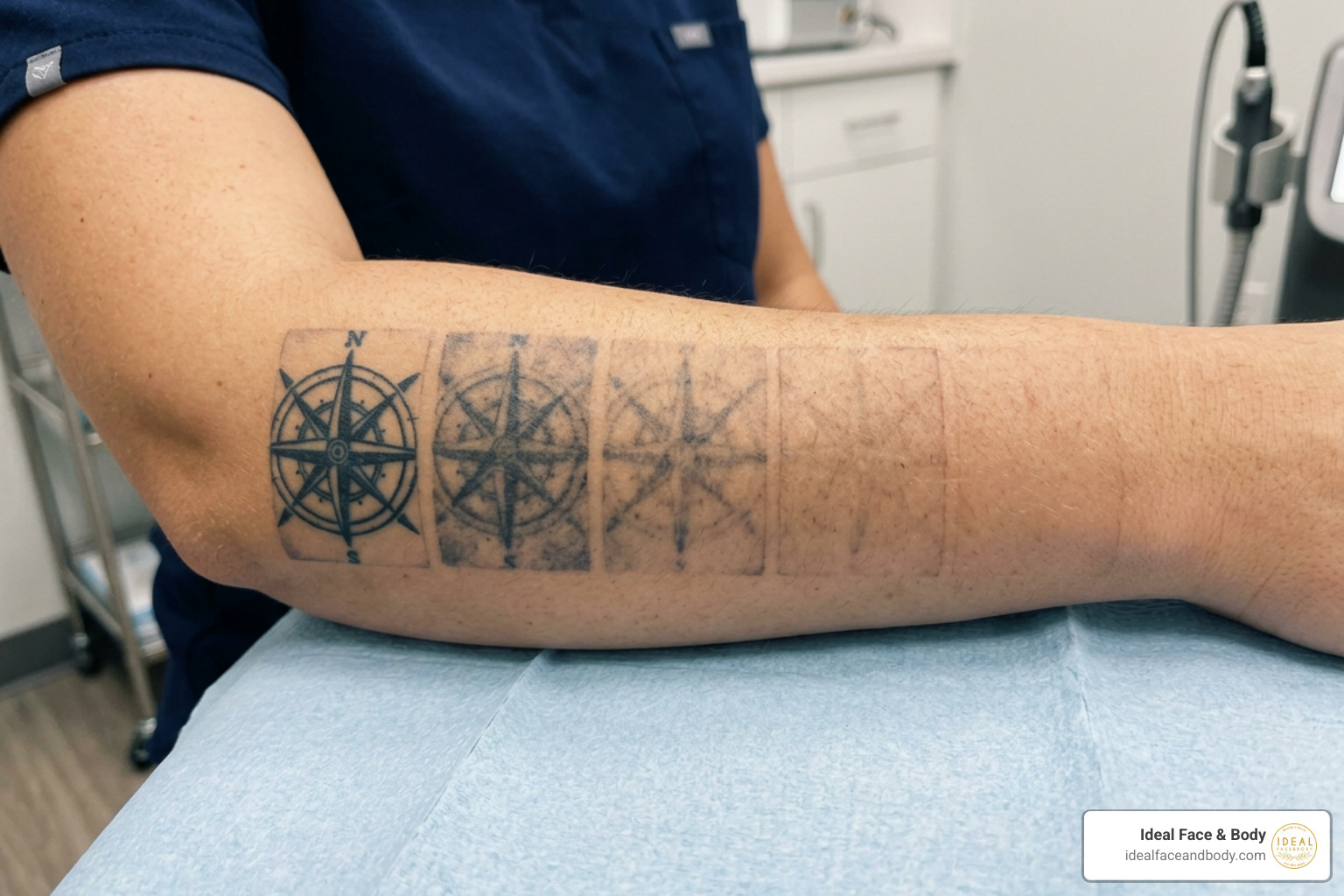
It is rare for a tattoo to disappear after a single visit. In fact, for professional laser tattoo removal, it could take between six and 12 sessions before you see final results on your skin. To understand why your timeline looks the way it does, we turn to the Kirby-Desai scale. This clinical scale analyzes several key variables to estimate how many sessions you will need:
- Tattoo Age: Older tattoos are generally easier to remove. Over time, your body has already naturally broken down some of the ink, meaning there is less pigment to target.
- Ink Density: Professional tattoos feature dense, deeply saturated ink layers. Amateur tattoos, on the other hand, are often superficial, use less ink, and can clear in far fewer sessions.
- Anatomical Location: Your lymphatic system relies on blood circulation to clear shattered ink. Tattoos located closer to your heart (such as on your chest, neck, or back) fade much faster than tattoos on your extremities (like your fingers, ankles, or toes) where circulation is slower.
- Your Immune System: Because your body does the heavy lifting of carrying the ink away, a healthy lymphatic system and active lifestyle speed up your results.
To get a better idea of what to expect for your specific situation, you can learn how many laser sessions you might need.
Fitzpatrick Skin Typing and Laser Selection
Your skin type is one of the most important safety factors we evaluate before starting your treatment. We use the Fitzpatrick scale, which classifies skin from Type I (very fair, always burns) to Type VI (deeply pigmented, never burns).
Because melanin absorbs laser energy, darker skin types face a higher risk of “melanin competition.” If the laser energy is absorbed by your skin’s natural pigment rather than the tattoo ink, it can cause:
- Hyperpigmentation: Darkening of the treated skin.
- Hypopigmentation: Lightening of the treated skin, leaving a “ghost” outline of the tattoo.
To protect your skin, we use safe parameters and specialized wavelengths—specifically the 1064 nm Nd:YAG laser, which penetrates deeply to bypass epidermal melanin. For a complete breakdown of how we protect your skin’s integrity, read our guide to safe laser tattoo removal.
Challenging Ink Colors and Potential Chemical Reactions
While black ink is highly responsive to lasers because it absorbs all wavelengths of light, other colors can be quite stubborn.
- Recalcitrant Colors: Green, yellow, and bright neon hues are notoriously difficult to target because they reflect most laser wavelengths.
- Paradoxical Darkening: Some cosmetic tattoos (such as permanent makeup on eyebrows or lips) contain inks formulated with titanium dioxide or ferric oxide. When exposed to laser light, these compounds can undergo a rapid chemical reduction, turning permanently black or dark brown instantly.
Because of this, we always perform a careful evaluation and a test patch on cosmetic tattoos. If you are dealing with permanent makeup regret, you can learn more about our specialized approach by reading From Bold to Bare: Navigating Laser Lip Tattoo Removal.
Minimizing Risks, Side Effects, and Discomfort
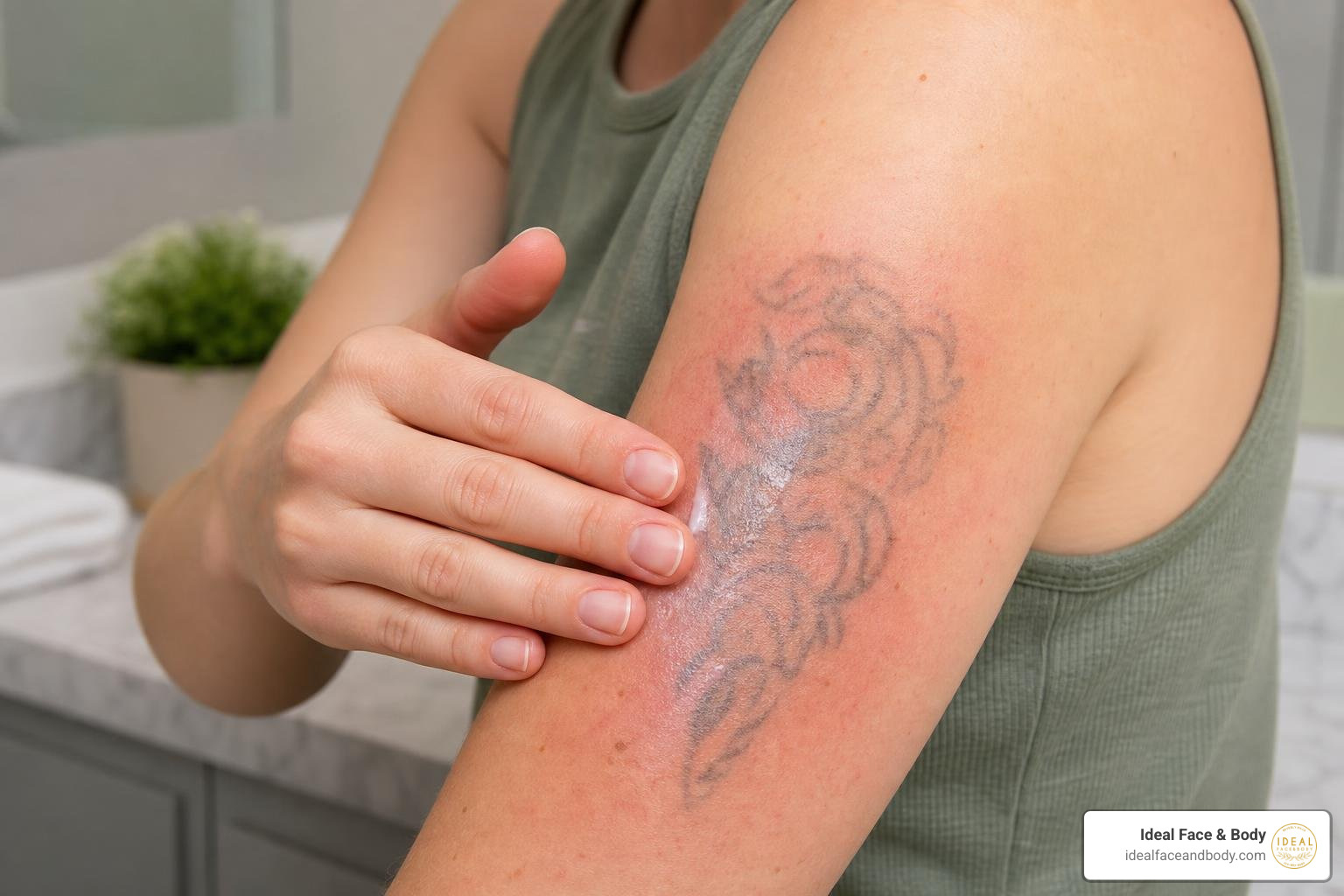
While modern laser technology has made the removal process safer than ever, it is still a medical procedure. Some temporary side effects are a normal part of the skin’s natural healing process:
- Frosting: This is an immediate, temporary whitening of the treated area caused by rapid gas bubbles releasing from the heated ink. It typically resolves within 15 to 30 minutes.
- Redness and Swelling: Comparable to a mild sunburn, this usually lasts for a few days.
- Blistering and Pinpoint Bleeding: Small, superficial blisters are common and show that your skin is reacting appropriately to the shattered ink.
To ensure your comfort during the session, we offer several pain management solutions. While many describe the feeling as a quick rubber band snap, we can apply topical numbing creams or administer local anesthetics to make the experience virtually painless. To explore how we keep you comfortable, read about local anesthetic options for comfortable removal.
Essential Aftercare Protocols for Optimal Healing
What you do at home is just as important as what we do in our Beverly Hills, CA office. Proper aftercare prevents infection, supports your immune system, and minimizes the risk of scarring:
- Keep It Clean and Covered: Gently wash the area with mild soap and water, pat dry, and apply a thin layer of recommended ointment for the first few days.
- Do Not Pop Blisters: If blisters form, let them heal naturally. Popping them increases the risk of infection and scarring.
- Protect It from the Sun: Sun exposure can trigger hyperpigmentation in healing skin. Keep the area covered or wear a broad-spectrum SPF 30+ sunscreen whenever you are outdoors.
- Stay Hydrated: Drinking plenty of water keeps your lymphatic system active, helping your body flush out the shattered ink particles faster.
Frequently Asked Questions About Tattoo Removal
Does laser tattoo removal hurt?
Most patients compare the sensation of laser tattoo removal to a rubber band snapping against the skin, accompanied by a warm, prickly feeling. While it is uncomfortable, the sessions are incredibly fast—often lasting only a few minutes. To make your experience as pleasant as possible, we offer topical numbing creams and local anesthetic injections to block the discomfort completely.
Why non-laser DIY tattoo removal methods are unsafe and ineffective
It can be tempting to try at-home tattoo removal creams, chemical peels, or DIY kits, but these methods are highly dangerous and ineffective. The FDA has not approved any tattoo removal creams or ointments. Because tattoo ink lives deep in the dermis, topical creams cannot reach it. Instead, these highly acidic or abrasive products sit on the epidermis, often leading to severe chemical burns, permanent scarring, and systemic skin infections.
Can multi-colored or older tattoos be safely removed?
Yes! Older tattoos actually tend to fade faster because your body has already spent years slowly breaking down the pigments. Multi-colored tattoos are also highly treatable, but they require a customized treatment plan using multiple laser wavelengths to safely target each specific color.
Conclusion
If you are ready to say goodbye to an old memory, a design that no longer fits your style, or permanent makeup that didn’t turn out quite right, we are here to help. At Ideal Face & Body in Beverly Hills, CA, Dr. Sarah Yovino and Dr. Justin Yovino combine state-of-the-art laser technology with a warm, patient-first approach to give you clear, beautiful skin.
Every tattoo is unique, and your removal plan should be too. Schedule a consultation and explore our ultimate guide to tattoo removal costs, which vary based on your unique tattoo. Let us help you start your journey to bare, beautiful skin today!