
Preventative Botox is the elective, timing-based use of an FDA-approved wrinkle-relaxing injection to soften repetitive muscle movement before expression lines become permanently set, with effects that are temporary and require maintenance. It isn't a guarantee that wrinkles will never develop, and there isn't an evidence-based age at which everyone should begin.
You may be considering it after noticing faint lines in your forehead, between your eyebrows, or beside your eyes that linger a little longer after you stop frowning, squinting, or smiling. Perhaps someone has told you to start early, while another person has warned that beginning too soon means committing to treatment forever. Both reactions miss the more useful question: what is preventative Botox realistically capable of changing, and does your facial movement justify it?
A thoughtful answer starts with muscle dynamics, existing lines, skin quality, medical history, and your comfort with repeat treatment. It also separates expression-line management from broader facial aging, which involves sun exposure, collagen changes, pigmentation, volume, laxity, and other factors that neurotoxin doesn't correct.
Table of Contents
- What Preventative Botox Means
- How the Treatment Interrupts Muscle Movement
- Who Makes a Good Preventative Candidate
- Typical Treatment Areas and Conservative Dosing
- What Results and Longevity Look Like Over Time
- What Preventative Botox Cannot Fix
- Safety, Side Effects, and How to Weigh Risk
- Building a Personal Plan With a Qualified Injector
What Preventative Botox Means
You may notice this question comes up after a specific moment in the mirror. You raise your brows, frown, or squint, then relax, and a faint line hangs on a beat longer than it used to. That is usually what people mean by preventative Botox: using botulinum toxin while lines are still tied mainly to movement, before they become more noticeable at rest.
Dynamic lines show up when a muscle contracts. Forehead lines, crow's feet, and the vertical glabellar “11” lines are common examples. With repeated folding, some of those creases can start to linger even when the face is relaxed. The goal of early treatment is to reduce that repeated mechanical folding in selected areas, so the skin is creased less forcefully and less often.
That framing matters.
Preventative Botox is a treatment approach, not a separate product and not a special preventive indication on the label. Botox Cosmetic received FDA approval letter for the temporary improvement of moderate-to-severe glabellar lines in adults younger than 65, based on two randomized, placebo-controlled clinical trials involving 537 participants with at least moderate glabellar lines at maximum frown. In other words, the original approval addressed visible frown lines that were already present, not the long-term prevention of every future wrinkle.
That is why age by itself is a weak guide.
A better way to define candidacy is by muscle behavior, current lines, and your goals. Two people who are the same age can age very differently in the upper face. One may have strong habitual brow movement and early lingering lines. Another may have minimal expression creasing but more pigment change, skin laxity, or volume loss. Neurotoxin targets muscle-driven folding. It does not prevent sun damage, restore lost volume, tighten loose skin, or correct texture and discoloration.
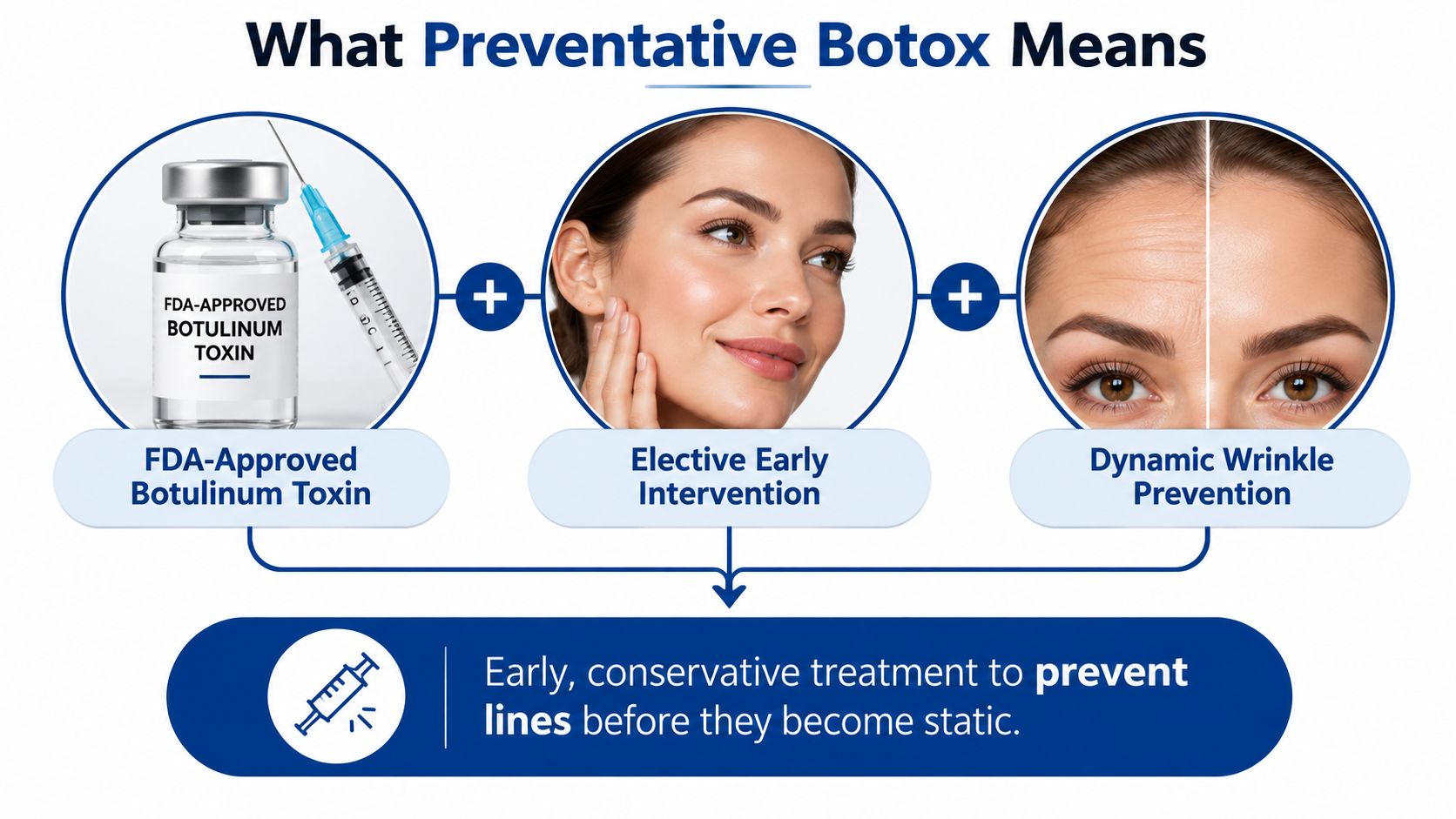
The practical takeaway is conservative and specific. Early neuromodulator use may help slow the deepening of expression lines in the right patient, but it is temporary, selective, and dependent on repeat treatment when appropriate. It is not a promise that you will never develop wrinkles. For a broader explanation of how neuromodulation may fit into facial aesthetics, it helps to keep one idea in mind: preventative Botox is individualized management of muscle movement, not an age-based obligation.
How the Treatment Interrupts Muscle Movement
Every expression line starts with motion. If you repeatedly frown, squint, or lift your brows, the skin over those muscles creases in the same places again and again. Neurotoxin treatment changes that pattern by reducing how strongly a selected muscle can contract.
At the nerve-to-muscle junction, a motor nerve normally releases acetylcholine, the chemical signal that tells the muscle to fire. OnabotulinumtoxinA acts locally at that junction. It binds to motor nerve terminals, enters presynaptic nerve endings, and cleaves SNAP-25, a protein involved in acetylcholine vesicle docking. With less acetylcholine released, the treated muscle contracts less forcefully for a limited time. (FDA prescribing information)
A simple comparison helps here. It works like dimming a light rather than cutting the power to the whole house. The nerve is still there. The muscle is still there. The signal just does not get through with the same strength, which is why careful dosing can soften movement without erasing expression.
From nerve signal to softer movement
The sequence is straightforward:
- The toxin attaches to targeted nerve endings. The effect stays local, so placement matters.
- Acetylcholine release drops. The contraction signal is interrupted before it reaches full strength.
- The muscle moves less forcefully. With less repeated folding, the skin above that muscle gets a break.
That mechanism explains why preventative treatment is selective. It can reduce muscle-driven creasing in areas such as the glabella, forehead, or crow's feet, but it does not stop other parts of facial aging. It will not prevent sun damage, restore lost volume, or tighten lax skin. Those changes come from different processes.
The effect is also temporary. Over time, nerve signaling recovers, the muscle gradually regains activity, and movement returns. That is expected biology, not a sign that something went wrong.
Because of that, good maintenance is not about chasing a rigid calendar. It is based on how your muscles behave, whether lines are starting to linger again, and how much movement you want to keep. This explanation of factors that influence Botox effectiveness gives a practical overview of why one person's response can differ from another's.
Who Makes a Good Preventative Candidate
A good candidate isn't defined by a birthday. During an assessment, an injector watches how your face moves, not just how it looks in a neutral photograph. They may observe you frown, raise your eyebrows, squint, and smile, then compare the movement with the lines that remain after your face relaxes.
The practical candidacy checklist
Strong candidates often have:
- Pronounced expression movement: The glabella, forehead, or outer eye area repeatedly creases during ordinary expressions.
- Early lines that linger: A line may disappear when the face relaxes, but it no longer disappears as quickly as it once did.
- Realistic goals: You want softer movement and a smoother appearance, not a promise that facial aging will stop.
- Comfort with maintenance: You understand that the effect fades and that future treatment is elective, not medically required.
- Suitable anatomy and health history: Brow position, muscle strength, asymmetry, skin quality, medications, and medical conditions all affect the plan.
Consider two contrasting examples. A person with strong brow movement and faint horizontal forehead lines that persist briefly at rest may benefit from a conservative consultation. Someone whose main concern is uneven pigmentation from sun exposure may need a skin-focused approach instead, because relaxing a muscle won't remove pigment.
When waiting makes more sense
Early treatment may not be useful if you have minimal expression-driven creasing, don't want repeat injections, or are hoping neurotoxin will correct laxity, volume loss, or skin texture. It also deserves extra caution when a person has a low brow position, pre-existing eyelid heaviness, facial asymmetry, or muscle patterns that could make relaxation look unbalanced.
The most important part of candidacy is informed preference. You can decide that preserving every natural movement matters more than reducing a faint line. You can also choose treatment while asking for a conservative result. A qualified injector should be able to explain both options, including why waiting may be reasonable.
Typical Treatment Areas and Conservative Dosing
Preventative treatment focuses on muscles that create frequent expression folds. The three most relevant areas are usually the glabella, the forehead, and the lateral canthal region, commonly called the crow's-feet area. Each area requires a different anatomical assessment.
The glabella often contains strong muscles that pull the brows inward and downward. The forehead raises the brows, so treating it without considering the muscles below can affect brow position. Around the eyes, the injector must balance softening squint-related creasing with preserving a natural smile.

Why early dosing should be restrained
An early-stage patient usually doesn't need every visible area treated. The injector evaluates:
- Muscle strength: Strong muscles may need a different plan from delicate or less active muscles.
- Asymmetry: One side may move more or sit differently at rest.
- Brow position: Forehead treatment must account for how the brows are supported.
- Static lines: Lines etched into relaxed skin may need skincare or resurfacing in addition to muscle relaxation.
- Desired expression: The goal is softer movement, not the removal of personality from the face.
The appropriate amount is individualized. It can vary with treatment area, muscle activity, metabolism, sex, and injection technique. A lower dose isn't automatically safer or better, and a higher dose isn't automatically more effective. The right plan uses enough product to address the selected movement while avoiding unnecessary weakening of adjacent muscles.
That balance is especially important for people who are new to neurotoxin. A staged approach lets the injector observe your response before considering adjustments. It also gives you a chance to decide whether the change feels natural and worth repeating.
What Results and Longevity Look Like Over Time
A typical early result is subtle at first. Someone treated for strong glabellar movement with faint lines at rest may notice, around the third or fourth day, that frowning takes less effort and the skin between the brows creases less sharply. Cleveland Clinic notes that onset often begins around then, with full effect by 10 to 14 days and a usual duration of about 3 to 4 months. (Cleveland Clinic's overview of botulinum toxin injections)
By the second week, you can judge the outcome more fairly. The goal is controlled movement, not a mask-like face. In a good preventive plan, expression is still there, but the repeated folding is softer, so the skin gets less of the same mechanical stress each time you squint or frown. If one brow still lifts a little more than the other, or one side softens faster, that is usually assessed after the full effect has declared itself, not in the first few days.
A maintenance pattern, not a permanent change
Neurotoxin is temporary. The nerve signal gradually resumes, muscle activity returns, and the old pattern can start to reappear. In practice, many maintenance schedules fall into a 3 to 6 months rhythm, but the right timing depends on your movement pattern, dose, anatomy, and how much change you want to keep. A rigid calendar makes less sense than reassessment. This is the context for ongoing Botox upkeep and regular sessions, not a reason to treat automatically.
The broader evidence also has limits. The Cochrane review of botulinum toxin for facial wrinkles summarizes studies ranging from one week to one year, with an average observation period of 20 weeks. That supports what injectors see in clinic. Results wear off, then are repeated if the patient still likes the effect. It does not show that starting younger guarantees a better face decades later.
Repeated treatment can sometimes make a targeted muscle less active over time, and in some people that may stretch out how long the area stays calmer. That possibility should be approached conservatively. More product is not automatically better, especially in a patient seeking prevention rather than strong correction. If you weaken a muscle more than needed, you can trade a softer line for heaviness, altered brow position, or an expression that no longer feels like you.
What Preventative Botox Cannot Fix
Preventative Botox can reduce repetitive muscle contraction. It cannot prevent every process that changes the face over time. A person may have excellent control of expression lines and still develop sun-related texture, pigmentation, collagen loss, volume changes, skin laxity, or changes in facial support.
This distinction protects you from choosing the wrong treatment for the problem. If the concern is brown discoloration, a pigment-focused plan may be more relevant. If the concern is laxity, relaxing a muscle won't tighten loose skin. If the concern is volume loss, neurotoxin won't replace lost volume.
The limits of muscle relaxation
Neurotoxin may help with the dynamic component of lines in selected areas, but it doesn't:
- Block sun damage: Daily sun protection remains important for reducing ongoing ultraviolet exposure.
- Restore collagen broadly: Muscle relaxation doesn't rebuild all of the collagen affected by aging or environmental exposure.
- Correct pigmentation: Color changes require a different evaluation and treatment category.
- Replace lost volume: Neurotoxin isn't a substitute for a volume-restoring approach when volume is the concern.
- Tighten lax skin: Skin looseness and structural changes involve tissues beyond muscle contraction.
- Stop facial aging: Aging includes multiple biological and structural processes, not just expression lines.
The evidence for long-term wrinkle prevention remains limited. A 2025 systematic review reported that early botulinum-toxin treatment may reduce muscle hyperactivity and delay dynamic-wrinkle formation, but it also emphasized heterogeneous studies and insufficient long-term safety and efficacy data, particularly in younger or minimally wrinkled populations. (2025 systematic review on preventive botulinum toxin)
What happens if you stop
Stopping doesn't create a documented rebound-aging mechanism. Because the cosmetic effect is temporary, treated muscle activity and the appearance of expression lines generally return as the effect wears off. Your face continues aging naturally from that point, rather than accelerating because you discontinued injections.
Preventative neurotoxin fits best beside, not instead of, sunscreen, medical-grade skincare, resurfacing, peels, microneedling, or other non-surgical options available in Beverly Hills, CA. Each addresses a different part of the picture.
Safety, Side Effects, and How to Weigh Risk
A responsible decision includes both the likely inconveniences and the uncommon warnings. Temporary bruising, swelling, and injection-site pain can occur after treatment. Less common aesthetic effects include eyelid ptosis, or drooping, and eyebrow ptosis. These issues may affect appearance and function for a period while the product's effect is present.
The FDA also warns that botulinum toxin effects can spread beyond the injection site. Possible symptoms include generalized weakness, double vision, eyelid drooping, swallowing difficulty, speech changes, and breathing problems, and these symptoms can occur hours to weeks after injection. (FDA safety information and prescribing label) These warnings don't mean serious complications are expected, but they do mean treatment belongs with a qualified medical professional who can review your history and explain when to seek help.
A sensible risk review
Before treatment, ask:
- Who will inject you: Confirm the clinician's training, medical credentials, and experience with facial anatomy.
- What will be treated: A clear plan should identify the muscles and the reason for each site.
- How much movement will remain: “Natural” should be discussed as a specific aesthetic goal, not used as a vague promise.
- How often will you reassess: Routine intervals shorter than three months should not be used casually, since safety and effectiveness of more frequent dosing haven't been clinically evaluated in the FDA labeling.
- What happens if your anatomy changes: Brow position, muscle strength, and skin quality can change, so an old plan may not remain appropriate.
Healthcare professionals who want a broader educational review can consult key toxins for healthcare pros, while patients should focus on the qualifications and communication of the clinician treating them. The cumulative burden also deserves attention. Even without discussing pricing, repeat appointments, injection sites, dose changes, changing expression, and the possibility of complications are all part of informed consent.
Practical rule: Choose a plan you can explain in plain language. You should know what is being relaxed, what will remain unchanged, and when the clinician wants to reassess you.
Building a Personal Plan With a Qualified Injector
Preventative Botox makes the most sense when your decision rests on muscle dynamics, early lines, facial anatomy, and personal goals, not an age-based marketing message. A consultation should review your medical history, observe movement, assess brow position and asymmetry, and distinguish dynamic creasing from concerns such as pigmentation, laxity, texture, or volume loss.
At Ideal Face & Body in Beverly Hills, Dr. Sarah Yovino and Dr. Justin Yovino can evaluate whether conservative neurotoxin treatment fits your goals and discuss how it may sit alongside non-surgical care such as microneedling, energy-based resurfacing, medical-grade peels, skincare, and physician-led injectable treatment. The useful outcome of a consultation may be treatment, a modified plan, or a recommendation to wait.
If repetitive expression lines are beginning to linger, schedule a consultation with Ideal Face & Body to discuss candidacy, conservative dosing, realistic maintenance, and the skin-health treatments that neurotoxin cannot replace. You can use that conversation to decide whether preventative Botox belongs in your personal plan, without committing to an age-based routine.