The most popular advice about a mini neck lift is also the least reliable: if the procedure is called “mini,” it must be a standardized, simpler version of a full neck lift. That assumption can lead patients to compare the wrong things. The meaningful questions are which tissues will be treated, how much dissection is planned, what type of anesthesia is appropriate, and whether the anatomy can realistically support a limited result.
A mini neck lift is a limited-incision surgical strategy for early to moderate neck aging, including mild skin laxity, early platysmal banding, and localized fullness. It may use incisions around or behind the ears, sometimes with a small incision beneath the chin, to tighten selected soft tissues, treat the platysma, and remove or contour localized fat when indicated. It doesn't provide the broad correction of a traditional face-and-neck lift, and “mini” doesn't guarantee a proportionally smaller recovery or lower risk.
Table of Contents
- The Truth About the Mini Neck Lift Label
- Anatomy of the Cervicomental Unit
- Mini Neck Lift Versus Full Neck and Facelift
- The Awake Local Anesthesia Approach
- Recovery Timeline and Healing Expectations
- Patient Selection and Documented Outcomes
- Planning Your Consultation in Beverly Hills
The Truth About the Mini Neck Lift Label
What “mini” can mean
A mini neck lift isn't one standardized operation. The label may describe skin excision, liposuction, platysma tightening, suspension sutures, a short-scar lift, or a combination of these techniques. Two practices can use the same phrase while performing substantially different procedures.
That matters because patients can't reliably compare expected results, recovery, anesthesia, or fees by the label alone. A limited approach could focus mainly on submental fat, while another could include muscle tightening and skin redraping. The surgical footprint, not the marketing name, determines what the operation can accomplish.
The concept belongs to the broader history of limited-access facial rejuvenation. Modern rhytidectomy traces back to a 1912 report by Jacques Joseph, while temporal skin excision was described by Suzanne Noël in 1926. Contemporary short-scar approaches generally use incisions around or behind the ears and may add a small submental incision, allowing the surgeon to work on selected layers rather than broadly dissecting the face and neck. The published discussion of minimally invasive facelift techniques reflects both the appeal and the limitations of this approach.
Practical rule: Ask what will be removed, tightened, repositioned, or left untreated. “Mini” is not an anatomical diagnosis.
The footprint matters more than the name
A limited-incision procedure is most useful when the problem is limited. Mild skin laxity, a modest pocket of superficial or submental fat, and early separation of the platysma may respond well. A smaller operation can provide meaningful contour improvement without the longer incisions and broader tissue dissection associated with a full lift.
It won't reliably correct every cause of a heavy or aged neck. Marked loose skin, substantial jowling, pronounced platysmal degeneration, enlarged glands, or deep structural fullness may remain after a limited procedure. In those circumstances, promising a “mini” solution can create an avoidable mismatch between the patient's anatomy and the operation.
The evidence also needs careful interpretation. A systematic review of the related MACS minimally invasive facelift technique included 6 studies and 739 patients, reporting high satisfaction and no reported major complications, but it concluded that neck rejuvenation was limited and that evidence quality was low in 3 of the 6 studies. That doesn't make limited access surgery inappropriate. It means the operation should be selected for the right anatomy rather than treated as a universal substitute for a full lift.
Anatomy of the Cervicomental Unit
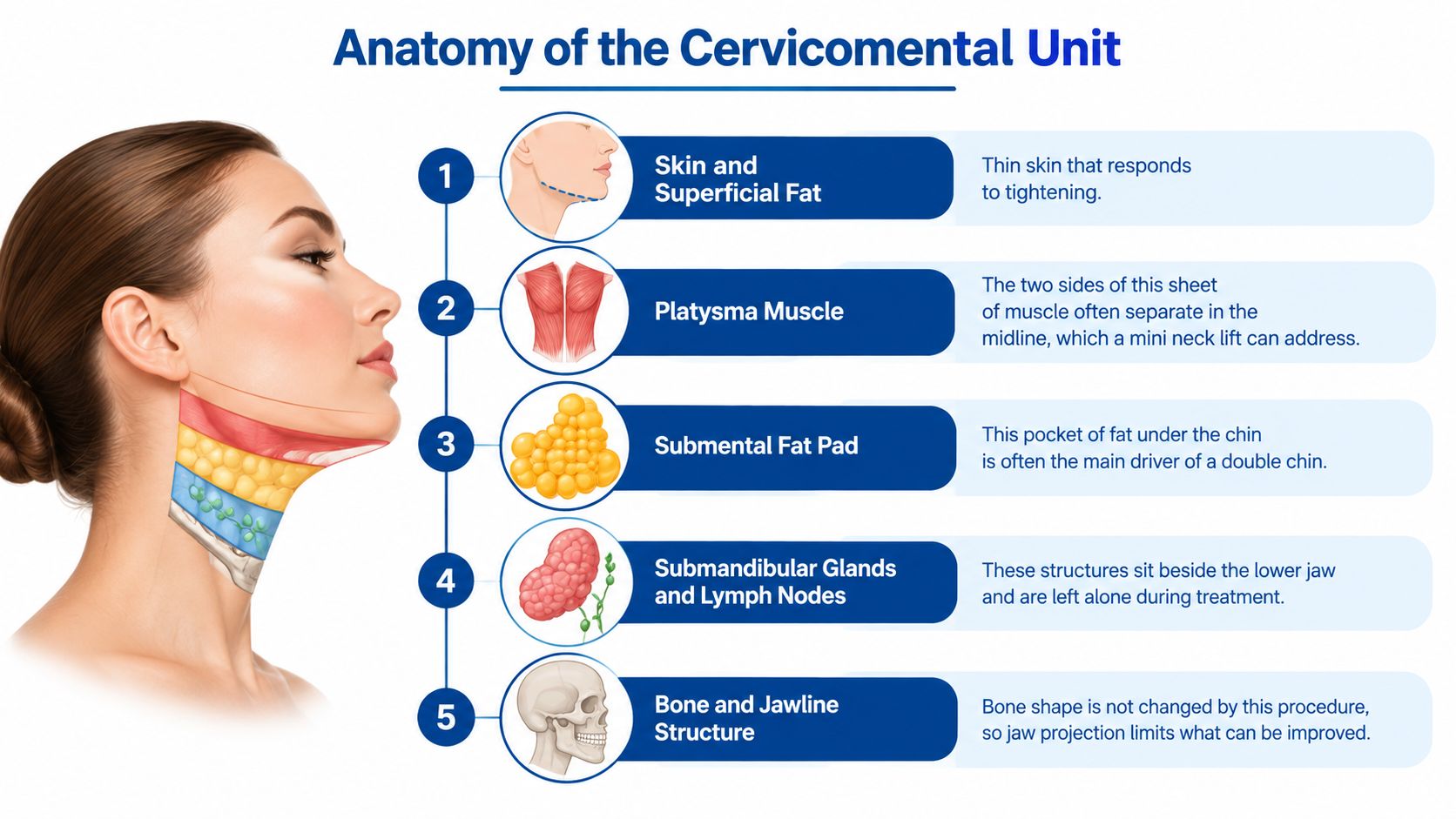
The cervicomental unit is the connected zone where the chin, jawline, and upper neck meet. A refined result depends on more than pulling skin backward. The surgeon has to identify whether fullness comes from skin, superficial fat, the platysma, deeper fat, glands, muscles, or the underlying jaw structure.
The platysma and visible neck bands
The platysma is a thin sheet of muscle that continues into the facial superficial musculoaponeurotic system, commonly called the SMAS. As its medial borders separate, vertical cords or bands can become visible. A targeted lift may bring those borders together with medial platysmaplasty, creating a supportive sling and improving the cervicomental angle.
This goes beyond removing fat. Liposuction can reduce a superficial pocket beneath the chin, but it doesn't repair separated muscle borders or tighten significantly lax skin. Conversely, muscle tightening won't solve fullness created by deep fat or a prominent submandibular structure.
Patients interested in the muscle component can review this explanation of platysma muscle tightening before a consultation. The useful question isn't whether the procedure includes “tightening” in general. It's whether the surgeon has identified the specific layer responsible for the visible problem.
Why depth changes the treatment plan
Neck fullness may arise from several distinct structures:
- Skin and superficial fat: These layers may respond to limited skin redraping and carefully selected contouring.
- The platysma: Separation or laxity can create vertical bands and a less defined neck angle.
- Interplatysmal and deep subplatysmal fat: These deeper compartments may not be corrected through a superficial approach.
- Digastric muscles and submandibular glands: Enlargement can create fullness beside the lower jaw and may require a different surgical plan.
- Jawline and skeletal projection: A limited neck lift doesn't change bone shape, so a recessed or modest chin can limit the apparent improvement in profile.
A layered assessment is therefore essential. A limited operation is most predictable when skin excess and deep structural enlargement are limited. When the glands, heavy platysmal degeneration, or skeletal proportions dominate the appearance, a surgeon may recommend a broader plan or explain that surgery can improve, but not completely redefine, the contour.
Mini Neck Lift Versus Full Neck and Facelift
The practical difference is not short incisions versus long incisions. A mini neck lift treats a narrower group of tissues through limited access. A full neck and facelift can extend correction across the lower face, jowls, neck skin, platysma, and supporting tissues. The right choice depends on which anatomical structures create the visible concern, not on the marketing label attached to the operation.
A decision matrix based on anatomy
| Feature | Mini Neck Lift | Full Neck and Facelift |
|---|---|---|
| Main indication | Early to moderate neck aging, localized fullness, or early banding | More extensive lower-face and neck aging |
| Incision pattern | Generally around or behind the ears, sometimes with a small incision beneath the chin | Broader incisions around the ears, with access designed for wider facial and neck correction |
| Tissue treatment | Selected skin, superficial fat, platysma, or suspension structures | More extensive skin redraping, lower-face support, neck correction, and platysma treatment when indicated |
| Best anatomical fit | Limited skin excess, modest jowling, and manageable muscle laxity | Marked loose skin, substantial jowling, heavy platysmal laxity, or complex neck fullness |
| Expected change | Targeted improvement in neck contour and the cervicomental angle | Broader improvement across the jawline, lower face, and neck |
| Main limitation | Doesn't reliably correct advanced laxity or deep structural fullness | Greater surgical footprint and a broader recovery process |
A patient with a small pocket of localized fat and early muscle separation may gain a clear benefit from limited surgery. Someone with a loose, folded neck, strong bands, significant jowling, and deep fullness may be disappointed if short access is used to address every concern.
For broader background on aesthetic options beyond a single procedure label, patients can browse rejuvenation therapies, then return to the central clinical question: which tissues need correction?
When a limited approach falls short
Severe laxity is the clearest warning sign. Removing a small amount of fat will not tighten hanging skin, and tightening the platysma will not eliminate fullness caused by enlarged glands or deep muscular structures. A limited lift also has less ability to address substantial jowling because jowls involve the lower face as well as the neck.
Patients whose concerns extend beyond the neck may need a face and neck lift rather than a neck-only procedure. The choice should follow the anatomy. If the proposed access cannot reach the structures responsible for the appearance, reducing the operation may also reduce the achievable result.
The Awake Local Anesthesia Approach
At Ideal Face & Body in Beverly Hills, selected neck-rejuvenation procedures may be performed while the patient is awake under local anesthesia. That approach can be valuable, but it needs to be understood as a carefully managed anesthesia pathway, not as proof that the surgery is automatically minor or risk-free.
What avoiding general anesthesia changes
Local anesthesia can avoid airway instrumentation and some systemic effects associated with general anesthesia. It may also allow a patient to recover without the same immediate effects that can accompany general anesthesia. For an appropriately selected limited procedure, staying awake can make the experience more direct and may support an office-based pathway.
Mayo Clinic notes that neck lifts are most often performed under general anesthesia but may also use sedation with local anesthesia. Its discussion of neck-lift risks includes hematoma, infection, nerve injury, skin loss, anesthetic reactions, swelling, and bruising. This overview of neck-lift anesthesia and recovery considerations is useful because it places anesthesia choice in the context of the entire procedure.
Awake surgery doesn't mean no sedation. Depending on the operation and patient, oral or intravenous sedation may be considered, with appropriate monitoring and a clear plan for discomfort, movement, airway concerns, or a change in surgical requirements.
What local anesthesia doesn't change
The patient can still experience surgical bleeding, infection, temporary or persistent nerve symptoms, contour irregularity, asymmetry, swelling, bruising, and scar-related concerns. Local anesthesia doesn't reduce a procedure's anatomical scope. If the planned correction requires extensive dissection, a more formal operating-room setting or general anesthesia may be more appropriate.
The key safety questions are practical:
- Patient selection: Is the patient's health, anxiety level, anatomy, and ability to remain still compatible with awake surgery?
- Monitoring: Who administers sedation, and what physiologic monitoring is used?
- Rescue capability: What happens if discomfort, bleeding, or movement makes the planned procedure unsuitable for completion?
- Procedure scope: Is the operation limited, or is “awake” being used to describe a broader intervention?
Patients considering this pathway should review the complete guide to awake surgery and bring specific questions to the consultation. The sound position is neither that awake surgery is always superior nor that general anesthesia is always necessary. The choice should match the patient's health, the surgeon's setting, and the actual tissues being treated.
Recovery Timeline and Healing Expectations
A smaller surgical footprint doesn't switch off the body's healing response. Swelling, bruising, tissue adherence, nerve recovery, and scar maturation still take time, even when incisions are shorter and the dissection is limited.
The early phase
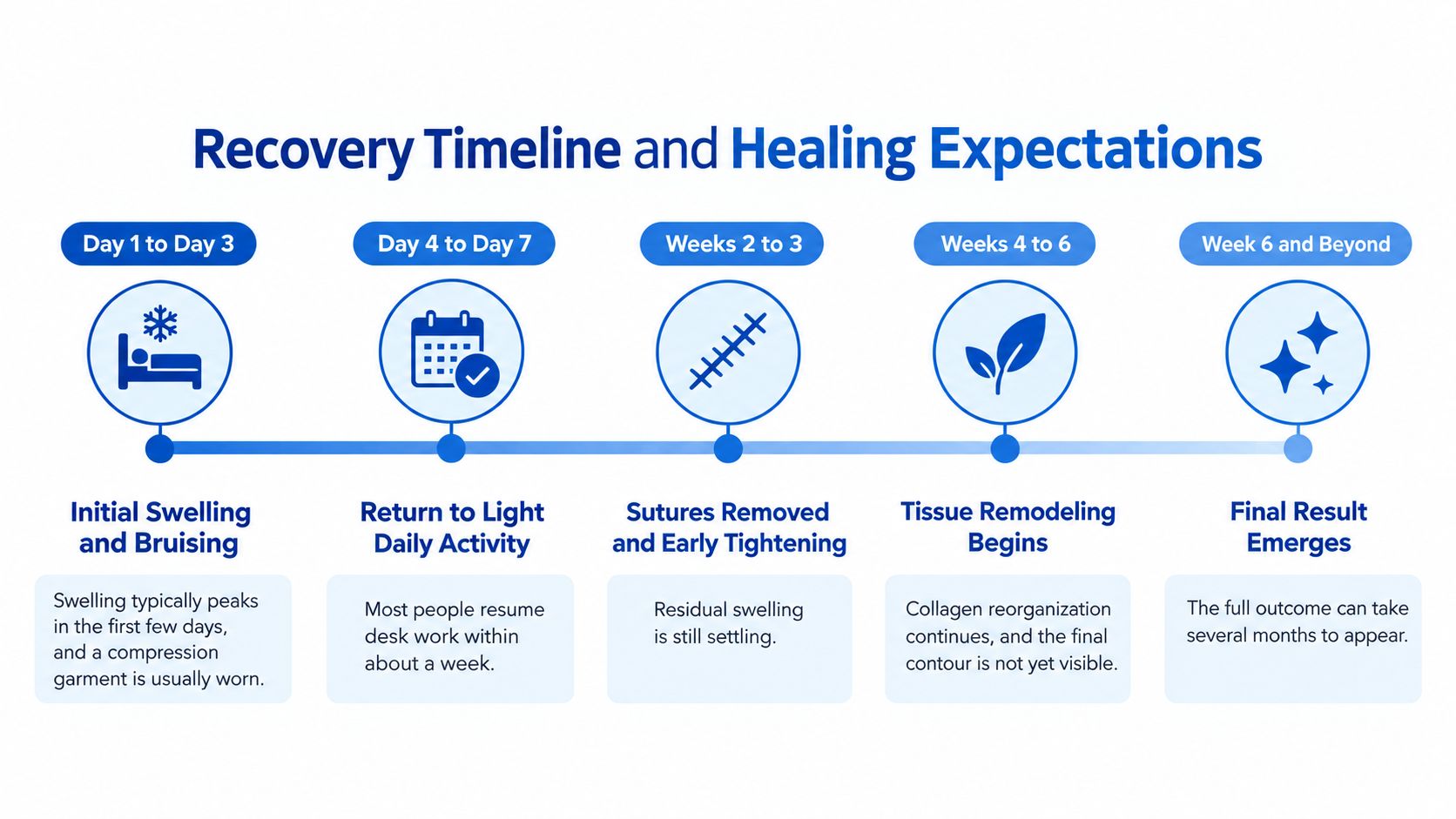
Immediately after surgery, the neck and head are usually supported with a custom compression wrap or garment. Swelling and bruising commonly become most noticeable during the first few days. Elevating the head, following wound-care instructions, and avoiding unnecessary exertion help protect the early result.
Desk work and light daily activity may be possible within about a week for some patients, but that isn't a promise of complete healing. Work that involves lifting, bending, strenuous exercise, or prolonged social exposure may require a different schedule.
The settling phase
Sutures may be removed during early follow-up, depending on the closure and the surgeon's protocol. Residual swelling can persist while the tissues settle, and temporary tightness or altered sensation around the ears and neck isn't unusual during nerve recovery.
Incisions are commonly placed around or behind the ears, sometimes with a submental incision. Their shorter length can make them discreet, but shorter doesn't mean invisible immediately. Scar lines continue to mature and fade over subsequent months, and some incision changes can continue for as long as a year.
Patients who want additional general guidance can review these recovery insights for faster healing, while treating the operating surgeon's instructions as the controlling advice.
When the result becomes trustworthy
Early photographs can be misleading because swelling can obscure the contour or make one side look different from the other. The jawline may look sharper before the final tissue behavior is clear, while another area may appear fuller temporarily.
Expect gradual refinement rather than an overnight final result. Your surgeon should explain when to resume exercise, how long to use compression, when scar care begins, and which symptoms require urgent contact. A realistic recovery plan protects the result and prevents the common mistake of judging the operation before the tissues have matured.
Patient Selection and Documented Outcomes
The best candidate for a mini neck lift usually has early to moderate neck laxity, localized submental fullness, or visible platysmal bands without extensive lower-face aging. Skin excess should be limited enough for a smaller amount of redraping to create a meaningful improvement, and deep structural enlargement shouldn't be the main source of the fullness.
What the clinical data actually show
A peer-reviewed 2009 study of a short-scar facelift technique included 137 patients who underwent surgery between 2004 and 2007. The mean age was 55 years, with an age range of 23 to 79, and 102 patients, or 74%, were assessed at one year. At final follow-up, 129 of 137 patients, or 94%, reported being satisfied or very satisfied. The published study provides useful context for limited-access surgery, but its results shouldn't be presented as a universal satisfaction rate for every mini neck lift.
The same series reported no major complications, while documenting specific events including one temporary buccal-branch neuropraxia that resolved after two months, two hematomas requiring outpatient evacuation, two cases of neck traction dimpling requiring later revision, and one hypertrophic preauricular scar. The operation, surgeon experience, follow-up, and patient selection all influence these findings.
The broader risk picture
A systematic review of deep neck-lift procedures identified 57 studies involving more than 8,600 patients. Reported neuropraxia rates ranged from 0.2% to 12%, while hematoma rates ranged from 0.2% to 4%. These figures cover a broad group of neck-lift procedures and shouldn't be treated as the expected risk for an individual limited operation.
The useful conclusion is balanced. A smaller approach may offer meaningful improvement with less extensive dissection for the right patient, but it doesn't remove the possibility of bleeding, nerve symptoms, contour irregularity, scarring, or revision. Patients with marked loose skin, prominent platysmal bands, heavy platysmal degeneration, or extensive lower-face aging may need a more thorough neck or face-and-neck lift.
A favorable study result describes a selected group. It doesn't replace an examination of your skin, muscle, fat, glands, and jawline.
Planning Your Consultation in Beverly Hills
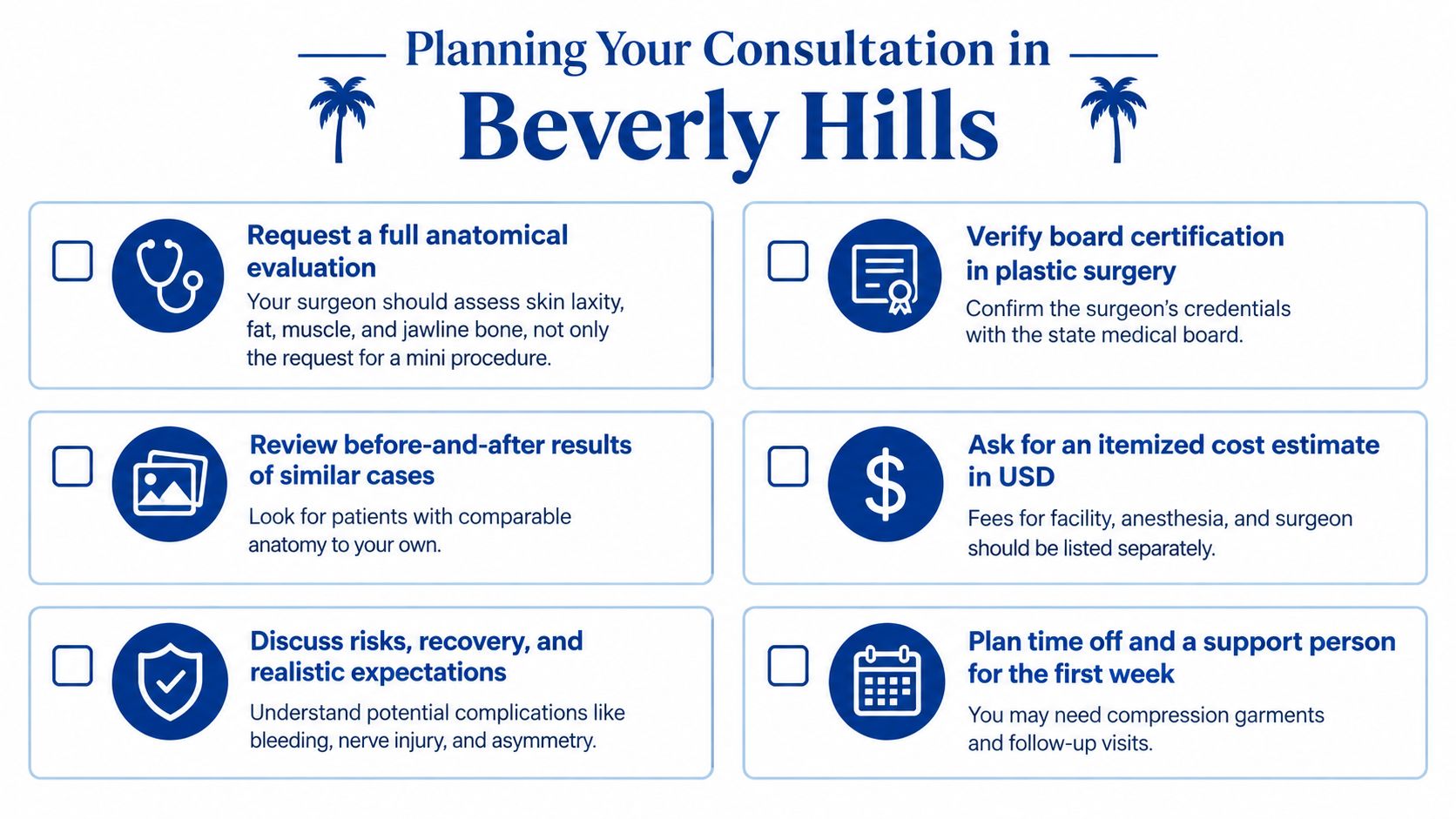
A productive consultation starts with anatomy, not with a request for a named procedure. Dr. Justin Yovino and Dr. Sarah Yovino should be able to explain whether the visible concern comes primarily from skin, superficial fat, the platysma, deeper structures, or the relationship between the chin and jaw.
Questions worth bringing
- Anatomy: Which layer is creating my neck fullness or banding?
- Muscle treatment: Will the platysma be tightened, suspended, or left untreated?
- Fat contouring: Is localized fat the main issue, or would fat removal leave loose skin behind?
- Skin management: Will limited redraping be enough, or is skin excision required?
- Scope: What won't this procedure correct?
- Anesthesia: Will the procedure use local anesthesia alone, oral sedation, or intravenous sedation, and how will I be monitored?
- Recovery: What restrictions, compression, follow-up visits, and scar-care steps should I expect?
Ideal Face & Body focuses on awake, office-based facial and body-contouring procedures performed under local anesthesia for appropriately selected patients. The practice no longer offers breast implant placement, implant-based breast augmentation, or breast implant revision procedures. Breast implant care requires separate counseling because implants aren't lifetime devices, and the FDA explains that the likelihood of removal or replacement increases the longer they remain in place. The FDA's patient information on breast implants outlines those distinct considerations.
The consultation should end with a procedure-specific plan, not just the word “mini.” You should know which tissues will be treated, which limitations remain, why the anesthesia pathway fits the operation, and what recovery will demand from you.
If you're considering a mini neck lift, Ideal Face & Body offers anatomy-based neck, jawline, and facial contouring plans, including awake approaches for appropriately selected patients. Visit Ideal Face & Body to request a consultation with Dr. Justin Yovino or Dr. Sarah Yovino and replace the “mini” label with a clear surgical plan.