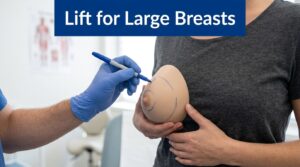
Breast augmentation without implant usually adds up to one cup size with fat transfer, or restores shape through a breast lift when drooping is the main issue. The right choice depends on your starting anatomy, because volume loss and ptosis aren't the same problem.
A lot of people start by asking for “augmentation,” then realize they may want a lift, a small volume increase, or both. That's where non-implant planning gets useful, because the goal isn't to force one operation into every body. It's to match the technique to the breast you already have, the tissue you can safely use, and the result you can realistically live with.
Table of Contents
- Why More Patients Are Choosing Implant-Free Breast Enhancement
- The Three Implant-Free Breast Augmentation Paths
- Fat Transfer vs Breast Lift Decisions
- The Awake Office-Based Approach to Implant-Free Surgery
- Realistic Expectations and Long-Term Trade-offs
- How to Determine Your Ideal Implant-Free Option
- Your Next Steps Toward Implant-Free Breast Enhancement
Why More Patients Are Choosing Implant-Free Breast Enhancement
A patient may say she wants fuller breasts, but what she often means is that pregnancy or weight loss left the breasts looking softer and less supported. She may not want a foreign body, she may not want a large increase in size, and she may want the result to move like her own tissue. In that setting, implant-free planning becomes a practical place to start.
The choice is also changing because more patients are asking for results that fit their body instead of forcing the body to fit an implant. In an institutional series on fat augmentation mastopexy, researchers identified 137 patients. Of those, 71 (51.8%) had single-stage augmentation mastopexy, 55 (40.1%) had mastopexy with fat grafting, and 11 (8.0%) had mastopexy without fat grafting (PubMed). Among 66 planned staged patients, 52 (78.8%) were satisfied with the volume achieved and no longer wanted implant augmentation. That pattern matters because it shows that, for selected patients, non-implant planning is part of real surgical practice rather than a passing preference.
Population data point in the same direction. An international market summary reported 22% year-over-year growth in fat-transfer breast augmentation in 2017, while silicone implants rose 11% and saline implants fell 4% (ISAPS-reported summary). Separate clinical literature also notes meaningful revision rates in the breast lift and augmentation space, including 7.97% for individual procedures and 12.4% for combined procedures. For patients who are trying to avoid the trade-offs of an implant, that is a reminder to compare options carefully, not just focus on volume.
A lift alone can be the right answer. Many patients do not need more breast tissue, they need the tissue they already have to be repositioned and reshaped. In those cases, a mastopexy may give a better outline than fat transfer, especially when the main concern is droop or nipple position rather than size. The planning question is simple: do you need more volume, better shape, or both?
Practical rule: If your goal is a softer contour, not a large size jump, implant-free options deserve a serious look.
For readers comparing whether fat transfer is worth it, this guide on breast fat transfer risks lays out the trade-offs in plain language.
The Three Implant-Free Breast Augmentation Paths
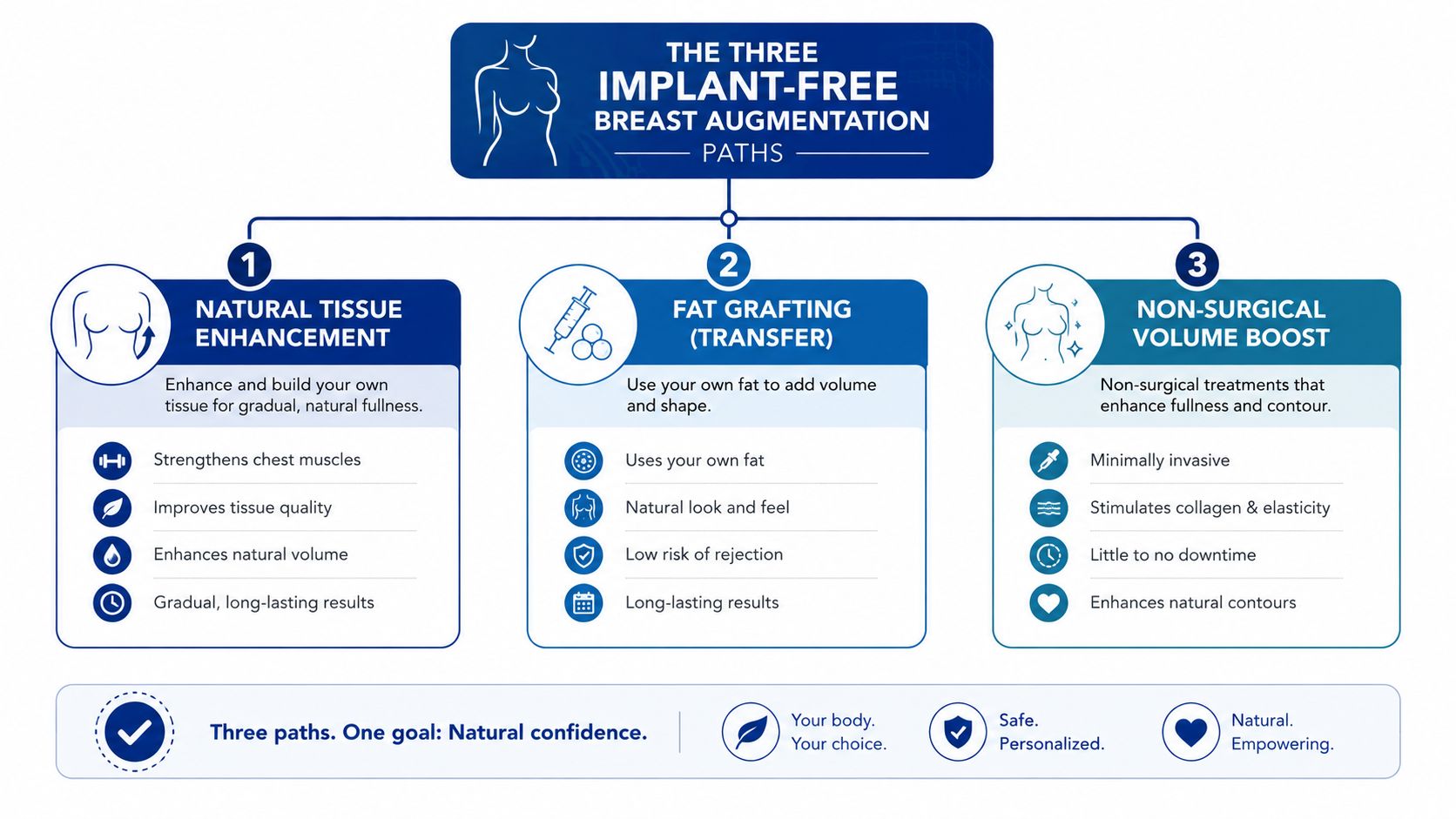
Think of fat transfer like sculpting with natural clay, while an implant acts more like placing in a pre-formed shape. The difference isn't just philosophy, it changes how the breast feels, how the skin drapes, and how much projection you can expect.
Fat transfer breast augmentation
Autologous fat grafting starts with liposuction from donor sites such as the abdomen, flanks, hips, or thighs. The fat is processed and then reinjected into the breast in small amounts across multiple tissue planes so it can revascularize and survive better (American Board of Cosmetic Surgery and ASPS guidance). The result is usually a modest increase, typically up to one cup size (American Board of Cosmetic Surgery and ASPS guidance).
Breast lift without implants
A mastopexy without implants reshapes the breast by removing excess skin, lifting the breast mound, and repositioning the nipple-areola complex. It doesn't add much true volume, but it can make the breast look fuller because the tissue sits higher and the upper pole appears more defined (systematic review on mastopexy without implants).
Auto-augmentation mastopexy
Auto-augmentation mastopexy uses your own breast tissue during the lift to create more upper-pole fullness and projection. It's a hybrid option, especially helpful when the breast has some tissue to work with, but the shape has fallen over time (review on auto-augmentation and tissue limits).
If the breast needs shape, a lift may be enough. If it needs volume, fat transfer may be the better tool. If it needs both, a hybrid plan can make more sense.
The main limitation is simple. Implant-free enhancement can improve contour, but it can't create the same structural projection as an implant, and very small breasts or larger desired increases may need staging or tissue expansion (review on auto-augmentation and tissue limits). For patients who want a deeper look at result durability, this breast fat transfer results guide is a useful companion.
Fat Transfer vs Breast Lift Decisions
A common mistake is treating fat transfer as the automatic answer because it avoids implants. Breast shape does not work that way. If the main issue is drooping, a small increase in volume will not correct the position of the breast or the nipple as cleanly as a lift.
Fat transfer can help when the problem is mild volume loss and the breast still sits in a reasonable position. A breast lift without implants is better when the breast has descended, the skin has stretched, or the nipple has moved lower on the chest. If you want a fuller upper pole, fat transfer may help. If you want the breast back where it belongs on the chest wall, a lift does the heavier work.
| Decision point | Fat transfer | Breast lift without implants |
|---|---|---|
| Main problem it treats | Mild volume loss | Ptosis, stretched skin, nipple position |
| Typical size change | Up to one cup size (ASPS guidance) | Shape change more than size change (PubMed review) |
| Tissue source | Donor fat from the patient | Native breast tissue and skin envelope |
| Best candidate | Patient with enough donor fat and mild-to-moderate loss | Patient whose breast sits low but still has acceptable volume |
| Maintenance issue | Some resorption, possible staged sessions | Scar management and shape settling |
A lean patient who wants a dramatic increase often feels disappointed with fat transfer, because the breast can only accept a limited amount of grafted fat at one time. A patient after pregnancy may have enough breast tissue, but the breast has dropped, so a lift alone may create a more satisfying silhouette than trying to fill a low breast mound with limited fat.
For patients who want to understand how long fat transfer changes tend to last, this guide to breast fat transfer results and longevity explains what settles in, what can resorb, and why staged treatment is sometimes part of the plan.
The complication profile differs too. In fat grafting, the main concerns are fat necrosis, cysts, and lumps. Mastopexy brings scar visibility and possible nipple-areola changes into the conversation (systematic review on AFT, PubMed review). The key point is that neither option is universally better. They solve different problems.
Good candidacy rule: If you lift the breast with your hand and the shape looks better but the size does not, a lift may be doing more work than augmentation.
The Awake Office-Based Approach to Implant-Free Surgery
What if you could have breast surgery without general anesthesia? For the right candidate, an awake office-based procedure changes both the surgical experience and the recovery. The patient arrives, reviews the plan again, and stays comfortable with local anesthesia while the surgeon performs the procedure.
That approach works best for operations that do not require the extensive tissue dissection used in implant placement. In an office-based setting in Beverly Hills, breast lift and fat transfer can be performed with local anesthesia, and the patient can still communicate during the procedure if needed. Ideal Face & Body offers PRECISION SCULPT laser liposculpting for fat harvesting, along with the Awake Breast Lift and Raise Your Cup fat transfer approach.
The day is usually very direct. The patient checks in, markings are reviewed, and the treated areas are numb while the rest of the body stays awake. Many patients find the experience calmer than expected because there is no part of the process that involves “going under.”
For readers who want a broader overview of how this office-based model works, the awake breast augmentation guide explains the approach in more detail.
The main advantage is precision with less physiological stress. Local anesthesia lets the surgeon make careful adjustments without the recovery burden that often follows general anesthesia, and it fits contour-focused procedures where the work centers on fat harvesting, reshaping, and exact tissue handling rather than pocket creation. It also suits patients who prefer a more gradual, lower-intensity surgical experience.
Realistic Expectations and Long-Term Trade-offs
Breast augmentation without implant is still limited by biology. Fat transfer can add softness and shape, but some of the transferred fat is naturally reabsorbed during the first year after surgery. That is why staged treatment is common when the goal is more than a modest increase, and why one operation does not always deliver the final result patients have in mind.
The trade-offs differ by technique. With fat transfer, the more common concerns are fat necrosis, cysts, and lumps (systematic review on AFT). With mastopexy, the main issues shift toward scars and nipple-areola changes, and a systematic review reported an overall complication rate of 10.4%, with scar-related problems at 3% and nipple-areola-related issues at 2.9% (PubMed). The same review found unsatisfactory breast shape in only 1.3% of cases (PubMed).
A newer clinical series on autologous fat grafting in reconstruction reported 3,068 sessions across 996 breasts, with a mean 3.5 sessions per breast, and higher injected volumes when assistive expansion methods were used (York CRD record). That kind of data reinforces the practical point, implant-free often means staged, not single-step.
The healthiest way to frame the choice is simple.
You may be trading implant surveillance and exchange risk for donor-site limits, partial resorption, and possible repeat grafting.
That trade-off is often acceptable when the goal is subtle enhancement. It becomes harder to accept if you want a larger size increase or do not have enough donor fat. In those situations, a lift without augmentation may be the better fit, or the honest conclusion may be that implant-free enhancement will not create the projection you are hoping for.
How to Determine Your Ideal Implant-Free Option
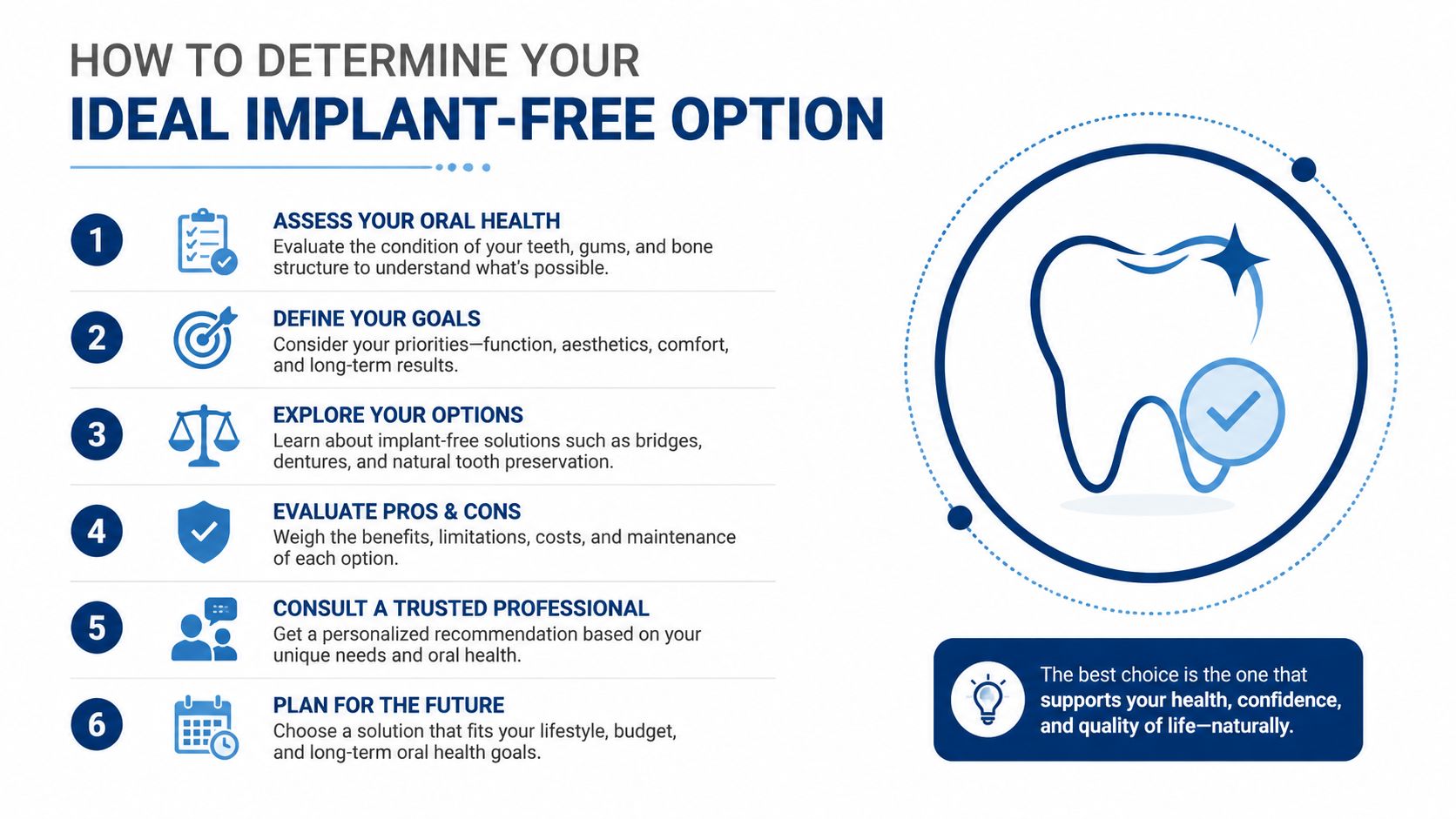
Which implant-free option fits best? The answer starts with what the breast already looks like, because the problem is often shape, position, or volume, and each one points to a different solution. If the breast sits low on the chest, a mastopexy may give the clearest improvement. If the breast sits in a reasonable position but looks flat or empty, fat transfer may be the better match.
A good consultation works like sorting a simple map. First identify where the issue is, then match the operation to that problem instead of forcing one procedure to do everything.
A practical candidacy checklist
- Check donor fat first: If you have enough fat in areas such as the abdomen, flanks, hips, or thighs, fat transfer becomes more realistic.
- Assess the main complaint: If drooping is the main issue and volume loss is secondary, mastopexy usually does more of the work.
- Match the size goal: If you want a modest increase, fat transfer can be a strong fit. If you want a larger change, implant-free options may feel limited.
- Think about skin quality: Loose skin changes how much shape you can restore without a lift.
- Discuss staging: One session is not always enough, especially when your volume goal is more ambitious.
Some patients do best with a combined plan. A lift can move the breast to a better position, and fat transfer can soften the upper pole or improve asymmetry. Others need a simpler answer, lift only or fat transfer only.
The best next step is a consultation with a board-certified plastic surgeon who looks at breast position, skin quality, and donor fat together. That approach helps you avoid choosing a procedure that sounds appealing on paper but does not fit your body.
Your Next Steps Toward Implant-Free Breast Enhancement
Breast augmentation without implant can be a very good fit when you want natural-looking change, not a dramatic size jump. Fat transfer adds modest volume, a breast lift restores shape, and auto-augmentation can bridge the gap when you need both. The right answer comes from your anatomy, not from a trend.
If you're comparing options, be honest about what bothers you most. Volume loss, drooping, or both can lead to different surgical plans, and the most satisfying result usually comes from choosing the simplest operation that solves the problem. Implant-free enhancement can be steady and durable, but it's usually measured, not extreme.
For people who want an office-based, awake approach, Ideal Face & Body offers breast lift and fat transfer options under local anesthesia in Beverly Hills. If you want to see how that model fits your goals, visit Ideal Face & Body and start with a consultation that focuses on your anatomy, your comfort level, and the result you want.