
What if the lowest quote for neck liposuction isn't the most affordable choice once anesthesia, facility charges, aftercare, and revision risk are included? The cost of neck liposuction is better understood as the price of a complete surgical experience, not a single number on a consultation sheet.
In Beverly Hills, patients often compare procedures by headline fee alone. A more useful comparison asks who is performing the operation, where it takes place, how anesthesia is managed, what follow-up includes, and whether the treatment matches the anatomy beneath the chin and along the jawline.
Table of Contents
- Understanding the Core Cost Drivers
- How Anesthesia and Facility Type Impact Pricing
- The Value of Awake and Office-Based Procedures
- Surgeon Expertise and Geographic Factors
- Financing Options and Consultation Insights
- Making an Informed Decision for Your Profile
Understanding the Core Cost Drivers
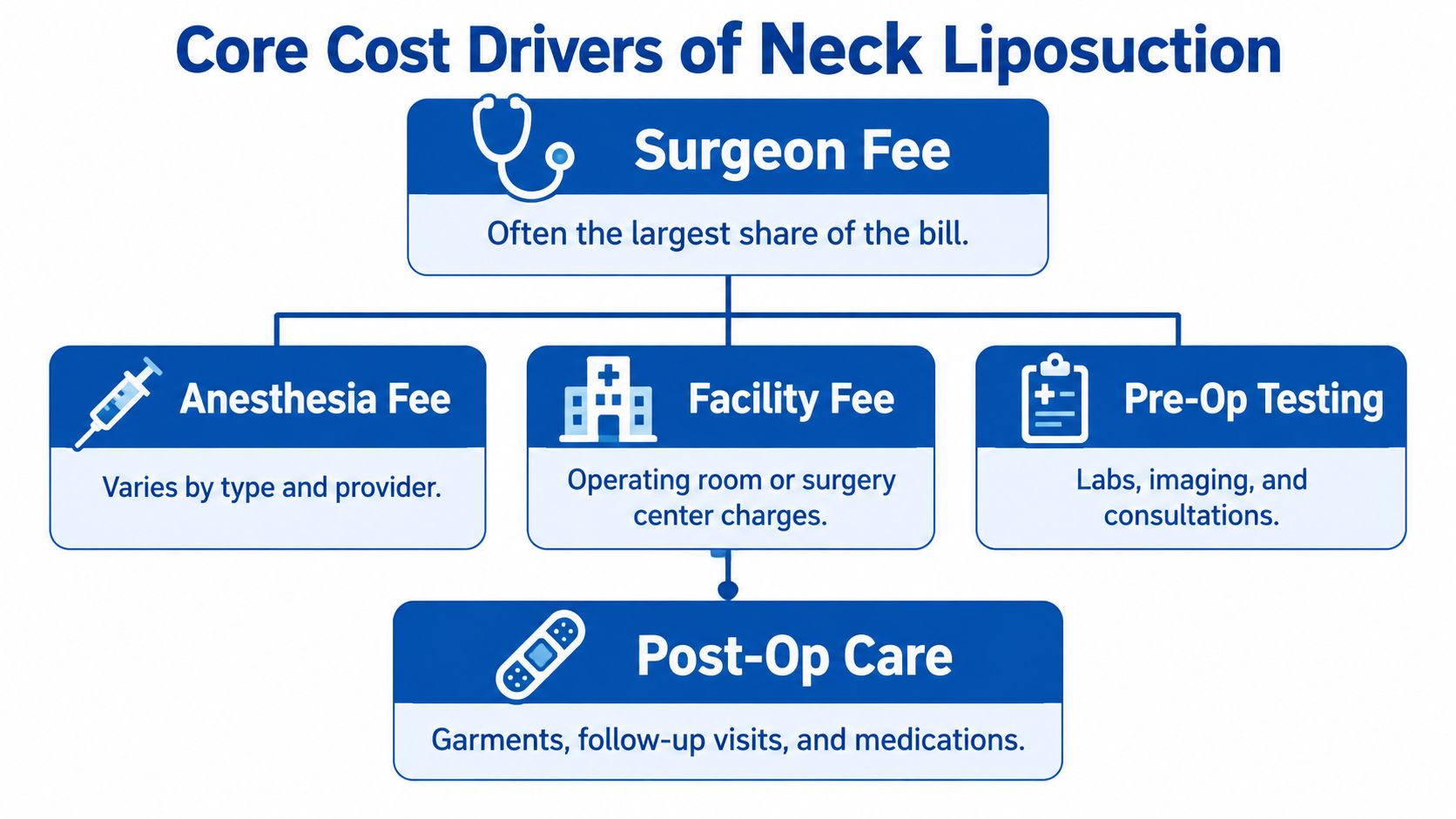
The surgeon's fee is usually the most visible part of the estimate, but it isn't the entire financial picture. A complete quote may also include anesthesia, facility use, consultation or testing, compression garments, prescriptions, follow-up visits, and care for an unexpected issue.
The American Society of Plastic Surgeons reports a national average liposuction surgeon fee of $4,711, based on its latest available statistics. That figure is a broad benchmark, not a guaranteed fee for submental treatment, and ASPS specifically says it excludes anesthesia, operating-room or facility charges, medical testing, prescriptions, and postoperative garments. Its liposuction cost guidance also identifies experience, technique, and geographic location as factors that affect professional fees.
What a complete estimate should show
A responsible written estimate separates each component instead of hiding everything under “procedure fee.”
- Surgeon fee: Covers planning, technical execution, and the surgeon's professional responsibility.
- Anesthesia: Varies according to local anesthesia, sedation, or general anesthesia and who administers it.
- Facility: Reflects the treatment setting, nursing support, equipment, monitoring, and operating-room resources.
- Aftercare: May include compression, medications, scheduled checks, and access to the team during recovery.
For the specific chin and neck area, published U.S. surgeon-fee projections place submental liposuction around $3,000 to $5,500, while broader liposuction commonly carries a higher fee range. The submental liposuction cost discussion makes clear that this is a surgeon-fee range, not necessarily the patient's final bill.
Why anatomy changes the estimate
Neck liposuction is a small-area procedure, but small doesn't mean simple. The surgeon must create a smooth transition from the chin to the neck, preserve natural contours, and avoid visible depressions or irregularities. Treatment may extend across the submental area, anterior neck, jawline, or nearby pockets of fat, and each addition can affect operative time and planning.
Skin quality matters just as much as fat volume. A patient with localized fat and good recoil may be suited to liposuction alone. Someone with lax skin, platysmal banding, or weak cervicomental definition may need an evaluation for skin tightening or a neck-lift strategy. Paying for a limited procedure that cannot address the underlying problem isn't value.
Practical rule: Ask for an itemized estimate that states what is included, what is separate, and what would change if the treatment plan expands.
How Anesthesia and Facility Type Impact Pricing
Anesthesia and facility selection can make two apparently similar quotes look very different. A hospital or large surgical center may involve an anesthesiologist, operating-room charges, additional personnel, and more involved preparation. An accredited office-based suite may use local anesthesia with carefully selected sedation, reducing some overhead while still requiring appropriate monitoring and emergency readiness.
The key question isn't whether local anesthesia is automatically better. It isn't suitable for every patient or every operation. The correct choice depends on anatomy, treatment extent, medical history, comfort, surgeon training, monitoring, and the facility's emergency capabilities.

Compare the setting, not just the anesthesia label
A quote involving general anesthesia may include a separate anesthesia professional and a higher facility charge. Local tumescent anesthesia can avoid some anesthesiologist and general-anesthesia expenses, but the office must still provide a controlled environment, sterile equipment, trained staff, monitoring, and a clear response plan.
Evidence summarized in the clinical review of liposuction anesthesia and complications shows why the decision deserves more than a price comparison. Published neck-liposuction experience has included temporary marginal-mandibular nerve dysfunction, submandibular-gland ptosis, and arterial bleeding. Energy-assisted procedures have also been associated with prolonged swelling, hardened areas, and temporary nerve symptoms, while rare airway obstruction has been reported.
Questions that reveal the real value
Before scheduling, ask:
- Who administers and monitors the anesthesia?
- Is the facility accredited and equipped for emergencies?
- What happens if you become uncomfortable during the procedure?
- Does the quoted amount include recovery monitoring and postoperative support?
- Will the plan change if the surgeon finds lax skin or platysmal bands?
Patients considering awake surgery can also review this guide to awake surgery and its financial structure. The point isn't to choose the cheapest setting. It's to understand what you're receiving for every part of the fee.
The Value of Awake and Office-Based Procedures
Awake neck liposuction under local anesthesia can offer meaningful value when the patient and procedure are appropriate. The patient remains responsive, the treatment area is numbed, and the team can assess contour and comfort during the operation. Because general anesthesia may not be necessary, the estimate can exclude some anesthesia-related charges and the recovery may involve less grogginess or nausea.
Office-based surgery can also carry lower overhead than a hospital-affiliated operating room. That difference may be reflected in the estimate, but lower overhead should never mean lower standards. The office needs trained personnel, sterile technique, reliable monitoring, emergency protocols, and a surgeon who performs the procedure regularly in that setting.
A 2025 peer-reviewed study reviewed 695 submental liposuction procedures performed under local anesthesia between October 2020 and August 2022. The authors reported minimal complications, with postoperative irregularity identified as the most important complication and treated with massage and ultrasound. The study on local-anesthesia submental liposuction supports the feasibility of this approach while reinforcing the need for follow-up.
Awake doesn't mean casual
Patients sometimes assume an office procedure is equivalent to a minor appointment. It isn't. Neck liposuction remains a surgical intervention, and the result depends on technical precision. The practice should explain how it controls pain, manages bleeding, protects deeper structures, provides compression, and responds if the patient needs additional attention.
A prospective review of 30 patients undergoing cervicofacial liposuction with local anesthesia and sedation reported an excellent postoperative neck-contour result in 86.6% of patients. Two patients developed postoperative sagging, and the study described a face-and-neck compression garment used for five days after surgery. These findings, detailed in the prospective cervicofacial liposuction review, illustrate both the potential of awake treatment and the importance of patient selection and aftercare.
For a broader discussion of patient comfort, recovery, and selection, see this explanation of awake liposuction and its practical benefits.
The best value is not the smallest quote. It's an appropriate operation performed by a qualified team in a setting prepared to care for you before, during, and after surgery.
Surgeon Expertise and Geographic Factors
Neck contouring leaves little room for technical error. The area is visible from multiple angles, and a small transition problem can affect the jawline, profile, or the way the neck meets the lower face. A surgeon with focused facial-contouring experience may structure fees differently from a general provider because the consultation, planning, technique, and follow-up reflect a more specialized service.
Geography also matters. Beverly Hills carries the overhead associated with a concentrated cosmetic-surgery market, premium office space, highly trained staff, accredited facilities, and substantial patient demand. Those factors can influence professional and facility fees, but a higher quote alone doesn't prove better care. Patients should examine what the fee represents.
| Factor | Impact on cost | Why it matters |
|---|---|---|
| Surgeon training and experience | May increase the professional fee | Refined contouring requires anatomical judgment and technical consistency |
| Treatment area | More extensive treatment can require more time | Chin, neck, jawline, and adjacent areas may involve different planning |
| Skin and muscle anatomy | Can change the recommended procedure | Liposuction alone may not correct lax skin or platysmal bands |
| Anesthesia plan | Affects professional and facility charges | Local anesthesia, sedation, and general anesthesia involve different resources |
| Facility type | Changes overhead and staffing | Accredited office suites and surgical centers have different operating structures |
| Postoperative care | Adds services beyond the operation | Compression, medications, visits, and access support recovery |
Ask whether the surgeon is board certified in the relevant specialty, how often the practice performs neck contouring, and who personally performs the critical portions of the procedure. Before-and-after photographs should show consistent, natural jawline transitions rather than only dramatic side views.
Ideal Face & Body's practice model centers on awake, office-based procedures under local anesthesia, with neck and jawline contouring offered through its PRECISION SCULPT approach. That is one example of how a practice may build value through its setting and technique, but patients still need an individualized examination before deciding whether the approach fits their anatomy.
Financing Options and Consultation Insights
Because cosmetic neck liposuction is generally elective, patients should plan for out-of-pocket payment. The American Society of Plastic Surgeons states that most health-insurance plans don't cover cosmetic liposuction or complications related to it. Financing can make a treatment easier to manage, but it shouldn't encourage a patient to accept an unclear quote or rush a medical decision.
Some practices offer internal payment plans, while others work with third-party medical financing providers. Review the interest rate, approval conditions, payment schedule, deferred-interest terms, and consequences of missed payments. A general resource on dental payment plans from Superior Credit Repair may help patients understand the kinds of financing questions worth asking, even though neck liposuction requires its own consultation and approval process.
Use the consultation to audit the estimate
A strong consultation should address both anatomy and logistics. Ask the surgeon to explain where fat is located, whether skin recoil appears adequate, and whether liposuction alone is likely to create the desired contour. Then request the financial details in writing.
Your checklist should include:
- Professional fee: Confirm what surgical planning and operative care include.
- Anesthesia: Ask who provides it and whether the plan uses local anesthesia, sedation, or general anesthesia.
- Facility: Verify the location, staffing, accreditation, and recovery arrangements.
- Aftercare: Clarify garments, medications, follow-up visits, and communication access.
- Contingencies: Ask how unexpected findings, complications, or revision discussions are handled.
The financing information from Ideal Face & Body can help patients review available payment pathways, but financing should follow a clear treatment plan. Borrowing for an operation without understanding the total obligation can turn an initially manageable decision into a stressful one.
Before signing: Make sure the written estimate matches the verbal explanation and identifies every included and excluded service.
Making an Informed Decision for Your Profile
Consider two patients with similar concerns about a double chin. The first has localized submental fat, firm skin, and a clear separation between the chin and neck. A focused awake procedure may address the concern without adding treatment that the anatomy doesn't need. The second has modest fat but substantial skin laxity and visible platysmal bands. A low-priced liposuction-only quote may look attractive, yet it may not produce the definition that patient expects.
The difference isn't the number on the estimate. It's whether the operation solves the correct problem.
Choose value through five questions
- What is being treated? Fat, loose skin, muscle bands, or a combination require different strategies.
- Who performs the surgery? Verify relevant board certification, experience, and responsibility for the procedure.
- Where does it happen? Assess monitoring, sterility, staffing, accreditation, and emergency readiness.
- What does recovery include? Compression, prescriptions, follow-up, and access to the team should be clear.
- What happens if the result needs attention? Understand the practice's policy for irregularities, prolonged swelling, or revision evaluation.
A 2025 series involving local-anesthesia submental liposuction identified postoperative contour irregularity as the most important complication, which is a useful reminder that technical quality and follow-up matter even when the procedure is performed in an office. The goal is not just to remove fat. It's to create a smooth, proportionate transition that remains natural in motion, conversation, and profile.
Patients should also remember that cosmetic surgery can involve future decisions. For example, the FDA explains that breast implants aren't lifetime devices and that removal or replacement becomes more likely the longer implants remain in place. It identifies capsular contracture, reoperation, and implant removal among common local complications, and warns that removal without replacement can change chest shape. Ideal Face & Body no longer offers breast implant placement, implant-based breast augmentation, or breast implant revision procedures, although its practice-specific service information states that implant removal may be offered when appropriate, along with breast fat transfer and breast lift procedures.
For neck liposuction, the same principle applies. A transparent consultation should help you understand not only what the procedure can improve, but also what it cannot correct. Choose the team that explains those boundaries clearly, offers an appropriate anesthesia and facility plan, and treats aftercare as part of the result rather than an optional add-on.
Ideal Face & Body offers awake neck and jawline contouring in Beverly Hills, including local-anesthesia treatment through its PRECISION SCULPT approach. Visit Ideal Face & Body to request a consultation, review whether the procedure fits your anatomy, and receive a personalized explanation of the treatment and financial plan.