You've probably searched for breast implant removal and found a single figure presented as if every patient, implant, and operating plan were identical. That approach creates confusion because explant surgery cost depends less on a generic average than on what your anatomy requires, why the implant is being removed, and whether you want reshaping at the same time.
Explantation may be a straightforward implant-only procedure, or it may involve capsule surgery, rupture management, a breast lift, fat transfer, imaging, pathology, or staged revision. The safest financial decision starts with understanding those clinical differences before comparing estimates.
Table of Contents
- Why Explant Surgery Cost Varies So Widely
- Implant Removal Versus Total Capsulectomy
- Planning for Post-Explant Breast Reshaping
- The Financial and Physical Impact of Awake Surgery
- Navigating Insurance and Medical Necessity
- Securing a Transparent and Itemized Estimate
Why Explant Surgery Cost Varies So Widely
A single online number can't describe every explant operation. In the United States, the American Society of Plastic Surgeons cost reference lists an average surgeon fee of $3,979 for breast implant removal, but that figure represents the physician component only. It excludes anesthesia, the operating room or surgical facility, prescription medicines, postoperative garments, medical tests, and imaging.
A separate national benchmark reported by CareCredit's explant overview describes an average U.S. explant cost of $6,837, while also noting that related expenses aren't included. These figures are useful for orientation, not promises. They show why two estimates can look dramatically different while both accurately describe only part of the episode of care.
The variables behind the estimate
The surgeon must evaluate more than the implant itself. The plan may change according to:
- Implant condition: A stable implant is a different surgical problem from a ruptured implant, a deflated saline implant, or silicone that has migrated beyond the shell.
- Capsule quality: A thin, quiet capsule may be left alone, while dense contracture or an abnormal capsule may require additional dissection.
- Breast envelope: Skin elasticity, stretch, nipple position, natural tissue volume, and implant size affect how the breast will settle after removal.
- Surgical setting: Facility charges, anesthesia, recovery monitoring, pathology, and postoperative supplies may be billed separately.
- Geographic market: Local operating costs and specialist fees vary between regions and practices.
The published national data also show that explantation has become a substantial part of implant care. CareCredit reported 37,679 breast implant-removal procedures in 2022, approximately 12% more than the 2019 level, and described average annual volume of about 37,000 procedures in the cited statistics. Those figures describe procedure volume, not what any individual patient should expect to pay.
Practical rule: Compare complete, itemized plans, not isolated surgeon fees.
A complex capsule-focused revision can require more operating time, specialized dissection, pathology, and a different recovery plan. The estimate should therefore identify whether it covers removal alone or the full episode of care.
Implant Removal Versus Total Capsulectomy
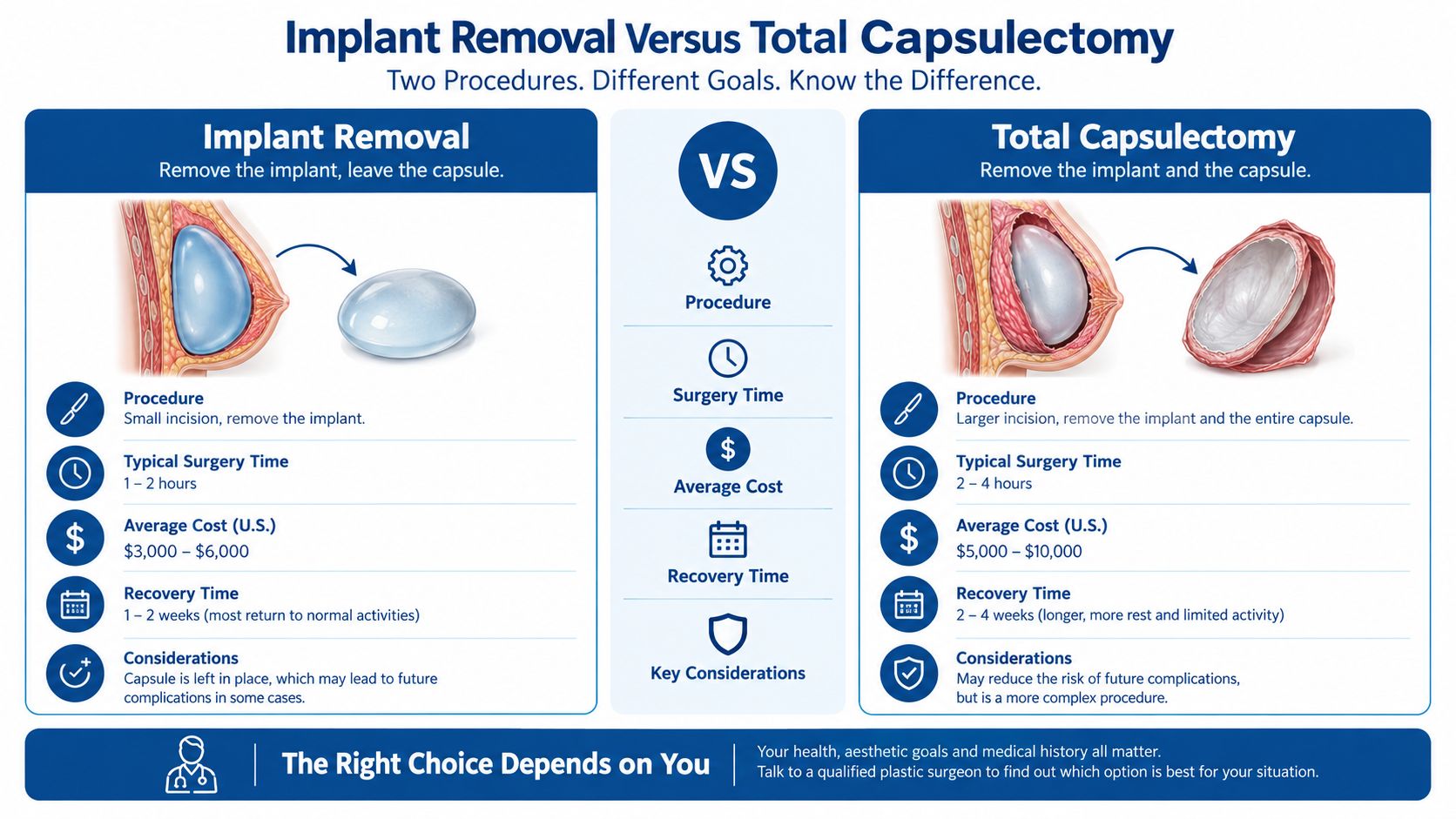
Every implant develops a surrounding scar capsule as part of the body's response to a foreign device. That capsule doesn't automatically need to be removed when the implant comes out. The FDA's guidance on breast implant risks and complications specifically explains that a surgeon may remove the implant and leave the capsule in place.
Implant-only removal generally involves accessing the existing pocket, removing the device, checking the surrounding area, and closing the incision. This approach may involve less dissection and may be appropriate when the capsule isn't causing a clinical problem. It can be a reasonable option for a patient who wants the implant removed without automatically converting the operation into a more extensive capsule procedure.
Partial or total capsulectomy is different. The surgeon removes some or all of the scar capsule, which can require more careful dissection around breast tissue, muscle, and blood vessels. It may be considered with severe capsular contracture, suspected rupture, an abnormal capsule, or a diagnostic concern. The added scope can affect operating time, anesthesia planning, pathology, facility use, discomfort, and recovery.
En bloc is not a universal requirement
Patients often hear that the implant and capsule should always be removed as one intact piece. That isn't the FDA's position. The FDA describes en bloc removal as one possible surgical approach, not an automatic requirement for every explant patient. Implant-only removal may involve less dissection and fewer local complications, including bleeding, when capsule removal isn't medically indicated.
For suspected or confirmed breast implant-associated anaplastic large cell lymphoma, the FDA's BIA-ALCL guidance states that treatment involves removal of the implant and surrounding capsule. Some patients may also need oncology treatment such as chemotherapy or radiation. That situation isn't comparable to elective implant removal for comfort or changing aesthetic preferences.
| Surgical scope | What usually changes the plan |
|---|---|
| Implant-only removal | Pocket access, device removal, inspection, closure, and routine follow-up |
| Partial capsulectomy | Removal of a selected portion of capsule where findings justify it |
| Total capsulectomy | More extensive dissection, often for contracture, rupture concerns, or abnormal tissue |
| Oncologic capsule removal | Implant and capsule removal, pathology, and possible additional medical treatment |
A consultation at Ideal Face & Body's breast implant removal and reconstruction service should focus first on the clinical reason for capsule treatment. The most extensive option isn't automatically the safest or most valuable option.
Planning for Post-Explant Breast Reshaping
Removing the implant is only one part of the aesthetic conversation. After explantation, some patients see less upper-pole fullness, central hollowing, skin laxity, reduced projection, rippling, altered breast shape, or nipple position changes. Those changes reflect the breast's history, not a surgical failure. The skin and supporting tissues may have stretched around the implant, and they must now redrape around a different volume.
The right question isn't only, “What does removal cost?” It's, “What result do I want after the implant is gone, and what operation can realistically create it?”
Removal alone
Some patients prefer the simplest plan and are comfortable allowing the breast to settle naturally. This may be appropriate when comfort, implant freedom, and a smaller breast contour matter more than restored projection. Others may initially choose removal alone and reassess after healing, especially when the tissue needs time to contract and the final shape isn't immediately apparent.
Removal with a lift
A mastopexy removes excess skin and repositions breast tissue and the nipple. It can address downward-pointing nipples, laxity, and a lower breast position, but it adds incisions, wound-healing considerations, and blood-supply planning. A lift can't replace the volume of a large implant. Its purpose is to improve position and contour.
Removal with fat transfer
Autologous fat transfer uses fat from another area of the body to soften hollow areas and add modest volume. It won't recreate a large implant, and the result depends on available donor fat, tissue quality, and how much transferred fat remains. Patients considering this option can review the specific approach to breast implant removal with fat transfer.
These choices change the surgical scope and the financial plan:
- Removal alone: The narrowest operative plan, with fewer reshaping steps.
- Removal plus lift: Adds skin and tissue repositioning, incision planning, and recovery needs.
- Removal plus fat transfer: Adds donor-site treatment, graft preparation, and contour planning.
- Staged reshaping: May separate removal from later refinement when tissue condition or safety makes one operation preferable.
The lowest initial estimate for removal alone may not be the lowest total investment if the patient already expects a lift or volume correction. Conversely, adding procedures that aren't clinically necessary can increase risk and complexity without improving the result enough to justify them.
A good plan separates what you need for safe implant removal from what you may want for aesthetic refinement.
The Financial and Physical Impact of Awake Surgery
Many patients assume explantation requires general anesthesia, intravenous sedation, and a hospital-based operating room. That isn't always true. For carefully selected patients and appropriate procedures, an office-based technique under local anesthesia may change both the physical recovery experience and the structure of the estimate.
Awake surgery doesn't mean casual surgery. The surgeon still needs appropriate patient selection, sterile technique, monitoring, emergency preparedness, and a clear plan for capsule work or unexpected findings. The approach must match the anatomy and the procedure. Extensive rupture management, oncologic treatment, or complex revision may not be suitable for an office-based operation.
What local anesthesia can change
Avoiding general anesthesia may reduce exposure to airway management, postoperative nausea, and the grogginess some patients experience after traditional anesthesia. An office setting may also remove certain hospital or facility components and may avoid an anesthesiologist's separate fee when those services aren't required. The exact structure depends on the practice, the procedure, and the patient's health.
At Ideal Face & Body in Beverly Hills, CA, Dr. Justin Yovino and Dr. Sarah Yovino provide procedures within an awake, office-based model for appropriate candidates. Their approach emphasizes local anesthesia and individualized surgical planning rather than assuming that every patient needs the same anesthetic pathway.

The practical comparison isn't just “awake versus asleep.” It includes:
- Patient suitability: Medical history, anxiety level, procedure scope, and ability to remain comfortable all matter.
- Surgical access: Implant-only removal may be more compatible with local anesthesia than extensive capsule dissection.
- Facility model: Office-based care can have different facility requirements from hospital surgery.
- Recovery logistics: Patients may spend less time in a recovery area, but they still need transport, support, wound care, and follow-up.
- Contingency planning: A responsible team must explain what happens if findings require a broader procedure.
Read the complete guide to awake surgery and its cost considerations before assuming that local anesthesia is either appropriate for everyone or merely a way to reduce fees. The priority is a safe operation with a realistic recovery, not a cheaper label attached to an unsuitable technique.
Navigating Insurance and Medical Necessity
Insurance decisions usually depend on the documented diagnosis, policy language, and required authorization. Elective removal based on preference, lifestyle, or appearance may be treated differently from removal for rupture, infection, severe capsular contracture, pain, asymmetry, or another documented complication. Even when a medical problem exists, the FDA warns that insurance may not cover implant removal or replacement.
Start with the diagnosis, not the billing department. Your surgeon should document the symptoms, examination findings, implant history, imaging, and recommended treatment. Your insurer can then evaluate the request under the relevant medical-necessity rules.
Ask for written verification
Before scheduling, request written answers to these questions:
- Does the policy cover the diagnosis being treated?
- Is prior authorization required?
- Are the surgeon, facility, and anesthesia billed separately?
- Is imaging covered, including MRI or ultrasound for suspected silicone rupture?
- Is pathology covered if capsule or tissue is submitted?
- Does coverage include capsulectomy, or only implant removal?
- Are a breast lift, fat transfer, or other contour procedures excluded as cosmetic?
- What deductibles, coinsurance, and exclusions remain your responsibility?
The FDA also notes that diagnostic surveillance for silicone implant rupture may not be covered. Don't assume that approval for an imaging study means approval for the operation, or that approval for removal includes reshaping.
Separate medical treatment from aesthetic goals
A documented rupture or severe contracture may support a medical-necessity review. A lift performed to improve loose skin after removal may still be considered cosmetic. The same operation can therefore contain covered and noncovered components, each with separate financial exposure.
Recovery planning matters too. Ask your surgical team what movement is restricted, how long support garments are needed, and when walking or upper-body activity can resume. For general guidance on what movement is safe after surgery, use a qualified physical-therapy resource, then follow your own surgeon's instructions because capsule work and reshaping change the recovery plan.
Securing a Transparent and Itemized Estimate
A useful consultation should connect three things: the diagnosis, the surgical plan, and the estimate. If a team gives you a number before examining the implant history, breast envelope, capsule, and reshaping goals, that figure may not represent the treatment you'll ultimately choose.
A patient might arrive expecting implant-only removal. During consultation, the examination may identify firmness and distortion that warrant capsule discussion, or substantial skin laxity that makes a lift part of the aesthetic plan. Another patient may have a stable implant, good tissue quality, and no desire for additional reshaping. Those are not equivalent operations, so they shouldn't receive identical estimates.
What the estimate should identify
Request an itemized document that distinguishes:
- Surgeon's professional fee: The physician's charge for the planned procedure.
- Anesthesia: Local anesthesia, sedation, or general anesthesia, if used.
- Facility expenses: Office, ambulatory, or hospital charges, including operating-room resources.
- Capsule treatment: Whether the plan includes no capsulectomy, partial removal, total removal, or en bloc technique.
- Diagnostics: Imaging, laboratory testing, and related evaluation.
- Pathology: Tissue analysis when clinically indicated.
- Postoperative care: Garments, medications, drains, follow-up visits, and dressing supplies.
- Reshaping procedures: Lift, fat transfer, skin excision, or later revision.
If you want to organize questions before the appointment, a free quote and invoice template can help you create a written checklist. It shouldn't replace a clinical estimate, but it can make missing line items easier to notice.
Ask this directly: “Does this estimate cover only the surgeon's fee, or does it represent the full episode of care?”
Bring your implant card, operative reports, prior imaging, insurance information, medication list, and a clear description of your goals. Tell the surgeon whether your priority is symptom relief, a smaller natural contour, removal of future implant maintenance, improved projection, or a combination. Those priorities determine whether removal alone, capsule treatment, reshaping, or a staged plan makes sense.
Ideal Face & Body offers awake, office-based explant surgery and breast reshaping options under the care of Dr. Justin Yovino and Dr. Sarah Yovino, with planning suited to the patient's anatomy and goals. Visit Ideal Face & Body to request a consultation and discuss an itemized plan for your implant removal journey.