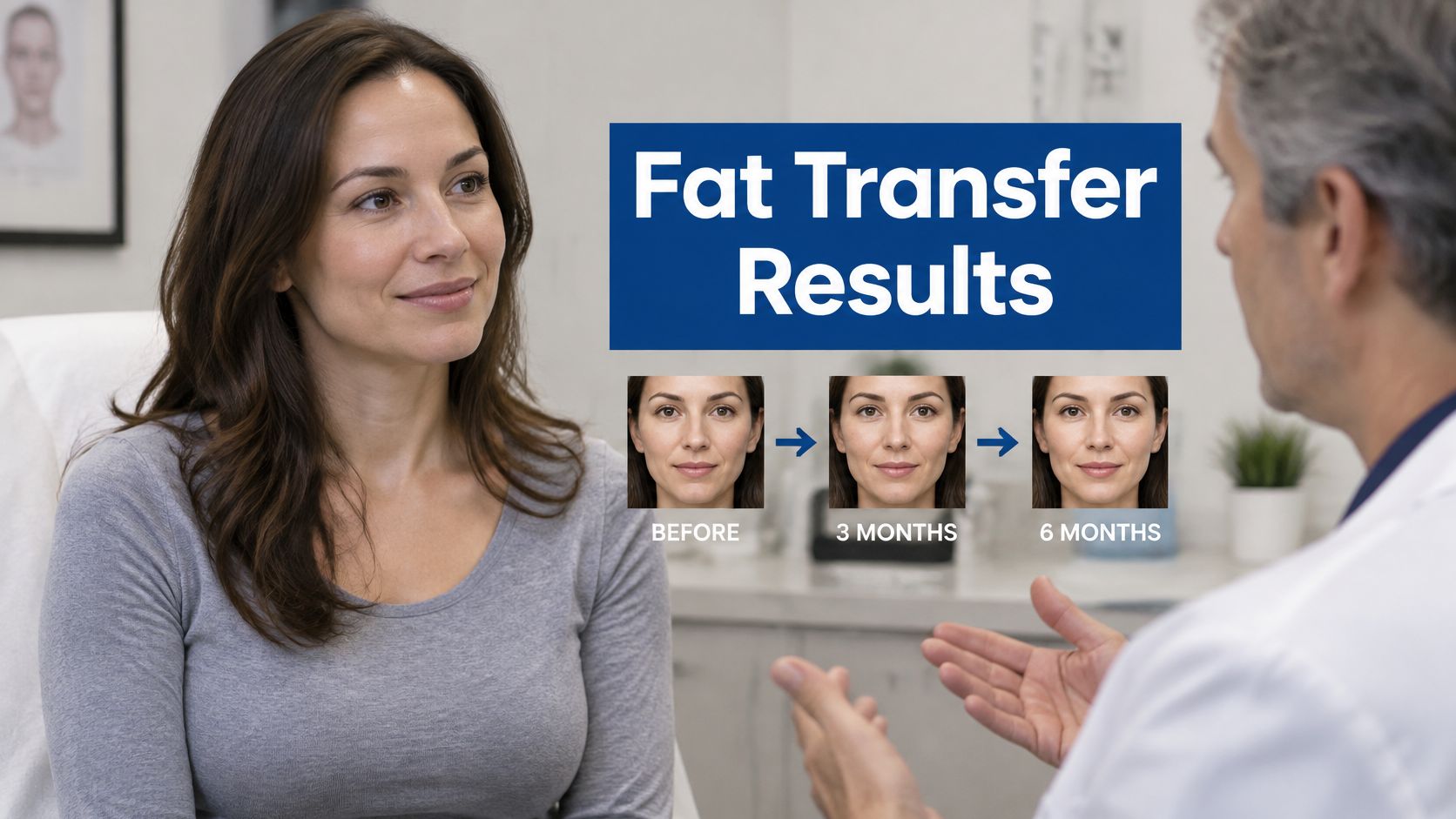
Across 35 studies and 3,757 women, the 2024 systematic review of autologous fat grafting in breast augmentation found that 58% of injected fat was retained on average, with study results ranging from 44% to 83%. That spread is the central fact about fat transfer breast augmentation results. The average tells you the procedure can preserve more than half the transferred volume. The range tells you why no surgeon can promise that you'll land on the average.
This distinction changes how you should plan. You're not buying a fixed number of milliliters that stays put. You're transplanting living tissue, and your body decides how much of it establishes a blood supply and survives. A good plan accounts for that uncertainty from the start, including whether a second session would be acceptable to you.
Table of Contents
- Expected Volume Retention After Breast Fat Transfer
- Factors and Candidacy That Shape Your Result
- Timeline and Reading Before-and-After Photos
- Recovery and Risks to Plan For
- Fat Transfer Compared With Breast Implants
- Confirm Your Fit Before You Book a Consultation
Expected Volume Retention After Breast Fat Transfer
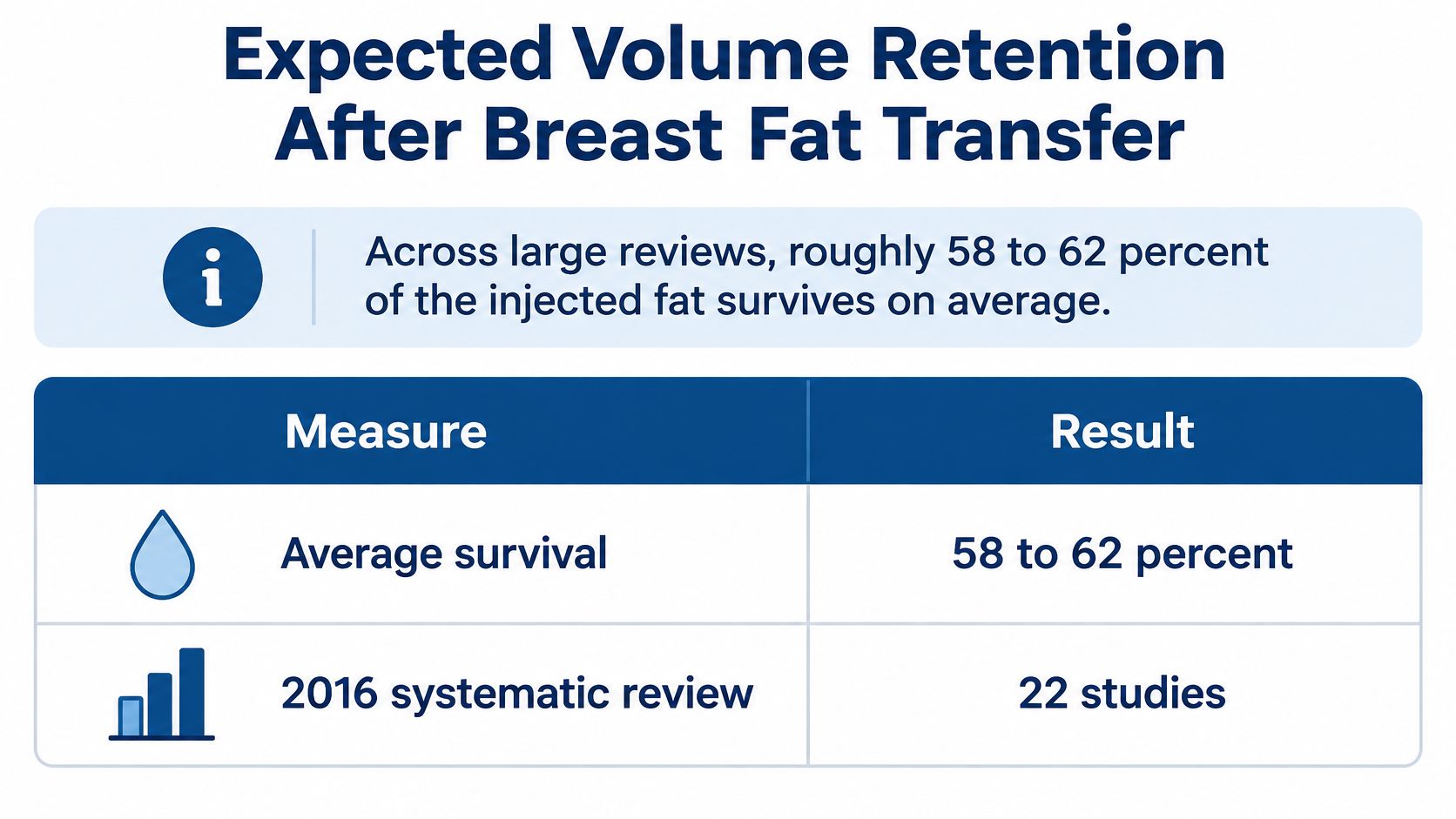
A retention average is a planning input with a wide error bar. The 2016 systematic review in Aesthetic Surgery Journal covered 22 studies involving 3,565 patients, followed results from 12 to 136 months, and reported mean fat-volume retention of 62.4%, individual study results from 44.7% to 82.6%, patient satisfaction of 92%, and surgeon satisfaction of 89%. Those satisfaction figures matter because losing part of the transferred volume can still leave a result both sides rate highly, which is central to interpreting fat transfer breast augmentation results.
What the Retention Numbers Say
Fat transfer breast volume retention by source
| Source | Patients or women | Mean volume retention | Reported range |
|---|---|---|---|
| 2016 systematic review of 22 studies | 3,565 | 62.4% | 44.7% to 82.6% by study |
| 2023 systematic review and meta-analysis of 35 studies | 3,757 | 58% | 44% to 83% by study |
| Narrative clinical reviews of reported series | Multiple cited series | Broadly consistent with review-level estimates | Wide, technique- and follow-up-dependent |
Fat grafting works like planting seeds in soil. You sow more than you expect to harvest because some seeds take root and some do not, and the yield depends on soil quality, spacing, and conditions after planting. Fat cells follow the same constraint. Cells placed close to well-perfused tissue can pick up a blood supply. Cells packed too far from that supply do not survive, and your body clears them away.
Why the Estimates Differ
The reviews do not agree to the decimal point because they did not measure identical things. Surgeons used different harvesting, processing, and injection techniques. Follow-up lengths differed, so some studies captured early volume before resorption finished while others measured settled results. Methods for measuring breast volume also varied, from clinical estimates to imaging. Each difference moves the reported percentage.
Practical rule: treat any single retention percentage as the middle of a wide distribution and plan around the spread.
That has a direct consequence for how you read your own early result. The volume you see on day one includes swelling plus all the injected fat, including cells that will not survive. You cannot judge retention until swelling resolves and resorption has run its course. Judging retention at two weeks measures swelling, not survival.
Use the range in your consultation. Ask which retention assumption the surgical plan is built on and what happens if you land at the low end. Ask whether the goal you have described still works if you keep roughly half the injected volume rather than two thirds. A plan that only works at the top of the range leaves no margin for error. The stronger plans state a target, a realistic lower outcome, and the option to add volume later if you want more.
Factors and Candidacy That Shape Your Result
Volume in is the first variable. The 2023 systematic review and meta-analysis covering 35 studies and 3,757 women found an average injected volume of approximately 300 mL, with study averages ranging from 134 to 610 mL. That same review reported retention appeared higher when grafted fat was supplemented with platelet-rich plasma or stromal vascular fraction, though protocols varied and those adjuncts shouldn't be treated as universally established. Injected volume and retention work together, so a modest injection with good survival can outperform a large injection with poor survival.
Factors You Can Check Before Surgery
- Injection volume and layering: fat placed in thin layers through multiple passes sits closer to blood supply than fat deposited in large pools.
- Donor fat quality: healthy, gently harvested fat with minimal damage during processing gives more viable cells to transfer.
- Surgical technique: harvesting pressure, purification method, and injection cannula size all affect how many cells arrive intact.
- Stable body weight: transferred cells are living fat, so significant weight loss after surgery can shrink them and weight gain can enlarge them.
- Smoking: nicotine constricts blood vessels, and new grafts depend entirely on nearby blood flow during the first days.
- Sessions planned: deciding in advance whether one or two sessions fits your goal prevents disappointment after the first.
- Existing breast tissue and skin: adequate tissue coverage and reasonable skin elasticity support smoother contour and better graft contact.
A Candidacy Checklist
- Enough donor fat: you need harvestable fat from areas such as the abdomen, flanks, or back. Very lean patients may not have enough to reach their goal.
- Moderate size goals: this procedure suits a natural, moderate increase rather than a dramatic change in one session.
- Breast health cleared: any active breast concern or other cancer concern needs appropriate evaluation and clearance before elective grafting.
- Pregnancy timing considered: planned pregnancy or breastfeeding changes breast volume and shape, so timing should be discussed openly.
- Acceptance of a possible second session: if a repeat procedure to reach your target would feel like a failure rather than a planned stage, reconsider.
Run this self-check before you book: Which donor areas do I actually have? Is my weight stable? Does my goal fit a moderate increase?
Timing for a second session follows the settling process. It's usually considered only once the first transfer has settled enough for the surgeon to judge what survived, not during early swelling when size is misleading. Operating again too early means planning against a moving target. Expect the interval to be set individually with your surgeon based on how your tissue looks and feels at follow-up, and expect the second plan to target specific areas, such as upper pole fullness or a side that retained less, rather than repeating the first procedure.
Timeline and Reading Before-and-After Photos
Results unfold in three phases, and confusing one phase for another is the most common source of early anxiety. A second source is subtler: retention figures are reported as a range, and that range is wide. Two patients can follow the same surgical plan and land at different points within it, so reading your progress by phase tells you more than comparing it against a single percentage.
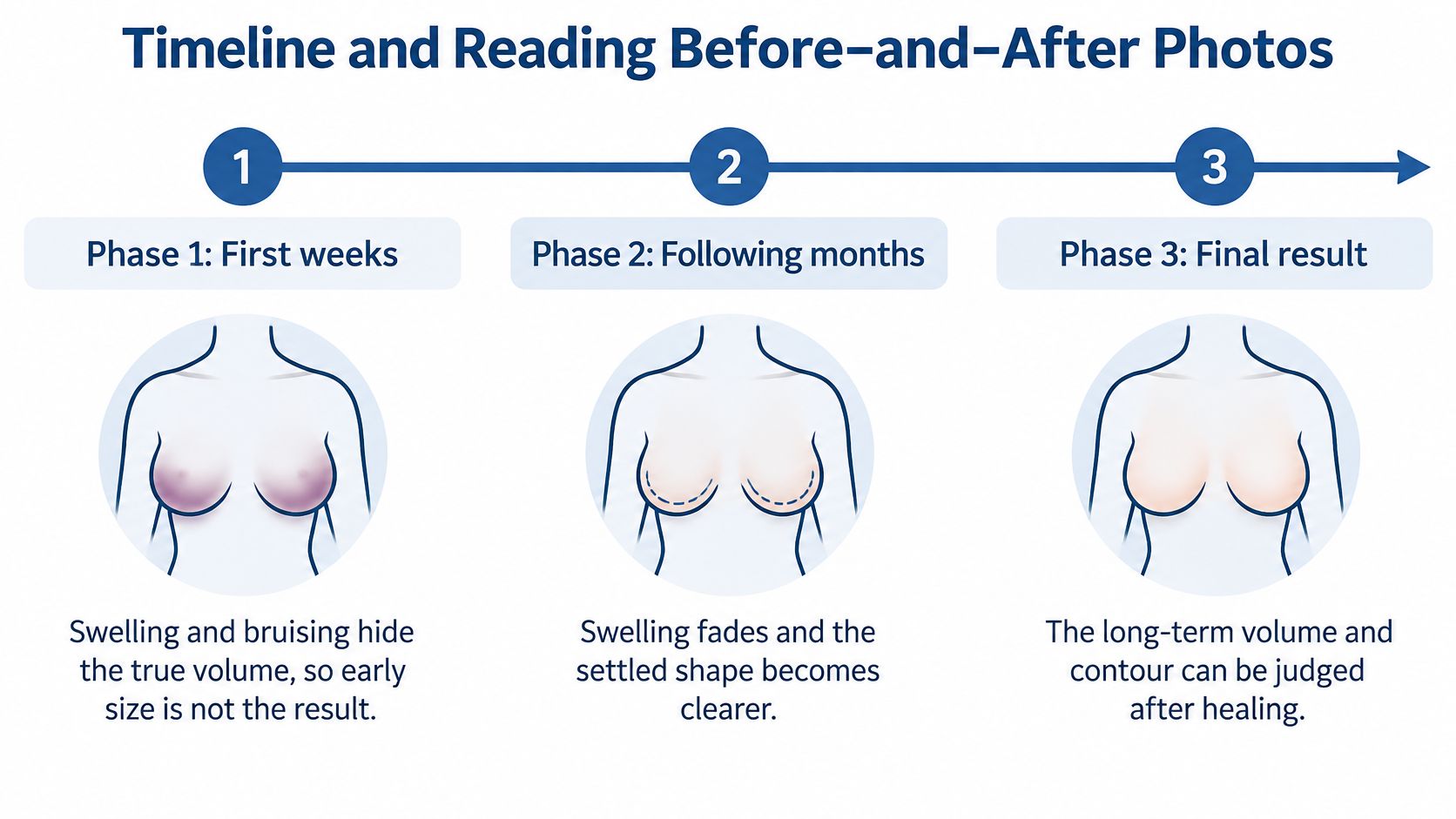
Phase One in the First Weeks
Swelling and bruising at both the breasts and the liposuction sites hide the true volume. Breasts often look larger and firmer than the final result, and asymmetry during this period usually reflects uneven swelling rather than uneven grafting. Nothing about retention can be judged yet. Your only jobs are following activity limits, wearing garments as directed, and avoiding pressure that could disturb grafts while they're most vulnerable.
Phase Two Over the Following Months
Swelling fades, surviving fat integrates, and non-surviving fat is resorbed. Grafted fat cells in the center of a transferred volume may receive inadequate nutrition, causing liquefaction and resorption, a process that can produce oil cysts or microcalcifications visible on breast imaging. The clinical review in PMC on fat grafting to the breast cites reported breast-fat-retention rates of approximately 47% to 65%. A spread that size means the honest expectation is a range, which also explains why breasts typically look smaller at three months than at three weeks even when the procedure worked exactly as intended.
This is the phase patients find hardest. You watch volume decrease and wonder whether it is all going away. Provided the decrease slows and stabilizes, it is not. The cells that secure a blood supply become permanent living tissue, and what you're losing is the predictable fraction that did not, plus the last of the swelling.
Phase Three as the Settled Shape
Judge the result only after swelling has fully resolved and your surgeon confirms at follow-up that settling looks complete. At that point you can compare retained volume against your goal and have a grounded conversation about whether a second session makes sense. A patient who retains at the lower end of the range may need two sessions to reach what a higher-retaining patient reached in one; that is planning for the spread, and it works better than treating the average as a promise. Weight stability matters from here on, because the transferred fat now behaves like fat anywhere else in your body.
A Typical Scenario
A woman in her forties has lost weight and wants modest fullness restored, particularly in the upper breast. Her baseline photos show deflated upper poles with reasonable skin quality. Fat is harvested from her abdomen and flanks, which also flattens her midsection. At two weeks she's swollen and looks a full size larger, which she knows she cannot trust. By three months the swelling is gone, some graft has resorbed, and she has soft, moderate fullness that looks like her younger breast rather than an augmented one. At her follow-up she and her surgeon compare dated photos and agree the result matches the goal they set, with no second session needed.
That scenario illustrates the pattern; it does not predict your outcome. Galleries work the same way. They show selected cases, often strong results, in patients whose anatomy may differ from yours. Prospective patients are shown before-and-after photos of people who had similar procedures, because similarity matters more than drama. You can browse the fat transfer before-and-after gallery with that filter in mind. One documented example, Gallery Case ID 13713, shows a patient 10 months after an awake Precision Sculpt lipo 360 abdomen and breast fat transfer after explant, with results described as stable. The timing is what makes it useful: a photo taken that far out records a settled result rather than early swelling.
How to Read Any Gallery Critically
- Time since surgery: photos taken weeks after surgery capture swelling rather than retained fat. Look for months.
- Number of sessions: a result after two sessions shouldn't set your expectation for one.
- Donor site: knowing where fat came from tells you whether the body contouring in the photo applies to you.
- Multiple angles: front, oblique, and side views reveal projection and symmetry that a single front view hides.
- Volume described: a stated transfer volume lets you judge whether the change matches your own goal.
- Similar starting point: a patient who started near your size and shape is more informative than the most striking transformation.
A gallery photo without a time point tells you almost nothing. Always ask when the after photo was taken.
Apply the same discipline to your own photos. Take dated pictures from the same angles, distance, and lighting at each stage. Consistent photos let you and your surgeon separate normal settling from a genuine concern, and they turn a vague impression like "I think I lost volume" into something you can compare directly. Bring them to every follow-up.
Recovery and Risks to Plan For
Normal recovery follows a recognizable pattern. Expect bruising and swelling at the donor sites and breasts, soreness for several days that is usually strongest where liposuction was performed, and a gradual return to normal activity over several weeks. Your surgeon sets the exact limits on lifting, exercise, and sleeping position, and those limits protect graft survival rather than comfort alone. Returning to the gym a week early trades short-term convenience against the result you are recovering for.
Reported complication rates after breast fat grafting
| Complication or follow-up | Reported frequency | What it means for you |
|---|---|---|
| Fat necrosis | 13% of cases | Firm area or imaging change that may need checks |
| Infection | 11% of cases | Needs prompt treatment and surgeon review |
| Reoperation | 11% of cases | May be needed to address volume or contour |
| Additional radiologic imaging | A minority of cases | Expect follow-up scans; tell imaging staff about prior fat transfer |
| Biopsy | Uncommon | Possible when imaging findings are unclear |
Fat necrosis, infection, and reoperation figures come from the 2024 systematic review and meta-analysis on long-term efficacy and safety of fat grafting in the breast. Reported rates of follow-up imaging and biopsy vary more between studies because screening protocols and thresholds for further workup differ.
Read these as group rates pooled across varied studies, never as your personal probability. Complication definitions differ between studies, and reconstruction patients are mixed with cosmetic patients in some analyses, which pushes pooled numbers in either direction. The page on whether breast fat transfer is worth the risks walks through that trade-off in more detail.
One distinction prevents a common misreading. Some reviews express each complication as a share of all reported adverse events, and in that framing fat necrosis is the largest single category. Those are two different denominators. Fat necrosis dominating the list of complications means it accounts for most of what goes wrong among the minority of patients who experience any complication at all; the 13% figure tells you how many patients experience it in the first place. It often presents as a firm area or an imaging finding and does not necessarily represent a serious clinical problem, though it can trigger extra examination.
Warning Signs That Need Prompt Contact
- Fever: a temperature rise with worsening pain can signal infection.
- Spreading redness: expanding redness or warmth at either site needs same-day advice.
- Rapidly growing firm lump: a fast-changing area should be examined rather than watched.
- Persistent pain: pain that intensifies instead of easing falls outside normal settling.
- New asymmetry: sudden one-sided swelling warrants a call.
Tell every breast imaging team about your fat transfer, permanently. Grafted fat can produce calcifications and oil cysts that look unfamiliar on a mammogram, and a radiologist who knows your history reads those findings differently from one who does not. Disclosure costs nothing and prevents avoidable workups.
Fat Transfer Compared With Breast Implants
The core difference is simple. Fat transfer uses your own tissue and produces a variable result shaped by graft survival. Implants deliver a fixed volume chosen at surgery. Everything else in the comparison flows from that.
Fat transfer and breast implants compared
| Criterion | Fat transfer | Breast implants |
|---|---|---|
| Volume predictability | Variable; partly resorbed over time | Fixed volume set at surgery |
| Tissue source | Patient's own fat | Synthetic implant |
| Donor site | Liposuction from areas such as abdomen or flanks | No donor site needed |
| Feel | Soft, natural tissue | Firmer feel shaped by implant type and placement |
| Imaging considerations | Oil cysts or calcifications may appear | Implant-specific imaging; disclose implant |
| Repeat treatment | Repeat fat grafting may be needed | Revision or removal surgery |
| Time to final shape | Settles over months | Largely settles after early swelling resolves |
Volume predictability is where most decisions are made. If you want a precise size, implants give the surgeon direct control over the final number. If you want a moderate, natural increase and can accept that the result lands within a range, fat transfer fits. That range is the practical consequence of retention variability: two patients starting with identical transferred volumes can heal to different endpoints, and a second grafting session is sometimes part of the plan rather than a sign of failure. Mismatching the method to your tolerance for uncertainty is what produces regret.
Donor site and incisions pull in opposite directions. Fat transfer requires liposuction, which means recovery at the harvest area, while the breast entry points stay tiny and no foreign body is placed. Implants skip the donor site. The trade is an incision for placement and a device your body must tolerate over the long term.
Imaging and revision paths also differ. After fat transfer, future mammograms may show oil cysts or calcifications that need informed interpretation, and adding volume later means another grafting session. Implants carry their own imaging follow-up, and changing size or addressing a problem means revision or removal surgery. If you're weighing a breast augmentation without an implant, that's the fork in the road.
Choose by three criteria: the volume you need, your tolerance for variability and repeat treatment, and whether avoiding a foreign body matters to you.
Ideal Face & Body offers breast augmentation with implants, implant revision, and implant removal alongside fat transfer, so this comparison covers both paths rather than only one. Whichever route you're leaning toward, the useful question at consultation is the same: given your donor tissue, your documented goal, and your tolerance for a variable endpoint, which method reaches the result you want. The assessment answers that plainly, including telling you when fat transfer can't get there.
Confirm Your Fit Before You Book a Consultation
Before booking, check whether your goals, available donor fat, and willingness to accept variable results align. Fat transfer may require a second session to reach the desired volume, so discuss that possibility as part of your decision.
A Five-Step Preparation Plan
- Gather dated photos: Take front and side views in consistent lighting to document your starting point.
- Write down your goal: Describe the volume and shape you want, including what you would consider too little.
- Note your health history: List prior breast surgery, breast imaging and findings, and smoking status.
- Ask about the retention assumption: Find out what retention the plan anticipates and how it accounts for lower-than-expected retention.
- Ask about follow-up and imaging: Confirm the visit schedule and how future mammograms will be handled.
Ideal Face & Body, in Beverly Hills, calls breast fat transfer Raise Your Cup®. It is a no-implant procedure that uses your own fat, removed from areas such as the stomach, to enhance and reshape the breasts. The plan depends on your donor areas, tissue, and documented goals.
Bring your photos and list of questions. Ask whether your target volume is realistic in one session, may require two, or is better addressed another way.
If you want to explore whether Raise Your Cup® fits your goals, a consultation can address your expected retention, donor areas, and likely treatment plan. Ideal Face & Body offers breast fat transfer using your own fat.