You're standing in front of a mirror, turning sideways, and seeing a horizontal ledge across the upper buttock instead of a gradual curve. Perhaps the swelling has already settled, or perhaps you've been told to wait, massage the area, or add more volume. The frustration is understandable, but a BBL shelf deformity usually isn't a simple problem of insufficient fat or incomplete healing.
The right correction starts by identifying what created the shelf. It may involve excess projection in the upper lateral buttock, an abrupt transition from the lower back, scar tethering, uneven fat survival, or over-resection in a neighboring zone. Once the anatomy is clear, treatment can be selective rather than another generalized attempt to make the buttocks larger.
Table of Contents
- Understanding the Anatomy of a BBL Shelf Deformity
- Evaluating Non-Surgical Treatments and Their Limitations
- Surgical Revision Techniques for Contour Correction
- The Awake Surgery Advantage in Revision Procedures
- Recovery Timelines and Managing Patient Expectations
- Choosing the Right Revision Surgeon and Common Questions
Understanding the Anatomy of a BBL Shelf Deformity
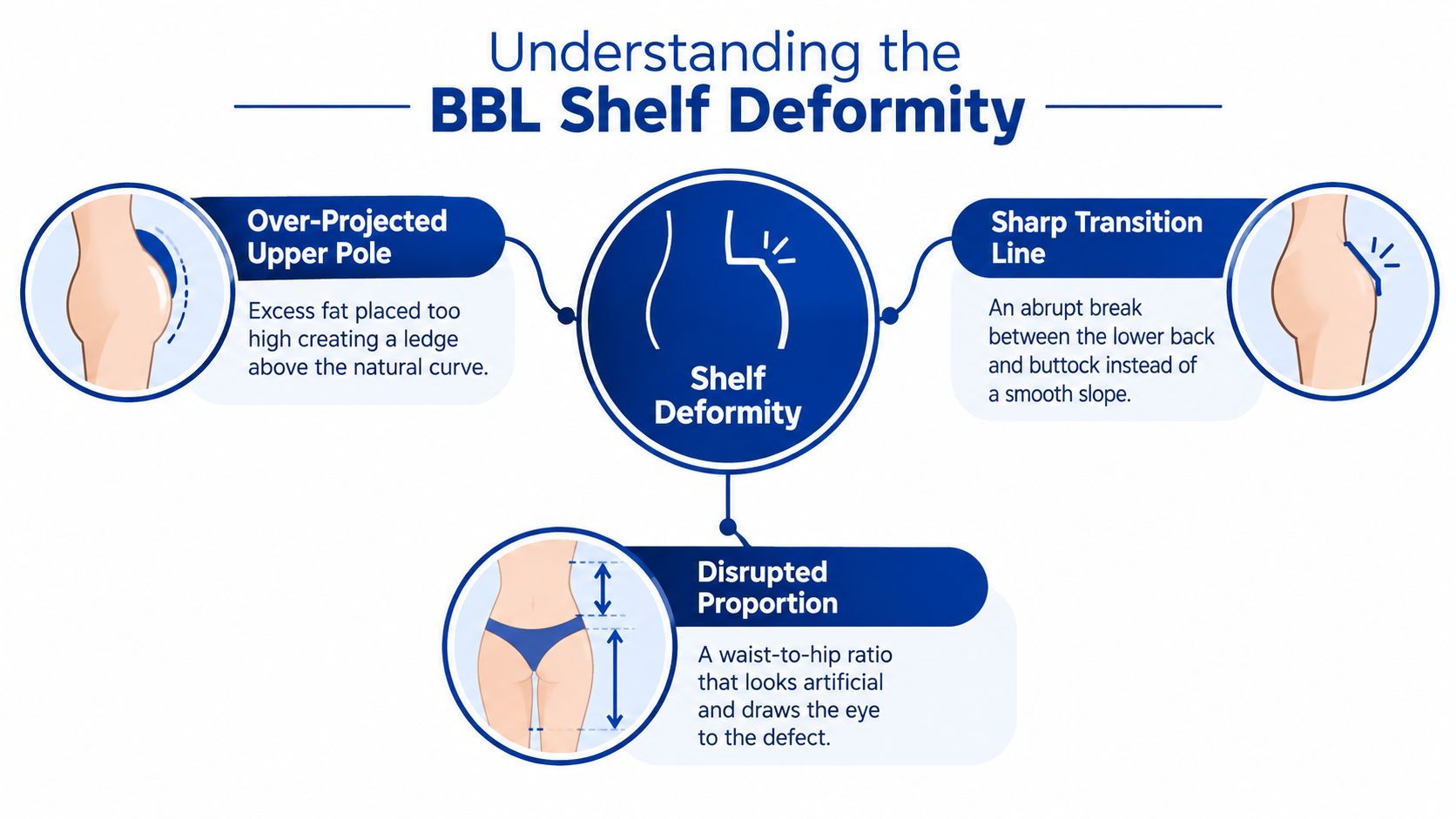
A patient may see a horizontal ledge across the upper buttock after swelling has settled, especially where the lower back meets the upper or lateral buttock. The profile stops abruptly instead of continuing through a gradual curve. Clothing can accentuate the line, but compression is not the cause. The underlying contour may remain visible without it.
A BBL shelf deformity is usually a placement and proportion problem. Fat may have been added too aggressively to the upper lateral buttock, leaving a projecting platform above the natural curve. The shelf can also result from poor blending between the lower back, waist, upper buttock, and lateral hip. When neighboring zones do not form one continuous surface, the eye reads the boundary as a step.
Why the transition zones matter
The buttock functions as part of a larger contour unit. Its appearance depends on the relationship between the waist, lower back, trochanteric area, gluteal curve, infragluteal fold, and upper thigh. A nearby depression can make an upper projection look more severe, even when the projection itself is moderate.
The infragluteal banana roll deserves particular attention. Technical guidance describes it as a supporting structure that should not be suctioned casually. Removing too much tissue from the lower buttock and upper-thigh transition can weaken the natural slope and make a shelf more conspicuous. The same guidance places maximum projection near the junction of the medial and central thirds of the upper and mid buttock, rather than distributing volume indiscriminately across the upper pole. Technical guidance on layered gluteal fat grafting explains how anatomy, injection depth, and transition zones affect contour planning.
A revision assessment should therefore map the contour in several positions, not judge the upper buttock alone. The surgeon needs to distinguish excess projection from a deficient lower curve, scar tethering, uneven fat survival, or over-resection in an adjacent zone. That distinction determines whether the correction requires selective fat removal, soft-tissue release, grafting, or a combination.
The history of gluteal augmentation also shows why volume alone does not solve every contour problem. A 2006 review notes that Bartels and colleagues described the first surgical approach to gluteal augmentation in 1969, using a breast prosthesis to improve gluteal contour. Illouz later expanded fat-grafting methods after beginning to graft aspirated fat in 1985, while foundational guidance from the American Society of Plastic Surgeons identifies autologous fat injection for soft-tissue augmentation as having been reported as early as 1893. The historical review of gluteal augmentation documents the field's progression from simple volume replacement toward deliberate contour design.
Structural placement versus temporary healing
Early swelling, firmness, inflammation, edema, and fat necrosis can distort a result. Some of these changes soften as healing progresses. Massage may support fluid movement or reduce mild postoperative stiffness, but it cannot relocate fat placed in the wrong anatomical area or reliably release a mature tethering scar.
The American Society for Aesthetic Plastic Surgery notes that some transferred fat may not survive, potentially leaving asymmetry or an uneven contour after healing. It also explains that buttock liposuction can produce loose skin and irregularity, similar to contour changes after substantial weight loss. The overview of BBL risks and safety helps separate a changing early result from a persistent structural defect.
Practical rule: If the ledge remains after the tissues settle and changes little with massage or position, treat it as an anatomical problem rather than ordinary swelling. A focused assessment may allow selective correction under local anesthesia, avoiding the added exposure and recovery burden of general anesthesia when the revision is appropriate for an awake technique.
For background on what BBL surgery involves, patients can review the original procedure and its contour goals. Revision planning asks a different question: which tissues must be reduced, released, or supported to restore proportion and continuity?
Evaluating Non-Surgical Treatments and Their Limitations
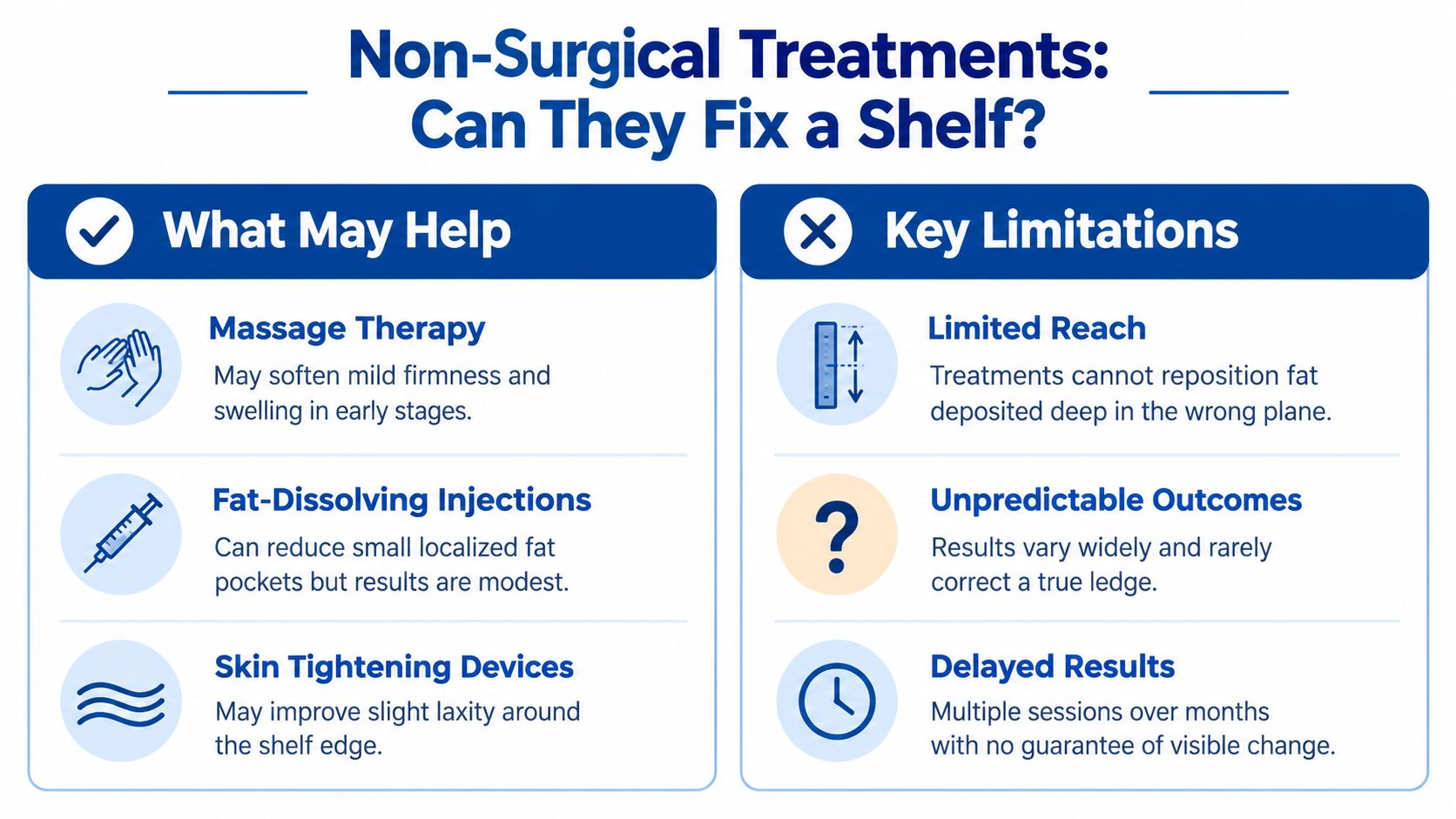
Many patients understandably want to avoid another operation. They ask whether massage, injections, or a skin-tightening device can flatten the shelf without removing or transferring fat. The honest answer is that non-surgical treatment can be useful for selected surface problems, but a true ledge is often a three-dimensional structural error.
Early postoperative care is different from late deformity correction. Time allows edema to resolve, graft behavior to stabilize, and areas of firmness to soften. Lymphatic massage may support comfort and fluid movement during recovery, but it won't move a mature fat deposit from the upper lateral buttock into a lower depression.
Matching the treatment to the problem
| Option | Where it may help | Where it falls short |
|---|---|---|
| Time and observation | Changing swelling, edema, or early firmness | It won't correct settled fat placement or a persistent step |
| Lymphatic massage | Mild early congestion and temporary tissue stiffness | It can't reposition grafted fat or release established scar tethering |
| Fat-dissolving injections | A small, clearly localized superficial pocket may respond | Large, fibrous, or deep contour problems are difficult to treat predictably |
| Energy-based tightening | Mild laxity or skin texture around an edge | It doesn't remove a deep volume excess or reshape the buttock's architecture |
| Revision contour surgery | Excess upper-pole volume, scar adhesion, and adjacent depressions | It requires careful planning and carries the risks of another procedure |
Fat-dissolving injections are not a universal shelf treatment. They may reduce a small localized pocket, but a shelf often involves a broad transition, dense tissue, or a combination of excess projection and neighboring deficiency. Treating only the most visible bulge can leave the proportions unchanged or create a new indentation.
Energy devices can improve skin quality and mild laxity. They aren't designed to relocate fat deposited in the wrong plane. If the problem is a sharp step between the back and buttock, tightening the skin over that step won't recreate the missing slope.
When adjunctive treatment makes sense
Non-surgical care can be reasonable when the contour is still changing, the concern is mostly swelling or firmness, or the patient has mild skin laxity without a meaningful volume imbalance. It may also serve as an adjunct after surgery, when the surgeon wants to support skin quality or tissue pliability.
A persistent, clearly demarcated ledge requires a different discussion. A 2026 revision guide describes the shelf as typically structural rather than temporary swelling and states that meaningful correction usually requires surgical revision rather than massage alone. The discussion of BBL revision and shelf deformity is consistent with the clinical distinction between a surface symptom and an underlying contour defect.
Massage can improve how healing tissue feels. It can't perform the work of sculpting, releasing, or replacing tissue.
The decision should be based on examination, not desperation. A surgeon should determine whether the dominant issue is excess projection, a scar band, lower-buttock heaviness, skin laxity, or a depression that makes the shelf look sharper. Only then can you decide whether observation, an adjunctive treatment, or structural revision is appropriate.
Surgical Revision Techniques for Contour Correction
A patient may stand with a smooth-looking buttock, then see a sharp ledge when bending, walking, or tightening the muscles. That change matters. Revision must address the structure creating the shelf, not just remove more fat. The plan may combine reduction, scar release, selective grafting, and correction of nearby contours while preserving the support that gives the buttock a natural transition.
The assessment starts with the patient standing and moving. The back, waist, upper buttock, lateral hip, lower buttock, and upper thigh need to be examined as one continuous profile. Flexing, relaxing, walking, and changing position can expose an irregularity hidden in a static photograph.
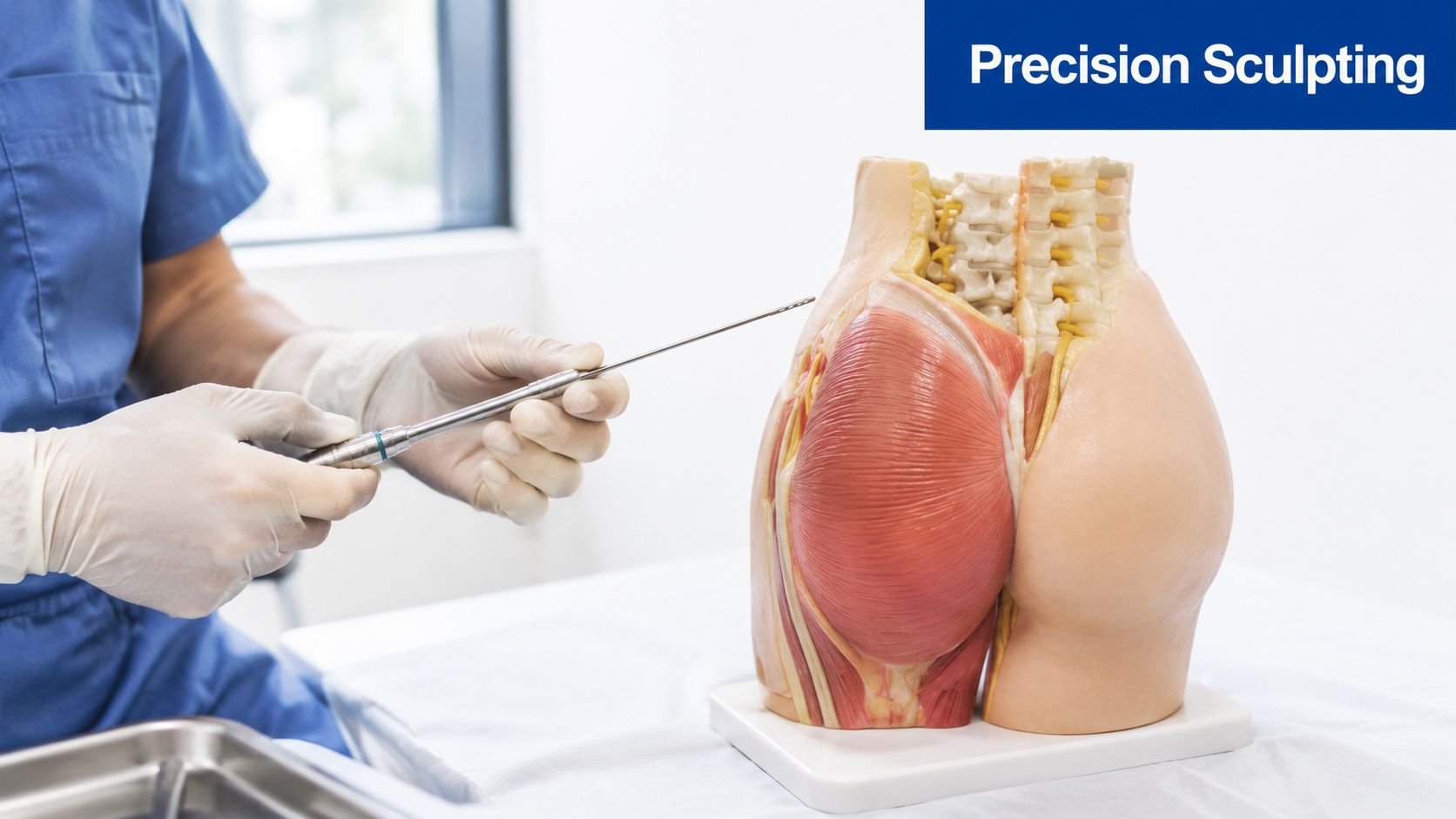
Debulking the upper projection
Excess upper-pole volume can be treated with targeted PRECISION SCULPT laser liposuction. The objective is to reduce the projection and recreate a gradual slope from the lower back into the buttock, rather than flattening the entire buttock. Removing too much can produce a new hollow, especially when the skin and underlying tissues provide limited support.
Scar tissue may be the main cause of the visible shadow. Dense adhesions can tether the skin and create a step-off even when the fat volume is modest. Releasing the tether allows the surface to move more freely. However, release alone may leave a depression, so the surgeon may pair it with carefully controlled volume restoration.
Patients researching available care can browse plastic surgery specialties to understand how body-contouring expertise differs from broader cosmetic practice.
Filling the deficit beside the shelf
The shelf often appears more pronounced because the tissue below or beside it lacks volume. Micro-aliquot fat grafting can soften that contrast by placing small deposits in selected layers. Published surgical guidance describes placement of no more than 0.3 cc per pass, with some cases involving nearly 3,000 tunnels per side to place about 825 cc per buttock. The surgical review of gluteal fat grafting technique illustrates the technical demands of small, layered placement.
Those figures are not a treatment prescription for a shelf deformity. Revision usually requires substantially less volume because the goal is to manage a transition, not perform broad augmentation. Small deposits distributed across a planned contour can soften a step more predictably than one large bolus.
The banana roll also needs protection. Removing it to sharpen the lower edge can weaken support and make the buttock look disconnected from the thigh. A balanced correction considers upper projection, adjacent depressions, scar tethering, and the lower transition together.
A reversal is not always a second BBL
Some patients need reduction and sculpting. Others need limited grafting. Donor fat may be available in one patient and scarce in another after extensive liposuction. The American Society of Plastic Surgeons notes that patients may seek another BBL because fat survival varies and healing can produce asymmetry or uneven contour. The professional discussion of BBL reversal and restoration supports tailoring the procedure to the actual deformity rather than repeating the original operation.
The safest plan corrects the anatomical cause with the smallest effective intervention. Scar quality, skin laxity, available donor fat, tissue planes, and the support of the infragluteal fold all influence that choice. Revision is a structural repair, not a volume contest.
The Awake Surgery Advantage in Revision Procedures
Awake revision under tumescent local anesthesia offers a distinct advantage when the main challenge is dynamic contour. The patient can change position, flex the gluteal muscles, and respond to the surgeon's questions while the contour is being refined. That feedback can reveal how the shelf behaves in a way that isn't available when the patient is fully unconscious and unable to participate.
A shelf isn't only a static photograph. Muscle contraction, skin tension, posture, and pressure on the posterior tissues can alter the line. An awake patient can help the surgeon confirm whether the transition looks natural during movement rather than relying solely on a relaxed operating position.
Precision without general anesthesia
Avoiding general anesthesia can also reduce exposure to airway manipulation and the physiologic demands associated with deeper anesthesia. It doesn't make revision risk-free, and it doesn't make every patient or every operation suitable for an office-based approach. The procedure still requires careful patient selection, sterile technique, monitoring, emergency planning, and an honest assessment of how extensive the correction will be.
Recent safety-focused literature has emphasized subcutaneous-only injection, real-time ultrasound guidance, and explicit limits based on anatomy and technique. Professional safety guidance for buttock enhancement reflects the broader move toward measurable, anatomy-based risk reduction rather than just adding more fat.
Awake surgery is most useful when the correction can be performed through focused contouring, scar release, and selective grafting. A surgeon may not recommend it when the patient needs a large excisional operation, extensive skin removal, or treatment that exceeds the safety limits of an office setting.
The patient's role becomes clinically useful
During an awake procedure, communication isn't a novelty. It can help the surgeon assess symmetry and the transition between the waist, back, and buttock in real time. That doesn't replace preoperative planning, but it adds information at the moment when small contour decisions are made.
Ideal Face & Body describes awake, office-based body contouring under local anesthesia as part of its practice model. Patients considering this route should ask exactly which portions of their correction can be performed awake, what monitoring is used, and when a hospital or general-anesthesia setting would be safer. More information about the approach is available in the awake surgery complete guide.
Recovery Timelines and Managing Patient Expectations
Revision patients often examine the treated area repeatedly because they've already experienced an unwanted result. That vigilance is understandable, but it can make normal postoperative asymmetry feel like failure. Swelling rarely resolves evenly, and the side that required more scar release or contour work may remain firmer or fuller for longer.
Timing before surgery matters. A surgical text recommends waiting at least 3 to 6 months to assess final graft take, with many surgeons preferring 12 months before secondary augmentation when donor fat is available. The surgical guidance on gluteal augmentation revision describes why the surgeon must distinguish persistent contour error from tissue that is still settling.
A separate revision guide says many surgeons prefer reassessment after at least 6 months, and sometimes longer when swelling, firmness, or scar maturation continues to change. The revision BBL planning guide reinforces the need to plan around tissue behavior rather than impatience.
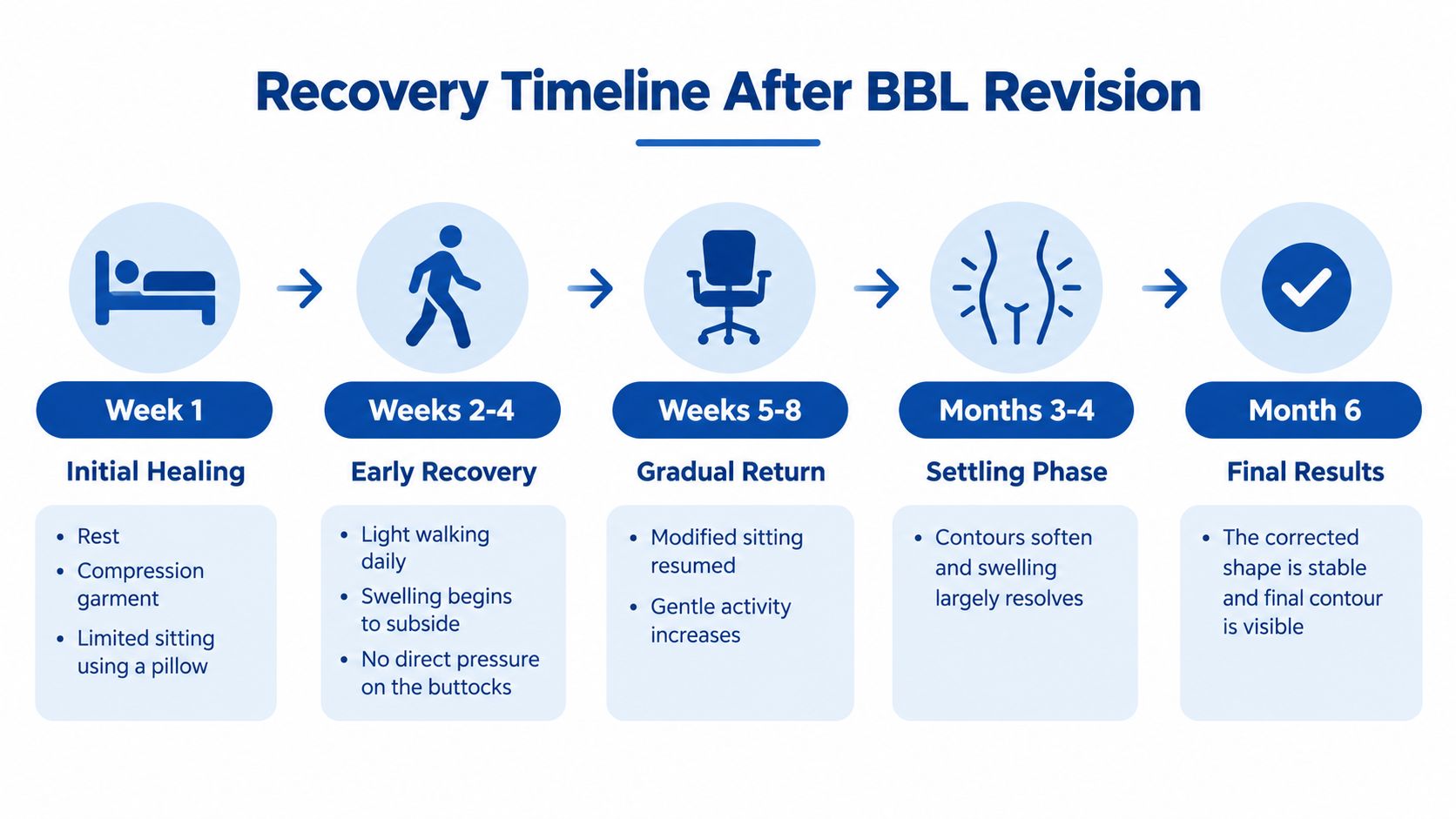
What the early period feels like
During the first week, the priorities are rest, wound care, compression, and protecting the newly sculpted transition zones. A custom garment or off-loading design may be used to reduce direct pressure where the surgeon has released scar tissue or added grafts.
Over the following weeks, light walking is usually introduced according to the surgeon's instructions. Direct sitting, exercise, and pressure on the buttocks are restricted or modified because the tissues need time to stabilize. The exact instructions depend on whether the procedure involved reduction, grafting, scar release, or a combination.
Why the contour changes after surgery
The early shape isn't the final shape. Swelling can obscure a depression, make one side look larger, or create firmness along the treated edge. As fluid resolves and tissue softens, the transition usually becomes less abrupt.
The recovery framework is gradual:
- Week 1: Rest, compression, and limited sitting with appropriate off-loading.
- Weeks 2 to 4: Light walking may increase, while direct pressure remains restricted.
- Weeks 5 to 8: Modified sitting and gentle activity may resume when cleared.
- Months 3 to 4: The contour begins to soften and settle more consistently.
- Month 6: The corrected shape may be stable enough for a meaningful final assessment.
These stages aren't a guarantee or a substitute for personal instructions. A patient with extensive scar release may progress differently from someone who has only had limited debulking.
For broader recovery guidance related to gluteal fat transfer, see the information on fat transfer to the buttocks recovery. Contact the surgical team promptly if pain, redness, drainage, fever, sudden swelling, or breathing symptoms develop. Normal healing should be monitored, not guessed at.
Choosing the Right Revision Surgeon and Common Questions
Revision requires a different skill set from primary augmentation. The surgeon must understand what was done previously, identify what remains, and avoid repeating the same volume-first logic that produced the shelf. Look for double board-certification, specific experience with complex body contouring, and a before-and-after gallery showing contour correction rather than only primary BBL results.
Ask to see examples involving excess upper-pole projection, asymmetry, scar tethering, and limited donor fat. A surgeon should be able to explain what will be reduced, what may need to be released, what might be grafted, and which structures will be preserved. If the proposed plan is only “add more fat,” ask why the existing ledge won't become more pronounced.
Common questions before consultation
Will I need imaging? Not always. A careful physical examination may identify the problem, but imaging can be considered when the anatomy is unclear, the defect is deep, or prior operative details are incomplete. The decision should follow the examination rather than a routine checklist.
How much donor fat will I need? There isn't a universal amount. It depends on whether the correction is primarily debulking, whether adjacent depressions need grafting, how much donor tissue remains, and how conservative the revision needs to be. Some patients need reduction with minimal grafting, while others require carefully distributed volume to restore the slope.
Can revision guarantee perfect symmetry? No. Human anatomy is naturally asymmetric, and prior surgery creates additional variables. The appropriate goal is a smoother, more proportional contour with a clear plan for the dominant deformity.
Will revision always require general anesthesia? No. Selected contour corrections may be performed awake under local anesthesia, while more extensive operations may require a different setting. The safer choice depends on the procedure, the patient's health, and the surgeon's assessment.
What about cost? It varies widely with scar tissue, the number of anatomical zones involved, the need for grafting or reduction, and the setting required. A consultation should provide a transparent discussion after the surgeon understands the correction, rather than a meaningful estimate based only on photographs.
A 2025 peer-reviewed article reviewing BBL reversal reported a 1% complication rate in the study it reviewed, and described revision or buttock reduction as an increasingly popular body-contouring procedure. The article on BBL reversal is useful context, but an individual patient's risk depends on anatomy, health, technique, and the extent of revision.
For Beverly Hills patients, Dr. Justin Yovino and Dr. Sarah Yovino can discuss whether awake contour correction, targeted reduction, scar release, or selective fat transfer fits the anatomy. Patients also benefit from organized communication before and after consultation, and an AI receptionist for aesthetics clinics can help practices manage scheduling and patient inquiries without replacing clinical judgment.
Ideal Face & Body evaluates BBL shelf deformity through awake, office-based body-contouring options when the correction is appropriate for local anesthesia, including targeted sculpting, scar release, and selective contour refinement. Visit Ideal Face & Body to request a consultation with Dr. Justin Yovino or Dr. Sarah Yovino and receive an anatomy-based plan for your revision.