You're looking at your reflection and realizing the shape you paid for isn't the shape you still have. Maybe the volume looked great at first, then softened, shifted, or settled into a contour that no longer matches your clothes, your posture, or the photos you saved after surgery. That's the point where BBL revision surgery becomes a real conversation, not a hypothetical one.
Table of Contents
- What BBL Revision Surgery Actually Means
- Why Primary BBLs Sometimes Need a Second Procedure
- Evaluating Your BBL Before Planning a Revision
- Surgical and Non-Surgical Revision Options Compared
- Planning for Surgery and the Recovery Timeline
- Safety Considerations and Risks to Understand
- Choosing a Surgeon and Planning Next Steps
What BBL Revision Surgery Actually Means
A woman can love her Brazilian Butt Lift for the first six months, then slowly notice that one side looks flatter, one cheek sits higher, or the curve she liked has changed enough that it no longer feels balanced. That's a common reason people start asking about BBL revision surgery, which is any secondary procedure on the buttocks after a primary fat-grafting BBL.
In plain language, revision means correcting what changed after the first operation. That might mean adding volume, removing excess fat, refining a shelf-like contour, softening a divot, or treating a complication that never settled well. The exact plan depends on what happened, not on what the original surgery was supposed to do.
A revision is not just a smaller version of the first operation. Prior fat survival, scar tissue, and altered anatomy change the playing field, so the second procedure has to be custom-built around what's left behind. If you're trying to compare your current shape to your early post-op photos, that comparison matters, because the issue may be volume loss, tissue distortion, or both.
For a basic overview of the primary operation, this explanation of BBL surgery is a useful starting point before you think about correction.
Practical rule: If the contour issue is stable, visible, and bothering you in real life, it deserves an in-person assessment rather than a guess from photos.
Why Primary BBLs Sometimes Need a Second Procedure
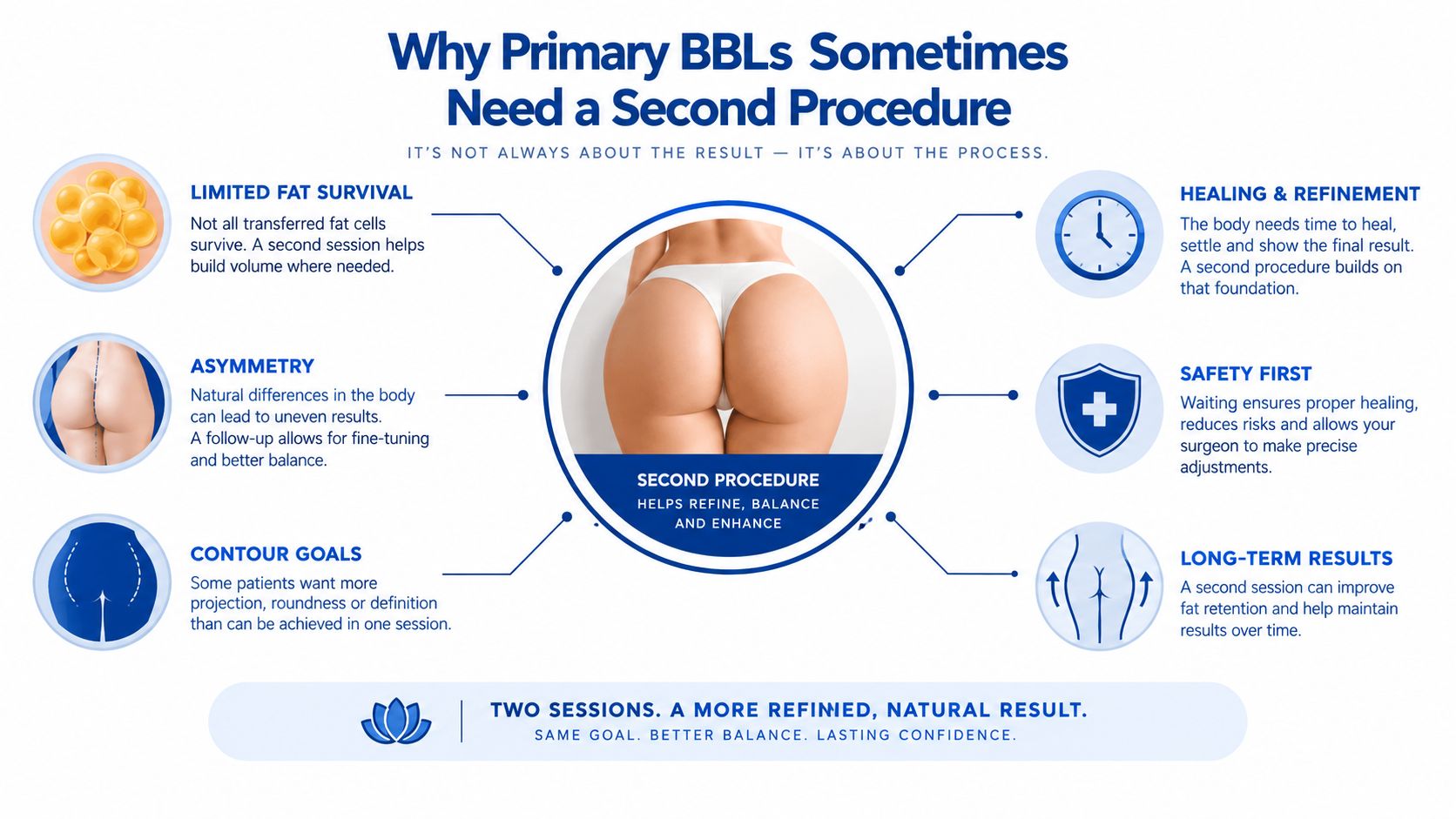
The most common reason a primary BBL needs revision is uneven fat survival. Some of the transferred fat cells establish a blood supply and last, while other areas resorb, which can leave dents, patchy flatness, or a textured surface that wasn't there right after surgery. That mismatch is frustrating, but it's also predictable in fat grafting.
Shape problems are usually technical, not mysterious
Contour asymmetry can come from many places. Pre-existing scoliosis, uneven hip structure, or donor-site differences can make one side look fuller or flatter, and aggressive liposuction can exaggerate that imbalance. Superficial grafting can also create a boxed-off or shelf-like look, especially if the fat sits too close to the skin.
Bottoming-out is another pattern I see often in revision discussions. It tends to happen when tissue support is weak or when a patient loses significant weight after the primary surgery, so the buttock loses projection and drape at the same time. Poorly filtered fat can add to the problem by leaving palpable nodules, irregular thickness, or small firm areas that don't blend with the surrounding tissue.
Complications matter too. In a modern series of more than 7,000 patients, revision surgery was recorded in 0.21% of cases, while secondary procedures accounted for 3% of cases overall and were reported with similar complication rates; the same dataset also listed minor complications such as seroma at 23%, anemia at 6.6%, fat necrosis at 1.9%, infection at 0.43%, hematoma at 0.14%, and asymmetry at 0.29% (Cleveland Clinic reference). Those numbers help explain why revisions are often driven by contour or healing issues, not just dramatic surgical failures.
Evaluating Your BBL Before Planning a Revision
The consultation starts with history, because the details of the first surgery tell you what kind of correction is even possible. I want to know the surgeon's technique, the plane of injection, how much fat was transferred, how long it's been since surgery, whether weight changed, and whether there were seromas, infections, nodules, or prior touch-ups.
What the exam has to document
The physical exam is where revision planning becomes concrete. Skin quality, gluteal laxity, lateral cheek depressions, the lumbosacral junction, and donor sites all have to be assessed together, because a smooth buttock shape depends on the entire frame around it. Abdomen, flanks, back, and thighs matter just as much as the buttock itself if liposuction was part of the original operation.
Ultrasound can be useful when I need to map prior graft planes or look for oil cysts and nodules. Photo-based morphing helps align expectations, but it doesn't replace an exam. An awake assessment is often the biggest advantage, because the patient can stand, sit, and contract while the surgeon palpates, which reveals dynamic contour problems an operating table won't show.
A revision plan should answer one question clearly, what can be improved safely, and what needs to be left alone.
Candidacy also depends on timing and habits. Smoking status matters, body mass has to be stable enough for the result to mean something, and I usually want to wait at least nine to twelve months before revising so the tissue has time to settle. If the patient is still changing weight, healing from inflammation, or chasing a moving target, the revision plan isn't ready yet.
Surgical and Non-Surgical Revision Options Compared
Some revision problems need surgery, some don't, and some need a mix. The right choice depends on whether the issue is excess volume, missing volume, scar tethering, loose skin, or a small projection mismatch that doesn't justify a major operation.
When surgery makes sense
Fat re-grafting can restore lost projection or soften a contour hollow when there's enough donor fat and the surrounding tissue is ready to accept it. Liposuction debulking works better when the problem is persistent fullness, a boxy edge, or localized overcorrection. Scar release can help tethered areas, while combination skin excision is reserved for true laxity that won't respond to contour-only correction.
Hybrid cases sometimes need implant exchange or removal, but that's a separate revision category. In practice, the key question is whether the tissue can still be reshaped without creating a worse irregularity than the one you're trying to fix.
When less invasive options are enough
Non-surgical tools can help with small asymmetries or mild texture problems, but they don't replace surgery when the anatomy is distorted. Fat-dissolving injectables may help selected localized fullness, RF skin tightening can support mild laxity, muscle-toning devices can improve adjacent support, and dermal fillers can camouflage minor projection differences.
For patients who are exploring butt lift fillers, this overview from Yoyime Clinic is a practical reference point for the category, though it won't solve the bigger structural issues that often drive revision surgery.
| Revision Options at a Glance | What It Corrects | Anesthesia | Downtime | Longevity |
|---|---|---|---|---|
| Fat re-grafting | Volume loss, dents, shape imbalance | Local or deeper anesthesia depending on scope | Moderate | Depends on fat survival |
| Liposuction debulking | Overfull areas, shelves, localized excess | Local or general, case-dependent | Moderate | Long-lasting if weight stays stable |
| Scar release | Tethering, contour pull, limited smoothness | Local or procedural anesthesia | Variable | Depends on scar behavior |
| Skin excision | Redundant skin, major laxity | Local or deeper anesthesia | Longer | Structural change, not temporary |
| Non-surgical contouring | Minor asymmetry, mild texture | Office-based | Minimal to brief | Usually temporary or staged |
Planning for Surgery and the Recovery Timeline
Awake, office-based revision starts with preparation that's more specific than most patients expect. I want pre-op labs if indicated, medication review, garment fitting, transportation arranged, and a plan for lymphatic massage if that's part of the recovery pathway. If the procedure is done under tumescent local anesthesia, same-day discharge is typical, and the patient needs to understand exactly how the first day will feel.
What recovery usually looks like
Day one is about drainage, compression, and protection of the treated areas. The garment stays on, the incisions may ooze a bit, and sitting directly on grafted tissue is off-limits. Week one usually brings the biggest swelling peak, even when the operation went well.
By the two-week point, garment transitions may begin if healing is on track. Month one is where most patients still need to avoid prolonged sitting on grafted areas and skip glute-focused exercise, even if walking feels easier. Around three months, contour starts looking more believable, and six months is where a final evaluation usually tells the full story.
Awake surgery has a practical advantage during the case itself. The patient can be repositioned in real time, can give feedback about pressure or contour, and avoids the recovery burden that comes with general anesthesia. For some patients, that makes the whole experience feel more controlled and less disorienting.
For a detailed recovery overview, this guide to BBL fat transfer recovery from Ideal Face & Body is a useful companion to the surgical conversation. If sleep positioning becomes a problem during recovery, the guide to recovery sleep with Full Circle is also worth a look.
Safety Considerations and Risks to Understand
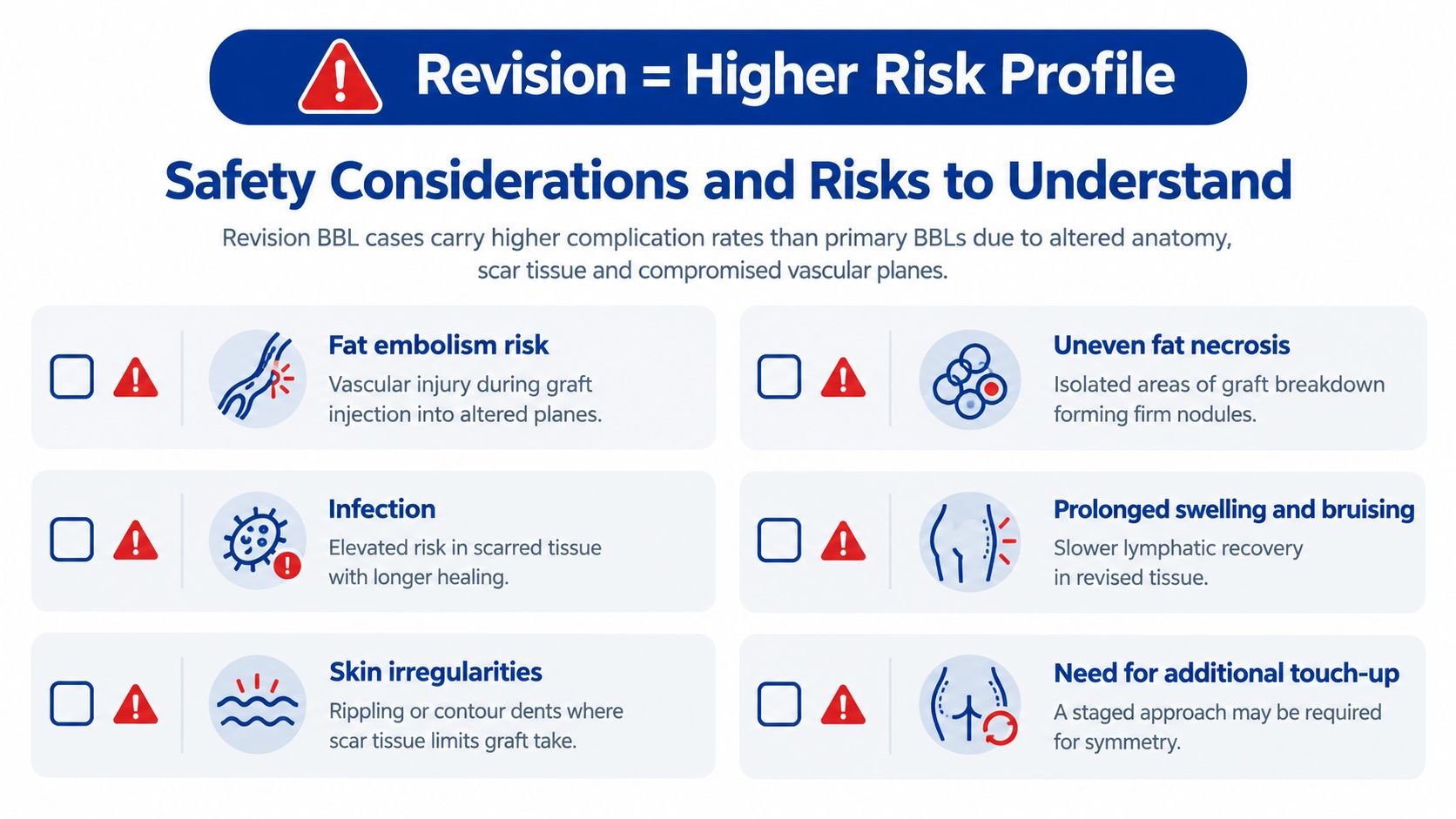
Revision cases deserve a stricter safety lens than primary BBLs. The anatomy has already been altered, scar tissue can distort tissue planes, and the margin for error gets smaller when the original contour was overtreated or unevenly treated. In that setting, the surgeon's job is not just shaping, it's avoiding preventable harm.
Plane of injection matters more than almost anything else
The highest-stakes issue is fat embolism prevention. Safety advisories and systematic reviews support subcutaneous-only placement and avoidance of intramuscular or subfascial injection, because those deeper planes carry higher risk; pooled estimates show major complications around 0.02% with ultrasound-guided grafting versus 0.08% without, and pulmonary embolism around 0.04% in meta-analysis (Gluteal Fat Grafting Safety Advisory). That's why plane control is not a technical detail, it's the foundation of safety.
Awake local protocols can add another layer of control because the patient remains responsive and the surgeon gets continuous feedback. Tumescent anesthesia also helps with vasoconstriction, which supports hemostasis and can make the operating field more predictable. I'd rather work in a setting where the team is focused on the plan, the plane, and the tissue response than one that depends on brute force.
If the original fat was placed above the muscle, reversal or reduction can be feasible, but the goal is correction, not simply undoing the past.
Other risks are more ordinary but still important. Seroma, infection, fat necrosis, asymmetry, and contour irregularity can all show up after revision, and the Cleveland Clinic data above helps explain why those issues are part of the conversation even when a case is technically straightforward. When a revision follows a poorly executed primary, the stakes rise because the tissue may already be depleted or scarred, which makes honest pre-op planning essential.
Facility safety matters too. Board certification, accredited operating rooms, emergency transfer protocols, and a real before-and-after portfolio should all be part of the vetting process. If a surgeon can't explain how they handle complications, they're not ready for complex revision work.
Choosing a Surgeon and Planning Next Steps
The safest path is to verify credentials first, then compare technique, not marketing. Look for ABPS board certification, an AAAASF-accredited OR if the case is done in a facility, and documented awake gluteal fat-grafting experience. If revision cases are being discussed, the surgeon should be able to show revision-specific results, not just primary BBL photos.
Questions that should get direct answers
Ask who performs the liposuction and injection steps. Ask whether awake local anesthesia is offered in-office and whether the plan changes if the case turns out to be more complex than expected. Ask how the team handles donor-site contouring, because revision isn't only about the buttocks, it's about the whole silhouette.
For some patients, Ideal Face & Body fits this model because it focuses on awake, office-based body contouring in Beverly Hills, CA, including buttock reshaping and reduction cases. The key is not the name on the door, it's whether the practice can explain the plan clearly and perform it safely.
| Surgeon Selection Criteria at a Glance | What to Look For | Red Flag |
|---|---|---|
| Board certification | Verified plastic surgery training and certification | Vague credentials |
| Facility | Accredited office or OR with emergency protocols | No clear backup plan |
| Revision portfolio | Before-and-after revision cases similar to yours | Only primary BBL photos |
| Anesthesia approach | Clear explanation of awake local vs deeper anesthesia | Unclear who monitors you |
| Technical plan | Specific discussion of plane, contour, and donor sites | Generic promises of “better shape” |
Cost varies with surgeon fee, facility, anesthesia, garments, and any revision-specific imaging or follow-up needs. Revision pricing often differs from a primary quote because the case is more individualized and the tissue has already been operated on once. If you're making a decision, request medical records, photograph your current contour in consistent lighting, wait the proper healing window, and meet with two or three surgeons before you commit.
BBL reduction and reshaping options in Beverly Hills can help you frame the conversation before you book a consultation, especially if you're trying to understand whether reduction, correction, or reversal is the right category.
If you're considering BBL revision surgery in an awake, office-based setting, Ideal Face & Body can evaluate your anatomy, review your prior records, and map out what correction is realistic before you make a commitment. Visit Ideal Face & Body to explore revision-focused body contouring and schedule a consultation in Beverly Hills, CA.