You may be searching “no belly button after tummy tuck” because you've seen a photo, heard a frightening story, or are imagining what your abdomen might look like after surgery. The concern is understandable. The belly button sits at the visual center of the abdomen, so even a subtle change in its position, depth, or shape can affect how the entire result appears.
The reassuring answer is that a standard tummy tuck is designed to preserve the belly button, not erase it. The surrounding abdominal skin is tightened and repositioned, while the umbilicus remains connected to the abdominal wall and is brought through a carefully created opening. The important questions are how that blood supply is protected, where the new opening is placed, and how the navel is shaped during healing. If you're still deciding whether abdominoplasty fits your anatomy, this guide to tummy tuck candidacy can help frame that consultation.
Table of Contents
- The Reality of Your Belly Button During Abdominoplasty
- How Surgeons Preserve and Relocate the Umbilicus
- Understanding the Risks of Umbilical Necrosis
- Mini Tummy Tuck vs Full Abdominoplasty Differences
- Revision Options and Secondary Umbilicoplasty
- Evaluating Before and After Galleries for Natural Results
- Reframing the Focus on Overall Abdominal Contour
The Reality of Your Belly Button During Abdominoplasty
A patient may come into consultation worried that a tummy tuck will leave a completely flat abdomen with no navel at all. She may have seen an early postoperative photograph in which swelling obscured the opening, or read about a complication involving tissue loss. Her fear is real, but the usual surgical plan is much less dramatic: the original umbilicus is preserved on its deeper attachment and repositioned through tightened skin.
The belly button isn't a sticker attached to the surface of your abdomen. Beneath the skin, it connects to deeper abdominal tissue through a central stalk. During a classic abdominoplasty, the surgeon separates the navel from the surrounding skin while maintaining that deeper connection. The excess skin then moves downward, and the preserved umbilicus emerges through a new opening in its new position.
Why the navel matters so much
A natural-looking abdomen needs a natural-looking center point. Even when the abdominal skin is smooth and the lower scar is well placed, an umbilicus that looks too round, shallow, low, high, or off-center can make the result look operated on. That's why surgeons treat navel design as part of the overall contour, not as a minor finishing detail.
Modern abdominoplasty evolved around this preservation problem. A historical review credits Thorek with pioneering a technique in 1924 that kept the umbilicus intact, while earlier work had included the umbilical area in fat resection as far back as 1890. By 1905, Gaudet and Morestin had described preserving the umbilicus during abdominal wall surgery, a milestone in the development of contemporary technique. These historical details are summarized in this peer-reviewed review of abdominoplasty history.
The practical takeaway: In a routine full tummy tuck, you generally keep your own belly button. The surgeon changes the skin around it and its visible position, not the deeper structure that makes it your navel.
Patients sometimes use “new belly button” to mean the new opening in the tightened skin. That wording can be confusing. In most full abdominoplasties, the visible opening is new, but the umbilical tissue brought through it is preserved from the patient's original navel. The result should look like a relocated and refined version of the same anatomical structure.
How Surgeons Preserve and Relocate the Umbilicus
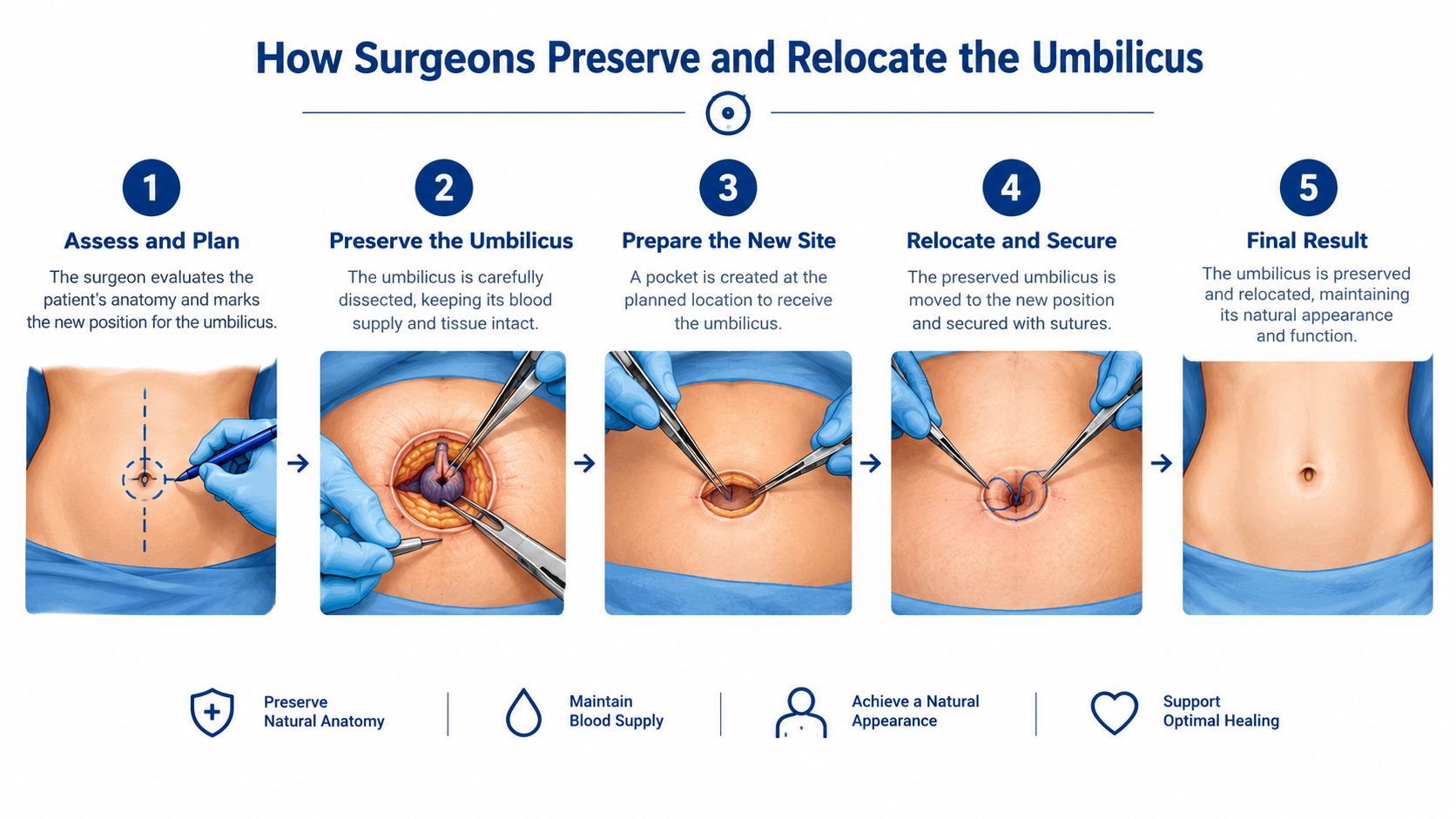
The mechanics become easier to understand if you think of the abdominal skin as a sheet being redraped over a fixed central attachment. The navel belongs to that deeper attachment. The sheet moves, while the stalk must remain healthy and connected.
The preservation process
First, the surgeon identifies the natural outline of the umbilicus and makes a controlled incision around it. This releases the navel from the surrounding abdominal skin without cutting through the deeper stalk that connects it to the abdominal wall. That stalk contains the tissue and vessels needed to keep the umbilicus viable.
Next, the surgeon lifts the abdominal flap and removes the skin that has become excess. The remaining skin is pulled downward toward the lower incision. Because the skin has shifted, the original surface opening no longer sits in the right place. Leaving it there would place the navel under tension or in an unnatural location.
A new opening is then designed in the upper abdominal flap. Surgical descriptions report that this opening may be circular, oval, vertical, or transverse, depending on the technique and the desired shape. One reviewed method uses an inverted U-shaped flap measuring about 1.5 centimeters in diameter, as described in this technical review of umbilical reconstruction during abdominoplasty.
Bringing the stalk through the new skin
The preserved umbilicus is delivered through the new opening and secured to the surrounding skin. The surgeon may use sutures that anchor the tissue to deeper fascia or the abdominal wall, helping maintain depth instead of allowing the navel to flatten as swelling resolves.
The final position is chosen in relation to the rest of the abdomen. Surgical papers describe the umbilicus as being repositioned lower than its original site by a few centimeters in some cases, reflecting the downward movement of the skin. Other descriptions explain that the stalk may be secured with multiple fixation sutures at key points so it remains stable and develops a natural contour. These mechanics are outlined in this surgical technique paper on umbilical transposition.
The visible result depends on more than creating a hole. A surgeon must consider the opening's orientation, the amount of skin hooding, the depth of the depression, the scar's location, and the relationship between the navel and the abdominal midline. A technically intact umbilicus can still look unnatural if those details aren't balanced.
Understanding the Risks of Umbilical Necrosis
The rare situation people fear when they search for “no belly button after tummy tuck” is usually umbilical necrosis, meaning tissue death caused by inadequate blood flow. The original navel can be preserved anatomically but still fail to heal if its circulation is damaged during dissection, pulled too tightly, or compressed by surrounding tissue.
A peer-reviewed clinical review reports umbilical necrosis at about 0.2% of abdominoplasty cases. The same reference describes broader abdominoplasty complication rates of 10% to 20% overall, with rates that can reach 30% to 50% in patients who have undergone massive weight loss. Another large study reported major complications in 4% of abdominoplasty patients, compared with 1.4% in other cosmetic surgery procedures. Those figures appear in this clinical overview of abdominoplasty complications.
What can threaten the blood supply
The umbilical stalk receives blood from a network of small vessels. Surgical decisions that preserve those vessels reduce the chance of tissue compromise. Risk can increase when the abdominal flap is thinned excessively, when dissection is aggressive, or when closure tension pulls strongly on the central tissues.
The main factors include:
- Excessive flap thinning: Removing too much tissue can reduce the vessels that support the skin and umbilicus.
- High closure tension: Pulling the abdominal flap downward too forcefully can strain the navel and its surrounding blood supply.
- Aggressive dissection: Extensive separation around the stalk can injure vessels that should remain intact.
- Combined procedures: Adding another extensive contouring procedure can increase the stress placed on already manipulated tissue.
- Higher-risk anatomy: Post-bariatric patients may have thin, scarred, or previously stretched tissues that require more careful planning.
Published series have reported umbilical necrosis rates as low as 0.2% in 1,008 patients, while a higher-risk post-bariatric cohort reported a rate of about 4.2%. The data are not a prediction for any individual patient, but they show why risk assessment matters more than assuming every tummy tuck carries the same vascular conditions. A technique paper discussing these issues is available in this review of umbilical necrosis prevention and reconstruction.
What loss may look like
Early healing can be deceptive. Swelling, crusting, or a temporarily shallow opening doesn't automatically mean the umbilicus has been lost. Darkening tissue, progressive breakdown, concerning drainage, or a wound that fails to heal requires prompt communication with the operating surgeon.
If the entire umbilicus dies, the final appearance may be a shallow scar, a distorted depression, or an absent central landmark. Reconstruction is possible, but treatment generally waits until the tissues have stabilized. The priority is first to protect healing and treat any active wound problem, then to evaluate the cosmetic result.
Mini Tummy Tuck vs Full Abdominoplasty Differences
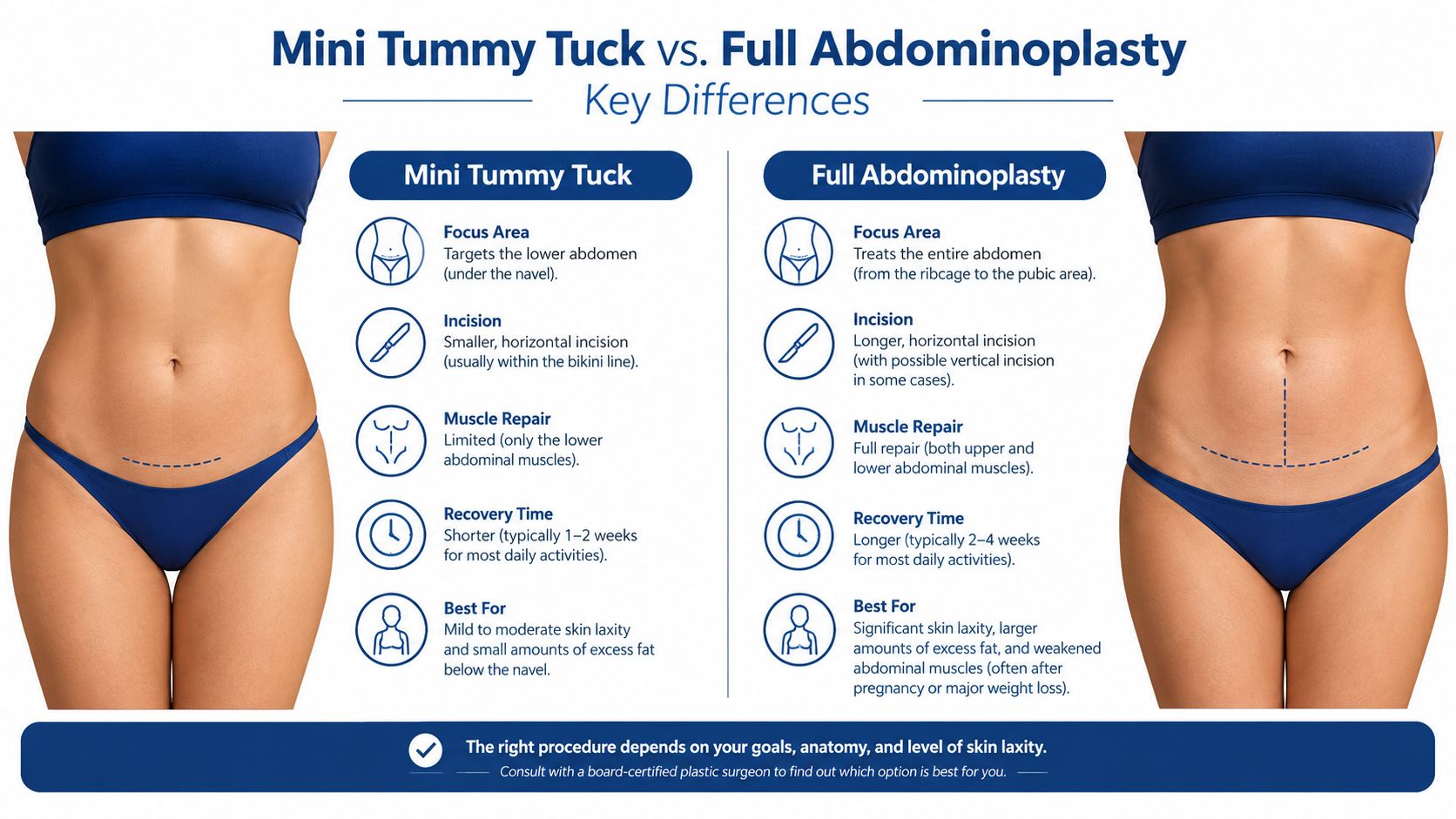
The phrase “tummy tuck” covers procedures that don't all manipulate the navel in the same way. The most important distinction is whether the operation needs to tighten and redrape skin above the belly button.
Mini tummy tuck
A mini tummy tuck focuses on the lower abdomen below the navel. Because the surgeon generally doesn't need to lift the upper abdominal skin over the umbilicus, there's usually no cut around the belly button. Cleveland Clinic describes this as a distinguishing feature of the mini approach in its tummy tuck procedure overview.
The navel normally remains in its original position and stays connected to the surrounding skin. That can be appealing for someone whose main concern is a small amount of loose skin below the umbilicus. However, the technique has limits. If laxity extends above the belly button, tightening only the lower abdomen may leave a mismatch between the treated and untreated skin.
Full abdominoplasty
A full tummy tuck addresses a broader area. The incision extends toward the level of the umbilicus, the navel is released from the surrounding skin while remaining attached to its deeper stalk, and the upper abdominal flap is pulled downward. The surgeon then creates a new opening so the preserved umbilicus can be brought through the tightened skin.
| Feature | Mini tummy tuck | Full abdominoplasty |
|---|---|---|
| Primary treatment area | Lower abdomen below the navel | Excess skin and laxity across a broader abdominal area |
| Umbilical manipulation | Usually left untouched | Usually released from surrounding skin and repositioned |
| Visible navel position | Generally remains where it started | May move lower with the redraped skin |
| Best suited to | Limited lower-abdominal laxity | Skin excess or contour concerns extending above the navel |
Why the choice affects expectations
A patient who wants a flatter abdomen but has loose skin above the navel may be disappointed by a mini procedure if the operation can't redrape that upper tissue. A patient with more limited lower laxity may not need the more extensive umbilical manipulation of a full abdominoplasty.
The decision should follow the anatomy, not the label. Ask where the skin excess sits, whether the abdominal wall needs repair, and whether the proposed operation will move the umbilicus. A discussion of the deeper abdominal wall question appears in this guide to whether muscle repair is necessary during a tummy tuck.
Revision Options and Secondary Umbilicoplasty
A belly button that healed poorly isn't necessarily a permanent failure. Revision may be considered for umbilical loss, severe distortion, narrowing, flattening, asymmetry, or a conspicuous scar after the original operation. The right method depends on how much viable tissue remains and whether the surrounding abdominal contour also needs correction.
Rebuilding depth and shape
A secondary umbilicoplasty can use local skin and soft tissue flaps to create a central depression. The surgeon may anchor the reconstructed tissue to the deeper fascia so it doesn't pull flat as the skin moves. The surface opening can be designed as a vertical oval, a small hooded shape, or another configuration that matches the patient's proportions.
Reconstruction often aims for a navel that is understated rather than perfectly geometric. A natural umbilicus has shadow, depth, and slight variation. A broad circular opening or a flat scar can draw attention, while a narrower vertical design may blend more quietly with the abdominal contour.
The scar tradeoff
Patients should ask specifically where the revision scar will sit. Some reconstruction methods can leave a vertical scar at the old umbilical site, especially when the original tissue has been lost or the surgeon must create a new central structure. That tradeoff may be acceptable when the alternative is an absent or severely distorted navel, but it belongs in the consent discussion.
A technique review reports reconstruction methods that reposition the umbilicus near the midline midpoint between the xiphoid and pubic symphysis and use deep dermal or fascial fixation to recreate a natural vertical shape. More recent literature also describes reconstruction methods with good satisfaction and low complication rates. A 2026 study reported hypertrophic scar and suture dehiscence as the most common issues, with no infection, necrosis, or stenosis reported in that study's findings, as summarized in the guideline on tummy tuck and umbilical reconstruction.
A revision should solve a defined problem. The goal may be to restore depth, narrow a wide opening, improve position, or replace tissue that didn't survive. Those are different operations, even though patients may call all of them a “belly button repair.”
Revision timing matters because operating on immature scar tissue can make assessment difficult and may add unnecessary trauma. Your surgeon should examine the healed contour, review photographs from before and after the first procedure, and determine whether the problem is limited to the navel or connected to a larger issue with skin tension and abdominal shape.
Evaluating Before and After Galleries for Natural Results
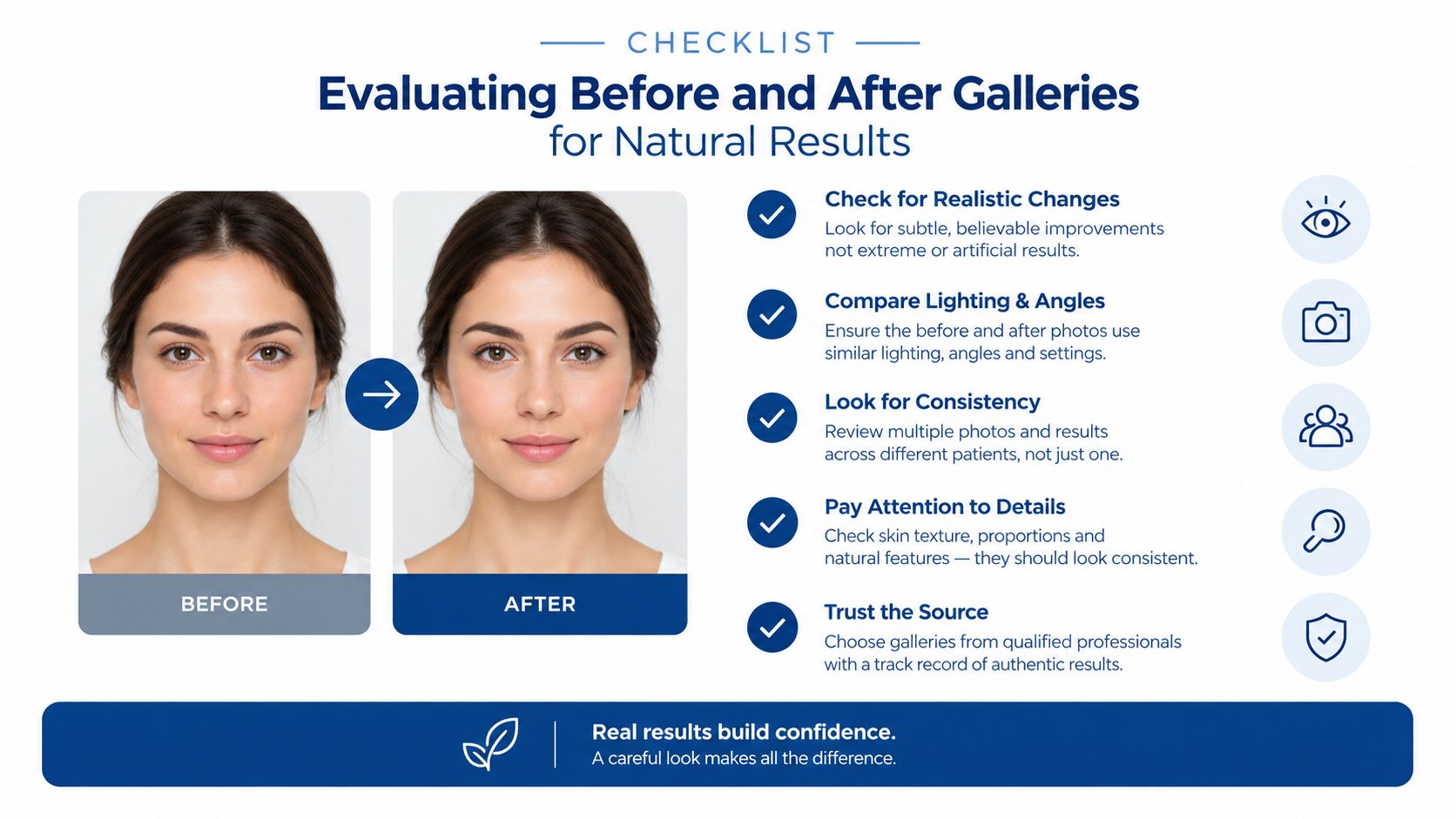
A before-and-after gallery should be evaluated at the belly button, not only at the waistline. A flat abdomen can look impressive in a photograph while the navel reveals excessive circular scarring, poor depth, or an unnatural position.
A focused visual checklist
Start with photographs taken from a straight-on view. Then examine oblique views if they're available, because depth and hooding can disappear in a flat image. Look for:
- Vertical orientation: A natural-looking navel often has a subtle vertical direction rather than a perfectly round outline.
- Controlled depth: The umbilicus should create a soft depression, not appear pasted onto the skin or completely flattened.
- Discreet scarring: A conspicuous circular scar outside the rim can create a bullseye appearance.
- Balanced position: The navel should align with the abdominal midline and sit in proportion to the distance between the upper and lower landmarks of the torso.
- Consistent lighting: Shadows and camera angles can exaggerate irregularities, so compare images under similar conditions.
- Healed examples: Early postoperative images may show swelling and distortion that later settle.
Questions that reveal surgical thinking
Bring the gallery into the consultation. Ask how the surgeon creates depth, where the scar is hidden, how the navel's position is selected, and what happens if the tissue heals with asymmetry or narrowing. You can also ask to see examples involving anatomy similar to yours, especially if you've had major weight change, prior abdominal surgery, or a previous tummy tuck.
Patients considering a consultation with Dr. Justin Yovino or Dr. Sarah Yovino in Beverly Hills, CA can use the belly button repair and umbilicoplasty gallery as a starting point for evaluating navel shape and reconstruction outcomes.
Don't judge a gallery by one dramatic image. Look for a pattern across multiple patients, different body proportions, and healed results. The most useful question isn't whether every navel looks identical. It's whether each one appears proportionate, centered, dimensional, and integrated with the abdomen around it.
Reframing the Focus on Overall Abdominal Contour
The belly button matters, but it's only one part of the operation. A tummy tuck also addresses excess skin, the lower abdominal scar, the relationship between the waist and hips, and, when indicated, the underlying abdominal wall. A natural navel can't compensate for poor scar placement or an abdomen that remains unevenly contoured.
That doesn't make umbilical concerns unimportant. A low position, visible asymmetry, flattening, or a scarred opening can affect clothing and swimwear because the navel is a central visual landmark. Those problems may be improved with revision, while a broader contour problem can require a much larger correction.
For general background on abdominal contouring and fat reduction, readers may also find this 3D Aesthetics Leamington Spa guide to abdominal fat reduction useful. It can help distinguish localized fat concerns from loose skin and abdominal laxity, although an individual surgical plan still requires an examination.
The best consultation prioritizes the whole picture: how much skin needs removal, whether the abdominal wall needs repair, where the scar will sit, how the navel will be positioned, and what revision options exist if healing changes the appearance. Ask your surgeon to explain the plan in relation to your anatomy rather than promising a generic shape.
Ideal Face & Body offers consultations for abdominal contouring and can discuss how full and mini tummy tuck approaches affect the umbilicus, skin, scar placement, and overall proportions. Visit Ideal Face & Body to explore the practice and request a consultation focused on your specific concerns about preserving or reconstructing the belly button.