Most patients feel comfortable returning to work and public life in about 10 to 14 days, while complete biological healing and final refinement can take several months. The answer to how long to recover from blepharoplasty depends on whether you mean looking presentable or reaching the point where the eyelid tissues have fully settled.
You may be planning time away from the office, wondering how you'll look on video calls, or trying to decide whether an upcoming event belongs on your calendar. Those are practical questions, and they deserve a more useful answer than a single recovery number. Blepharoplasty recovery happens in stages, with early swelling and bruising giving way to gradual tissue refinement.
The timeline also differs between upper and lower eyelid surgery, and your surgeon's instructions should take priority over any general guide. Cleveland Clinic describes swelling and bruising as expected early findings, with visible healing continuing after the first two weeks and complete healing taking longer, as outlined in its blepharoplasty recovery guidance.
Table of Contents
- Understanding Social Recovery Versus Biological Healing
- Navigating the First 72 Hours of Peak Swelling
- Days 4 to 14 and Returning to Public Life
- Weeks 3 to 12 and the Final Refinement Phase
- Managing Activity Restrictions and Daily Habits
- Recognizing Normal Symptoms Versus Complications
Understanding Social Recovery Versus Biological Healing
You may look suitable for work while your eyelids are still healing. That distinction helps set realistic expectations after blepharoplasty. Social recovery is the visibility threshold: bruising and swelling have reduced enough for work, public activities, photographs, and video calls. Biological recovery continues as the skin, muscle, connective tissue, incision lines, and deeper eyelid structures heal and remodel.
Health-system guidance commonly places the return to work and public life within a short early recovery window. The NHS says many people take about 2 weeks off work after eyelid surgery, while Alberta Health describes many patients as ready to return to work and public life in about 10 to 14 days in its aftercare information. Your actual timing depends on how visible the bruising is, what your work involves, and how comfortable you feel being seen before every trace of surgery has settled.
Why the two timelines don't match
Bruising often fades before the tissues have finished settling. You might look reasonably normal at work while still noticing tightness, a firm incision, mild redness, morning puffiness, or a small difference between the two sides. These findings do not automatically indicate a poor result. Each eyelid can respond differently to swelling and tissue manipulation, so healing is rarely perfectly symmetrical.
Biological healing continues for months. Alberta Health notes that appearance may keep improving for 1 to 3 months. The final contour cannot be judged reliably while swelling is still fluctuating, even if you already feel comfortable in public.
Practical rule: Plan your calendar around social recovery, but judge the result according to biological recovery.
Upper and lower eyelid expectations
Upper blepharoplasty often feels simpler from a daily-function perspective because the incision is usually placed in the natural upper eyelid crease. Lower blepharoplasty may produce more persistent puffiness or a slower visual transition, particularly when the procedure addresses lower-eyelid fat compartments or skin. Your anatomy, the surgical plan, and your surgeon's technique all influence the pace.
Recovery also varies when surgery involves the upper lids, lower lids, or both. A responsible consultation should identify your likely work window, activity restrictions, eye-care needs, and the point at which residual changes should be reviewed. Plan for improvement in stages, rather than treating the first public appearance as the end of healing.
Navigating the First 72 Hours of Peak Swelling
The first 48 to 72 hours are usually the most demanding part of recovery. Swelling and bruising can look more pronounced after you wake up, and many patients briefly feel they look worse before improvement begins. That pattern is usually part of the inflammatory response, not proof that something has gone wrong.
Your immediate routine
For the first few days, keep the routine deliberately simple:
Use cold compresses carefully. Apply them as your surgical team directs, usually during the first 24 to 48 hours, without pressing on the eyelids or incisions. A clean, cool compress should rest gently over the surrounding area. Excess pressure can irritate fresh tissue, so cooling isn't a reason to squeeze or massage the lids.
Keep your head raised. Surgical literature commonly recommends raising the head at 45 to 60 degrees, including during sleep, to limit fluid accumulation and reduce the chance of increased bleeding. Arrange pillows or a reclining setup before surgery so you aren't improvising while tired.
Avoid bending and heavy lifting. Bending forward, straining, and lifting heavy objects can increase pressure and swelling during this vulnerable period. Keep essentials at waist level, and ask someone else to handle childcare, pets, shopping, or household tasks that require effort.
Protect the eyelids from rubbing. Tearing, dryness, tightness, and blurred vision from ointment can occur early. Follow the prescribed eye-care plan and don't rub away crusting or touch the incisions unnecessarily.
The blepharoplasty procedure overview can also help you understand the procedure itself and why the first days require protection rather than activity.
What peak swelling looks like
You may notice puffy lids, bruising that becomes darker before it lightens, mild asymmetry, watery eyes, or a sensation of tightness. The eyelids can feel heavy, and morning swelling may be particularly noticeable because you've been lying down. You should be able to distinguish expected discomfort from escalating or severe symptoms.
Cold compresses and elevation help manage the early phase, but they don't erase it. Trying to accelerate healing by exercising, applying pressure, scrubbing the skin, or repeatedly inspecting the incisions usually works against your recovery.
If you're also caring for another eye procedure, keep its aftercare separate and follow the relevant clinical plan. A resource on a cataract eye drop routine may be useful for understanding how structured eye care is organized, but it doesn't replace your blepharoplasty instructions.
Days 4 to 14 and Returning to Public Life
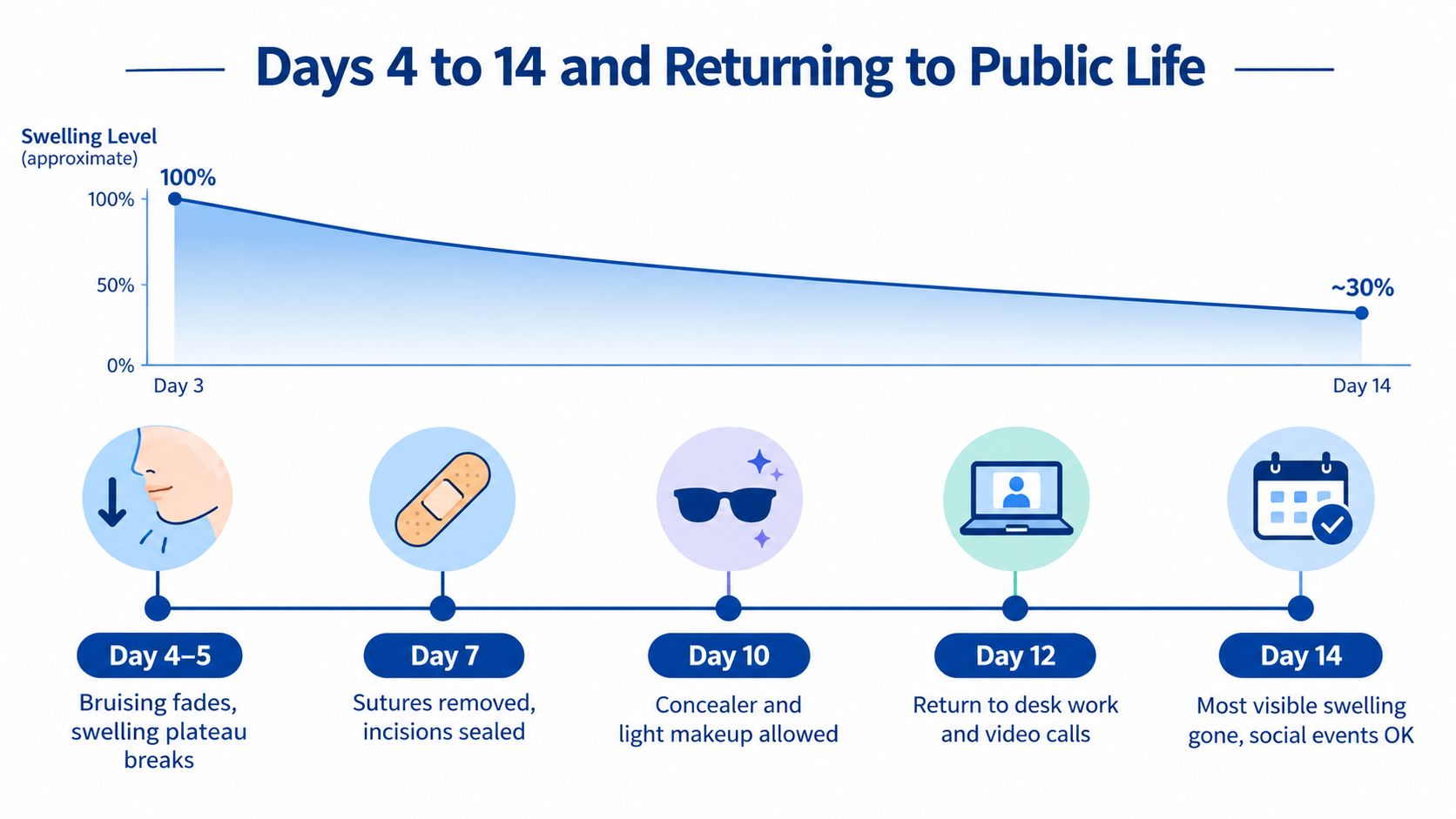
By the fourth day, the direction of change often becomes easier to recognize. Swelling may stop increasing and begin to recede gradually, while bruising shifts from darker tones toward lighter purple, green, or yellow. You may still look noticeably postoperative to yourself, even when other people see only mild residual changes.
A patient with a desk-based job might spend these days doing light tasks at home, testing screen tolerance, and taking short walks without straining. Someone who works in person or appears on camera may prefer to wait longer, particularly if the surgery involved both upper and lower lids. The correct return date depends on comfort, vision, job demands, and how much privacy you want around the procedure.
Milestones that restore independence
Removable sutures are commonly taken out around days 5 to 10, depending on the surgical plan and the surgeon's assessment. Once the incisions are appropriately closed and your team approves it, light makeup may help camouflage residual discoloration. Don't apply cosmetics directly over an open or irritated incision just to meet a calendar deadline.
Driving requires more than feeling alert. You need clear, reliable vision, no significant visual obstruction, and no narcotic pain medication affecting your reactions. Your surgeon should confirm when driving is appropriate for you, especially if swelling, ointment, tearing, or light sensitivity remains.
The practical public-life window is usually around 10 to 14 days. The NHS's guidance on taking about 2 weeks off work supports that planning approach, while Alberta Health notes that bruising and swelling can remain present for 1 to 3 weeks even as patients resume normal routines.
Planning work and social events
Use a staged return rather than assuming you'll wake up on one specific day looking exactly as you did before surgery:
- Desk work: Return when you can concentrate, manage screen time, and attend meetings comfortably.
- Video calls: Schedule them after the most obvious bruising has improved, and allow for lighting and camera angles that may emphasize swelling.
- Public events: Give yourself flexibility around the 10 to 14 day milestone, especially for an important photograph or formal gathering.
- Makeup: Use it only after your surgeon confirms the incision is ready and avoid rubbing when removing it.
Minor swelling at this stage doesn't mean you need to cancel every plan. It means your social recovery has arrived while biological healing continues.
Weeks 3 to 12 and the Final Refinement Phase
The point at which you resume normal routines is not the point at which healing stops. From the third week through the following months, the eyelid tissues continue to soften, contract, and settle. Incision lines gradually become less firm, tightness eases, and small differences in swelling become less noticeable.
Patients often focus on one eye appearing slightly more open or one side feeling tighter. Mild asymmetry can reflect unequal swelling, differences in sleeping position, or the normal fact that the two sides don't heal at exactly the same speed. Early comparisons can be misleading, particularly when you inspect the eyes repeatedly under different lighting.
What changes beneath the surface
Visible bruising may have largely resolved, but the deeper tissues are still remodeling. The skin around the eyelids is thin, and small amounts of retained swelling can alter the crease, lash-line contour, or lower-lid transition. As that fluid resolves, the appearance can change without any new treatment.
The same applies to scars. An incision may feel raised, itchy, numb, or tight before it becomes softer and less noticeable. Protecting the area from sun exposure and following your surgeon's wound-care plan supports the normal maturation process, but no topical product can force tissue to finish healing immediately.
Why patience matters
Cleveland Clinic notes that complete healing can take a few months, and Alberta Health says appearance may continue improving for 1 to 3 months. That period is when a result moves from an early postoperative shape toward a more settled contour.
Contact your surgeon if a symptom is worsening rather than gradually improving, or if one-sided swelling, pain, redness, drainage, or vision changes develops. Otherwise, fluctuating tightness or subtle asymmetry is often best handled with observation and scheduled follow-up rather than premature judgment.
Managing Activity Restrictions and Daily Habits
Recovery depends partly on how you use your body. A quiet walk and a strenuous workout don't place the same demand on healing tissues, just as washing gently differs from scrubbing the eyelids or applying irritating skincare. The safest approach is gradual reintegration, guided by your surgeon rather than by how energetic you feel.
The Mayo Clinic recommends avoiding strenuous activity for about 1 week and avoiding contact lenses for about 2 weeks in its blepharoplasty guidance. Those restrictions reflect the difference between feeling capable and being ready to stress healing tissue.
| Activity | Safe to Resume | Precautions |
|---|---|---|
| Gentle walking | When your surgeon allows it | Keep the pace easy and stop if swelling increases |
| Strenuous exercise | Usually after about 1 week | Resume gradually and avoid immediate high-intensity effort |
| Heavy lifting | After the early restriction period | Avoid straining and breath-holding |
| Yoga or inverted positions | Only after clearance | Positions with the head below the heart can increase facial pressure |
| Contact lenses | Usually after about 2 weeks | Wait longer if insertion causes pulling, dryness, or irritation |
| Eye makeup | After incision closure and surgeon approval | Apply and remove it without rubbing |
| Swimming or soaking | After explicit approval | Protect healing incisions from water exposure and contamination |
| Harsh skincare | After the skin has settled | Keep acids, scrubs, and irritating products away from fresh incisions |
Head elevation and sleep-position control remain useful during the early period. Authoritative surgical literature also emphasizes cold compresses during the first 3 days and avoiding bending or heavy lifting during the first postoperative week, as summarized in this clinical review of postoperative care.
What helps and what doesn't
Helpful habits are boring but effective: prepare food, arrange transportation, keep medications organized, and limit tasks that make you bend or strain. Sunglasses can improve comfort outdoors, but they shouldn't become an excuse to resume activities before your surgeon clears them.
A general comprehensive recovery guide 2026 may offer broader home-care planning, but your eyelid-specific instructions remain the deciding reference. Nutrition, hydration, and general health also matter, and this guide to maximizing surgery outcomes with good health and nutrition provides related preparation context.
Recognizing Normal Symptoms Versus Complications
Redness and swelling don't automatically signal a complication. Freshly operated eyelids commonly look uneven, feel tight, and produce sensations that seem alarming when you haven't experienced them before. The more useful question is whether the symptom is stable or gradually improving, or whether it is rapidly intensifying.
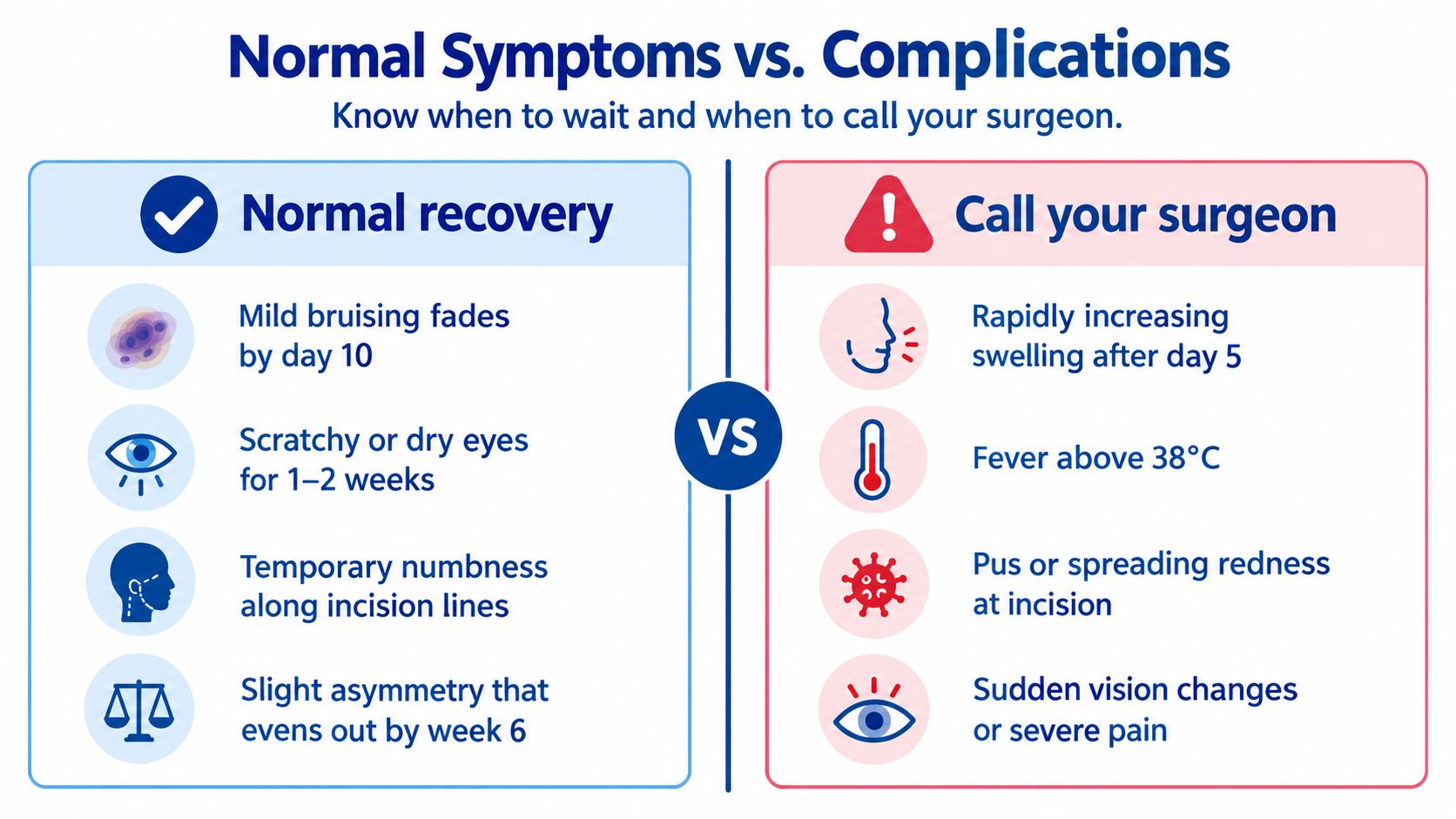
Expected findings can include bruising, temporary dryness, tearing, mild itching, numbness along an incision, and a modest difference between the sides. Cambridge University Hospitals notes that swelling generally subsides over a few days and bruising commonly resolves within 2 weeks in its blepharoplasty patient information. Alberta Health also describes swelling and bruising lasting 1 to 3 weeks, with appearance continuing to improve afterward.
Call promptly when the pattern changes
Contact your surgical team for an assessment if you notice:
- Rapidly increasing swelling: Particularly when it develops after the initial peak or is markedly worse on one side.
- Severe or escalating pain: Pain that doesn't respond to the prescribed plan deserves attention.
- Vision changes: Sudden changes, significant blurring, double vision, or any new visual disturbance should be reported promptly.
- Possible infection: Fever, pus, spreading redness, warmth, or worsening drainage requires medical review.
- Persistent bleeding: Bleeding that doesn't settle with the method your surgical team provided needs prompt guidance.
Don't wait for a routine appointment if you develop sudden vision changes or severe pain. If symptoms are mild but concerning, call the office and describe when they began, whether they're worsening, and whether one side is affected more than the other.
A consultation should also cover the broader eyelid surgery risks before surgery, so you know which symptoms require observation and which require immediate contact. Ideal Face & Body offers eyelid lift consultations and surgical care with recovery planning for the procedure and the patient's daily needs. Visit Ideal Face & Body to discuss your anatomy, expected social recovery, and the steps that support safe biological healing.