
You've probably already had the same experience many men in Los Angeles have. You work out, clean up your diet, and still catch yourself seeing the same chest fullness in the mirror, especially in fitted shirts or under gym lights. At that point, the key question isn't whether you can try harder, it's whether the fullness is fatty, glandular, or mixed, because that answer determines whether gynecomastia surgery is the right fix.
For men researching gynecomastia surgery Los Angeles, the decision often comes down to two practical issues, what tissue is present and whether the operation can be done awake with local anesthesia instead of traditional general anesthesia. In a market like Beverly Hills, CA, that distinction matters. The surgical plan should match the tissue, the recovery should match the person's schedule, and the anesthesia plan should match the complexity of the case. For broader context on how Los Angeles practices approach digital visibility and patient education, digital marketing articles by Data Hunters can be a useful side resource, but the decision still starts with anatomy and candidacy.
Table of Contents
- Why Men in Los Angeles Are Choosing Chest Contouring
- Understanding Gynecomastia and Tissue Composition
- Comparing Liposuction Excision and Combination Techniques
- The Awake Local Anesthesia Approach to Gynecomastia Surgery
- Recovery Timeline and What to Expect After Surgery
- How to Choose the Right Surgeon in Beverly Hills
- Frequently Asked Questions About Male Chest Contouring
Why Men in Los Angeles Are Choosing Chest Contouring
A lot of men arrive after they've already done the hard part. They've lost weight, trained consistently, and still have a chest that projects in a way that doesn't match the rest of their body. That's the moment when consultation becomes useful, because the problem may no longer be about fitness, it may be about true breast tissue, stubborn fat, or both.
That's also why gynecomastia surgery remains a common male cosmetic operation in the United States, with 23,831 breast reduction procedures in males in 2023, up from 22,900 in 2022, roughly a 4% year-over-year increase according to the American Society of Plastic Surgeons 2023 cosmetic procedures in men report. That national volume matters in Los Angeles because this city sits inside one of the country's largest cosmetic-surgery markets, where patients expect specialized evaluation and surgeons routinely discuss contouring options rather than treating male chest reduction as a one-off request.
What patients are usually trying to solve
The visible issue is often only part of the story. Men also talk about shirts fitting differently, avoiding certain fabrics, or feeling guarded when they're at the beach, in a locker room, or in a social setting where the chest is exposed.
Practical rule: if the chest fullness has stayed despite stable exercise habits, the next step isn't another workout plan, it's a tissue exam.
In Los Angeles and Beverly Hills, CA, that exam typically leads to a discussion of liposuction, gland excision, or a combination of both. That's because surgical planning isn't generic. A patient with mostly fatty fullness needs a different approach than someone with dense gland beneath the areola. A high-quality consultation should make that distinction clear before anyone talks about treatment.
Understanding Gynecomastia and Tissue Composition
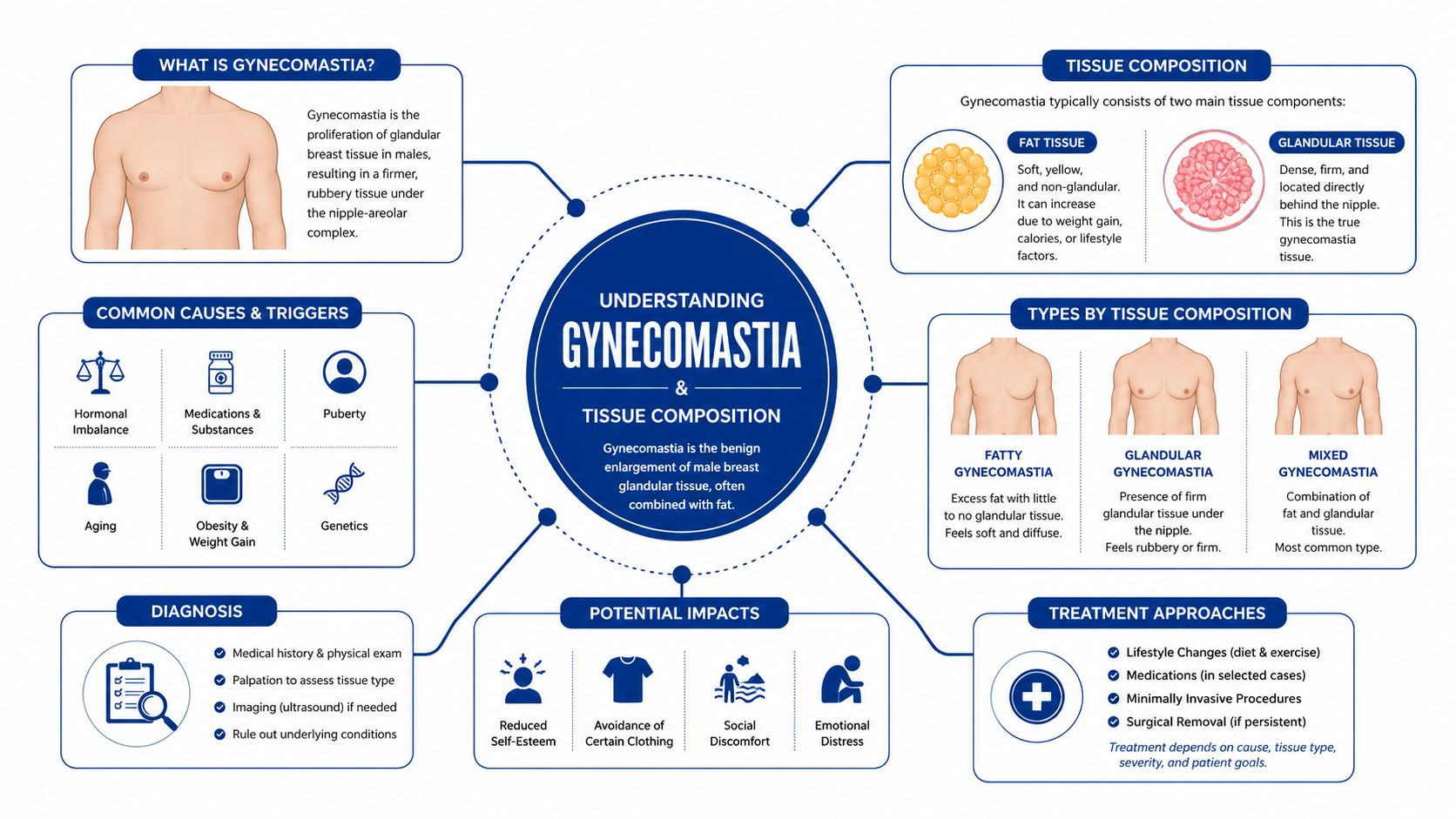
Gynecomastia means enlarged male breast tissue. Clinically, that enlargement can come from fatty tissue, glandular tissue, or both, and it can affect one side or both sides of the chest. That distinction sounds simple, but it's the core of the whole treatment plan, because each tissue type behaves differently under the scalpel and cannula.
Why the tissue type matters more than the label
If the fullness is mostly fat, liposuction can often address it well. If there's a firm gland under the nipple-areola complex, liposuction alone usually won't solve the problem because dense gland doesn't suction away the same way fat does. If the chest has both fat and gland, the plan usually needs both contouring and direct removal.
That's why a physical exam matters before anyone commits to surgery. The surgeon is trying to separate true gynecomastia from pseudogynecomastia, the latter being fat-only enlargement without true glandular overgrowth. If the wrong diagnosis is made, the result can be under-correction, contour irregularity, or the wrong procedure.
What a proper evaluation should sort out
A solid workup looks at more than the chest itself. It also considers whether the enlargement could relate to medications, hormonal imbalance, liver issues, or testicular causes. If the underlying driver is medical rather than structural, the surgical plan may need to be delayed or coordinated with other care.
The important takeaway is straightforward. The operation is chosen after the tissue is identified, not before. That's how a surgeon avoids using liposuction where gland excision is needed, or excising gland while leaving behind too much fatty fullness around it.
A patient doesn't need to know the anatomy in advance, but he should expect the surgeon to explain it clearly before surgery is scheduled.
Comparing Liposuction Excision and Combination Techniques
The practical difference between techniques comes down to what each method can remove. Liposuction addresses fat. Direct excision removes gland. Combination surgery handles both when the chest has mixed tissue, which is common enough that it often becomes the most useful plan.
A peer-reviewed review of gynecomastia surgery found that skin-sparing mastectomy with or without liposuction was the most frequently reported technique, appearing in 10 of 17 included studies, while mastectomy with skin reduction appeared in 8 studies. Those numbers don't mean every patient needs those exact methods, but they do show that the field relies on a layered approach rather than one universal operation. The Cleveland Clinic description of gynecomastia surgery also notes that surgery may include liposuction, excision, or both, and that results are generally permanent, though swelling can delay the visible endpoint for 3 to 6 months.
How surgeons usually match technique to tissue
In Los Angeles practices, liposuction is typically the first choice when the chest is mostly fatty. Small access points and contouring cannulas can refine the chest without a large incision when the gland is minimal.
Direct excision is the better answer when the gland is firm and concentrated behind the areola. That tissue often needs a periareolar incision, because the surgeon has to physically remove what suction can't. The incision is usually placed where the color change of the areola helps conceal it.
Combination surgery is the workhorse for mixed cases. Fat gets reduced with liposuction, then the gland gets removed directly so the chest doesn't stay puffy or projected. When there's meaningful skin excess, the surgeon may also need a skin-resection strategy to tighten the envelope and avoid a deflated look.
Technique comparison table
| Technique | Best For | Incision Type | Typical Duration |
|---|---|---|---|
| Liposuction | Mostly fatty fullness | Tiny access points | Often roughly 1 to 2 hours in typical cases |
| Direct excision | Dense glandular tissue | Usually periareolar | Often roughly 1 to 2 hours in typical cases |
| Combination technique | Mixed fat and gland | Access points plus periareolar incision | Often roughly 1 to 2 hours in typical cases |
| Skin-sparing or skin-reduction approach | Higher-grade cases with excess skin | Larger tailored incision pattern | Varies with tissue excess |
The right method is the one that solves the actual problem without over-treating tissue that doesn't need removal. In male chest contouring, restraint matters as much as removal.
The Awake Local Anesthesia Approach to Gynecomastia Surgery
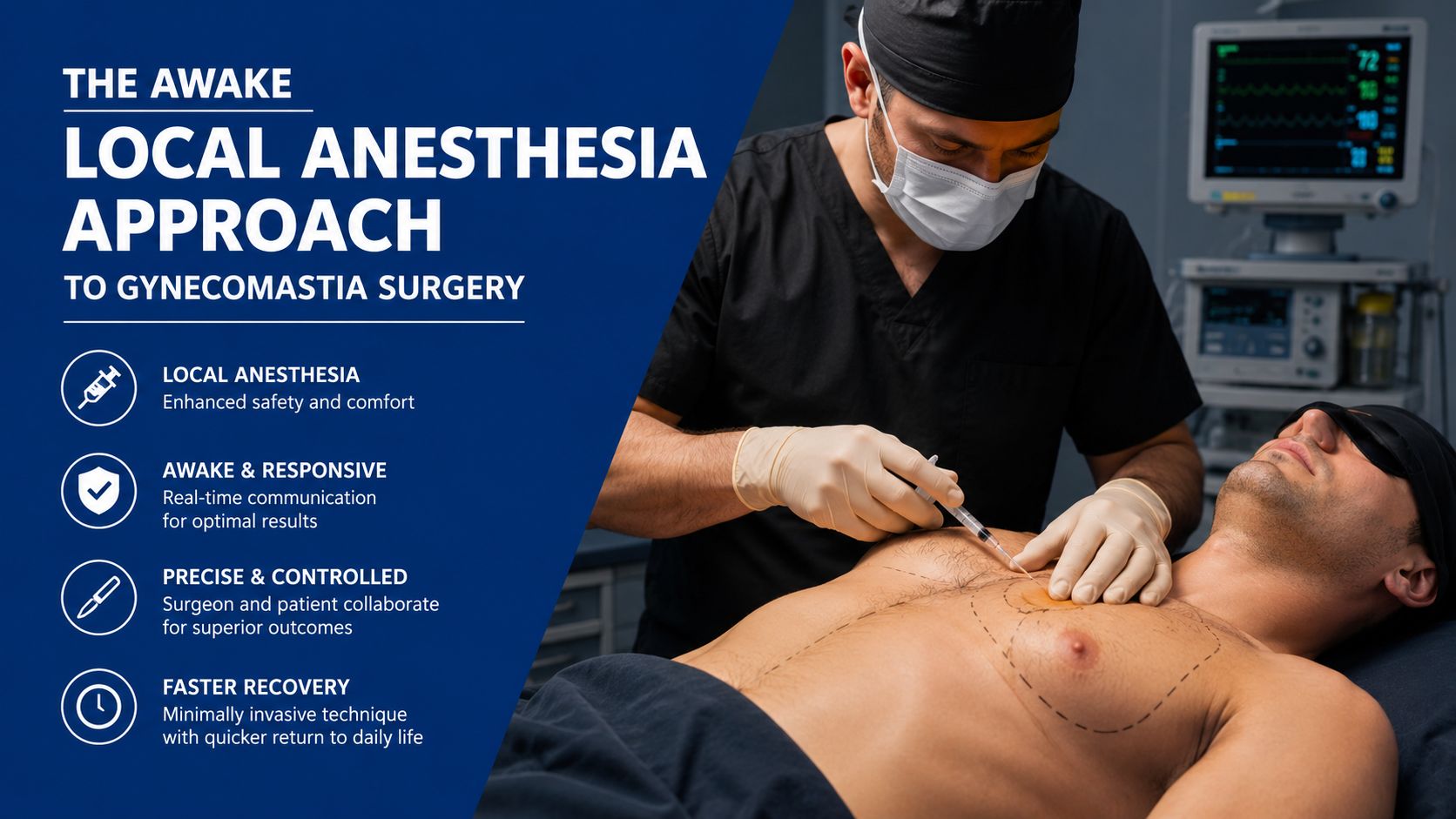
Most men who search for male breast reduction assume they'll need general anesthesia. That's not always true. In an awake, office-based model, the chest can be numbed with local anesthesia, and the procedure can be performed while the patient remains comfortable and responsive.
Why awake surgery changes the experience
The biggest difference is what doesn't happen. There's no intubation, no general anesthetic recovery, and no IV-based operating room pathway in the typical office-based awake model. For the right patient, that can mean a simpler perioperative experience and a faster return to the normal rhythm of the day.
The other advantage is precision. When a case is focused on contouring rather than major reconstruction, awake surgery lets the surgeon assess the chest in real time while the patient is already in the position used for treatment. That's one reason awake, local-anesthesia breast and body procedures have become a defining feature of Ideal Face & Body in Beverly Hills, CA under Dr. Justin Yovino, a double board-certified plastic surgeon. The practice's broader awake-surgery framework is also outlined in its awake surgery complete guide.
What patients worry about, and what actually helps
Most concern comes from the idea of being awake during surgery, not from the surgery itself. In practice, tumescent local anesthesia is designed to thoroughly numb the area, and the team's job is to maintain comfort, position, and communication throughout the case.
Some offices also integrate laser liposculpting tools into the awake model. In the right hands, that can support precise fat reduction and contour refinement. The important point is not the brand name of the device, it's whether the surgeon can use the awake setting to match the technique to the tissue.
Awake surgery is not a shortcut. It's a different pathway, and it works best when the case is selected correctly.
For men comparing anesthesia options, the trade-off is simple. General anesthesia may feel more familiar, but awake local anesthesia can be a cleaner fit for selected chest contouring cases. The surgeon should explain why one path makes more sense than the other based on tissue type, anxiety level, and the extent of excision required.
Recovery Timeline and What to Expect After Surgery
The recovery from gynecomastia surgery is usually manageable, but it isn't instant. Early improvement shows up quickly, while the final chest shape takes time to settle as swelling fades. Cleveland Clinic notes that visible refinement can take 3 to 6 months, even when the operation itself is straightforward.
The first days
The early focus is compression, rest, and protecting the shape the surgeon created. A compression garment supports the chest, limits fluid buildup, and helps the skin adapt to the new contour. Patients usually need to keep movement controlled, especially when lifting the arms or putting tension across the incision areas.
Showering, sleep position, and activity limits depend on the surgeon's protocol, but the general principle is consistent. Don't rush the chest. The tissue needs time to settle, and the garment does part of the work during that stage.
The compression garment guidance after liposuction is a helpful companion reference for patients trying to understand why compression matters so much after contouring.
Weeks two through four
Most men are moving more comfortably by this point, though the chest can still feel tight or uneven from swelling. Light daily activity usually returns before exercise does. The chest may look better already, but it won't look finished yet.
Many patients get impatient at this stage. That's a mistake. If the tissue was mixed or the gland was dense, the skin still needs time to contract and the contour needs time to sharpen.
Final shape is a healing process, not a same-day event.
What to watch for
Normal recovery means gradual improvement, some swelling, and a contour that becomes more refined over time. Concerning recovery means pain, redness, drainage, or a chest that gets worse instead of better. Those symptoms should trigger a call to the surgeon rather than a wait-and-see approach.
How to Choose the Right Surgeon in Beverly Hills
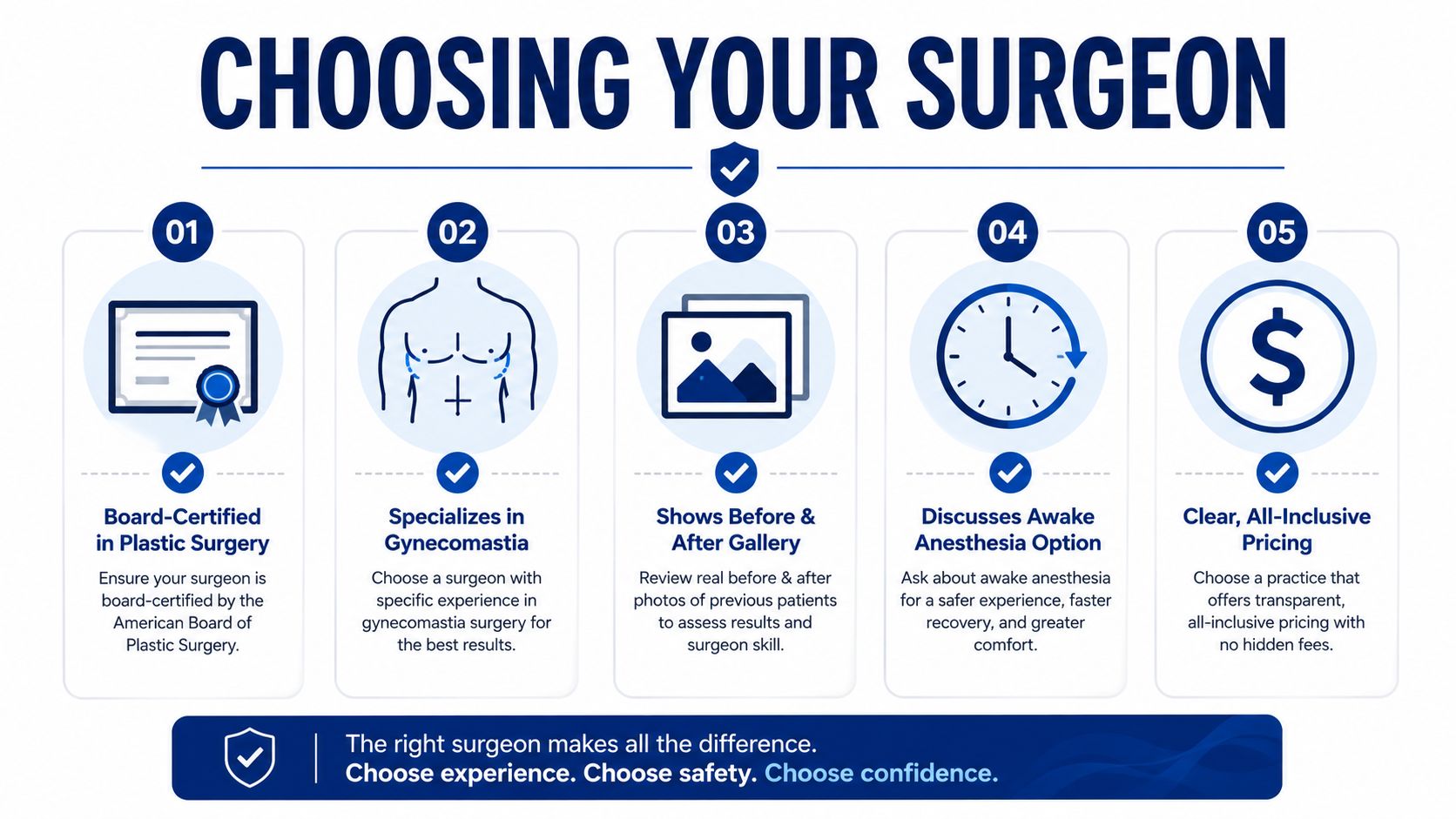
A strong consultation in Beverly Hills, CA should sound specific, not generic. The surgeon should explain whether the chest fullness is fat, gland, or both, then connect that finding to a technique and an anesthesia plan. If that discussion stays vague, the consultation is not complete.
Questions that separate a specialist from a generalist
Start with the tissue question. Ask how the surgeon decides whether liposuction alone is enough or whether direct excision is needed. Then ask what incision they expect to use and why that placement fits your anatomy.
The anesthesia discussion matters just as much. If awake local anesthesia is available, the surgeon should explain which cases are appropriate for it and which ones are not. A good answer includes comfort, safety, and the practical limits of an office-based procedure, not just a sales pitch about convenience.
For a closer look at the standards to apply during your search, see our guide to finding the best gynecomastia surgeon.
Finally, ask to see before-and-after examples of cases that resemble yours. A patient with mild, fatty fullness should not judge results from a severe mixed-tissue case, and the reverse is true as well.
One practical option in this market is Ideal Face & Body, which performs male breast correction in Beverly Hills, CA and focuses on awake, office-based procedures under local anesthesia. That matters because the right practice should match its methods to the patient, not force every chest into the same pathway.
What strong credentials look like
Board certification in plastic surgery should be required. Double board certification adds another layer of confidence when the surgeon is handling both contour and operative planning. Experience with gynecomastia specifically matters because chest shaping in men follows different aesthetic rules than other body procedures.
Ask for the explanation, not just the promise. The strongest consults make the plan understandable before they make it appealing.
If the answers are clear, the next step is usually straightforward. If they are not, keep looking. Male chest contouring is too anatomy-dependent to leave to a one-size-fits-all approach.
Frequently Asked Questions About Male Chest Contouring
Can gynecomastia come back after surgery?
Removed glandular tissue does not regrow in the same way, but new chest fullness can develop if weight changes significantly or if an underlying medical or hormonal issue isn't addressed. Stable habits matter after recovery.
Will there be visible scars?
Scarring depends on the technique. Tiny access points for liposuction are usually less noticeable than a periareolar incision for gland removal, and skin-reduction cases leave more visible incision patterns because they have to remove more tissue.
Is the procedure only for younger men?
No. Age isn't the deciding factor. Tissue type, overall health, and the reason for the enlargement matter more than the birthdate.
What if one side is worse than the other?
That's common. The surgeon can tailor the plan side by side, but asymmetry should be discussed upfront so expectations stay realistic.
Does pricing stay the same from patient to patient?
No, it varies with the amount of tissue removed, the technique needed, and the anesthesia plan. Personalized evaluation is the only honest way to quote a case.
If enlarged chest tissue is still affecting how you dress, train, or carry yourself, schedule a consultation with Ideal Face & Body. A careful exam can determine whether you need liposuction, excision, a combination approach, or a true awake local-anesthesia plan in Beverly Hills, CA.