Blepharoplasty usually takes about 45 to 60 minutes for the upper lids and up to 2 hours when the upper and lower lids are treated together. The total visit is longer than the surgery itself because preparation, anesthesia, recovery, and discharge are part of your day.
You may be looking at a work calendar, arranging a ride, or trying to decide whether eyelid surgery fits into a busy week. The most useful answer depends on which eyelids are treated and what the operation involves, but the clock becomes much easier to understand once you separate operative time from facility time.
Table of Contents
- The Short Answer on Blepharoplasty Surgery Time
- Upper Lids Versus Lower Lids Versus Both
- What Actually Adds Minutes During Surgery
- Procedure Time Versus Total Visit Time
- How Anesthesia Choice Changes the Clock
- Procedures Often Combined With Blepharoplasty
- Planning Your Day Around the Surgery
The Short Answer on Blepharoplasty Surgery Time
You may be fitting eyelid surgery between work, school pickup, or a ride arranged by someone else. Plan around two clocks: the operative clock, which measures the surgeon's work, and the facility clock, which covers your entire visit.
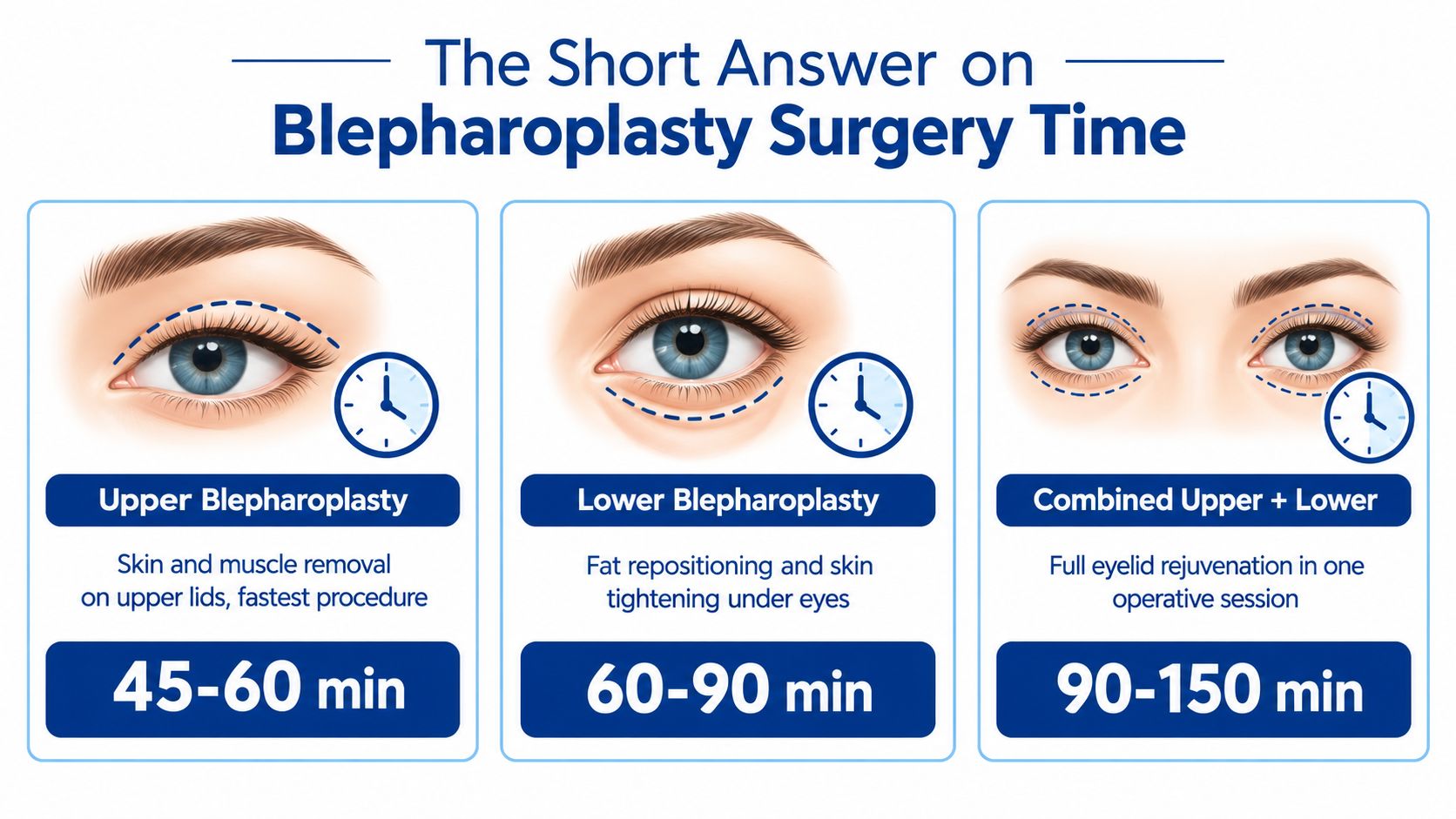
For a typical upper blepharoplasty, the operative window is about 45 minutes to 1 hour, according to a Cleveland Clinic patient guide to blepharoplasty. Treating both upper and lower eyelids in one session usually takes about 2 hours, although fat repositioning or other added work may extend the operation. UK guidance gives a broader eyelid-surgery range of approximately 45 minutes to 2.5 hours, and notes that patients commonly go home the same day, as described by the National Health Service eyelid-surgery guidance.
The operative clock starts with the first incision and ends with the final suture. The facility clock starts earlier. It includes check-in, medical review, surgical marking, anesthesia preparation, the procedure, recovery monitoring, discharge instructions, and the time required for your escort to collect you. In an awake, office-based setting, that schedule may be simpler, while sedation or general anesthesia can add preparation and recovery steps.
Planning rule: Reserve time for the full visit, not only for the minutes when the surgeon is operating.
Four variables commonly change the operative window:
- Which lids are treated: Upper-only surgery is generally shorter than lower-lid or combined surgery.
- How much tissue needs attention: Skin-only work is usually more straightforward than treatment involving muscle, fat, or lid support.
- The anesthesia setting: Local anesthesia in an office follows a different schedule from sedation or general anesthesia.
- Additional procedures: Brow, eyelid-muscle, fat-transfer, resurfacing, or revision work can lengthen the day.
Ask your surgeon for both times: the expected operation length, and your arrival-to-departure window. The second answer guides transportation, meals, work, and help at home.
Upper Lids Versus Lower Lids Versus Both
The scope of surgery gives you the simplest starting point for estimating operative time. Upper eyelid surgery often focuses on excess skin, with selective attention to muscle or fat when the anatomy calls for it. Lower eyelid surgery may require more delicate work around fat compartments, the orbital rim, and the structures supporting the lower lid.
| Procedure Scope | Operative Time | Primary Goal |
|---|---|---|
| Upper blepharoplasty | About 45 to 60 minutes | Reduce upper-lid hooding and, when appropriate, improve the effect of excess skin on the visual field |
| Lower blepharoplasty | Often longer than upper-only surgery, depending on fat and skin work | Reduce lower-lid bags, puffiness, and contour irregularity |
| Combined upper and lower blepharoplasty | About 90 minutes to 2 hours in many standard cases | Address aging around the eye as one coordinated area |
The upper lids are usually the most predictable starting point. A surgeon may remove carefully measured skin and, when indicated, a limited amount of orbicularis muscle or fat. The eyelid lift and blepharoplasty information from Ideal Face & Body can help you understand how the treatment is selected for the upper and lower lids rather than based on a fixed template.
Lower-lid surgery has more technical variation. A simple skin pinch may be relatively limited, while treatment that repositions fat across the tear trough or reinforces the outer corner requires additional dissection and precision. That's why two patients who both describe their procedure as “lower blepharoplasty” may have different operative windows.
A practical way to estimate your case
Ask yourself which of these descriptions matches your consultation:
- Upper lids only, mainly excess skin: Plan around the upper-lid range.
- Lower lids with bags, fat repositioning, or skin tightening: Expect a longer and more variable operation.
- Upper and lower lids together: Use the combined range as your starting point.
- Eyelid surgery plus another facial procedure: Ask for a separate estimate for the added procedure and the complete surgical block.
The range is not a promise. Your surgeon must examine skin quality, fat distribution, muscle activity, lid position, symmetry, and any previous surgery before giving you a patient-specific estimate.
What Actually Adds Minutes During Surgery
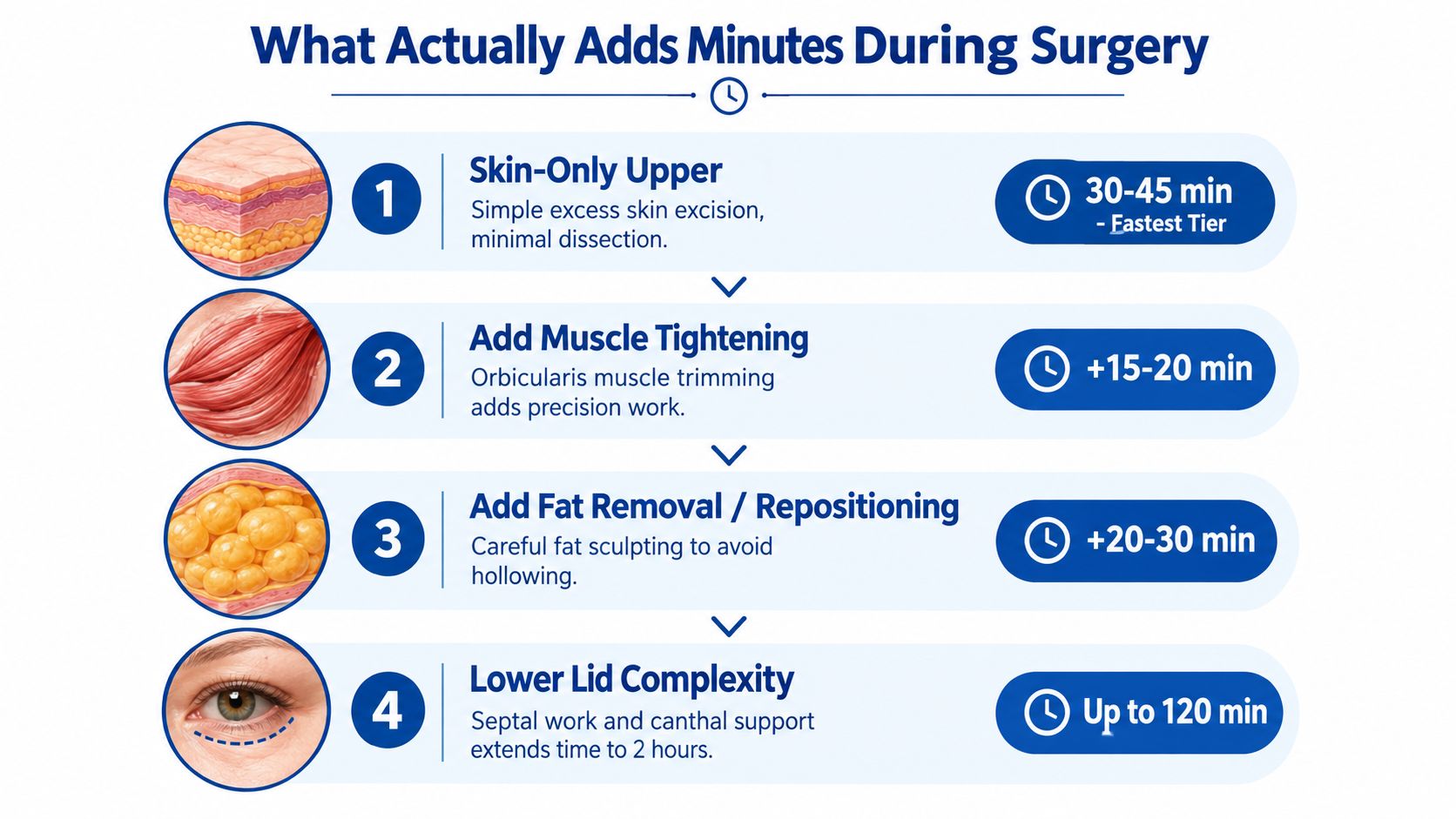
Not every eyelid operation involves the same amount of tissue work. A large clinical series reported mean operative times of 60.2 ± 11.7 minutes for skin-only upper blepharoplasty and 72.2 ± 22.8 minutes when orbicularis muscle and/or preaponeurotic or nasal fat pad excision was added, as shown in this peer-reviewed clinical series on upper blepharoplasty. The difference illustrates a basic surgical principle: more tissue layers usually require more dissection, inspection, and closure.
Skin-only surgery is the fastest tier because the surgeon can concentrate on marking, measured excision, hemostasis, and closure. Once muscle or fat enters the plan, the surgeon must work through deeper anatomy while protecting the structures responsible for eyelid movement and contour.
The tissue-level reasons for a longer operation
- Skin: Removing only the planned excess skin generally requires the least dissection.
- Orbicularis muscle: Muscle trimming adds precision because the surgeon must preserve appropriate eyelid function and avoid excessive removal.
- Upper-lid fat: Sculpting or removing fat takes judgment. The goal isn't just to remove volume, because over-resection can create a hollow appearance.
- Lower-lid fat: Repositioning fat across the orbital rim involves careful release and placement rather than a simple excision.
- Outer-corner support: Canthal support adds another technical step when the lower lid needs reinforcement.
These elements can stack. A case that begins as upper skin excision may become longer when muscle is addressed and fat is sculpted. A lower-lid operation can take still more time when the surgeon combines fat repositioning with skin management and support of the outer corner.
The clinical data above shouldn't be used to calculate your operation minute by minute. It's more useful as an explanation for why a surgeon may recommend a broader window after seeing muscle fullness, prominent fat, skin laxity, or previous surgical changes.
A longer estimate often reflects a more detailed plan, not a problem with your surgery.
Procedure Time Versus Total Visit Time
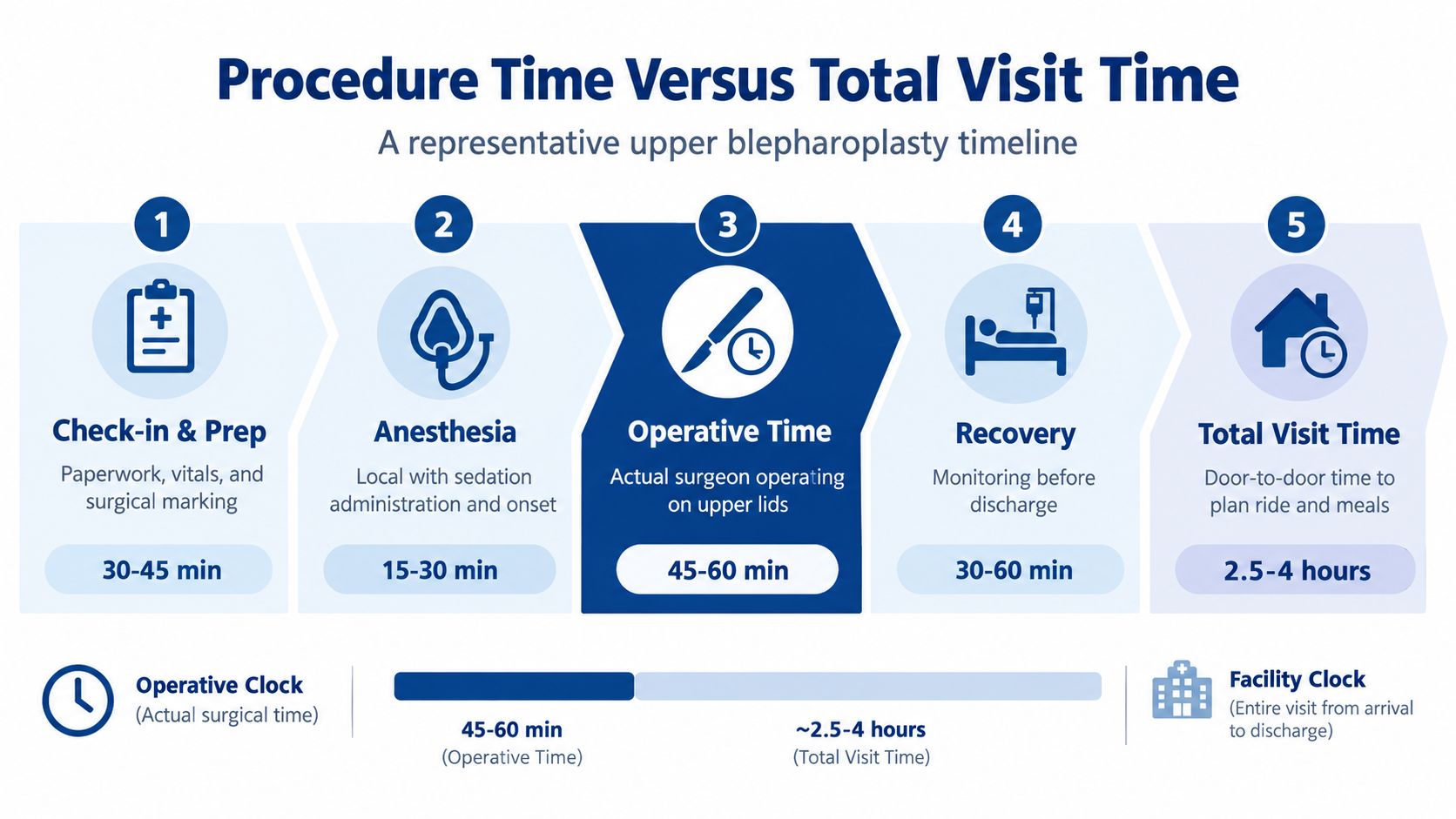
Your operative time and your facility time are two separate clocks. An upper blepharoplasty may involve 45 to 60 minutes of actual surgery, but that interval covers only the period from incision to closure. Awake, office-based treatment under local anesthesia is a common modern pathway for appropriately selected patients, yet you still need to arrive before the first incision.
Before surgery, the team may review your medical history, confirm consent, record vital signs, mark your eyelids while you are upright, prepare the treatment area, administer anesthesia, and answer final questions. These steps form the first part of the facility clock.
Afterward, you remain under observation until you are alert, stable, comfortable, and ready for discharge. The team also reviews wound care, medication, activity limits, warning signs, and transportation arrangements. Recovery does not run at the same pace for every patient, so the schedule may include extra time.
What your facility clock includes
- Arrival and check-in: Identification, forms, medical review, and confirmation of the surgical plan.
- Marking and preparation: The surgeon marks the eyelids, and the team prepares the treatment area.
- Anesthesia setup: Local anesthetic, oral medication, intravenous sedation, or another planned approach changes the preparation sequence.
- Operative time: The incision-to-closure window.
- Recovery and discharge: Monitoring, comfort assessment, instructions, and escort coordination.
A short operation can still require a longer day. The specialty eye-surgery explanation of procedure time versus facility time describes this practical difference between the surgical interval and the preparation and recovery surrounding it. Do not tell your driver to arrive exactly when the operation ends.
Ask the practice for two estimates: “How long will the surgery take?” and “How long should I expect to be at the facility?” The first explains the procedure itself. The second tells you how much time to reserve for the complete visit.
How Anesthesia Choice Changes the Clock
At your consultation, two clocks matter. The first measures the operation itself. The second measures how long anesthesia preparation, monitoring, and discharge keep you at the facility. Anesthesia choice can change the second clock more than the first.
Many blepharoplasty operations use local anesthesia, sometimes with sedation. General anesthesia may be considered for selected cases and patients. The UK patient leaflet on blepharoplasty describes local anesthesia as the usual approach, while noting that sedation or general anesthesia may also be used.
Compare the anesthesia pathways
| Anesthesia Type | Operative Time Added | Recovery Time | Total Visit |
|---|---|---|---|
| Local anesthesia | Usually limited to numbing and preparation | Typically shorter observation | Often the shortest facility stay |
| Local anesthesia with sedation | Adds medication administration and monitoring | Longer observation than local alone | Longer than an awake local case |
| General anesthesia | Requires broader preparation and a monitored wake-up | More observation before discharge | The most involved facility schedule |
For an appropriately selected patient, an awake, office-based procedure under local anesthesia is a practical modern pathway. It may avoid an intravenous line and general anesthesia, but the choice still depends on the operation, overall health, anxiety level, and surgeon's protocol. Local anesthesia does not make eyelid surgery casual. Sterile preparation, careful monitoring, and a safe discharge plan remain necessary.
Ideal Face & Body describes its plastic surgery under local anesthesia approach as office-based care for selected procedures. Ask whether your planned eyelid surgery can be performed while you are awake, whether oral medication is appropriate, and what restrictions follow any sedating medication.
Sedation also affects your ride home. Medication can temporarily reduce alertness and judgment, even when the incision and operative interval are limited. Arrange transportation according to the anesthesia plan, not only the expected surgical time.
Procedures Often Combined With Blepharoplasty
Blepharoplasty may be performed alone or combined with another procedure when the surrounding anatomy contributes to the concern. A patient with lower-lid hollowing, for example, may need a conversation about volume restoration rather than skin removal alone. Someone with brow descent may need assessment above the eyelid instead of removing more upper-lid skin.
The added procedure changes the surgical clock because it introduces a separate operative goal, setup, and closure. It can also change the recovery plan and the amount of monitoring required.
| Add-On Procedure | Additional Time | Why It Is Combined |
|---|---|---|
| Fat grafting to the cheeks or tear troughs | About 30 to 60 minutes | Restores or improves volume around the lower eyelid and cheek transition |
| Endoscopic or temporal brow lift | About 45 to 90 minutes | Treats brow position and forehead-related descent alongside the eyelids |
| Ptosis repair | About 15 to 30 minutes per side | Improves eyelid elevation when the levator mechanism contributes to drooping |
| Laser resurfacing or chemical peel | About 15 to 30 minutes | Addresses surface texture and skin quality around the eyes |
| Revision blepharoplasty | May substantially lengthen the primary-case estimate | Releases scar tissue, corrects prior over-resection, or restores contour |
The ranges in this table are planning estimates from the operative approach described for each add-on, not universal guarantees. A revision case can be particularly difficult to predict because scar tissue, altered planes, asymmetry, and limited remaining tissue may require a different sequence from primary surgery.
Ask for the combined plan: Your surgeon should explain the eyelid operation and every added procedure as separate components, then provide an estimate for the complete surgical and facility schedule.
The question isn't only how many minutes an add-on contributes. Ask how it changes bruising, swelling, activity restrictions, monitoring, and the requirement for an escort. A technically short addition can still affect the rest of your day if it changes anesthesia or discharge criteria.
Planning Your Day Around the Surgery
Start with the facility's arrival time, not the incision time. You'll usually need time for check-in, a health review, consent confirmation, marking, photographs or measurements when appropriate, and preparation of the treatment area. If your plan uses an awake office-based approach under local anesthesia, the stay may be more efficient because it can avoid some intravenous recovery steps, but the practice should give you its own arrival and discharge estimate.
Build your schedule around the following sequence:
- Arrival and preparation: Bring identification, required medical information, and any paperwork the practice has requested.
- Surgical marking: The surgeon confirms the plan and marks the eyelids before you recline.
- The operative window: This is the incision-to-closure period, not the entire appointment.
- Recovery assessment: Remain until the team confirms that you meet its discharge criteria.
- Travel home: Arrange an escort in advance, particularly if you receive sedation or general anesthesia.
You shouldn't drive yourself after sedating medication. General anesthesia also requires a longer period of caution, and your surgeon or anesthesia team will give you specific driving instructions. Even with local anesthesia, vision may be temporarily affected by ointment, swelling, or tearing, so transportation is a sensible part of the plan rather than an optional convenience.
Make work and home arrangements early
Your return to work depends on the amount of bruising, swelling, the nature of your job, and how comfortable you are being seen in public. Desk work may be possible after a short recovery period, while work involving frequent public contact can require more planning. Your surgeon's recovery guidance should take priority, and the blepharoplasty recovery information from Ideal Face & Body can help you prepare questions about activity, visibility of bruising, and follow-up care.
Arrange a quiet place to rest, easy meals, prescribed medications, and help with transportation. Don't schedule an important meeting immediately after the procedure, even if your estimated operative time is short. The safest plan treats the day as a medical appointment with an uncertain discharge time, not as a quick errand.
Use the consultation to request a written timeline that lists your expected arrival, anesthesia plan, operative estimate, discharge conditions, escort requirements, and follow-up schedule. Ideal Face & Body provides eyelid lift surgery in Beverly Hills, CA, and its team can explain whether an awake, local-anesthesia approach fits your anatomy and planning needs. Visit Ideal Face & Body to review the eyelid-lift offering and request a consultation focused on your expected operative and total facility time.