
The most popular advice on breast lift vs reduction is too simple: choose a lift for sagging and a reduction for heaviness. That distinction helps, but it can mislead if it turns into a fixed rule about how much tissue must be removed. A lift can ease some physical symptoms, and a reduction doesn't guarantee a better shape. The useful question is which change matters most to you: breast position, breast size, or relief from symptoms.
Those goals can overlap. The operation's name matters less than the planned changes to skin, tissue, nipple position, and breast weight. A good decision starts with your symptoms and desired result, then weighs those against your anatomy and the risks you're willing to accept.
Table of Contents
- Breast Lift and Reduction Side by Side
- How Each Technique Reshapes the Breast
- Outcomes Measured Beyond Cup Size
- Scarring and Complication Risks by Number
- Recovery Timeline From Surgery to Final Shape
- Implant Planning Changes the Decision
- Matching Your Concern and Confirming the Choice
Breast Lift and Reduction Side by Side
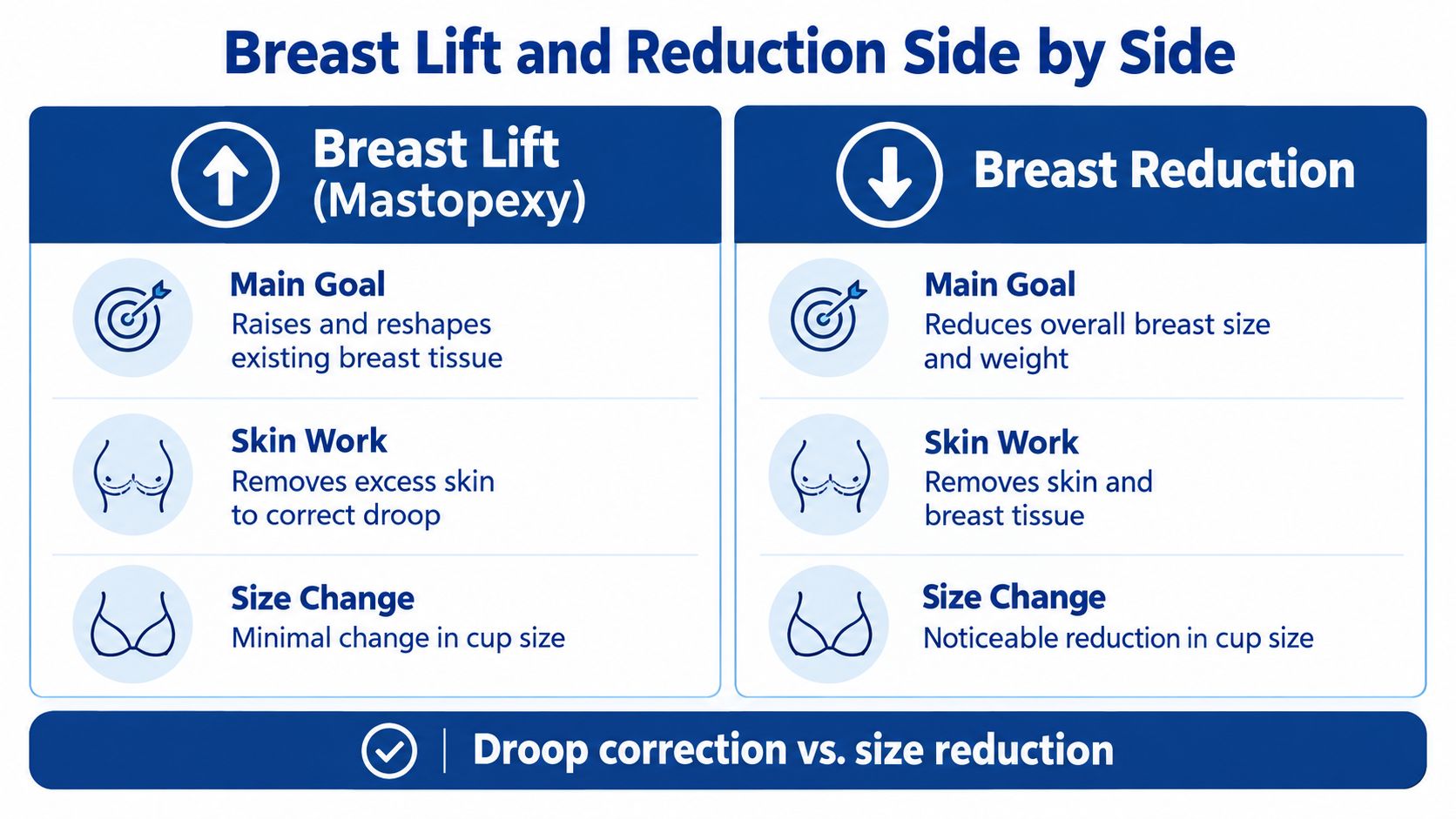
A breast lift, or mastopexy, raises and reshapes existing breast tissue by removing excess skin and tightening the surrounding tissue; a breast reduction removes breast tissue, fat, and skin to decrease breast mass while reshaping what remains. The American Society of Plastic Surgeons' breast lift overview describes the lift as a procedure focused on breast position and contour, not a specified reduction in volume.
| Feature | Breast Lift (Mastopexy) | Breast Reduction |
|---|---|---|
| Primary goal | Raise and reshape sagging breasts | Decrease breast mass and reshape |
| Tissue removed | Mainly excess skin, with little or no gland or fat | Gland, fat, and skin |
| Breast size change | Little to none | Noticeable decrease |
| Nipple-areola position | Raised to a higher position | Repositioned; sometimes moved as a free graft in large resections |
| Weight-related symptoms | Possible relief, less predictable | Designed to ease neck, shoulder, and back strain |
| Typical scar pattern | Around the areola and vertically, sometimes along the fold | Similar pattern, plus a horizontal scar along the fold |
| Breastfeeding | Usually preserved | Possible difficulty |
What those differences mean day to day
A lift mainly changes where the breast and nipple sit. It can make the breast look firmer and higher without a substantial change in volume. A reduction changes the load as well as the outline, which may matter if breast weight affects movement, clothing fit, or comfort.
The table can clarify what each operation changes, but it can't decide which is right for an individual. That requires considering your symptoms, preferred size, skin, and the amount of lift needed. For readers comparing breast procedures across different anatomy, this guide to male chest contouring options offers a separate overview of chest contouring for men.
How Each Technique Reshapes the Breast
The endpoint drives the technique: a reduction removes glandular, fatty, and skin tissue to reduce breast mass, while a lift primarily raises and reshapes existing tissue with limited or no volume removal. The amount of excess skin and the planned tissue movement matter as much as the procedure's name.
| Technique | Typical Use | Scar Pattern | Main Trade-Off |
|---|---|---|---|
| Periareolar lift | Mild droop with little excess skin | Around the areola only | Limited lift; not suited to marked sagging |
| Lollipop lift | Moderate droop | Around the areola and down to the fold | The vertical scar is a common concern |
| Anchor (inverted-T) lift | Marked droop or significant skin excess | Around the areola, vertically, and along the fold | Most lift, longest scar |
| Inferior pedicle reduction | Moderate to large volume reduction | Lollipop or inverted-T pattern | Nipple keeps its blood supply from below; widely used |
| Superior pedicle reduction | Moderate reduction with adequate upper tissue | Similar pattern | Nipple is supplied from above; suited to selected shapes |
| Free nipple graft reduction | Very large volume reduction | Around the areola plus a fold scar | Nipple is fully detached; sensation risk rises |
| Awake breast lift | Lift planned for local anesthesia in the office | Pattern selected for the planned lift | Suitability depends on the tissue and pattern |
| Awake breast reduction | Reduction planned for local anesthesia in the office | Pattern selected for the planned reduction | Surgeon assesses the planned volume case by case |
A periareolar incision leaves the shortest pattern, but it offers less capacity to reposition a breast with marked droop. The lollipop pattern adds a vertical incision for more reshaping. An anchor pattern adds a horizontal incision along the fold, making it useful when more skin and shape correction are needed, while also creating a longer scar.
In a reduction, the pedicle is the tissue that maintains the nipple's blood supply. With an inferior pedicle, that connection comes from below; a superior pedicle keeps the connection from above. A free nipple graft fully detaches the nipple and carries a greater concern about sensation, so it's reserved for selected, very large reductions.
An American Society of Plastic Surgeons evidence review concluded that symptom burden, not a fixed removal amount, should guide evaluation. It found that resection volume didn't correlate with symptom relief, judged the evidence for a mandatory 500-gram-per-breast threshold weak, and described meaningful relief in a separate review when less than 250 grams per breast was removed. The ASPS evidence review also notes that higher resection weights were associated with greater complication risk. Ask how the proposed pattern fits your symptoms and desired size, rather than treating a gram target as the goal.
Ideal Face & Body performs its Awake Breast Lift and Awake breast reduction in its Beverly Hills office under local anesthesia, without general anesthesia. Whether an office setting suits a particular plan depends on the tissue involved and the planned pattern; because a reduction removes more tissue, the surgeon assesses its suitability case by case. If pregnancy and weaning are part of your planning, this resource on supporting breast shape after weaning can help you think through changes in breast shape over time.
Outcomes Measured Beyond Cup Size
In an adolescent reduction-mammaplasty cohort, mean BREAST-Q breast-satisfaction scores rose from 24.1 to 92.6, while psychosocial well-being scores rose from 37.7 to 90.4; both changes were statistically significant at P < .001, according to the study published in Aesthetic Surgery Journal. Those shifts show why a cup-size estimate alone can't capture whether an operation meets a patient's goals.
The validated BREAST-Q Reduction/Mastopexy Module measures satisfaction with breasts as well as psychosocial, sexual, and physical well-being. For someone whose breast size causes functional or psychosocial strain, improvement in those areas may be central to judging a reduction. For someone choosing a lift, the relevant results are more likely to be breast contour, nipple position, symmetry, scar quality, and how well the shape holds.

Separate symptom relief from the cosmetic goal
A prospective study found significant reductions in physical symptoms among both mastopexy and reduction patients, including patients whose procedures removed less than 300 grams per breast. Across the procedures, satisfaction was 94.3%, self-esteem improved for 89.3%, and quality of life improved for 69.5%, as reported in the study indexed by PubMed. This makes the boundary between lift and reduction less rigid: some patients may experience symptom improvement after a lift, but that doesn't mean a lift will reduce breast weight as reliably as a reduction.
Larger resections may raise wound-healing and complication risks. A lift that preserves most breast volume may retain the weight that contributes to discomfort. Discuss these as separate trade-offs rather than assuming that the operation that changes size the most will also produce the shape you prefer.
Before consultation, make a simple scorecard:
- Photographs: Bring front and side views to show the position and contour that trouble you.
- Measurements: Record the measurements your surgical team requests, so changes can be assessed consistently.
- Symptoms: Write down what you experience, when it occurs, and what activities it limits.
- Goals: Use BREAST-Q-style questions to separate breast satisfaction and physical comfort from the specific wish to be smaller.
If back discomfort is one of your concerns, this discussion of breast reduction for back pain may help you prepare questions. Be clear about whether symptom relief, a smaller size, or a different shape is your priority.
Scarring and Complication Risks by Number
A complication rate is not a prediction for an individual, and a higher rate does not necessarily mean a poor result. For adolescent breast reduction, a 2025 systematic review and meta-analysis found a pooled postoperative complication rate of 17.5%, with a 95% confidence interval of 9.7% to 29.5%; wound separation, hematoma, and infection were among the common events, according to the 2025 review and cohort data indexed by PubMed. The same linked 2025 evidence reports that 28.8% of patients in a separate cohort experienced a complication, and 92.8% of those complications were Clavien-Dindo grade II or lower.
| Complication | Reported Rate | Context |
|---|---|---|
| Any postoperative complication, adolescent reduction meta-analysis | 17.5% pooled (95% CI 9.7% to 29.5%) | Wound separation, hematoma, and infection were common |
| Any complication, 2025 cohort | 28.8% | 92.8% of complications were Clavien-Dindo grade II or lower |
| Painful or hypertrophic scars | 9.4% | A reported patient-facing scar outcome |
| Hematoma | 6.5% | A reported early complication |
| Delayed wound healing, 2025 cohort | 5.9% | May affect recovery and scar appearance |
| Delayed wound healing, patient guide | About 3% to 5% | The T-junction is especially vulnerable |
| Partial or total nipple loss | Less than 1% | A concern related to preserving nipple blood supply |
The Royal Berkshire Hospital breast reduction guide explains the vulnerability of the T-junction, where vertical and horizontal incisions meet: its blood supply is poorer, making wound breakdown more likely there. Rates from reduction and adolescent cohorts help frame possible outcomes, but they do not provide a direct estimate for every patient or a lift-specific risk. The choice between a lift and reduction should therefore reflect the main goal, since changing shape, reducing size, and relieving symptoms are distinct aims.
The Mayo Clinic's breast reduction guide lists other possible risks, including bleeding, infection, anesthesia reactions, scarring, asymmetry, breastfeeding difficulty, and rare loss of sensation or of the nipple and surrounding skin. Ask your surgeon which complications they monitor for, how to care for incisions, and whom to contact if a wound opens or swelling increases. For guidance on scar appearance and care, see scars after breast reduction.
Recovery Timeline From Surgery to Final Shape
A lift can ease some physical symptoms by reshaping the breast, while a reduction changes both size and shape. Neither operation guarantees a particular final contour. The recovery estimates below are typical planning ranges, not fixed deadlines. Your incision pattern, tissue removal and wound care affect healing, so follow your surgeon's instructions on activity.
| Phase | Breast Lift | Breast Reduction |
|---|---|---|
| First three days | Rest, wear a support garment and expect mild soreness | Rest, manage dressings and expect more pronounced swelling; drains may be used |
| Weeks one to two | Desk work may be possible within about a week | Desk work is typically possible within one to two weeks |
| Weeks three to six | Gradually return to exercise around four to six weeks | Lifting and exercise restrictions often last about six weeks |
| Months three to six | Scars begin to fade and flatten | Scars continue to mature; wound issues usually appear earlier |
| Months six to twelve | Shape continues to settle | Shape and nipple sensation continue to settle; scars mature over about a year |
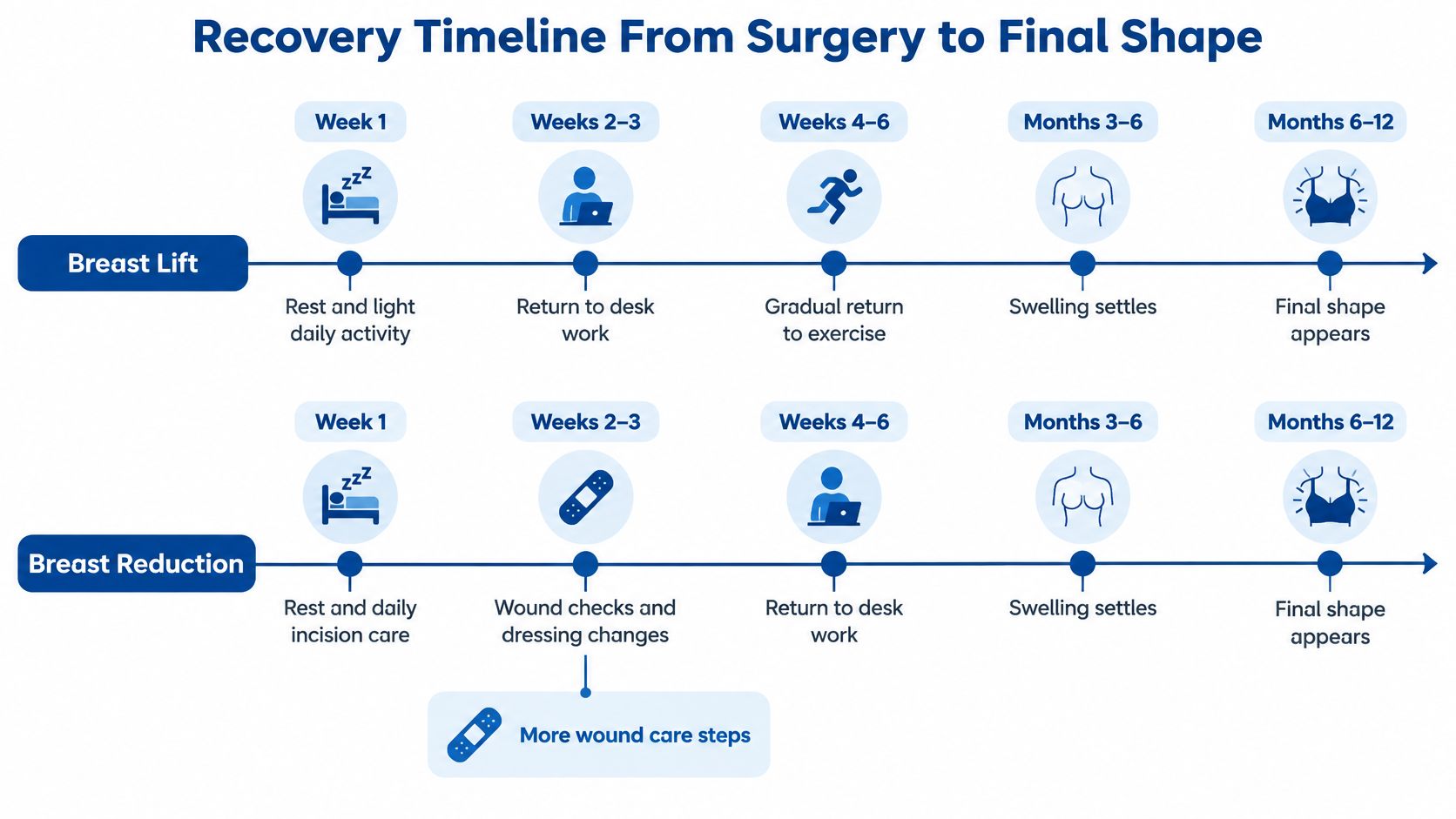
These timeframes help with planning, but they do not define which operation is right for you. A reduction may involve more incision care because it removes more tissue and can leave a longer scar pattern. The T-junction, described in the previous section, may need particular attention during healing. Royal Berkshire Hospital's guide reports delayed wound healing at about 3% to 5% after reduction and partial or total nipple loss at less than 1%. These figures describe reported risks, not a prediction of an individual's recovery.
Smoking, weight stability, activity and medical conditions that affect wound repair can also influence healing. Ask your surgeon when to resume work, lifting and exercise for your incision pattern, and whom to contact if a wound needs extra care. At follow-up, ask how nipple sensation is being assessed and whether changes are continuing; the six-month point in the timeline is a planning marker, not a guarantee that sensation has settled.
Implant Planning Changes the Decision
Implant planning matters when your goal includes added volume, because the implant's weight affects how the lifted breast is supported. The surgeon must account for the implant, the skin envelope, breast-tissue reshaping, and nipple position. A reduction removes gland and skin, changing the space available for an implant and potentially affecting shape and symmetry. Implant size, pocket position, and skin elasticity all influence the plan.
A lift combined with an implant is called augmentation-mastopexy. It addresses two goals, adding volume and correcting droop, which can compete: the implant adds weight while the lift tightens and repositions the breast. Before discussing preferences with an implant surgeon, review this guide to choosing breast implant size. Size is one part of the decision; the implant's position and the breast's capacity to support it also shape the plan.
Fat transfer adds a limited amount of volume without an implant, so it suits a different goal from implant-based enlargement. It does not replace implant planning when the desired size or support depends on an implant. Ask the surgeon how the breast and implant will be supported, how nipple position will be set, and how the plan could change if you later remove or replace the implant. The choice should follow your priority: changing shape, adding volume, or reducing breast size.
Matching Your Concern and Confirming the Choice
The choice is not settled by age or a tissue-removal threshold. First separate the goals: changing shape, changing size, and relieving symptoms. A lift can reposition the breast and may address some concerns tied to droop; reduction removes volume and can also use a lifting pattern. When goals overlap, the planned amount of removal and the reshaping approach matter more than the procedure's name.
In 2023, U.S. patients aged 30 to 39 had 40,033 mastopexies, or 26% of all breast lifts, and 14,275 aesthetic breast reductions, or 19% of reductions. Among patients aged 70 and older, there were 4,422 lifts and 1,596 aesthetic reductions. In both age groups, lifts outnumbered reductions by about 2.8 to 1, according to the ASPS age-specific statistics. These are procedure patterns, not guidance on which operation suits an individual.
| Primary Concern | Likely Fit | Why It Matters |
|---|---|---|
| Nipple sits low, skin has lost elasticity, size is acceptable | Breast lift | Repositioning and shape are the main goals, not reducing weight |
| Heavy breasts cause bra-strap grooves, rashes, or neck and back pain | Breast reduction | Removing breast mass may address symptoms associated with heaviness |
| Deflation after pregnancy or weight loss, with a flattened upper breast | Breast lift | The aim is to reshape existing volume rather than remove it |
| Wants a clearly smaller cup size | Breast reduction | Volume removal is a primary goal |
| Moderate droop with moderate heaviness | Either, decided case by case | Desired size and symptoms help determine the plan |
| Symptoms plus droop after a large weight change | Reduction, often with a lift pattern | The plan may need to address both excess mass and skin |
If shape and position matter most and your current volume is acceptable, a lift may fit. If reducing size and weight is the priority, consider reduction. When symptoms and droop both matter, ask how much tissue the surgeon expects to remove and what shape the proposed incision pattern is intended to create. The line between the procedures can be fluid: a reduction may lift the breast, while a lift can affect some physical concerns without removing much tissue.
Smoking, weight stability, pregnancy plans, and medical conditions can also affect surgical planning and healing. If you're seeking insurance approval for a reduction, read about why insurers require treatment approval. The approval process is separate from the choice of operation, which should reflect your goals and the surgeon's assessment.
Confirm the surgical plan
With photographs, symptoms, goals, and measurements already part of your assessment, focus this discussion on the incision pattern and what happens if the result later needs revision. Ask why the proposed pattern fits your anatomy, what scars to expect, and how the surgeon would assess a concern after healing. Discuss possible effects on breastfeeding and nipple sensation, too.
Secondary reduction is uncommon but can happen. A 2024 Cleveland Clinic study reviewed 7,179 nononcological breast-reduction charts from January 2001 through October 2023 and found that 122 patients, or 1.7%, underwent a secondary reduction (Cleveland Clinic study indexed by PubMed). This rate describes that study group, not an individual's likelihood. Ask how follow-up is handled and what criteria would guide a revision decision.
At a consultation, discuss whether an awake breast lift or awake breast reduction under local anesthesia matches your priorities. Ideal Face & Body offers both procedures in Beverly Hills, with virtual and out-of-town consultations available. Its plan can be customized to whether your primary goal is shape, size, or symptom relief.