You're standing in front of the mirror, noticing the same combination of concerns: fine lines that look deeper in certain light, uneven pigment left by sun exposure, rough texture, or acne scars that makeup can't quite disguise. Then you see two familiar options, laser resurfacing vs chemical peel, and the internet makes the decision sound simpler than it is.
The right treatment isn't determined by which option is universally stronger. It depends on what you want corrected, how much recovery you can accept, and how your skin responds to inflammation and pigment changes. Your skin tone matters just as much as your diagnosis, especially if you have medium-to-deep skin.
My direct recommendation is this: choose a peel when the problem is mainly superficial tone, dullness, or mild congestion. Choose laser resurfacing when texture, etched lines, or scarring requires controlled remodeling. If you have mixed pigment and texture concerns, a carefully sequenced combination can be more intelligent than forcing one treatment to do everything.
Table of Contents
- Why Patients Compare Laser Resurfacing and Chemical Peels
- How Each Treatment Actually Works
- Side-by-Side Comparison of Laser Resurfacing and Chemical Peels
- Which Skin Concerns Each Option Treats Best
- The Case for Combining Laser Resurfacing and Chemical Peels
- Safety, Skin Tone, Cost Reality, and Contraindications
- Pre-Care, Recovery, and Your Next Step in Beverly Hills
Why Patients Compare Laser Resurfacing and Chemical Peels
Most patients asking about this choice aren't really asking which procedure is “better.” They're asking whether they should accept more recovery for a larger change, or start with a gentler treatment that may require ongoing maintenance.
Consider two patients with similar-looking sun damage. One has uneven surface pigment and occasional breakouts. The other has etched lines around the mouth and depressed acne scars. A superficial or medium-depth peel may be a logical first move for the first patient. It may brighten the skin and improve surface roughness without treating the deeper structural problem. The second patient may need laser energy to remodel tissue below the surface, because a light peel can't erase a scar that extends into the dermis.
That's why I use three signals during consultation:
- Primary concern: Pigment, acne, dullness, and mild lines often respond well to peels. Deep texture, scars, and more established wrinkles usually require a laser strategy.
- Downtime tolerance: A superficial peel generally fits a busy schedule more easily. More aggressive peels and ablative lasers require a serious recovery plan, not a casual appointment between commitments.
- Skin tone: Patients with darker skin have a greater need for pigment-safe planning. Treatment depth, energy, preconditioning, and aftercare can change the risk profile substantially.
Both procedures are established cosmetic treatments, not experimental trends. The American Society of Plastic Surgeons procedure statistics reported 3,501,696 minimally invasive skin resurfacing procedures in 2023 and 3,703,305 in 2024, a 6% year-over-year increase. Those totals include both chemical peels and laser-based resurfacing.
My consultation rule: Don't choose the treatment with the most dramatic marketing. Choose the treatment that matches the depth of the problem without creating an avoidable pigment or recovery problem.
The practical question is not “laser or peel?” It's “what layer needs treatment, and what level of risk is reasonable for this skin?”
How Each Treatment Actually Works
Laser resurfacing and chemical peels both remove or alter damaged skin, but they do it through different mechanisms. That distinction explains why they behave differently during recovery and why one can be better suited to a particular concern.
Laser resurfacing
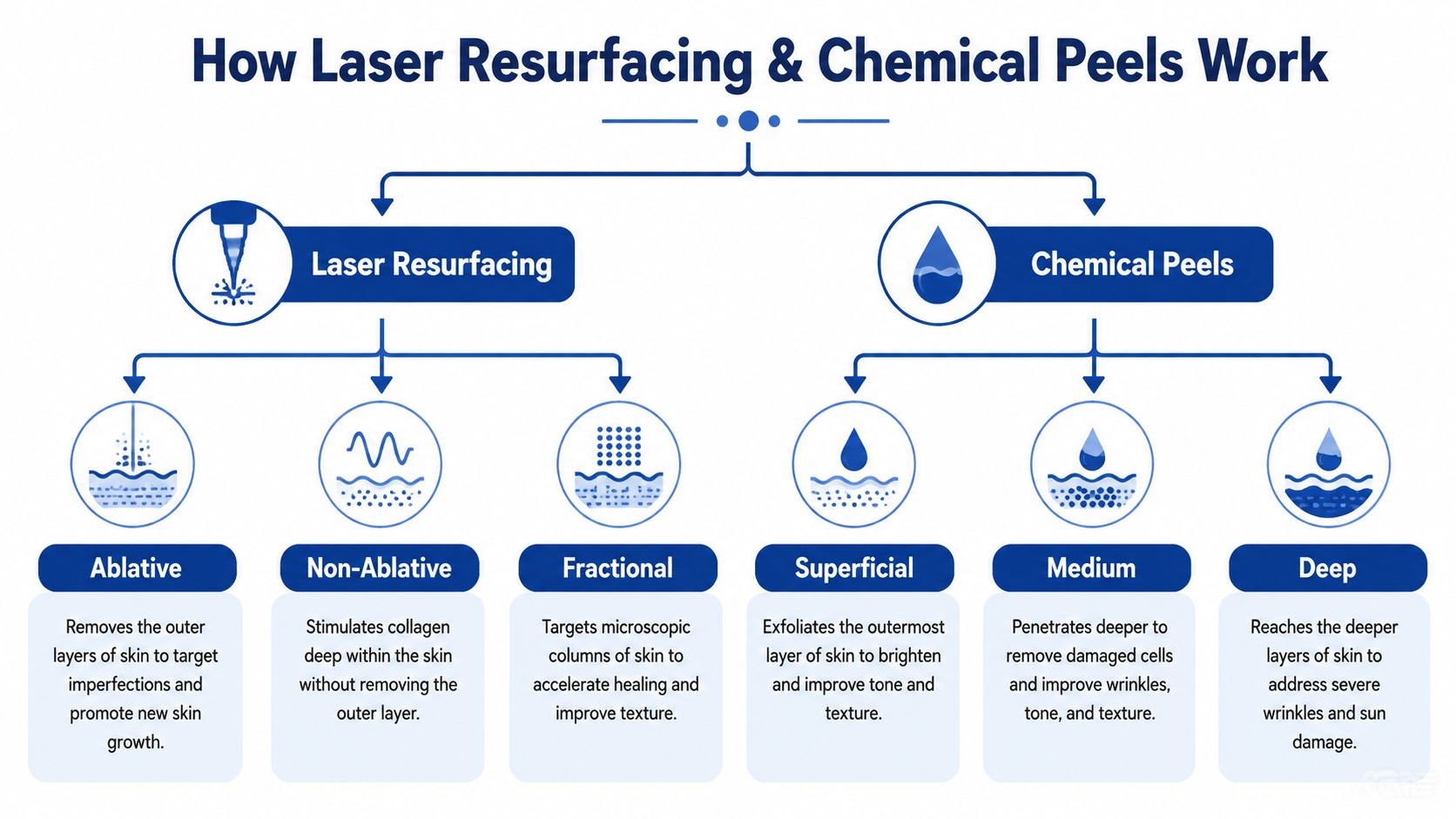
Ablative laser resurfacing targets water in the skin. The energy can destroy the epithelium and papillary dermis, and in deeper treatment may extend into the reticular dermis. The result is controlled removal of damaged tissue followed by wound healing and collagen remodeling. This mechanism is described in a review of laser resurfacing and chemical peeling mechanisms.
Ablative lasers are the more aggressive category. They remove portions of the surface rather than warming the tissue. That makes them useful for deeper wrinkles, established photoaging, and some acne scars, but it also creates more visible healing and a greater need for careful aftercare.
Non-ablative lasers heat deeper tissue while preserving more of the surface. They usually offer a more gradual result and less disruption, but they're not a substitute for ablative treatment in every patient with deep scarring or etched lines.
Fractional treatment creates microscopic treatment zones while leaving untreated skin between them. Those intact areas help the skin heal more efficiently than a fully treated surface. Fractional and non-ablative approaches are especially valuable when the goal is to balance collagen remodeling against recovery and pigment risk.
For readers researching device options beyond traditional ablative treatment, this overview of comparing CO2 laser alternatives provides useful context. You can also review the treatment approach described on the laser resurfacing service page.
Chemical peels
Chemical peels use acids containing carboxyl or hydroxyl groups to disrupt the epidermis and, depending on formulation and strength, the dermis. The controlled injury triggers wound-healing changes and encourages fresh surface renewal. A medical review of resurfacing mechanisms explains why peel depth determines both the potential benefit and the risk.
- Superficial peels work mainly within the outer epidermal layers. They're commonly selected for dullness, mild uneven tone, congestion, and maintenance.
- Medium-depth peels penetrate farther and can address more pronounced pigment and fine lines, with more visible peeling and recovery.
- Deep peels reach deeper tissue and can create stronger correction, but they also carry substantially more risk. I reserve them for carefully selected situations, not routine brightening.
The key point is simple. Lasers offer precise control over energy, pattern, and depth. Peels offer formulation-based control over chemical penetration and intensity. Neither category is automatically safer or more effective, because the treatment's depth and the patient's skin biology matter more than the label.
Side-by-Side Comparison of Laser Resurfacing and Chemical Peels
The right choice depends on your skin tone, the depth of the problem, your recovery window, and how much pigment risk you can accept. A device or acid name matters less than treatment depth and your skin's response to inflammation.
Laser Resurfacing vs Chemical Peel at a Glance
| Criterion | Laser Resurfacing | Chemical Peel |
|---|---|---|
| Candidacy | Stronger fit for deeper texture, wrinkles, scars, and selected pigment concerns | Stronger fit for surface pigment, dullness, congestion, and mild lines |
| Downtime | Ablative treatment requires more recovery than fractional or non-ablative treatment | Superficial treatment may cause limited flaking, while deeper peels require more recovery |
| Number of sessions | Often requires fewer sessions for comparable overall efficacy | Often works through a series, especially with superficial treatment |
| Results timeline | Texture remodeling can continue after healing | Brightness and surface smoothness may appear sooner, with cumulative improvement over time |
| Primary risks | Pigment changes, erythema, pain, infection, and scarring | Pigment changes, erythema, infection, lines of demarcation, and scarring |
| Cost range | Varies by device, depth, provider, treatment area, and anesthesia needs | Varies by formulation, depth, provider, treatment area, and number of sessions |
A 2026 systematic review and meta-analysis covering 38 studies and 1,695 patients found broadly comparable overall efficacy between laser resurfacing and chemical peeling. The pooled standardized mean difference was 1.53, with a 95% confidence interval of 0.57 to 2.50. Laser treatment required about two fewer sessions on average, with a mean difference of 2.00 sessions and P<0.001. The practical takeaway is clear: lasers may achieve comparable overall results with fewer visits, but fewer sessions do not automatically make them the better choice. Read the meta-analysis on PubMed.
What the trade-off feels like
Laser resurfacing gives the clinician tighter control over treatment pattern, energy, and depth. That control can improve correction of structural texture, but it may also mean more discomfort and a harder recovery, particularly with ablative treatment. The same meta-analysis found transient erythema and procedure pain more often with lasers, with a pain risk ratio of 4.42 and a 95% confidence interval of 1.72 to 11.37.
For medium-to-deep skin tones, I generally favor fractional or non-ablative lasers over aggressive resurfacing when the target is texture and the patient needs controlled treatment. They still require careful settings and pigment-risk planning. Peels can be a better fit for superficial discoloration, but the formulation and depth must match the skin tone and diagnosis. A superficial peel and a deep peel are different procedures, not interchangeable labels.
Deeper peels can produce stronger correction while increasing the risk of infection, pigment disturbance, lines of demarcation, and scarring. A clinical summary reports that scar rates for medium-depth peels are less than 1%. Review chemical peel risks and indications.
Combination treatment can outperform either option alone when texture, pigment, and surface dullness coexist. I prefer staged treatment rather than stacking aggressive procedures at once, especially in deeper skin tones. That approach lets the clinician address structural texture with fractional or non-ablative laser treatment and use a carefully selected peel for residual surface pigment.
Which Skin Concerns Each Option Treats Best
Start with the tissue change, not the label “resurfacing.” A patient with dull surface tone needs a different plan from someone with etched scars, and medium-to-deep skin tones require tighter pigment-risk control.
Fine lines and texture
For mild dullness, roughness, and early fine lines, a superficial or medium-depth peel is often the sensible starting point. It refreshes the surface without the recovery associated with aggressive resurfacing. A medical-grade peel option can fit patients who want gradual improvement and have no deeper textural problem.
Etched lines, coarse texture, and established photoaging usually favor laser resurfacing. Laser energy can create controlled thermal injury below the surface and stimulate remodeling. A peel may brighten surrounding skin, but it generally cannot match that structural correction.
For medium-to-deep skin tones, I favor fractional or non-ablative laser treatment when texture is the main concern and treatment settings can be carefully controlled. Aggressive resurfacing raises the pigment-risk burden. The safer choice depends on the patient's history of post-inflammatory hyperpigmentation, current inflammation, and tolerance for recovery.
Sun damage and pigment
Peels work well for superficial uneven tone, especially alongside medical skincare and strict sun avoidance. They also suit patients who prefer incremental improvement rather than a major recovery period.
Laser treatment can help selected pigment concerns, but inflammation from energy-based treatment can trigger pigment changes. Before choosing a device or peel, identify whether the discoloration represents superficial sun damage, melasma, post-inflammatory pigment, or another condition. The diagnosis determines the risk more than the treatment category alone.
Acne and acne scarring
A carefully selected peel may help acne-prone congestion by addressing surface buildup. It is not a substitute for medical treatment when inflammation is active, persistent, or causing new scars.
Acne scars require more precision. Fractional laser approaches generally remodel irregular texture more effectively than a superficial peel. If scars coexist with pigment or active breakouts, combination care can outperform either treatment used alone. I would stage the procedures rather than apply aggressive treatments at the same visit, particularly for deeper skin tones.
Melasma and psoriasis
A published comparative analysis found that lasers were more effective for melasma, while chemical peeling was superior for psoriasis. See the comparative findings in the published analysis. Treat those findings as guidance, not a universal prescription. Melasma can rebound when inflammation and sun exposure remain uncontrolled.
Psoriasis requires diagnosis and medical oversight. Resurfacing does not manage the underlying disease, and active inflammation can make either treatment inappropriate.
For broad rejuvenation, I usually recommend a coordinated plan. Surface treatment can improve clarity, while fractional or non-ablative laser addresses deeper texture. The sequence should follow the patient's pigment history, diagnosis, and healing response.
The Case for Combining Laser Resurfacing and Chemical Peels
The most effective answer to laser resurfacing vs chemical peel is often neither. It's a staged plan that assigns each treatment a specific job.
Laser resurfacing is better suited to deeper remodeling, scar revision, and established texture. Peels are useful for surface pigment, clarity, and maintenance. Asking one procedure to correct both deep scarring and recurring surface discoloration can lead to unnecessary intensity or disappointing results.
A rational sequence
For a patient with acne scarring and post-inflammatory pigment, I may first control active inflammation and stabilize the skin barrier. A fractional or non-ablative laser can then address the structural texture problem. After recovery, carefully selected peels may support surface pigment management and ongoing maintenance.
For photoaging, the order can change. If pigment is the dominant concern and the skin is reactive, beginning with conservative surface treatment may make more sense. Once the skin is stable, laser remodeling can target lines and texture without asking the first treatment to do everything.
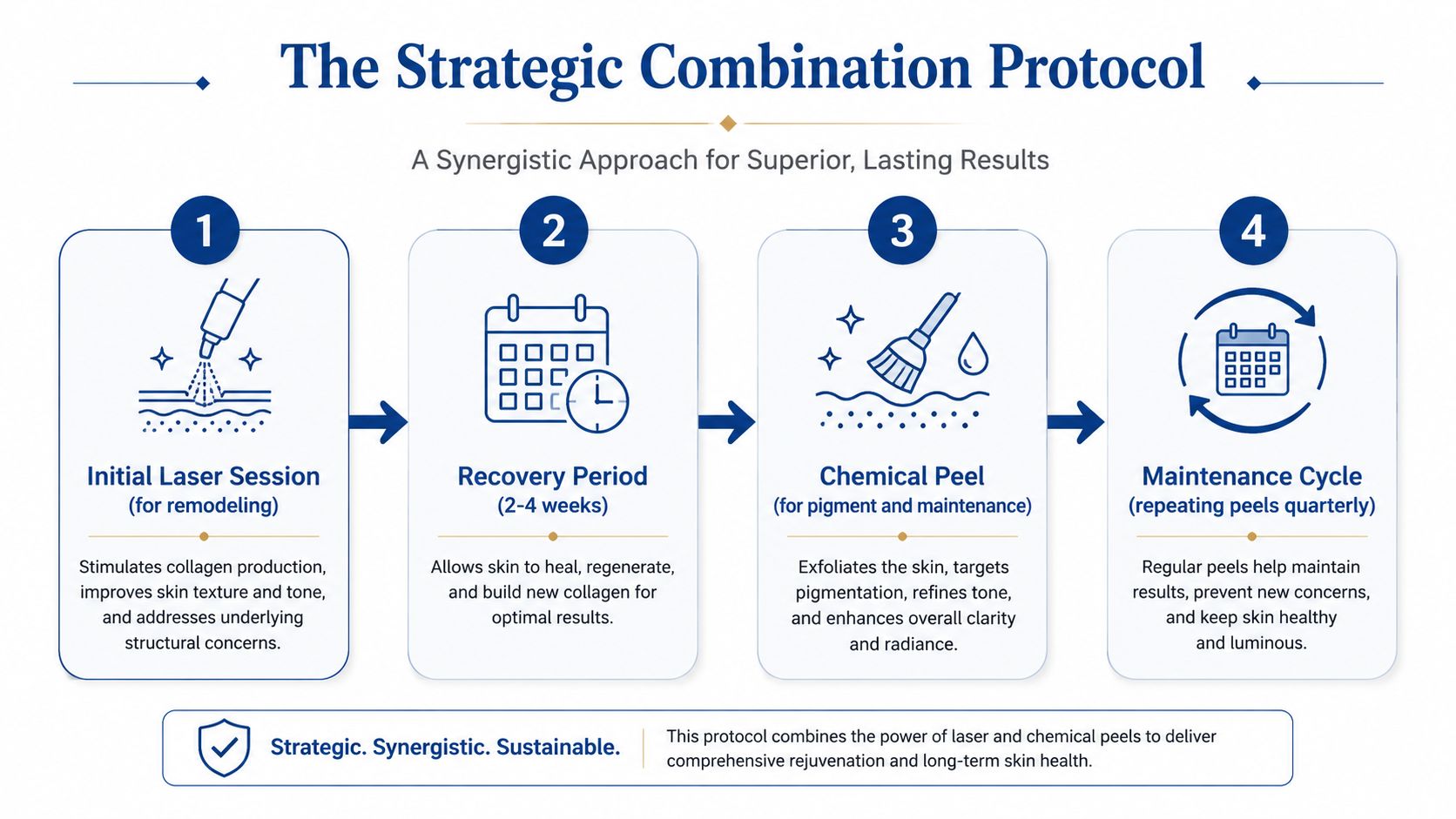
The visual sequence is useful as a framework, but the recovery interval must be individualized. The infographic shows a recovery period of 2-4 weeks and a maintenance cycle involving repeated peels quarterly. Those intervals shouldn't be treated as automatic instructions for every patient, because treatment depth, skin tone, healing, and complications can change the schedule.
When combination therapy is overkill
Combination therapy isn't better. If your concern is mild dullness, a laser adds complexity without a clear reason. If you have a single depressed scar and otherwise calm, even-toned skin, repeated peels may distract from the treatment that addresses the scar.
The combination earns its place when you have two different problems in two different layers, such as pigment plus textural scarring, or surface photoaging plus deeper laxity. The plan should be sequenced, not stacked casually in one appointment.
Safety, Skin Tone, Cost Reality, and Contraindications
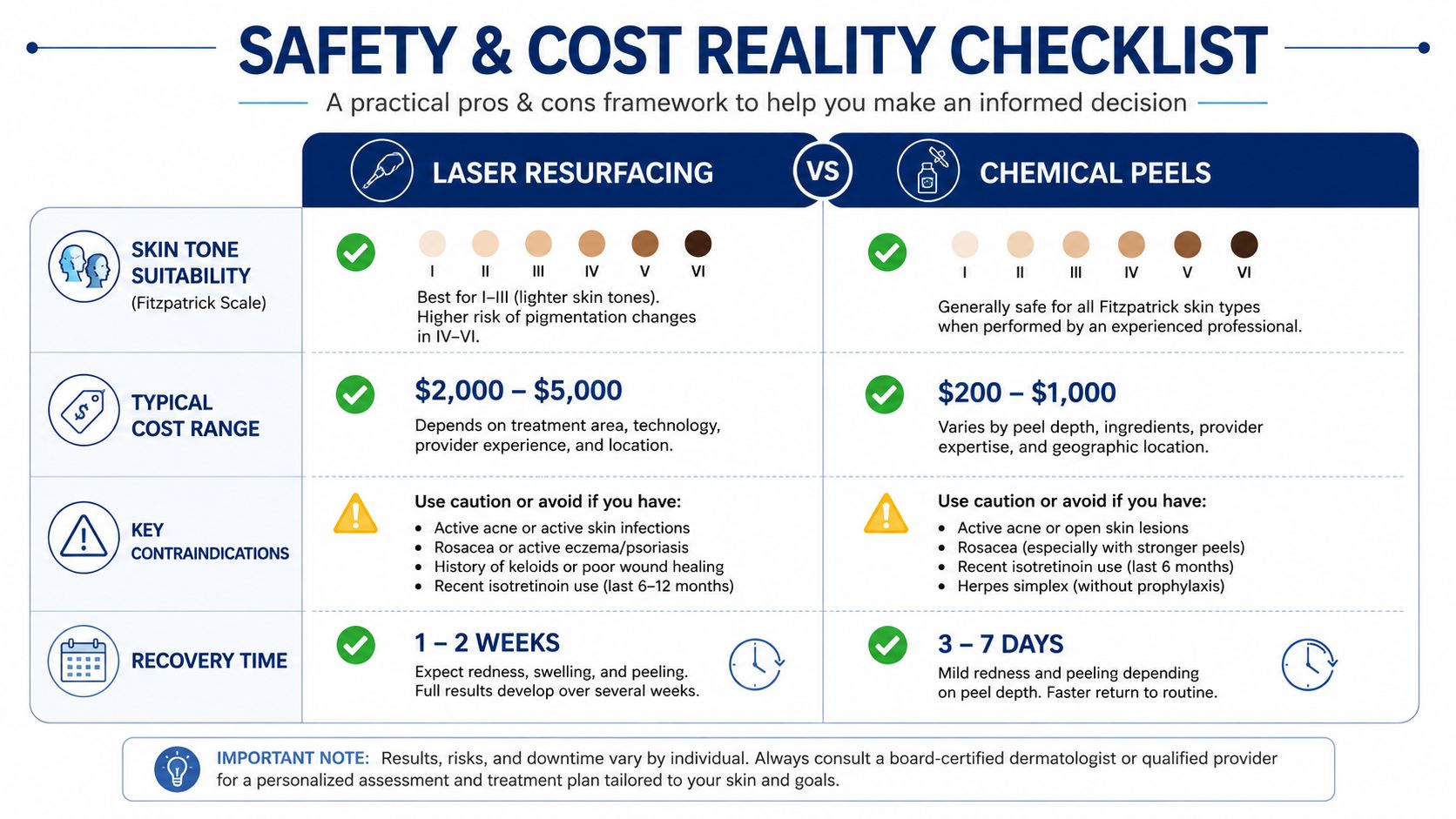
Skin tone is one of the most important factors in this decision, and it's frequently treated as an afterthought. Patients with medium-to-deep skin tones may be more vulnerable to post-inflammatory pigment changes, hypopigmentation, scarring, and prolonged erythema after overly aggressive treatment.
Independent review data indicate that deeper peels and aggressive resurfacing carry greater pigment and scarring risk in darker skin. By contrast, superficial peels have shown relatively low complication rates in Fitzpatrick III through VI populations, including a retrospective series reporting 3.8% complications across 473 superficial peel procedures. The review of chemical peels and lasers in skin of color also emphasizes that ablative lasers may provide stronger correction but can involve longer recovery and greater side-effect risk.
That doesn't mean “darker skin equals peel only.” Newer fractional and non-ablative laser approaches were developed partly to reduce dyschromia and scarring risk. With appropriate settings, patient selection, and pigment management before and after treatment, these options can be safe and effective for skin of color.
What cost reality means
Exact costs vary by provider, treatment depth, geographic area, treatment size, anesthesia, and the number of sessions. A peel may seem simpler at the appointment level, while a laser may require fewer visits. The correct comparison is the complete treatment plan, not the fee attached to one session.
When neither treatment should happen yet
Postpone treatment when you have an active infection, open wound, uncontrolled inflammatory flare, or a healing problem that hasn't been evaluated. Recent isotretinoin use may also affect candidacy, so disclose the medication and timing during consultation rather than assuming the issue is irrelevant.
Your clinician also needs to know about a history of abnormal scarring, cold sore reactivation, pigment disorders, autoimmune disease, pregnancy or nursing, and medications that affect healing. The final contraindication is often overlooked: unrealistic expectations. Resurfacing can improve skin, but it can't reproduce untouched skin or remove every wrinkle and scar.
For medium-to-deep skin tones, the safer choice isn't automatically the gentlest treatment. It's the treatment with the most appropriate depth, settings, pigment preparation, and follow-up.
Pre-Care, Recovery, and Your Next Step in Beverly Hills
Preparation begins before the appointment. Stop treating your skin as if more exfoliation will produce a better result. Your clinician may ask you to pause irritating products, simplify your routine, treat active acne or inflammation, and use pigment-management skincare when appropriate.
Tell the practice about every medication, supplement, previous procedure, cold sore history, and past reaction to peels or lasers. Avoid scheduling treatment immediately before important events, travel, or intense sun exposure. Your skin needs a predictable environment to heal.
What recovery requires
After a peel, don't pick or manually remove flaking skin. Use only the cleanser, moisturizer, and protective products recommended for your treatment. After laser resurfacing, follow wound-care instructions closely, protect the area from sunlight, and expect redness or sensitivity to evolve rather than disappear instantly.
The recovery experience depends on treatment depth. A superficial peel is usually easier to hide than a medium or deep peel. Fractional or non-ablative laser treatment may be easier to schedule than ablative resurfacing, but “less downtime” doesn't mean “no risk.”
For a practical explanation of what to expect after a peel, review this guide to chemical peel recovery.
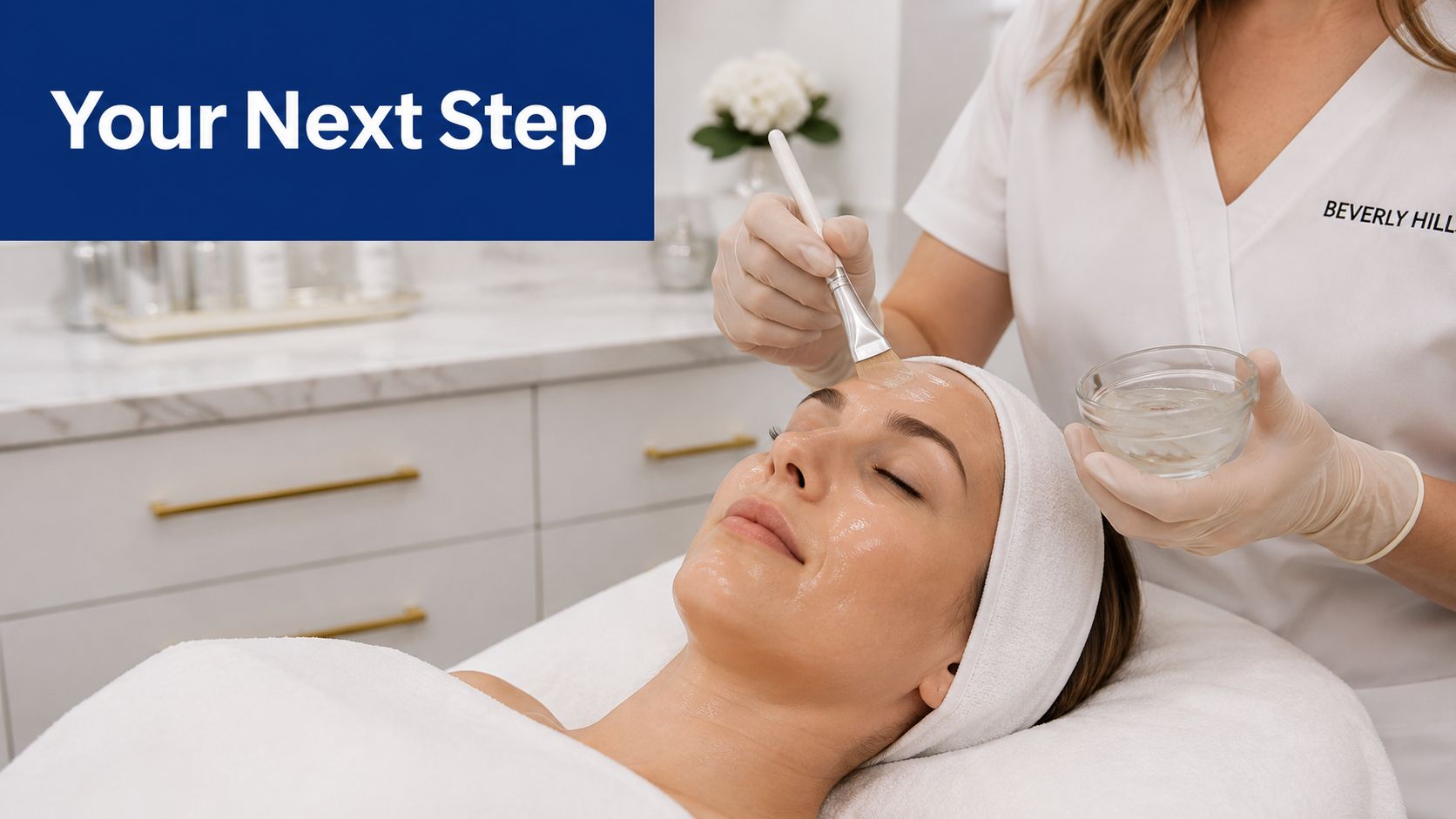
At a Beverly Hills consultation, Dr. Justin Yovino or Dr. Sarah Yovino can evaluate your skin tone, pigment history, texture, scarring, recovery limits, and broader facial goals. Ideal Face & Body offers energy-based resurfacing options including Morpheus8, Venus Viva, and IPL, as well as medical-grade peels. The appropriate recommendation may be one modality, a staged combination, or no resurfacing until the skin is stable.
Frequently asked questions
Is a superficial peel always safer for medium-to-deep skin?
No. Superficial peels often have a lower complication profile, but a poorly selected acid, inadequate pigment management, or repeated inflammation can still create problems. A fractional or non-ablative laser may offer better long-term value when the main concern is texture, provided the settings and preparation are appropriate.
Can laser resurfacing and a peel be done together?
They can be combined in a planned sequence, but stacking treatments without adequate recovery is a mistake. The clinician should decide which concern comes first and how much time your skin needs before the next treatment.
Which should a first-time patient choose?
Start with the least aggressive treatment that can realistically address the primary concern. For surface dullness or mild uneven tone, that often means a peel. For meaningful scarring or etched texture, a laser consultation is more appropriate than repeating superficial treatments that cannot reach the problem.
Ideal Face & Body offers laser and energy-based resurfacing, medical-grade chemical peels, and individualized planning for patients whose skin goals may connect to facial rejuvenation or broader aesthetic care. Visit Ideal Face & Body to schedule a Beverly Hills consultation and receive a treatment recommendation based on your concern, skin tone, and recovery priorities.