You catch your reflection from the side while getting dressed and notice that your nipple sits lower than it used to. One breast may appear to hang differently from the other, the upper chest may look less full, and a bra that once shaped your silhouette no longer seems to change the underlying contour. It's natural to wonder whether pregnancy, breastfeeding, weight change, or aging is responsible.
The medical term is breast ptosis, commonly called breast sagging. It describes a change in breast position and shape, not a personal failure or a diagnosis that says anything about your health. A surgeon evaluates ptosis by looking at measurable anatomy, especially the position of the nipple-areola complex relative to the crease beneath the breast.
The path from noticing a change to choosing treatment should be deliberate. You need to understand what counts as ptosis, why it develops, what the grades mean, and which lift pattern can realistically address your anatomy. Personal experiences with breast size can also shape how you view support, proportion, and clothing, and Momotaro Apotheca's confessions on bust size offers useful context for that everyday perspective.
Table of Contents
- What Ptosis of Breasts Looks Like in Real Life
- How Surgeons Define and Grade Breast Ptosis
- What Causes Drooping
- Matching Mastopexy Techniques to Ptosis Severity
- Lift With or Without Implants
- The Awake Breast Lift and What to Expect
- Your Next Steps and Consultation Questions
What Ptosis of Breasts Looks Like in Real Life
A woman may first notice ptosis while changing clothes, not during a medical examination. From the front, her breasts may still look familiar. From the side, however, the nipple may sit closer to, at, or below the crease beneath the breast, while the lower breast tissue rests lower on the chest.
That distinction matters. Breast ptosis is defined by anatomy, particularly nipple position relative to the inframammary fold, or IMF. The IMF is the natural crease where the lower breast meets the chest wall. Breast volume, skin excess, nipple direction, and the amount of lower-pole descent also influence the overall appearance, but the nipple-to-fold relationship gives surgeons a consistent starting point.
Ptosis can affect one breast more than the other. Mild differences are common, and a lift may improve asymmetry without creating mathematical sameness. The aim is usually a balanced shape that fits the person's chest, tissue quality, and expectations.
What you may notice in the mirror
Common visual changes include:
- A lower nipple position: The nipple may align with the fold or sit beneath it.
- A longer lower pole: Tissue below the nipple can appear more elongated as the breast descends.
- Reduced upper fullness: The upper breast may look flatter even when the total breast tissue remains substantial.
- Downward-facing nipples: In more advanced ptosis, the nipple may point toward the floor rather than forward.
- Different breast behavior in clothing: A bra can support the breast temporarily, but it doesn't permanently reposition the skin or nipple.
A prospective study of 1,204 women found clinically measurable ptosis in 22.8% of breasts using one assessment method, while a second method recorded 26.1%, illustrating that roughly one-quarter of participants had measurable descent and that prevalence changes with the definition used (study details). The same study reported average breast volume of 340.0 ± 9.1 mL, showing that surgeons can connect breast position with measurable anatomy rather than relying only on a subjective description.
A useful distinction: Ptosis describes position and descent. It doesn't automatically mean that your breasts are too large, too small, unhealthy, or in need of surgery.
How Surgeons Define and Grade Breast Ptosis
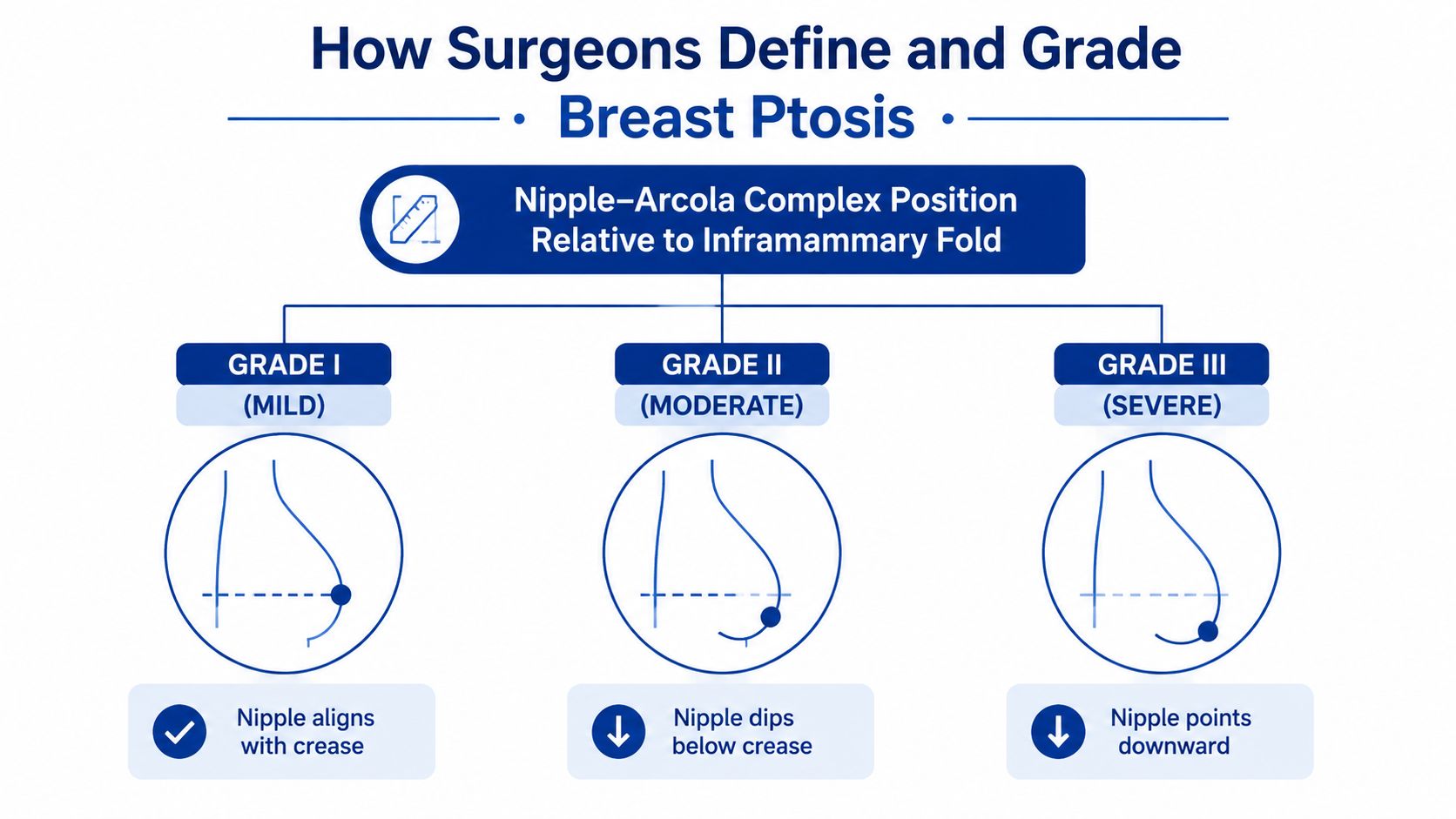
A surgeon doesn't grade breast ptosis by asking whether the breasts look “saggy” in a general sense. The examination focuses on the nipple-areola complex, or NAC, and where it sits compared with the IMF.
The most commonly used framework is the Regnault classification. It gives the patient and surgeon a shared anatomical language, although it isn't the only system in use.
The Regnault grades in plain English
- Pseudoptosis: The nipple is at or above the IMF, but most of the breast tissue has descended below the fold. The breast may look low even though the nipple itself hasn't dropped beneath the crease.
- Grade I: The nipple sits at the level of the IMF. This is often described as mild ptosis.
- Grade II: The nipple is below the IMF but remains above the lowest, most dependent part of the breast. The nipple may still point forward.
- Grade III: The nipple sits at the lowest point of the breast and often points downward. This represents more advanced descent.
A separate framework uses one-centimeter stages from Stage A through Stage F. Stage A begins with the nipple 2 cm above the IMF, Stage C places it level with the fold, Stage E places it 2 cm below the IMF, and Stage F describes a position beyond Stage E (classic staging system). These measurements help the surgeon estimate how much skin may need removal and how the breast envelope can be redraped.
The systems don't always produce identical labels. A 2023 systematic review examined 7 classifications and 4 measurement techniques across 18 studies involving 2,033 subjects, and found substantial inconsistency in how researchers measured and graded ptosis (systematic review). That's why two consultations can produce different terminology even when both surgeons are observing the same anatomy.
For a fuller description of the operation and candidacy considerations, review the breast lift and mastopexy information before your appointment.
What Causes Drooping
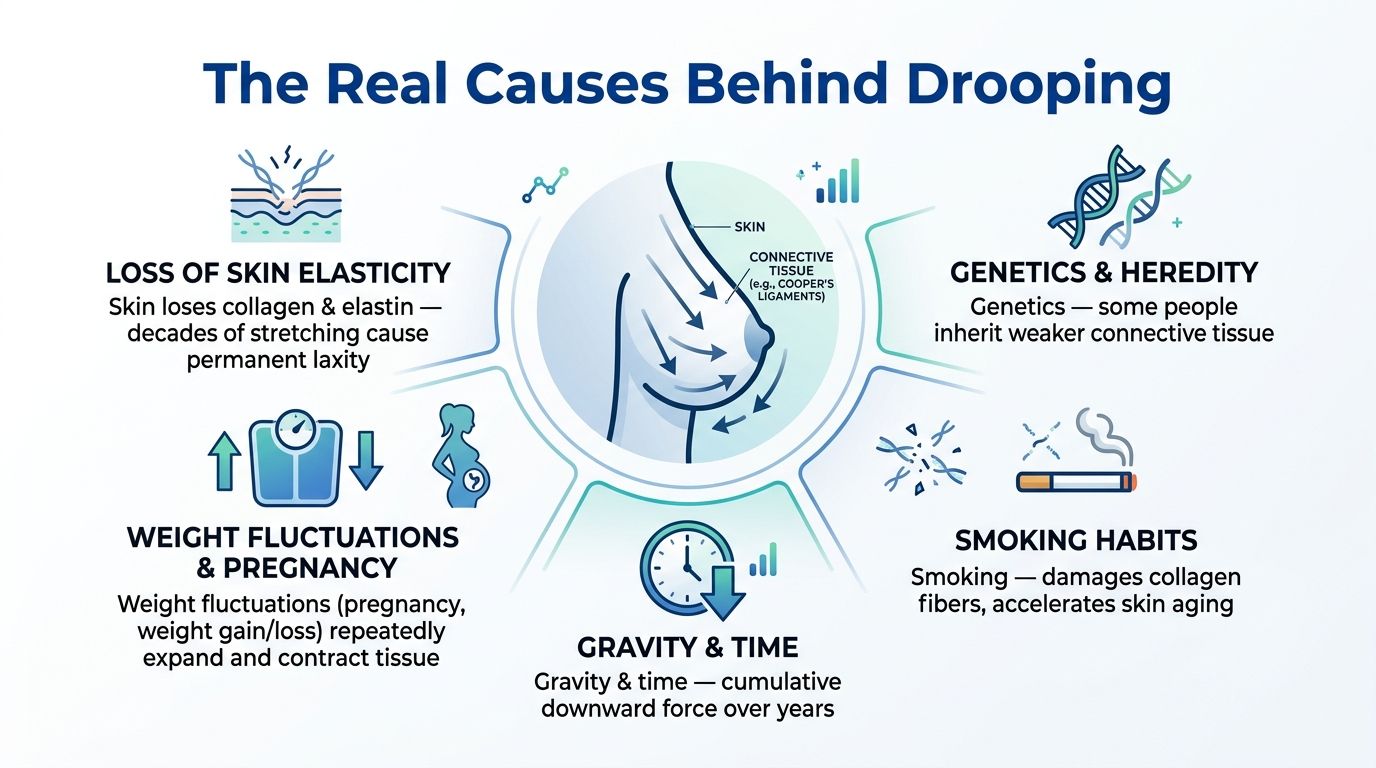
Breast ptosis usually develops through cumulative mechanical stress. Skin, connective tissue, breast tissue, and the structures supporting the breast carry its weight over time. As the skin envelope stretches and loses recoil, the nipple-areola complex and breast tissue can descend.
Age affects skin elasticity, but it is only one part of the picture. Higher BMI, larger bra cup size, multiple pregnancies, significant weight loss, and smoking history have each been identified as independent predictors in logistic-regression research. One study found that weight loss greater than 50 lb was a significant risk factor (risk-factor study).
How the mechanism works
Breast skin works like a fabric envelope around a changing internal load. Repeated expansion and contraction can leave the envelope less able to spring back. A heavier breast also places greater ongoing tension on the lower skin. Genetics influence the elasticity and connective-tissue strength a person starts with, so similar life events can produce different visible changes.
A separate study identified age, BMI, breast tissue weight, and number of pregnancies as significant contributors. In that analysis, breast tissue weight was the most important factor (breast tissue and ptosis research). These findings support a mechanical explanation involving several forces rather than one isolated event.
The breastfeeding question
Breastfeeding is often blamed for sagging, although the evidence is more nuanced. In a prospective cohort, breastfeeding longer than six months was associated with ptosis. Post-menopausal status and higher BMI were also independent risk factors (prospective ptosis study).
Another logistic-regression analysis found that breastfeeding itself was not a significant predictor after other factors were considered. Age, weight loss greater than 50 lb, BMI, breast size, pregnancy count, and smoking history were associated with ptosis, while breastfeeding, pregnancy weight gain, and lack of upper-body exercise did not reach significance (multivariable analysis).
The practical conclusion is straightforward. Breast changes after pregnancy can reflect breast expansion, tissue stretching, weight fluctuation, and the anatomy of pregnancy, rather than nursing alone. General skin-support approaches should be kept in perspective. This discussion of collagen support for women over 40 may help distinguish expectations for skin care from the changes surgery is designed to correct.
Matching Mastopexy Techniques to Ptosis Severity
If the nipple sits below the crease beneath the breast, the operation must do more than move the breast higher on the chest. A mastopexy reshapes the entire breast envelope. The surgeon may remove excess skin, reposition the nipple and areola complex (NAC), reshape breast tissue, and redrape the remaining skin around the new contour.
The incision pattern should match the amount of descent and loose skin. A smaller scar may suit modest nipple descent, but limiting the incision can leave lower-pole excess behind. Scar length is therefore a planning tool, not the main goal. The better question is which pattern can create the intended shape while addressing the skin that needs correction.
The usual grade-to-technique relationship
| Technique | Best for ptosis grade | Incision pattern | Trade-off |
|---|---|---|---|
| Periareolar mastopexy | Usually Grade I and selected mild cases | Around the areola | Less visible incision pattern, but limited ability to correct substantial lower-pole excess |
| Vertical mastopexy | Commonly Grade II and selected Grade III cases | Around the areola and vertically downward | More reshaping power, with a vertical scar |
| Inverted-T mastopexy | Significant Grade III ptosis | Around the areola, vertically downward, and along the IMF | Greatest skin-redraping capacity, with a longer scar pattern |
Periareolar mastopexy usually fits mild ptosis with limited lower-pole skin redundancy. It works like tightening a drawstring around the areola, so its ability to reshape the lower breast is limited. Vertical mastopexy gives more control over tissue shaping and skin redraping, making it useful for many Grade II cases and selected Grade III cases. An inverted-T approach adds a horizontal incision along the inframammary fold, or IMF, and provides the greatest ability to remove and redistribute substantial excess skin. Borderline Grade II to III cases require individual judgment rather than a rigid label (technique review).
More than three scar patterns
The grade describes nipple position, not every feature that shapes the operation. Nonimplant mastopexy includes dermal reshaping, glandular reshaping, glandular reshaping with perforator flaps, and glandular reshaping with mesh support. These technique families give the surgeon different ways to support and arrange the breast tissue.
Two patients with the same Regnault grade may therefore need different procedures. Breast volume, skin quality, chest shape, tissue distribution, previous surgery, and IMF position all influence the plan. A lift can correct present descent, while future changes in tissue and skin remain possible.
Lift With or Without Implants
A mastopexy alone is often the most direct option when you have enough native breast tissue and your main goal is a higher, better-shaped breast. The operation removes or tightens excess skin and repositions the existing tissue. It can improve the nipple position and breast contour, but it won't reliably create the firm, rounded upper-pole fullness associated with added volume.
An implant adds volume and can make the upper breast fuller, but it also introduces implant-specific considerations. Implant removal, or explant, may be paired with a lift when someone wants to address sagging after removing an implant. Fat grafting uses the patient's own tissue to add selected fullness, although it's still a surgical procedure and may not replace the structural effect of an implant in every anatomy.
A practical comparison
- Lift alone: Best when shape and position matter more than increased size. It uses existing breast tissue and accepts that upper-pole fullness may remain moderate.
- Lift with an implant: Adds volume while lifting the breast. It requires a discussion about implant choice, long-term management, and the relationship between added weight and future tissue descent.
- Explant with lift: Removes an existing implant and reshapes the remaining breast envelope. The final appearance depends on the amount and quality of native tissue.
- Lift with fat transfer: Combines mastopexy with autologous volume in selected areas. It may suit someone who wants a softer increase without an implant, provided the anatomy and available donor tissue are appropriate.
Ideal Face & Body no longer offers breast implant placement, implant-based breast augmentation, or breast implant revision procedures. Its breast-focused path can include mastopexy with or without autologous fat transfer, an approach the practice brands as Raise Your Cup, as well as implant removal with optional fat transfer when clinically appropriate.
The key decision: A lift changes position and shape. Added volume changes size and fullness. Those are related goals, but they aren't interchangeable.
Clothing can help you assess what support changes visually while you're considering options. A practical minimizer bra guide can also help if your immediate concern is how breast volume sits beneath clothing rather than a permanent anatomical change.
The Awake Breast Lift and What to Expect
If you are considering a breast lift but want to avoid general anesthesia, an awake breast lift may be part of the conversation. It is still a true mastopexy performed with local anesthesia, often in an office-based setting. The anesthesia plan and location change, while skin removal, tissue reshaping, nipple repositioning, and scar care remain part of the operation.
Dr. Justin Yovino performs the Awake Breast Lift through Ideal Face & Body in Beverly Hills, CA. Suitability depends on your overall health, smoking status, breast anatomy, anxiety level, and the amount of surgery anticipated. The surgeon must determine whether the procedure can be performed comfortably and safely with local anesthesia.
What the pathway involves
The consultation should clarify your ptosis grade, preferred size and shape, likely scar pattern, medical history, medications, and expectations. Local anesthetic numbs the treatment area while the team monitors your comfort and the surgeon completes the planned lift. Some patients may receive oral medication for relaxation, depending on the individualized plan.
You remain awake, but that does not make recovery effortless. You will receive wound-care instructions and may need support garments. A gradual return to normal movement is expected. Work and exercise timing depend on the operation, your healing, and the surgeon's instructions, so a responsible consultation will not promise one schedule for everyone.
Scars are part of the trade-off. Incisions may be periareolar, vertical, or inverted-T, and their appearance changes as healing continues. Discuss asymmetry, altered nipple sensation, delayed healing, recurrent ptosis, and possible revision before choosing surgery. These topics deserve clear counseling because a lift changes the breast envelope, not just its position in the operating room.
The breast lift under local anesthesia information page can help you prepare questions about the awake approach. Related procedures may include awake breast reduction, explant with optional fat transfer, and body contouring such as PRECISION SCULPT laser liposculpting. Combining procedures depends on your safety, anatomy, and surgical plan.
Your Next Steps and Consultation Questions
A suitable candidate for an Awake Breast Lift is generally a healthy adult with stable weight, realistic expectations, and a willingness to accept scars. Ptosis in the Grade I to Grade III range may be addressed, but the right procedure depends on breast volume, skin quality, asymmetry, medical history, and whether you want a lift, reduction, added fullness, or implant removal.
Some patients are better served by another operation. Very large breasts may point toward reduction, while significant volume loss may make fat transfer or another volume strategy part of the discussion. Active smoking, unstable weight, an unaddressed medical condition, or expectations that a lift will create permanent upper-pole fullness can change the recommendation.
Pricing varies with technique, anesthesia, and case complexity. The only honest estimate comes from the practice after a personalized examination and surgical plan.
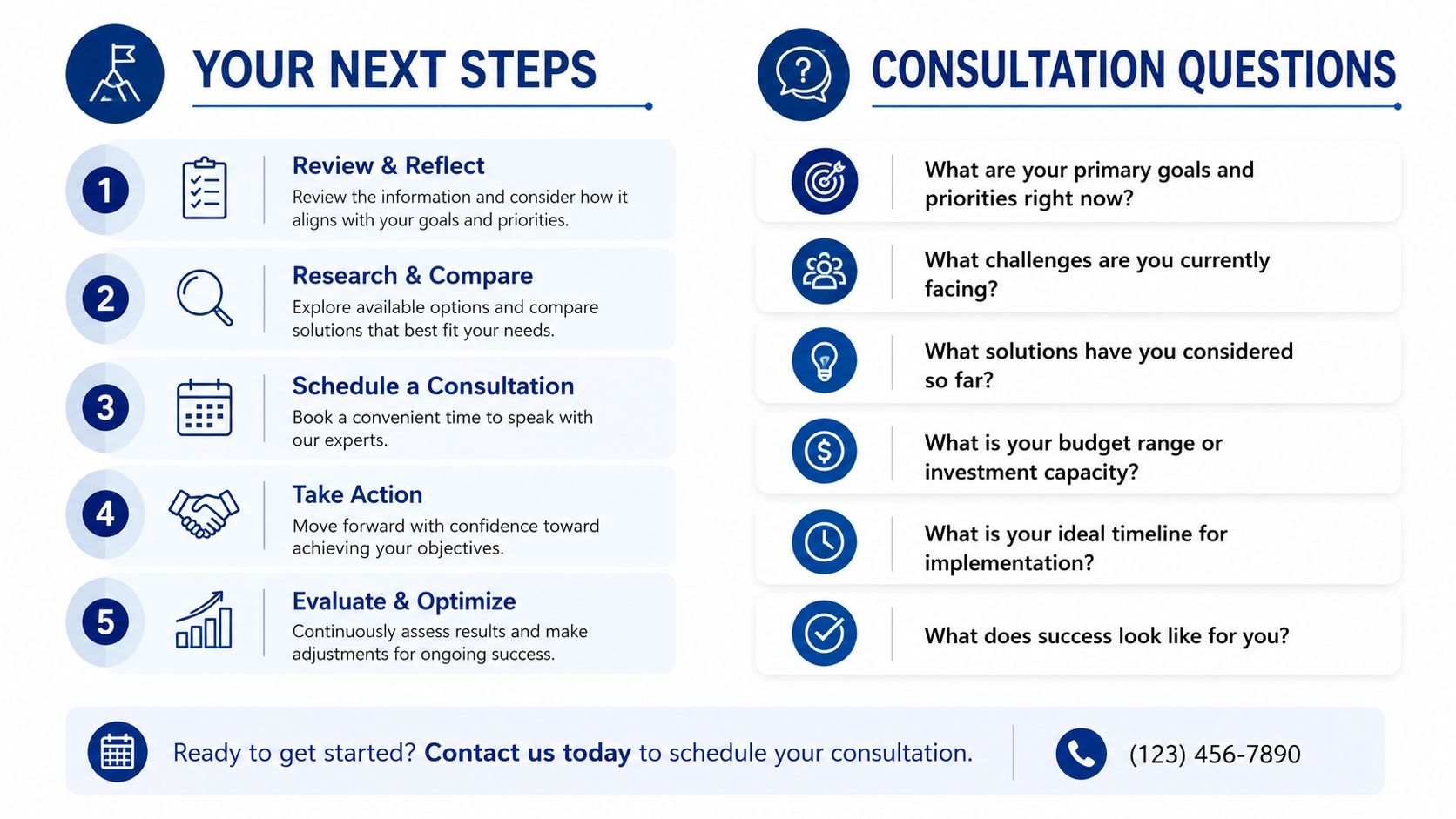
Questions worth bringing to your consultation
- Ask for your grade: Which classification are you using, and where is my nipple relative to the IMF?
- Clarify the technique: Would you recommend periareolar, vertical, or inverted-T mastopexy, and why?
- Discuss the scar: Where will the incisions be, and which areas need the most skin removal?
- Define the result: What can a lift alone change, and would fat transfer address a specific volume concern?
- Review anesthesia: Am I an appropriate candidate for local anesthesia and an office-based procedure?
- Plan recovery: What restrictions, wound care, support, and follow-up will I need?
- Discuss uncertainty: What risks apply to my anatomy, including asymmetry, sensation changes, recurrent ptosis, or revision?
The breast lift candidacy guide can help you organize your medical history and goals before meeting the surgical team.
Short FAQ
Can ptosis return after a lift?
Yes. A lift cannot stop aging, future weight changes, pregnancy-related changes, or ongoing tissue stretching. Recurrence is one of the trade-offs that should be addressed before surgery.
Can bras or creams correct ptosis?
Bras can support and reshape the appearance while worn. Creams may affect the surface of the skin, but neither permanently repositions the nipple or removes excess breast skin.
How soon after pregnancy or weight loss can I consider a lift?
The timing should be individualized. Many surgeons prefer that pregnancy-related changes have settled and weight has stabilized before planning a permanent reshaping procedure. Ask during a consultation, particularly if future pregnancy or additional weight change is possible.
Ideal Face & Body offers an Awake Breast Lift in Beverly Hills, CA, with mastopexy planning focused on breast position, tissue shape, and realistic scar expectations. If ptosis of breasts is affecting how you feel in clothing or in the mirror, visit Ideal Face & Body to request a consultation and discuss whether an awake lift, lift with fat transfer, reduction, or another option fits your anatomy.