The International Society of Aesthetic Plastic Surgery global survey reported more than 2.2 million liposuction procedures worldwide in 2023, making liposuction the most common surgical aesthetic procedure that year, even though eyelid surgery ranked as the leading surgical procedure for men in 2023. That split matters for Liposuccion Para Hombres. Men aren't asking for less fat. They're usually asking for a flatter abdomen, a cleaner waist, a less puffy chest, or a sharper jawline, and each goal depends on whether the problem is subcutaneous fat, glandular tissue, visceral fat, or skin that won't retract.
Table of Contents
- Where Men Choose Liposuction and What Each Area Needs
- Awake, Tumescent and Laser Options Compared
- Is Liposuction Right for You? A Candidacy Checklist
- Chest Fat, Gynecomastia or Skin Excess and the Plan That Fits
- Safety Limits for Multi-Area and Awake Procedures
- Natural Torso Results Versus Over-Etched Abs
- What Recovery Looks Like and When Results Settle
- Confirm Your Candidacy Before You Book a Consultation
Where Men Choose Liposuction and What Each Area Needs
Common male target areas and planning points
| Target area | Typical male concern | Planning point |
|---|---|---|
| Abdomen and love handles | Stubborn fat despite regular training | Even soft-tissue envelope and skin recoil |
| Flanks | Waistline definition | Smooth transition into the back and abdomen |
| Chest | Fat, gland or excess skin | Identify the component before choosing a plan |
| Neck and jawline | Under-chin fullness | Skin elasticity and tissue shape under the chin |
| Arms | Upper-arm fullness | Skin recoil after fat removal |
| Upper back and dorsocervical area | Buffalo hump prominence | Fat pad location and resulting profile |
| Thighs, calves and ankles | Localized fat in the lower body | Stable weight and skin quality |
Abdomen flanks and back
The abdomen and love handles are the most requested areas, but a good male result doesn't carve sharp borders between treated and untreated tissue. The surgeon blends the area into a smooth, even envelope, then relies on skin recoil to settle that envelope over the smaller volume. If the skin can't retract well, removing more fat can make looseness more obvious instead of making the torso look leaner.
Flanks shouldn't be planned as isolated pockets. They're planned with the waistline and back so the transition from the ribs to the hips looks continuous from the front, side, and back. Treating only the front of the waist while leaving fullness behind it can leave a visible step that looks unfinished in fitted clothing.
Neck arms and lower body
For the neck and jawline, the key questions are how much fullness sits under the chin and whether the skin has enough elasticity to tighten once that volume is gone. A man with good recoil and a discrete pocket is a different case from a man whose main issue is loose skin. The same logic applies to the arms, where the plan is judged by how the skin behaves after fat removal, not by fat volume alone.
The upper back and dorsocervical area, often called a buffalo hump, can be treated with laser-assisted liposuction in selected cases, based on where the fat pad sits and how it changes the profile. Thighs, calves and ankles respond best when weight is stable, because later weight gain can refill remaining fat cells and blur the new contour. The chest needs its own sorting process, covered in detail below, because fat, gland, and skin each call for a different plan.
Match your main concern to one row first. That tells you which planning point should dominate your consultation.
Globally, liposuction led surgical aesthetic procedures in 2023 while eyelid surgery led among men, so male contouring is common but it isn't one uniform operation. Use your row to frame the next question, which technique fits that area and that tissue.
Awake, Tumescent and Laser Options Compared
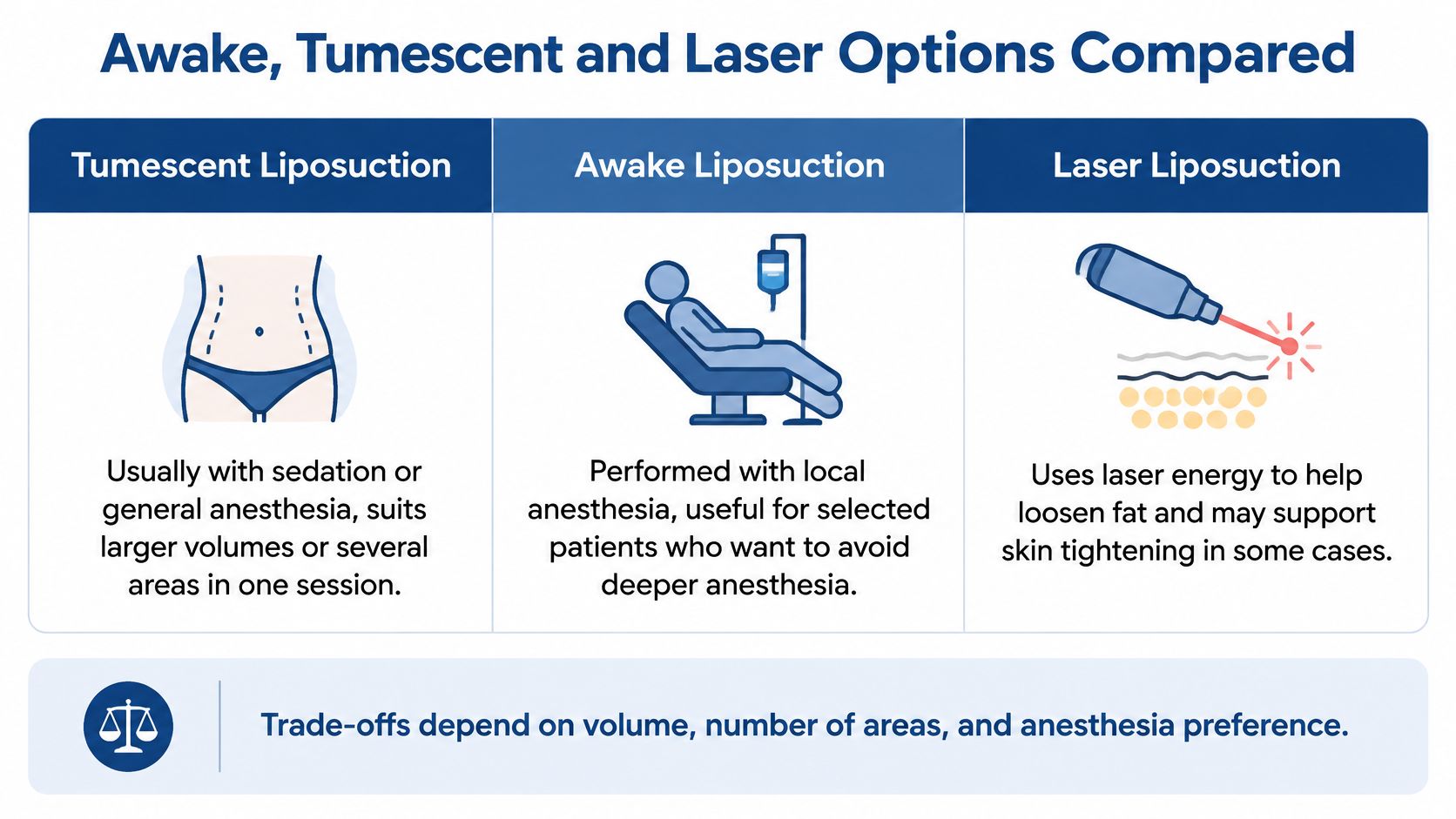
Liposuction techniques and anesthesia options for men
| Technique | Anesthesia | Best suited for | Main trade-off |
|---|---|---|---|
| Tumescent liposuction | Local anesthetic with sedation or general anesthesia | Larger volumes or several areas in one session | Longer monitoring and facility requirements |
| Awake liposuction | Local anesthesia only, no general anesthetic | Targeted areas with moderate volume | Patient feels pressure and volume is limited |
| Laser-assisted liposuction (PRECISION SCULPT) | Local anesthesia with laser energy | Refined contour in focused areas | Results depend on skin quality and technique |
| Revision liposuction | Local anesthetic with sedation or general anesthesia based on extent | Correcting an earlier result | Scar tissue and altered anatomy add complexity |
How the trade-offs work in practice
Tumescent liposuction is the workhorse option. Diluted local anesthetic fluid is placed in the tissue before fat is removed, and it's usually paired with sedation or general anesthesia when the plan covers larger volumes or several areas in one session. The trade-off is a bigger operation around the operation, with longer monitoring and stricter facility requirements.
Awake liposuction uses local anesthesia only and fits targeted areas with moderate volume in an office-based setting. You shouldn't feel sharp pain, but you may feel pressure, movement, and vibration, and the amount that can be treated in one visit is limited. If you're weighing terminology, this explanation of what awake liposuction is called and how it's described helps separate the anesthesia approach from the fat removal itself.
Laser-assisted liposuction, such as PRECISION SCULPT, adds laser energy during treatment and suits refined contour in focused areas. It doesn't override anatomy. Results still depend on skin quality, how fibrous the tissue is, and how evenly the surgeon treats the area.
Revision liposuction corrects an earlier result, such as unevenness or a missed pocket. Scar tissue and altered anatomy make planning more complex, so the surgeon has to map what was already removed before deciding what can safely be adjusted.
Practical rule: Don't choose by the anesthesia label alone. Local anesthesia lowers some anesthetic burden, but it doesn't remove risks from fluid shifts or bleeding.
Large volumes or many areas change the setting, the monitoring, and sometimes whether the plan should be staged. The safety thresholds later in this guide give you the specific volume questions to ask before you commit to any of these options.
Is Liposuction Right for You? A Candidacy Checklist
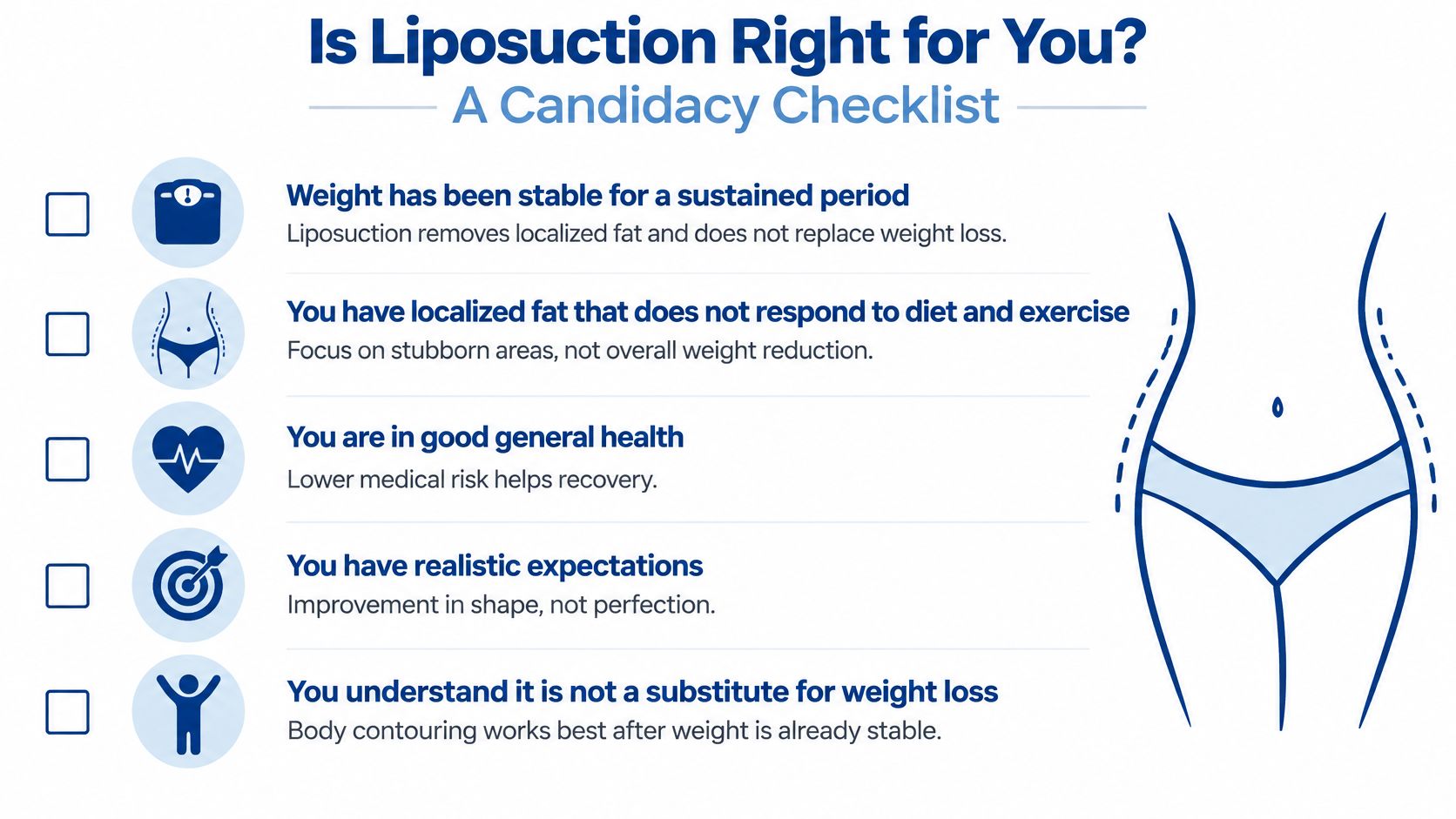
Answer these as plain yes or no questions. A no doesn't always end the conversation, but it changes what surgery can realistically do.
- Has your weight been stable for a sustained period? Liposuction removes localized fat, and it doesn't replace weight loss. Operating while weight is still moving makes the target move too.
- Does your skin recoil well? Pinch the area and watch how it settles. Skin that doesn't retract may look loose once the volume beneath it is gone.
- Is the fat in discrete deposits? A defined pocket at the flanks or under the chin is treatable. Diffuse fullness across the whole trunk usually points to overall fat loss first.
- Is your goal contour refinement? You're a better fit if you want a cleaner outline, not a dramatic change in body size or a lower number on the scale.
Why male tissue changes the plan
Men commonly have denser, more fibrous subcutaneous tissue and seek sharper transitions at the abdomen, flanks, chest, and jawline, which is why high-definition male lipoplasty literature in the Aesthetic Surgery Journal reported satisfaction ranging from 84% to 100% while also listing recurring adverse outcomes including fluid collections, hyperpigmentation, and contour irregularities. Fibrous tissue can require more effort to treat evenly, and uneven treatment is exactly what produces visible irregularity. The technique therefore has to balance superficial contour refinement with preservation of an even soft-tissue envelope.
If you're unsure whether your fullness is fat at all, objective body composition data can help you separate fat mass from lean mass before you plan surgery, and resources such as DEXA body composition testing in Manchester show how that kind of scan breaks the numbers down. That distinction matters because liposuction only addresses fat that sits under the skin and can be reached with a cannula.
What liposuction can't correct
Liposuction can't correct substantial rectus diastasis, where the abdominal muscles have separated and push the belly outward. It can't remove visceral adiposity, the fat that sits around the organs inside the abdomen, and it can't fix major skin excess that needs removal rather than retraction. Naming those limits early prevents the most common disappointment, a technically successful fat removal that doesn't change the shape you see.
End with one benchmark question you can ask directly. Is the visible prominence mainly subcutaneous fat, glandular tissue, or skin excess? Each answer leads to a different operative plan and a different expected contour.
Chest Fat, Gynecomastia or Skin Excess and the Plan That Fits
Chest findings and the plan that matches each
| Finding | Likely component | Typical plan | Next step |
|---|---|---|---|
| Soft, mobile prominence with good skin | Fatty tissue (pseudogynecomastia) | Liposuction | Consultation to confirm |
| Firm disc under the nipple | Glandular tissue | Excision, with or without liposuction | Surgical planning |
| Loose skin with prominence | Skin excess | Skin resection, sometimes combined with other steps | Assess skin quality |
| New, painful, unilateral or fast-growing tissue | Possible non-cosmetic cause | Medical evaluation first | Doctor referral before any surgery |
The one distinction that changes everything
Liposuction removes fatty tissue. It doesn't remove the glandular tissue that can form a firm disc beneath the nipple. That's the core difference between removing male chest fat and treating true gynecomastia.
With pseudogynecomastia, excess fat is the main issue, the tissue feels soft and mobile, and liposuction may respond well. With glandular enlargement, you can often feel a firmer, rubbery disc centered under the nipple, and that tissue may require excision in addition to contouring. If a plan is described as lipo only, this overview of when gynecomastia surgery uses liposuction alone is a useful check on whether your finding fits that approach.
Skin is the third component. Skin quality and the degree of enlargement decide whether surgery alone will produce a flat chest, and advanced cases may need skin resection because the envelope is too large for the reduced volume.
The questions men actually ask
Why does the chest stay puffy after weight loss or liposuction? Usually because glandular tissue remains, or because the skin didn't retract. Fat loss shrinks fat cells, but it doesn't remove gland.
Will the nipple flatten? It can look flatter when the tissue pushing it forward is the tissue that's treated. If a glandular disc is left behind, the nipple can stay projected even after the surrounding chest is thinner.
Can surgery correct asymmetry? Often it can improve it, because each side can be assessed and treated for its own mix of fat, gland, and skin. Perfect symmetry isn't a realistic promise, since chest wall shape and muscle also differ side to side.
The Mayo Clinic gynecomastia diagnosis and treatment guidance sits alongside newer technique evidence, including a 2025 study of 140 men that reported endoscopic lipolysis and liposuction had shorter incisions, shorter operations, less bleeding, and shorter hospital stays than traditional open excision, with comparable longer-term effectiveness. Technique choice can change recovery, but it doesn't change the need to identify the tissue first.
Get a medical evaluation before any cosmetic plan if breast tissue is new, painful, unilateral, or rapidly enlarging. Those features shouldn't be treated as a simple fat problem. Use the table as your decision framework, fat-only contouring, gland excision, combined treatment, or medical evaluation first.
Safety Limits for Multi-Area and Awake Procedures

Safety depends more on total aspirate, the number of treated regions, fluid management, and monitoring than on whether the plan is labeled local or general. Total aspirate means everything removed during the procedure, fat plus fluid and blood, not fat volume alone. That's the number that drives fluid shifts and recovery burden.
The BAAPS liposuction safety guidance framework defines large-volume liposuction as at least 5,000 mL of total aspirate, and professional safety guidance recommends that procedures above this threshold occur in an accredited or licensed facility capable of higher-acuity monitoring, regardless of anesthetic method. The same clinical reference lists 55 mg/kg as a demonstrated upper lidocaine limit, while noting that many surgeons use a more conservative ceiling of 35 mg/kg, and it advises that when aspirate exceeds 4 L, maintenance fluids plus approximately 0.25 mL of crystalloid for every additional 1 mL aspirated should be considered.
Safety reference values and what to ask
| Parameter | Reference value | What to ask |
|---|---|---|
| Total aspirate (not fat volume) | Large-volume at 5,000 mL or more | Request the estimated total aspirate |
| Fluid replacement | Consider when aspirate exceeds 4 L | Ask for the fluid protocol |
| Lidocaine dose | Demonstrated upper limit 55 mg/kg; conservative ceiling 35 mg/kg | Ask the dose and the ceiling used |
| Facility and monitoring | Accredited or licensed facility above large-volume threshold | Ask about observation and emergency capability |
Tumescent infiltration typically uses diluted lidocaine and epinephrine in crystalloid, which is why the lidocaine dose has to be calculated against your body weight before treatment starts. Awake or office-based procedures lower some anesthesia-related burdens, but they don't remove risks from fluid shifts, bleeding, lidocaine toxicity, thromboembolism, or excessive treatment extent.
If you're considering multi-area, 360-degree contouring, request a written estimate covering total aspirate, treated regions, lidocaine dose, fluid replacement protocol, postoperative observation, and emergency capability. Bring the table above and ask each row out loud.
Natural Torso Results Versus Over-Etched Abs
Many men assume high-definition liposuction always produces better definition because it promises more visible muscle lines. Patient-reported evidence challenges that assumption. A 2025 analysis of 743 men in Aesthetic Surgery Journal Open Forum found high-definition treatment was associated with self-reported “fake abs” and lower durable BODY-Q satisfaction, whereas a more restrained real-definition approach produced more stable outcomes and fewer revisions, with reported revision odds of OR 0.32 for real-definition treatment.
The same analysis found outcomes were particularly stable among men with BMI 25 or below who exercised at least four times weekly. That's a candidacy point, not a footnote. Liposuction refines contour on top of muscle you've built and fat you've already lost, and it doesn't substitute for either.
Where the trade-off shows up
Etching works by removing fat unevenly on purpose, leaving more in some lines and less in grooves so shadows mimic muscle borders. The risk is that those grooves can look drawn on, especially when the underlying muscle isn't developed, when weight changes, or when the skin settles differently than planned. Over-etching can produce irregular contours and dissatisfaction that's harder to revise than a conservative result.
If you're comparing approaches, read how high-definition lipo is structured as a procedure and then ask what a restrained version of that plan would look like on your torso. Protecting the muscle you already have matters just as much, and nutrition strategies to protect lean mass can help you think through protein and training habits that support a stable result.
A believable torso follows your own anatomy. Lines that only work at one weight, in one light, rarely age well.
Three questions deserve direct answers at consultation. How much abdominal fat can be removed safely in your case, how does visceral fat pushing the abdomen outward limit the outline, and when does mild skin laxity need a separate tightening plan? Add a fourth about weight fluctuation, because remaining fat cells can still enlarge.
Aim for a torso that looks like a leaner version of you, with definition that matches your real muscle development. That's the result most likely to still look natural years later.
What Recovery Looks Like and When Results Settle
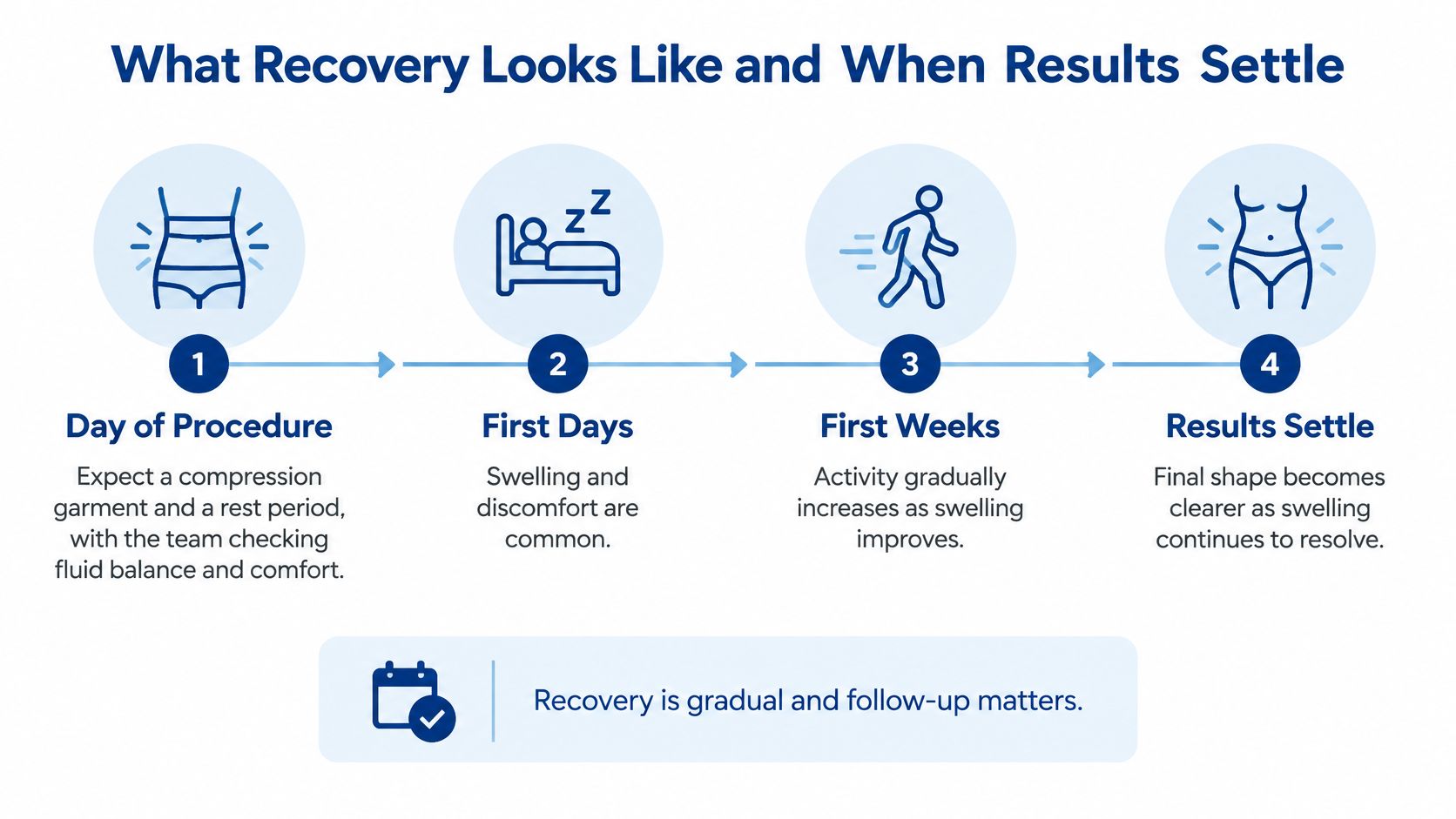
Day of procedure and first days
Say you have your abdomen and flanks treated on a weekday morning. You go home wearing a compression garment, with a rest period built into the day while the team checks fluid balance and comfort before discharge. Plan for someone to drive you and for a quiet evening rather than errands.
During the first days, swelling and bruising are normal and they peak early rather than improving in a straight line. Soreness tends to feel more like deep bruising and stiffness than sharp pain. Short, gentle walks around the house help you stay mobile without stressing treated tissue.
First weeks
In the first week or two, light desk work may be possible if your surgeon agrees and your job doesn't involve lifting or long periods on your feet. Heavy exercise waits until you're cleared, because raising blood pressure and straining treated areas too early can worsen swelling and bleeding risk. Compression continues as directed, and it does real work by limiting fluid accumulation and supporting the new contour while tissue adheres.
Recovery length depends on the total extent of treatment, so a single focused area and a multi-area plan aren't comparable timelines. General guidance on pacing activity, sleep, and wound care, such as postsurgery advice from MedAmerica Rehab Center, can help you structure the basics, but your surgeon's instructions override any general timeline.
When results settle and when to call
Over the following months, swelling settles gradually and unevenly, so one side may look ahead of the other for a while. The final contour becomes visible only after the tissue has fully healed and the skin has finished retracting. Early shape isn't the final result, and judging it too soon leads to unnecessary worry.
Contact your care team promptly for any of these warning signs.
- Fever: A rising temperature can signal infection.
- Increasing pain: Pain that gets worse after improving needs review.
- Spreading redness or unusual drainage: Both can indicate a wound problem.
- A firm, tender area that grows: This can point to a fluid collection or bleeding.
Patience is part of the treatment. Give the tissue time to settle before you decide what the result is.
Confirm Your Candidacy Before You Book a Consultation
Bring material that lets the surgeon plan from your actual anatomy rather than from a general description. Recent photographs from several angles show the areas in consistent light, and a written note of the areas that bother you keeps the conversation focused. Add your weight history over the past year, since stability is a candidacy point and a quickly changing weight changes the plan.
List any previous surgery, including earlier liposuction, because scar tissue and altered anatomy affect what's feasible. Bring your answers to the candidacy checklist and, if your chest is a concern, the row from the chest table that best matches what you feel. That gives you a shared starting point for choosing which areas and which technique to discuss.
What to confirm before you decide
Confirm the total aspirate estimate, not just expected fat volume. Confirm the fluid and lidocaine plan, including the ceiling your surgeon uses and how fluids are managed if aspirate runs high. If your chest is involved, confirm whether the assessment found fat, gland, skin excess, or a combination, and what each component means for the operation.
Cost varies by plan and extent of treatment, so ask for a written estimate that also covers total aspirate, treated regions, fluid protocol, observation, and emergency capability. A clear written plan protects you better than a verbal summary.
At Ideal Face & Body in Beverly Hills, CA, Dr. Justin Yovino performs consultations, and we offer awake liposculpting performed using only numbing and buffalo hump removal with PRECISION SCULPT awake laser liposuction. PRECISION SCULPT lipo is a liposuction procedure developed and pioneered by Justin Yovino, MD, so confirm whether that approach fits your findings or whether a different technique suits your tissue better. Ideal Face & Body no longer offers breast implant placement, implant-based breast augmentation, or breast implant revision procedures, which keeps the scope of this discussion on non-implant contouring.
Your next step is specific. Book a consultation, bring the completed checklist, your photographs, and your weight history, and ask for the written aspirate, lidocaine, and fluid plan before you agree to a date.
If you're considering Liposuccion Para Hombres and want a plan based on your tissue, your total aspirate estimate, and a clear fat versus gland versus skin assessment, our team can walk through awake liposculpting and PRECISION SCULPT options with you at consultation. Bring your completed checklist and photographs, and visit Ideal Face & Body to book your consultation and confirm which approach fits your goals.