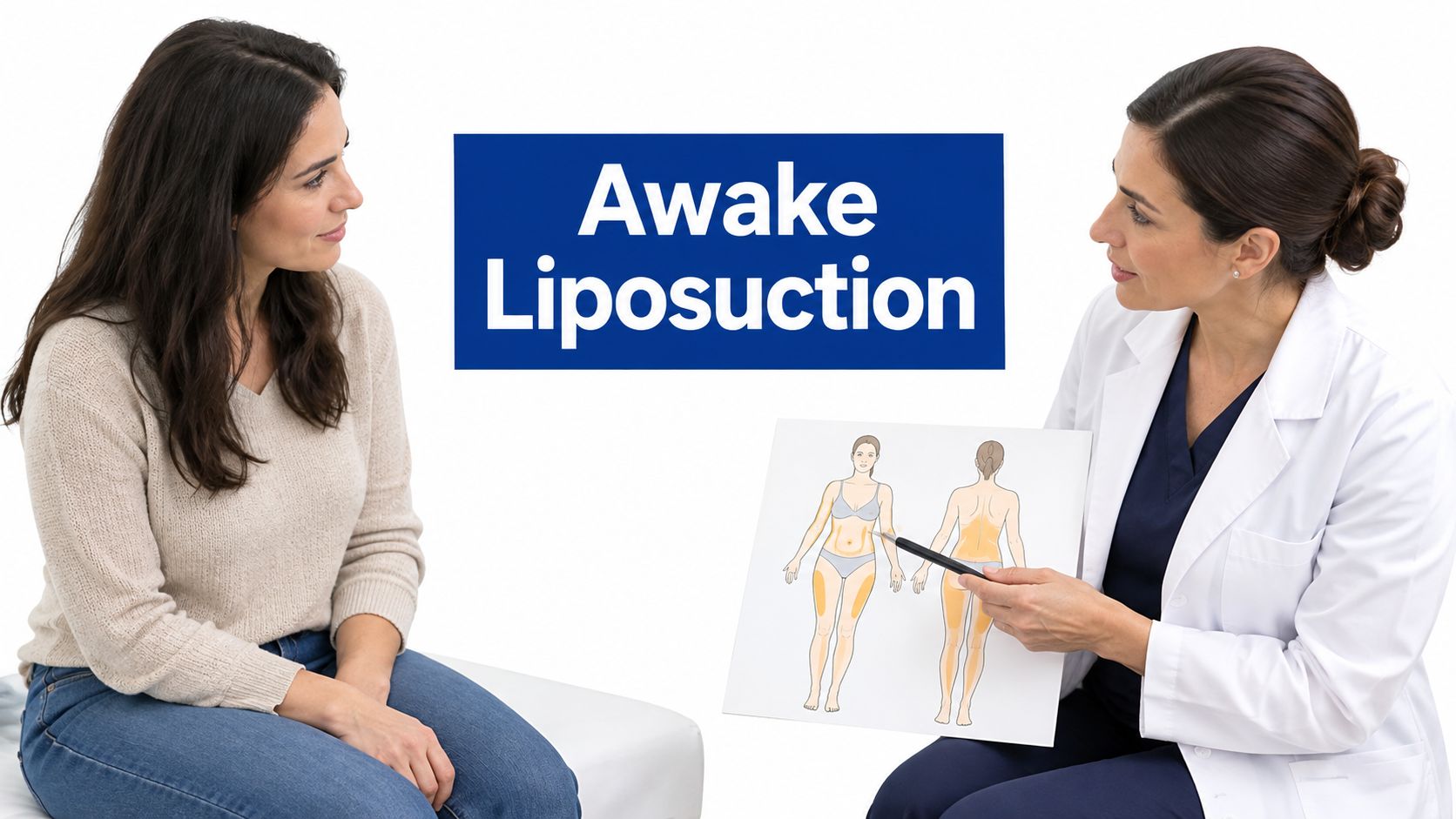
Awake liposuction is most commonly called tumescent liposuction under local anesthesia, also written as pure tumescent liposuction when general anesthesia and IV sedation are excluded. The important distinction is that “awake” describes consciousness, not a guarantee of safety.
Advice to choose awake surgery just because it avoids general anesthesia skips the questions that matter most. How much anesthetic will you receive? How much material will the surgeon remove, and is the facility prepared to manage complications? Those answers matter more than the marketing name.
Table of Contents
- Awake Liposuction Names and What Each One Means
- How Tumescent Anesthesia Makes Awake Surgery Possible
- Awake Benefits Compared With General Anesthesia
- Dose and Volume Limits That Set the Safe Line
- Who Is a Good Candidate for Awake Liposuction
- Confirm the Plan Before You Book a Consultation
Awake Liposuction Names and What Each One Means
Tumescent liposuction under local anesthesia is the clearest clinical answer to “What is awake liposuction called?” The other names you'll encounter may describe a contouring goal, an anesthesia approach, or a practice's own service.
The distinction between awake and tumescent helps you sort them. Awake describes your conscious state. Tumescent describes tissue that becomes swollen and firm after the surgeon infiltrates a dilute anesthetic solution into the fat layer.
Names and terms for awake liposuction
| Term | What it describes | Where you will see it |
|---|---|---|
| Tumescent liposuction under local anesthesia | Fat removal after the area is swollen with dilute anesthetic; the patient stays conscious | Medical literature and patient education |
| Pure tumescent liposuction | Tumescent technique excluding general anesthesia and IV sedation | Technical and surgical literature |
| Liposculpture | Contouring liposuction, typically performed under local anesthesia | Hospital patient guides |
| Awake liposuction | Lay term for the conscious-patient approach, not a standardized procedure category | Search results and marketing pages |
| Awake body sculpting | Practice-specific label for awake body contouring | Ideal Face & Body's Awake 360 Body Sculpting |
| PRECISION SCULPT | The practice's own liposculpting service name | The practice's treatment menu |
Cleveland Clinic's explanation of liposuction and liposculpture distinguishes contouring terminology from the anesthesia choice. Liposculpture typically uses local anesthesia, while liposuction may use local or general anesthesia. Neither word, by itself, tells you the complete medication plan.
A service name isn't an anesthesia record
PRECISION SCULPT and Awake 360 Body Sculpting are service names, not separate scientific categories of anesthesia. The practice describes contouring options for the arms, chin, neck and jawline, abdomen, flanks, thighs, and calves and ankles. Its guide to different types of liposuction provides context for comparing those labels.
Ask whether your proposed treatment uses local anesthesia alone or includes additional medication. Pure tumescent has a narrower meaning than a general promise that you'll remain awake.
Naming rule: Ask for the actual anesthetic plan, not just the name printed on the treatment menu.
A familiar label doesn't establish how extensive a procedure will be. Your surgeon still needs to specify the treatment areas, anticipated removal volume, monitoring, and setting.
How Tumescent Anesthesia Makes Awake Surgery Possible
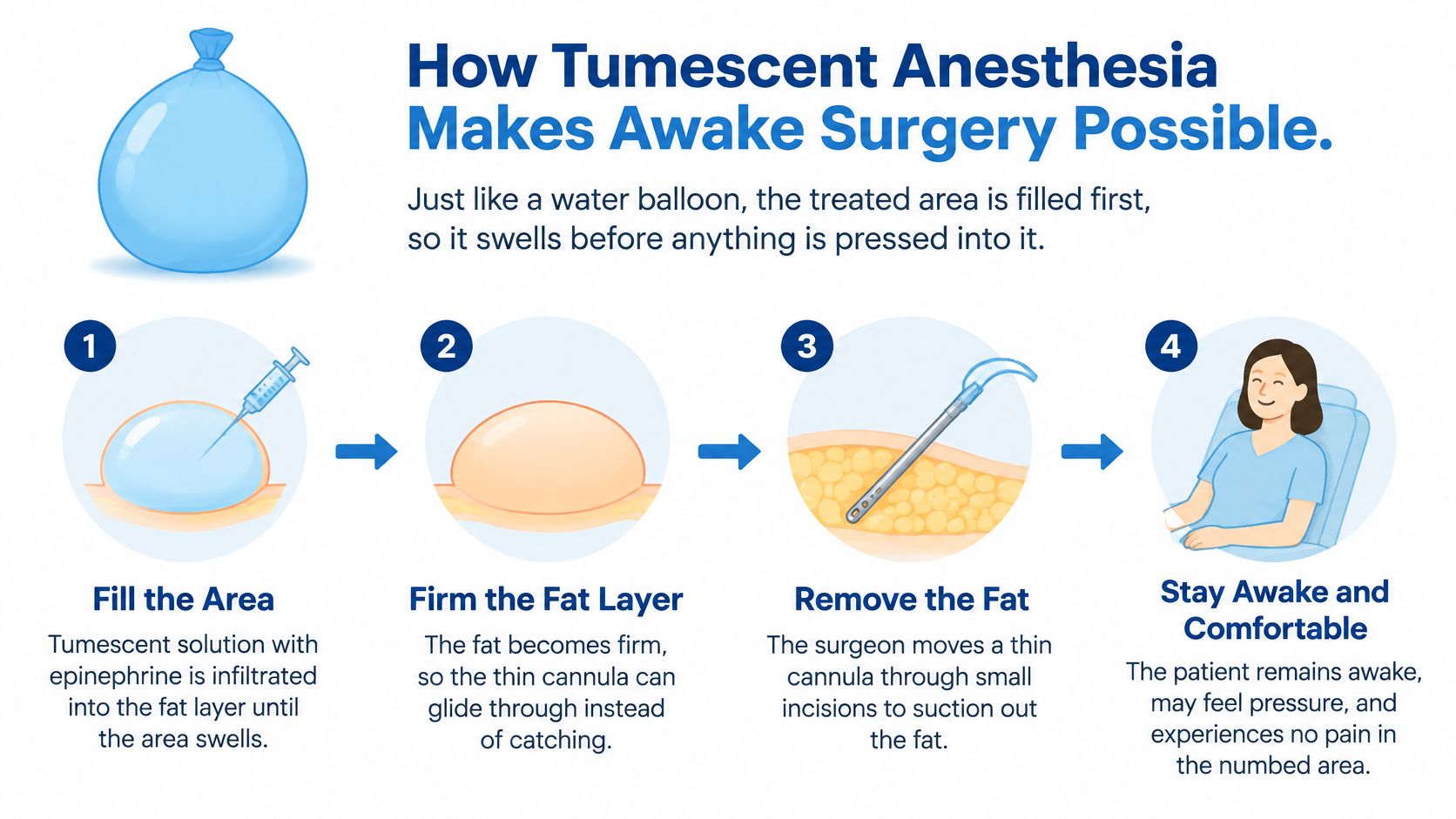
A water balloon offers a simple analogy: adding fluid makes it swell and feel firmer before you press against it. Tumescent infiltration similarly changes the feel of the treated fat layer, although living tissue isn't a balloon and must be treated with carefully controlled medication and fluid.
The solution combines lidocaine for numbness, epinephrine to narrow blood vessels and reduce bleeding, and saline to carry the diluted medication throughout the treatment area. The foundational description appeared in 1987, helping establish liposuction entirely under local anesthesia when earlier approaches relied more heavily on general anesthesia, as described in this clinical review of tumescent liposuction.
What happens during treatment
The practical sequence includes planning and aftercare, not just injection and suction:
- Mark the treatment area and confirm the planned volume. This establishes the intended contour and treatment boundaries before surgery starts.
- Calculate the lidocaine dose by body weight before injection. The surgeon must account for the complete anesthetic plan, rather than treating each injection as an isolated dose.
- Infiltrate the tumescent solution until the tissue becomes firm. Distributing the solution through the fat layer creates the local anesthetic effect.
- Allow the anesthetic to take effect. The surgeon should confirm adequate numbness before proceeding.
- Remove fat through small incisions with a thin cannula. The cannula is the instrument used to aspirate fat from the planned areas.
- Apply the prescribed compression and review aftercare. You need clear instructions for postoperative support, follow-up, and contacting the surgical team.
The practice's explanation of liposuction with local anesthesia offers additional context for discussing this approach during a consultation.
Numb doesn't mean unaware
The goal is to block sharp pain in the treatment area while you remain conscious. You may still notice pressure or movement, which is different from the sharp sensation anesthesia is intended to prevent.
Don't assume you must tolerate pain because you chose awake surgery. Tell the team if you feel sharp discomfort so the surgeon can reassess before continuing. Comfort depends on an adequate anesthetic effect, not on completing the injections alone.
Awake Benefits Compared With General Anesthesia
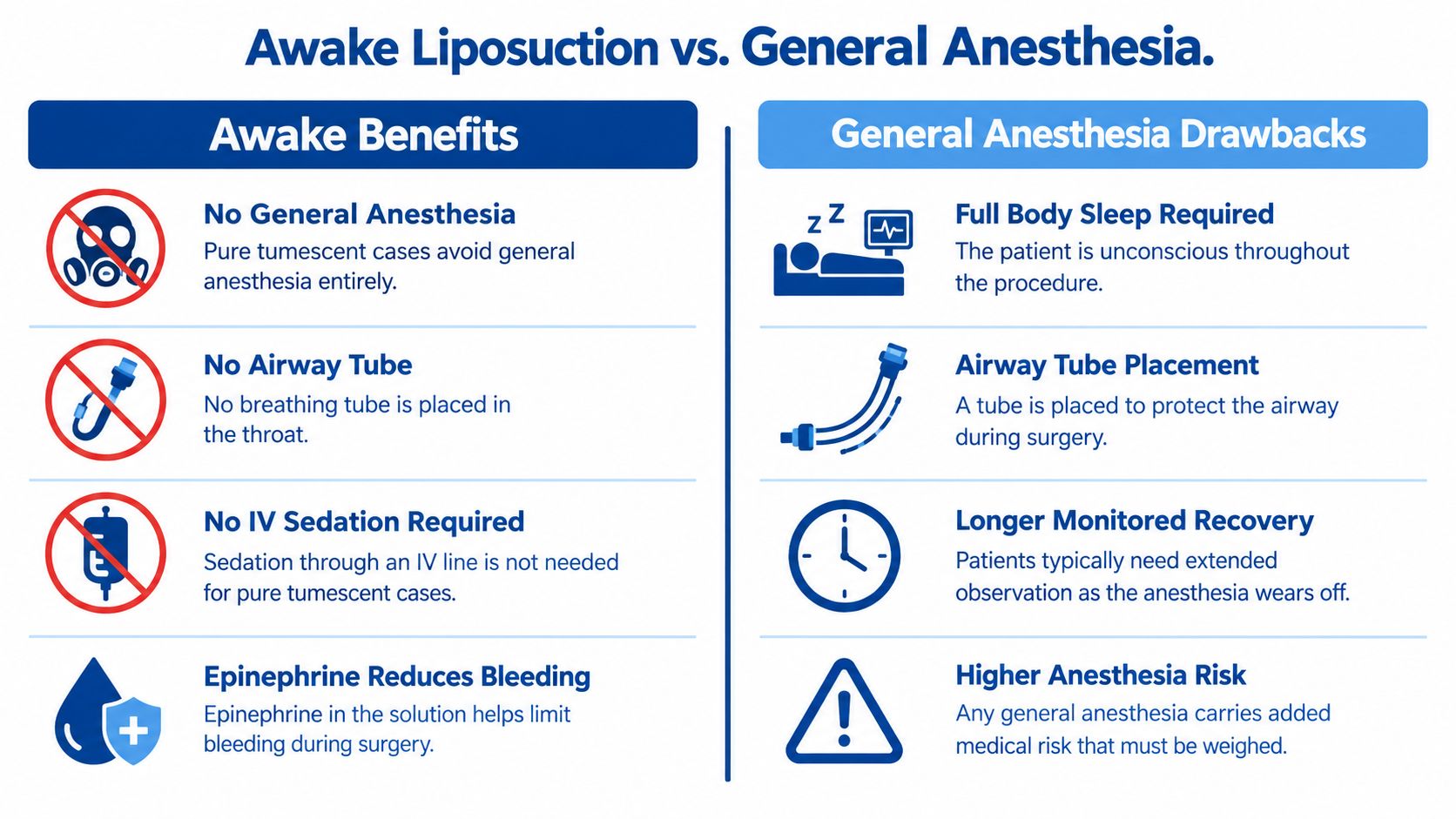
The clearest benefit of pure tumescent liposuction is avoiding general anesthesia and IV sedation. A conscious patient can also communicate with the team during treatment.
That doesn't establish that awake treatment is superior for every operation. General anesthesia may be appropriate when the planned procedure or patient's needs make local anesthesia alone unsuitable. The useful comparison is between complete surgical plans, not between an appealing label and a frightening alternative.
Awake tumescent liposuction compared with general anesthesia
| Factor | Awake tumescent liposuction | General anesthesia |
|---|---|---|
| Anesthesia approach | Local anesthesia; pure tumescent excludes general anesthesia and IV sedation | Anesthesia producing unconsciousness |
| Airway tube | Not required for the pure tumescent technique itself | Airway management depends on the anesthetic plan |
| Patient awake during surgery | Yes; all 43 patients stayed responsive in a 2025 outpatient study | No |
| Immediate postoperative pain | Average 2.42 out of 10 in a 2023 office-based study | No matched comparison provided |
| Day 1 postoperative pain | Average 1.03 out of 10 in that same study | No matched comparison provided |
| Dose and volume limits | Local-anesthetic exposure and treatment volume constrain the plan | Surgical volume, fluid management, and anesthesia still require individualized limits |
The outpatient study cited in the table reported no conversions to general anesthesia. That supports feasibility in its selected patients, not a prediction that every patient or procedure can follow the same course.
Likewise, the pain scores describe a particular office-based study. They aren't a head-to-head demonstration that awake liposuction hurts less than liposuction under general anesthesia, and they don't guarantee your experience.
Balance the benefit against the treatment scope
Epinephrine's bleeding-reduction role belongs to the tumescent solution, not to consciousness itself. A patient being awake doesn't independently prevent bleeding, infection, fluid shifts, or uneven contours.
Avoiding general anesthesia also doesn't remove the need for monitoring or an emergency plan. The American Society of Plastic Surgeons' liposuction safety guidance includes anesthesia risks, bruising, persistent sensory changes, and possible injury to deeper structures among recognized complications.
A reasonable benefit is avoiding an anesthetic approach you don't need. An unreasonable promise is that remaining awake removes surgical risk.
For a limited treatment area, carefully managed local anesthesia may fit the procedure well. For a more extensive plan, a different setting or anesthetic approach may be more appropriate.
Dose and Volume Limits That Set the Safe Line
Awake does not mean risk-free. The central medication issue is how much lidocaine enters the patient's body, not whether the patient can hold a conversation.
The surgeon must calculate the dose by body weight and account for every local-anesthetic source. Fluid planning matters separately, because increasing the treatment scope can increase both anesthetic exposure and the demands of surgery.
Dose and volume thresholds in awake liposuction
These figures describe different research conditions, clinical cautions, and regulatory purposes. They aren't interchangeable permissions.
| Threshold | Figure | What it means |
|---|---|---|
| Published tumescent lidocaine upper-limit estimate | About 35 mg/kg | A planning limit also discussed in the ASPS liposuction safety advisory |
| Preliminary maximum safe dose with liposuction | 45 mg/kg | Higher estimate under the volunteer-study conditions summarized in the tumescent-anesthesia safety evidence |
| Preliminary maximum safe dose without liposuction | 28 mg/kg | Lower estimate when fat isn't removed, from the same evidence |
| Calculated lidocaine-toxicity risk for those estimates | No more than 1 in 2,000 | Applies under those study conditions, not to every patient |
| Large-volume aspiration risk zone | More than roughly 4–5 liters | Associated with rare but severe complications in the same clinical discussion |
| Total aspirate generally to avoid in an office | More than 5 liters | Setting guidance discussed in the office-based anesthesia safety review |
| Aspirate generally to avoid when liposuction is adjunctive | More than 2 liters | A more restrictive office-setting recommendation when combined with other procedures |
| New York office-based surgery oversight threshold | 500 cc | An oversight threshold, not a universal safe-removal limit |
The later volunteer-study estimates don't automatically replace a conservative clinical ceiling. The ASPS advisory cautions that low protein levels or conditions affecting lidocaine metabolism may make its stated threshold inappropriate for a particular patient.
The calculated toxicity estimate also isn't an overall surgical-complication rate. It addresses a specific medication risk under study conditions.
Volume and facility readiness matter independently
Large-volume aspiration has been associated with local-anesthetic toxicity, fluid overload, pulmonary edema, pulmonary embolism, and hypothermia. A plan can become inappropriate for an office even if the patient remains comfortable and responsive.
Ask what the estimated aspirate includes and how the surgeon uses that estimate to choose the setting. Don't interpret an oversight threshold as permission to remove that amount, or an office-volume recommendation as proof that every smaller procedure is safe.
Practical safeguard: Your team should be able to explain both the dose calculation and what it would do if a complication developed.
Appropriate care includes physiologic monitoring and a facility capable of recognizing and treating local-anesthetic systemic toxicity. The question isn't merely whether emergency equipment exists, but whether the team has a workable response plan.
Who Is a Good Candidate for Awake Liposuction
An adult seeking correction of localized fat, with stable weight and realistic expectations, is a reasonable starting profile for an awake-liposuction consultation. That's a screening description, not medical clearance.
A focused neck treatment illustrates the difference between targeted contouring and extensive body surgery. An ASPS discussion of deep-plane neck liposuction describes local-anesthetic treatment taking approximately 30 to 40 minutes.
Other selected procedures have also been performed this way. A 2024 gynecomastia study reported 60 male patients treated between 2010 and 2023, with no conversions to general anesthesia. In a 2025 outpatient study, 69.8% of patients underwent combined thigh lift and liposuction, showing that a combined procedure isn't automatically excluded.

Candidate fit by situation
| Situation | Typical fit |
|---|---|
| Localized fat in a limited area, stable weight | Reasonable starting profile for assessment |
| Neck or jawline contouring | A targeted local-anesthetic option in selected patients |
| Several areas in a session | Consider only after total dose, volume, and time are assessed |
| Combined thigh lift and liposuction | Demonstrated in selected patients; requires individualized planning |
| Chest contouring for gynecomastia | Supported by the selected-patient study described above |
| Heart, lung, bleeding, or metabolic conditions | Requires medical assessment before determining suitability |
| Revision after earlier liposuction | Case-by-case assessment |
What may change the recommendation
Large treatment volumes and lengthy combined procedures deserve particular scrutiny. The number of named body areas alone doesn't tell you whether a plan is appropriate: a small targeted area and a broad contouring area can require very different treatment.
Bring up heart or lung disease, bleeding disorders, liver or kidney conditions, low protein levels, and all medications during screening. Ask whether any of these affect drug handling, monitoring, or the recommended facility. Significant anxiety also matters if remaining awake would be unworkable.
If your goals follow substantial weight change, the practice's discussion of liposuction after weight loss can help you prepare questions about contouring expectations.
PRECISION SCULPT and Awake 360 Body Sculpting are offered in the practice's Beverly Hills, CA, office. Out-of-town patients can ask about a virtual consultation, but an initial conversation doesn't replace the examination and medical review needed to confirm candidacy.
Confirm the Plan Before You Book a Consultation
Book an assessment for a specific treatment goal, not just because you prefer the word "awake." Bring your health history, medication list, and these questions.
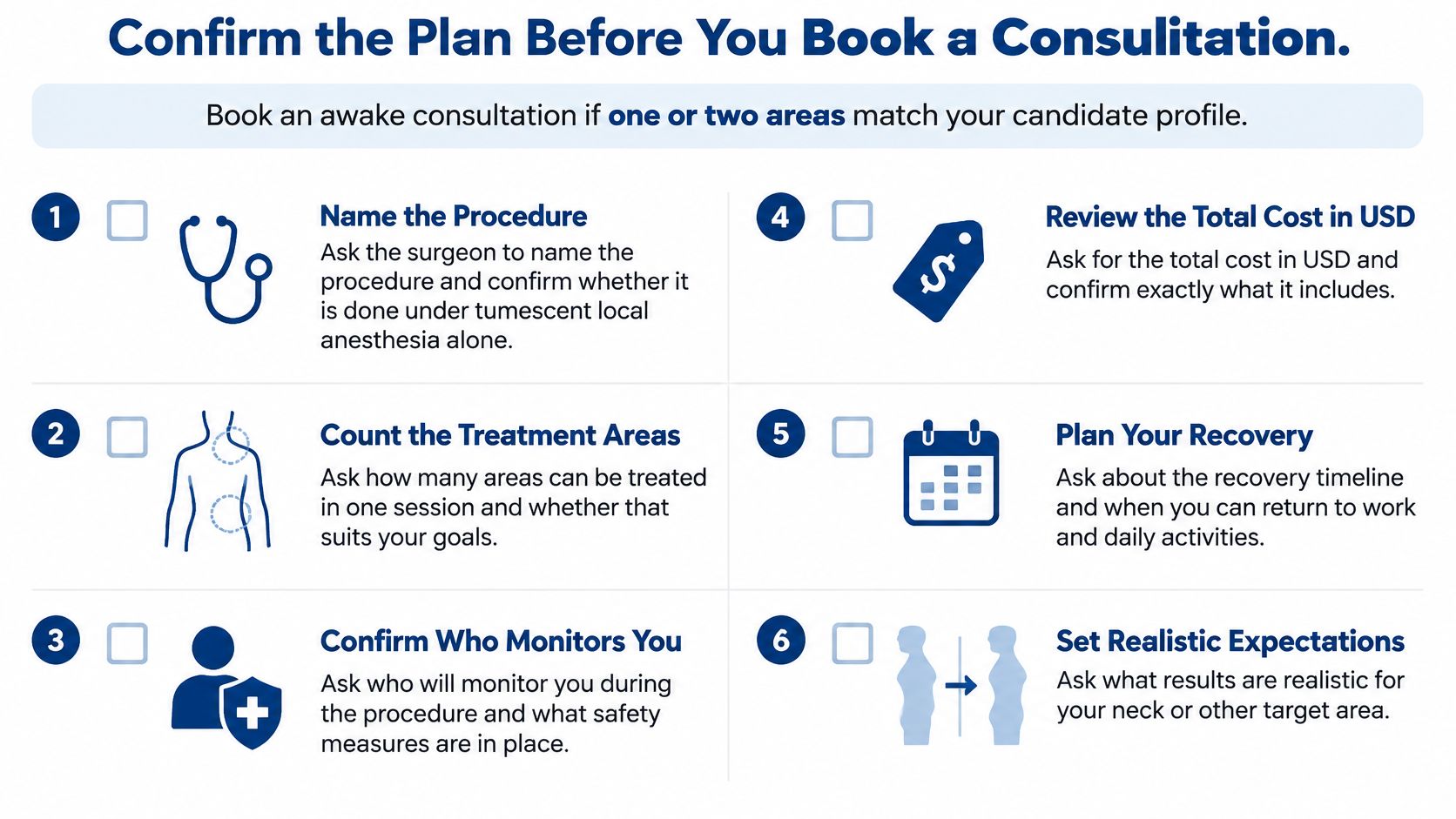
- What is the exact procedure? Confirm whether it's pure tumescent treatment or includes additional sedation.
- What are the estimated aspirate volume and operative time? Ask how those estimates affect the setting.
- How will you calculate my lidocaine dose? Include your weight and every other local anesthetic.
- Who monitors me, and what happens in an emergency? Ask about equipment, hospital-transfer criteria, and postoperative escort requirements.
- Which conditions or medications change my plan? Request individualized instructions rather than making medication changes yourself.
- Who performs the procedure? Ask about experience with comparable treatment areas and procedures.
The practice is led by Dr. Justin Yovino and Dr. Sarah Yovino, with in-person and virtual consultation options. Confirm who would perform your proposed treatment.
Its current breast-procedure policy states that it no longer offers breast implant placement, implant-based breast augmentation, or breast implant revision procedures. Implant questions therefore require a separate, procedure-specific discussion.
If the answers about dose or volume remain unclear, get a second opinion before proceeding.
Ideal Face & Body offers awake body contouring under local anesthesia in Beverly Hills, CA. Visit Ideal Face & Body to request an in-person or virtual consultation and discuss your target area, anesthetic plan, and suitability for office-based treatment.