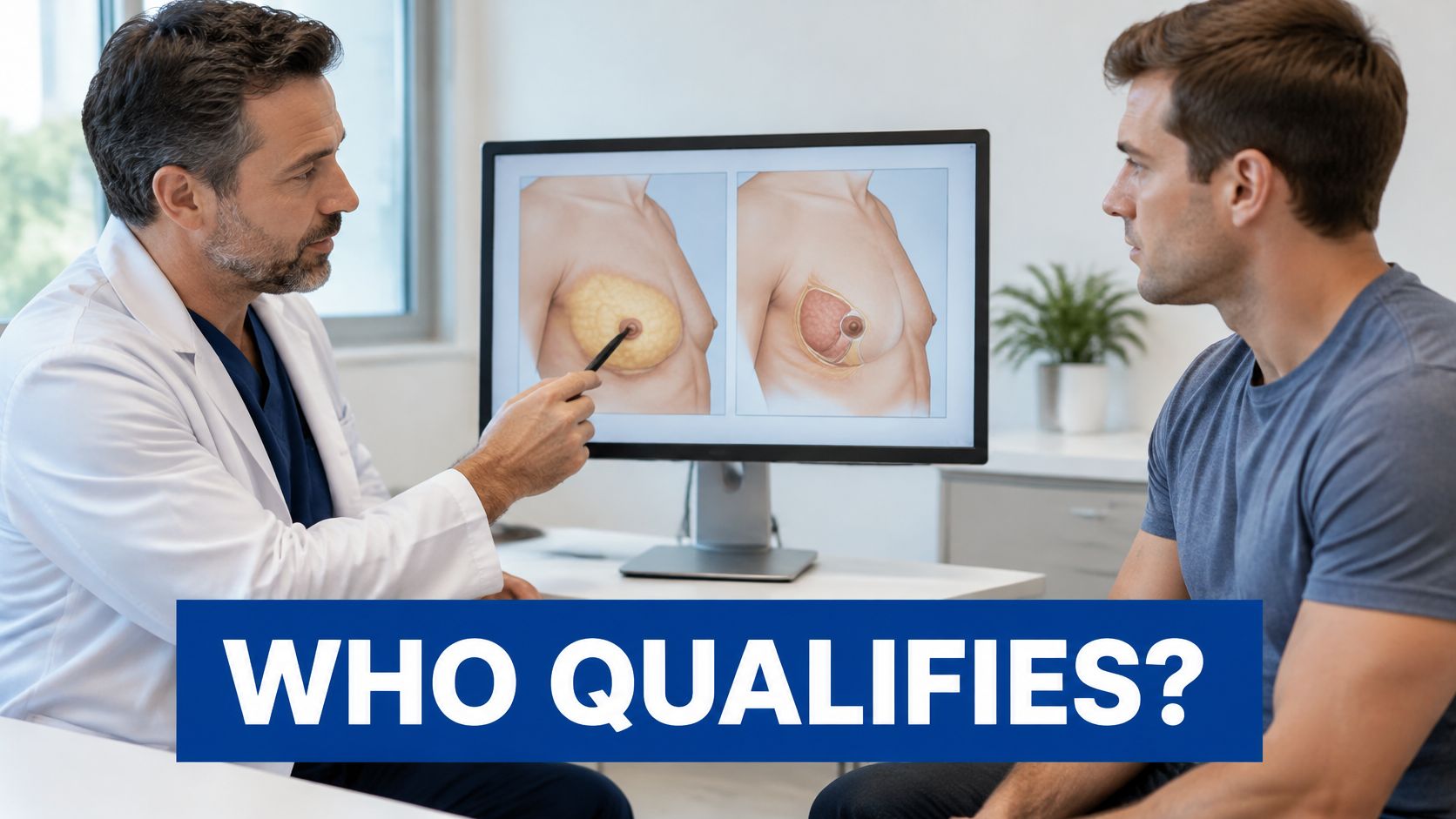
Could choosing smaller scars leave the chest flatter at the sides but still full beneath the nipples? If the tissue under the nipple is firm gland rather than fat, liposuction may leave that central fullness behind. The least invasive operation is not automatically the better fit: choosing it without identifying the tissue can mean residual enlargement and another procedure.
Table of Contents
- The Short Answer on Liposuction-Only Gynecomastia Surgery
- How to Tell Fatty From Glandular Chest Enlargement
- What Liposuction Alone Corrects and What It Leaves Behind
- Complication Rates Across Gynecomastia Techniques
- Awake Surgery Under Local Anesthesia
- Revision Considerations After Liposuction-Only Surgery
- Confirm the Right Approach Before You Book
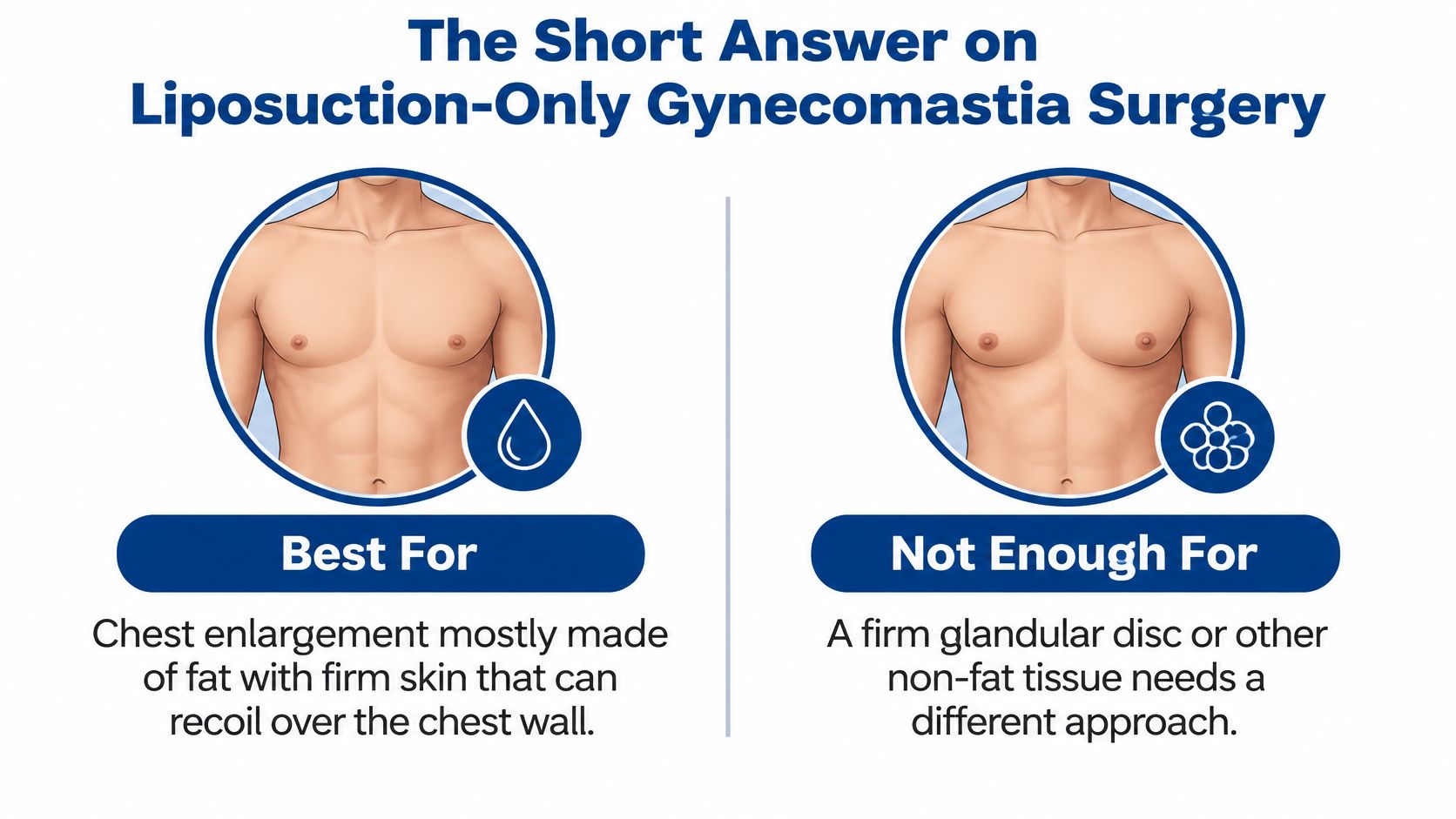
The Short Answer on Liposuction-Only Gynecomastia Surgery
Could a smaller operation leave the chest less flat than you hoped? It can, if the plan is based on incision size rather than what the tissue and skin require. Liposuction-only surgery is a conditional choice: it works when the chest is mostly fatty and the skin can settle after fat is removed.
Which operation fits which chest
| Approach | Best Fit | Main Limit | Incision Pattern |
|---|---|---|---|
| Liposuction alone | Mostly fatty enlargement with good skin recoil | Shapes the fatty chest, but leaves firm gland or excess skin untreated | Small access incisions |
| Gland excision alone | Firm subareolar gland with little fat | Removes the central gland, but does not contour surrounding fat | Incision around or near the areola |
| Liposuction plus gland excision | Mixed fat and firm gland | Adds tissue removal to contouring, with more tissue handling and longer recovery than fat-only surgery | Small access incisions plus excision incision |
| Skin excision with tissue removal | Significant skin excess or advanced tissue descent | Removes excess skin as well as tissue, with more visible scarring | Larger incisions for skin and tissue removal |
A 2010 retrospective review examined records from January 1988 through October 2007 for 227 patients: open excision alone (45), open excision plus liposuction (56), liposuction alone (50), and liposuction plus an arthroscopic shaver (76). Liposuction alone accounted for about 22.0% of the cases. The figures show that suction was one of several approaches, chosen according to the tissue being treated.
Practical rule: Fewer incisions aren't a reason to skip gland removal when a firm disc is present.
How to Tell Fatty From Glandular Chest Enlargement
Fat feels soft and spreads across the chest; glandular tissue is usually firmer and concentrated beneath the areola. A cannula can remove fat through small access points, but it may not clear a firm glandular disc. That difference helps determine whether liposuction alone is likely to suit the tissue.
Diffuse, soft fullness may respond to aspiration. A distinct, rubbery mass directly under the nipple may require direct excision. The American Society of Plastic Surgeons' overview of gynecomastia surgery says liposuction alone may be used when fatty tissue is the main component, while glandular tissue or excess skin may require excision. The American Society for Aesthetic Plastic Surgery's procedure information also notes that liposuction-assisted reduction does not correct glandular gynecomastia.
Six checks before anyone names the operation
- Assess the tissue beneath the nipple. With the chest relaxed, gently feel beneath the areola. Soft, diffuse tissue may be mostly fat; a distinct, firm button may indicate gland.
- Check skin recoil. Skin that springs back may settle after fat is removed. Thin, loose skin after weight loss may remain loose.
- Look at the nipple and areola. An enlarged areola, a low nipple, or visible droop can affect whether tissue removal or skin tailoring is considered.
- Consider duration and weight stability. Fullness that appeared with recent weight gain differs from tissue that has remained firm for years at a stable weight.
- Review medicines and supplements. Some drugs and hormones can stimulate breast tissue. If the cause continues, removing fat may not address the ongoing enlargement.
- Consider further medical assessment when the history raises concern. One-sided growth, pain, or rapid change may call for evaluation before a cosmetic plan. A guide to identifying gynecomastia explains signs that can help distinguish it from fatty fullness.
For example, a soft chest that extends from the sternum toward the side, with springy skin and no distinct firm area beneath the nipple, may fit a liposuction-only plan. If the surrounding chest feels soft but a firm disc sits under the areola, removing fat around it may leave the nipple projecting. The least invasive operation is useful only when it matches the tissue being treated.
What Liposuction Alone Corrects and What It Leaves Behind
Liposuction can flatten diffuse, fat-based fullness and smooth the contour toward the sides of the chest. Its small access points do not let it reliably remove dense glandular or fibrous tissue, and it does not tighten substantial loose skin.
During surgery, a surgeon may find a small, firm area beneath one nipple. If that tissue is left behind, the sides may look flatter while the center remains full, sometimes creating a “puffy nipple.” The choice to remove it depends on the tissue found and the agreed surgical plan.
The different types of gynecomastia surgery address fat, gland, or both. Liposuction alone suits fat-dominant fullness; a distinct glandular area may call for targeted removal. The incision trade-off is part of that decision, but choosing the least invasive approach can leave more tissue behind if the diagnosis is wrong.
A small study of 18 patients with grade I or II gynecomastia examined liposuction combined with glandular liposculpturing without formal gland excision. The authors described liposuction alone as having minimal scarring but limited effect on dense glandular and fibroconnective tissue. A firm area may remain when glandular tissue is substantial. Because the study was small, it illustrates a possible limitation rather than predicting every patient's result.
When to judge the result
Swelling can obscure the chest contour for months, so the shape in the second week is not a reliable guide to the final result. After healing has substantially settled, persistent central firmness may indicate residual glandular tissue, which can require a secondary excision. Judge the result with your surgeon once the swelling has had time to resolve.
Complication Rates Across Gynecomastia Techniques
A systematic review of 94 studies involving 7,294 patients reported complications in 14.87% of aspiration-only cases, 30.64% of excision-only cases, and 11.76% of combined aspiration-plus-excision cases. Those figures are a review of published series, not a ranking you can apply to your own chest.
Reported complication rates by technique
| Technique | Reported Complication Rate | How to Read It |
|---|---|---|
| Aspiration only | 14.87% | Lower burden, but fits fat-dominant chests only |
| Excision only | 30.64% | Highest reported burden in the review |
| Aspiration plus excision | 11.76% | Likely reflects matching technique to tissue, not universal superiority |
The authors cautioned that technique labels were inconsistent across studies and that substantial heterogeneity biased direct comparisons. You can't read the lowest number as proof that one operation is best for every man.
What the numbers can still tell you
The combined figure likely reflects a sensible match. Surgeons removed gland where gland was present and used liposuction to smooth the fat around it. It doesn't prove that adding an incision always lowers risk.
On a fat-dominant chest with good recoil and no real glandular button, the lower aspiration-only burden fits the job. Using aspiration alone on a firm subareolar component is a different bet. The risk there is residual nipple projection, an incomplete correction, or an uneven contour, even if the early recovery felt easier.
Match the technique to the tissue you actually have. Use aspiration alone only when fat dominates. Combine aspiration with excision when both tissues are present. A lighter incision burden can trade against an incomplete result when the diagnosis was wrong.
Awake Surgery Under Local Anesthesia
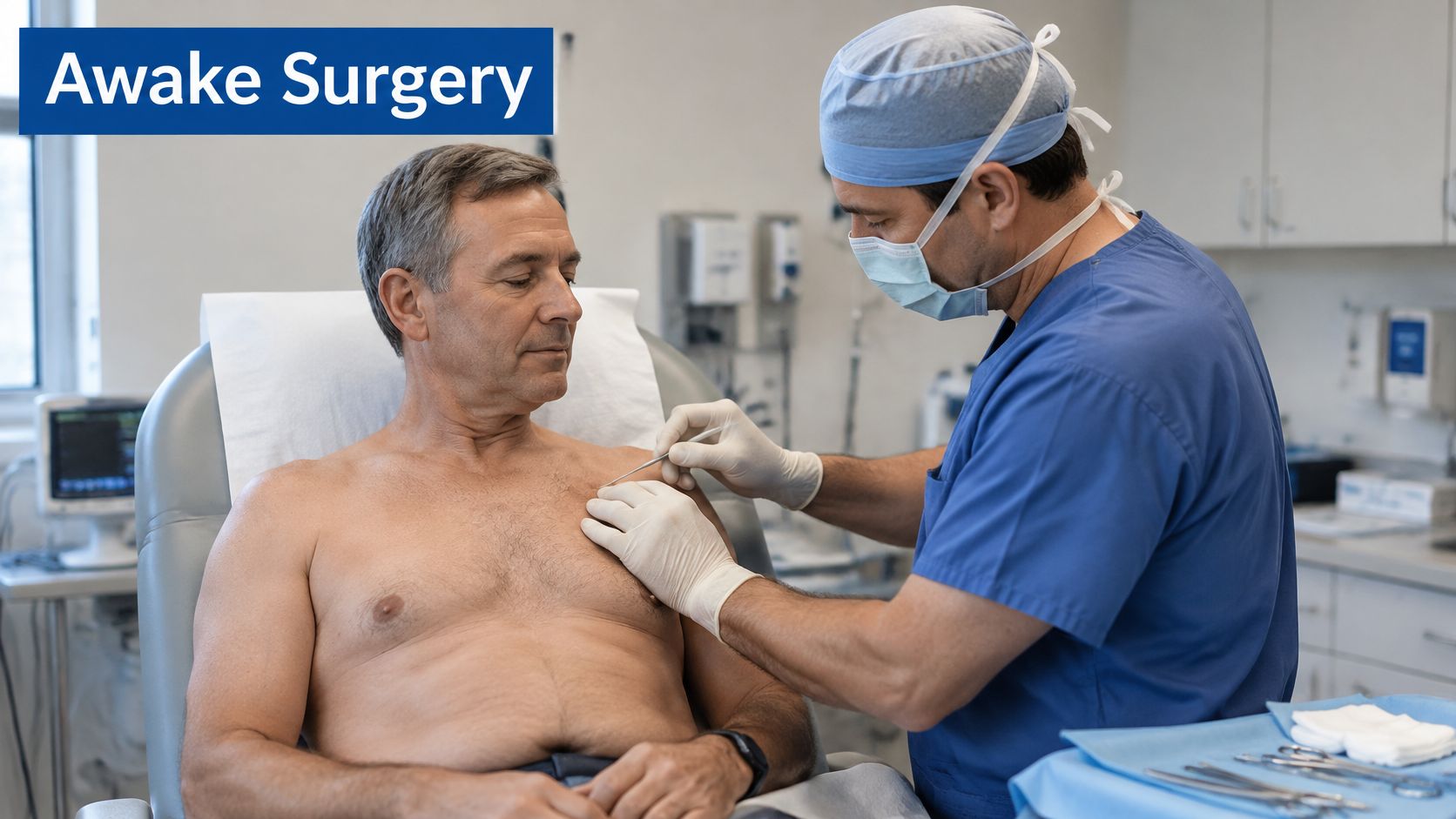
Awake chest surgery uses local anesthesia in an office setting. The patient remains awake, avoiding general anesthesia and a breathing tube. Local anesthesia changes the setting; the exam still determines the tissue.
Who fits an awake plan
A reasonable candidate has a predominantly fatty chest, good skin quality, and a stable weight, with no need for skin removal or substantial gland excision. A sizable glandular disc or clear skin excess may call for a different surgical plan, even if an awake setting is suitable.
Ideal Face & Body offers awake, office-based procedures under local anesthesia. Body and chest surgical procedures are led by Justin Yovino, MD, FACS; Sarah Yovino, MD, is a physician injector. Read about the practice's approach to male chest contouring.
Recovery in plain terms
A compression garment is commonly worn to help the skin settle against the chest as swelling subsides. Bruising and swelling are expected; they ease over weeks, while the final shape can take months to emerge. Follow your surgeon's instructions for returning to desk work and exercise, since timing depends on the procedure and your recovery.
Before choosing an awake procedure, ask:
- Gland check: Will the surgeon assess for glandular tissue during the consultation, as well as review the chest's appearance?
- Excision option: Is direct excision available if the exam finds a firm disc?
- Plan during surgery: What will happen if a firm area is found during the procedure?
- Unresolved fullness: How will persistent central fullness be assessed after healing?
Awake surgery describes the anesthesia and setting. The planned operation still needs to fit the findings on examination.
Revision Considerations After Liposuction-Only Surgery
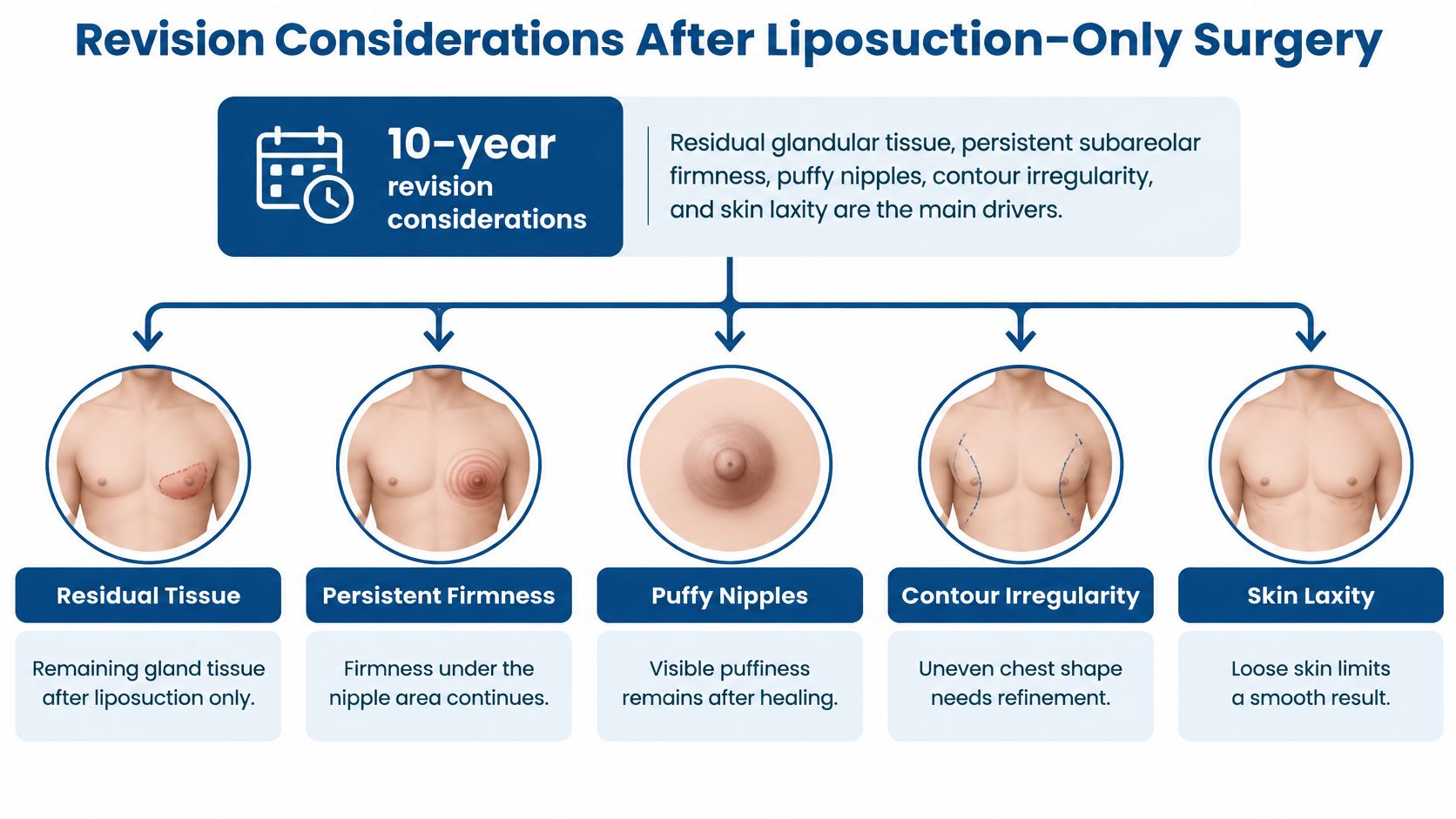
Revision usually traces back to something suction couldn't finish: residual gland, persistent firmness under the areola, puffy nipples, an uneven contour, or skin that stayed loose.
What published series actually found
A 10-year University of Texas Medical Branch series covered 34 patients treated from 1991 to 2001. 12 received cross-chest suction-assisted lipectomy alone because the exam showed predominantly fatty enlargement. Average bilateral lipoaspirate volume in those suction cases was 385 mL, with a range of 75 to 800 mL. The authors reported satisfactory aesthetic results and no postoperative complications among patients treated with suction alone or suction plus excision. The only hematoma was in a patient treated with excision alone.
A more recent comparison in that same report looked at 32 breasts, 17 treated with liposuction alone and 15 with liposuction plus glandular excision. There was bruising in four breasts, two hematomas managed without surgery, and one redo for persistent "puffy nipples" in the liposuction-only group. That redo was 1 of 17 breasts, about 5.9%. Both series are small, so treat the figures as directional. They don't prove a personal risk. They do show that fat-dominant chests can do well, and that leftover gland can still force another operation. Volume removed doesn't replace tissue selection.
A revision decision, in order
- Wait for swelling to settle. Early firmness is often edema. Operating on it can chase a shape that was going to soften.
- Re-examine for a disc or lasting projection. If the center is still firm after healing, the first operation likely left gland.
- Rule out a new driver. Hormones, a medicine, or a clear weight change can enlarge a chest that was adequately treated.
- Name the leftover problem. Residual gland, extra skin, and new enlargement are different findings and need different fixes.
- Pick the tool that matches. Targeted excision for a disc, more liposuction for remaining fat, or both when the chest has both.
- Set timing with your surgeon. A second operation on inflamed tissue raises trouble that waiting would avoid.
Residual tissue isn't the same as true recurrence. Residual tissue was there on the day of surgery and never left. Recurrence is new growth after a complete removal, often from a hormonal or medication stimulus or from weight change. One needs a technical correction. The other needs the cause addressed, or the same fullness can return.
Revision liposuction is part of our Precision Sculpt® services when the remaining issue is fat or contour, not a disc that still needs excision.
Confirm the Right Approach Before You Book
What should you bring to a consultation about liposuction-only gynecomastia surgery? Useful details include:
- Photos of your chest from the front and both sides, taken in even light.
- A timeline of how long the enlargement has been present.
- A list of medicines and supplements, including hormones and recent changes.
- Weight history, including any large loss or gain.
- Symptoms and changes, such as pain, one-sided growth, or rapid enlargement.
The exam should assess skin recoil and whether the chest has a firm central area that may need direct removal. When fat and gland both contribute, liposuction alone may leave fullness behind. A combined approach may better address both tissues in one operation.
Ideal Face & Body in Beverly Hills offers awake liposculpting performed with numbing only. PRECISION SCULPT lipo, developed and pioneered by Justin Yovino, MD, is the practice's liposuction method. Justin Yovino, MD, FACS, can assess whether liposuction alone fits your anatomy, whether another approach is more suitable, and how residual tissue would be addressed.
The practice offers awake, office-based chest contouring under local anesthesia for men with fatty, glandular, or mixed enlargement. To discuss which approach fits your case, visit Ideal Face & Body and schedule a consultation with Justin Yovino, MD, FACS, in Beverly Hills. Bring your photos, medication list, and questions about the options.