The most popular advice about under-eye bags is also the most misleading. You're often told to find a surgeon who'll remove the fat, as if every bag were the same problem waiting for the same trim. It isn't. A bulge can come from protruding orbital fat, a hollow beside it, loose skin, prominent muscle, pigment, or a descended cheek. Lower eyelid blepharoplasty changes some of those directly, helps others only partly, and can't fix the rest at all.
Table of Contents
- What Lower Eyelid Blepharoplasty Corrects and Why Under-Eye Bags Differ
- Who Qualifies for Lower Eyelid Blepharoplasty
- Transconjunctival vs Subciliary Approach Compared
- Risks and Complications in Real Numbers
- Recovery Timeline From Surgery Day to Final Result
- Results, Longevity and When to Revise
- Confirm Your Candidacy Before Booking Surgery
What Lower Eyelid Blepharoplasty Corrects and Why Under-Eye Bags Differ
Lower eyelid blepharoplasty refines the lower lid by reducing or repositioning orbital fat, managing excess skin when needed, and smoothing the transition from lid to cheek. The lower lid is built in layers: skin, orbicularis muscle, orbital septum, orbital fat, and the bony rim with cheek support below. A visible bag appears when one layer changes relative to another. The operation works less like cutting fabric away and more like re-sewing a seam so one surface flows into the next without a ridge. Practice has moved from simple fat removal toward fat repositioning that preserves volume, because removing too much can leave a hollow, aged look.
Match the cause to the correction
A useful way to judge any plan is to ask which cause is creating your bag. In a 2025 study of 183 patients, transconjunctival blepharoplasty combined with nanofat improved orbital-fat prolapse, tear-trough depression, and dark circles, yet orbicularis prominence became more evident and skin elasticity did not significantly change. That result explains why bags can improve while wrinkles remain.
| Under-eye cause | Changed by surgery? | Evidence or note |
|---|---|---|
| Protruding orbital fat | Directly | Core target; fat is excised or repositioned |
| Tear-trough depression | Directly | Improved with fat repositioning in a 2025 study of 183 patients |
| Dark circles | Partly | Improved in the 2025 study; not a pigment treatment |
| Thin or crepey skin | Not significantly | Skin elasticity did not change in the 2025 study |
| Prominent orbicularis muscle | Not corrected | Became more visible after surgery in the 2025 study |
| Midface descent | Not by lid surgery alone | Needs a midface approach |
| Skeletal contour | Not by lid surgery alone | Outside the reach of an eyelid incision |
The same 2025 study of 183 patients reported increased fine wrinkles in 5.5%, undercorrection of the tear trough in 2.7%, infraorbital hollowness in 1.1%, and recurrence in 1.6%. The study's complications show what fat work cannot do: it does not tighten skin, erase pigment, or lift a cheek. Where crepey surface skin is the remaining issue, staged resurfacing may be discussed separately. This 3D Aesthetics Leamington Spa CO2 advice gives background on laser options before you ask a surgeon what fits. Sometimes volume treatment fits better. Sometimes no procedure is the honest answer.
One visible bag can have several causes, so a good result for the fat can still leave hollowness, fine lines, or color behind.
Who Qualifies for Lower Eyelid Blepharoplasty
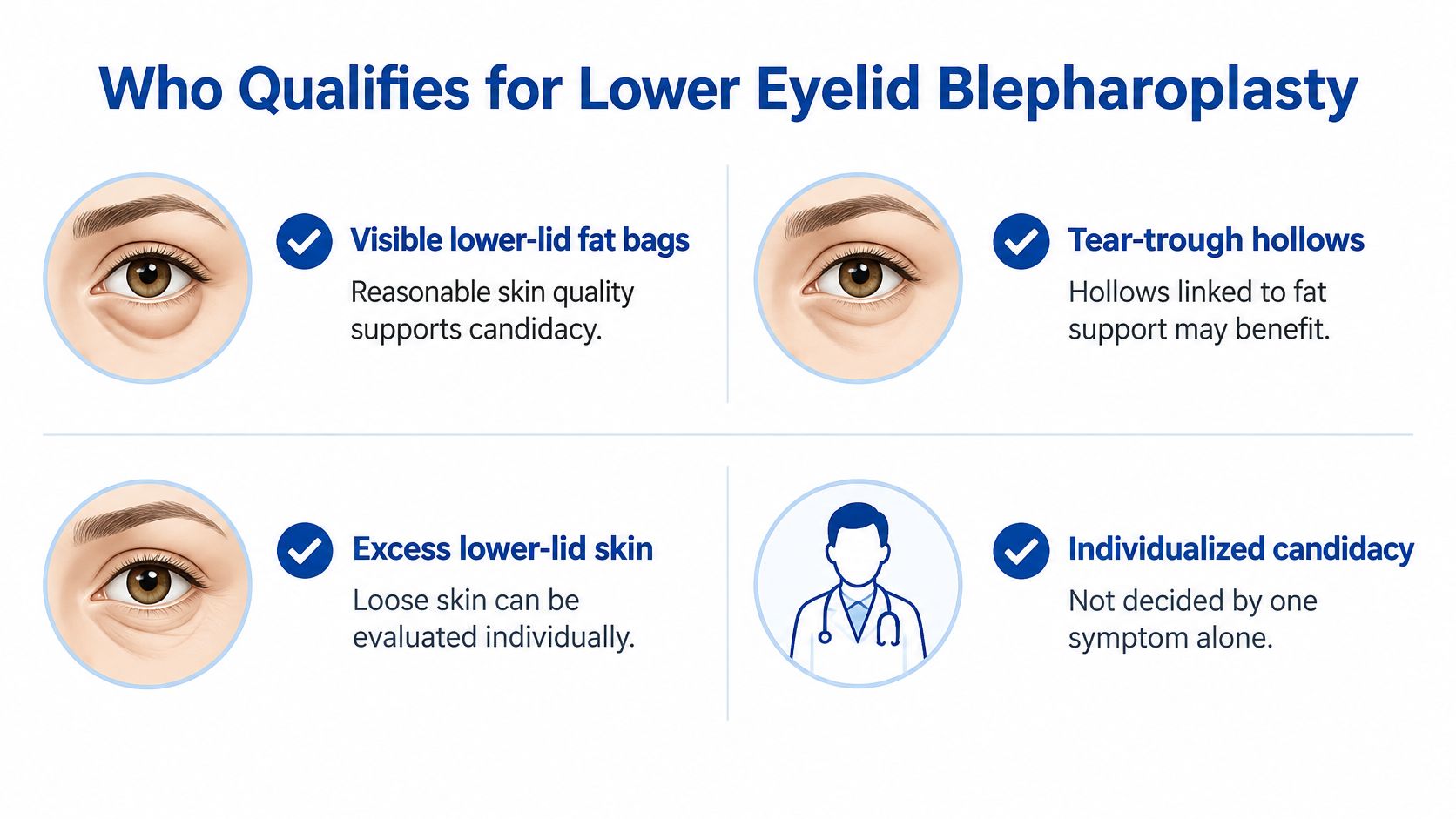
Candidacy isn't decided by one symptom. As the StatPearls chapter on lower eyelid blepharoplasty frames it, this is a three-dimensional volume-and-support operation, not a fat-excision procedure. The same apparent eye bag can reflect fat prolapse, skin excess, midface descent, or skeletal contour, and each needs a different maneuver.
Signs that often fit surgery
- Visible lower-lid fat bags: Your skin quality is reasonable and the main problem is fat pushing forward.
- Tear-trough hollows linked to fat prolapse: A bulge sits above a groove, so moving fat can smooth both at once.
- Excess skin or laxity: Loose tissue can be managed in a controlled way, with lateral canthal support if your lid needs it.
- A contour goal: You want a smoother lid to cheek transition, not the removal of every line or all pigment.
Fat repositioning matters most when you have both orbital fat prominence and tear-trough depression. Fat mobilized over the infraorbital rim toward the malar region fills the groove instead of being discarded, which lowers the risk of the skeletonized hollow that aggressive excision can create.
Signals that need more evaluation first
- Uncontrolled dry eye: Your tear film and blink need assessment before anyone operates near the lid margin.
- Prior eyelid surgery: Scar and altered support change what's safe to remove or move.
- Prominent eyes or a negative vector: Your eye sits forward of the cheek support, so the lid has less natural backing.
- Midface descent: A lid operation alone won't lift a cheek that has dropped.
- Pigment or wrinkle expectations: Surgery aimed at fat won't meet a goal centered on color or surface texture.
Before deciding, your surgeon should document the snap-back test, distraction test, scleral show, canthal tilt, tear-film and blink assessment, ocular-surface symptoms, and tear-trough anatomy. Those findings link directly to treatment. Prominent fat with good skin may suit a transconjunctival incision, while significant dermatochalasis or a lid-position abnormality may call for controlled skin management and lateral canthal support.
Transconjunctival vs Subciliary Approach Compared
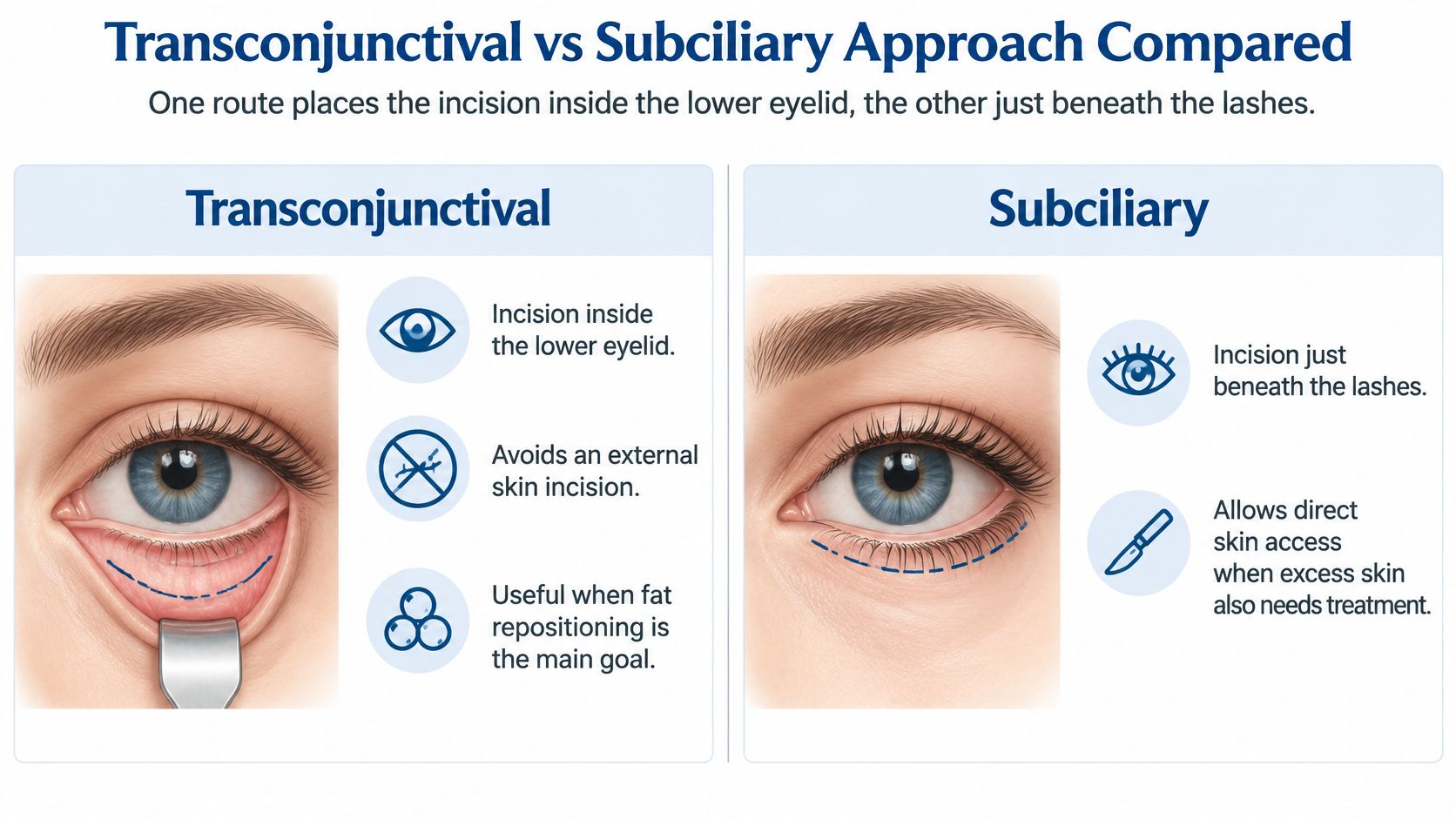
The two lower-lid routes enter the same orbital fat compartment through different doors. One door is on the inner lining of the lid. The other is just beneath the lashes. Choosing by scar alone ignores the factors that decide the route: how much of your visible bag is fat, how much is loose skin, and how well your lid supports itself.
The inside route
The transconjunctival approach reaches orbital fat through the conjunctiva, the moist inner lining of the lid. It leaves no scar on the skin surface. Through that access, your surgeon can reduce fat or reposition it into the tear trough. Because the skin and the lid-supporting muscle are not cut from the front, this route suits a lid where fat is the main problem and skin does not need removal.
Its limit is easy to state. Working from inside, your surgeon cannot remove excess skin. If loose, crepey skin is a major part of what you see, an inside-only operation leaves that skin behind. The route addresses fat, so it fits fat-predominant lids rather than skin-predominant ones.
The route beneath the lashes
The subciliary approach, also called transcutaneous, uses an incision just beneath the lower lashes. It gives direct access to skin, muscle, and fat in one field. That access makes it easier to manipulate a pedicled fat flap and to remove skin when genuine excess is present. The trade-off is a fine external scar at the lash line and a greater need for restraint. Skin removal can add downward tension to a lid that already lacks support.
A systematic review of 24 cohort studies found that both approaches can safely achieve effective orbital-fat excision or repositioning, with no significant overall difference in outcomes. The review noted that the transcutaneous approach provides easier access for manipulating a pedicled fat flap, while the transconjunctival approach is particularly suited to younger patients who have lower-eyelid fat prominence but do not require skin excision.
| Feature | Transconjunctival | Subciliary (transcutaneous) |
|---|---|---|
| Incision location | Inside the lower eyelid (conjunctiva) | Just beneath the lower lashes |
| Skin removal | Not performed; suited to fat-only problems | Possible when skin excess is present |
| Fat access | Direct access to orbital fat; repositioning possible | Easier handling of a pedicled fat flap |
| Best-fit patient | Younger patients with fat prominence and no skin excess | Patients with skin laxity or a need for skin excision |
| Visible external scar | None on the skin surface | Fine scar hidden at the lash line |
| Main limitation | Cannot remove excess skin | Adds an external scar and requires conservative skin removal |
The practical decision starts with what the lid shows. A 38-year-old with a clear fat bulge, smooth skin, and a firm snap-back test is the classic inside-route candidate. Fat repositioning can soften the tear trough while the skin is left intact. A 62-year-old with loose skin, fine wrinkling, and a lid that pulls away easily needs a different conversation. Skin access and lid support move to the center, and the surgeon may combine skin handling with fat work. The incision should match the diagnosis. Scar preference is secondary.
Risks and Complications in Real Numbers
Numbers help only if you know what they can and can't tell you. The figures here are benchmarks from published series, not guarantees for any one person. They vary by technique, follow-up length, combined procedures, and how each study defined a complication. If you want a broader overview before a consultation, our guide to eyelid surgery risks covers the general categories.
What pooled data show
A 2018 pooled analysis of 10,698 patients from 29 studies found a reoperation rate of 0.77% (82 patients), scleral show in 0.37% (39 patients), eyelid malposition in 0.25% (27 patients), and ectropion in 0.24% (25 patients). Follow-up in those studies ranged from 1 week to 192 months, with a mean of 14.8 months among studies reporting it. Serious malposition was uncommon in that pooled dataset. It still happened.
Technique details shift the picture. In a 265-patient transcutaneous series using controlled skin resection, increased scleral show occurred in 3 patients, or 1%, and intralamellar scarring requiring repeated 5-fluorouracil injections occurred in 5 patients, or 1.9%. That series preserved orbicularis innervation and used selective canthal support, which shows why support is part of the operation rather than an optional extra.
| Complication or outcome | Reported rate or pattern | Study context |
|---|---|---|
| Reoperation | 0.77% (82 of 10,698 patients) | 2018 pooled analysis of 29 studies |
| Scleral show | 0.37% (39 patients) | 2018 pooled analysis of 29 studies |
| Eyelid malposition | 0.25% (27 patients) | 2018 pooled analysis of 29 studies |
| Ectropion | 0.24% (25 patients) | 2018 pooled analysis of 29 studies |
| Scleral show after controlled skin resection | 1% (3 of 265 patients) | 265-patient transcutaneous series with muscle preservation and canthal support |
| Intralamellar scarring needing repeated 5-fluorouracil | 1.9% (5 of 265 patients) | 265-patient transcutaneous series with controlled skin resection |
| Postoperative dry-eye symptoms, lower blepharoplasty alone | About 21.4% | 2024 systematic review record |
| Postoperative dry-eye symptoms, combined upper and lower | About 31.3% | 2024 systematic review record |
| Periorbital hollowing or depression | Recognized aesthetic complication, no single pooled rate | Aesthetic outcomes reported across studies with differing definitions |
| Inappropriate fat removal | Recognized aesthetic complication, no single pooled rate | Aesthetic outcomes reported across studies with differing definitions |
| Postoperative touch-up | Definition-dependent, reported ranges vary by study | Revision definitions differ between series |
The risk patients underestimate
Dry eye deserves separate attention because it's far more common than ectropion. A review summarized in a 2024 systematic review record reports postoperative dry-eye symptoms in approximately 21.4% of patients undergoing lower blepharoplasty and 31.3% when upper and lower procedures were combined, with higher rates associated with skin-muscle flap approaches. Temporary irritation after surgery differs from persistent exposure-related disease. Follow-up is how you tell them apart.
You're more vulnerable if you already have dry eye, lid laxity, or prior eyelid surgery. Prominent eyes or a negative vector also raise concern, as does excessive skin or fat removal. Those are the same signals that should slow down a candidacy decision and prompt tear-film testing, blink assessment, and a support plan.
Aesthetic problems follow a different pattern. Published series describe periorbital hollowing or depression and inappropriate fat removal as recognized aesthetic complications, yet they do not settle on a single pooled rate. A fat bulge and a hollow can look similar in a mirror but belong to different problems, which is why the same operation can improve one and worsen the other. Touch-up rates are even more definition-dependent: one surgeon's revision is another's expected second-stage refinement. Ask what your surgeon counts as a touch-up before you compare numbers.
Less surgery carries its own risks. Under-treating laxity can leave symptoms and contour problems unresolved, while over-removal creates the hollowing and malposition that are hardest to undo.
Recovery Timeline From Surgery Day to Final Result
Week one is the loudest part of recovery and the least informative. Swelling and bruising sit at their peak, so the contour in the mirror on day 5 says almost nothing about the result you will keep at six months. What a timeline can teach you is which complaints are temporary fluid and which belong to the anatomy the surgery never touched. Our overview of eyelid lift recovery time gives the general shape, and your surgeon's instructions override it for your case.
A 40-patient study of transconjunctival blepharoplasty combined orbital fat repositioning with orbicularis oculi muscle plication and suspension in patients without substantial skin laxity. Operative duration ranged from 28 to 49 minutes, and ultrasound showed soft-tissue thickness between the skin and infraorbital rim peaking 5 days after surgery before gradually declining. Patient satisfaction at 6 months reached 96.6%. A separate 97-patient study of transconjunctival lower blepharoplasty reported a mean operative time of 56.34 minutes and no major complications.
The table below lines those measurements up against what you feel day to day.
| Window | What you will notice | What to do |
|---|---|---|
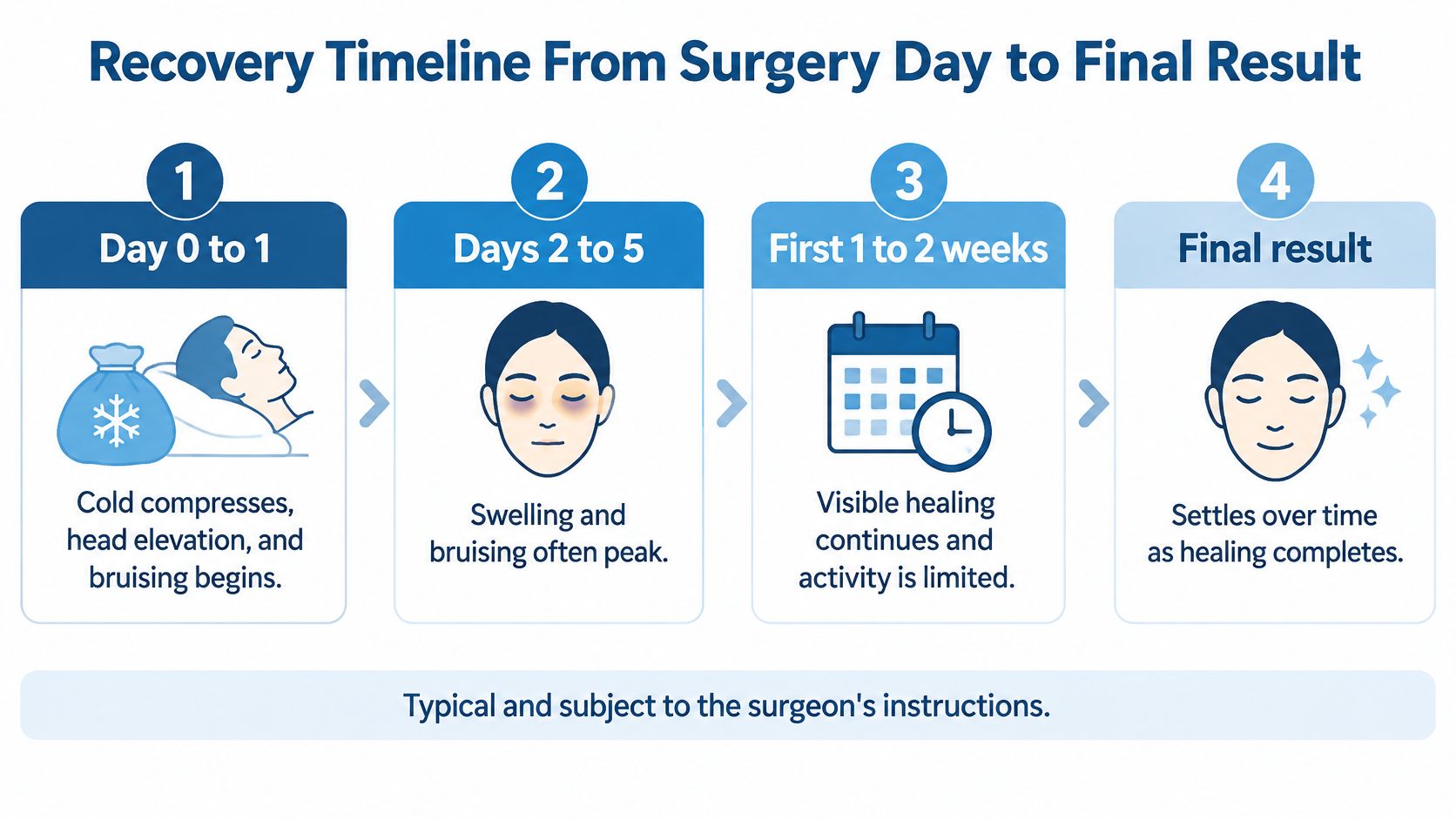
| Day 0 to 1 | Bruising begins | Cold compresses; sleep with your head raised |
| Days 2 to 5 | Swelling and bruising peak; lid soft-tissue thickness peaks around day 5 in the study above | Keep your head propped up and follow medication instructions |
| Week 1 | Most visible bruising fades | Many return to desk work; transcutaneous sutures are typically removed |
| Weeks 2 to 4 | Residual swelling settles | Makeup and light exercise with surgeon clearance; daily sun protection |
| Months 3 to 6 | Contour settles; lid thickness stays above baseline | Judge the result only after swelling has fully settled |
| Month 6 | Final result reviewed at follow-up | Ask which complaints changed and which did not |
Swelling keeps a schedule. Skin laxity and hollowing do not. When a lower lid bag came from fat that was repositioned, the fluid clearing is what finally reveals the change, which is why the improvement often reads as sudden somewhere between months two and four. When the same complaint traces to loose skin or a hollow the procedure was never designed to fill, waiting longer changes nothing. A day-5 mirror check cannot separate the two.
Expect tightness, watery or dry eyes, and uneven swelling early on. One side often bruises more than the other, and that asymmetry usually settles as fluid resolves. Some patients ask about manual lymphatic work once their surgeon clears it, and this guide to choosing a qualified lymphatic massage provider can help you vet credentials. Don't book any massage near a healing lid without explicit clearance, because pressure at the wrong time helps nothing.
Temporary problems reported after fat repositioning include small granulomas, dry eye, swelling, and numbness. In the series reporting them, all resolved. Resolution in a published series doesn't mean you should wait through worrying symptoms of your own.
Call your surgeon rather than waiting if pain worsens instead of easing, your vision changes, or you develop double vision. A lid that won't close, increasing redness, or discharge also warrants a prompt call. Those symptoms sit outside the normal bruise and swell pattern, and early review protects both your eye surface and your result.
Results, Longevity and When to Revise
A fair question follows any operation. Does it last? For repositioned fat, the evidence is encouraging but specific. In a 226-patient orbital-fat repositioning series, tear-trough deformity was eliminated in 86.7% of cases, and magnetic-resonance imaging confirmed viability of the transposed fat during follow-up at 6 to 8 months. Living fat that stays in place is the mechanical reason the lid to cheek transition can stay smooth.
That doesn't make the result permanent in every sense. Surgery corrects the anatomy you have now, while your skin keeps losing elasticity and your midface keeps changing. Long-lasting is the accurate phrase. If you want the longer view, our page on how long blepharoplasty lasts explains what continues to age after the fat is corrected.
What satisfaction looks like in practice
In a 150-patient study of transconjunctival lower blepharoplasty with fat repositioning, the mean patient age was 49 years, and 141 patients, or 94%, were very satisfied with the final result, while 5 were satisfied and 4 were dissatisfied. One patient developed a bilateral lower-lid infection that required abscess drainage. It was a Level III therapeutic study, meaning observational rather than randomized, so read it as a real outcome report rather than proof for every patient.
When revision enters the conversation
Don't judge the result while swelling is still distorting the contour. Residual fullness at three weeks may be fluid, not fat. Once healing settles, the common reasons for revision become clearer.
- Undercorrected tear trough: The groove remains visible because not enough volume reached it or settled there.
- Residual hollowness: The area looks scooped, often where too much fat was removed or too little was preserved.
- Recurrence of fat prominence: A bulge returns or was never fully addressed.
- Increased fine wrinkles: Smoother fat contour can make surface lines easier to see.
Undercorrection is usually easier to revise than permanent hollowing or ectropion. Adding or adjusting volume is a smaller problem than rebuilding support after tissue was taken away. That asymmetry is the strongest argument for conservative fat handling at the first operation.
Some lids need more than the standard operation at the outset. A 2025 study of extended lower blepharoplasty reported 93 extended procedures among 913 total lower blepharoplasty operations performed from 2013 through 2023, representing approximately 10% of cases. An extended plan is a recognition that the problem reaches beyond a simple fat pad.
If you're unhappy after healing, bring one planning question to your review. Which specific correction was missed? A precise answer, whether it's volume, skin, support, or surface texture, leads to a smaller and safer revision than a vague request to redo the eyelid.
Confirm Your Candidacy Before Booking Surgery
Book a consultation when under-eye bags persist after rest, sleep, and skincare, when you want to know which underlying cause applies to you, or when dry eye or lid position already concerns you. A consultation is a diagnosis, and surgery is a separate decision. Candidacy is a matching exercise: each cause gets a yes or no for whether lower eyelid surgery changes it. Fat, skin, support, and surface texture do not all respond to the same operation.
Prepare three things before the visit. Write down your symptoms and when they started, including dryness, tearing, or incomplete blink if you've noticed them. Take photographs in natural light from the front and side, without makeup, so change over time is visible. Bring a written list of questions; the conversation moves quickly once you are in the room.
Ask which incision route fits your anatomy and why. Ask how lid snap-back, distraction, and scleral show will be recorded before and after surgery, what the plan is if the result is undercorrected, how dry-eye symptoms will be tracked, and what follow-up looks like. Ask about fees as well, since fees vary by surgeon and by case, and request a written estimate at the visit.
If midface descent contributes, ask whether eyelid evaluation should be combined with other facial work. The face surgical services at Ideal Face & Body include Buccal Lipectomy (Cheek Reduction), Eyelid Lift, Facelift, Neck Lift, and Mini Neck Lift, so the eyelid can be assessed alongside the rest of the face.
If under-eye bags haven't responded to rest and skincare, a candidacy consultation can identify whether fat, skin, support, or surface texture is driving what you see. The Beverly Hills office is led by Justin Yovino, MD, FACS, a double board-certified plastic surgeon. Request a consultation and bring your photographs and questions with you.