
You're probably in one of two places right now. You've lost weight, built muscle, cleaned up your diet, and your midsection still doesn't match the effort. Or you're lean enough everywhere else, but the lower abdomen still looks loose, soft, or protruding in a way the gym won't fix.
That's where the key question starts. Not whether a male tummy tuck can help, but why the procedure scope varies so much from one man to the next in Beverly Hills, CA. The answer isn't marketing. It's anatomy, surgical planning, and how precise your result needs to be to look masculine instead of overdone.
If you're researching male tummy tuck cost, stop thinking about it as a single sticker price. In Beverly Hills, the smarter approach is to understand what drives the investment, what changes the surgical plan, and what's worth paying for.
Table of Contents
- Understanding Your Abdominal Contouring Goals
- Deconstructing the Male Tummy Tuck Investment
- Key Factors That Influence Your Procedure Scope
- Comparing Tummy Tucks to Alternative Contouring Options
- Navigating Your Consultation at Ideal Face & Body
- Frequently Asked Questions About the Procedure
Understanding Your Abdominal Contouring Goals
A lot of male patients describe the same frustration. They've done the hard part already. They dropped the weight, hired the trainer, got serious about nutrition, and built a stronger frame. Then they take off their shirt and still see loose skin, a fold at the lower abdomen, or a stomach that pushes outward despite everything else looking better.
That's not a discipline problem. It's usually a structural problem.
For men, the goal usually isn't just “flatter.” It's firmer, cleaner, and more athletic-looking. That may mean removing hanging skin after major weight loss. It may mean tightening an abdominal wall that no longer sits flat. It may mean reshaping the midsection so the torso looks stronger and more proportionate in fitted clothes and without a shirt.
What most men are actually trying to fix
The issue usually falls into one or more of these categories:
- Loose skin after weight loss that bunches, hangs, or folds at the lower stomach
- Abdominal wall weakness that creates a rounded look even when body fat is low
- Residual fullness and poor contour that hides the natural lines of the torso
- A mismatch between chest, waist, and abdomen that makes the body look softer than it is
A male tummy tuck works when the problem is something diet and exercise can't remove. Skin won't tighten on command. Stretched tissue doesn't always rebound. And if the abdominal wall needs repair, no amount of crunches will replace surgery.
Practical rule: If your weight is stable and your abdomen still looks loose or projects outward, you need a surgical evaluation, not another round of guessing.
The masculine result matters
Many men get cautious about the aesthetic outcome, and rightfully so. Male abdominal contouring shouldn't create an artificially cinched or over-tight look. It should preserve a natural male frame. The flatness, tension, and contour all have to be balanced.
That's why consultation quality matters. A proper evaluation looks at skin quality, fat distribution, muscle support, scar placement, and whether a tummy tuck is even the right answer. Some men are better served by liposuction alone. Others need more than skin removal. If you're still figuring out whether you fit the profile, this guide on who makes a good tummy tuck candidate is a useful place to start.
Dr. Justin Yovino approaches abdominal contouring with that exact lens. The conversation isn't “How do we make your stomach smaller?” It's “What's preventing your torso from looking natural, tight, and masculine?”
Deconstructing the Male Tummy Tuck Investment
The biggest mistake patients make is treating male tummy tuck cost like they're shopping for a single item. You're not buying a jacket off a rack. You're commissioning a custom surgical plan, and every part of that plan affects safety, execution, and outcome.
Consider a custom-made suit. The final result depends on the cut, the fitter, the materials, and the finishing. Surgery works the same way. What you're paying for is a coordinated package of medical judgment, operating resources, and recovery support.
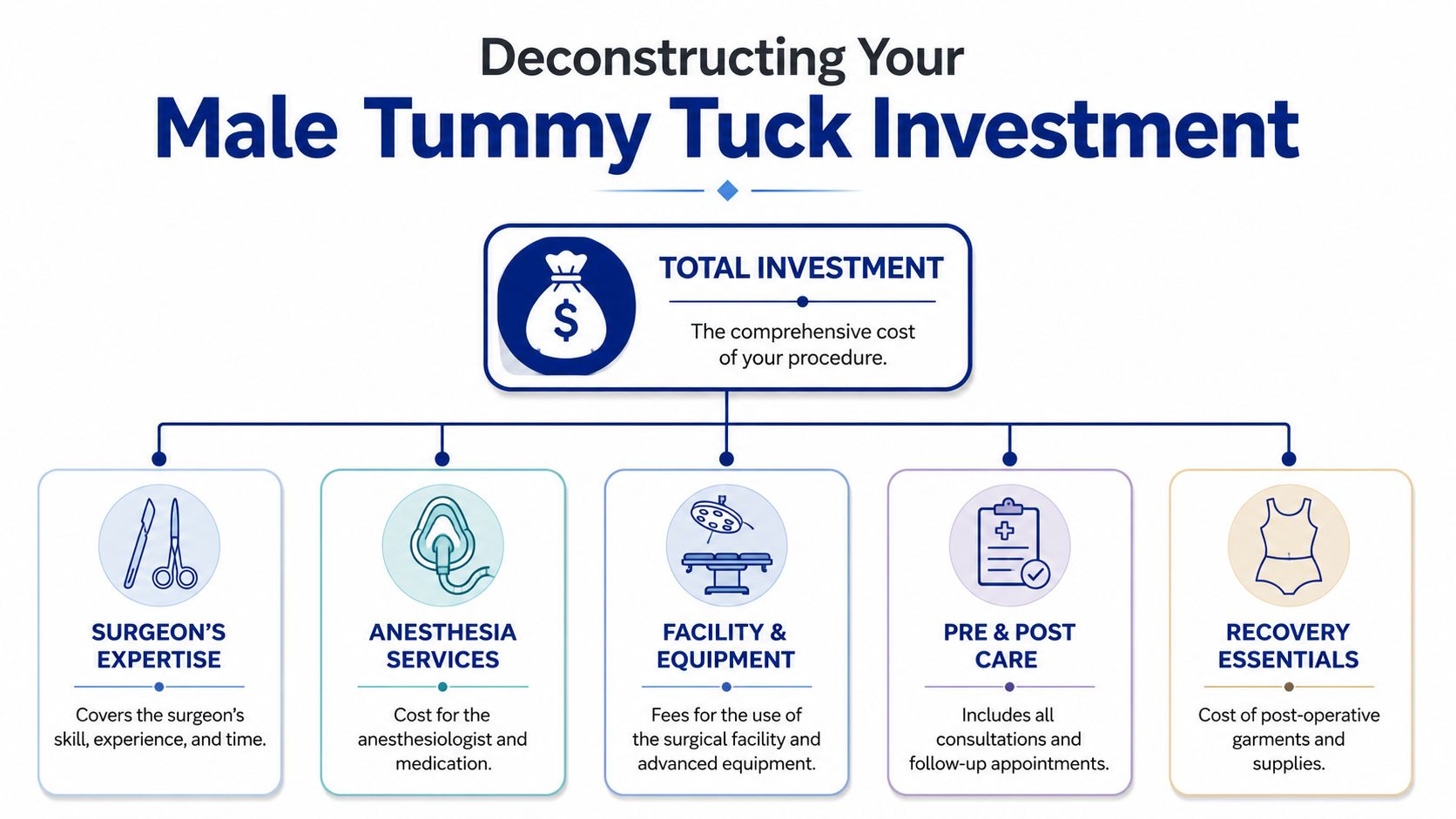
The core structure is straightforward. The total all-in investment for a tummy tuck generally includes the surgeon's fee, anesthesia costs, and facility fees, though this can vary based on individual needs and the complexity of the procedure according to this Beverly Hills tummy tuck cost overview.
What the surgeon's portion actually covers
This isn't just time in the operating room. The surgeon's role starts before surgery and continues through recovery.
It includes:
- Preoperative planning based on your anatomy, goals, and candidacy
- Operative judgment about how much skin to remove and how aggressively to contour
- Technical execution involving incision design, tissue handling, symmetry, and scar placement
- Postoperative management so healing stays on track and issues are addressed quickly
A less experienced surgeon can make a tummy tuck look obvious. A skilled surgeon makes it look like your body finally matches your effort.
Why facility and anesthesia matter
Patients often underestimate these two categories because they aren't as visible as the result. That's backwards. These are central to surgical safety.
Here's the practical breakdown:
| Component | What it supports |
|---|---|
| Anesthesia services | Monitoring, medications, and your comfort during the procedure |
| Facility use | Operating room setup, sterile environment, trained staff, and equipment |
| Recovery essentials | Garments, supplies, and the immediate postoperative process |
If your procedure becomes more involved, these parts become more resource-intensive too. More surgical time means more staffing, more monitoring, and more facility utilization.
A quote only becomes meaningful when you know what's included and how the plan was built.
Why Beverly Hills quotes vary
In Beverly Hills, CA, variation usually comes from the procedure scope and the level of surgical customization. A straightforward case and a complex abdominal reconstruction are not the same operation, even though both may be called a tummy tuck.
That's why broad online comparisons often mislead patients. You need a quote tied to your body, not someone else's forum post. If you want a deeper explanation of how quotes are structured locally, review how tummy tuck pricing is typically framed in Beverly Hills.
My recommendation is simple. Don't ask only, “What does it cost?” Ask, “What am I getting, what does my anatomy require, and what has been included from surgery through follow-up?” That's the adult way to evaluate value.
Key Factors That Influence Your Procedure Scope
Two men can both ask for a flatter stomach and need completely different operations. That's why male tummy tuck cost varies so much in real life. The surgeon isn't pricing a label. The surgeon is pricing the work your anatomy demands.

Skin laxity changes everything
Loose skin is the most obvious reason a man needs a tummy tuck instead of liposuction alone. If skin hangs, folds, or pools at the lower abdomen, removing fat by itself won't fix the issue. In some cases, it can make the looseness more apparent.
The amount and distribution of skin excess matter. A small lower-abdominal pinch is one thing. A broad apron of skin across the full abdomen is another. Men after major weight loss often need more extensive tailoring because the excess doesn't stay confined to one narrow area.
Muscle repair increases complexity
This is the part many patients don't see. The abdominal wall can stretch or separate, and that creates a persistent outward contour that survives even when body fat improves.
The need for muscle repair (rectus plication), often required in patients with significant diastasis, can add considerable time to the operation, thus influencing the procedure's overall complexity and required resources according to this breakdown of tummy tuck surgical factors.
In plain terms, if the internal support system is loose, the surgeon may need to tighten it. That adds surgical work, planning, and recovery considerations.
If your abdomen protrudes more than it sags, the real issue may be under the skin, not on top of it.
Fat pattern matters in men
Men often want a stronger V-shape through the waist and flanks, not just a flatter front. That usually means the plan has to consider the sides of the torso, not only the center.
A surgeon evaluating a male abdomen will look at:
- Flank fullness that blunts the waistline
- Upper abdominal thickness that affects how flat the stomach can look
- Lower abdominal redundancy that may require skin removal
- Overall torso balance so the result still looks masculine
This is also why some men should address weight and hormonal issues before surgery. If you're still working through resistant body composition changes, resources on hormone therapy and weight loss can help you think more clearly about whether surgery should come now or after medical optimization.
Combined contouring is common for a reason
A tummy tuck alone treats loose skin and abdominal wall shape. It does not always produce the sharpest torso contour on its own. Men commonly ask for added contouring at the flanks or hips because that's where the silhouette gets finished.
That combination makes sense. It also makes the case more involved.
Some factors that expand the scope are:
- Adding flank liposuction to carve the waistline more effectively
- Treating hip fullness so the abdomen doesn't look flat but blocky
- Correcting a prior surgery where scar tissue or uneven contour raises the difficulty
- Addressing post-weight-loss changes that extend beyond the central abdomen
Revision surgery deserves special mention. Scar tissue, altered blood supply, and distorted anatomy make revisions less forgiving than first-time cases. If you've had prior abdominal work, say it early and say it clearly.
One factual recommendation is important. Combining flank or hip liposuction with a tummy tuck is a common way to enhance contouring results, but this expansion of the surgical plan naturally increases the procedure's complexity and overall investment. That's one reason personalized planning matters more than generic online estimates.
Comparing Tummy Tucks to Alternative Contouring Options
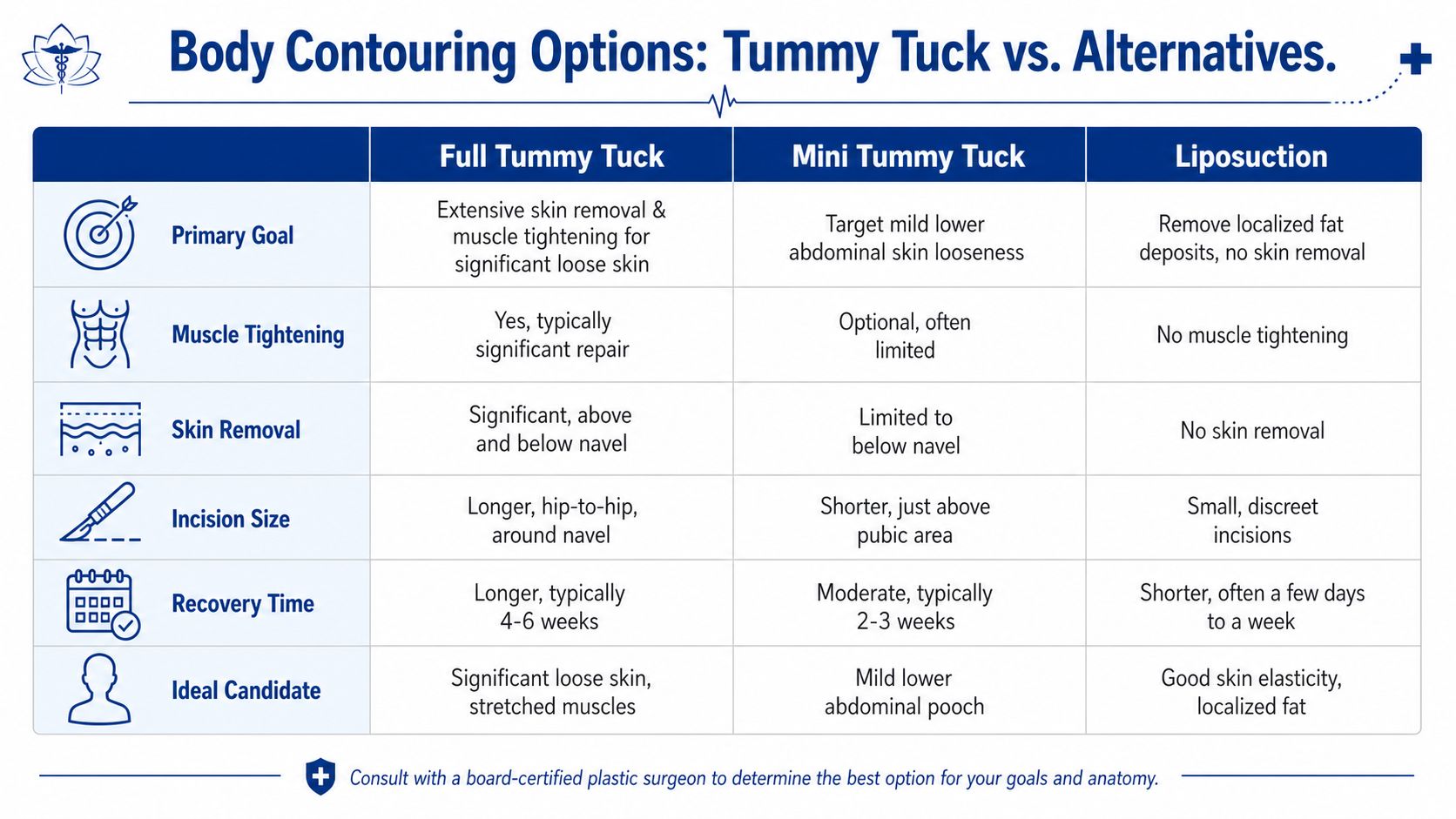
Not every male abdomen needs a full tummy tuck. Some men need skin removal and muscle tightening. Others only need targeted fat reduction. If you choose the wrong procedure because it sounds simpler, you'll spend recovery time and still keep the problem that bothered you in the first place.
The better question is this: What exactly are you trying to remove or tighten?
When a full tummy tuck makes sense
A full tummy tuck is usually the right call when the issue includes loose skin across a broader portion of the abdomen, visible lower abdominal redundancy, or an abdominal wall that needs tightening. It's the procedure for structural correction, not just fat removal.
That's especially relevant for men who've had major weight changes. If the skin doesn't contract and the abdominal wall feels weak, liposuction won't solve the root problem.
When a mini tummy tuck is enough
A mini tummy tuck is more limited. It's generally for men whose problem lives mostly below the navel and whose upper abdomen still has decent tone and skin quality.
That candidate usually has:
- A smaller lower abdominal pouch
- Less skin excess overall
- No need for major upper-abdominal reshaping
- More localized concern near the waistband area
A mini can be the smarter move when the anatomy supports it. Bigger surgery isn't better if you don't need it.
When liposuction is the better fit
If your skin has good elasticity and your main issue is stubborn fat, not hanging skin, liposuction may be the better answer. That's where body contouring methods such as PRECISION SCULPT™ or Awake 360 Body Sculpting enter the conversation. They target fat and shaping. They do not replace a tummy tuck when skin excess or muscle laxity is the core issue.
Here's the simplest side-by-side view:
| Procedure | Best for | Doesn't solve |
|---|---|---|
| Full tummy tuck | Significant loose skin and abdominal wall laxity | Isolated fat alone |
| Mini tummy tuck | Mild lower abdominal looseness | Broad upper-abdominal skin issues |
| Liposuction | Localized fat with good skin tone | Loose skin and muscle separation |
The right operation is the one that matches the problem. Men get disappointed when they choose the lighter procedure for a heavier issue.
If your contour goals include both skin tightening and torso definition, tummy tuck with liposuction is often the conversation worth having. That combination is common because it addresses two different problems at once: excess skin and side-to-side fullness.
Navigating Your Consultation at Ideal Face & Body
Most anxiety about male tummy tuck cost disappears once a patient sees how the consultation works. A good consultation replaces vague internet guesses with a personalized surgical plan. That's the whole point.

What happens in the appointment
Dr. Justin Yovino starts with the anatomy, not the sales pitch. The abdomen is examined for skin excess, tissue thickness, abdominal wall support, scar history, and whether the flanks should be treated as part of the same plan.
You should expect a detailed conversation about:
Your goal
Do you want a leaner look, post-weight-loss skin removal, stronger abdominal definition, or all three?Your current baseline
Stable weight matters. So does skin quality, previous surgery, and where fat is distributed.Procedure fit
You may be a candidate for a full tummy tuck, a mini tuck, liposuction-based contouring, or a combined approach.
How the quote becomes precise
The final figure can't be accurate until the surgeon decides what the operation includes. That's why online price hunting only gets you so far.
A proper quote usually depends on:
- Extent of skin removal
- Whether muscle repair is needed
- Whether contouring of the flanks or hips is added
- Whether the case is primary or revision
- How much postoperative support is built into the plan
This is also where patients should ask direct questions. What's included? What's optional? What would change the scope after the exam? You don't need to be polite about this. You need clarity.
Insurance and payment expectations
Because tummy tucks are classified as cosmetic procedures rather than medically necessary, insurance coverage is virtually unavailable, requiring patients to finance the full cost out-of-pocket according to this overview of tummy tuck payment expectations.
That means you should walk into consultation prepared to discuss self-pay and financing options. Most established cosmetic practices can explain available payment pathways and timing, even if the exact structure depends on your procedure plan.
Ask for the surgical plan first, then evaluate the financial plan. Doing it in the reverse order leads people into the wrong procedure.
Ideal Face & Body is one Beverly Hills option for men who want a formal evaluation of abdominal contouring and related awake body contouring treatments. Dr. Sarah Yovino and Dr. Justin Yovino are the only physicians you should be comparing inside this practice conversation, because what matters here is whether your plan fits your anatomy and your goals.
Frequently Asked Questions About the Procedure
When can I get back to the gym
Don't rush it. Most men can return to light movement first, then gradually build back to more demanding exercise after clearance. Walking starts early because it supports circulation. Heavy lifting, intense core training, and aggressive workouts have to wait until the repair is stable.
Your timeline depends on what was done. A skin-only contouring procedure and a tummy tuck with muscle repair don't recover the same way.
What will the scar look like
A tummy tuck scar is typically placed low enough to sit under most underwear or swimwear lines. The exact length depends on how much skin has to be removed. Men with more extensive laxity usually need a longer incision because the surgeon needs room to remove and redrape tissue properly.
Early scars look more obvious than final scars. That's normal. Scar quality improves with time, careful aftercare, and good surgical design from the start.
Are results permanent
They're long-lasting if you maintain your result. The skin and tissue removed during surgery don't come back on their own. But weight gain, major body composition changes, and inconsistent habits can still change your contour over time.
The men who hold their results best usually do three things well:
- They keep a stable weight
- They stay active without extreme cycles
- They follow postoperative instructions instead of improvising
Will my abdomen look natural
It should. That's the standard. A well-executed male tummy tuck doesn't look “done.” It looks tighter, cleaner, and more proportional to your chest and waist.
This comes down to restraint and planning. Over-resection, poor scar placement, or ignoring the flanks can make the result look artificial. Good male contouring preserves masculine structure.
Is liposuction alone ever enough
Yes, if your skin quality is still strong and your main issue is fat, not loose skin or muscle laxity. No, if the problem is hanging skin, significant lower abdominal redundancy, or an abdominal wall that pushes outward.
That's why consultation matters. The right answer depends less on what you want to call the procedure and more on what your abdomen needs.
How should I prepare before surgery
Get your weight stable. Be honest about medications, prior surgery, and recovery support at home. Stop thinking of surgery as the shortcut and start thinking of it as the finishing step after you've done the foundational work.
The men who do best usually show up prepared, informed, and realistic. That mindset matters more than people think.
If you're considering a male tummy tuck in Beverly Hills, CA, the smartest next step is a personalized consultation with Ideal Face & Body. Dr. Justin Yovino can evaluate your anatomy, explain whether you need a full tuck, a mini tuck, or combined contouring, and give you a clear plan based on your goals instead of generic online estimates.