You may be looking in the mirror and thinking, “I've done the hard part. I changed how I eat. I move my body. Why does my stomach still not look like mine?” That frustration is common, especially after pregnancy or major weight loss. Fat can shrink, but stretched skin and separated abdominal muscles don't always bounce back.
Patients often receive mixed messages regarding their options. Some are told they only need liposuction. Others assume a tummy tuck is the only answer. In reality, the right plan depends on what is sitting under the skin, what the skin itself is doing, and whether the abdominal wall has loosened.
A tummy tuck with lipo can address all three at once. It removes stubborn fat, tightens the skin envelope, and repairs the internal support when needed. That combination is one reason it stands out. Combined abdominoplasty with liposuction has a patient satisfaction rate of over 99%, with 98% of patients willing to undergo it again and 99% recommending it to others according to the American Society of Plastic Surgeons press release on quality of life after liposuction and tummy tuck.
Table of Contents
- Reclaiming Your Confidence After Diet and Exercise
- Why Tummy Tuck and Lipo Are Better Together
- Are You an Ideal Candidate for This Combined Procedure
- The Awake Tummy Tuck A Modern Approach
- Your Recovery Timeline and Aftercare Plan
- Seeing Your New Contour Emerge
- Begin Your Journey at Ideal Face & Body
Reclaiming Your Confidence After Diet and Exercise
A patient story often starts the same way. She's back in her routine, eating well, walking, training, doing everything “right,” yet the lower abdomen still folds over jeans, bunches under fitted clothes, or bulges in a way that doesn't match the rest of her frame. The problem isn't effort. The problem is that exercise can strengthen muscle, but it can't remove stretched skin, and weight loss can reveal loose tissue rather than fix it.
That disconnect can feel discouraging. You may be smaller, healthier, and stronger, but still feel like your midsection belongs to an earlier chapter of your life. After pregnancy, the issue may be separated muscles and skin laxity. After weight loss, it may be deflated skin with pockets of persistent fat. Those are surgical problems, not willpower problems.
A helpful mindset: If your body changed structurally, it makes sense that a structural solution may be the answer.
For many people, a tummy tuck with lipo is the first approach that finally matches the problem. Liposuction refines what's full. The tummy tuck removes what's hanging and restores what's weakened. If you're also exploring non-surgical ways to support your skin quality, this guide on effective methods to tighten skin gives useful context on where lifestyle and skin-focused treatments may help, and where surgery becomes the more complete option.
The emotional side matters too. Patients don't usually ask for perfection. They want their abdomen to look more in line with the work they've already put in. They want to zip pants without the roll at the waistband, wear a dress without shapewear, or stop tugging at a shirt all day.
Why Tummy Tuck and Lipo Are Better Together
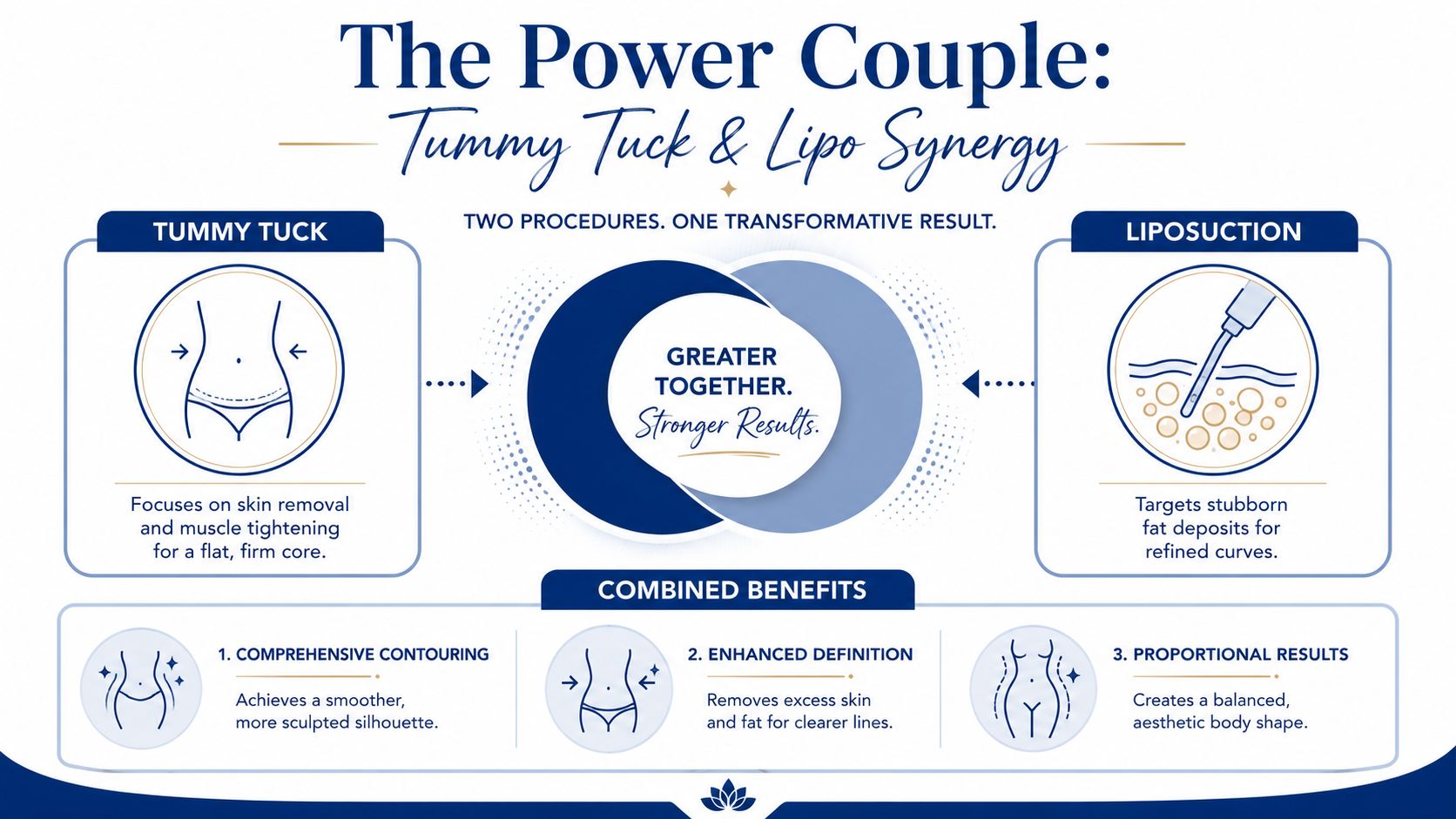
A combined tummy tuck with liposuction works well because it addresses different layers of the same problem. One treatment reduces excess fat. The other removes loose skin and repairs the abdominal wall when it has been stretched or separated. If both issues are present, treating only one often leaves the result looking incomplete.
Patients usually notice this in very practical ways. The lower belly may still hang even after fat is reduced. Or the front may look flatter after a tummy tuck, but the waist and flanks still hold fullness that keeps the midsection from looking balanced.
Two different problems under one shirt
Liposuction treats fat that sits between the skin and muscle. A tummy tuck treats skin laxity and, when needed, tightens the underlying abdominal muscles. Those are separate jobs.
A simple way to picture it is tailoring clothing. Removing extra padding changes bulk. Taking in stretched fabric changes shape. If a garment has both problems, fixing only one part rarely gives the cleanest fit.
That distinction matters even more in an awake procedure. At Ideal Face & Body, I often combine tummy tuck surgery with PRECISION SCULPT laser liposuction under local anesthesia for patients who need both debulking and reshaping. The laser-assisted lipo helps refine contour in areas like the upper abdomen and flanks, while the tummy tuck addresses the loose lower abdominal skin and weakened support beneath it.
Why one procedure alone can miss the mark
Liposuction alone can slim an area, but it does not shrink skin the way many people hope. If the skin has already been stretched by pregnancy or weight changes, removing fat without removing that extra skin can make the surface look looser or more deflated.
A tummy tuck alone can flatten the lower abdomen and improve muscle support, but it does not always create the most polished contour by itself. Fullness at the sides of the waist or upper abdomen can remain. That is often why patients say they look better, but not quite finished.
Here is the practical difference:
| Procedure | What it addresses | What it doesn't fully solve |
|---|---|---|
| Liposuction alone | Localized fat | Loose skin, muscle separation |
| Tummy tuck alone | Excess skin, weakened abdominal muscles | Persistent contour fullness around adjacent areas |
| Tummy tuck with lipo | Fat, skin, and abdominal support together | Not a substitute for long-term weight stability |
During consultation, I explain it this way. A flatter stomach is not only about what needs to come out. It is also about what needs to be tightened, smoothed, and blended with the surrounding areas so the abdomen matches the rest of your frame.
That is why combining these procedures often creates a more natural result. The abdomen looks flatter, the waist looks more defined, and the transition from the stomach to the flanks looks smoother. If you are unsure whether your concern is fat, skin laxity, muscle separation, or a mix of all three, this guide on who is a good candidate for a tummy tuck can help you understand what to look for before your consultation.
Are You an Ideal Candidate for This Combined Procedure
You may look in the mirror and see a stomach that still seems out of step with the rest of your body, even after weight loss, exercise, or time after pregnancy. The hard part is figuring out why. In many patients, the answer is not just fat. It is a combination of stretched skin, loosened support in the abdominal wall, and pockets of fullness that hide the shape underneath.
I explain candidacy by separating the abdomen into three layers. The skin is the outer covering. The fat is the padding beneath it. The abdominal wall is the internal support, almost like the corset of the midsection. If more than one of those layers has changed, a combined tummy tuck with liposuction often makes more sense than treating only one problem.
Who usually benefits most
A good candidate is usually close to a stable, maintainable weight and bothered by changes that have not improved with healthy habits alone. These are some of the patterns I see most often:
- After pregnancy: The lower abdomen may bulge, the skin may look creased or loose, and the core can feel weaker even after returning to regular activity.
- After significant weight loss: Fat has gone down, but the skin has not tightened enough to match the new shape.
- With persistent midsection fullness: The abdomen or waist still looks heavy or uneven despite otherwise proportionate results from diet and exercise.
The shared theme is structural change. Skin that has been stretched beyond its ability to recoil does not behave like stubborn fat. Separated abdominal muscles do not tighten with crunches alone. Liposuction can remove volume, but it cannot shrink loose skin or restore support in the abdominal wall.
One patient may have a small lower belly fold and mild muscle separation. Another may have more skin laxity after major weight loss. Another may be fairly fit but still carry fullness through the upper abdomen and flanks that keeps the whole waistline from looking balanced. Different patterns, same question: what exactly needs to be tightened, reduced, and reshaped?
A simple self-check before consultation
A few honest questions can help you tell whether this combined approach may fit your goals:
- Has your weight been stable for several months? Surgery refines your current shape. It does not replace long-term weight management.
- Do you notice loose skin, folding, or a crepe-like texture? That points to a skin issue, not just excess fat.
- Does your abdomen push outward even when the rest of you is leaner? That can suggest weakened internal support.
- Are you healthy enough for surgery and recovery? Good healing capacity matters just as much as the procedure itself.
- Can you accept a scar in exchange for a flatter, smoother contour? A tummy tuck improves shape by removing skin, and that tradeoff matters.
Here is the practical rule I give patients. If you can pinch fat but also see extra skin and feel weakness through the core, you are probably looking at more than one problem at the same time.
If you want to prepare before your visit, this guide on how to tell if you are a good candidate for a tummy tuck can help you organize your questions.
Candidacy also depends on mindset. The strongest candidates usually want improvement, not perfection. They understand that surgery can flatten, tighten, and sculpt, but it does not create a different body. It reveals a better version of the one you already have.
That perspective matters even more if you are considering an awake procedure with local anesthesia and PRECISION SCULPT laser liposuction. In that setting, patient selection is thoughtful and specific. The goal is not only a better contour, but a safer, more controlled experience that matches the right anatomy, the right expectations, and the right plan.
The Awake Tummy Tuck A Modern Approach
A common consultation starts like this. Someone has done the hard part already. They lost the weight, stayed active, and still feel held back by loose abdominal skin and fullness through the waist. What often stops them is not the goal. It is the idea of going fully under anesthesia for a procedure they assumed had to be done that way.
That assumption leaves out an option many patients have never been taught to consider. For carefully selected patients, a tummy tuck with liposuction can be performed awake under local anesthesia. At Ideal Face & Body, that approach is paired with PRECISION SCULPT laser liposuction, which changes both the surgical experience and the way contouring is refined.
Why the awake approach matters
General anesthesia is not the only reason surgery feels intimidating, but it is a major one. Patients often worry about nausea, grogginess, and the sense of giving up control for the day. An awake procedure under local anesthesia addresses that concern directly.
Local anesthesia works like numbing medicine at the dentist, but applied in a much more planned and detailed way for body contouring. You stay comfortable, your surgical team stays in close communication with you, and the recovery experience is often clearer because you are not shaking off a full general anesthetic.
That does not make the procedure casual. It makes it deliberate.

What local anesthesia changes during surgery
The best way to understand the awake approach is to separate comfort from complexity. A tummy tuck is still real surgery. Skin is removed, the abdominal contour is improved, and liposuction is used with intention. The difference is how the procedure is carried out and how the patient experiences it.
For the right candidate, local anesthesia can offer several practical advantages:
- A clearer recovery experience: Many patients like avoiding the heavy, foggy feeling often associated with general anesthesia.
- More direct communication: Because you are awake, the process feels more participatory and less like disappearing into an operating room routine.
- An office-based setting: The environment often feels calmer and more personal than a hospital-style experience.
Patients sometimes confuse "awake" with "feeling everything." That is not what this means. The goal is comfort, control, and precision, with careful numbing of the treatment area and close monitoring throughout the procedure.
How PRECISION SCULPT laser liposuction fits into the plan
A tummy tuck addresses loose skin and lower abdominal laxity. Liposuction addresses pockets of fat. PRECISION SCULPT laser liposuction adds another layer of control by helping refine the transitions around the treated area.
That matters because a good result is not just a flatter center. It is a balanced contour from the abdomen into the waist and nearby zones. If the tummy is tightened but the surrounding fullness is left untreated, the result can feel incomplete. PRECISION SCULPT helps shape those edges with more finesse, much like trimming and tailoring fabric after the main structure has been adjusted.
You can learn more about how this process is planned in Ideal Face & Body's awake tummy tuck guide.
Why planning still matters at home
An awake procedure can make the surgical day feel more manageable, but thoughtful preparation still matters. Patients do best when they set up a comfortable recovery space, organize help in advance, and make daily routines easier before surgery. This guide on preparing your home for healing is a useful starting point.
The larger point is simple. Awake surgery gives the right patient a more controlled path through an operation that many articles describe only through the lens of general anesthesia. For people who want abdominal tightening and precise sculpting without that traditional hospital-style experience, it is a modern option worth understanding clearly.
Your Recovery Timeline and Aftercare Plan
The part many patients fear most is not the procedure itself. It is waking up the next day and wondering, "How limited will I feel, and how long will this last?"
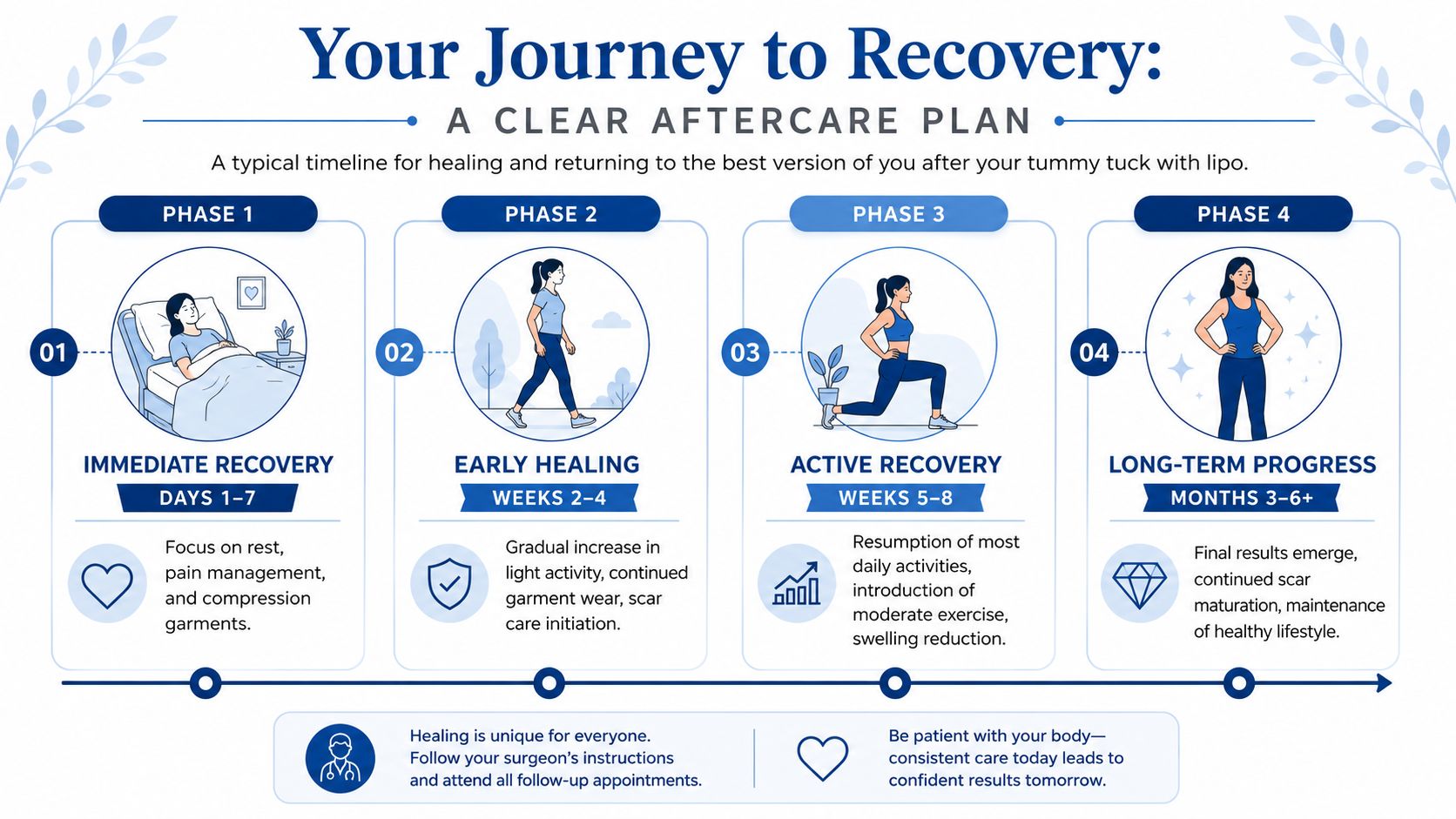
A clearer timeline helps remove some of that uncertainty. It also helps to know that recovery after an awake tummy tuck with liposuction often feels more manageable than patients expected, because you avoid the fog, nausea, and grogginess that can come with general anesthesia. That does not make recovery effortless. It does make the process easier to understand and plan for.
Another point often gets missed in general articles. Liposuction is not only a shaping tool. In a carefully planned tummy tuck, it can also help the tissues lie down more evenly and reduce pockets where fluid may collect. In practice, that can support a drainless approach in selected patients, which is one reason technique matters so much.
The first week
The first several days are usually about protecting your repair while keeping your body in motion just enough to heal well. Patients often describe the abdomen as tight, sore, and swollen, with a pulling sensation when standing upright. That tight feeling makes sense. The skin and deeper support layers have been adjusted, much like taking in a garment so it fits closer to the body.
Short walks matter early. They support circulation, reduce stiffness, and help you feel more normal faster. Rest matters too, but full bed rest is rarely the goal.
Your setup at home can make this first week much easier. A chair with arms, loose clothing, water within reach, simple meals, and a place to sleep with your upper body slightly propped up all reduce unnecessary strain. This practical guide on preparing your home for healing is a useful checklist before surgery.
A few habits usually make the biggest difference:
- Walk gently several times a day: Small, steady movement supports recovery better than long periods of complete stillness.
- Wear compression exactly as directed: Compression works like a light support wrap for the healing tissues and helps control swelling.
- Stay ahead of aftercare tasks: Medications, hydration, and incision care are easier when you follow a routine instead of waiting until you feel uncomfortable.
- Protect your energy: Healing uses more of your body's resources than many patients expect.
Weeks two through eight
This phase can be misleading because you often feel better before the tissues are fully healed. The outside may look improved while the deeper layers are still bonding and settling into place.
During these weeks, many patients stand straighter, move more comfortably, and return to more of their normal routine. Swelling is still part of the picture, especially later in the day. That is normal. Healing works in stages, and the body does not reveal every detail at once.
Your job here is consistency. Keep walking. Keep using compression if your surgeon recommends it. Start scar care only when you are told the incision is ready. Hold off on strenuous exercise until you are cleared, even if your energy returns sooner than expected.
If you want a stage-by-stage explanation of what is typical during this period, this tummy tuck recovery time guide gives a more detailed breakdown.
Most recovery frustration comes from expecting a finished result from a body that is still healing.
The long view
Healing continues long after you feel functional again. Scars usually soften and fade over time, and swelling gradually steps out of the way so your new contour becomes easier to appreciate.
It helps to separate healing from outcome. Healing is your body closing, sealing, and rebuilding support. Outcome is the polished shape that appears after that process settles. Those are related, but they are not the same thing.
That distinction matters even more with an awake tummy tuck and PRECISION SCULPT laser liposuction approach, because the goal is not only a flatter abdomen. The goal is a smoother transition through the waist and surrounding contour, with less disruption from general anesthesia and a recovery plan that feels more controlled from day one.
Seeing Your New Contour Emerge
A common moment happens a few weeks after surgery. You put on a pair of pants you know well, and the waistband closes without that familiar lower-abdomen pushback. The mirror may still show swelling, but your clothing often notices the change first.
That is because contour shows up in layers. Early on, you usually see the big changes before the fine details. The abdomen looks flatter. The lower belly sits closer to the body. Fabrics fall more cleanly instead of catching on extra skin or fullness.
What changes first
A tummy tuck with lipo addresses different parts of the same problem at once. The tummy tuck removes loose skin and can repair separated abdominal muscles when needed. Liposuction shapes the surrounding areas so the result looks balanced, not just tighter in the center. With the awake approach at Ideal Face & Body, local anesthesia and PRECISION SCULPT laser liposuction also allow a more controlled sculpting process, which matters when the goal is a natural transition through the waist and lower abdomen.
Patients are sometimes surprised that the first visible win is not dramatic "definition." It is proportion. Your midsection often starts to look more in line with the rest of your body, like smoothing a wrinkled sheet so the whole surface reads cleaner even before every crease is gone.
That emotional shift is real.
Many patients notice they stand differently, dress differently, and feel less distracted by the same areas that used to pull their attention every day.
What keeps improving
The polished result takes patience. Swelling gradually steps aside over the coming months, and each stage reveals a little more of the shape underneath. The abdomen usually becomes smoother first, then the waist contour reads more clearly, and the transition into the flanks looks more refined.
This is one reason I encourage patients to judge progress in trends, not day to day. Healing is rarely linear. One week your stomach may look more defined in the morning and puffier by evening. Another week the lower abdomen may still seem firm while the waist looks noticeably slimmer. That does not mean the result is changing for the worse. It means the tissues are still settling.
With awake tummy tuck and PRECISION SCULPT laser liposuction, the goal is not only to make the front flatter. The goal is to shape the whole area so your contour makes sense from multiple angles. Front, side, and three-quarter view all matter.
If you want to see how that progression can look across different body types, this gallery is worth reviewing:

Long term, results tend to hold best when your weight stays fairly steady. Surgery reshapes the framework. Your daily habits help maintain the outline you worked hard to achieve.
Begin Your Journey at Ideal Face & Body
Choosing a tummy tuck with lipo is partly a surgical decision and partly a trust decision. You want a surgeon who can evaluate whether the actual issue is fat, skin, muscle laxity, or all three. You also want a plan that fits how you want to experience surgery and recovery.
Dr. Justin Yovino is a double board-certified plastic surgeon, and Dr. Sarah Yovino is part of the physician team patients may meet as they explore treatment options. Consultations are designed to clarify what kind of abdominal contouring makes sense for your anatomy, your goals, and whether an awake approach under local anesthesia is appropriate.
In-person visits are available in Beverly Hills, CA, and virtual planning can help patients who are coming from outside the area. During consultation, the conversation usually covers your surgical goals, your skin quality, whether muscle repair may be needed, expected scar placement, and what recovery will realistically involve. If cost is part of your decision, that discussion is handled privately because it varies based on the surgical plan.
If you've been stuck between “I've tried everything” and “I'm not sure what would work,” a personalized consultation can turn a vague idea into a clear plan.
If you're ready to explore whether a tummy tuck with lipo is the right fit for your body and goals, schedule a consultation with Ideal Face & Body. You can discuss awake options, recovery expectations, and a personalized contouring plan with Dr. Justin Yovino in a setting built around thoughtful, office-based care.