
If you're reading this, you're probably doing the same math most patients do before surgery. How many days do I need off work? When will I look normal in public? Will I feel foggy afterward, or mostly like myself? Those are the right questions.
Mini neck lift recovery is usually much more manageable than people expect, especially when the procedure is performed awake in the office under local anesthesia. Recovery isn't just something that happens to you. It responds to planning, positioning, swelling control, activity choices, and following instructions closely. In my experience, patients feel calmer when they know the sequence of recovery instead of waiting for surprises.
At our practice in Beverly Hills, CA, Dr. Justin Yovino and Dr. Sarah Yovino have built much of their approach around awake procedures because the recovery experience starts the moment surgery ends. Patients often care as much about that first night and first weekend as they do about the final contour. A smoother start matters.
Table of Contents
- Preparing for a Smooth Mini Neck Lift Recovery
- Your First 48 Hours After Surgery
- The Mini Neck Lift Recovery Timeline Explained
- Managing Swelling Bruising and Discomfort
- How Awake Surgery Transforms Your Recovery
- Returning to Daily Life and Caring for Scars
- Your Path to Final Results and Follow-Up Care
Preparing for a Smooth Mini Neck Lift Recovery
A smooth recovery starts before surgery day. The patients who do best usually haven't done anything dramatic. They've made the first few days easy. That means arranging a ride, setting up pillows so the head remains raised, choosing soft foods that don't require much chewing, and clearing space on the calendar for actual rest.
The mental side matters too. Many people worry that recovery will feel unpredictable. In reality, mini neck lift recovery tends to follow a recognizable pattern when the procedure is limited, tissue handling is careful, and post-op instructions are followed closely. The goal isn't to guess how you'll feel each hour. It's to create conditions that make healing easier.
What to set up before surgery
A practical setup should include:
- A resting area with support: Use extra pillows so your head and shoulders stay raised.
- Easy hydration and simple meals: Keep water and soft foods within reach.
- Medications ready at home: You don't want errands after surgery.
- A helper for the first stretch: Even independent patients appreciate having someone nearby.
Practical rule: Recovery goes better when you remove friction. If you have to search for supplies, cook, bend, or make decisions while tired, you're making those first days harder than they need to be.
Sleep is one of the most overlooked parts of healing. If you're someone who already struggles to rest, it can help to review ways to optimize overnight recovery before surgery so your sleep environment supports elevation, comfort, and less overnight disruption.
What actually makes recovery feel manageable
Patients often assume the difficult part is pain. More often, it's tightness, swelling, awkward sleep, and not knowing what's normal. That's why awake, office-based surgery appeals to so many people. Starting recovery without the typical fog of a deeper anesthetic experience often makes patients feel more in control from the beginning.
Calm preparation doesn't make recovery perfect. It makes recovery organized. That difference is substantial.
Your First 48 Hours After Surgery
The first two days are about protection, positioning, and keeping everything quiet. You do not need to test your toughness. You need to reduce swelling, avoid unnecessary motion, and let the tissue settle.

With an awake procedure, most patients go home without that heavy groggy feeling people often associate with surgery. That's one reason the first evening tends to feel calmer and more straightforward. Even so, you should still plan to rest and have someone with you.
The first evening
Your priorities are simple:
- Keep the head raised. This helps limit swelling and reduces pressure in the neck.
- Leave dressings and wraps alone unless instructed otherwise. Compression only works if it's worn correctly.
- Take medication exactly as directed. Staying ahead of discomfort is easier than catching up to it.
- Eat lightly and hydrate. Small, easy meals are usually better than a large dinner.
- Move carefully. Short, gentle walks around the house are fine. Repeated bending, lifting, and neck motion are not.
If your wrap feels snug, that's expected. If it feels dramatically tighter over time, or discomfort seems to escalate instead of settle, that's a reason to contact the office.
Keep your recovery small. Small movements, small meals, small tasks. The less you ask of your body early on, the better it usually responds.
Day one into day two
By the next day, patients often start paying closer attention to swelling and bruising. That's normal. The appearance can shift quickly in this early window, and it doesn't mean anything has gone wrong. What matters more is whether you're following the basics consistently.
A good second-day routine usually includes:
- Resting upright when possible: Reclining flat tends to worsen puffiness.
- Keeping chewing limited if the area feels tight: The neck appreciates less motion early on.
- Checking in with how you feel overall: Mild soreness, tightness, and pressure are expected.
- Letting your helper help: Patients often try to resume independence too fast.
What not to do
The first 48 hours are not the time for errands, social plans, exercise, long showers unless cleared, or peeking under dressings just to reassure yourself. Those choices usually increase swelling or create anxiety without helping healing.
The best recoveries in this window are usually uneventful. That's exactly what you want.
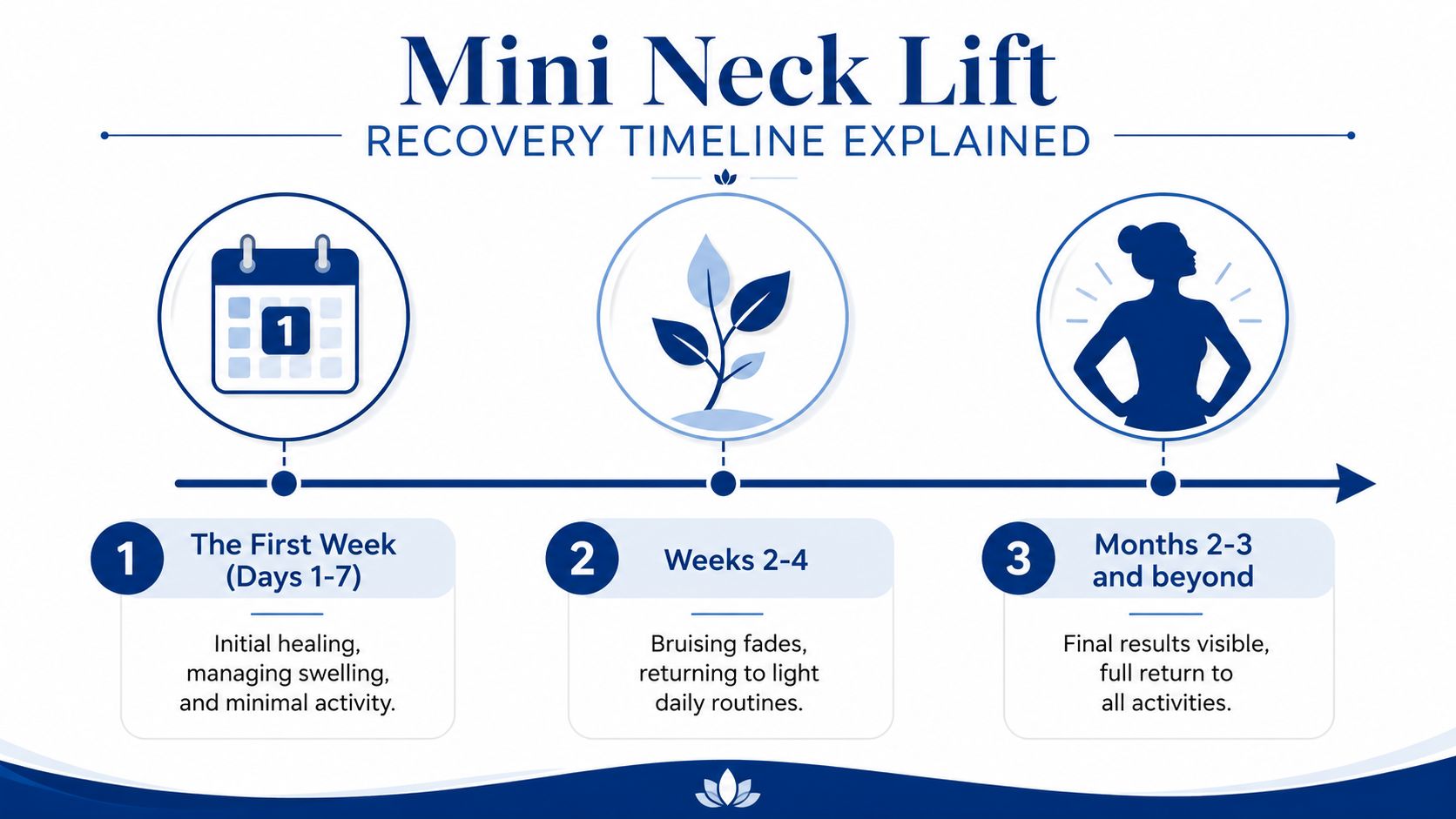
The Mini Neck Lift Recovery Timeline Explained
Most patients want one thing above all else. A realistic calendar. Not a vague promise that they'll "heal soon," but an actual sense of when they'll feel presentable, comfortable, and functional again.
The broad outline is fairly consistent. The recovery timeline for a mini neck lift is significantly shorter than traditional neck lift surgery, with most patients experiencing initial recovery within 1 to 2 weeks, bruising and swelling often becoming socially acceptable around 7 to 10 days, prescription pain medication commonly ending within 2 to 3 days, return to non-strenuous work often happening within one week, and rigorous physical activity staying restricted for at least 3 weeks, according to this mini neck lift recovery overview.
For patients who also have under-chin contouring, the healing pattern often overlaps with the guidance in this chin liposuction recovery guide, especially when swelling and compression are part of the plan.
The first week
This is the most active part of recovery, even though your job is mostly to rest. Swelling, tightness, and stiffness tend to dominate the experience more than pain. Many patients are pleasantly surprised by that distinction. The area can feel firm and somewhat strange before it feels natural.
Several practical milestones usually matter most in this first phase:
- Medication shift: Many patients stop prescription pain medication within a few days and transition to simpler comfort measures.
- Appearance changes: Bruising and swelling often improve enough by the later part of the first stretch that patients feel less hesitant about being seen.
- Work planning: If your job is sedentary, this is often the period when return becomes realistic.
What doesn't work in this phase is impatience. Patients sometimes think, "I feel decent, so I must be ready for normal activity." That's the wrong test. Tissue can still be vulnerable even when you feel relatively good.
Weeks two through four
This is when mini neck lift recovery starts to feel rewarding. The neckline looks cleaner. Bruising fades. Daily routines become easier. You stop thinking about recovery every waking minute.
Still, this stage has its own trap. People assume that looking better means healing is finished. It isn't. Residual swelling can linger, and the neck may still feel tight or slightly numb. That doesn't mean the result is off track. It means deeper healing is continuing under the surface.
A simple way to think about this phase:
| Recovery area | What patients often notice |
|---|---|
| Appearance | Better contour and less visible bruising |
| Comfort | Less soreness, but some firmness or pulling |
| Energy | More normal mentally and physically |
| Restrictions | Exercise still needs caution and medical clearance |
A mini neck lift usually looks better before it feels completely normal. That sequence is expected.
Months two and beyond
By this stage, the result is more refined and stable. Day-to-day swelling isn't the main story anymore. Instead, patients focus on scar blending, skin settling, and the final quality of the contour.
This is also when perspective helps. Early recovery is about getting through visible healing. Later recovery is about allowing the tissues to mature without overreacting to every small sensation. Minor firmness can gradually soften. The under-chin area can continue to normalize. The final result often reveals itself by degrees, not all at once.
What works best in the long run is boring consistency. Good scar care. Sun protection. Appropriate activity progression. Showing up to follow-up visits. Patients who do those things usually feel much less anxious because they can see steady forward movement, even when healing is subtle.
Managing Swelling Bruising and Discomfort
Swelling control is where patients have the most influence over how recovery feels. You can't force bruising to disappear overnight, but you can absolutely make the recovery period easier by controlling pressure, motion, and inflammation triggers.

The common mistake is doing helpful things inconsistently. Elevating only part of the night, wearing the wrap loosely, forgetting hydration, then wondering why swelling lingers. Small lapses add up.
What helps swelling go down
Start with the basics and do them well:
- Head elevation: Keep your head above your chest when resting or sleeping. That encourages fluid to move out of the area instead of pooling.
- Cold application if instructed: Cool therapy can help early on, but it should be gentle and never press hard on healing tissue.
- Low-salt choices: Salty meals often make post-op puffiness worse.
- Hydration: Water supports circulation and helps your body move through the inflammatory phase more smoothly.
If neck discomfort makes sleep positioning harder, some patients like to read general options for a best neck pain relief cream, but after surgery you should only apply or use topical products if your own surgeon has cleared them for your specific incisions and timeline.
What discomfort is normal
Most patients describe recovery as tightness, pressure, soreness, and stiffness rather than severe pain. That distinction matters because it helps you interpret sensations correctly. Feeling firm under the chin doesn't automatically mean something is wrong. Feeling pulling when you turn too quickly doesn't mean you've damaged the result.
Common, expected sensations can include:
- A compressed feeling from the wrap
- Tenderness near incision areas
- Stiffness when getting up or lying down
- Temporary asymmetry in swelling
One caution: discomfort should gradually become easier to manage. If symptoms sharply intensify, or you notice something that feels distinctly different rather than slowly improving, contact your surgeon's office.
What doesn't help is repeatedly checking the mirror, palpating the neck, or comparing one side to the other every few hours. That usually increases stress and irritation without changing healing.
How Awake Surgery Transforms Your Recovery
Many recovery guides treat all mini neck lifts as if they feel the same afterward. They don't. The anesthesia experience changes the first phase of healing in a meaningful way.
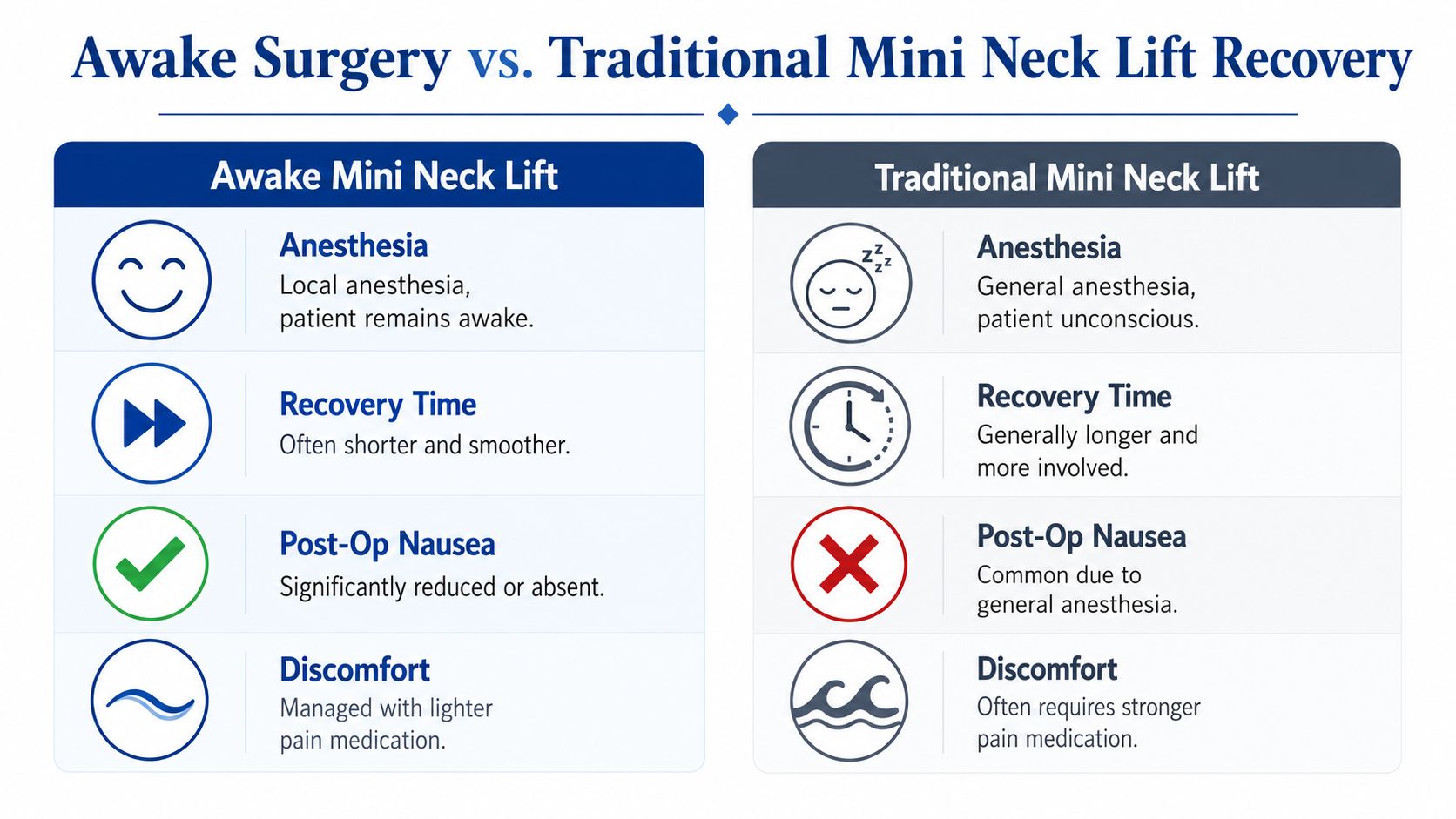
When a mini neck lift is performed awake under local anesthesia, patients avoid IV lines and intubation. According to this discussion of mini neck lift healing after awake surgery, that often means less systemic nausea and grogginess, a more compressed first 72 hours, and near-instantaneous cognitive function compared with general anesthesia recovery.
For a closer look at that approach, patients often find this awake neck lift guide useful because it focuses on what the experience is like before, during, and after office-based treatment.
Why local anesthesia changes the experience
The biggest difference isn't just comfort. It's clarity. Patients often feel like themselves much sooner. They can follow instructions more easily, hydrate sooner, and settle into recovery without the fog that sometimes follows deeper anesthesia.
That doesn't mean awake surgery eliminates swelling or normal surgical healing. It changes the systemic burden of recovery. In other words, you're dealing with neck surgery recovery, not neck surgery recovery plus the aftereffects of general anesthesia.
A practical comparison looks like this:
| Factor | Awake procedure | Traditional deeper anesthesia approach |
|---|---|---|
| Mental clarity | Often returns very quickly | May take longer |
| Nausea risk | Often reduced | More commonly part of recovery |
| Early mobility | Usually easier | Sometimes slower to resume |
| First-day comfort | More predictable for many patients | More variable |
What patients notice right away
Patients commonly notice three things first. They feel more mentally present. They usually don't describe the same "hangover" feeling many people fear after surgery. And the transition from procedure to home recovery tends to feel simpler.
Awake surgery doesn't make recovery disappear. It removes obstacles that often make the first part of recovery feel harder than it needs to be.
That difference is one reason many patients specifically seek an awake, office-based mini neck lift. The final result matters, but the first few days matter too.
Returning to Daily Life and Caring for Scars
Once the visible swelling starts to settle, patients shift from "How do I get through this week?" to "When can I get back to normal?" That's the right time to think in phases instead of all at once.
Getting back to regular routines
Return to work and activity should be guided by what stresses the neck, not just by how energetic you feel.
A useful framework is:
- Desk work and light routines: Often possible earlier, as long as you're not bending, straining, or constantly looking down.
- Household tasks: Fine if they're gentle. Not fine if they involve lifting, reaching, or repeated neck tension.
- Exercise: Resume only in stages and only when you've been cleared. Light activity and full workouts are not the same thing.
- Social events: Many patients feel ready before they feel completely healed. That's normal.
If you rush strenuous activity, swelling often tells on you quickly. Patients may notice the neck feels tighter, fuller, or more reactive as the day progresses. That's not a sign to push through. It's a sign to slow down.
How scars and sensation change over time
Scar anxiety is common because patients can see the incision line before they can appreciate how much it will evolve. The reassuring part is that scar maturation is a process, not a single moment. Incisions are often well concealed by 30 days, the color shift from pink or red toward white typically happens over 6 to 12 weeks, and firmness or numbness under the chin can take 6 to 12 months to resolve as sensory nerves adapt, based on this mini neck lift healing guide that discusses scar maturation and sensation.
That timeline helps patients interpret what they're feeling:
- Early stage: The scar may look more noticeable to you than it does to anyone else.
- Middle stage: Color and texture begin to soften.
- Late stage: Sensation and firmness continue improving long after the surface looks healed.
For patients who want to go deeper on scar support, this guide to scar healing treatments outlines common options and when they may fit into recovery. In some practices, adjunctive resurfacing such as Morpheus8 may also be considered as part of a broader scar-blending plan when the timing is appropriate.
What works best is steady care, not aggressive treatment too soon. Gentle incision care, sun protection, and patience outperform over-handling almost every time.
Your Path to Final Results and Follow-Up Care
The best mini neck lift recovery is rarely the one that feels dramatic. It's the one that moves forward in a steady, boring way. Less swelling. Better contour. More comfort sleeping. More confidence being seen. That's the pattern patients want.
Follow-up care matters because healing isn't judged by photos alone. A surgeon looks at contour, tissue response, incision quality, symmetry, compression needs, and whether your activity level matches where you are in recovery. Those check-ins also give patients something just as important. Context. Many of the sensations that feel alarming at home are completely routine when examined in person.
A strong recovery usually comes down to a few habits:
- Follow instructions closely: Especially around garments, sleep position, and activity.
- Communicate early: Don't sit on a concern and hope it sorts itself out.
- Be patient with sensation changes: Tightness and numbness don't follow the same timeline as bruising.
- Protect the long-term result: The early contour is exciting, but tissue still needs time to mature.
If you give recovery the respect it needs, the process tends to reward you. The goal isn't just to heal quickly. It's to heal cleanly, comfortably, and with confidence in the result you're building toward.
If you're considering an awake mini neck lift and want guidance specific to your anatomy, schedule a consultation with Ideal Face & Body. Dr. Justin Yovino and Dr. Sarah Yovino focus on office-based procedures under local anesthesia in Beverly Hills, CA, with a recovery approach designed to make the first days after surgery easier to manage.