
You may be staring at your chest in the mirror, pulling at a T-shirt to see if the fabric hides the fullness better, or skipping the pool, the beach, or fitted workout clothes because your chest doesn't look the way you want it to. That frustration is real. For many men, it isn't a matter of poor fitness or lack of discipline. It's gynecomastia.
Gynecomastia is enlargement of the male chest caused by excess glandular tissue, excess fat, or both. That distinction matters because fat can often be sculpted, but dense glandular tissue won't respond to more push-ups, stricter dieting, or another round of chest exercises. When the issue is true glandular enlargement, surgery is often the definitive answer.
If you've been asking what is gynecomastia surgery, the simple answer is this: it's a procedure designed to flatten and reshape the male chest by removing the tissue that created the fullness in the first place. In the right patient, it can create a more masculine contour that looks natural both in and out of clothing.
Modern male chest correction also isn't limited to the old model of hospital surgery under general anesthesia. Today, carefully selected patients may have treatment performed awake, with local anesthesia in an office-based setting. That changes the experience in meaningful ways, from comfort to recovery to overall efficiency.
Table of Contents
- Introduction A Definitive Solution for Male Chest Contouring
- Understanding Gynecomastia Causes and Candidacy
- A Guide to Gynecomastia Surgical Techniques
- The Awake Surgery Advantage in an Office Setting
- Your Recovery Journey and Expected Results
- Potential Risks and How They Are Minimized
- Your Consultation and Preparing for Surgery
Introduction A Definitive Solution for Male Chest Contouring
A prominent male chest can come from different causes, but the emotional effect is often the same. Men change how they dress, how they stand, and where they go. Some stop wearing light-colored shirts. Others avoid locker rooms altogether.
Gynecomastia surgery addresses that problem directly. Instead of trying to camouflage the chest, the procedure removes the tissue creating the contour issue. That's why it's often such a satisfying operation for the right patient. The goal isn't to make the chest look operated on. The goal is to make it look flat, balanced, and masculine.
What the procedure is actually treating
The chest may look enlarged because of fat, glandular breast tissue, or a combination of both. True gynecomastia usually has a firmer component, often centered beneath or around the nipple-areola area. Pseudogynecomastia is more related to fatty fullness. They can look similar in a shirt, but they are not treated the same way.
Practical rule: If the problem is dense glandular tissue, exercise can strengthen the chest underneath it, but it won't remove the gland itself.
That's why a proper exam matters. A treatment plan that ignores the tissue type often leaves patients disappointed. Too little treatment leaves residual fullness. Too aggressive a treatment can create contour problems or visible scarring.
Why surgery is considered definitive
For men whose chest fullness has persisted and whose tissue has matured, surgery offers a direct mechanical solution. It physically removes what the body has not resolved on its own. In practical terms, that means shaping the chest in a way diet, exercise, and nonsurgical measures often can't.
Today's techniques also allow a more personalized approach. Some patients need only contouring of fatty tissue. Others need focused gland removal. Others need both, sometimes with skin tightening strategies. The details matter, and they are what turn a generic “male breast reduction” into a carefully planned contouring procedure.
Understanding Gynecomastia Causes and Candidacy
Gynecomastia isn't one diagnosis with one look. It's a spectrum. Some men have a small, puffy areola caused by gland under the nipple. Others have a broader chest fullness with fat and skin laxity. The cause helps determine whether observation, medication, or surgery makes sense.

True gynecomastia versus pseudogynecomastia
True gynecomastia means enlarged glandular tissue. This tissue tends to feel firm or rubbery and often sits beneath the nipple-areola complex.
Pseudogynecomastia is different. The fullness comes mostly from fat. These patients may still want surgery, but the operation can be more focused on liposuction-based contouring when gland isn't a major issue.
If you want a broader overview of how chest structures relate to appearance and contour, a complete guide to human anatomy systems is a useful refresher.
Why it happens
Common causes include hormonal shifts during puberty, aging, medication effects, weight gain, and certain medical conditions. In practice, some men can identify a clear trigger and some can't. What matters most during consultation is whether the condition is stable, what kind of tissue is present, and whether there is an underlying issue that still needs medical evaluation.
A patient who develops chest fullness quickly, has tenderness, or has other systemic symptoms may need medical workup before any cosmetic plan is made. Surgery should correct a contour problem, not bypass an untreated health issue.
If the chest changed recently, the first question isn't “How do we remove it?” It's “Why did it happen?”
When surgery becomes the right option
There is an important point many men don't hear early enough. Surgical excision becomes the definitive treatment of choice only when gynecomastia persists for more than 12 months, as hypertrophic glandular tissue undergoes irreversible fibrotic remodeling within this window and cannot be resolved through conservative pharmacologic therapy like tamoxifen. While tamoxifen at 20 mg daily for up to 3 months achieves regression in up to 80% of patients with earlier-stage or physiologic gynecomastia, tissue that has fibrosed beyond the 12-month mark requires mechanical removal according to this NCBI review on gynecomastia management.
That explains why so many men say the same thing: they tried to lean out, they trained harder, and their chest still looked the same. Once tissue has become fibrotic, willpower isn't the issue.
Good candidates usually share a few traits
- Stable concern: The chest fullness has remained present rather than changing week to week.
- Reasonable expectations: The goal is improvement in contour, not perfection or absolute left-right symmetry.
- Good overall health: Healing and recovery are better when broader medical issues are controlled.
- Commitment to follow-up: Compression, activity restrictions, and healing patience all affect the final result.
A Guide to Gynecomastia Surgical Techniques
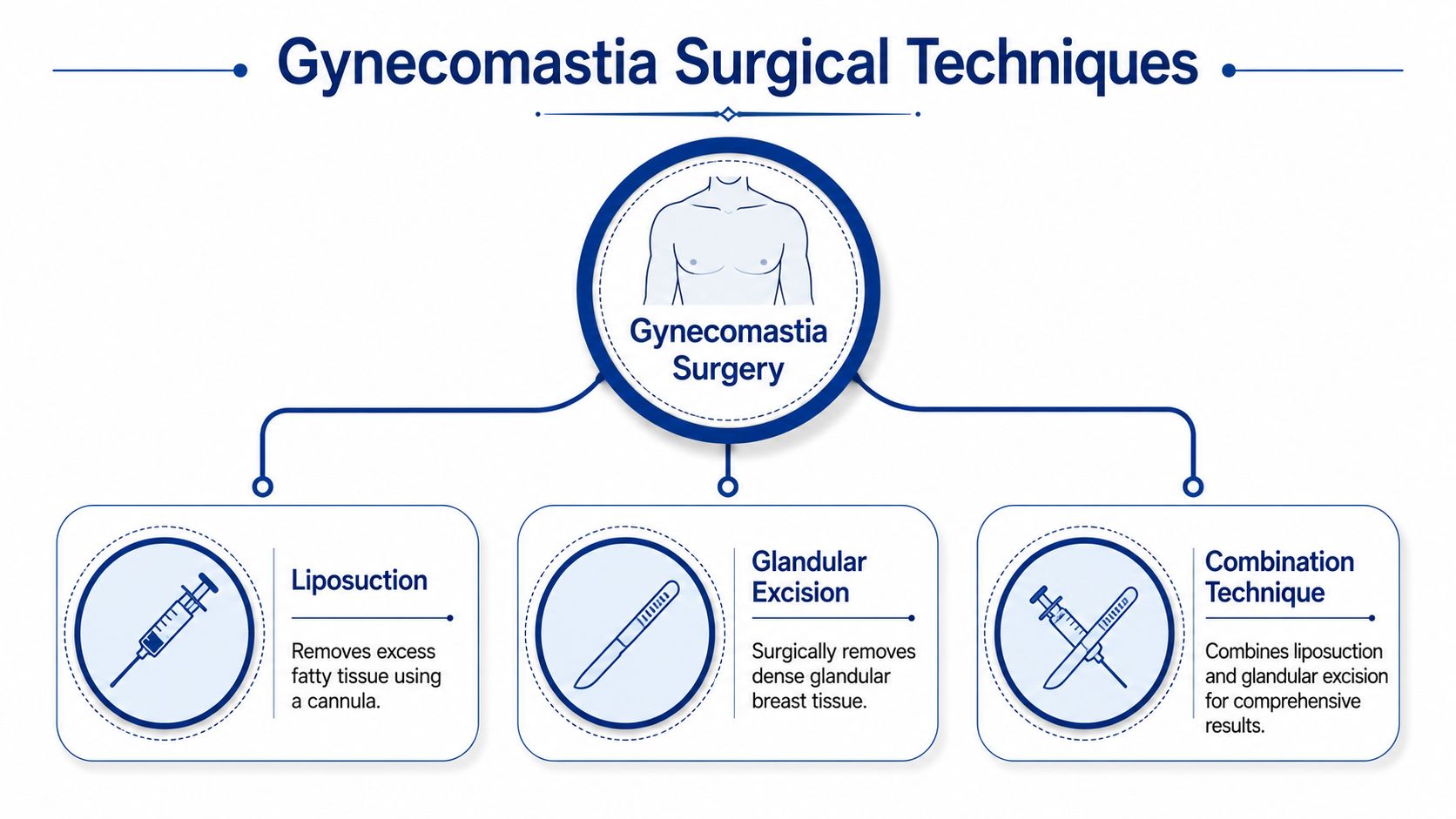
The answer to what is gynecomastia surgery depends on the chest in front of the surgeon. There isn't one universal operation. There are several core techniques, and the right one depends on whether the tissue is mostly fat, mostly gland, or a mixed pattern with skin excess.
Liposuction for fatty fullness
Liposuction is most useful when the chest contains a significant fatty component. A small cannula is used to remove fat and contour the surrounding chest so the result looks smooth rather than hollowed out.
Modern correction may use ultrasound-assisted liposuction, sometimes referred to as UAL or VASER-type technology. According to this PMC review of gynecomastia surgery techniques, a specialized probe emits ultrasonic waves to emulsify fat cells while selectively preserving blood vessels, nerves, and connective tissue, which can reduce bleeding and help with later glandular excision. That matters because chest contouring isn't just removal. It's precise shaping.
Liposuction alone can work well for pseudogynecomastia and some mild cases. It does not reliably remove dense glandular tissue.
Direct excision for glandular tissue
When the problem is firm gland beneath the nipple, direct excision is often necessary. This is the part many patients need but don't realize they need. If the surgeon only removes fat and leaves the gland, the chest can still project or the areola can remain puffy.
Excision is typically performed through a carefully placed incision that tries to hide the scar at the natural border of the areola or in another location selected for the patient's anatomy. The goal is complete enough gland removal to flatten the chest while preserving a natural transition so the nipple doesn't collapse inward.
Good gynecomastia surgery is a balance. Remove too little and the chest still looks full. Remove too much and the contour can look scooped out.
Combined treatment for the most common presentations
Most real-world cases aren't pure fat or pure gland. They're mixed. That's why a combined approach is common. Liposuction feathers the surrounding area and smooths the chest contour. Excision removes the dense core that suction alone can't address.
For men researching options in more detail, gynecomastia treatment options generally fall into this same decision tree of fat removal, gland removal, or both.
One office-based approach used for male chest contouring is PRECISION SCULPT, which applies these principles with an emphasis on local-anesthesia body contouring and detailed shaping of the chest.
How technique selection affects scars and contour
Technique choice isn't arbitrary. It should follow severity and anatomy. The gold standard for correcting gynecomastia is surgical excision of glandular tissue combined with excess skin removal, with incision patterns mapped to severity grades. A lateral circumareolar incision is indicated for grade I, the round block technique with de-epithelialization is optimum for grade II, and grade III requires combined techniques or reduction mammoplasty in severe cases, as described in this journal article on grade-based surgical management.
That grading matters because low-grade cases shouldn't be overtreated with unnecessary skin removal, while high-grade cases shouldn't be undertreated with a minimalist plan that leaves loose skin or poor nipple position.
A related surgical principle is the handling of more severe skin excess. The Aesthetic Society notes that when the nipple-to-inframammary fold distance exceeds 10 cm, surgeons advocate for simple mastectomy via the inframammary approach with free nipple grafting, while distances under 10 cm may allow mastectomy with skin resection and preservation of nipple-areola blood supply, as outlined in this detailed gynecomastia procedure information. That threshold highlights a key trade-off: preserving the nipple-areola complex when safe, and changing technique when doing so would put blood supply at risk.
The Awake Surgery Advantage in an Office Setting
Traditional gynecomastia surgery is often associated with a hospital or surgery center, general anesthesia, and a longer perioperative process. That model still exists. It isn't the only model.
For appropriately selected patients, male chest correction can be performed awake with local anesthesia in an office-based setting. The patient is comfortable, the chest is numbed thoroughly, and the procedure is carried out without the deeper physiologic effects associated with general anesthesia.
How awake treatment changes the experience
General anesthesia has a place in surgery, but it also changes the experience before, during, and after the procedure. Many patients want to avoid feeling groggy, nauseated, or slowed down afterward. They also prefer to avoid intubation and the heavier recovery that can come with being fully asleep.
With local anesthesia and light sedation when appropriate, patients remain comfortable without going through the same depth of anesthetic exposure. In practical terms, that often means a smoother surgical day and an easier immediate recovery period.
A private office-based setting can also feel less intimidating than a hospital. For cosmetic procedures, that matters. Men often delay gynecomastia surgery because they've built it up in their minds as a major event. An awake approach can make it feel more approachable without making it casual. It is still surgery. It is performed in a more controlled and efficient way for the right candidate.
The safest operation is not the most dramatic one. It's the one matched carefully to the patient, the anatomy, and the setting.
Who benefits most from this approach
Not every patient should have every procedure awake. Good judgment matters. A strong candidate for office-based local-anesthesia treatment typically has a straightforward contour problem, understands the process, and values a recovery that avoids the after-effects of general anesthesia.
Patients often appreciate several practical advantages:
- Less disruption: The day tends to feel more manageable when the anesthetic plan is lighter.
- More privacy: Office-based surgery can feel more discreet than a larger facility.
- Clearer recovery: Many men prefer waking up already awake, oriented, and past the fog that can follow general anesthesia.
- Focused care: Cosmetic contouring in an office setting allows the team to concentrate on one procedure and one recovery plan.
This doesn't make awake surgery “better” in every scenario. It makes it well-suited for many gynecomastia patients when the surgeon has the training, the facility, and the judgment to do it properly.
Your Recovery Journey and Expected Results
Recovery is usually more straightforward than patients fear, but it still requires discipline. The chest will look improved early, then temporarily look more swollen than expected, then gradually refine. That sequence is normal.
The first phase of healing
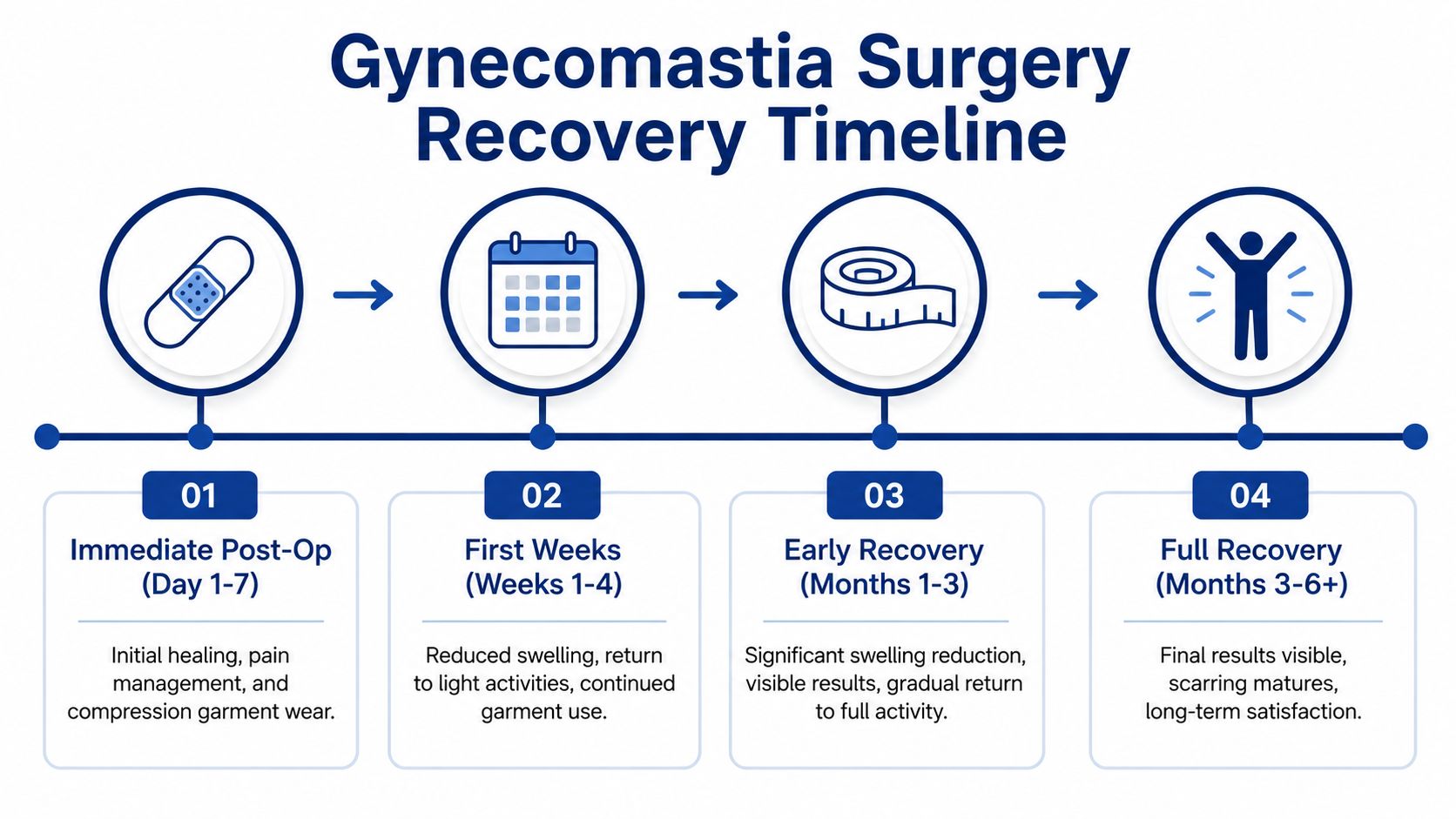
The first few days are about swelling control, compression, and limiting strain on the chest. Expect soreness, tightness, and bruising. Most men describe this less as sharp pain and more as pressure, tenderness, or the feeling of having done an intense chest workout.
Compression garments matter because they help support the tissues as they settle. They also reduce swelling and encourage a smoother contour. You may be surprised by how uneven the chest looks at first. One side can swell differently than the other. That doesn't mean the final result will be uneven.
The middle phase when contour starts to show
By the first weeks, day-to-day life usually gets easier. Desk work and light routine activity often feel manageable much sooner than strenuous workouts. The chest starts to look flatter, but it won't look final.
A common mistake is judging the result too early. The tissues are still healing internally even when the skin looks much better externally. If you want a fuller overview of what that healing period typically involves, gynecomastia surgery recovery is worth reviewing before your procedure.
Here's the practical rhythm most patients should expect:
- First 48 hours: Focus on rest, hydration, walking lightly, and keeping pressure off the chest.
- Week one: Bruising and swelling are usually still present. Compression remains important.
- Weeks 2 to 4: The chest often starts to look more normal in clothing, though firmness and residual swelling can remain.
- Months 1 to 6: The contour continues to refine as swelling settles and scars mature.
Early improvement is encouraging. Final judgment should wait until the tissues have had time to soften and settle.
When the result looks settled
The best gynecomastia results don't just look flatter. They look natural. The nipple sits appropriately, the contour blends into the surrounding chest, and there isn't a sharp crater or obvious surgical tell.
Patients also need realistic expectations. Surgery improves shape. It does not create the chest of a different person. Skin quality, baseline asymmetry, and healing behavior all affect the final look. Men who understand that usually feel better throughout recovery because they aren't expecting the process to be linear.
Potential Risks and How They Are Minimized
Every surgery involves trade-offs. Patients deserve a clear explanation of them. With gynecomastia correction, the concerns I hear most often are scar visibility, asymmetry, contour irregularities, changes in nipple sensation, and persistent swelling.
These are reasonable concerns because the male chest is a highly visible area. Small technical decisions matter. A few millimeters can change the contour. A poorly placed incision can draw the eye. Over-resection can look just as unnatural as under-resection.
The trade-offs patients should understand
Some swelling is part of healing. Some temporary sensory change can happen as tissue is lifted and reshaped. Minor asymmetries may still exist because the chest often begins asymmetrical. The goal is improvement, not anatomical perfection.
Scarring is another honest topic. The scar burden depends on the technique required. Minimal-incision cases usually leave less visible evidence than cases requiring skin removal. But trying to avoid all scars at any cost can produce a worse chest shape. The right question isn't “Can I have no scar?” It's “Which scar pattern gives me the safest and most natural result?”
How surgical planning lowers risk
Good planning starts with matching the operation to the tissue type and skin quality. It continues with careful contouring, conservative hemostasis, and incision placement that respects natural borders.
There is also an important nuance that many patients never hear. In men who are prone to hypertrophic scarring or keloids, excision through a small periareolar incision should be avoided to reduce the risk of unsightly scarring. In grade I gynecomastia with this scar-sensitive profile, liposuction alone is recommended as the primary modality, as discussed in this PMC article on surgical approaches and scar-sensitive patients.
That's a good example of patient-first surgery. Not every patient benefits from the most aggressive tissue removal. Sometimes the best result comes from doing less, because the skin's healing pattern changes the risk calculation.
Your Consultation and Preparing for Surgery
The consultation should leave you with clarity, not confusion. You should understand what kind of tissue you have, whether skin removal is likely, what scars are expected, and whether an awake office-based approach makes sense for you.

Questions worth asking in consultation
Bring direct questions. The best consultations are conversations.
- Ask about tissue type: Is your chest mostly fat, mostly gland, or mixed?
- Ask about scars: Where will incisions be, and why is that pattern being recommended?
- Ask about anesthesia: Are you a candidate for local anesthesia in an office-based setting, or does your anatomy call for a different plan?
- Ask about revisions: What problems are most important to avoid, and how does the surgical plan reduce them?
It also helps to ask how recovery is managed. Compression, activity restrictions, follow-up visits, and swelling expectations should all be clear before surgery day.
What to expect in Beverly Hills
A thoughtful consultation with Dr. Justin Yovino in Beverly Hills, CA should include an exam, a discussion of your goals, and a recommendation based on anatomy rather than a one-size-fits-all formula. Patients who are comparing options can also review information about the best gynecomastia surgeon to understand what experience and planning details matter.
If you're wondering whether your concern is unusual, it isn't. In 2019, 24,123 male patients underwent surgical treatment for gynecomastia in the United States, a 19% increase in procedure volume since 2000, and 60% were younger than age 29 at the time of surgery, according to this gynecomastia overview. That same source notes that the American Board of Cosmetic Surgery identifies surgery as the "most effective known treatment" for the condition.
Cost is a common question, and the honest answer is that it varies. The complexity of the chest, whether gland excision is required, whether skin removal is needed, and the setting of the procedure all affect the overall plan. A personalized quote should come after an exam, not before one.
If you're ready to find out whether your chest fullness is fat, gland, or both, the next step is a private consultation with Ideal Face & Body. Dr. Justin Yovino and Dr. Sarah Yovino offer office-based aesthetic care in Beverly Hills, CA with a focus on precise planning, realistic outcomes, and patient safety.