You've cleaned up your diet. You're exercising. Your weight feels stable. Yet the lower abdomen still doesn't match the effort you've put in. For many people, that last pocket of loose skin or fullness below the belly button becomes the most frustrating part of the journey.
That's usually when patients start searching for mini tummy tuck before and after photos. They want to know if the change will look natural, how visible the scar will be, and whether the result is worth recovery. Those are the right questions.
A mini tummy tuck isn't a weight loss procedure. It's a focused contouring operation for a specific area of the abdomen. In my practice, I think of it as a finishing procedure for the right candidate, not a substitute for healthy habits. If your concern is mainly a small lower belly pouch, often after pregnancy or weight change, this can be a very effective option.
At Ideal Face & Body in Beverly Hills, CA, Dr. Justin Yovino and Dr. Sarah Yovino are known for a patient-centered approach that includes awake, office-based procedures under local anesthesia. That modern approach matters because patients today want more than a flatter abdomen. They want precision, safety, and a recovery experience that feels thoughtful from start to finish.
Table of Contents
- Introduction The Last Hurdle in Your Fitness Journey
- What Exactly Is a Mini Tummy Tuck
- Mini Tummy Tuck vs Full Tummy Tuck and Liposuction
- Understanding Your Before and After Results
- Your Recovery Timeline and Scar Care Strategy
- Planning Your Consultation in Beverly Hills
- Frequently Asked Questions About Mini Tummy Tucks
Introduction The Last Hurdle in Your Fitness Journey
A common story goes like this. You zip up jeans and notice the same soft fold at the lower abdomen that has bothered you for years. You can hide it in some clothes, but fitted dresses, swimwear, and workout gear make it feel obvious. You start wondering whether you're doing something wrong.
You probably aren't.
The lower abdomen is one of the hardest places to improve when the issue is loose skin and a small amount of stubborn fat rather than overall body weight. Diet can shrink fat cells. Exercise can strengthen muscle. Neither can remove stretched skin. That's where a mini tummy tuck can make sense.
I like patients to think of this operation as a contouring tool with a narrow purpose. It targets the area below the belly button and can create a smoother transition from the lower abdomen into the pubic area. For the right person, that change feels less like becoming someone new and more like finally matching the effort they've already made.
Practical rule: If your main concern sits below the navel, a mini tummy tuck may be worth discussing. If your concerns extend above it, you may need a different plan.
What Exactly Is a Mini Tummy Tuck
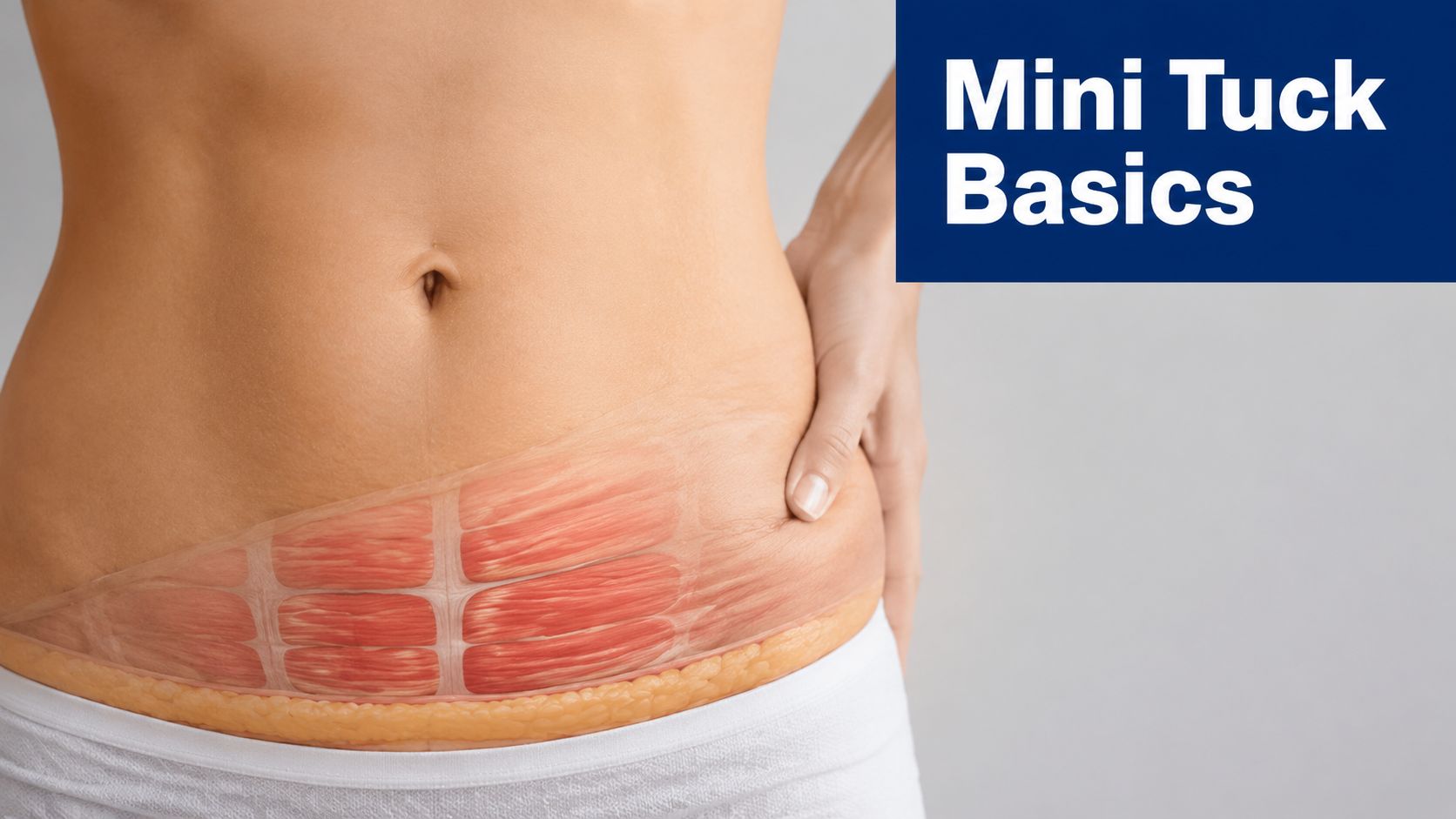
A mini tummy tuck, also called a partial abdominoplasty, is a smaller version of a full tummy tuck, but “smaller” doesn't just mean shorter surgery. It means the operation has a tightly defined zone and a different goal.
The key detail is anatomical. The mini tummy tuck is technically defined by its exclusive focus on the sub-umbilical region, addressing excess skin and fat strictly below the belly button while leaving the navel in its natural position. A critical technical distinction is the absence of a periumbilical scar; the incision is a short horizontal line placed just above the pubic hairline according to Becker Plastic Surgery's description of mini abdominoplasty.
What the procedure treats
A mini tummy tuck is built for a very specific problem. That usually includes:
- Lower abdominal skin laxity below the belly button
- A small lower belly pouch that hasn't responded to fitness efforts
- Mild lower abdominal muscle looseness in selected cases
- A desire for a low, concealed scar without a scar around the navel
It does not treat the whole abdomen. It won't correct significant upper abdominal looseness, and it isn't the right choice if you have substantial laxity above the belly button.
That's where patients often get confused. They see a beautiful mini tummy tuck before and after gallery and assume the procedure can reshape the entire midsection. It can't. The best results happen when the anatomy matches the operation.
Who tends to be a good fit
The right candidate usually has concerns concentrated between the belly button and the pubic area. A clinical overview of mini versus full tummy tuck indications describes the mini tummy tuck as best suited to mild lower belly skin laxity between the belly button and pubic area, while a full tummy tuck is used for more extensive abdominal laxity.
Here's the simplest way to think about candidacy:
- Good fit: your upper abdomen looks relatively smooth, but the lower abdomen has extra skin or a small overhang
- Less ideal fit: you want major tightening from ribs to pubic area
- Not a weight loss tool: the surgery removes tissue, but the amount removed is small and the goal is shape, not major weight change
A mini tummy tuck can also fit well into an awake surgery philosophy. In an office-based setting under local anesthesia, a focused operation like this can feel more controlled and more suited to the patient's actual problem. That doesn't make it casual surgery. It makes it precise surgery.
Mini Tummy Tuck vs Full Tummy Tuck and Liposuction
Many patients don't need more surgery. They need the right surgery. The challenge is figuring out whether your issue is skin, fat, muscle laxity, or some combination of all three.
The quickest way to sort that out is to compare the three procedures patients most often mix up.
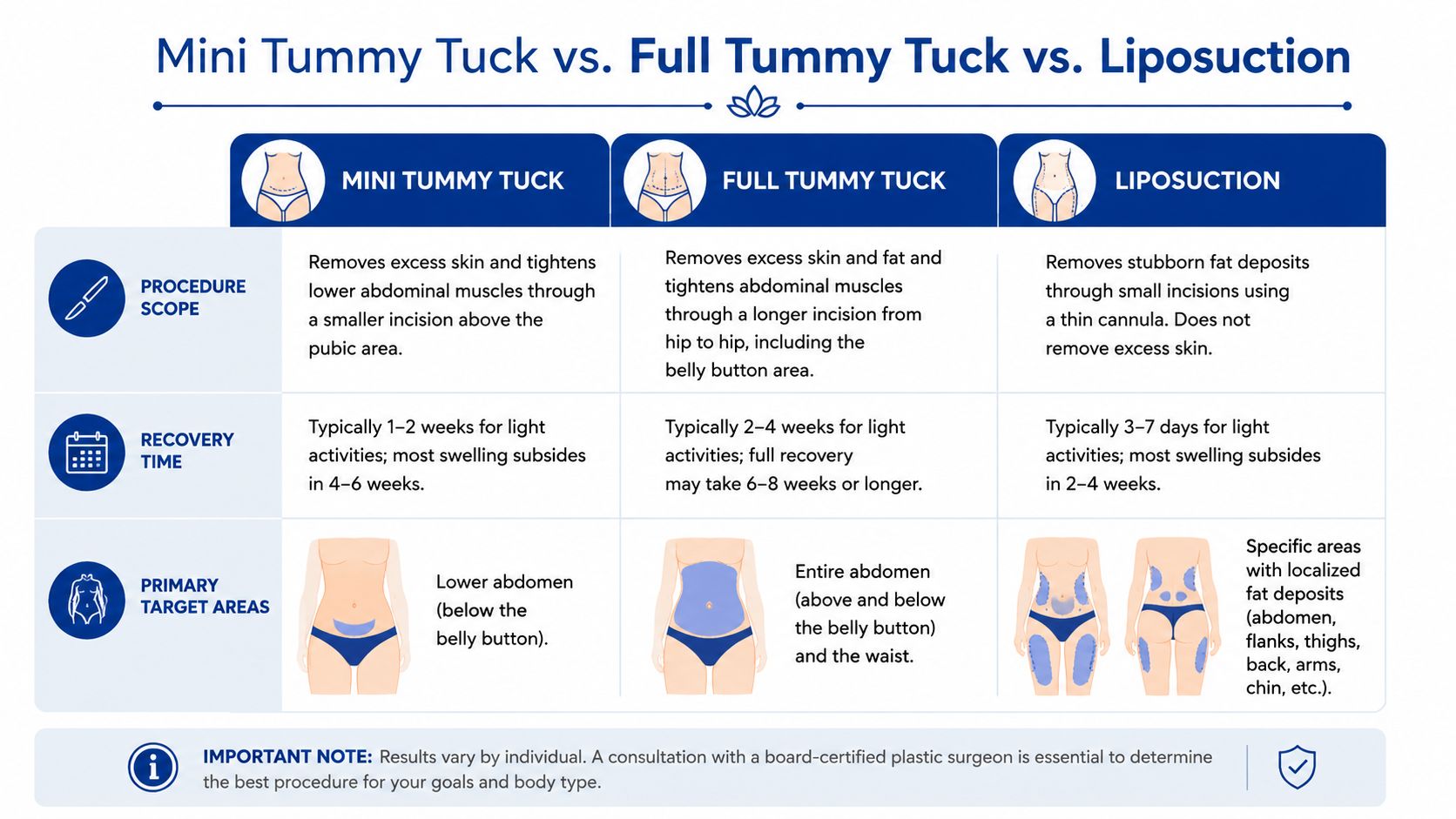
Three procedures with very different jobs
A mini tummy tuck removes extra lower abdominal skin and some fat. It may include limited tightening in the lower abdomen when appropriate. It's about flattening the area below the navel.
A full tummy tuck is broader. It addresses more extensive abdominal laxity and often deals with muscle separation across a larger part of the abdominal wall. It also involves changing the skin around the belly button.
Liposuction does something different. It removes fat but does not remove loose skin. That distinction matters. If your skin still has good snap and your problem is fullness alone, liposuction may be enough. If your skin hangs or creases, liposuction by itself can leave you disappointed.
For some patients, combining a mini tummy tuck with liposuction creates the most polished contour. That's especially true when there's a central lower abdominal pouch plus extra fullness at the flanks or hips. In those situations, a contouring approach such as tummy tuck with lipo at Ideal Face & Body can help create a smoother transition across the whole waistline.
Side by side comparison
According to Dr. Steinberg's mini tummy tuck timing and recovery overview, a mini tummy tuck typically takes 1 to 2 hours, with a recovery of 1 to 2 weeks for light activity, while a full tummy tuck lasts 2 to 5 hours and requires 3 to 6 weeks before returning to light activity.
| Feature | Mini Tummy Tuck | Full Tummy Tuck | Liposuction (PRECISION SCULPT) |
|---|---|---|---|
| Procedure scope | Targets loose skin and fat below the belly button | Addresses more extensive abdominal skin laxity and broader contour issues | Removes localized fat through contouring, without removing loose skin |
| Main problem treated | Lower abdominal pouch and mild lower skin excess | More significant abdominal laxity | Stubborn fat deposits |
| Belly button | Usually stays in natural position | Commonly requires alteration of abdominal skin around the navel | Not altered |
| Scar pattern | Short low horizontal scar | Longer lower abdominal scar, with navel-related scarring pattern | Small access points |
| Recovery for light activity | 1 to 2 weeks | 3 to 6 weeks | Varies by treatment area and extent |
| Best candidate | Mild lower abdominal laxity | More extensive laxity above and below the navel | Good skin tone with localized fat |
A flat stomach isn't one diagnosis. Some patients need skin removal. Some need fat removal. Some need both.
The reason awake body contouring has become so appealing is that it fits this decision-making process well. A targeted operation under local anesthesia encourages precision. It also helps frame the surgery around what the patient needs, rather than automatically escalating to the largest operation available.
Understanding Your Before and After Results
Patients usually expect the “after” to appear quickly. What occurs is more gradual and far more normal than most photo galleries suggest.
The early result often looks better than before, but it rarely looks final. That doesn't mean something is wrong. It means tissue has been lifted, tightened, and asked to heal.

Why early photos can be misleading
One of the biggest sources of anxiety is swelling that mimics residual fat. Dr. Leela Mundra's discussion of mini tummy tuck healing notes that while patients see immediate improvement, the final result often takes up to three months as subcutaneous edema subsides, and the scar can continue refining for a full year. The same source also explains that early lower abdominal bulging is often fluid retention, not retained fat.
That point matters because many patients compare a six-week mirror check to polished long-term before and after photos. Those aren't equivalent moments in the healing process.
A simple example helps. If a patient has surgery and sees a flatter lower abdomen right away, that's encouraging. If the same patient notices fullness weeks later, especially near the lower incision line, that can still be part of normal swelling. The contour is changing while the tissue settles.
Healing isn't linear. Some mornings look flatter. Some evenings look puffier. That pattern can be normal.
What a strong result usually looks like
A good mini tummy tuck before and after result usually has a few recognizable features:
- A smoother lower abdominal line when viewed from the side
- Less folding or overhang above the pubic area
- A more natural transition into the hips and flanks when contouring is balanced
- Clothing that fits more cleanly through the lower midsection
When patients also have stretch marks, it helps to understand what surgery can and can't change. Lower abdominal skin that gets removed takes any stretch marks in that excised skin with it, but stretch marks outside that removal zone remain. For readers trying to sort out that difference, Weight Method's guide to stretch marks gives a useful plain-language overview of why skin texture issues behave differently from fat and weight.
Combining a mini tummy tuck with precise liposuction can also improve the silhouette by blending the lower abdomen into the waistline. That's often why the best after photos don't just look flatter. They look more harmonious.
Your Recovery Timeline and Scar Care Strategy
The first thing I tell patients is this. Recovery is easier when you expect the right things. If you expect perfection in a week, you'll worry. If you expect a steady progression, you'll usually feel reassured.
A mini tummy tuck has a shorter recovery than a full tummy tuck, but it still requires discipline. Rest matters. Compression matters. Scar care matters.
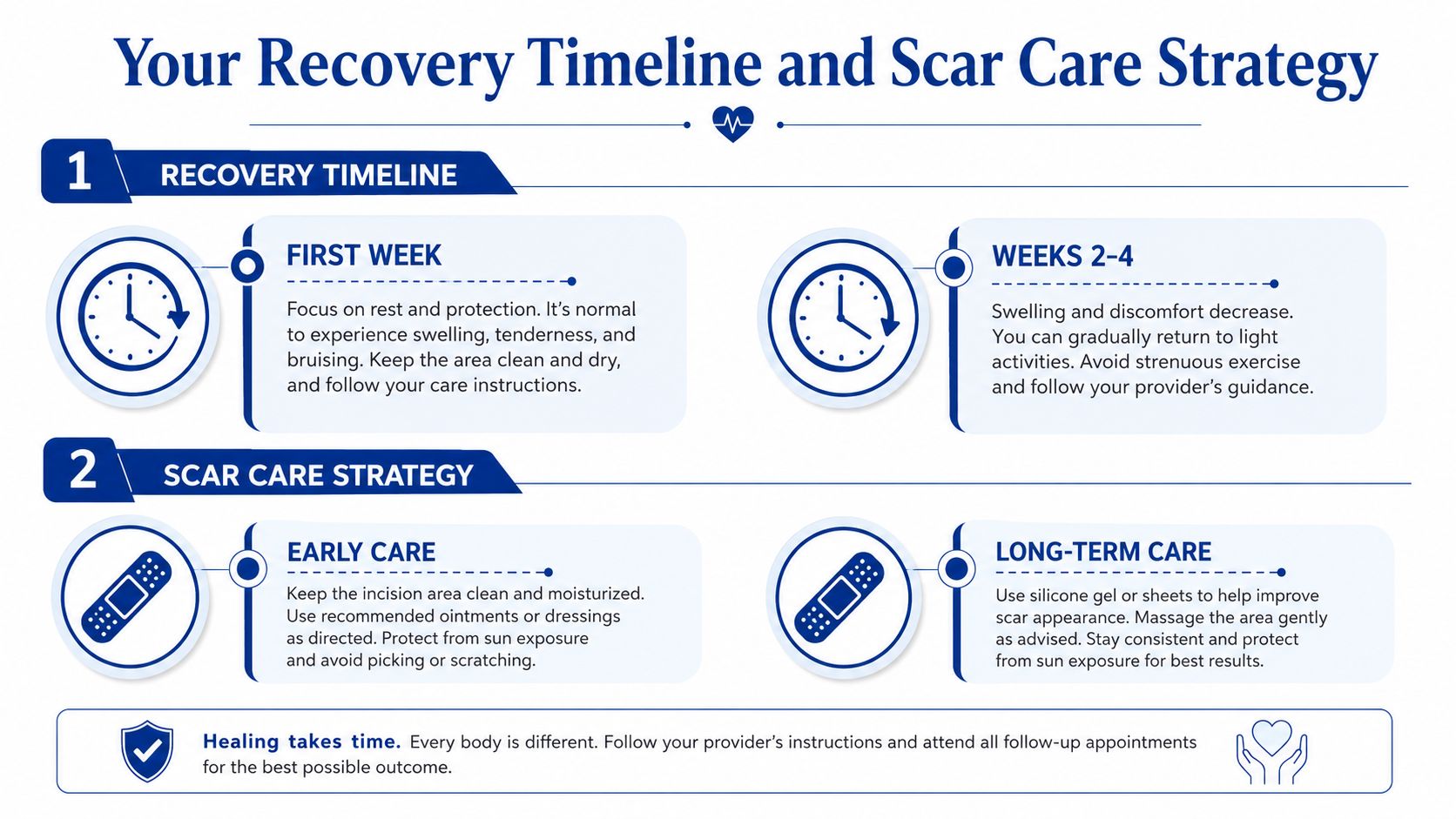
What recovery usually feels like
Most patients describe the first phase as tightness, soreness, and swelling rather than sharp pain. Movement feels guarded at first. Standing fully upright may take time. That's expected after lower abdominal skin tightening.
A practical recovery rhythm often looks like this:
- First week: focus on rest, short walks, hydration, and protecting the incision
- Weeks two through four: daily activity gets easier, but swelling still comes and goes
- Months one through three: the contour starts looking more believable to the patient, not just to the surgeon
- Longer term: the scar continues to mature even after the shape looks much better
If you want a deeper walkthrough of incision healing, this guide to tummy tuck incision healing covers practical recovery habits in more detail.
How to help a scar heal well
Scar care starts with realistic expectations. Acibadem Beauty Center's scar maturation overview explains that a mini tummy tuck scar initially presents as raised and firm, then gradually fades and flattens over 6 to 12 months, with complete scar refinement and stable tissue settling taking up to a year.
That timeline surprises people. They expect the scar to look “final” much sooner than it does.
Helpful scar habits usually include:
- Follow incision instructions closely: your surgeon's wound care plan comes first
- Protect the scar from sun exposure: darkening can make a scar more noticeable
- Use silicone-based scar support when cleared: many patients ask about gels and sheets, and products such as Healtsy's Dermatix scar gel are examples of the type of silicone scar care people often explore after their surgeon says it's appropriate
- Be patient with texture changes: firmness early on doesn't mean the scar will stay that way
Scar truth: A scar can look worse before it looks better. Raised and pink early on can still mature into a softer, flatter line.
This is one reason I like the awake surgery conversation. Patients who choose a highly focused procedure under local anesthesia are often very engaged in aftercare. That mindset helps. Good surgery matters, and so does good healing behavior.
Planning Your Consultation in Beverly Hills
A consultation should leave you clearer, not more confused. If it doesn't answer whether your problem is skin, fat, muscle laxity, or a mix, it hasn't done its job.
In Beverly Hills, the consultation process for a mini tummy tuck should start with anatomy and end with a plan. That means examining where the excess tissue sits, whether the upper abdomen is involved, how much skin movement is possible, and whether liposuction should be part of the strategy.
What to bring to the visit
You don't need to overprepare, but a few things help:
- Photos of your goals: not to copy someone else, but to clarify what you notice
- A list of prior surgeries: especially C-section scars or abdominal procedures
- Questions about downtime: work, lifting, travel, and exercise all matter
- Honesty about your goals: some patients want subtle refinement, others want the most dramatic flattening their anatomy allows
A focused consultation with Beverly Hills mini tummy tuck surgeons at Ideal Face & Body can also help patients understand whether a mini procedure is enough or whether a broader approach would make more sense.
Why the awake approach changes the conversation
Dr. Justin Yovino's approach is particularly noteworthy. Awake, office-based surgery under local anesthesia changes how many patients think about body contouring. It often feels more personal, more controlled, and less overwhelming than the idea of a major hospital-based procedure.
That doesn't mean every patient is a candidate for every awake procedure. It means the consultation becomes more individualized. The discussion centers on safety, comfort, candidacy, and realistic outcomes rather than assuming one standard operating model for everyone.
Frequently Asked Questions About Mini Tummy Tucks
By the time patients reach the FAQ section, the questions usually become more personal. They are no longer asking, “What is a mini tummy tuck?” They are asking, “What will this really be like for me, and is it a smart choice?”
That is the right place to start.
How long do results last
Results can last for many years when your weight stays relatively stable and you are finished with pregnancy. Skin and fat that are removed do not come back on their own. The better way to view a mini tummy tuck is as a reset, not a shield against future body changes.
Your abdomen still responds to life. Weight fluctuation, pregnancy, aging, and changes in muscle tone can all affect the contour over time. In my practice, the patients who keep the most consistent improvement are usually the ones who treat surgery as the final step after building healthy habits, not as a substitute for them.
What risks should you understand
A mini tummy tuck is a smaller operation than a full tummy tuck, but it is still real surgery. That means swelling, bruising, discomfort, scar healing, fluid collections, bleeding, and infection all need to be discussed clearly before anyone schedules a procedure.
Safety starts with patient selection. It continues with careful planning, good surgical technique, and close follow-up after surgery. That is one reason the awake approach at Ideal Face & Body matters. For appropriate candidates, surgery under local anesthesia allows a more controlled, patient-centered experience, and it avoids defaulting to general anesthesia when a focused lower abdominal procedure may not require it.
PRECISION SCULPT also matters here. Precise contouring is not just about appearance. It helps create a thoughtful plan for how the lower abdomen is shaped, how tension is managed, and how the final result fits the rest of your torso.
What about the floating belly button technique
This question comes up often because patients want the flattest result possible with the least visible scarring. That goal makes sense. The anatomy is where the decision gets more nuanced.
A floating belly button technique can sometimes help address lower abdominal skin without placing a scar around the navel. The tradeoff is that belly button position and shape can become less predictable if too much movement is forced. A natural abdomen is not judged by whether one scar was avoided. It is judged by proportion, smooth contour, and whether the navel still looks like it belongs on your body.
That is why this part of the plan should never be decided by a catchy phrase alone.
What is an awake mini tummy tuck like
For the right patient, awake surgery feels more like a modern office-based procedure than the hospital-based experience many people picture. You are carefully numbed with local anesthesia, monitored throughout the procedure, and guided step by step by the surgical team.
Patients often tell me the idea sounds intimidating until they understand how controlled it is. A good comparison is dental treatment at a high level of precision. You are not relying on brute force or a rushed process. You are relying on targeted numbing, meticulous technique, and constant communication.
That approach fits a mini tummy tuck especially well because the treatment area is limited and the surgical goals are specific. It also allows the conversation to stay focused on candidacy, comfort, and safety, which is exactly where it belongs.
If you're ready to talk through whether a mini tummy tuck fits your anatomy and goals, Ideal Face & Body offers a private consultation experience focused on precision, patient safety, and awake surgical options under local anesthesia in Beverly Hills, CA.