
You've probably already seen a headline figure for gynecomastia surgery cost, then called several clinics and received estimates that don't seem comparable. One quote may include anesthesia and the operating facility. Another may cover only the surgeon's work. A third may assume liposuction, even though firm glandular tissue could require excision.
That confusion isn't accidental. Gynecomastia surgery is priced as a treatment plan, not as a single product. Tissue type, severity, surgical technique, anesthesia setting, facility use, insurance eligibility, and revision risk all shape the final quote. The right question isn't “What's the cheapest surgery?” It's “What exactly am I paying for, and does the plan match my anatomy?”
Table of Contents
- Why Gynecomastia Surgery Quotes Feel So Unclear
- True vs Pseudo Gynecomastia and Why It Matters
- What Goes Into the Bundled Quote
- Technique Choices and Their Cost Implications
- When Insurance and Medical Necessity Change the Math
- How to Get an Accurate Quote You Can Trust
- Smart Questions to Ask Before You Commit
Why Gynecomastia Surgery Quotes Feel So Unclear
The headline fee is only one piece
A man can receive three gynecomastia surgery quotes and still lack a usable comparison. One estimate may list only the surgeon's work. Another may include anesthesia and the operating facility. A third may assume liposuction, even when firm glandular tissue or loose skin requires a different plan.
The American Society of Plastic Surgeons lists an average surgeon's fee of $5,587 for gynecomastia surgery. Its 2024 statistics document gives an estimated surgeon-fee range of $5,000 to $9,000 for male breast reduction. Those figures cover the surgeon's fee, not the full surgical experience. The gynecomastia.org pricing framework explains why a headline figure should serve as a starting point, not an all-in quote.
Published pricing guidance places many patients' total out-of-pocket spending around $8,500 to $15,000 once anesthesia, facility charges, and recovery-related items are included. Other guides describe typical totals around $8,600 to $9,100, broad U.S. ranges from about $5,000 to more than $10,000, and complex cases reaching approximately $15,000 to $18,000. The Levamedical cost breakdown helps separate the surgeon's fee from the broader financial obligation.
Why three clinics can quote three different amounts
One clinic may plan liposuction alone in an office setting. Another may recommend gland excision under general anesthesia in an accredited surgical center. A third may combine gland excision, liposuction, and skin removal. These are different procedures, with different staffing, operating time, facility use, and recovery requirements.
Severity grading often drives that gap. A mild case may need limited tissue removal, while more advanced enlargement can involve loose skin, a widened areola, or contour correction. Insurance eligibility can change the calculation too, so ask whether the office will verify benefits and separate covered services from excluded cosmetic charges.
Geography and surgeon experience also influence the quote. Compare scope and inclusions, not just the final figure.
Practical rule: Never compare a surgeon-only fee with an all-inclusive surgical quote.
Ask whether the estimate includes the facility, anesthesia provider, compression garments, pathology, prescriptions, laboratory work, imaging, follow-up visits, and complication treatment. Excluded items can turn an attractive number into an incomplete budget.
True vs Pseudo Gynecomastia and Why It Matters
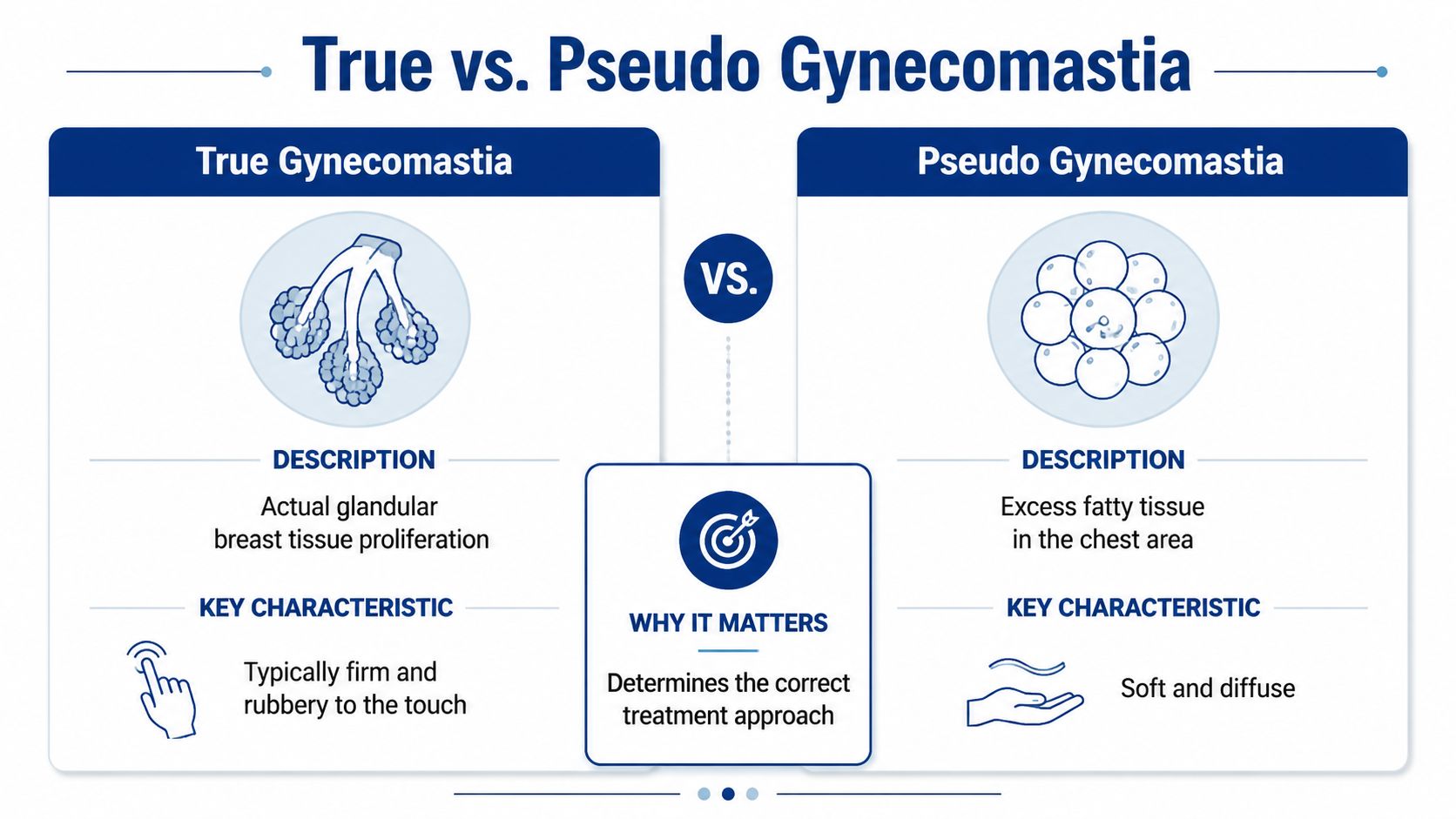
Before discussing a quote, identify what's creating the chest fullness. True gynecomastia involves actual glandular breast tissue, often felt as firm or rubbery tissue beneath the nipple. Pseudo gynecomastia is predominantly fatty tissue, which tends to feel softer and more diffuse. Mixed cases contain both.
Tissue determines the operation
Fat responds to liposuction. Dense glandular tissue generally needs direct excision, often through an incision near the areola. A mixed chest commonly needs both methods, because removing fat without addressing the gland can leave a firm mound or persistent nipple prominence.
That's why a low quote based on liposuction alone may be a poor bargain for true gynecomastia. The surgeon may remove surrounding fat while leaving the central tissue that bothers you most. You then face an unsatisfactory contour and possibly another operation, adding a second round of anesthesia, facility use, recovery, and surgeon fees.
Severity changes the plan again. Mild fullness may require limited tissue removal. More advanced enlargement can include loose skin, a widened areola, or a chest contour that won't settle after tissue removal. In those cases, skin tightening or skin reduction may be necessary. A review of surgical approaches recommends skin-sparing mastectomy with liposuction when there's no significant excess skin, and mastectomy with skin reduction when loose skin is substantial. The surgical review of gynecomastia techniques provides useful context for why anatomy, not marketing, should determine the approach.
Diagnosis comes before pricing
A surgeon should examine the chest, assess firmness and distribution, check for asymmetry, and grade the severity. Adult enlargement can also be associated with medications, obesity, systemic disease, endocrine disorders, or testosterone deficiency. Adult gynecomastia prevalence has been reported in the 32% to 65% range, depending on age and definition, and clinical guidance stresses that an underlying cause should be considered rather than assuming the issue is purely cosmetic. The adult gynecomastia guideline supports that diagnostic-first approach.
For a plain-language explanation of non-surgical considerations and the distinction between tissue types, you can also review 3D Aesthetics Leamington Spa's guide to gynecomastia treatment. Use it as background, not as a substitute for an in-person examination.
What Goes Into the Bundled Quote
A trustworthy estimate names each component. You should be able to see what the surgeon charges, where the procedure occurs, who provides anesthesia, and which aftercare items are included. If the clinic gives you one unexplained total, you can't tell whether the quote is efficient or just incomplete.
| Line Item | What It Covers |
|---|---|
| Surgeon fee | Examination, surgical planning, operative work, and the surgeon's professional time |
| Facility or hospital fee | Operating room, staff, equipment, supplies, and recovery area |
| Anesthesia fee | Anesthesia medications, monitoring, and the anesthesia professional |
| Compression garments | Postoperative support garments selected for the treatment area |
| Pathology | Analysis of removed tissue when the surgical plan sends it for examination |
| Postoperative visits | Wound checks, contour assessment, garment guidance, and recovery monitoring |
| Preoperative work | Possible laboratory tests, imaging, medical clearance, and prescriptions |
Anesthesia setting changes the bundle
The setting can shift the quote substantially. Local anesthesia with oral sedation in an appropriate office-based operating room usually involves a different staffing and facility structure than general anesthesia in an accredited surgical center with a board-certified anesthesiologist.
That doesn't make one setting universally better. The correct choice depends on the extent of tissue removal, the planned technique, your health, and the surgeon's safety protocol. You should be cautious when a clinic uses anesthesia language as a selling point without explaining who monitors you, where the procedure occurs, and what happens if the operation becomes more extensive than expected.
A surgical center may add facility and anesthesia charges, but it can also provide the resources appropriate for a longer or more complex operation. An office-based approach may reduce those components when the case is suitable for it. The decision should follow the anatomy and safety plan, not an arbitrary desire to force every patient into the cheapest setting.
Revision work creates a different estimate
Revision surgery isn't priced like primary surgery. Scar release, re-excision of residual gland, correction of contour irregularities, or fat grafting can add separate work. Prior surgery may also distort tissue planes and make the dissection less predictable.
Ask whether the quote covers only the planned primary operation. Confirm how the practice handles a touch-up, what conditions must be met, and whether surgeon, facility, anesthesia, and garment charges apply again. A clear revision policy is part of financial planning, not a minor administrative detail.
Technique Choices and Their Cost Implications
Technique should explain the quote. If the estimate rises, you should know which added task creates the increase.
| Technique | Best For | Operative Time | Cost Driver Most Affected | Facility Setting |
|---|---|---|---|---|
| Liposuction alone | Pseudo gynecomastia or predominantly fatty fullness | Usually the least extensive option | Anesthesia and facility use | Office-based setting or surgical center, depending on the case |
| Excision alone | Firm glandular tissue concentrated behind the areola | Adds precise dissection and tissue removal | Surgeon time and facility use | Office-based setting or surgical center |
| Liposuction with excision | Mixed tissue or true gynecomastia with surrounding fat | Combines contouring and gland removal | Surgeon, anesthesia, and facility components | Often an accredited surgical setting |
| Excision with skin reduction | Significant skin excess or advanced contour changes | More extensive operation and closure | Operating time, facility, anesthesia, and postoperative care | Accredited surgical center or hospital setting |
Liposuction-only treatment can be appropriate when fat dominates the chest. It generally requires fewer surgical steps, which can reduce operating time and the related facility and anesthesia components. It won't remove a dense gland directly beneath the nipple.
Excision alone addresses the firm tissue but may leave fullness in the surrounding chest if fat is also present. Combined lipo-excision is therefore common for true or mixed gynecomastia. It costs more because the surgeon performs two distinct tasks, contouring the fat and removing the gland.
Skin removal represents another level of complexity. If the skin envelope is too loose to contract adequately, the surgeon may need to remove skin and reposition or reshape the nipple-areola complex. That adds planning, incision management, closure work, and postoperative care.
The gynecomastia surgery types guide can help you understand the terminology before a consultation. Don't choose a technique from a webpage, though. Choose it after the surgeon has examined the tissue and explained the tradeoff between contour, scarring, operating time, and recovery.
Published cost guidance describes the surgeon's fee as potentially representing roughly 40% to 60% of the total, with facility charges, anesthesia, and compression garments making up much of the remainder. The procedure-complexity breakdown reinforces the central point: added technique changes the entire bundle, not just one line item.
When Insurance and Medical Necessity Change the Math
Many men assume gynecomastia surgery is always self-pay. That assumption is too broad. Insurance coverage is uncommon, but it can be possible when a medical evaluation documents true gynecomastia, symptoms, persistence, and medical necessity rather than fat-only fullness.
What insurers usually want to see
Coverage rules differ by plan, so no surgeon can promise approval before reviewing your policy. Insurers may look for documentation such as:
- Persistent enlargement: The condition remains after the expected hormonal or developmental period.
- Physical symptoms: Pain, tenderness, irritation, or functional limitations may support medical necessity.
- Clinical diagnosis: A physician confirms glandular tissue rather than attributing the chest entirely to adiposity.
- Underlying-cause evaluation: Medication history, endocrine review, and other medical factors have been considered.
- Conservative management: The record may show that appropriate non-surgical measures didn't resolve the problem.
A workup can involve primary-care documentation, hormone panels, imaging when clinically indicated, and records describing symptoms or failed management. Those tests aren't automatically required for every patient, but they can affect both diagnosis and insurance review when the history suggests an underlying medical issue.
Approval doesn't mean zero out-of-pocket expense
Pre-authorization may shift the financial structure from a self-pay bundle to itemized billing. You may still have a deductible, co-insurance, non-covered services, facility differences, or charges for contouring that the policy excludes.
Denials are also common because many policies classify the operation as cosmetic, especially when the enlargement is painless, fat-dominant, or not sufficiently documented. If approval fails, you'll need to compare a cosmetic quote with the medical costs already incurred for consultations, imaging, and laboratory work.
The cheapest path isn't always the smallest initial quote. Treating the correct tissue problem the first time can protect you from paying for an incomplete operation and a later revision.
For a practical overview of the financial questions that arise during coverage review, see Ideal Face & Body's guide to gynecomastia surgery cost with insurance. Bring your insurance policy details and medical records to the consultation so the team can distinguish likely covered services from elective contouring.
How to Get an Accurate Quote You Can Trust
A defensible estimate starts with an examination. Remote photos can help a practice decide whether a consultation is appropriate, but they can't reliably determine the firmness of tissue, the degree of skin laxity, the severity grade, or the technical steps required.
Start with an anatomy-based consultation
Ask the surgeon to identify whether you have true gynecomastia, pseudo gynecomastia, or a mixed pattern. Request an explanation of the severity and the reason for the recommended technique. If the surgeon discusses only fat without examining the tissue beneath the areola, the consultation is incomplete.
The surgeon may also recommend medical evaluation when the history suggests medication-related, endocrine, systemic, or newly developing enlargement. Don't skip that step because you're focused on the operation. Treating an underlying cause may change whether surgery is appropriate and how an insurer views the case.
Demand a line-by-line estimate
Your written quote should separate:
- Surgeon's fee, including the planned operative work.
- Facility fee, including the location and recovery area.
- Anesthesia, including the provider and anesthesia setting.
- Garments, including whether the initial garment is included.
- Pathology, if tissue will be sent for analysis.
- Laboratory work, imaging, and prescriptions, identifying what is excluded.
- Follow-up visits, including the routine postoperative schedule.
- Revision policy, describing what happens if residual tissue or contour concerns require additional treatment.
Ask which items are fixed and which depend on intraoperative findings. A quote may change if the surgeon finds more glandular tissue, significant skin excess, unexpected scar tissue, or a need for a different closure.
Separate primary and revision assumptions
Make the practice state whether the estimate is for primary surgery or revision work. Scar tissue and previous contour changes can increase dissection difficulty and alter the plan. A revision quote should explain whether scar release, re-excision, contour correction, or fat grafting is included or billed separately.
Get the final estimate in writing, with a validity window and a list of events that could change it. A possible overnight stay, additional skin tightening, or a change in facility should never appear as a surprise after you've committed.
Smart Questions to Ask Before You Commit
Walk into the consultation with a pricing test, not just a list of medical questions. The quote should reflect your severity grade, tissue type, anesthesia setting, and likely technique. If the practice cannot explain what changes the fee, you do not yet have a reliable basis for comparison.
Surgeon and facility
Ask:
- What board certifications and hospital affiliations do you hold?
- How often do you perform gynecomastia surgery?
- Can I see results from patients with similar severity and tissue patterns?
- Where will the procedure occur?
- Who provides and monitors anesthesia?
- What emergency resources are available in that setting?
Review results with comparable anatomy. Look for chests involving fat, glandular tissue, asymmetry, skin excess, or revision work when those features match your case. A polished gallery of ideal cases tells you little about how a surgeon handles your actual tissue pattern.
Use a gynecomastia surgeon consultation resource to prepare, but judge the surgeon by the examination and explanation in front of you. The consultation should identify whether your enlargement is true gynecomastia, pseudo gynecomastia, or a mixture of both.
Procedure and tissue diagnosis
Ask the surgeon to explain the recommendation in plain language:
- Is my enlargement glandular, fatty, or mixed?
- What did you feel during the examination?
- Why is liposuction alone, excision alone, or combined treatment appropriate?
- Will skin reduction be necessary?
- Where will the incisions sit?
- What happens if the tissue or skin behaves differently during surgery?
Every technical choice should connect to your anatomy. Fat-dominant tissue may call for a different plan from firm glandular tissue. A higher severity grade, substantial skin excess, or mixed tissue can require more operative work and change the quote. If the explanation sounds like a standard package rather than a plan built for your chest, obtain a second opinion.
Quote and logistics
Request an itemized written estimate. Confirm whether it includes:
- The surgeon's operative fee
- The facility and recovery area
- Anesthesia and its setting
- Compression garments
- Pathology, if tissue is analyzed
- Laboratory work, imaging, and prescriptions
- Routine follow-up visits
- Revision care and its limits
Then ask:
- Which services are optional?
- Which charges are fixed, and which depend on findings during surgery?
- What could increase the estimate?
- Is this a primary or revision quote?
- How long does the written estimate remain valid?
- If insurance is involved, which services will be submitted and what remains self-pay?
A possible overnight stay, added skin reduction, different facility, or more extensive excision should be identified before you commit. Ask the practice to state whether the quote covers only planned work or also addresses residual glandular tissue, contour concerns, and scar-related revisions.
Published surgeon-fee figures can change over time and do not represent the complete surgical total. The gynecomastia.org historical fee comparison illustrates why a headline number cannot replace an itemized estimate. Compare matching categories, not isolated surgeon fees.
Recovery and results
Ask about downtime, compression, activity restrictions, scar care, asymmetry, nipple sensation, contour irregularities, and revision risk. A 2025 systematic review of excisional techniques provides context on the approaches and complications reported in the literature, but your personal risk depends on your anatomy, severity, tissue diagnosis, and treatment plan.
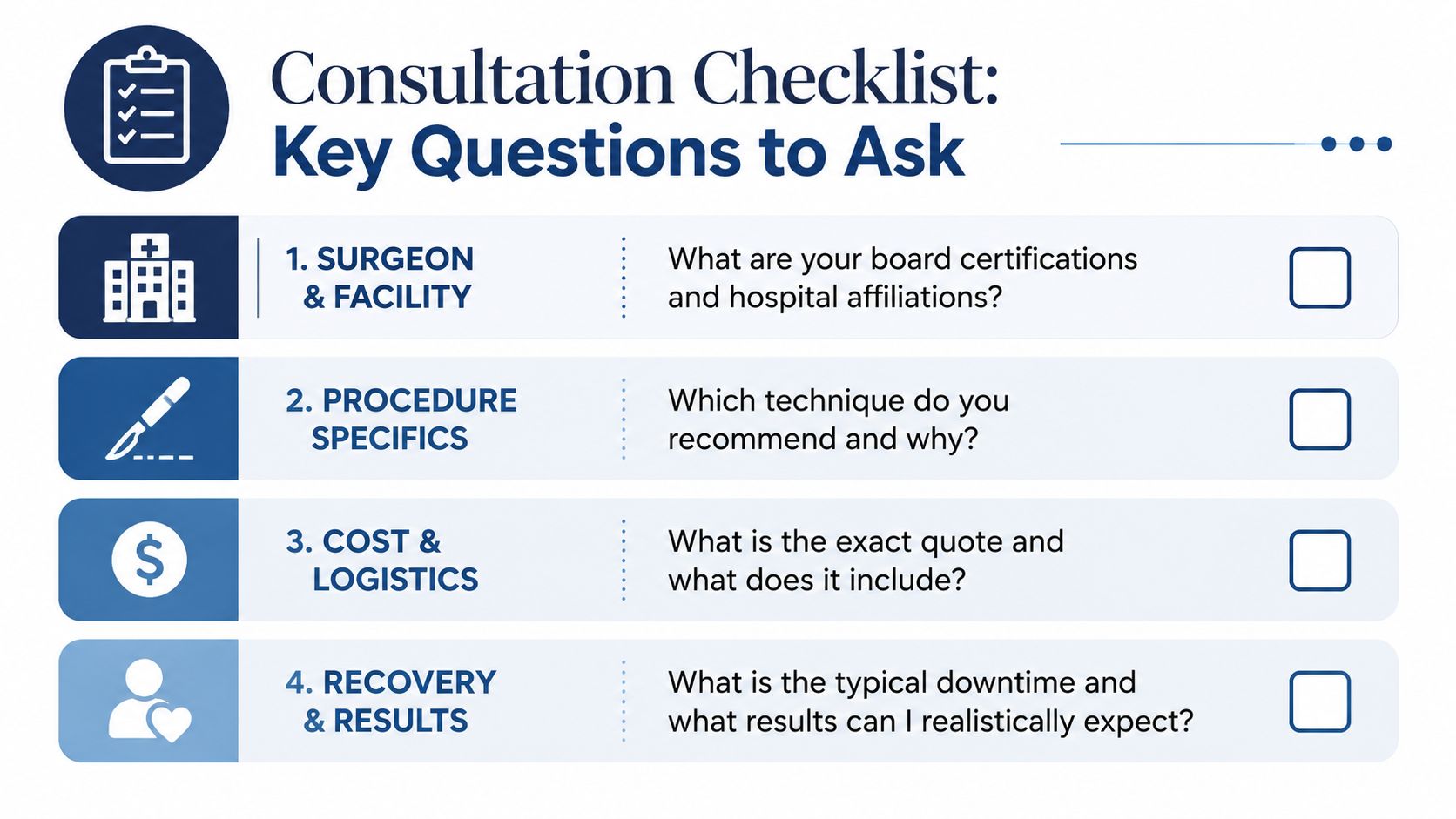
Warning signs include pressure to book immediately, refusal to itemize the quote, a diagnosis made without examining the tissue, and promises that ignore scars or revision risk. Insurance eligibility can also alter the financial picture, so ask what documentation, medical-necessity criteria, and prior authorization steps apply before assuming the entire procedure is self-pay.
Ideal Face & Body provides consultations for male chest contouring, including tissue evaluation, surgical planning, and review of cost factors that affect a gynecomastia quote. Visit Ideal Face & Body to request a consultation, and bring your medical history, insurance information, and written questions.