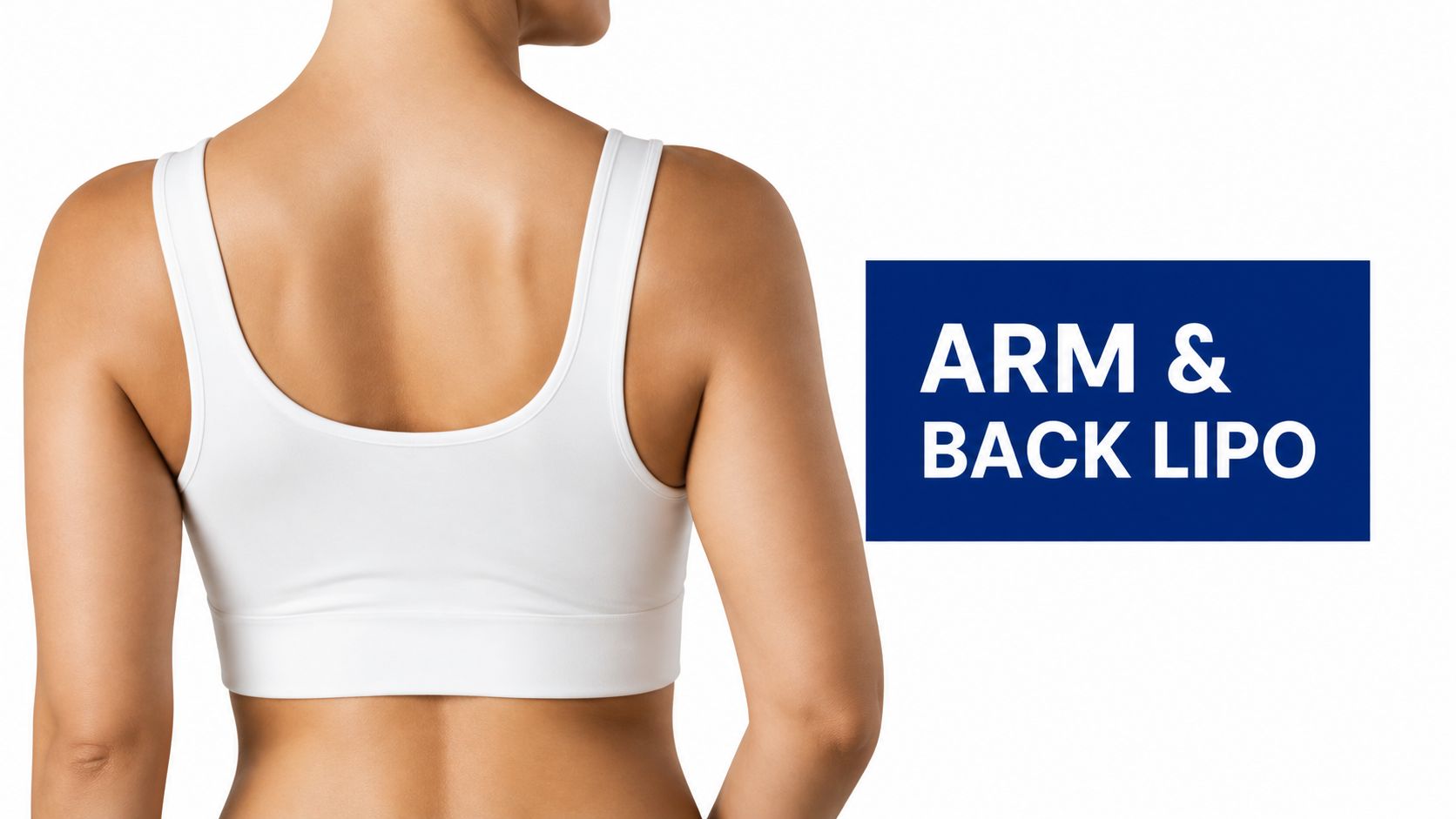
You're standing in front of your closet, holding a sleeveless top you like but don't feel comfortable wearing. The upper arm looks fuller than you'd like, even though you've tried strength training and changed your diet. Or perhaps the problem is the back: a bra-line bulge that appears under fitted clothing, or rolls that become obvious the moment you turn sideways.
That's often when people start searching for arm and back lipo. The search usually comes after months of adjusting sleeves, checking mirrors, and reading conflicting advice about awake procedures, laser energy, skin tightening, and arm lifts. The useful question isn't just whether liposuction can remove fat. It's whether your anatomy, skin quality, health, and expectations make liposuction the right tool.
Table of Contents
- Why Arm and Back Lipo Is on Your Radar
- How the Arms and Back Are Actually Built
- Comparing the Main Lipo Techniques for Arms and Back
- Who Is a Real Candidate and Who Is Not
- What an Awake Laser Lipo Appointment Looks Like
- Recovery Week by Week and When You See the Result
- Real Risks and the Revision Conversation
- Deciding Whether Arm and Back Lipo Is Right for You
Why Arm and Back Lipo Is on Your Radar
A patient may arrive concerned about a small area that changes how every outfit feels. The upper-arm fullness may sit mainly along the triceps, where exercise can strengthen the muscle without removing the layer of fat above it. On the back, the concern may be a fold beneath the bra line or fullness near the posterior armpit that remains despite a stable, healthy routine.
These concerns don't necessarily mean someone is overweight. Genetics, age-related changes, fat distribution, and skin elasticity all affect how the arms and back look. A person can be active and medically healthy while still having pinchable fat in a location that doesn't respond much to diet or exercise. Lifestyle changes remain important for overall health, and anyone trying to reduce body fat can review practical guidance on how to drop body fat percentage sustainably, but lifestyle work and local contouring solve different problems.
The distinction that matters
Liposuction removes localized subcutaneous fat. It doesn't remove every cause of fullness, and it doesn't reliably tighten a large envelope of loose skin. That distinction becomes especially important after major weight loss, pregnancy, or years of reduced skin elasticity.
The history of modern liposuction helps explain why arm and back treatment became feasible. Early attempts to remove subcutaneous fat were followed much later by blunt cannulas, criss-cross suctioning, refined suction-assisted lipoplasty, and tumescent techniques using local anesthesia. These developments made controlled, superficial contouring more reproducible, particularly in areas where aggressive suction can create visible irregularities. The history of modern liposuction and its technical development provides useful context for why technique matters in these smaller, more visible treatment zones.
Why the decision can feel confusing
The arms and back are highly visible, but they don't all respond in the same way. A modest amount of fat with good skin recoil may respond well to liposuction. Thin, stretched skin with little remaining fat may look looser after the fat is removed, even when the suction itself is technically successful.
The best consultation therefore includes an honest examination while you're standing, moving, and sometimes pinching the tissue yourself. The objective is to identify what is fat, what is skin, and what is the natural structure beneath both.
How the Arms and Back Are Actually Built
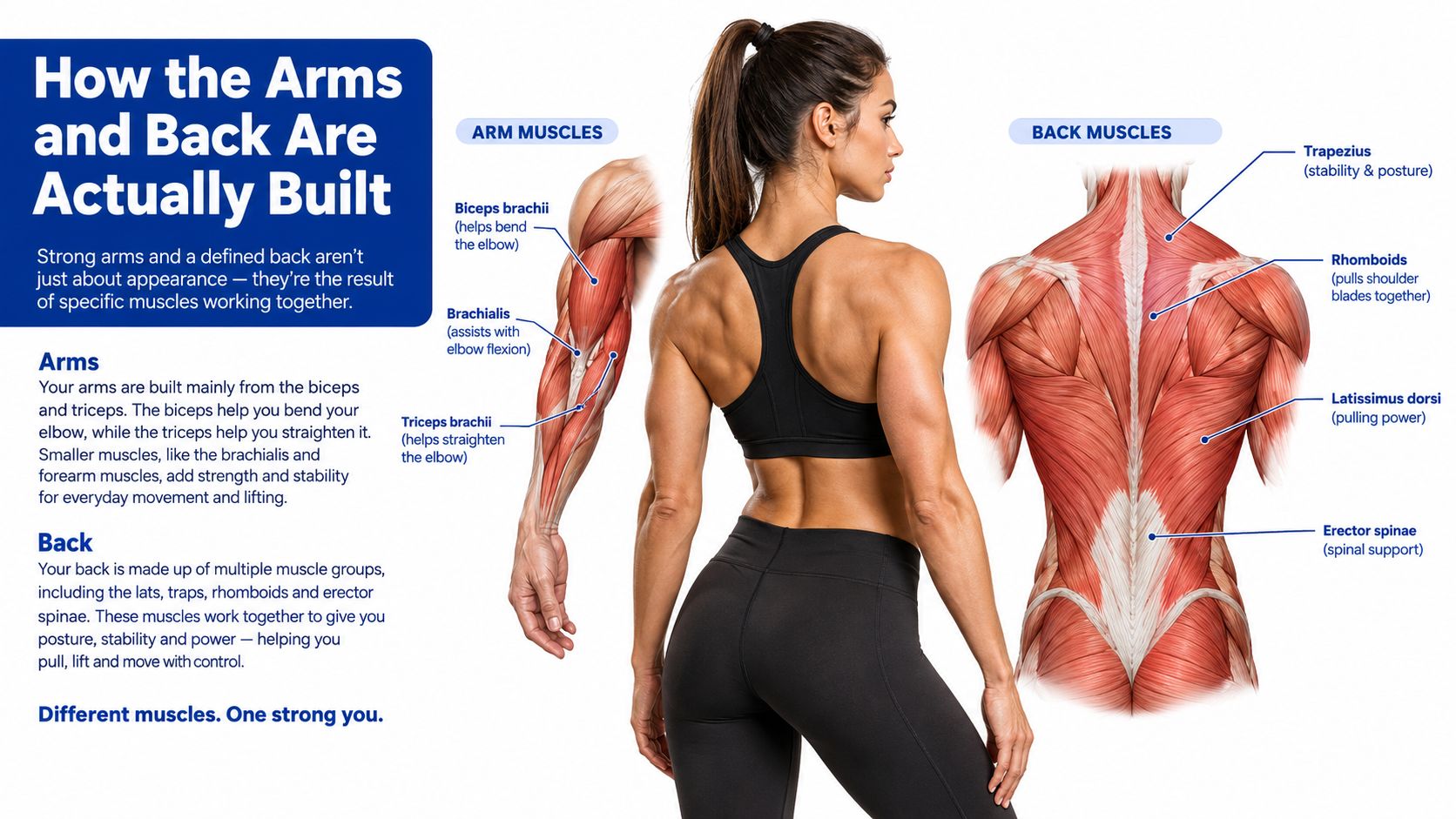
At a consultation, I'd explain the arms and back in layers rather than treating each area as one smooth surface. The upper arm commonly has a subcutaneous fat layer along the triceps region. In some patients, that layer is substantial and soft. In others, particularly after weight loss or with aging, the skin is the dominant issue and there may be relatively little fat to remove.
Think of the arm as a sweater sleeve. Removing excess padding can make the sleeve narrower, but suction won't shorten a stretched sleeve. If the skin has enough elasticity, it can contract around the smaller contour. If it doesn't, the remaining skin may drape or show texture that was previously hidden by volume.
Why the back needs a different plan
The back isn't one deep fat compartment. It includes a relatively even subcutaneous layer with fibrous connections, along with more discrete areas such as the tissue beneath the shoulder blade region and the lower back fat pad. Those areas can form visible rolls, but each may have a different thickness, mobility, and response to suction.
A useful analogy is layered fabric folded across a chair. Removing material from one fold without blending it into the neighboring fold can create a step-off. On the back, a surgeon must create smooth transitions between the posterior axillary fold, bra-line fullness, lateral back, and lumbar flank. The anatomy of liposuction treatment in the hips and back explains why these tissues require even, conservative treatment rather than isolated removal from the most prominent roll.
Back skin also tends to adhere more firmly than abdominal skin. That can help support a smooth result, but it can also limit how much the skin retracts. A body-composition assessment, such as DEXA body composition testing in Liverpool, may help someone understand overall fat and lean-mass distribution, although it can't replace a hands-on examination of skin laxity or pinchable fat.
Practical rule: If the tissue you can pinch is mostly skin, more suction isn't the answer. If it's mostly soft, localized fat beneath reasonably elastic skin, liposuction has a more logical target.
The back also carries a higher risk of visible contour problems when the superficial plane is overtreated. Suction that's too shallow can create waviness or redness, while suction that's too deep risks injuring structures beneath the fat layer. That's why the procedure is closer to surface sculpture than simple fat removal.
Comparing the Main Lipo Techniques for Arms and Back
The right technique depends on the tissue being treated, the amount of fat, skin quality, and how extensive the plan needs to be. Traditional suction-assisted liposuction remains effective for localized fat. It can reduce fullness reliably, but suction alone does not create substantial skin tightening. Energy-assisted methods may add some contraction, while introducing risks that still require careful contour planning.
Laser-assisted liposuction applies thermal energy around the fat layer before suction. The goal is to remove fat while encouraging some contraction of collagen-containing tissue. This can matter in the upper arms when mild laxity, rather than excess skin, limits the expected result. Laser energy cannot replace an arm lift when a large amount of hanging skin needs removal.
Ultrasound-assisted liposuction uses energy to help separate fat before suction and may be useful in more fibrous tissue. Some back areas contain fibrous attachments that make controlled cannula movement important. The device can support fat separation, but it does not correct poor marking, overly aggressive suction, or an incomplete understanding of how the contours connect.
Awake laser approaches, including PRECISION SCULPT, use tumescent local anesthesia, with oral or light intravenous sedation when appropriate. Avoiding general anesthesia can reduce exposure to its risks, but the approach changes candidacy. Treatment must remain within a scope the patient can tolerate while alert, including repositioning and pressure. Extensive treatment, significant medical risk, or limited cooperation may call for a different anesthetic plan or staged treatment.
| Technique | Anesthesia | Skin Tightening | Best For | Key Tradeoff |
|---|---|---|---|---|
| Traditional suction-assisted liposuction | Tumescent local anesthesia, with oral or light IV sedation when needed | Limited tightening from suction alone | Localized fat with relatively good skin recoil | Reliable fat reduction, but loose skin may remain |
| Laser-assisted liposuction | Tumescent local anesthesia, with oral or light IV sedation for selected patients | May encourage some tissue contraction | Fat-dominant arms with mild laxity | Thermal energy adds burn risk and requires controlled movement |
| Ultrasound-assisted liposuction | Local anesthesia for limited areas, sedation or general anesthesia for extensive treatment | Not primarily a skin-tightening method | Fibrous areas, including selected back contours | Energy may assist fat separation, but operator judgment still determines the contour |
| Awake laser liposuction | Tumescent local anesthesia, with oral or light IV sedation when appropriate | May provide fat removal with some contraction | Carefully selected, alert adults seeking office-based treatment | Avoids general anesthesia exposure, but limits treatment scope and requires cooperation |
The practical steps are described in how laser liposuction is done. No device guarantees a smooth result. On the back, the outcome depends on accurate markings, controlled cannula depth, symmetry, and restraint as much as on the energy source. The safest choice is the technique that matches the tissue and the treatment the patient can reasonably tolerate.
Who Is a Real Candidate and Who Is Not
A good candidate has a localized, pinchable fat layer, generally stable weight, acceptable medical risk, and skin that can tolerate some reduction in volume. BMI may be part of the conversation, but it isn't a stand-alone approval test. The more useful questions are whether the area is fat-dominant, whether weight has been reasonably stable, and whether the patient expects refinement rather than weight loss.
Weight stability matters because substantial future weight change can alter the contour again. It also helps the surgeon distinguish a persistent local deposit from a broader body-composition issue. A patient doesn't need a perfect body or a particular number to be considered, but treatment planning is more predictable when weight has remained steady over time.
When skin quality changes the answer
Skin is often the deciding factor on the upper arm. Stretch-marked skin, significant laxity after weight loss, thin tissue, or a visible hanging fold may not respond well to liposuction alone. Removing the underlying fat can make the loose skin more apparent.
In that situation, a brachioplasty, or arm lift, may be the more direct surgical answer because it removes excess skin. The tradeoff is a longer scar. That isn't a failure of liposuction. It's a recognition that skin and fat are separate problems requiring different tools.
The same principle applies to the back. A back lift or excisional procedure may be considered when the main concern is a large, lax skin envelope rather than a discrete fat roll. Smaller areas of residual laxity may be addressed with tightening technology in selected patients, but tightening has limits and can't replicate skin excision.
Reasons to pause or change the plan
Liposuction can underdeliver when:
- The fullness is deep: Intra-abdominal fat and fat beneath strong muscle layers aren't reachable through superficial liposuction.
- The skin is very loose: Suction removes volume but doesn't remove a redundant skin envelope.
- Scars cross the treatment area: Prior surgery may alter tissue planes and affect cannula movement.
- Expectations come from filtered images: Digital images don't show texture, posture, lighting changes, or the healing process.
- Medical risks aren't controlled: Bleeding tendencies, active smoking, unmanaged medical conditions, or an inability to follow aftercare can make elective treatment unsafe.
The consultation should end with a clear recommendation, even if that recommendation is to wait, lose additional weight, choose skin excision, or do nothing. A surgeon who can explain why liposuction won't solve your primary concern is giving you more useful information than one who promises that every issue can be treated with a cannula.
What an Awake Laser Lipo Appointment Looks Like
Awake treatment doesn't mean you're expected to tolerate surgery without comfort measures. It means you remain breathing independently and responsive while the treatment area is numbed with local anesthesia. Local anesthesia with a sedative is an accepted option for adult liposuction, and hospital guidance describes it alongside other anesthesia choices for appropriate patients (local anesthesia and sedation for liposuction).
Marking comes before medication
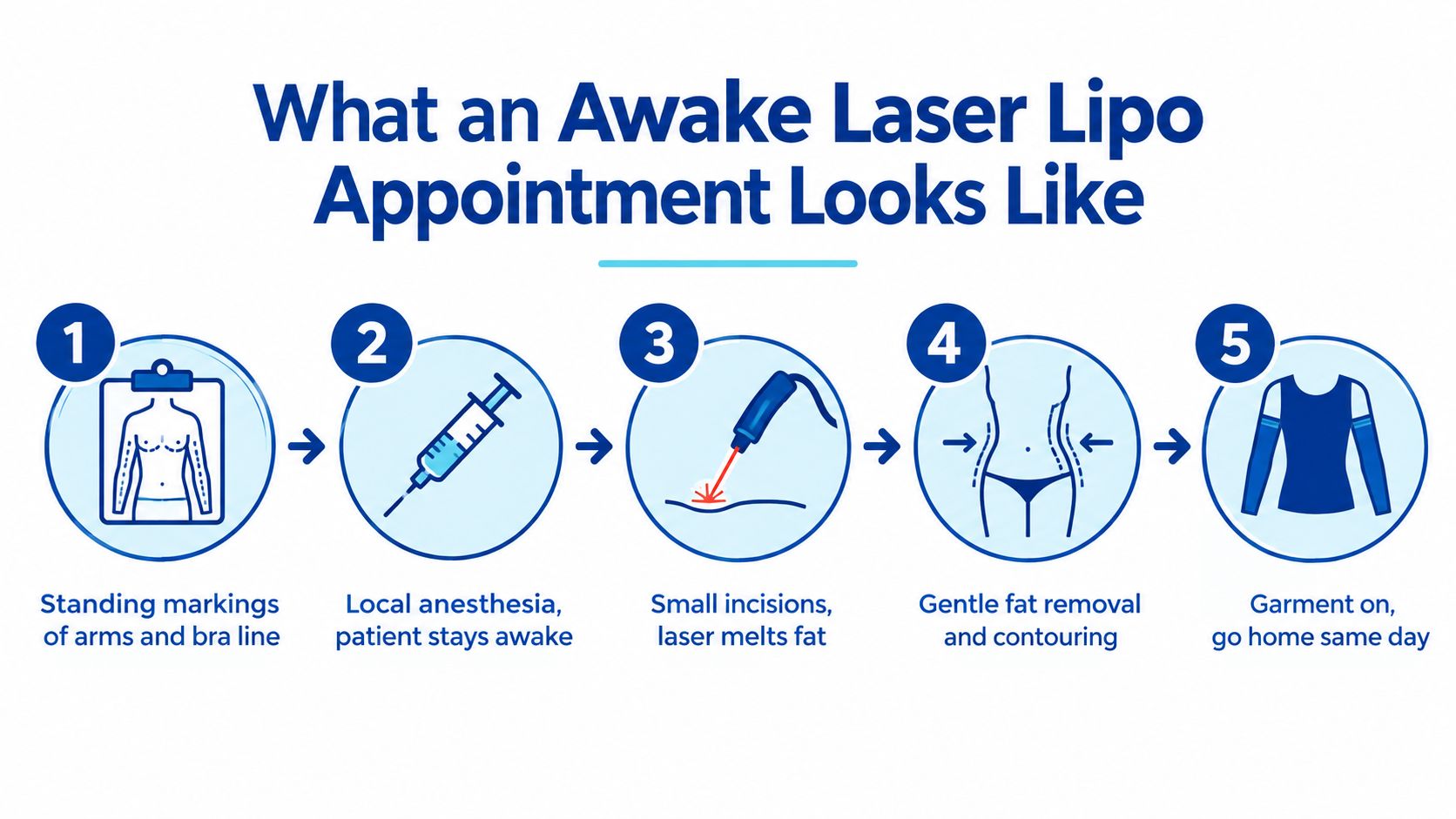
The appointment begins with standing markings. The arms and back change shape when you lie down. The surgeon maps the upper arm, posterior axillary fold, bra line, and back rolls while gravity shows the actual distribution of fullness.
The markings aren't decorative. They identify where fat is concentrated, where transitions should remain soft, and where suction must be conservative. You may be asked to turn, lift your arms, or relax them at your sides so the plan reflects movement rather than one posed photograph.
Tumescent fluid is then placed into the tissue. Patients usually feel pressure, coolness, and a series of small injections before the area becomes numb. As the anesthetic takes effect, sharp sensation should decrease substantially, although pressure and movement remain noticeable.
What you hear and feel
During laser-assisted treatment, you may hear a low mechanical hum. Suction creates additional sound, and the cannula can produce occasional clicks or changes in pitch as it moves through different tissue planes. You should feel pressure, pulling, and repositioning, not sharp pain. If you do feel sharp pain, you should say so immediately rather than trying to endure it.
The team monitors vital signs and your level of comfort throughout the appointment. Depending on the plan, relaxation may involve an oral medication or light intravenous medication. Tumescent lidocaine must remain within documented safety limits, and the dose is calculated rather than guessed. Awake care still requires a proper medical environment, emergency readiness, trained staff, and an appropriate plan for converting or stopping treatment if your response changes.
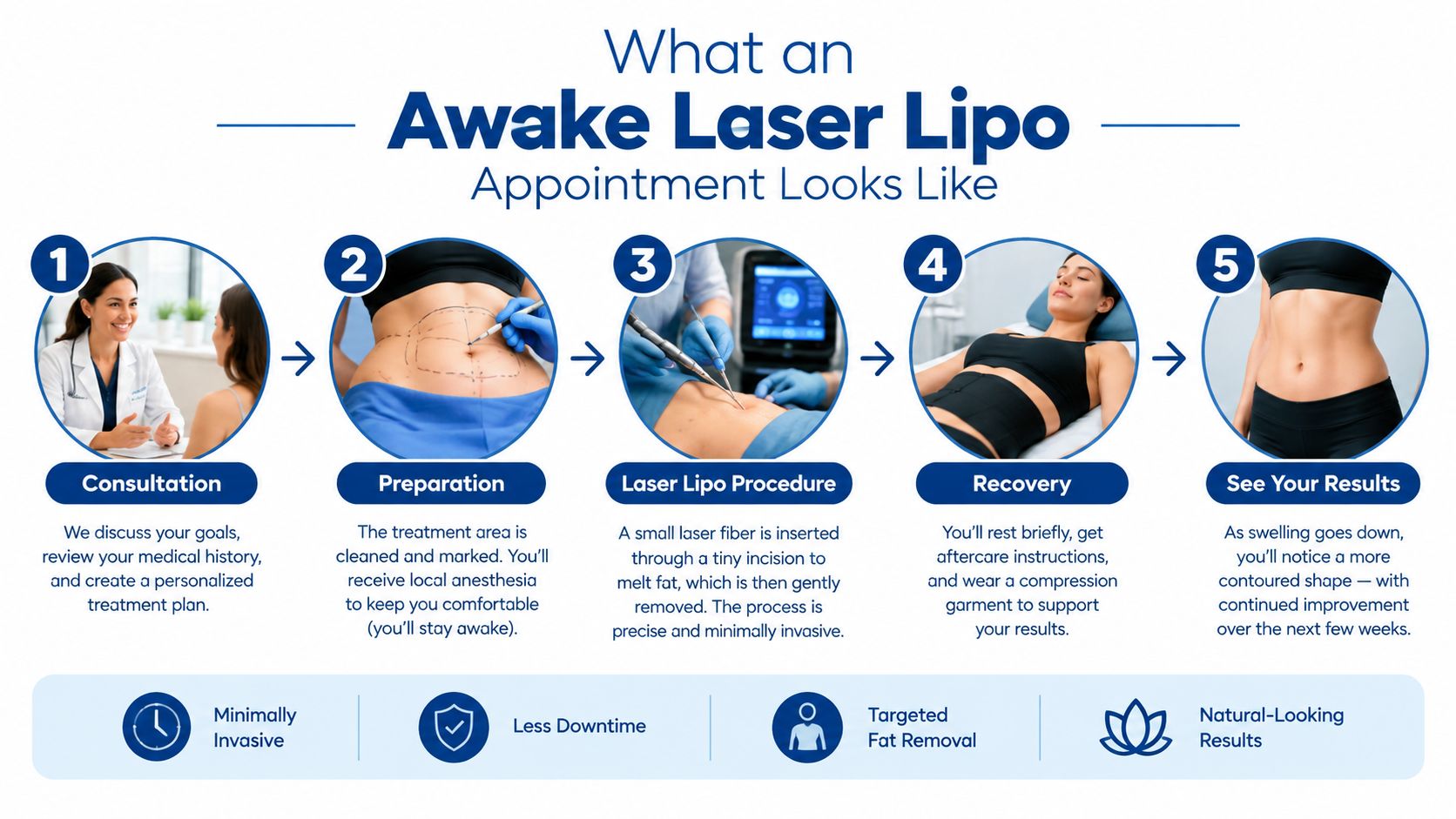
The surgeon may reposition you during arm and back lipo. That's normal. Treating the back evenly often requires access from more than one direction, and changing position helps maintain control of depth and symmetry. A typical awake appointment is planned around the treatment area and patient tolerance rather than a universal clock. You can read more about the patient experience in awake lipo treatment, but candidacy remains the safety issue, not convenience alone.
Recovery Week by Week and When You See the Result
Recovery is easier when you plan around swelling rather than assuming the first visible change is the final contour. The arms often need prolonged external compression. A professional society summary notes that compression garments are typically worn for at least six weeks after upper-arm liposuction, sometimes longer, and that the visible result can take three to six months to settle as edema and fibrosis resolve (upper-arm liposuction recovery guidance).
The early phase
In the first several days, expect soreness, swelling, drainage from small entry points, and a strong dependence on the garment. Short walks are usually encouraged, while lifting, pushing, pulling, and repetitive arm activity are restricted. Keep dressings and compression exactly as instructed, and don't interpret early fullness as proof that fat remains.
During the remainder of the first week, bruising may change color and swelling can appear uneven. Desk work may be possible for some patients once they're comfortable, but the back can remain stiff and turning may be awkward. The right activity level depends on the extent of treatment and your surgeon's instructions.
The following weeks
As the tissues settle, light cardiovascular activity may return before resistance training. Lymphatic massage can be an adjunct for selected patients, but it shouldn't replace compression, follow-up, or evaluation of abnormal swelling. Numbness, tingling, firmness, and areas that feel temporarily lumpy can occur during healing.
The garment schedule may gradually reduce as your surgeon sees improvement. Don't assume that removing it early will speed recovery. The upper arm is sensitive to fluid accumulation, and early heavy lifting can worsen edema or contribute to uncomfortable scar tethering.
| Timeframe | Garment | Swelling and Sensation | Activity Allowed |
|---|---|---|---|
| Early recovery | Frequently worn as directed, often continuously | Soreness, drainage, bruising, swelling, and numbness are common | Short walks and essential movement |
| First healing phase | Continued use according to the treatment plan | Bruising evolves, swelling may look uneven, firmness develops | Desk work and gentle daily activity when cleared |
| Intermediate healing | Gradual reduction only with approval | Tingling, altered sensation, and residual swelling may persist | Light cardio before heavier exercise |
| Later healing | Continued support if swelling remains | Contour becomes more apparent as edema and fibrosis resolve | Progressive return to exercise after clearance |
| Three to six months | Usually based on individual healing needs | Final contour becomes easier to judge | Normal activity if fully healed and cleared |
Most patients can return to work within a few days after upper-arm liposuction, according to the professional guidance cited above, but that doesn't mean the arms are ready for heavy use. The awake liposuction recovery process should be planned around your actual job, caregiving responsibilities, exercise habits, and willingness to wear compression.
Real Risks and the Revision Conversation
Arm and back liposuction is less invasive than an excisional lift, but it remains a real operation. A published clinical review of liposuction complications reports overall complication rates around 2.4%, with lower rates when liposuction is performed alone rather than combined with other procedures.
That figure does not predict your personal risk, and complications do not all carry the same significance. A small treatment area still requires careful planning, realistic limits, and appropriate monitoring. Awake, local-anesthesia treatment may suit selected patients, but it does not remove the risks of tissue injury, fluid collection, infection, or contour problems. It also requires stopping or modifying the plan if discomfort, bleeding, or treatment conditions make continued work unsafe.
Problems patients should understand
Contour irregularity can appear as dimpling, waves, depressions, or asymmetry along the posterior arm or bra line. The risk increases when too much fat is removed from the superficial plane, when the treated area is not blended into its edges, or when the surgeon tries to correct a small fullness while swelling is still active.
Back tissue can develop a seroma, a collection of fluid in the space created during treatment. Persistent swelling may conceal the eventual shape for months. Infection, hematoma, altered sensation, and skin discoloration are recognized liposuction complications. The Mayo Clinic overview of liposuction risks also covers contour irregularity, fluid collections, numbness, infection, and rare serious complications.
Laser-assisted treatment adds a thermal risk. Excessive energy, poor temperature control, or keeping the fiber in one place too long can cause burns or other tissue injury. Laser energy may support tissue treatment, but it does not make aggressive fat removal safer.
When revision becomes reasonable
Some irregularities improve as swelling settles and scar tissue softens. Revision usually makes more sense after the tissues mature and the problem becomes stable, unless an urgent complication requires earlier treatment.
A touch-up may involve limited suction, fat grafting, scar treatment, or skin excision, depending on the cause. Revision does not automatically mean the first procedure was careless. Uneven healing, under-retraction, pre-existing asymmetry, or lax skin treated without excision can all contribute.
A responsible consultation includes the possibility of revision before you consent to the first operation.
Garment compliance, follow-up attendance, smoking status, skin quality, and surgical restraint all affect the result. No technique removes every variable.
Deciding Whether Arm and Back Lipo Is Right for You
The decision should start with a pinch test and a skin assessment, not a treatment name. If the primary concern is soft, localized fat beneath skin that still retracts reasonably well, arm and back lipo may provide meaningful refinement. If the main issue is hanging skin, stretch-marked laxity, or a large post-weight-loss envelope, skin excision may make more sense.
A stable weight for a sustained period improves planning, but the exact target should be individualized rather than reduced to a universal BMI rule. You should also accept that scarless tightening has limits. Back rolls often respond more predictably when they're fat-dominant, while the upper arm near the shoulder can be less forgiving because thinner skin may reveal residual laxity.
Questions to bring to the consultation
- What am I feeling? Ask the surgeon to distinguish fat, skin, muscle, and deeper tissue.
- What will liposuction not fix? Request a direct explanation of residual laxity, texture, and asymmetry.
- Which technique fits my tissue? Ask why suction-assisted, laser-assisted, ultrasound-assisted, or an excisional approach is being considered.
- What does awake treatment change? Discuss candidacy, monitoring, sedation, treatment limits, and what happens if you become uncomfortable.
- What recovery can I realistically manage? Cover compression, work, caregiving, driving, exercise, and follow-up.
- How are revisions handled? Ask when a concern can be evaluated and what options exist if the skin doesn't retract or an irregularity persists.
- Can I see comparable cases? Look for arms and backs with similar skin quality, fat distribution, and body proportions, not only idealized images.
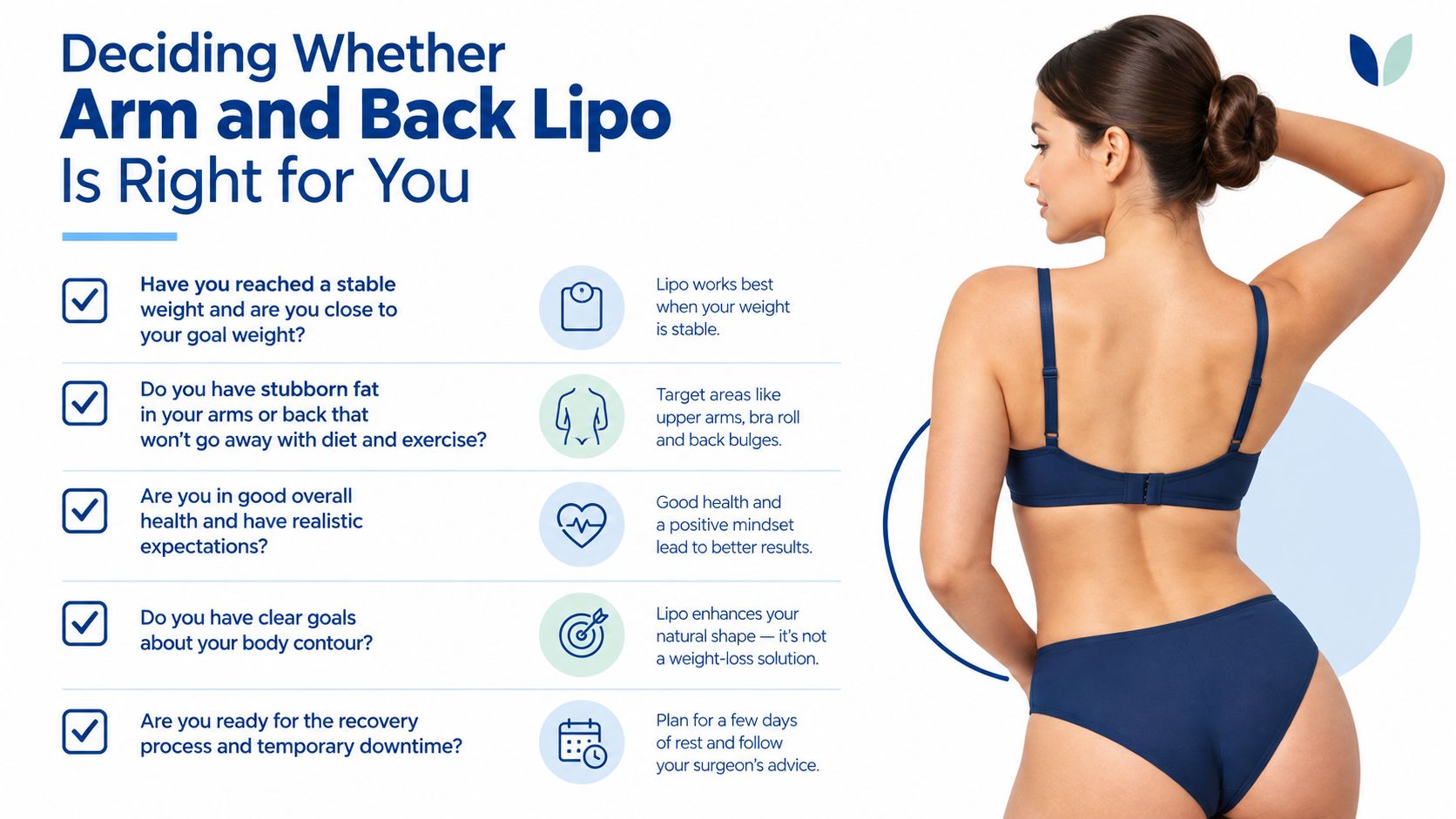
Arm and back lipo delivers when the problem is primarily localized fat and the patient understands what the skin can and can't do afterward. The safest choice may be liposuction, skin tightening, excision, staged treatment, or no procedure at all. A careful consultation should make that distinction clearer, not pressure you toward a particular operation.
Ideal Face & Body offers awake, office-based body contouring under local anesthesia, including arm and back treatment planning with techniques such as PRECISION SCULPT when appropriate. Visit Ideal Face & Body to request a consultation focused on your candidacy, skin quality, anesthesia options, and realistic recovery.