You may have liked your Brazilian Butt Lift for the first year, then noticed that the result settled into something that no longer feels like you. The buttocks may look too round from the side, feel heavy in clothing, or appear uneven when you stand naturally. That doesn't mean you made a wrong decision. Bodies change, aesthetic preferences change, and a result that once felt exciting can later feel excessive.
BBR, or BBL reduction, is the conversation about reversing, refining, or softening a previous buttock augmentation. It's more nuanced than “removing fat.” The safest plan depends on where the original fat was placed, how much remains, the condition of the skin, and whether your concern is volume, projection, width, asymmetry, or surface irregularity.
Table of Contents
- What BBR and BBL Reduction Actually Mean
- How BBL Safety Has Changed Over Time
- Reduction Techniques Surgeons Use Today
- Why Awake and Office-Based Options Matter
- Who Is a Good Candidate for Reduction
- What Recovery Looks Like After BBL Reduction
- When a Second Revision Becomes Necessary
- Consulting a Beverly Hills Specialist for BBR
What BBR and BBL Reduction Actually Mean
A patient might say, “I want my BBL taken out,” but that phrase can describe several different goals. BBR, short for buttock BBL reduction, is an umbrella term for procedures that decrease buttock volume, projection, or contour after a prior BBL or buttock augmentation. It isn't one standardized operation, and different practices may use the term differently.
The first distinction is volume reduction. This means removing some of the fat transferred during a BBL, usually through liposuction, or removing an implant if the augmentation used implants. The aim is a smaller overall buttock, but the surgeon must still preserve enough tissue to avoid a hollow or deflated appearance.
The second is contour reduction. Here, the problem may be lumps, firm nodules, depressions, a shelf-like transition, or uneven fullness. The total volume may not be dramatically excessive. Instead, the surgeon reshapes selected areas so the buttocks blend more naturally into the waist, thighs, and lower back.
The third is shape reduction. Some patients want less side-to-side width or less backward projection without losing much total volume. A surgeon might reduce fullness in carefully chosen zones while preserving the central curve that gives the body balance.
Reduction doesn't always mean total reversal
Many patients don't want to erase the BBL. They want a quieter result that fits their current proportions. That may involve selective debulking, smoothing, or reducing the outer contour rather than removing every grafted area.
A helpful starting point is to review what a primary BBL involves through this guide to what BBL surgery means. For a reduction consultation, bring photographs from before the original procedure, your operative report if available, and clear examples of what feels excessive now.
Practical rule: Describe the shape you want to live with, not only the tissue you want removed.
How BBL Safety Has Changed Over Time
A patient seeking BBR may assume that removing fat is automatically safer than placing it. The same anatomy that made the original procedure risky still matters during revision. The plane of injection matters more than the label of the procedure, because fat entering or injuring deeper structures can cause pulmonary fat embolism, allowing fat to travel toward the heart or lungs.
A 2023 review reported 25 pulmonary fat embolism fatalities in the United States over a 5-year, 9-month period from 2011 to 2016, with an estimated mortality rate of 1 in 4,000. Earlier commentary cited a worldwide estimate near 1 in 3,000, while a 2018 multisociety advisory described BBL as having the highest estimated death rate among aesthetic procedures, approximately 1 in 3,000. These figures explain why BBL became a major patient-safety focus, as detailed in The review in Aesthetic Surgery Journal.
The safety concern became more specific as investigators examined where fat was found. An ASERF task force reported that all reviewed fatalities were associated with fat found in the gluteal muscle at autopsy, while no deaths were linked to fat placed only in the subcutaneous plane. One estimate based on United States cases from 2011 through 2016 placed annual mortality at 1 in 3,448. A later survey estimated 1 in 14,921 in 2019, lower than reported abdominoplasty mortality estimates of approximately 1 in 13,147 to 1 in 13,193. The Aesthetic Surgery Education and Research Foundation safety review summarizes these findings.
The documented safety arc
| Period | Estimated mortality | Dominant technique | Source |
|---|---|---|---|
| 2011 to 2016 | 1 in 3,448 | Technique varied, with fatal cases associated with intramuscular fat | ASERF task force summary |
| 2017 to 2018 warnings | Approximately 1 in 3,000 | Deep-plane injection remained the central concern | 2018 multisociety advisory |
| 2019 | 1 in 14,921 | Safer subcutaneous-only technique and stricter guidance | Expert safety review |
BBR planning must account for the original injection plane. Fat remaining in the subcutaneous tissue is generally more accessible than fat placed within the gluteal muscle. Scar tissue, altered anatomy, and incomplete operative records can make that distinction difficult to assess.
The practical rule is direct: the plane of injection influences the plane of removal. For a subcutaneous-only reduction, the surgeon should keep continuous three-dimensional awareness of the cannula tip and avoid deep-plane work. If grafting is part of a revision, motion-only injection and current safety protocols remain relevant. Patients considering anesthesia choices can also review this guide to why awake surgery became a preferred method in some plastic-surgery settings.
Long-term data specific to BBR remains limited. Your surgeon should separate established safety principles from decisions that depend on tissue quality, scar patterns, and the original operation.
Reduction Techniques Surgeons Use Today
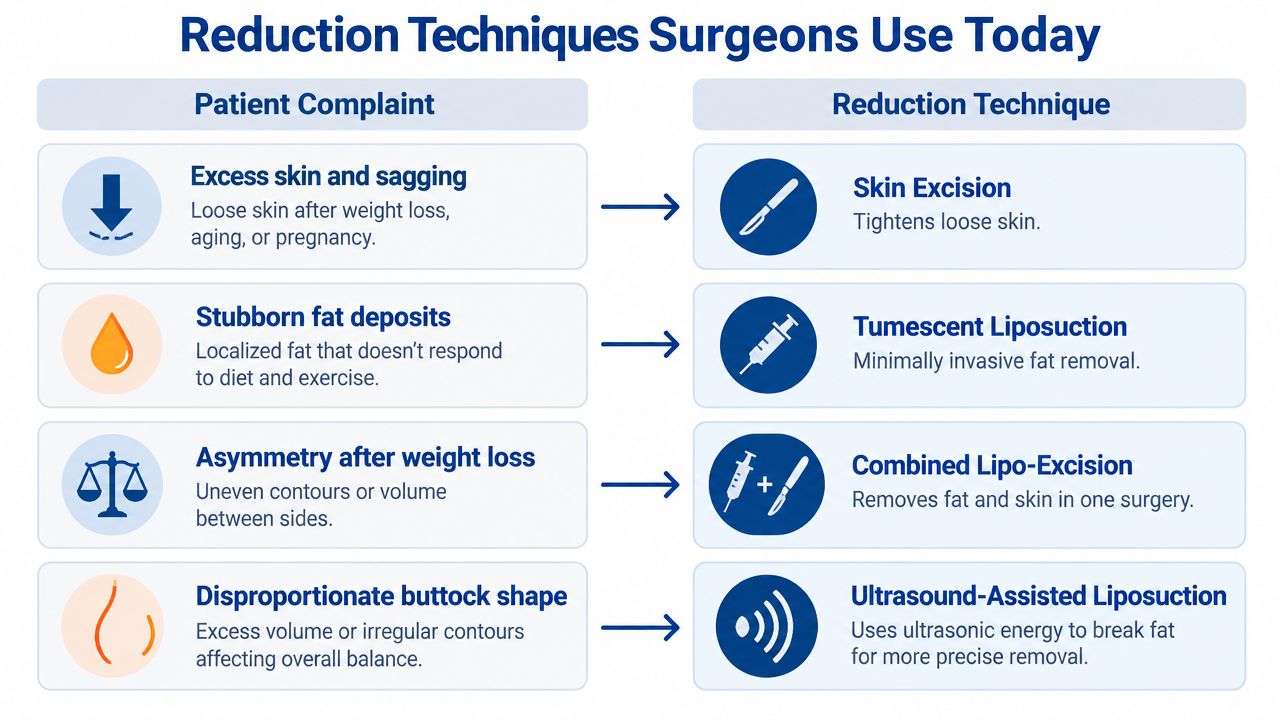
The right technique depends on the complaint. Someone who feels generally overfilled may need a different operation from someone with firm nodules, loose skin, or a narrow depression left by uneven healing.
Tumescent or power-assisted liposuction is often considered when excess grafted fat remains soft and accessible in the subcutaneous plane. Small access incisions may be placed in existing scars or discreet creases. A cannula removes selected fat while the surgeon protects the surrounding contour. This can reduce volume and projection, but it won't reliably tighten significant loose skin or correct a deep defect by itself.
Ultrasound-assisted liposuction may help when previous surgery has left fibrotic planes. Scar tissue can make standard cannula passage less predictable. Energy-assisted techniques may help separate fat in selected cases, but they don't eliminate the need for careful plane control, conservative removal, and an experienced assessment of tissue quality.
When removal requires a different plan
Direct surgical excision is more invasive and may be appropriate for an implant, substantial excess skin, or firm encapsulated nodules that suction can't adequately address. The incision may be longer, and the operation can involve managing skin tension as well as volume. If an implant is present, implant removal follows a separate pathway. Capsule management can influence future revision options and must be discussed before surgery.
Staged re-contouring is useful when removing all desired volume in one operation could create an uneven or deflated result. The first stage may reduce the dominant areas, allow swelling and skin response to settle, and then address remaining asymmetry later. In selected cases, a small targeted fat graft may be used to soften a depression, but any grafting must remain strictly subcutaneous.
A 2026 systematic review and meta-analysis of 22,151 patients reported pooled minor complications of 3.58%, seroma of 2.03%, contour irregularities of 2.29%, and pulmonary embolism of 0.04%. Ultrasound guidance was associated with fewer major complications, 0.02% compared with 0.08%, and fewer minor complications, 2.82% compared with 3.70%, than non-guided techniques, according to the published systematic review and meta-analysis.
Those figures aren't a guarantee for revision patients. They support a planning principle: conservative removal, subcutaneous-only management, and imaging guidance can be especially important when the buttocks have already been operated on. A discussion of revision liposuction may also help you understand how scarred tissue changes the approach, as described in revision liposuction guidance.
Why Awake and Office-Based Options Matter
An awake BBL reduction uses tumescent local anesthesia in an appropriately equipped office-based operating room. The patient remains responsive rather than receiving general anesthesia or intravenous sedation. That can allow the surgeon to mark the body while the patient stands, reposition the patient during contour checks, and receive real-time feedback about symmetry and pressure points.
The process usually begins with standing photographs and markings. The patient then lies prone while the surgeon numbs the treatment area through small access points. Fat is removed from the superficial plane, and the surgeon can reassess the outline as the patient changes position. That feedback is useful when the complaint is localized excess or a visible side-to-side difference.
Who may fit an awake approach
Awake reduction may suit a patient with:
- Localized superficial fat: The target should be accessible above the muscle and not dominated by an implant or deep scar.
- Reasonable skin retraction: Skin that can contract after volume reduction gives the surgeon more predictable contour control.
- Appropriate health status: Candidates require an individualized medical assessment, including anesthesia risk and overall health.
- Comfort with awareness: A patient who feels highly anxious about hearing or sensing the procedure may prefer a different setting.
An office-based approach isn't automatically safer because it happens in an office. Safety depends on surgeon training, facility standards, emergency preparation, monitoring, and the ability to manage complications. The setting should have appropriate resuscitation capability, including ACLS readiness, and the surgeon should explain when a hospital or operating-room plan is more appropriate.
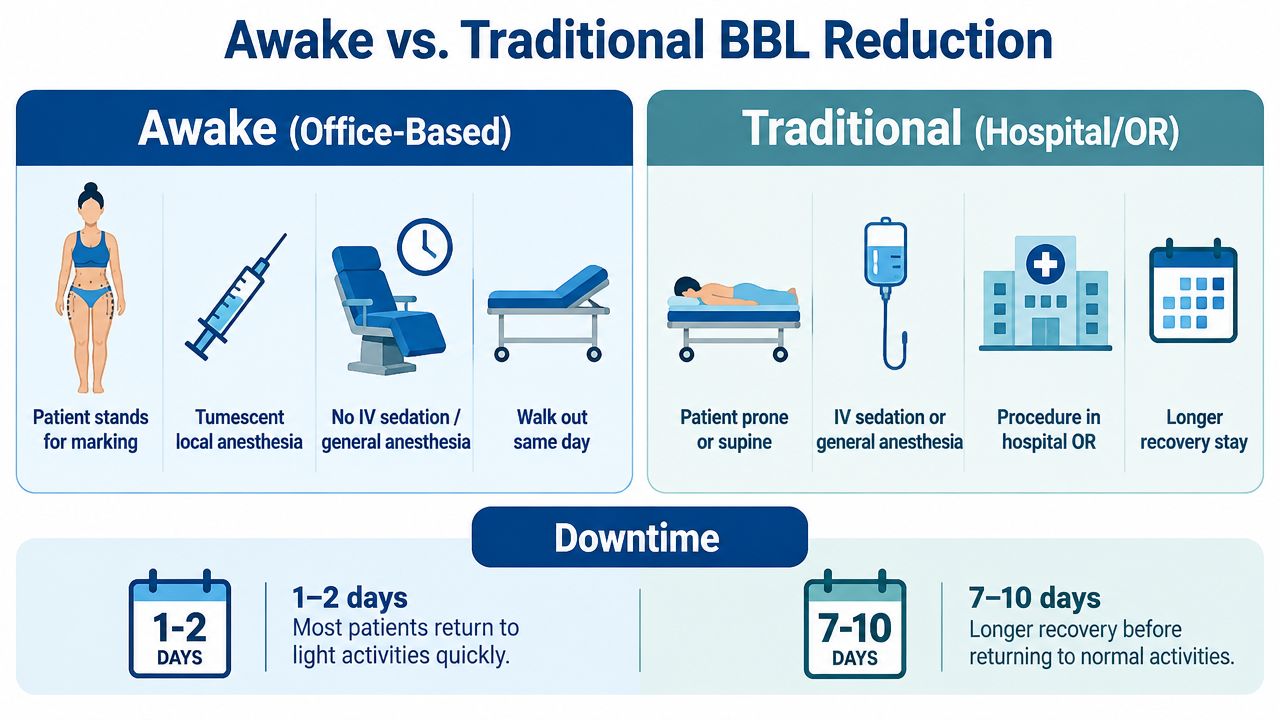
Awake protocols such as PRECISION SCULPT fit a narrow but meaningful revision niche. They may not be suitable for implant removal, large-volume excision, severe laxity, extensive deep scarring, or someone who can't tolerate procedural awareness. Ask what happens if the planned awake procedure reveals a deeper problem, and whether the surgeon would stop, stage the correction, or move the operation to another setting.
Who Is a Good Candidate for Reduction
A strong candidate usually has a clear mismatch between the current buttock shape and the result they want. The goal might be less projection, a narrower outer contour, removal of a persistent lump, or improved balance between the buttocks and the rest of the body.
Weight stability matters because ongoing weight change can alter both retained grafted fat and the surrounding tissues. Your surgeon should also discuss whether the skin is likely to retract after debulking. Removing volume from a stretched skin envelope can reveal laxity that wasn't obvious when the buttocks were fuller.
What the surgeon needs to know
Bring the original operative report if you can obtain it. It may show whether the fat was intended for the subcutaneous plane or whether older techniques were used. A physical examination then evaluates palpable nodules, dimpling, asymmetry, skin quality, and the thickness of the tissue that can be safely pinched above the muscle.
Imaging is selective, not automatic. It may be considered when the history or examination raises concern about deeper placement, unusual firmness, or anatomy that can't be assessed confidently from the surface. The important question isn't whether imaging sounds advanced. It's whether it changes the surgeon's understanding of the safe treatment plane.
Patients with buttock implants, active smoking, uncontrolled metabolic disease, or active skin infection may need to postpone surgery or pursue a different plan. A consultation should also identify whether reduction alone is realistic or whether a lift, skin excision, or staged correction may be needed.
| Factor | Favorable finding | Caution flag |
|---|---|---|
| Aesthetic goal | Specific request for less volume, projection, width, or irregularity | Vague expectation of complete erasure without skin consequences |
| Prior records | Operative report identifies the grafting method and treatment areas | No records, uncertain injection plane, or suspected deep placement |
| Skin quality | Adequate elasticity and limited laxity | Loose skin likely to sag after debulking |
| Tissue examination | Soft, accessible subcutaneous fat | Firm nodules, extensive fibrosis, or deep tenderness |
| Medical status | Stable health and appropriate anesthesia assessment | Active smoking, uncontrolled disease, or infection |
| Planning | Willingness to consider staged correction | Expectation of a single operation regardless of anatomy |
A realistic plan should identify the zones to treat, the expected amount of tissue to remove on each side, the possibility of residual asymmetry, and whether a staged lift could become necessary. The surgeon shouldn't promise identical sides because human anatomy and healing are never perfectly symmetrical.
What Recovery Looks Like After BBL Reduction
Recovery depends on whether the procedure involves limited liposuction, extensive excision, implant removal, or staged correction. An awake patient may walk out the same day, while a more involved operation can require a longer period of observation and a more restrictive activity plan.
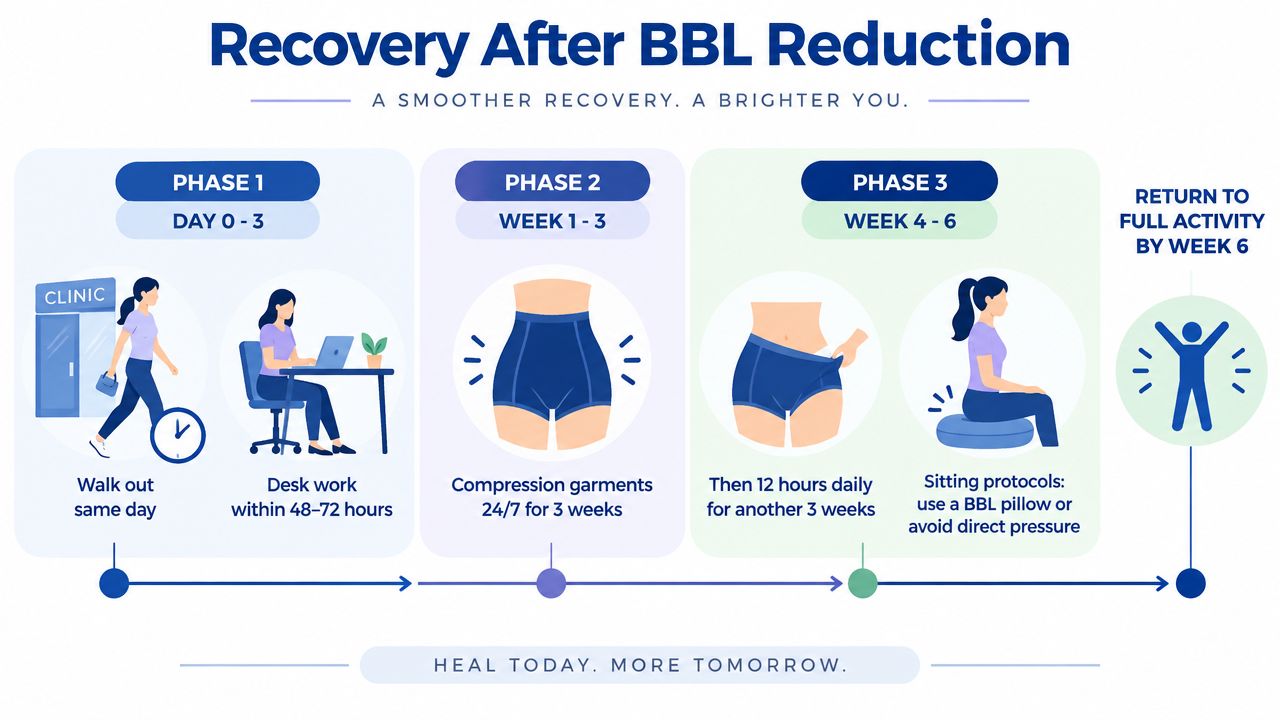
The first days focus on protecting access sites and controlling swelling. Drainage from small port sites commonly decreases quickly, but your surgeon's instructions should take priority over a generic timeline. Desk work may be possible within 48 to 72 hours for selected awake patients, but discomfort, bruising, and the physical demands of your job still matter.
A practical healing sequence
- Early period: Walk gently, protect the treated areas, and follow the sitting instructions you were given. Some surgeons permit a donut cushion, while others restrict direct pressure for a period after surgery.
- Compression phase: A common plan is continuous compression for three weeks, followed by 12 hours daily for another three weeks. The exact garment and schedule depend on the operation and the surgeon's assessment.
- Visible settling: Bruising often becomes less noticeable by about the second week. Swelling can continue to recede through approximately the sixth week, while the final contour may keep settling toward the fourth month.
- Activity progression: Lymphatic massage may begin around the seventh day when approved. Strenuous lower-body exercise is often delayed until approximately six weeks, with clearance based on healing rather than the calendar alone.
- Final assessment: Standardized comparison photographs may be taken around six months, when the tissues have had more time to stabilize.
Call the office for a fever above 101.5°F, expanding bruising, sudden asymmetric swelling, calf pain, or a new fluid collection. Shortness of breath, chest pain, fainting, or severe sudden symptoms require urgent medical attention rather than waiting for a routine appointment.
When a Second Revision Becomes Necessary
A second revision isn't automatically a sign that the first correction failed. Revision surgery changes tissue that has already healed, and surgeons sometimes need to work in stages to protect the contour and the skin envelope. A patient may return because asymmetry remains after healing, a liposuction plane created a visible depression, or the skin became looser after volume was removed.
The most useful assessment happens after swelling has had time to resolve. A surgeon may compare standardized photographs, repeat the pinch test, feel for firm areas, and inspect the waist-to-hip transition while you stand and move naturally. Treating too early can mistake temporary swelling for a permanent contour problem.
Common reasons for another correction
The available revision literature identifies dissatisfaction related to residual adiposity at 10%, skin laxity at 6%, and persistent asymmetry at 4%, with a reported complication rate of 1% in the reviewed reversal and reduction literature. These figures come from a 2025 review of BBL reversal and buttock reduction, which also reported high satisfaction, but the authors emphasized that revision-specific evidence remains limited. See the review of Brazilian buttock lift reversal for the published findings.
Those categories help explain why a second procedure may be discussed, but they shouldn't be turned into a personal prediction. Your own risk changes with the original grafting plane, scar tissue, skin elasticity, weight changes, and the amount removed during the first correction.
A staged plan may intentionally under-correct the first time. After several months, the surgeon can decide whether a small additional reduction, skin procedure, or carefully targeted subcutaneous fat graft is appropriate. Return for evaluation if you notice persistent firmness, a visible step-off at the waist-to-hip transition, a depression, or buttock drooping that exceeds what was present before surgery.
Consulting a Beverly Hills Specialist for BBR
A consultation for BBR should feel like an anatomical assessment, not a promise to make the buttocks as small as possible. In Beverly Hills, CA, Ideal Face & Body evaluates awake gluteal contouring and revision candidates through the lens of tissue plane, skin quality, symmetry, and the patient's desired proportions.
Dr. Justin Yovino is a double board-certified plastic surgeon, and the practice describes an awake approach built around tumescent local anesthesia, subcutaneous-plane fat removal, and real-time positioning for symmetry checks. The clinic's PRECISION SCULPT approach may be relevant for selected patients with accessible superficial fat, but not every BBL is suitable for awake reversal.
What to bring to the consultation
Bring the original operative notes if available, photographs from before and after the BBL, and a clear description of what you want changed. Useful questions include:
- Was the original fat placed only in the subcutaneous plane?
- Which areas can be reduced without worsening laxity?
- Would liposuction, excision, or staged contouring be safer for my anatomy?
- How will the surgeon protect the deep muscle and monitor the cannula plane?
- What degree of residual asymmetry should I realistically expect?
- What signs would make an office-based procedure inappropriate?
The practice provides in-person consultations and a virtual pathway for patients who can't attend initially. A virtual review generally requires standardized photographs from multiple angles, current weight information, and prior operative records when available. The team can then determine whether an in-person examination is needed before a final plan is made.
Ideal Face & Body no longer offers breast implant placement, implant-based breast augmentation, or breast implant revision procedures. For BBR, the relevant discussion remains focused on buttock contour reduction, correction, and whether an awake or facility-based setting matches the complexity of the case.
Ideal Face & Body offers evaluation for selected BBL reduction and revision cases, including awake subcutaneous fat removal when the anatomy is appropriate. Visit Ideal Face & Body to request a Beverly Hills or virtual consultation and bring your prior operative records so the team can assess the safest path toward a smaller, more balanced contour.