What does a single PRP session tell you about the PRP hair loss treatment cost? Very little, if the treatment is designed as a series of visits followed by maintenance. A low advertised entry price can look attractive while leaving out the consultations, preparation method, number of treatment areas, follow-up care, and recurring sessions that shape the financial commitment.
PRP can be a sensible option for selected patients with androgenetic alopecia, but it isn't a one-time purchase. The better question is not, “What does one injection visit cost?” It's, “What am I committing to over the first year, and what will maintaining the result require later?”
Table of Contents
- Why PRP Pricing Is More Complex Than It Appears
- Understanding the Typical PRP Treatment Protocol
- Key Factors That Drive PRP Pricing Variations
- Comparing PRP to Alternative Hair Loss Treatments
- Questions to Ask During Your PRP Consultation
- Making an Informed Decision About PRP Investment
Why PRP Pricing Is More Complex Than It Appears
A per-session quote is only one line in a longer treatment plan. PRP, or platelet-rich plasma, uses a patient's blood, processes the platelet-containing portion, and places it into areas of scalp thinning. The procedure itself may be completed during one appointment, but the biological objective depends on repeated stimulation and later reassessment.
Professional guidance describes a broad range, from about $400 to $1,500 or more per session, depending on region, clinician expertise, processing systems, and adjunctive techniques, as reported by the International Society of Hair Restoration Surgery's PRP treatment guidance. That range doesn't mean every clinic is equally valuable at either end. It means the headline number needs context.
The advertised session is rarely the complete plan
A clinic may promote one treatment visit because it's easy to understand and easy to compare. Yet most protocols involve an induction course rather than a single appointment. Market guidance describes an initial course of three sessions, with maintenance commonly scheduled every three to six months, placing a typical first-year commitment around $3,000 to $10,000 in the cited 2026 guide, depending on the protocol and provider according to this PRP treatment cost guide.
That total can include more than injections. Ask whether the plan includes:
- Medical assessment: Diagnosis of the hair-loss pattern and review of relevant health factors.
- Preparation and processing: The collection method, centrifuge system, and PRP handling approach.
- Follow-up care: Progress reviews, photography, scalp assessment, and treatment adjustments.
- Maintenance: Later visits needed to preserve the response.
- Adjunctive care: Optional services or products recommended alongside PRP.
Practical rule: Compare complete treatment pathways, not isolated appointment prices.
Why geography can change the quote
Location has a meaningful effect. One large U.S. consumer survey reported an average session price of $1,715, with city averages ranging from $750 in Cleveland to $3,700 in Boston and $2,733 in New York City. The same source shows that geography alone can more than quadruple the price of one session, so a quote should always be judged against local clinical standards and the service included.
For a useful overview of how providers present the broader treatment investment, review this PRP For HairLoss pricing guide. The value of any guide is that it encourages patients to ask about the full protocol rather than assuming the first advertised figure represents the entire journey.
Understanding the Typical PRP Treatment Protocol
Before comparing providers, understand the sequence you're buying. PRP hair restoration generally has an induction phase, when treatments are placed relatively close together, and a maintenance phase, when appointments are spaced farther apart to support the response.
An umbrella review recommended at least three consecutive monthly treatments, with follow-up over three to six months to assess benefit. It also recommended an injection volume of at least 0.05 mL per square centimeter, preferably 0.1 mL per square centimeter, which illustrates why two appointments described as “PRP” may not be equivalent in the umbrella review of PRP protocols.
What happens during the induction phase
The first visits usually follow a consistent clinical sequence:
- Assessment and preparation: The provider reviews the scalp, confirms the treatment area, and discusses medical history and expectations.
- Blood collection: A small sample is drawn from your arm.
- Centrifuge processing: The sample is separated so the platelet-rich portion can be prepared for use.
- Scalp treatment: The provider places injections through areas of thinning, using a planned distribution rather than random placement.
- Aftercare and documentation: Instructions are provided, and the clinic may record photographs or other observations for later comparison.
The sessions are commonly spaced every four to eight weeks during induction, according to patient-facing protocol guidance. That spacing is intended to provide repeated stimulation while allowing the scalp and follicles time to respond.
Maintenance is part of the commitment
Once the initial course is complete, maintenance becomes the less visible part of the financial plan. Some guides describe maintenance every six to twelve months, while other protocols use shorter intervals. The appropriate schedule depends on the diagnosis, response, treatment method, and the clinician's assessment.
Patients considering treatment should ask for a written schedule covering the first year and later years. The PRP hair restoration service at Ideal Face & Body is one example of why a consultation matters, because the relevant question is how a provider evaluates hair loss and structures care, not merely what appears on a promotional page.
Key Factors That Drive PRP Pricing Variations
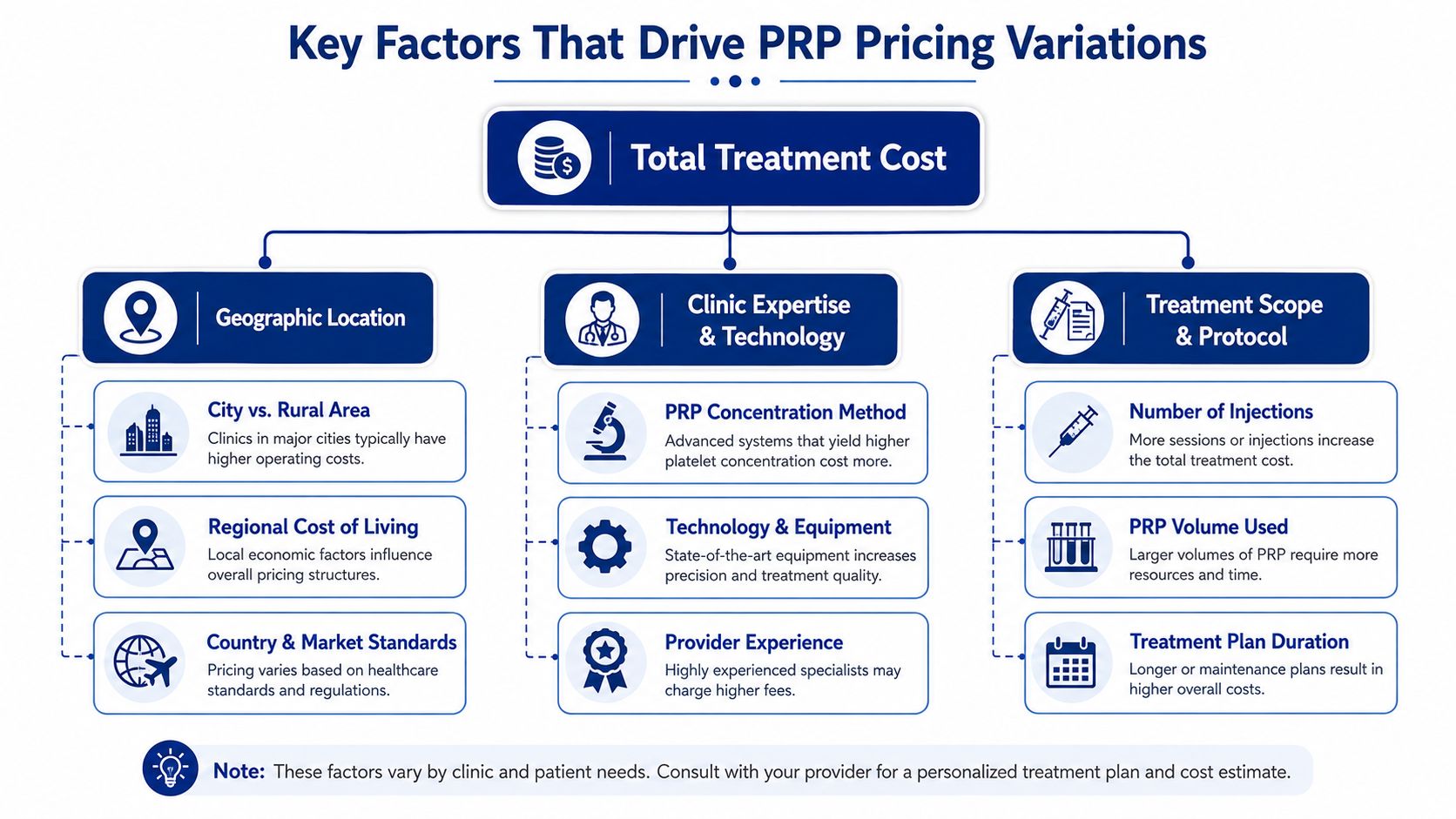
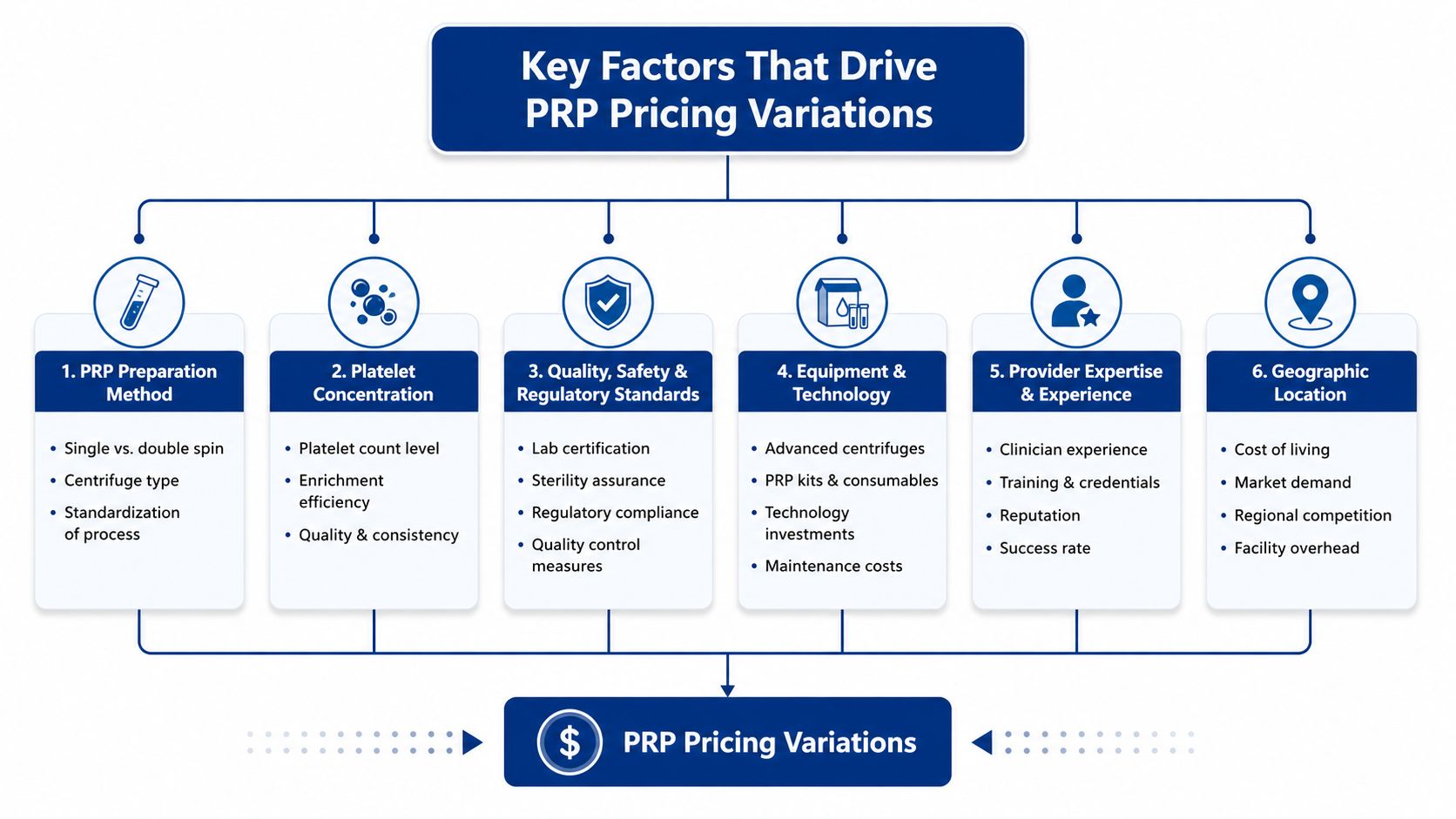
Price differences usually reflect a combination of clinical and business variables. Some affect the quality and safety of care directly. Others influence the practice's overhead or positioning without necessarily improving your outcome.
Provider expertise and diagnosis
A qualified medical provider should first determine what type of hair loss you have. PRP is generally discussed for androgenetic alopecia, but thinning can also reflect inflammatory scalp disease, nutritional problems, medication effects, or other conditions that need a different evaluation.
A physician-led practice may charge more than a non-medical setting because the service can include diagnosis, medical oversight, informed consent, sterile technique, and management of complications. That premium has practical value when it reflects stronger assessment and more careful treatment planning. It has less value when it only reflects branding.
Processing method and treatment design
The way blood is processed matters because platelet concentration, preparation, injection volume, and distribution can vary. The umbrella review's recommended injection volumes show why patients should ask for technical details rather than accepting “our standard PRP” as a complete explanation.
Treatment scope also changes the quote. A plan covering a smaller thinning area may require a different amount of product and appointment time than a plan covering diffuse scalp loss. Add-ons such as microneedling may be clinically appropriate in selected cases, but they should be explained separately so you know what you're accepting.
Location and clinic overhead
Geography affects staffing, rent, equipment, and demand. The ISHRS notes that session pricing can range from $400 to $1,500 or more, and the consumer survey cited earlier found substantial differences between U.S. markets. A premium setting such as Beverly Hills, CA, may have higher overhead, but a higher quote alone doesn't prove superior care.
Ask what the premium buys: Better diagnosis, clearer documentation, safer technique, stronger follow-up, and a protocol matched to your condition are more meaningful than an impressive facility alone.
Comparing PRP to Alternative Hair Loss Treatments
PRP isn't the only path for hair thinning, and it shouldn't be evaluated in isolation. Pharmaceutical treatments may involve ongoing use, surgical restoration involves a larger procedural commitment, and light-based approaches require consistent participation. The right comparison depends on whether your priority is avoiding surgery, limiting daily medication, improving existing hair density, or pursuing a more definitive change in areas with substantial loss.
| Treatment | Cost Structure | Time Commitment | Invasiveness | Maintenance Required |
|---|---|---|---|---|
| PRP | Repeated treatment investment | Induction visits followed by reassessment | Injectable, minimally invasive | Usually yes |
| Topical or oral medication | Ongoing purchase and use | Daily or scheduled use | Non-surgical | Usually continuous |
| Hair transplantation | Larger procedural investment | Surgical planning and recovery | Surgical | Ongoing care for surrounding hair may still matter |
| Low-level light therapy | Device or treatment-course investment | Repeated home or clinic use | Non-invasive | Continued use is generally needed |
| Microneedling with PRP | Combined treatment investment | Multiple visits and aftercare | Minimally invasive | Depends on the plan |
Medication can be appealing when you value convenience and are comfortable with continued use and medical monitoring. Its limitations include the need for adherence and the possibility of side effects, depending on the medication and the patient. Surgical transplantation may create a more substantial change in selected candidates, but it involves surgery, donor-area considerations, recovery, and a different financial structure.
PRP occupies a middle position. It doesn't transplant follicles, and it isn't a permanent substitute for treating the underlying pattern of hair loss. Its purpose is to support existing follicles through a minimally invasive treatment plan. Patients interested in combining approaches can read about microneedling with PRP benefits and should discuss whether combination treatment is appropriate rather than assuming more treatment is automatically better.
For cosmetic camouflage while you evaluate medical options, resources about the best hair extensions for fine thin hair can help you understand non-medical styling approaches. Extensions may change appearance, but they don't treat follicle miniaturization or the cause of shedding.
Questions to Ask During Your PRP Consultation
A consultation should produce more than a treatment quote. It should clarify your diagnosis, the proposed protocol, how the clinic measures progress, and what happens if your response is limited. Bring photographs of your hair from earlier periods if you have them, along with a list of medications and relevant medical conditions.
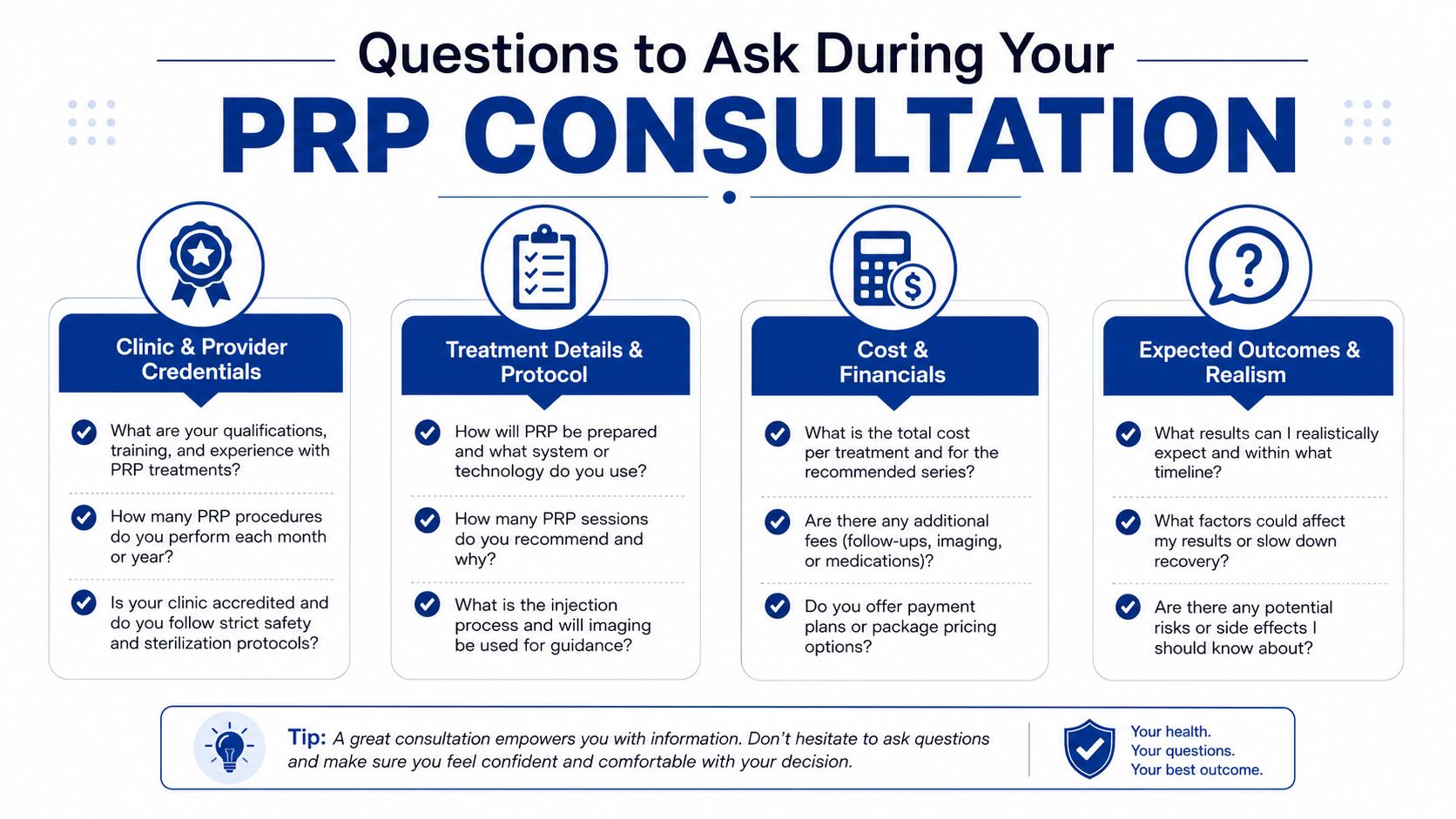
Questions about credentials and diagnosis
Start with the person performing the procedure. Ask:
- Who evaluates my hair loss: Is the diagnosis made by a qualified medical provider?
- Who performs each visit: Will the same clinician treat you throughout the protocol?
- What conditions are being considered: Has the provider ruled out causes that PRP won't address?
- How is safety managed: What screening, sterile technique, and aftercare process does the clinic use?
A provider who avoids diagnosis and moves directly to a package may be treating the transaction rather than the patient.
Questions about the protocol
Ask for specifics in plain language. What preparation system does the clinic use? How much treatment is planned for each area? How far apart will the induction appointments be, and what findings would lead the provider to modify the schedule?
You should also ask how results will be documented. Consistent photographs, lighting, camera position, and scalp assessment make progress easier to judge. Hair changes gradually, so memory and casual mirror comparisons aren't reliable enough for a long-term treatment decision.
Questions about the financial commitment
Request an itemized plan rather than a single figure. Confirm whether the consultation, follow-up visits, aftercare guidance, and maintenance appointments are included or billed separately. Ask whether recommended add-ons are optional, clinically justified, or built into a package.
The microneedling with PRP near Beverly Hills consultation process can serve as a reminder to ask how combined treatments are structured. You should leave knowing the planned treatment, the alternatives, the expected review point, and the likely recurring obligations.
A credible consultation makes uncertainty smaller. It won't promise a guaranteed result, but it should explain why the proposed plan fits your diagnosis.
Making an Informed Decision About PRP Investment
PRP makes the most sense when the treatment matches three realities: your diagnosis is suitable, your expectations are realistic, and you're willing to follow the complete protocol. A patient who wants a single appointment and a permanent transformation may be disappointed. Someone seeking a non-surgical approach to support existing follicles, and prepared for repeated care, may view the commitment differently.
Evidence supports cautious optimism rather than certainty. One meta-analysis found that PRP increased hair density compared with control treatment by about 17.90 hairs per square centimeter, with a 95% confidence interval from 5.84 to 29.95 and a statistically significant p-value of .004 in the published meta-analysis. Another systematic review found a medium-term mean difference of 25.6 hairs per square centimeter compared with saline, but rated the overall evidence as low quality because of inconsistency and risk of bias in its systematic review.
Use a long-term decision filter
Before scheduling, consider these questions:
- Diagnosis: Has a qualified provider identified the likely cause and stage of your hair loss?
- Time: Can you attend the induction appointments and later reviews?
- Budget: Can you plan for maintenance rather than treating it as an unexpected expense?
- Evidence: Will the clinic document your baseline and assess whether the treatment is helping?
- Alternatives: Have you compared PRP with medication, light-based treatment, styling solutions, or surgery?
- Expectations: Are you seeking improved density and follicle support rather than guaranteed restoration?
PRP is usually an out-of-pocket cosmetic treatment, so patients should ask about payment plans without allowing financing to replace clinical judgment. A manageable monthly payment doesn't make an unsuitable treatment appropriate. It only changes how the financial obligation is distributed.
Choose value over the lowest quote
The cheapest appointment may omit the assessment, use a less detailed protocol, or leave maintenance undefined. The most expensive appointment may include unnecessary extras. Value comes from the relationship between medical expertise, appropriate technique, transparent planning, and measurable follow-up.
If you're also comparing aesthetic procedures, a practical resource on how much erbium laser resurfacing costs illustrates the same broader principle. Procedure pricing becomes more useful when you understand what the treatment includes, who performs it, and what ongoing care may be required.
Ideal Face & Body offers PRP hair restoration in Beverly Hills, CA, as part of its hair and skin services. A consultation with Dr. Sarah Yovino or Dr. Justin Yovino can help determine whether PRP fits your hair-loss pattern and whether the proposed treatment commitment is reasonable for your goals.
Schedule a consultation with Ideal Face & Body to discuss your hair-loss pattern, PRP options, and the full treatment timeline. Ask for a clear plan that explains the clinical rationale, follow-up process, and long-term investment before you decide.