
You're probably not sitting around obsessing over breast implants in the abstract. You're looking in the mirror after pregnancy, weight change, or just years of feeling out of proportion, and you're trying to figure out whether augmentation is the right fix or whether you need a lift, a fat transfer, or even removal if you already have implants. That's the decision here, and the honest answer is that pros cons breast augmentation only makes sense when it's compared against the other paths, not sold as the default.
| Procedure | Primary Goal | Scarring Profile | Typical Longevity | Best-Fit Candidate |
|---|---|---|---|---|
| Implant augmentation | Add volume and upper-pole fullness | Usually limited incisions, but still surgery | Not permanent, replacement may be needed | Someone who wants a clearer size increase |
| Fat transfer | Add modest volume with your own tissue | Small liposuction and injection entry points | Variable, some of the transferred fat may not remain | Someone wanting a softer, more natural-feeling change |
| Breast lift | Improve shape and nipple position | Lift scars are usually more visible than augmentation scars | Long-lasting shape change, but aging continues | Someone whose main issue is ptosis, not size |
| Breast reduction | Reduce heaviness and reshape | More scar burden because more tissue is removed | Durable, with future changes tied to aging and weight | Someone whose breasts feel too large or painful |
| Explant or revision | Remove, replace, or correct prior implants | Depends on the revision plan | Depends on the end state you choose | Someone who wants to go implant-free or fix an older result |
Table of Contents
- Mapping Your Decision Before You Choose a Procedure
- Comparing the Main Options Side by Side
- Documented Benefits That Drive Most Decisions
- Trade-offs Most Articles Soften
- How Candidacy Shapes the Right Procedure
- Awake Surgery Versus Traditional Settings
- Recovery Timelines and the Long View
- Matching the Procedure to Your Real Priorities
Mapping Your Decision Before You Choose a Procedure
A patient sits in a consultation and says she wants “a breast augmentation,” but what she's really pointing to is a shape problem. Her breasts have dropped after pregnancy, her upper pole looks flat, and she keeps asking whether bigger implants will fix it. They won't, not by themselves, and that's exactly why the first question is never “implants or not,” it's what problem are you trying to solve.
Start with the real goal, not the procedure name
If you want more volume, augmentation may belong in the conversation. If you want better position, a lift is usually the primary answer. If you want a subtle change and you've got donor fat, fat transfer can make sense, and if you already have implants but don't want them anymore, explant becomes part of the decision tree. Mayo Clinic is blunt that implants can still sag with time and that a lift is often needed when skin laxity is the issue, not volume alone, which is why shape and position matter as much as fullness (Mayo Clinic).
A good consult should separate volume, shape, symmetry, and lifestyle goals. A woman who wants to look fuller in clothes after breastfeeding is not asking the same question as someone who wants to go implant-free and feel lighter. Those are different surgeries, different trade-offs, and different attitudes toward future maintenance.
Practical rule: If your breast sits low before surgery, adding an implant alone usually gives you a fuller low breast, not a lifted one.
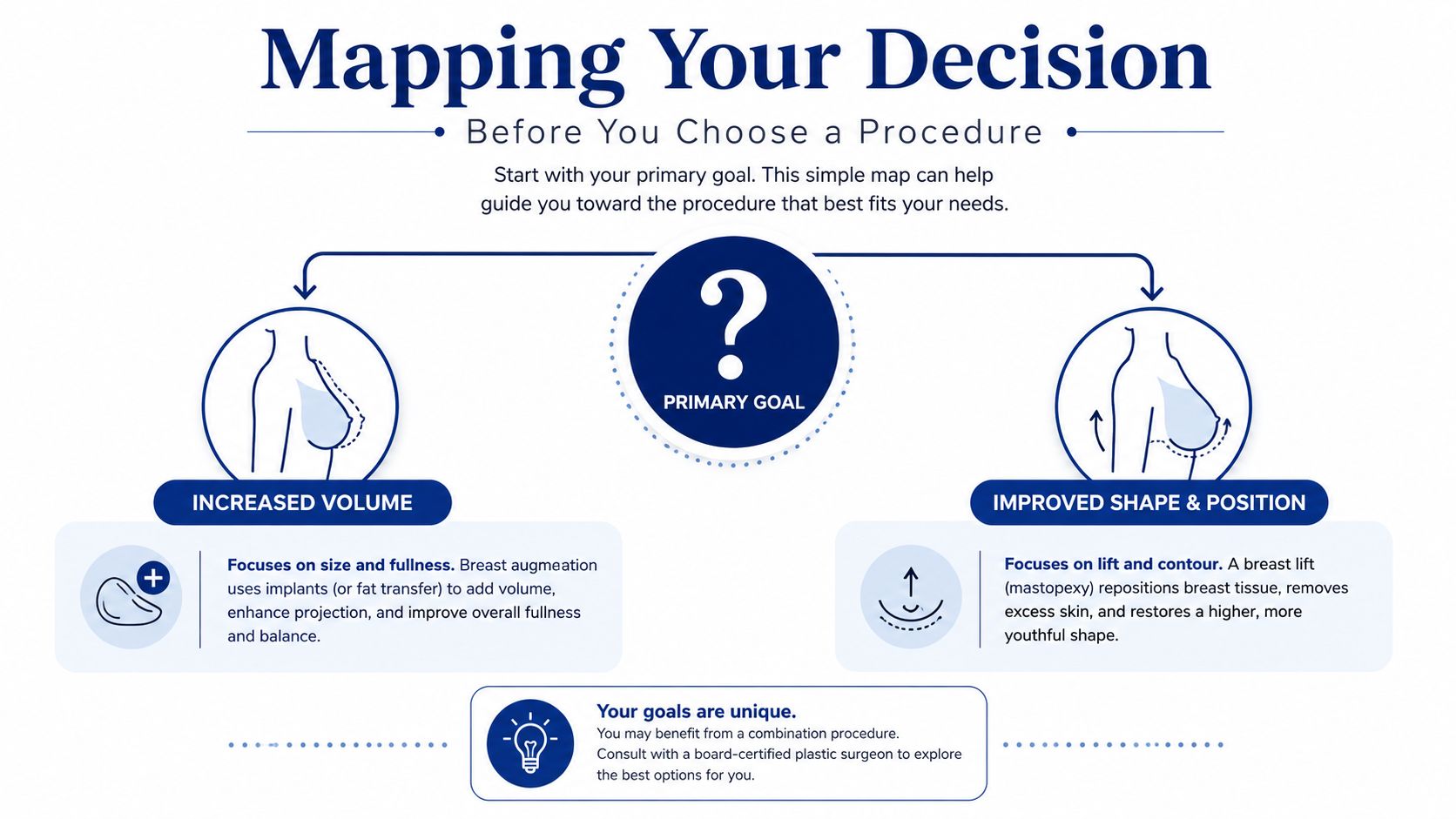
The decision also depends on how you feel about future surgery. Augmentation can be satisfying, but implants are not forever, and that long-term reality matters when you're choosing your first operation. If you're done having children, comfortable with the idea of monitoring, and want a visible size change, augmentation may fit. If you're still building your family, chasing a very natural result, or hate the idea of maintenance, another branch of the tree may fit better.
Comparing the Main Options Side by Side
A patient who wants a big size change is making a different choice from a patient who wants a small, tissue-based improvement. A woman who mainly hates sagging after pregnancy usually needs a lift with or without augmentation, because an implant alone adds volume but does not fix position.
Use the opening table as the broad reference, then judge each operation by what it changes in the breast. That is the cleaner way to compare them.
Breast Procedure Options at a Glance
| Procedure | Primary Goal | Scarring Profile | Typical Longevity | Best-Fit Candidate |
|---|---|---|---|---|
| Implant augmentation | Increase size and upper-pole fullness | Small incisions, but visible surgical scars still exist | Long-lasting, not lifetime | Wants a noticeable size change |
| Fat transfer to breasts | Modest volume with autologous tissue | Small liposuction and injection access points | Variable, depends on fat retention | Wants a smaller, softer change |
| Breast lift | Reposition tissue and nipple | More scarring than augmentation | Durable shape correction | Main concern is sagging |
| Breast reduction | Reduce heaviness and reshape | Usually the most scar-intensive option here | Durable | Wants relief from excess size |
| Explant or revision | Remove or correct implants | Depends on the revision plan | Depends on the goal after surgery | Wants implant-free breasts or a correction |
The difference is not just size. It is how each procedure treats skin, glandular tissue, and nipple position. Implant augmentation gives the clearest increase in projection and upper fullness, but the trade-off is an implant pocket, a foreign body, and the possibility that you may need revision later. Fat transfer feels more natural because it uses your own tissue, yet it is limited by how much fat you have and how much survives after transfer. Breast lift solves the architecture problem by tightening and repositioning the breast, which is why it is the right answer when the nipple sits low or the breast has dropped. Breast reduction goes in the opposite direction, removing weight and often improving comfort, posture, and bra fit. Explant is the cleanest path for patients who want implants out, but it may leave deflation or loose skin that needs to be addressed in the same plan.
Scarring deserves a straight answer. Augmentation usually has the smallest scars, but “small” does not mean invisible. Fat transfer leaves tiny access points and liposuction scars, which can be appealing if you care more about scar burden than about major size change. A lift has more visible incisions because the skin has to be removed and the breast reshaped, and that is the price of correcting droop. Reduction often carries the most scarring of the group because it combines tissue removal with reshaping. Revision surgery varies the most, because the scars depend on what is being fixed and what was done before. If scar minimization is your top priority, that often pushes you toward fat transfer or a limited augmentation plan rather than a lift or reduction.
Shape goals also matter. Implant choice affects that, including whether you want a rounder look or a narrower footprint. If you are trying to understand that part of the decision, the difference between high-profile and moderate implants changes how the breast sits on the chest and how much projection you get. That said, implant profile is only one piece of the plan. A patient with loose skin and a low nipple still needs lifting of some kind, and a patient who wants to stay implant-free should be talking about fat transfer or explant, not just implant size.
Documented Benefits That Drive Most Decisions
A patient sits down asking about pros cons breast augmentation, and the first thing that matters is the payoff. For the right body and the right goals, augmentation delivers a clear satisfaction boost. An ASPS-reported prospective study found 98% of women said their results met or exceeded expectations, 92% reported improved self-esteem, and 64% reported improved quality of life after augmentation (American Society of Plastic Surgeons). That is the kind of outcome that keeps the procedure at the center of the conversation.
What those numbers mean in real life
BREAST-Q research says the same thing in a more practical way. A systematic review and meta-analysis found significant gains in psychosocial well-being (+38.10), sexual well-being (+40.20), and satisfaction with breasts (+47.88), all with p < 0.00001 (American Society of Plastic Surgeons). Patients were not only happier with the mirror result, they also reported feeling better in daily life and more comfortable with their bodies.
That is one reason augmentation stays so common. A 2024 review estimated more than 1.8 million procedures were performed in 2023, about 35 million women globally currently have breast implants, and the overall global penetration rate among adult women was 1.4% (PMC review). Those figures do two things. They show the procedure is mainstream, and they also show why the implant path deserves a serious look rather than a casual yes or no.

Bottom line: The main benefit of augmentation is often not just size, it is feeling more balanced, more proportional, and less self-conscious in everyday clothes.
Cleveland Clinic describes augmentation as a choice many people make to change breast appearance and improve confidence and self-esteem (Cleveland Clinic). That is a major upside. For the right patient, the benefit is not vanity, it is relief.
If you want a non-implant path, breast augmentation without implants is part of the decision tree too, especially for patients who care more about subtle reshaping than a larger jump in size.
Trade-offs Most Articles Soften
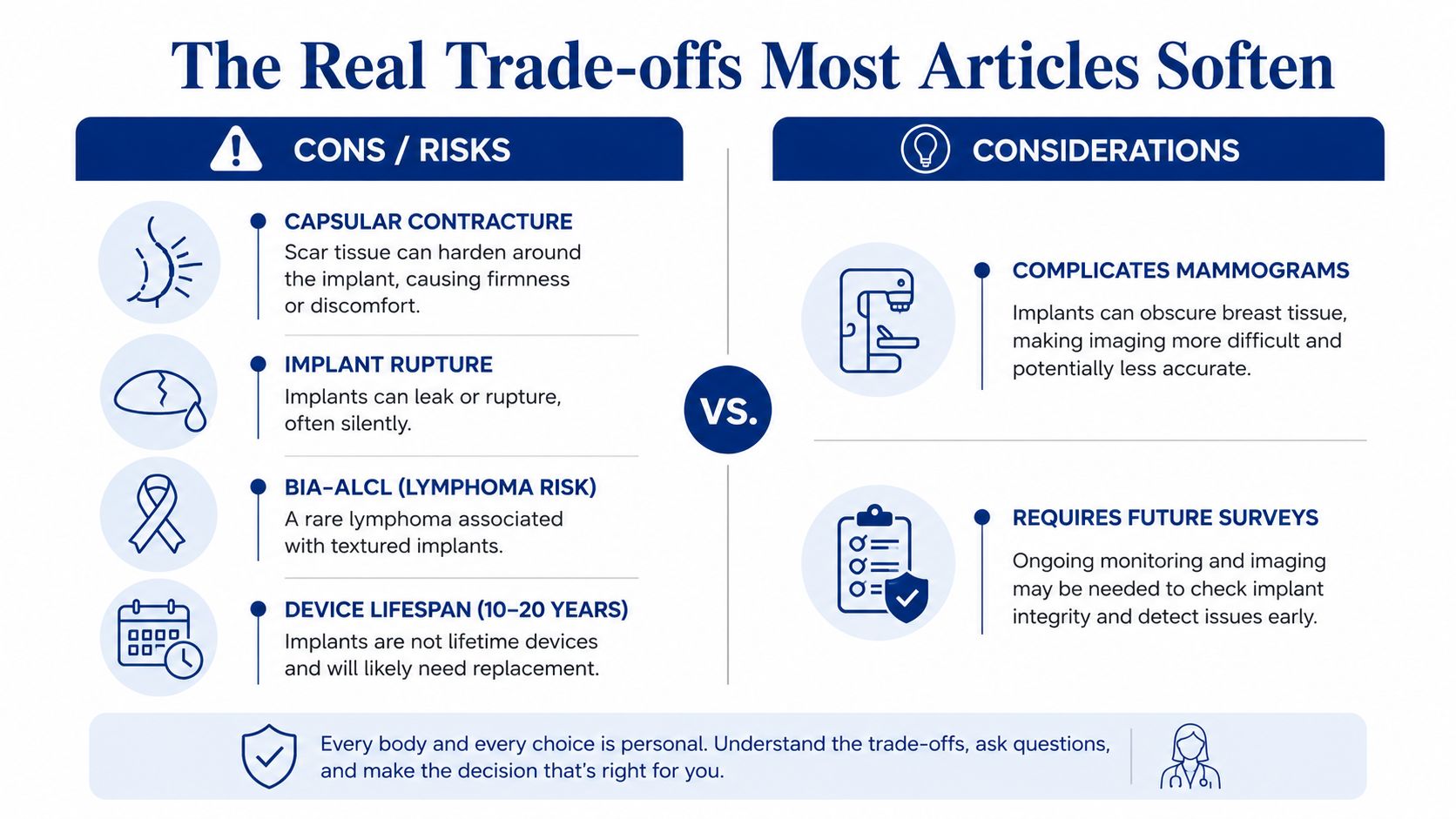
The part people gloss over is maintenance. Implants are not lifetime devices, and Mayo Clinic says they last about 10 years, while other patient guidance commonly places the range around 10 to 20 years. That means a first operation can become the opening chapter in a longer implant story, not the final step.
What the implant risks mean
FDA guidance says it has not detected an association between silicone gel-filled implants and connective tissue disease, breast cancer, or reproductive problems, but it also clearly states that implants still carry recognized risks and complications that patients need to discuss before surgery (FDA risks and complications). That risk list includes implant rupture, capsular contracture, and BIA-ALCL, and you should hear those names before you sign anything. These are practical reasons some patients revise, replace, or remove implants later.
Screening is another real trade-off. Implants can complicate mammography and sometimes require specialized views, so routine breast cancer screening becomes less straightforward. They can also sag with age, which is why augmentation does not automatically solve ptosis.
A recent review adds another layer. Silicone implants remain associated with rupture and capsular contracture, procedures using acellular dermal matrix show higher seroma and infection rates than non-ADM procedures, and prepectoral placement can reduce postoperative pain and animation deformity because the implant sits without muscle involvement (PMC review). That is useful planning information, not a reason to panic.
If you want the cleanest possible beauty trade-off, understand this first. An implant can add shape and volume, but it can also add future maintenance.
That is the fundamental conversation. The question is not whether implants are good or bad. The question is whether you want the benefit enough to accept the future obligations that come with it.
How Candidacy Shapes the Right Procedure
Some patients are poor candidates for standard augmentation because the anatomy itself changes the outcome. Asymmetry, tuberous breast shape, chest-wall curvature, prior pregnancy changes, and weight fluctuations all influence whether implants help or make the picture messier. A peer-reviewed review found that about one in five augmentation candidates had breast, chest-wall, or spinal deformities that could worsen cosmetic outcomes if not recognized beforehand, and 3D simulation commentary says those tools should be avoided in patients with asymmetries or unusual thoracic anatomy (PMC review).
The anatomy check that should happen before any surgery plan
If one breast sits higher, lower, or wider than the other, a standard implant plan may magnify the difference instead of smoothing it. If the breast base is constricted, as in tuberous deformity, volume alone rarely solves the shape issue. If the chest wall is asymmetric, the final result depends more on the skeleton beneath the breast than on the implant choice.
That's why a patient with obvious sagging after pregnancy often needs a lift, sometimes with augmentation, while a patient with only mild loss of upper fullness might do well with fat transfer. Weight stability matters too. If you're still losing or gaining weight, your result is more likely to change after surgery than you want it to.
Smoking history matters because wound healing and scar quality matter. A surgeon should be direct about whether your habits make one option safer or smarter than another.
For breastfeeding concerns and future family planning, read the separate discussion here: how breast augmentation may affect breastfeeding. The key idea is not to let desire for fullness override anatomy. Good candidacy usually beats a bigger implant every time.
Best predictor of satisfaction: the right procedure for your body, not the biggest change you can technically get.
Awake Surgery Versus Traditional Settings
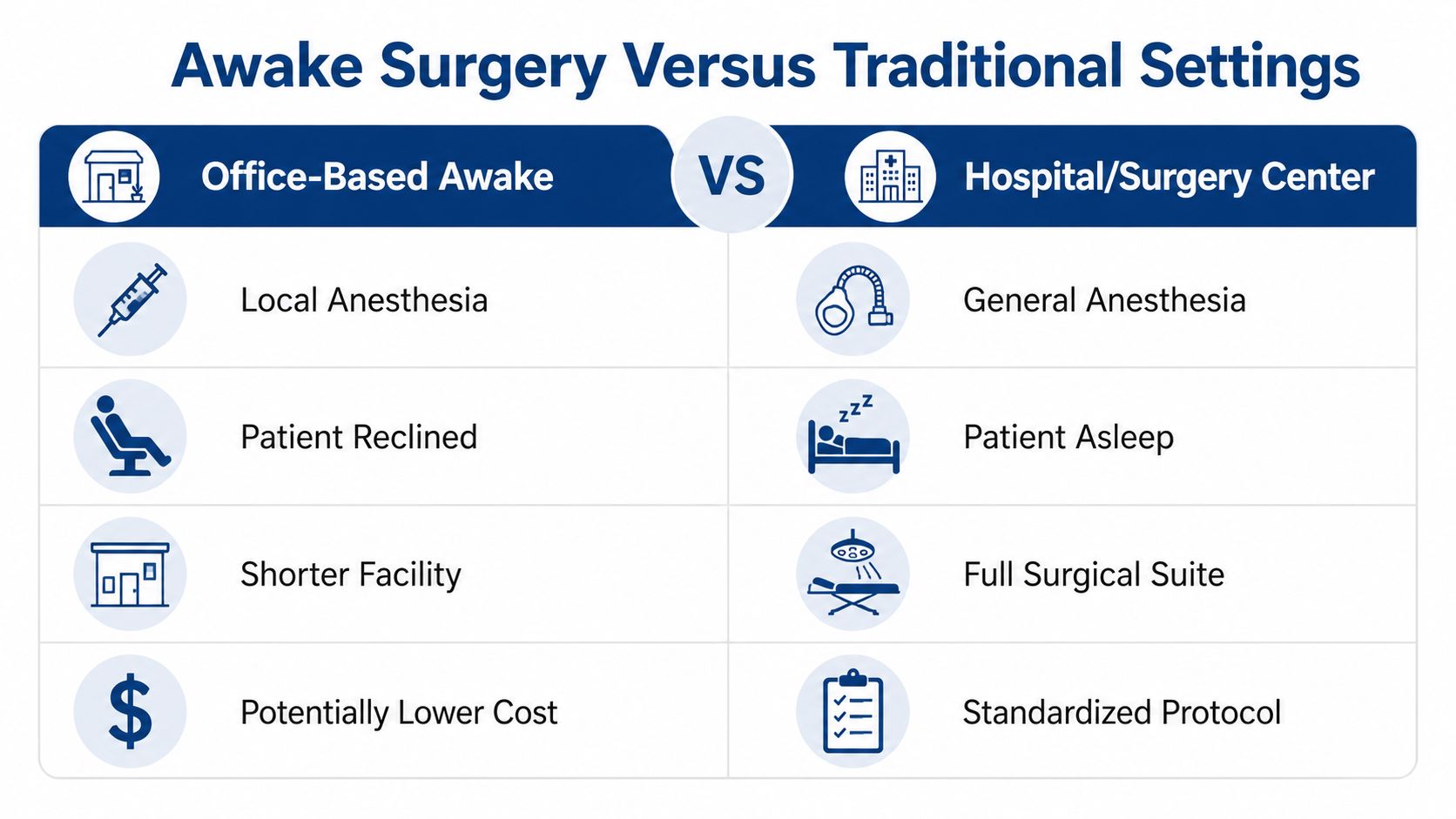
The setting matters as much as the procedure. In an office-based awake approach using local anesthesia, the patient stays reclined, the team avoids general anesthesia, and the flow is simpler. Traditional hospital or surgery-center cases more often rely on general anesthesia, IV access, and a fuller anesthesia setup.
What changes for the patient
Awake surgery often means no IV lines and no intubation, which is a meaningful difference for people who want to avoid being fully put under. It can also mean faster in-room turnaround and earlier walking after the procedure. That doesn't make it automatically better for everyone, but it does make the experience feel less like a major hospital event.
Not every procedure is handled the same way in every setting. Implant-based augmentation, mastopexy, reduction, and fat grafting each have their own technical needs. Also, Ideal Face & Body no longer offers breast implant placement, implant-based breast augmentation, or breast implant revision, so readers should understand that some clinics have a narrower current scope than their broader educational content might suggest.
Ask the surgeon where the procedure will happen, who gives the anesthesia, and what monitoring is in the room. Those are not small details, they tell you how serious the setup is and how the team handles unexpected issues.
Recovery Timelines and the Long View
The first few weeks matter because real life doesn't stop for surgery. Desk work usually comes back before heavy lifting, driving returns before upper-body exercise, and childcare changes have to be planned around your energy and range of motion. If you're the kind of patient who thinks only about the first post-op appointment, you're not planning far enough ahead.
Recovery milestones worth asking about
- Return to desk work: Ask when you can sit comfortably, type normally, and get through a workday without overstretching.
- Resume driving: Don't guess. You need enough control and comfort to brake, steer, and react without guarding your chest.
- Resume upper-body exercise: This should be cleared deliberately, not when you “feel okay.”
- Handle childcare and chores: Lifting a child or carrying laundry too early can undo a careful operation.
- Monitor swelling and shape settling: Final contours take time, and the early look is not the final look.
The longer view matters even more. Mayo Clinic's roughly 10-year implant lifespan and the broader 10 to 20 year range commonly cited for replacement planning mean you need to think beyond the honeymoon phase (Mayo Clinic, MedicineNet). Pregnancy, weight change, and shifting body image goals can all make a once-perfect result feel dated later.
The right procedure is the one you'd still be comfortable with ten years from now, not just the one that looks best at six weeks.
Matching the Procedure to Your Real Priorities
If you want volume and upper-pole fullness, implant-based augmentation is the direct answer. If you want a natural feel and a smaller size change, fat transfer is the cleaner fit. If your main complaint is sagging after pregnancy or weight loss, a lift with or without augmentation is usually the honest recommendation, because implants alone don't correct ptosis.
If you already have implants and you want them out, explant belongs on the table, and fat grafting can help reshape the result if you still want softness and contour. That's the part many patients overlook. Going implant-free doesn't mean giving up shape, it just means choosing a different way to build it.
My opinion is simple. Come to the consult ready to talk about your anatomy, not just your cup size goal. Ask whether your problem is volume, position, asymmetry, or all three, ask what happens if you get pregnant again, and ask what future surgery might look like if your goals change. Dr. Sarah Yovino and Dr. Justin Yovino should be able to answer those questions plainly, and if they can't, keep asking until the plan makes sense.
If you're weighing augmentation, lift, reduction, fat transfer, or explant, the next step is a real anatomy-based consult, not more guessing from before-and-after photos. Ideal Face & Body focuses on awake, office-based procedures and can help you sort out which path fits your body and your long-term goals. Visit Ideal Face & Body and bring the questions that matter most, especially the ones about shape, recovery, and what you'll want five or ten years from now.