You may be looking in the mirror and seeing the same thing many patients describe to me: your face still looks like you, but the jawline has softened, the early jowls are showing up in photos, and you want a real lift without signing up for the scope and downtime of a full facelift. That's a very common place to be.
The problem is that the phrase mini facelift sounds more precise than it is. In practice, it often means very different things from one office to the next. As noted in this discussion of why “mini facelift” is a marketing label rather than a standardized operation, there's no universally defined surgical protocol, which is exactly why patients get confused about what kind of result they should expect.
That confusion matters. A good lower-face procedure can create elegant, natural improvement. A vague promise cannot. If you're trying to understand what mini facelift results really look like, what the awake version changes, and who tends to be happy with this approach, it helps to start with a clear framework rather than glossy before-and-after language.
Many readers first explore broader cosmetic benefits of a facelift before narrowing in on whether a mini approach makes sense. That's the right sequence. The best procedure isn't the smallest one. It's the one that matches your anatomy, skin quality, and goals.
Table of Contents
- Introduction What Are Mini Facelift Results Really Like
- Defining the Awake Mini Facelift Technique
- The Mini Facelift Recovery Timeline
- How Long You Can Expect Your Results to Last
- Mini Facelift vs Full Facelift A Detailed Comparison
- Achieve Your Ideal Results in Beverly Hills
Introduction What Are Mini Facelift Results Really Like
When mini facelift results are done well, they usually don't look dramatic in the obvious, overpulled sense. They look cleaner. The jawline reads sharper. Early jowling looks reduced. The lower face appears less tired. Friends may notice that you look refreshed without being able to point to one exact change.
That's also why expectations need to be grounded in what this operation is designed to do. A mini facelift is for selective improvement, not total facial reset. Patients who come in wanting a better contour along the jawline often do very well. Patients who want major neck correction, broad midface lifting, or a complete reversal of advanced aging usually need a different conversation.
Why the term creates so much confusion
The biggest issue in online searches is that the same label gets applied to very different procedures. Some versions are little more than limited skin tightening. Others involve more meaningful repositioning of the support layer beneath the skin. Those are not the same surgery, and they won't produce the same mini facelift results.
Practical rule: Don't judge a mini facelift by the name alone. Judge it by what layer is actually being lifted, what area is being treated, and what problem it's meant to solve.
A proper consultation should answer a few direct questions:
- What part of the face is being treated: Is the focus the lower face and jawline, or is the language broader than the operation?
- What tissue is being repositioned: Is the result coming from superficial skin tension alone, or is there support deeper than that?
- What isn't included: If neck bands, heavy laxity, or deeper folds bother you, you need to know whether those concerns are outside the reach of a mini procedure.
What realistic success looks like
The happiest patients usually share the same mindset. They want to look less worn out, not transformed into someone else. They understand that mini facelift results should fit their stage of aging. They're not chasing maximal correction.
In practical terms, strong candidates tend to notice improvement in photos taken from the front and slight angle views first. The lower face looks more structured. Makeup sits better along the jaw. Video calls often show less heaviness near the mouth and jowl area.
A mini facelift should make your face look more rested and better supported. It shouldn't look like your skin was pulled backward.
That distinction is where good surgical judgment matters most.
Defining the Awake Mini Facelift Technique
A patient will often come in asking for a mini facelift, but the term itself can be misleading. It is used broadly in marketing, even though the procedure may vary a great deal from one practice to another. The useful question is much simpler. What is being lifted, and what part of the face is being treated?
In my view, an awake mini facelift is best defined by its scope. It is a focused surgical lift for the lower third of the face, especially the jawline, pre-jowl area, and in select patients, a limited portion of the upper neck. The goal is refinement, not full facial correction.
What a mini facelift treats
A true mini facelift is designed for patients who have started to see early descent in the lower face. The jawline looks less crisp. The corners of the mouth may look heavier. Early jowls begin to interrupt a clean contour.
That usually makes it a good option for concerns such as:
- Early jowls: Mild tissue descent that softens the transition from chin to jaw.
- Jawline blur: Enough laxity to create heaviness, but not enough to justify a more extensive facelift.
- Mild upper neck looseness: A limited amount of laxity near the jawline in patients with favorable anatomy.
It has limits, and patients need that explained clearly. A mini facelift does not reliably correct advanced neck laxity, prominent platysmal banding, or heavier facial descent extending through the midface and neck. If those issues are present, a smaller operation can leave someone under-corrected.
To make the anatomy easier to visualize, this summary helps: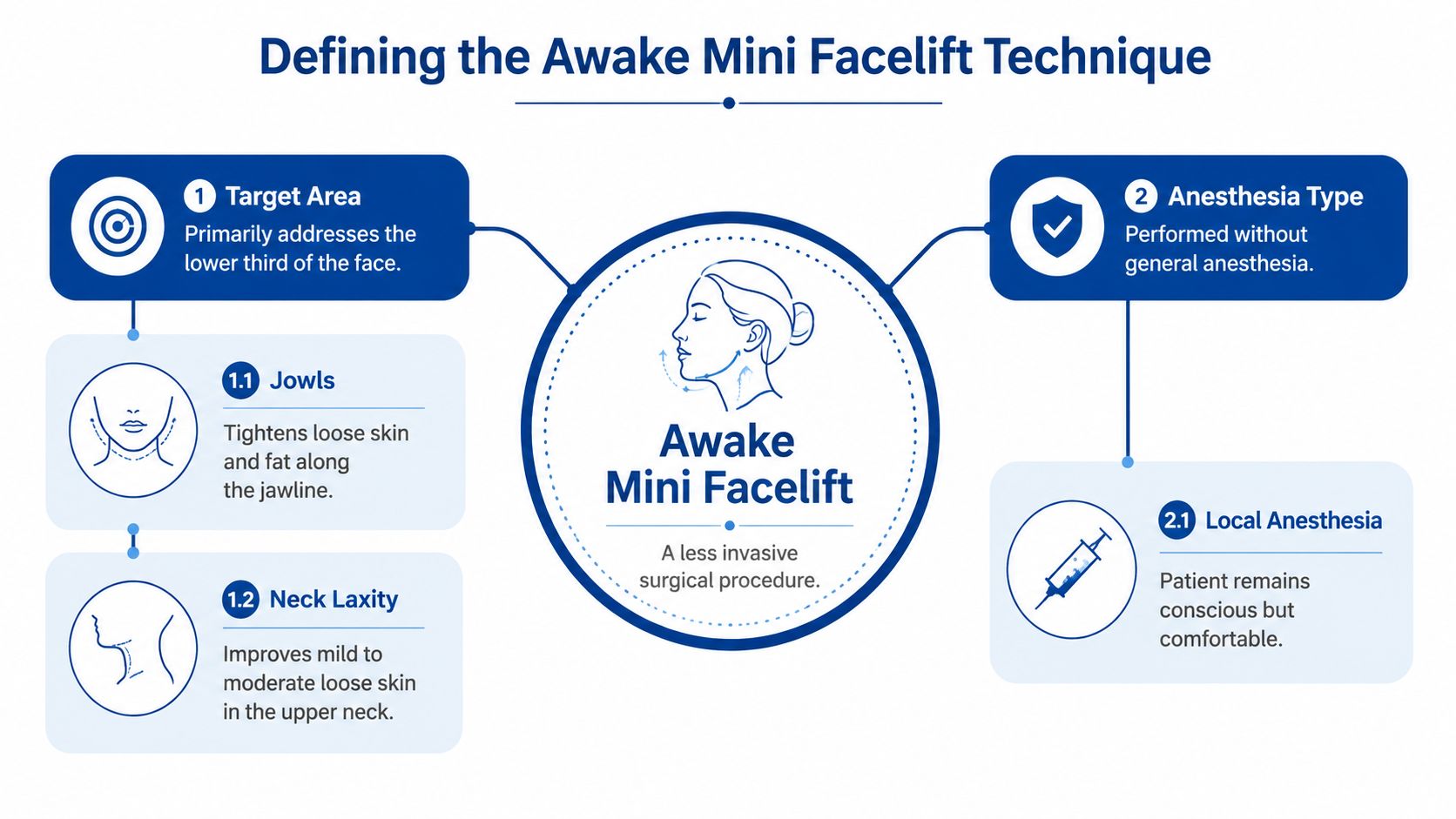
What makes the awake approach different
The awake technique changes the surgical experience, not the need for precision. Patients remain comfortable under local anesthesia, which avoids general anesthesia and often makes the day of surgery feel more manageable. For many people, that matters as much as the smaller incision pattern or shorter downtime. A fuller explanation appears in this guide to how the awake facelift approach works.
The operation still needs real structural support. Good mini facelift results come from repositioning and support in the deeper tissue, not from pulling skin tighter on the surface. If a procedure relies too heavily on skin tension alone, the result can look artificial and may not hold up as well.
That is why technique matters so much. The best candidates for an awake mini facelift usually have decent skin elasticity, localized aging in the lower face, and a goal of looking fresher rather than dramatically different.
A practical summary looks like this:
| Element | Awake Mini Facelift |
|---|---|
| Primary goal | Improve lower-face definition |
| Main focus | Jawline and pre-jowl area |
| Setting | Office-based, awake procedure |
| Anesthesia style | Local anesthesia |
| Surgical philosophy | Limited dissection with support-oriented lifting |
“Awake” refers to the anesthesia approach and the surgical setting. It does not mean the procedure is minor or superficial.
Patients with the best experience tend to fit a narrow lane. They want cleaner definition along the jawline, they are not trying to correct every sign of aging, and their anatomy still allows a focused lift to look natural. If the neck has become significantly loose or the aging pattern extends beyond the lower face, a mini facelift may be too limited to deliver the result they have in mind.
The Mini Facelift Recovery Timeline
A common patient scenario goes like this. The procedure is on Thursday or Friday, and the first real question is whether they can be back to work, out to dinner, or on a video call without feeling self-conscious the next week.
For an awake mini facelift, recovery is usually measured in phases, not a single finish line. Many patients feel surprisingly functional early, but visible healing takes longer than people expect from the word "mini." That distinction matters. You can feel well before you look fully settled.
This visual gives a practical overview of the usual progression: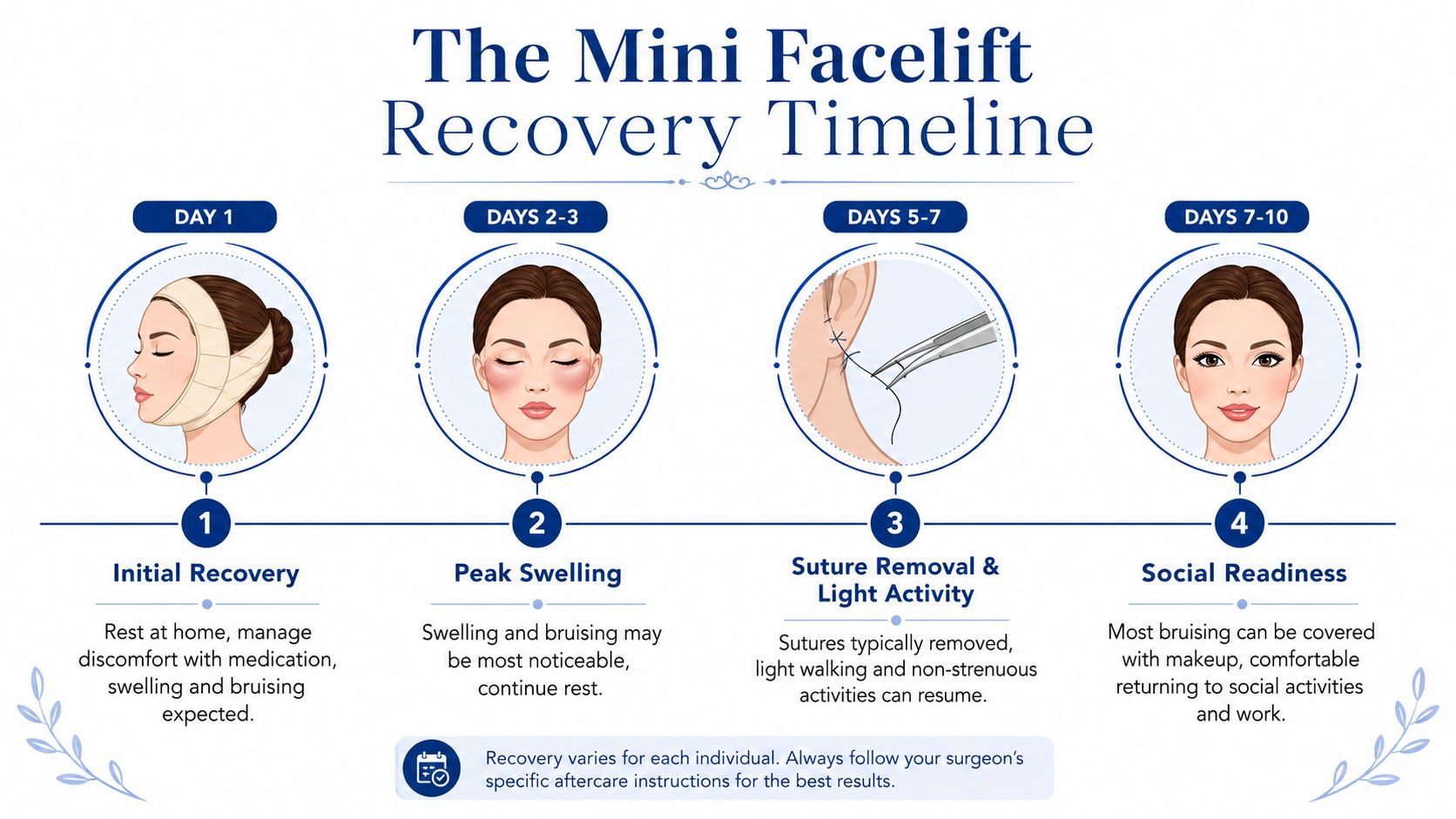
What the first several days usually feel like
The first 24 hours are usually defined by tightness, mild soreness, and swelling that is just starting to develop. Severe pain is uncommon with an awake mini facelift. Most patients describe more pressure and stiffness than pain.
Days 2 and 3 are often the most discouraging visually. Swelling becomes more noticeable, bruising can declare itself, and the lower face may look uneven. None of that means the result is off track. It means the tissues are doing exactly what healing tissues do.
A practical timeline usually looks like this:
- Day 1: Rest, keep your head raised, limit activity, and stay on your postoperative care plan.
- Days 2 to 3: Swelling and bruising often peak or become more obvious.
- Days 5 to 7: Many patients feel more comfortable moving around and look less overtly postoperative.
- Days 7 to 10: A large percentage of patients feel ready for work, social plans, or other public-facing activities, with makeup and hairstyling helping hide residual bruising when needed.
Recovery is shorter than with a more extensive facelift, but it still requires real downtime.
When patients usually feel comfortable being seen again
This depends as much on personality as anatomy. Some patients are comfortable returning once they can cover a little bruising and no longer look obviously swollen. Others want to wait until friends and coworkers are unlikely to notice anything at all.
That difference is normal, and it is one reason I set expectations carefully before surgery. "Recovered" can mean physically safe to resume routine activity, or it can mean socially invisible. Those are not the same milestone.
The awake approach helps by avoiding general anesthesia and keeping the procedure focused, but it does not erase the biology of healing. If a patient adds other procedures, recovery usually becomes longer and less predictable. A mini facelift by itself and a combined facial surgery plan should never be treated as the same experience.
Patients also have more control over how smoothly the healing period goes than they realize. Good sleep, head elevation, avoiding strenuous exercise too early, and following a facelift aftercare plan that helps prolong your results can make the recovery period easier and protect the quality of the result.
The short version is simple. An awake mini facelift can fit into real life well, but it still needs planning, patience, and a clear understanding of what the first week will be like.
How Long You Can Expect Your Results to Last
A common question in consultation is simple: “If I do an awake mini facelift, how long will it look better?”
The honest answer is that a mini facelift can produce a meaningful improvement in the jawline and lower face, but it does not stop aging and it does not last as long as a more extensive facelift. In the right patient, results often hold for years. In the wrong patient, the improvement can fade sooner because the procedure was never designed to correct heavier laxity in the first place.
That distinction matters because “mini facelift” is often used as a marketing term. It can sound like a shortcut to full facelift results with less surgery, less recovery, and the same longevity. That is not how facial aging works. An awake mini facelift is a targeted operation for selected patients with earlier lower-face aging, not a smaller version of every facelift problem.
What affects how long the result lasts
Longevity depends less on the word “mini” and more on whether the procedure matched the anatomy well.
Several factors matter:
- Degree of aging before surgery: Mild jowling and early laxity usually hold up better than advanced sagging treated with a limited lift.
- Skin quality: Good elasticity helps the tissues redrape and maintain a cleaner contour.
- Neck involvement: If the neck is aging significantly too, a mini facelift usually has a shorter-looking lifespan because it does not fully address that area.
- Weight changes and sun exposure: Both can accelerate how quickly the lower face starts to look looser again.
- Surgical technique and judgment: A well-executed awake mini facelift can age very nicely. An underpowered procedure done to avoid a more appropriate full facelift usually does not.
I tell patients this clearly. A mini facelift tends to last best when it is used for early aging, not when it is expected to correct a face and neck that need a broader lift.
The trade-off patients should understand
The appeal of the awake mini facelift at Ideal Face & Body is real. Smaller incisions, a focused correction, and an easier overall experience for the right candidate are meaningful advantages. The trade-off is durability and scope. You are choosing a more limited correction, so you should expect a more limited lifespan than a stronger, more extensive facelift.
That does not make it a lesser procedure. It makes it a specific procedure.
For patients in their late 30s to 50s with early jowling, decent skin tone, and aging concentrated in the lower face, that trade can make excellent sense. For patients with heavier neck laxity, deeper folds, or more advanced descent, the better long-term decision is often a fuller operation rather than repeating smaller ones.
How to help your result last longer
Good maintenance supports a better-looking result over time, even though it cannot preserve it permanently. Consistent skin care, stable weight, sun protection, and avoiding nicotine all help. Patients who want practical ways to protect their investment should review these facelift aftercare and maintenance tips that help prolong results.
My view is straightforward. The best long-term mini facelift result comes from honest patient selection. If your aging pattern fits the procedure, the result can look refreshed, natural, and worth it for years. If the label “mini” is being used to promise more than the operation can realistically deliver, disappointment is much more likely.
Mini Facelift vs Full Facelift A Detailed Comparison
A common consultation starts the same way. A patient wants a fresher jawline, wants to avoid looking overdone, and asks whether the word "mini" means a simpler version of the same result.
It usually does not.
"Mini facelift" is a marketing term used loosely. In my practice, the awake mini facelift refers to a focused lower-face procedure designed for a specific aging pattern. A full facelift addresses a broader set of changes, often involving the cheeks, jawline, and neck with more extensive lifting and redraping. The right choice depends on where the laxity sits, how heavy the tissues are, and how much correction you need.
Mini Facelift vs. Full Facelift at a Glance
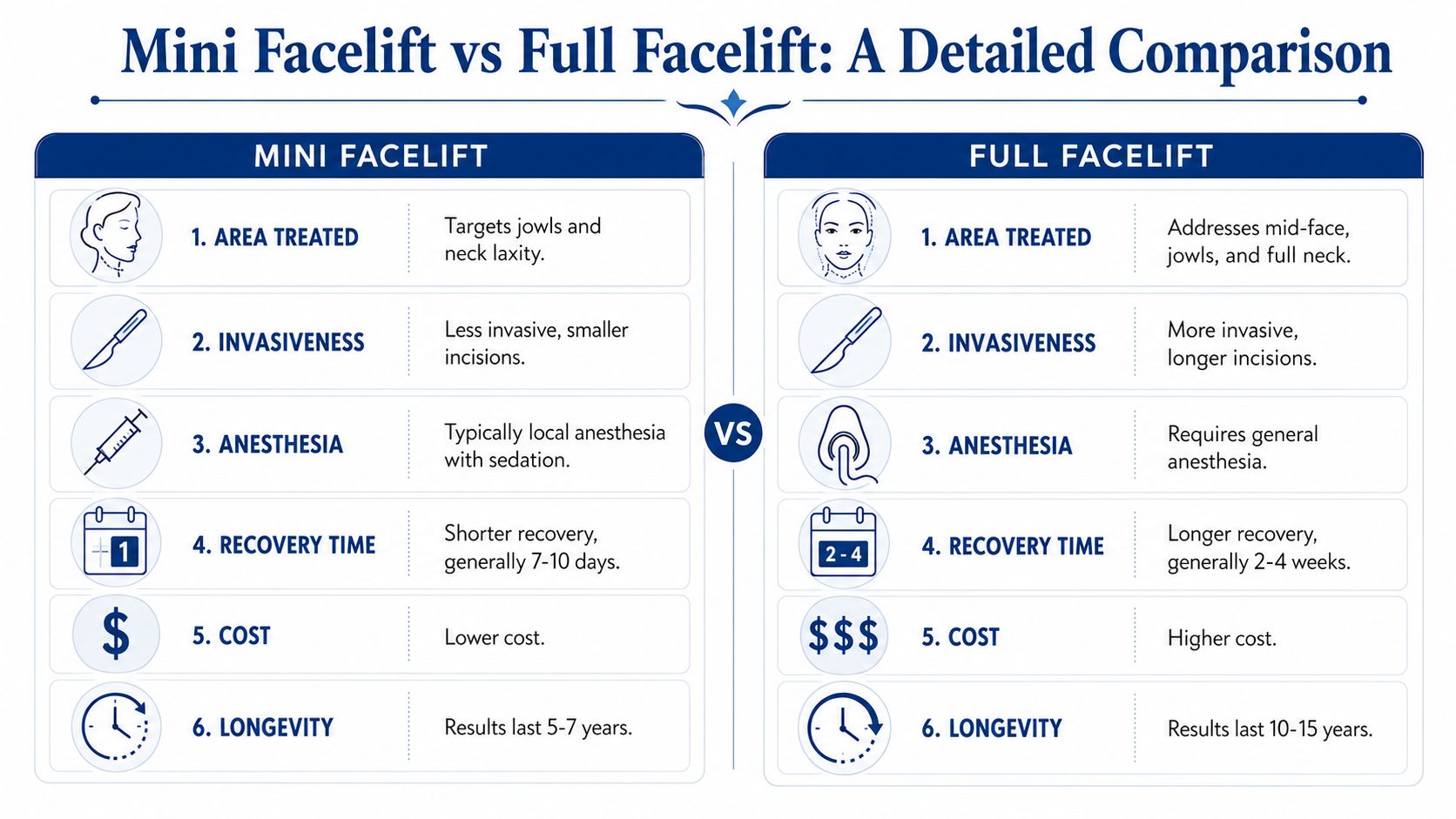
| Feature | Mini Facelift | Full Facelift |
|---|---|---|
| Area treated | Lower face and jawline | Broader face, often including more extensive neck correction |
| Best for | Early jowls and mild laxity | More advanced sagging and deeper structural descent |
| Incisions | Smaller and more limited | Longer and more extensive |
| Anesthesia | Often local anesthesia with sedation | Often requires a broader anesthesia plan |
| Recovery | Shorter | Longer |
| Longevity | More limited | Longer-lasting |
| Neck correction | Mild, selective improvement only | Better option for significant neck aging |
Where the decision gets off track
Patients get into trouble when they choose the smallest procedure that sounds appealing instead of the procedure that matches their anatomy. The awake mini facelift has real advantages for the right candidate, but it does not replace a full facelift.
The neck is usually the deciding factor.
If the main problem is early jowling with mild looseness along the jawline, a mini facelift can work very well. If the main complaint is a heavy neck, visible platysmal banding, or laxity under the chin, a limited lower-face lift will not reliably create the sharper neck angle many patients want. In those cases, selling a mini facelift as if it will produce full-neck correction sets the wrong expectation from the start.
This is also where consultation quality matters for practices trying to improve patient communication and decision-making. Resources like Simbie AI solutions for practices reflect how strongly patient satisfaction depends on clear expectations before surgery, not after.
A practical way to frame the choice is this:
- Choose a mini facelift if: Your aging is centered in the lower face, the jawline has softened, and you want a focused improvement with less downtime.
- Reconsider if: Your goal is major neck tightening from a limited procedure.
- Choose a full facelift if: The cheeks, jawline, and neck are aging together and you want a more complete correction in one operation.
I tell patients this directly. If your concerns are modest and concentrated low in the face, an awake mini facelift can be a very elegant solution. If the aging is broader or the neck is the priority, a full facelift is usually the more honest operation and the better value over time.
Achieve Your Ideal Results in Beverly Hills
A patient often comes in asking for a mini facelift because the term sounds smaller, easier, and safer. What usually matters more is whether that operation matches the way the lower face is aging.
The best result starts with an accurate diagnosis. In my practice, an awake mini facelift works well for patients with early jowling, mild laxity along the jawline, and a goal of looking fresher without looking surgically altered. It does not replace a full facelift for someone with heavier neck laxity, more advanced tissue descent, or a broader need for correction.
A strong outcome in Beverly Hills is not about choosing the lightest procedure. It is about choosing the procedure that fits your anatomy and your goals, then performing it with restraint and precision.
The best result comes from the right indication
The awake mini facelift is a focused operation. It improves the lower face and jawline by addressing looseness in the tissues that create early jowling and blur the mandibular line. When the indication is right, the change can be meaningful but still natural.
That limit matters.
Patients usually do better when the surgeon is clear about what this procedure can and cannot do. If your main concern is the jawline, an awake mini facelift may be enough. If your priority is a sharper neck angle or correction of more advanced aging, forcing a limited procedure to chase a bigger result usually leads to disappointment.
This practice environment also matters:
Why consultation quality matters
Consultation quality shapes the result before surgery ever begins. The awake mini facelift should never be presented as a vague lifestyle procedure. It is still surgery, and it works best when the plan is specific about where the lift starts, what it improves, and where its effect ends.
I tell patients this directly. A natural result usually comes from doing enough, but not too much. That judgment is different for a patient with mild lower-face aging than it is for someone whose cheeks, jawline, and neck are all changing together.
That same attention to patient experience carries into how a practice communicates before and after surgery. For teams working to improve follow-up and patient communication, Simbie AI solutions for practices offers useful ideas around patient satisfaction workflows.
Patients in Beverly Hills, CA usually fall into two groups. One group wants early intervention while the aging changes are still limited. The other asks for a mini facelift because the name feels more comfortable, even though a fuller correction would be more honest and more effective. A careful consultation separates those situations quickly and protects the final outcome.
Dr. Sarah Yovino and Dr. Justin Yovino believe realistic planning is what keeps results looking refined. If an awake mini facelift fits, that recommendation should be clear. If it does not, that should be just as clear.
If your goal is a cleaner jawline, softer jowls, and an honest assessment of whether an awake mini facelift fits your face, the next step is a personalized consultation in Beverly Hills, CA.
If you're ready for an honest evaluation of your lower-face aging and whether an awake mini facelift is the right fit, schedule a consultation with Ideal Face & Body.