Liposuction after weight loss is a contouring tool, not a weight-loss tool. In practice, that means 44,935 post-weight-loss body contouring procedures were reported in 2014, and abdominoplasty was the largest single operation at 17,261 cases.
The scale may look better, but the mirror can still show a different problem: residual fat, loose skin, or both. That's why the key question after major weight loss isn't whether liposuction exists, it's whether your concern is a shape problem that suction can refine or a skin problem that needs excision.
A patient who's lost a large amount of weight often points to the same spots, the lower belly, flanks, upper arms, thighs, or the back bra line. The frustration is real because the hard work is already done, but the body doesn't always shrink in a balanced way. Liposuction can help with stubborn fat pockets, yet it cannot replace the extra skin that hangs after the volume is gone.
If you've been trying to understand why inches are changing faster than weight, this inches-versus-weight guide is a useful companion read because it helps frame what scale change can, and can't, tell you. For the skin side of the equation, flabby skin after weight loss is the kind of problem that needs a different plan than suction alone.
Table of Contents
- What Liposuction Can and Cannot Do After Weight Loss
- Candidacy, Timing, and Weight Stability
- Liposuction vs Skin Excision Procedures
- Technique Options Worth Understanding
- How to Stage Lipo With Other Procedures
- Risks, Recovery, and Realistic Before and After Expectations
- Choosing a Surgeon for Liposuction After Weight Loss
What Liposuction Can and Cannot Do After Weight Loss
A common scene: someone has lost a major amount of weight, maybe through lifestyle change or bariatric surgery, and the number on the scale finally matches the goal. Then the mirror gets confusing. The abdomen still blurs the waistline, the flanks create a straight side profile, or the upper arms and inner thighs keep a softer outline that doesn't match the new body.
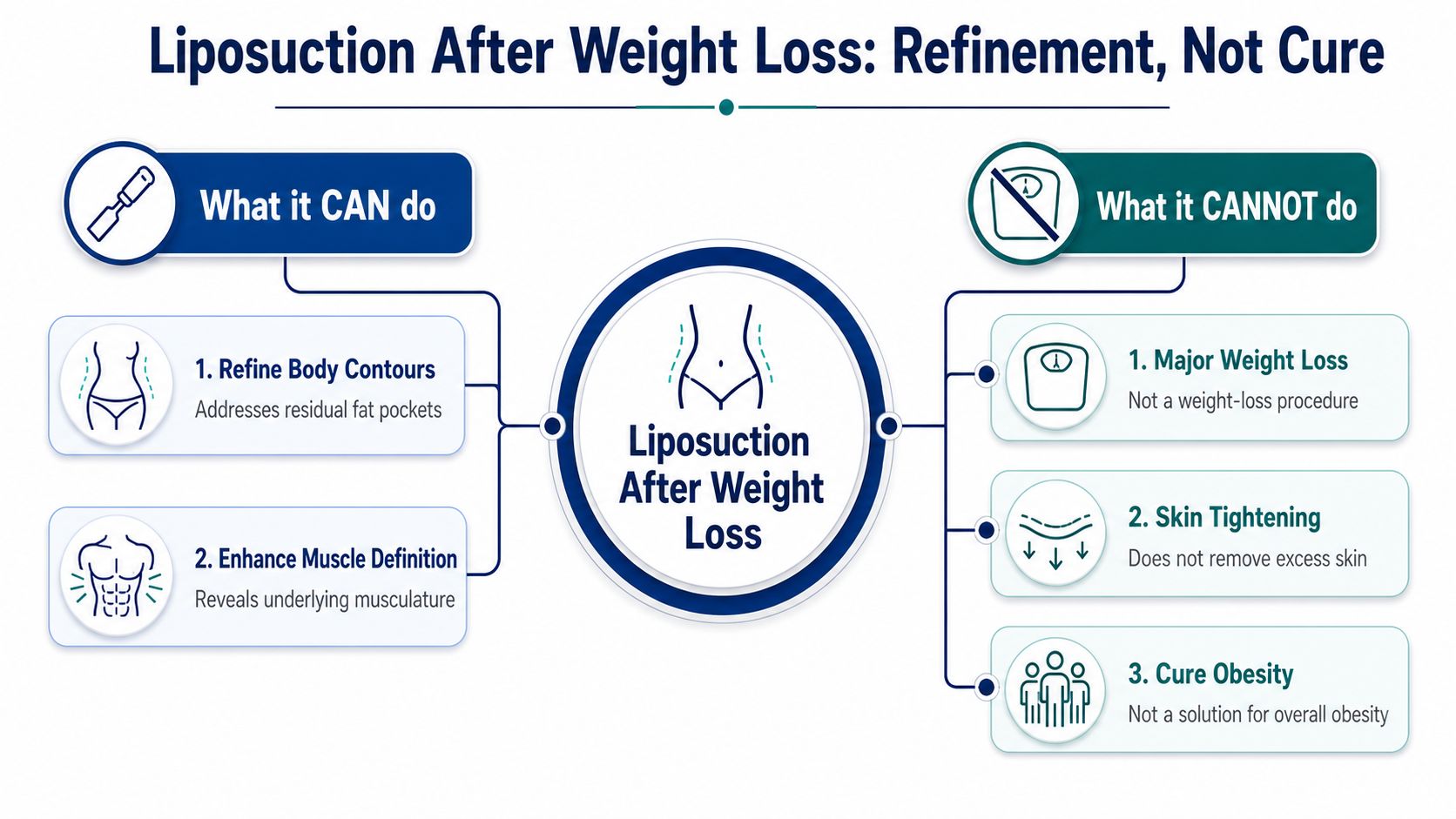
That's where liposuction after weight loss fits. It can refine remaining fat deposits, clean up uneven contours, and help reveal shape that was hidden under stubborn pockets. It cannot pull back loose skin, and it does not erase the structural changes that major weight loss leaves behind.
The easiest way to sort the problem
If the area looks full because of residual fat, suction can often improve it. If the area looks full because skin is stretched, folded, or hanging, liposuction alone usually disappoints because the skin has nothing firm to retract against. Many post-weight-loss patients have both issues at once, which is why the best answer is often mixed, not all-or-nothing.
The surgical mix in post-weight-loss care has also become a standard part of practice, not a fringe niche. The American Society of Plastic Surgeons reported 44,935 total body contouring procedures after massive weight loss in 2014, up from 41,998 in 2013, a 7% year-over-year increase. In that same category, abdominoplasty led with 17,261 cases, followed by breast lift at 12,048, upper arm lift at 6,112, thigh lift at 4,885, and lower body lift at 4,629 (ASPS data).
Practical rule: if you can pinch a little fullness, liposuction may help. If you can lift a hanging fold, excision is usually the more relevant conversation.
The internal question is simple, even if the answer isn't. Are you dealing with fat, skin, or both? That distinction drives everything else.
Candidacy, Timing, and Weight Stability
The best candidates for liposuction after weight loss are usually people who are close to their goal and want refinement, not more reduction. The procedure tends to work better once the body has settled, because shifting weight can blur the outcome and make planning less predictable. If you are still losing weight quickly, waiting until your shape plateaus usually gives a clearer target.
A steady baseline also helps the surgeon judge what is fat, what is loose skin, and what is a contour problem that sits somewhere in between. That distinction matters more after major weight loss than it does in routine liposuction cases.
A practical readiness checklist
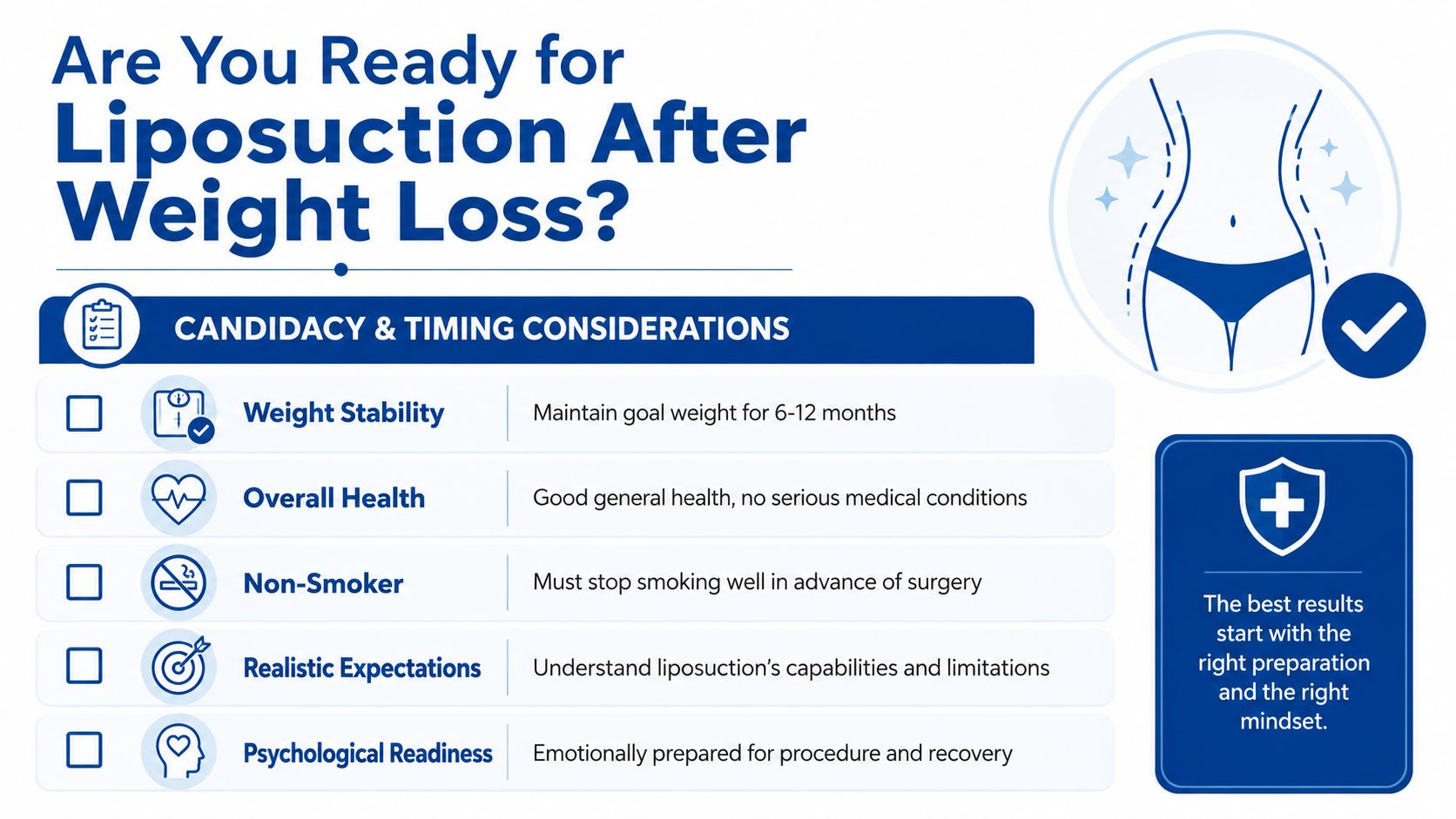
- Weight stability: your weight has settled and you are not still in a rapid-loss phase.
- Overall health: you are medically fit for surgery and recovery.
- Smoking status: you have stopped smoking well in advance.
- Expectation match: you understand that liposuction improves contour, not loose skin.
- Emotional readiness: you can handle swelling, gradual change, and imperfect early healing.
That framework matters because post-weight-loss bodies do not all behave the same way. A person who lost weight through diet and exercise may have different skin behavior than someone after bariatric surgery, where the skin envelope is often more stretched. The contouring goal may look similar, but the route to a good result is rarely identical.
The question of timing also includes what happens before and after surgery. Liposuction is not a substitute for weight management, so the habits that keep weight steady protect the result as much as the operation itself does. If you want a practical reminder of the habits that support a stable result, Empire Medical Wellness weight maintenance is a useful place to start.
One simple test helps patients sort through the gray area. If the area mostly feels full because of leftover fat, liposuction may help. If the area looks fuller because the skin is stretched, folded, or hanging, surgery that removes skin usually belongs in the conversation sooner.
For more details on candidacy, see our guide on chin lipo after major weight loss.
If your main concern is mostly skin, not fat, pause and reassess before scheduling liposuction on its own.
The right time is when the body has stopped changing quickly, the health picture is clear, and the goal is contour refinement. That is when planning becomes more precise and less speculative.
Liposuction vs Skin Excision Procedures
The easiest way to think about the choice is this, liposuction removes fat, excision procedures remove skin, and sometimes a contour problem needs both. A tummy tuck, arm lift, thigh lift, or lower body lift is built to tighten and reshape lax tissue. Liposuction, by itself, is built to slim and sculpt areas that still have a fat layer worth removing.
Side-by-side comparison
| Liposuction vs Skin Excision After Weight Loss | What It Addresses | Scarring | Best For | Limits |
|---|---|---|---|---|
| Liposuction | Residual fat pockets, uneven fullness, contour bulges | Small access incisions | People with better skin tone and localized fat | Does not remove significant excess skin |
| Tummy tuck, arm lift, thigh lift, body lift | Loose, hanging skin and shape distortion from laxity | Longer, visible scars placed to hide as much as possible | People whose main issue is skin excess | Not the best choice if the main issue is only stubborn fat |
For patients with good skin tone and a few remaining problem zones, liposuction can be the right finish. For patients whose skin drapes or folds after major weight loss, excision usually carries the mechanical solution. That's why many consultations end with a blended plan instead of a single-procedure answer.
The scar trade-off is part of the decision too. Liposuction leaves smaller access marks, while excisional surgery accepts longer scars in exchange for removing the excess tissue that suction cannot fix. Recovery also differs, because excision procedures usually involve more wound care and a more visible healing arc.
A useful perspective on the non-surgical side is nutrition and exercise for loose skin, because it reminds patients that healthy habits can support body composition, but they won't rebuild stretched skin the way surgery can. For people trying to decide between options, whether you need a tummy tuck or just lipo is the underlying question.
The key is not choosing the “smaller” surgery by default. It's choosing the operation that matches the anatomy in front of you.
Technique Options Worth Understanding
The word liposuction covers more than one method. While the result is often the primary concern, technique matters because it changes how tissue is treated, how much bruising to expect, and how well a surgeon can work across different areas after weight loss.
The main technique ideas in plain language
Tumescent liposuction uses fluid infiltration to make fat easier to remove and tissues easier to work in. It's the foundation of many modern approaches because it improves control and helps make the procedure more predictable.
Power-assisted liposuction uses a moving cannula tip to help break up fat more efficiently. That can be useful when multiple zones need shaping and the surgeon wants smoother mechanical motion.
Ultrasound-assisted liposuction, including VASER, uses energy to help loosen fat before removal. In post-weight-loss patients, that can matter when the goal is detail work around the trunk or when a surgeon wants more deliberate contouring. Published VASER outcomes showed mean body-weight reduction of 4.73 ± 4.73 kg in females and 3.39 ± 4.27 kg in males one month after surgery, but the study found no correlation between scale change and aspirate volume, fat volume, age, or sex (VASER study).
Awake liposuction means local anesthesia, no IV or general anesthesia in the usual setup, and a procedure done in an office-based setting for selected patients. For the right candidate, that can mean a simpler recovery experience, but it doesn't make the surgery minor, and it doesn't change the need for careful selection.
The best technique is the one that matches the tissue, the area, and the patient's tolerance for downtime, not the one with the flashiest name.
A newer pattern-based idea is 360 liposuction, which treats the abdomen, flanks, and upper back as one contour unit instead of chasing a single bulge. That's especially relevant after weight loss, because the leftover fullness is often distributed, not isolated.
How to Stage Lipo With Other Procedures
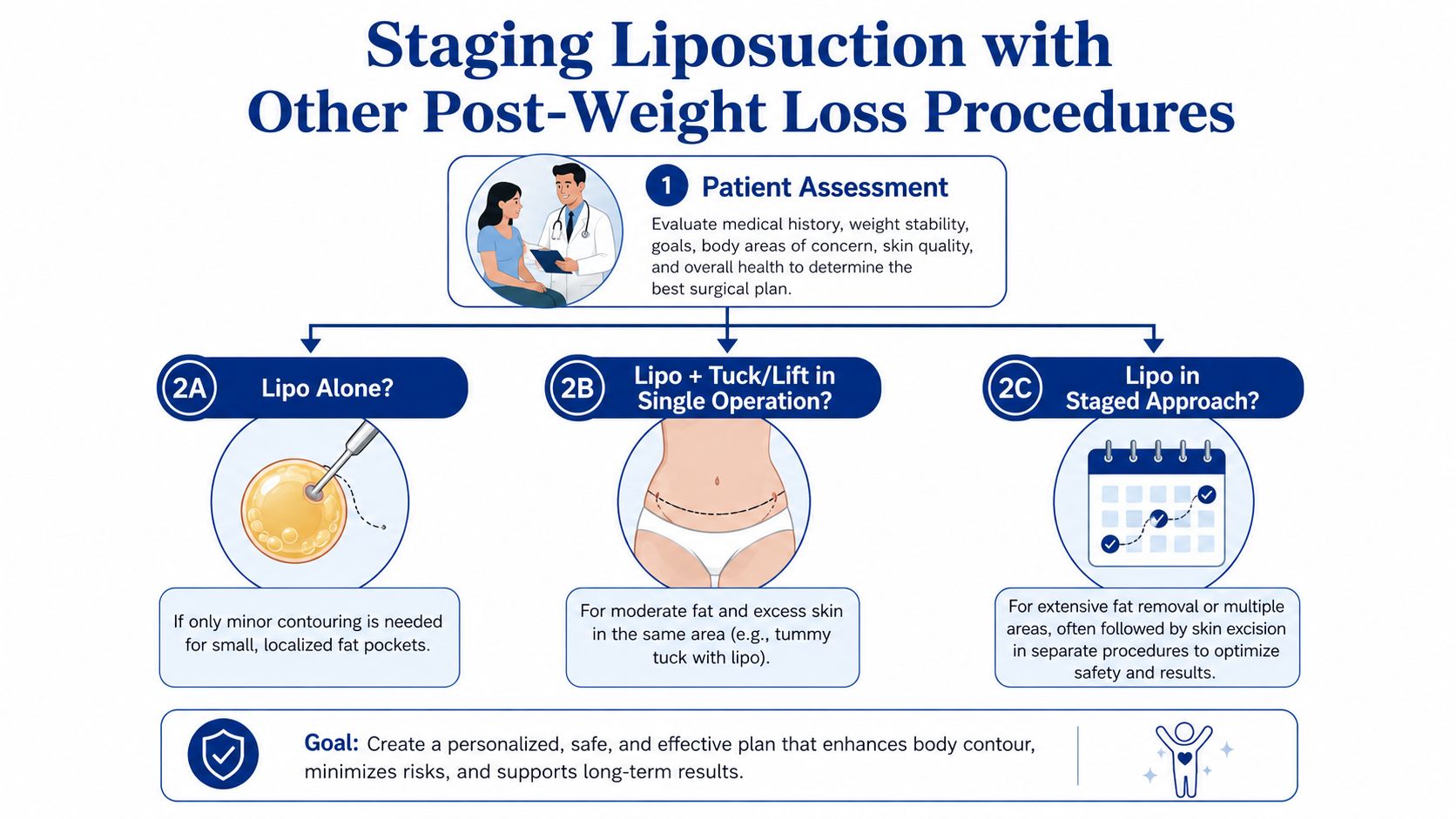
Staging becomes important when a patient has both fat excess and skin excess, but not in exactly the same amount everywhere. In that situation, liposuction can either come first, happen at the same time as a tuck or lift, or wait until after skin surgery. The right answer depends on the skin quality in the area, how much laxity is present, and how much contour refinement is still needed.
Common staging logic
Sometimes liposuction is used to debulk before excision. For example, the flanks may be thinned before an abdominoplasty so the waistline sits better once the abdomen is tightened. In other cases, suction and excision happen together because the surgeon can remove fat and skin in one coordinated operation when the anatomy supports it.
Other times, lipo is safer later. If the skin is already fragile or heavily lax, trying to remove too much fat first can make the remaining envelope even looser. That's why some post-weight-loss patients are better served by skin surgery first, then small contour refinements later if they still need them.
The literature on body contouring reflects that flexibility. Peer-reviewed reviews note that liposuction may be used to debulk localized fat just before excision, and some massive-weight-loss patients are better treated with circumferential liposuction first and excision later. That isn't a universal rule, it's a planning principle.
I also mention Ideal Face & Body here as one practice that focuses on awake, office-based contouring with local anesthesia, because some patients do want a consultation in a setting built around staged body contour planning. That matters less as a brand promise than as a reminder that the anesthesia plan and the staging plan should be discussed together, not separately.
The cleanest decisions come from anatomy, not wishful thinking. If a surgeon explains why one area is ready for suction and another needs excision or delay, that's usually a sign the plan is being customized instead of forced.
Risks, Recovery, and Realistic Before and After Expectations
The most honest before-and-after expectation is this, the shape change can be meaningful, but the scale change is usually modest. A long-term study of 301 liposuction cases reported an average weight change of only 2.2 lb after lower-body liposuction and 4.6 lb when combined with abdominoplasty, even though the treated regions became narrower (301-case study). A different long-term study found that patients maintained more than a 10% reduction in total body fat mass, but metabolic measures such as glucose tolerance, blood pressure, and cholesterol markers didn't change from baseline over follow-up (long-term liposuction study).
What recovery usually feels like
Early swelling is part of the process, not a sign of failure. The first month is about compression, walking, and letting bruising settle. By the third month, contour becomes easier to read, but the body can still hold swelling in a few stubborn places. If liposuction is paired with excision, scar care becomes part of the daily routine.
Risks are real and should be discussed directly. Common ones include contour irregularity, persistent swelling, seroma, asymmetry, and the possibility that a small revision may be needed later if healing doesn't match the plan. Those issues don't mean the surgery was wrong, but they do mean the healing process is not perfectly linear.
A 2023 systematic review found liposuction was associated with a mean body-weight reduction of 2.64 kg, along with decreases in BMI, triglycerides, glucose, insulin, and leptin. The takeaway isn't that liposuction is a metabolic treatment, it's that the visible and measurable effects reported in the literature are still modest and should be interpreted cautiously.
The one-year mark is where the result should feel settled. If body weight stays stable, the treated areas usually reflect the surgical plan much more clearly than they did in the first few weeks.
Choosing a Surgeon for Liposuction After Weight Loss
A good consultation starts with credentials and ends with a plan you can repeat back in plain English. Look for board certification in plastic surgery, experience with post-weight-loss patients, and before-and-after photos of people who started from a similar body type and stage of healing. A surgeon who regularly handles contouring after major weight loss should be able to explain where liposuction ends and skin excision begins.
Questions worth asking
- How do you decide between lipo alone and a staged plan?
- Which areas can be treated now, and which need skin surgery first?
- What type of anesthesia do you recommend, and why?
- What is the revision plan if one area heals unevenly?
- How do you handle patients who still have unstable weight?
You should also pay attention to how the consultation feels. If the discussion jumps straight to aggressive fat removal without addressing skin quality, that's a warning sign. If the surgeon can't explain the scar trade-offs or the recovery timeline, that's another one.

A strong consultation answers three things clearly, what fat can be removed, what skin can't be fixed by suction, and whether the plan should be staged.
Red flags include vague promises, pressure to do everything at once, and any suggestion that liposuction will solve loose skin on its own. The best plan is the one that matches your anatomy, your healing capacity, and your long-term maintenance habits.
If you're comparing options after major weight loss, Ideal Face & Body can evaluate whether your concern is residual fat, lax skin, or both, and help you map out a contour plan that fits the anatomy in front of you. Visit Ideal Face & Body to review your options and start a consultation focused on realistic, body-specific surgical planning.