When people type BBR surgery, they're often looking for one thing and finding three different answers. One person wants to reduce a previous butt augmentation, another wants to revise shape after a BBL, and a third wants a more refined contour without more volume. The acronym gets used loosely, so the first step is learning what problem you're trying to solve.
That confusion matters because the right procedure depends on intent, not just the label. In Beverly Hills, CA, awake contouring is often discussed in terms of how much fat should be removed, where it should be removed from, and whether the goal is reduction, reshaping, or staged refinement. At Ideal Face & Body, the conversation is centered on office-based, local-anesthesia planning, which keeps the focus on safety, control, and realistic contour change.
A helpful way to think about it is this, a garment can be taken in, recut, or adjusted with a softer line. Buttock refinement works the same way. Some cases call for liposuction, some for revision, and some for a gradual plan that respects the skin and the patient's anatomy.
Practical rule: if the request is “less projection,” the operation is usually about removal or redistribution, not simply adding something new.
Table of Contents
- Introduction to BBR Surgery and Why the Term Confuses Patients
- What BBR Surgery Means and How It Differs From BBL
- Understanding Your Procedure Options for Buttock Refinement
- Are You a Candidate for BBR Surgery and What to Ask at Consultation
- What to Expect Before During and After Your Procedure Day
- Safety Risks and Why Technique Matters for Revision Cases
- Recovery Timeline Results and When to Seek a Revision Specialist
Introduction to BBR Surgery and Why the Term Confuses Patients
A typical search starts with a simple question, “What is BBR surgery?” The problem is that the term isn't fixed in everyday use, so patients often land on pages about different goals. Some are trying to undo an overfilled buttock, some are worried about asymmetry after a previous BBL, and some want a cleaner shape after weight change or healing.
That's why the conversation has to start with the outcome, not the acronym. BBR surgery is best understood as a shorthand for buttock reduction, revision, and refinement, especially after a Brazilian Butt Lift. It isn't a single one-size-fits-all operation, it's a category of solutions built around how the buttocks look, feel, and sit on the frame.
A patient might use the same word for a very different problem. One person may want less fullness at the lower pole. Another may want smoother transitions into the hips and back. A third may only need a conservative reshaping because the underlying volume is fine but the contour reads uneven in clothes.
That distinction is why a careful consultation matters more than the name on the search bar. In awake contouring practices, surgeons spend a lot of time matching the plan to the anatomy, the previous surgery, and the patient's tolerance for staged change. A good plan doesn't chase a dramatic label, it solves the specific contour problem in front of it.
What BBR Surgery Means and How It Differs From BBL
BBL means Brazilian Butt Lift, which is gluteal fat grafting, a procedure designed to add volume and shape. BBR, in patient language, usually points in the opposite direction or a corrective direction. Instead of asking, “How do we add more?”, the question becomes, “How do we make this look smaller, smoother, or better balanced?”
BBL is closer to adding fabric. BBR is closer to taking fabric away, re-cutting the line, or adjusting seams so the shape fits better. The goal may be reduction, but it can also be correction of contour irregularities, asymmetry, or an overprojected look that no longer matches the patient's body.
The main difference is the direction of change
A BBL builds volume with fat transfer. A BBR-style plan often uses liposuction, selective reshaping, or staged refinement to reduce projection and improve proportion. In some cases, the surgeon only needs to soften one area. In others, the problem is broader and involves the transition from waist to hip to buttock.
Plain truth: BBR isn't about “making it smaller” in a vacuum, it's about making the silhouette read more naturally from every angle.
This is also why people get confused by before-and-after photos. Two patients can both say they want a BBR result, but one may need removal of excess grafted fat, while another needs contour correction after a prior operation healed unevenly. The technique follows the problem, not the acronym.
For readers who want the basic BBL background first, this internal overview helps frame the original operation: what is BBL surgery.
Understanding Your Procedure Options for Buttock Refinement
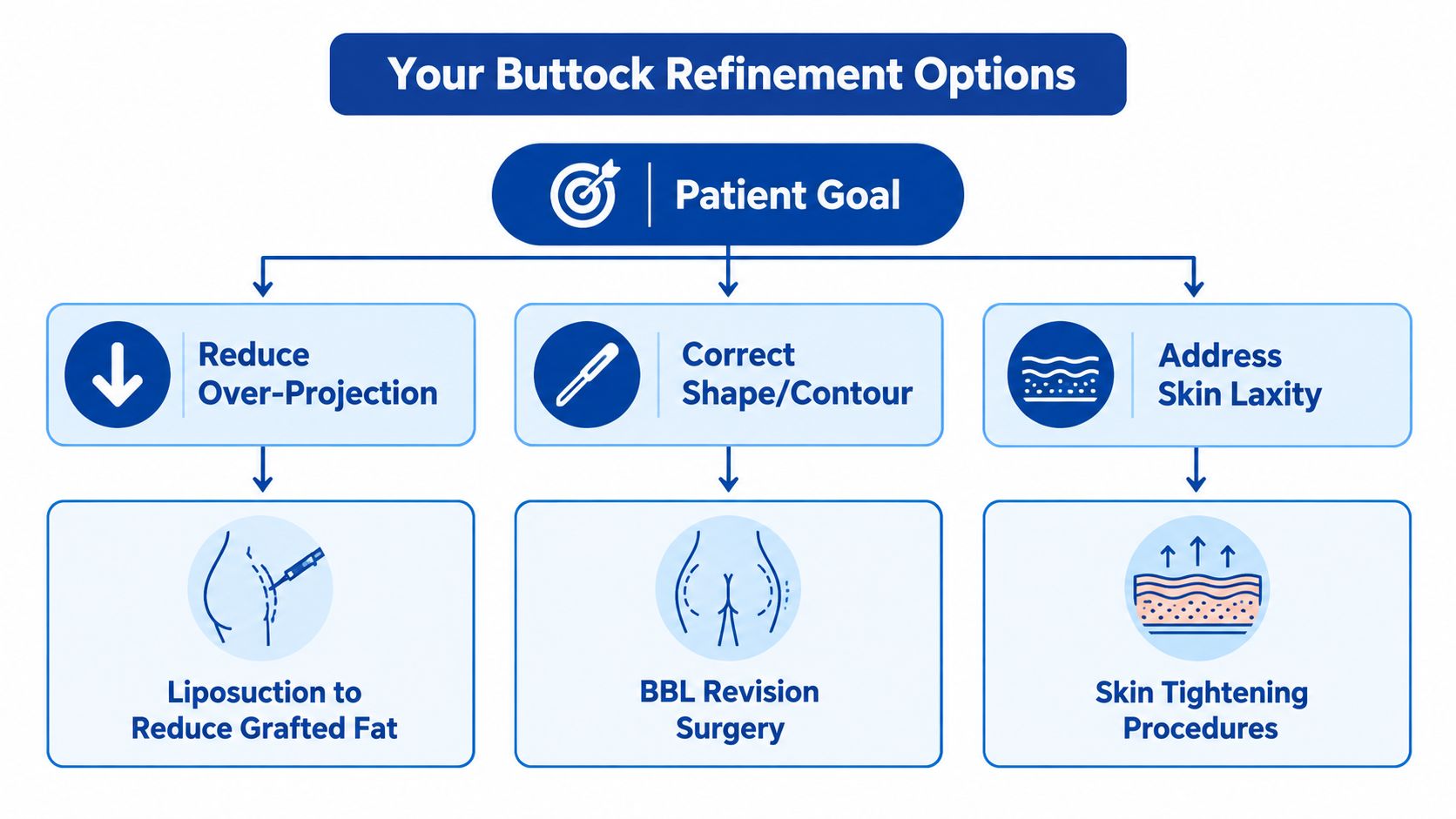
The right option depends on the shape issue you're solving. If the buttocks sit too projected, the plan may center on reduction. If the issue is a dent, a bulge, or an off-center curve, the focus shifts to revision. If the skin line is part of the problem, then tightening or staged improvement may matter just as much as fat removal.
Reduction, revision, and refinement aren't the same job
A BBL reduction is most useful when the buttocks are too full or too projected for the frame. A revision case is different, because the surgeon has to work around prior fat placement, scar tissue, and altered contours. A refinement case can be even more subtle, with the plan aimed at smoother transitions rather than obvious size change.
Awake contouring can help here because the patient stays able to communicate about positioning and comfort while the surgeon works under local anesthesia. That's one reason office-based approaches are appealing for selected cases, especially when the goal is precision rather than dramatic transformation. Ideal Face & Body also uses awake methods in body contouring, including Awake Butt Lift planning and PRECISION SCULPT laser liposculpting for selected patients.
One decision framework that helps patients sort the options
- Too much projection: liposuction or reduction-focused reshaping may be the relevant path.
- Uneven shape after a prior BBL: revision work may be needed to smooth one side or restore balance.
- Need for a softer overall line: conservative contouring may be enough, especially if the skin quality is still good.
- Need for fat transfer elsewhere: in some plans, fat may be redirected to another contour area when that makes the silhouette more balanced.
The most important point is that “more surgery” isn't automatically better. The best plan is the one that matches the anatomy and avoids forcing a deeper or more aggressive correction than the tissues can support. In Beverly Hills, CA, that usually means a careful, conservative conversation before any procedure is booked.
Are You a Candidate for BBR Surgery and What to Ask at Consultation
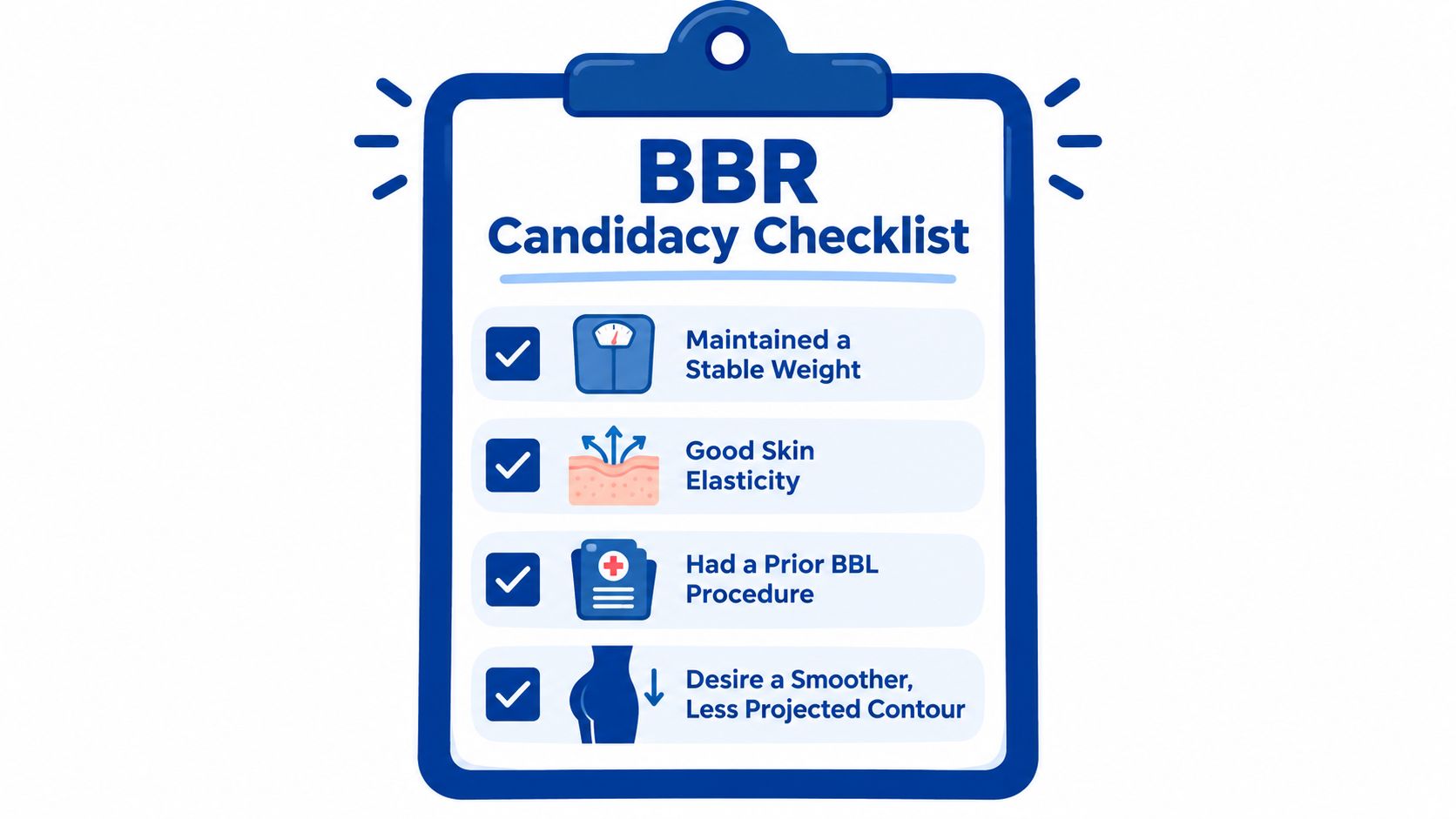
Good candidacy starts with stable weight and realistic goals. If the body is still changing, contour work can be harder to predict. Skin quality matters too, because loose skin and strong skin elasticity don't respond the same way to liposuction, revision, or reshaping.
Prior BBL history also matters. A patient who had grafted fat placed before may have scar tissue, uneven fat survival, or a shape that needs correction rather than more volume. That's why the consultation should include the full surgical history, what feels wrong now, and what result would feel like a success.
What to bring and what to ask
Bring records if you have them, but don't worry if you don't. Clear photos, a simple explanation of what bothers you, and a timeline of how the shape changed after surgery can be enough to start. Ask directly how the surgeon would reduce projection, whether the plan would be staged, and what part of the contour can realistically improve under local anesthesia.
Useful question: “Is my concern really about volume, asymmetry, skin laxity, or all three?”
If awake surgery is being considered, ask how comfort is managed during the procedure and how the surgeon checks positioning while you remain conscious. If the plan might involve multiple steps, ask what gets done first and what should wait. That matters because a safe plan often favors control over speed.
Virtual and out-of-town consultations are available through the Beverly Hills practice, which helps patients sort out candidacy before they travel. If you're comparing approaches, ask about the difference between refinement and dramatic reduction, because those are not the same promise. For some patients, cost varies by the individual plan, and that's best discussed after the anatomy is reviewed.
What to Expect Before During and After Your Procedure Day
The day starts long before the first incision. You'll review the plan, confirm the areas being treated, and go over comfort measures and markings. In awake contouring, that early conversation matters because it gives the surgeon and patient one last chance to align the target shape with what's on the table.
During the procedure, local anesthesia keeps the area numb while you stay awake and able to respond. That doesn't mean the experience feels dramatic. It usually means you're aware, comfortable, and able to shift or give feedback when the team asks about position or pressure.
The day-of flow usually feels sequential, not chaotic
At Ideal Face & Body, many body contouring procedures are done without general anesthesia or IV lines. That can make the process feel more contained, especially for patients who prefer a focused office setting over a hospital-style experience. The surgeon then performs the planned liposuction or contouring with attention to the targeted plane and the patient's anatomy.
Afterward, immediate aftercare centers on compression, wrapping, and instructions for movement. Swelling is expected, and the body needs time to settle before the contour reads clearly. Patients usually leave the office the same day once the team is satisfied that the plan is stable and the recovery instructions are clear.
A few sensation cues help set expectations
- Numbness with awareness: you may feel movement or pressure, but not the sharp sensation people fear.
- Positioning guidance: the team may ask you to shift so they can assess symmetry and contour.
- Compression after treatment: this is part of shaping, not just comfort.
- Gradual mobility: walking and daily movement usually return before the final result is visible.
A patient considering awake contouring should think in terms of staged settling, not instant final shape. That mindset makes recovery less stressful and helps people judge results fairly.
Safety Risks and Why Technique Matters for Revision Cases
Gluteal fat grafting drew intense scrutiny because the key danger came from fat embolism, especially when fat was placed too deep. The modern safety consensus is simple and strict, fat should stay in the subcutaneous plane and should never cross the gluteal fascia. Multiple expert bodies also recommend real-time ultrasound guidance to confirm cannula position, because the danger is tied to unintended intramuscular or subfascial placement. The 2018 multisociety safety advisory reported an estimated mortality rate of about 1 in 3,000 and warned that fat should never be placed in the muscle, while later estimates suggested the risk may be closer to 1 in 15,000, similar to abdominoplasty mortality risk. A 2020 analysis reported pulmonary fat embolism incidence fell from 1 in 1,030 in 2017 to 1 in 2,492, while mortality declined from 1 in 3,448 in 2017 to 1 in 14,952 in 2019 after the safety recommendations were adopted. These figures are in the BBL safety advisory, and they shaped current technique.
Revision cases deserve extra caution because the anatomy isn't fresh. Scar tissue can change how a cannula moves, and previous fat placement can distort the normal layers. Expert reviews emphasize shallow cannula control, avoiding downward angulation, and using a stiff cannula at least 4 mm wide to reduce tip deflection, which is one reason technique training matters so much in revision work. The anatomic rationale is laid out in a surgical task-force review on safe gluteal fat grafting (safe technique review).
Why revision planning is more conservative
If the desired change would require too much fat removal from the subcutaneous layer, surgeons should stage the work rather than push deeper. British, Canadian, and New York guidance converge on that practical idea, and one Canadian position statement recommends limiting injected fat volume to no more than 600 mL per buttock in grafting contexts, while keeping the cannula moving and the pressure low to avoid forceful bolus deposition (BAAPS safety recommendations). The point isn't just volume, it's control.
Safety takeaway: in revision cases, the surgeon's ability to stay shallow and controlled matters more than any promise of a bigger visual change.
For patients who want a focused overview of the safety framework, this internal resource explains the practice's approach to careful fat transfer planning: safe fat transfer to the buttocks safe Brazilian butt lift.
Recovery Timeline Results and When to Seek a Revision Specialist
Recovery starts with swelling, tenderness, and the normal uncertainty that comes after body contouring. Early shape is not final shape. The tissues need time to settle, and fat survival continues to declare itself over weeks and months, so patience is part of the process.
A practical way to think about recovery is in phases. First comes basic mobility and compression use. Then comes gradual return to sitting, exercise, and daily routines. Final contour assessment happens later, once swelling has quieted and the body has had time to reveal what the procedure accomplished.
When to ask for a specialist opinion
If the contour still looks uneven after healing has matured, that may point to residual fullness, asymmetry, or a scar-related shape issue. Persistent dissatisfaction with projection, a visible step-off, or a result that doesn't match the original plan are all good reasons to seek a revision specialist. Some patients only need observation, but others benefit from a targeted second-stage plan.
The internal recovery guide for fat transfer cases is a useful companion for home planning: fat transfer to buttocks recovery. For general home setup ideas, preparing your home for surgery recovery is a practical resource on comfort, organization, and making the first days at home easier.
Good recovery habit: keep the environment simple, the instructions visible, and the follow-up schedule clear.
If you're deciding whether a result needs refinement, compare what you see now with the original goal, not with social media after photos. The right specialist will help you separate normal healing from a contour problem that needs correction. That distinction saves time, reduces anxiety, and keeps the next step focused on the issue.
If you're considering BBR surgery or want a careful second opinion on reduction, revision, or refinement, Ideal Face & Body offers awake, office-based body contouring in Beverly Hills, CA with a focus on local-anesthesia planning and precise technique. Visit Ideal Face & Body to review the options and request a consultation that matches your anatomy, your recovery expectations, and your goals.