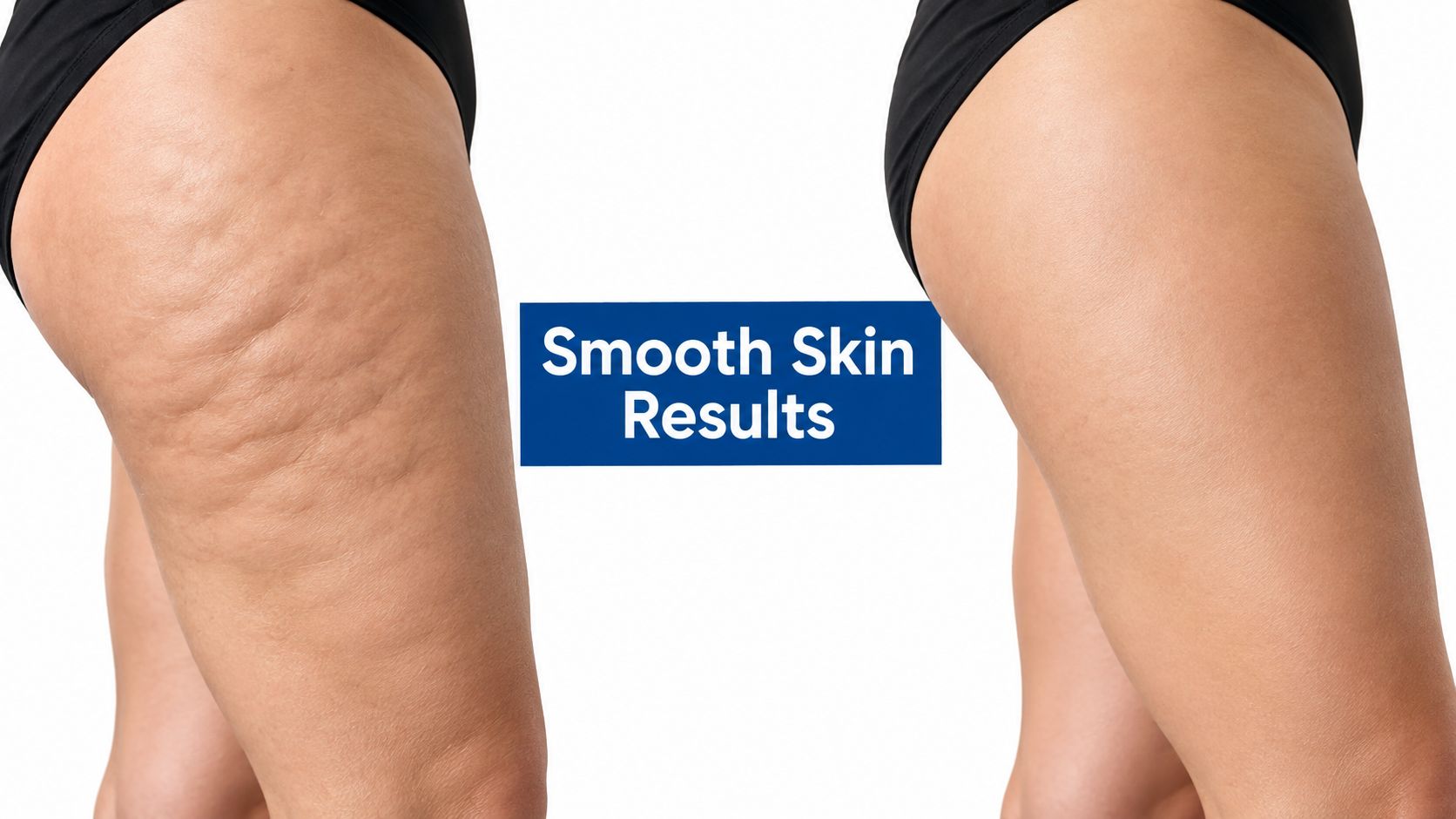
You may be comparing two photos on your phone, wondering whether the smoother-looking result reflects a real change or just different lighting and posture. That's a fair question. Before-and-after cellulite removal should show a reduction in dimpling or unevenness, not promise that normal skin texture will disappear forever.
The right comparison starts with the concern being treated: tethered dimples, loose skin, or contour irregularity. Those features have different causes and may respond to different approaches. Treatment choice, cellulite severity, skin quality, and the way photos are taken all affect what you see.
Table of Contents
- What Before and After Cellulite Removal Really Shows
- Why Cellulite Looks the Way It Does
- Main Treatment Families and the Changes They Produce
- Gallery-Style Case Examples and What Each One Shows
- How to Read Before and After Photos Honestly
- Who Is a Good Candidate and How Results Are Maintained
- Choosing a Treatment Path and Preparing for a Consultation
What Before and After Cellulite Removal Really Shows
A credible before-and-after pair documents a change in severity, such as shallower dimples, a smoother contour, or a lower rating on a standardized scale. It doesn't prove that cellulite has been erased permanently. A 2024 review found 24 randomized controlled trials covering 2,084 patients, with mean follow-up of approximately 3.33 weeks, a short window for judging how durable a result may be.
Percentages in research also need context. In that review, collagenase treatment was associated with clinician-rated improvement of 17.0% and patient-rated improvement of 25.7% on photonumeric severity assessments. Those figures describe ratings, not a percentage of the body becoming smooth. They don't mean that every dimple vanished or that every patient would see the same change.
Read the result as a comparison, not a promise
Think of a severity rating as a way to describe the overall appearance of an area. A modest score change may correspond to a visible softening of deeper dimples while some texture remains, especially when the skin is relaxed or the lighting is angled. The rating doesn't translate neatly into a universal “before” and “after” for every body.
Study design matters, too. A short follow-up may capture an early appearance before tissue changes have settled, while an uncontrolled photograph can't separate treatment effects from posture, lighting, or other factors. Stronger evidence describes who was treated, how the result was assessed, and how long patients were followed.
In the sections ahead, the focus is on what cellulite is, which treatment families target which visible changes, and how to assess gallery photos and maintenance needs. The practical takeaway is simple: look for a measured reduction in dimpling or irregularity, not a filter-like promise of permanent smoothness.
Why Cellulite Looks the Way It Does
Under the skin, fat lobules sit like small pillows. Connective-tissue bands anchor the skin to deeper layers. When some bands pull downward while the tissue between them pushes upward, the surface can look dimpled. The visible pattern depends on how these structures interact, not just on how much fat is present.
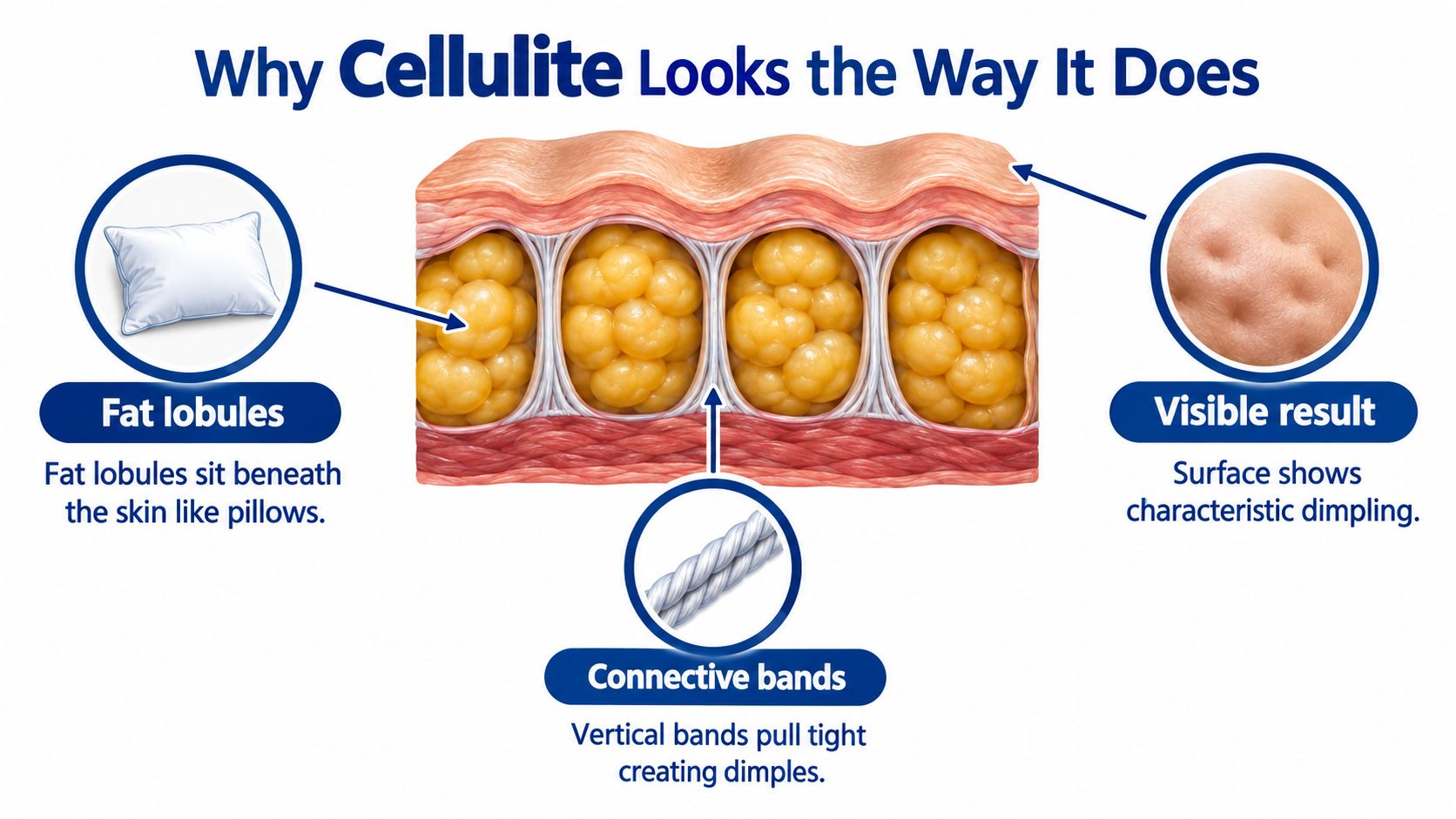
Reviews estimate that approximately 80%–90% of postpubertal women have cellulite, often on the thighs, buttocks, and hips, while fewer than 10% of men are affected. The difference reflects structural and hormonal influences. Cellulite is not a sign of excess weight, and it can be present in people with a range of body sizes.
Why appearance can matter
Cellulite is common, but that doesn't make someone's concerns about it trivial. A clinical review notes that cellulite can have substantial psychosocial and quality-of-life effects. Patients may feel self-conscious about dimpling even when it has no bearing on health or fitness.
This is also why a before-and-after photo should be interpreted in relation to the tissue being treated. A reduced dimple may reflect a change in how the bands tether the skin; it doesn't necessarily indicate fat loss or a change in overall body shape. For a related discussion of how hip contours can vary through different life stages, see this guide to hip dips for perimenopause.
Practical rule: Match the visible change to the underlying concern. A smoother dimple pattern is not the same outcome as tighter skin or reduced volume.
Main Treatment Families and the Changes They Produce
Treatment selection makes more sense when it starts with the feature you want to change. Subcision addresses tethering: a needle or specialized instrument releases bands beneath a dimple, so photos may show a shallower indentation rather than a smaller overall thigh. Energy-based treatments, including radiofrequency and laser approaches, are generally discussed for skin texture or contour changes. Shock-wave therapy is another option that aims to improve the appearance of uneven skin, though results vary by method and evidence.
A multicenter study of a three-step, minimally invasive 1,440-nm Nd:YAG laser treatment reported mean improvement scores at six months of 1.7 points for cellulite dimples and 1.1 points for contour irregularities on five-point scales. Physician satisfaction averaged 5.6/6, and patient satisfaction averaged 5.3/6 (clinical study of 1,440-nm laser treatment). These scores indicate reported improvement, not guaranteed removal.
Compare the visual goal
| Treatment family | Mechanism | Typical change in photos | Typical sessions |
|---|---|---|---|
| Subcision | Releases bands that pull the skin down | Reduced dimple depth, with little expected change in overall volume | Often planned as a procedure, with need based on the pattern and treatment plan |
| Energy-based devices | Uses heat or other energy to address skin texture and contour | Smoother-looking skin or softer irregularity | May involve a series; the plan varies by device and response |
| Collagenase-based injectables | Targets structural components associated with dimpling | A change in severity ratings, not full surface erasure | Determined by the treatment protocol and clinician |
| Surgical or combined contouring | Addresses selected contour concerns, sometimes alongside other treatments | Potentially broader reshaping, with recovery and risks dependent on the procedure | Individualized |
Collagenase Clostridium histolyticum-aaes has shown statistically significant clinician- and patient-rated improvements in randomized trials, but the evidence should be read through the limitations of follow-up and study design. More extensive surgical or combination approaches may produce more visible contour changes, but they also bring procedure-specific recovery and trade-offs. Topical cellulite products haven't received U.S. FDA approval for durable clinical efficacy, while device-based options have reached FDA clearance or approval milestones.
For patients comparing non-invasive approaches for skin texture, Venus Legacy for cellulite reduction describes a device-based option. No single treatment is automatically the right match: the key question is whether the photo goal is less dimpling, improved skin appearance, or a broader contour change.
Gallery-Style Case Examples and What Each One Shows
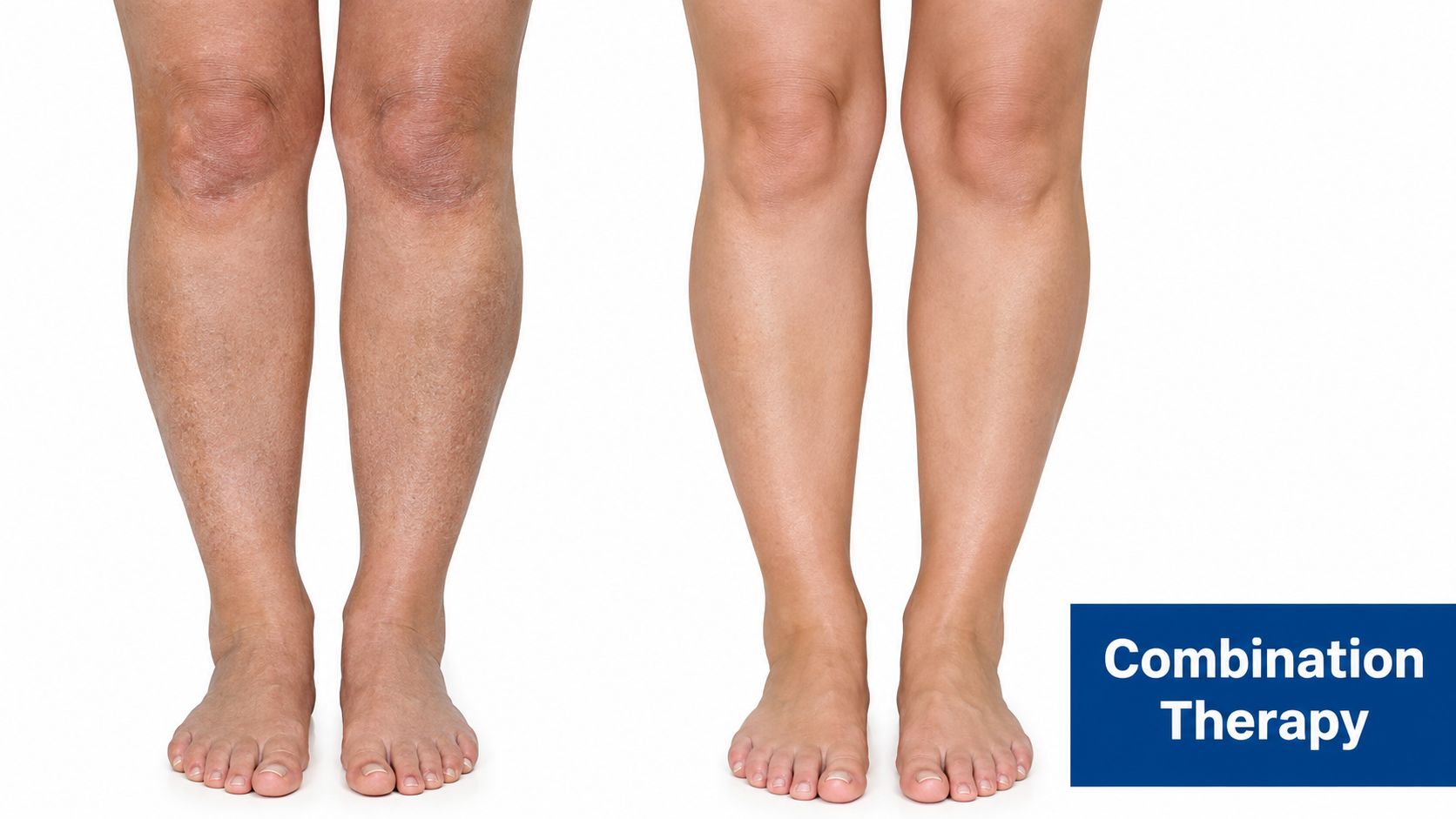
Dimple-focused example: A patient whose main concern is a small number of persistent indentations may consider subcision. The gallery change to look for is a shallower pull in the treated dimples, not an overall reduction in thigh or buttock size. The number of treatments and recovery depend on the area and the clinician's plan; temporary bruising, tenderness, or swelling can affect the early appearance.
Energy-based smoothing example: Someone more concerned with diffuse uneven texture than distinct tethered dimples may discuss an energy-based treatment. A series of sessions may be recommended, with the photographs showing smoother light across the skin rather than a dramatic alteration in body shape. Results and downtime vary with the device and treatment settings, so ask what the practice expects for your specific plan.
Read each example by its goal
Contour plus laxity: A patient with both dimpling and nearby skin laxity may need a combination plan. The expected image may show more even contour, but no single procedure should be described as fixing every cause of surface irregularity. A consultation helps separate what can be treated together from what needs a different approach.
Maintenance-focused example: A person who has already improved may choose follow-up care based on how the skin and contour change over time. That doesn't mean a repeat session is always required. It means the plan accounts for the possibility that one intervention won't address every concern indefinitely.
A randomized controlled trial of 55 women with moderate-to-severe cellulite found a mean 2.1-point improvement on the Cellulite Severity Scale at three months and 2.0 points at 12 months after a single procedure, based on blinded assessments of standardized photographs (controlled trial with 12-month follow-up). This is a severity-scale change, not a promised percentage reduction or complete disappearance.
Ideal Face & Body is located in Beverly Hills' Golden Triangle and performs awake, office-based procedures under local anesthesia for related body-contouring goals. The practice no longer offers breast implant placement, implant-based breast augmentation, or breast implant revision. To review cellulite treatment images, see the Avéli treatment gallery.
How to Read Before and After Photos Honestly
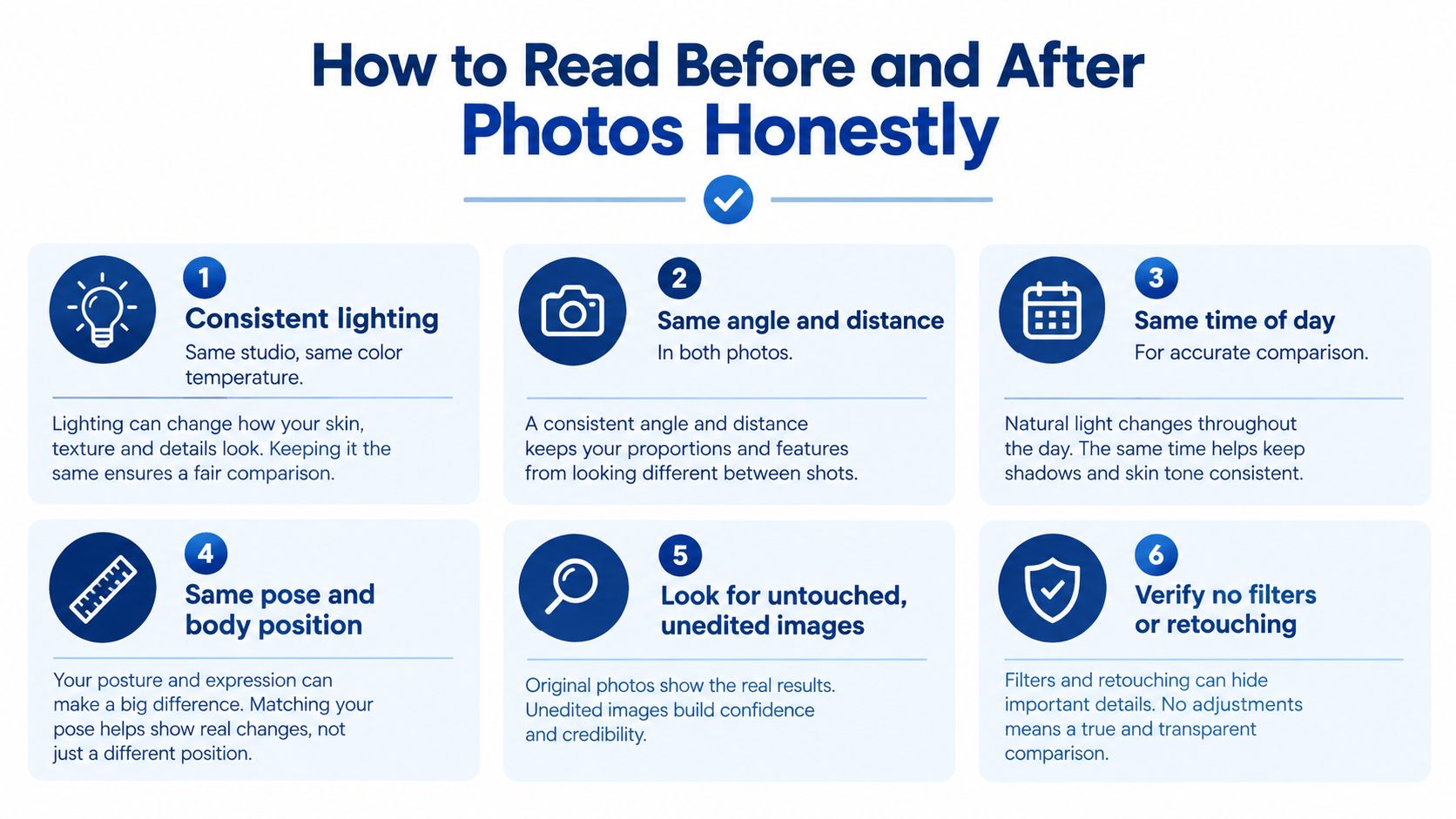
Start with the conditions of the photographs. The same lighting, camera height, distance, lens, pose, and muscle relaxation make a comparison more useful. If the “after” photo uses stronger side lighting, a different stance, or a flexed leg, the skin can look smoother even when the tissue hasn't changed by the same amount.
A practical photo checklist
- Match the setup: Look for the same lighting, angle, camera distance, and body position in both images.
- Check the timing: A photo taken soon after treatment may not represent the settled result. Ask when follow-up images were taken.
- Look across the treated area: One flattering angle can conceal dimpling that remains nearby.
- Ask how severity was scored: A validated scale such as the Cellulite Severity Scale adds structure beyond a casual visual impression.
- Look for both viewpoints: Clinician ratings and patient-reported experience can offer different, complementary perspectives.
Subcision-related improvement may become visible as soon as one month after the first treatment, according to the Cleveland Clinic's overview and the American Academy of Dermatology's discussion of cellulite treatments. An early photo can be informative, but it can't answer every question about durability. Longer follow-up matters because skin and connective tissue continue to change.
When you track your own progress, keep the same photo conditions each time rather than relying on memory or a single snapshot. This guide to tracking workout progress the right way offers a helpful framework for consistent comparisons. The same principle applies here: standardize the record before judging the result.
Who Is a Good Candidate and How Results Are Maintained
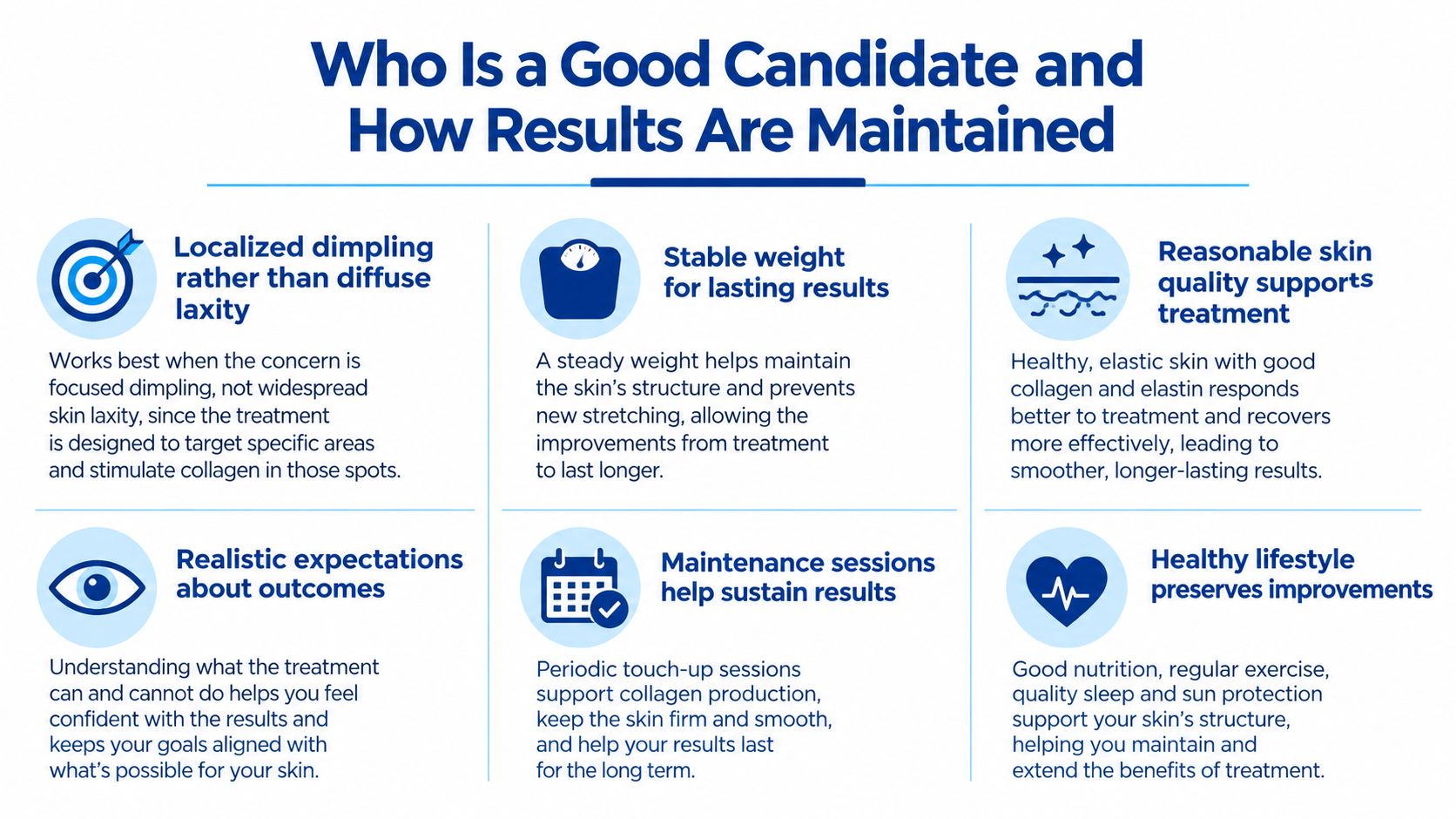
A good candidate often has localized dimpling that remains noticeable despite a stable weight, reasonable skin quality, and realistic expectations. Someone whose main concern is diffuse laxity may not get the change they want from a treatment that targets tethered bands. Matching the treatment to the anatomy matters more than choosing the most dramatic-looking gallery image.
Protect the result with realistic habits
- Keep weight reasonably stable: Significant weight changes can alter the contour around treated areas.
- Support the underlying muscle: Strength training can help maintain overall body contour, though it won't release cellulite bands.
- Care for skin quality: Hydration and appropriate skin treatments, such as microneedling or energy-based skin work when indicated, may form part of a broader plan.
- Plan for follow-up: Some patients choose periodic maintenance rather than expecting one procedure to be definitive.
A maintenance plan should be based on what changed and what remains. A patient with softened dimples but persistent laxity may need a different discussion from someone whose skin texture is the main concern. Broader body-contouring options, including laser liposculpting for nearby areas, can be discussed when appropriate, but they don't replace treatment directed at tethering.
For readers thinking about weight management over time, this resource on sustainable weight loss for every life stage offers broader lifestyle context. Healthy habits can support the overall result, but they can't guarantee that cellulite will disappear or stay unchanged.
Choosing a Treatment Path and Preparing for a Consultation
Begin by naming the change you want to see. If distinct dimples remain despite a stable weight, ask whether a tether-focused option such as subcision is appropriate. If the surface looks uneven because of laxity, discuss skin-quality or energy-based approaches. If the concern is broader contour irregularity, ask whether a contouring plan is relevant, while keeping its recovery and limits in view.
Bring specific questions to the consultation:
- Which severity scale or photo protocol will you use?
- When should I expect to assess the result, and what follow-up is available?
- How many sessions are typical for this concern?
- What downtime and maintenance should I plan for?
- Which visible changes are realistic for my skin and cellulite pattern?
Ideal Face & Body, led by double board-certified plastic surgeon Dr. Justin Yovino and physician injector Dr. Sarah Yovino, offers awake, office-based procedures under local anesthesia for related body-contouring goals from its Beverly Hills location. Virtual and out-of-town consultations are available. The practice no longer offers breast implant placement, implant-based breast augmentation, or breast implant revision procedures; patients considering other contouring approaches can review alternatives to CoolSculpting for inner thighs.
If cellulite dimpling or uneven contour is affecting how you feel in your clothes, schedule a consultation with Ideal Face & Body to discuss which treatment matches the change you want and what results are realistic. Explore the practice's options and request a consultation with Ideal Face & Body.