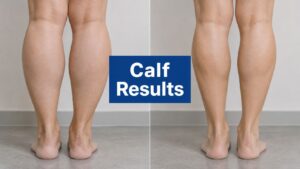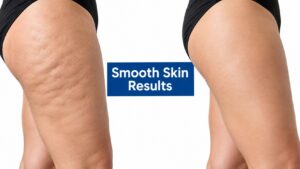
You're looking at your waist in the mirror, wondering whether a flatter stomach would give you the shape you want, or whether your buttocks also need more volume. The difference between liposuction and BBL matters because those goals require different surgical decisions. Removing fat and transferring fat aren't interchangeable, even when they're discussed in the same consultation.
Table of Contents
- The Question Most Patients Actually Bring to Consult
- What Each Procedure Actually Does
- Side-by-Side Comparison at a Glance
- Why BBL Is Really a Two-Stage Decision
- Where the Real Safety Difference Lives
- Awake and Office-Based Approaches
- Matching the Procedure to the Goal
- Consult Checklist and Practical Next Steps
The Question Most Patients Actually Bring to Consult
A patient sits down wanting a flatter midsection, a more defined waist, and better waist-to-hip proportion. She's saved photos of results she likes, but she doesn't know whether the change came from removing fat, adding volume, or both. Her question sounds simple: Do I need liposuction or a BBL?
The first answer shouldn't be a procedure name. It should be a conversation about what she wants to change. Is she unhappy with abdominal fullness, the transition between her waist and hips, limited buttock projection, or some combination?
Those concerns can look similar in clothing while requiring different treatment plans. A person who wants less fullness around the flanks isn't necessarily asking for larger buttocks. Another person may be satisfied with her waist but want a rounder gluteal contour.
Separate the desired changes
The consultation needs to distinguish the patient's goals before discussing technique:
- Donor-area goals: Where does she want less fullness, and what contour would she consider successful?
- Recipient-area goals: Does she want added buttock or hip volume, or a different surrounding silhouette?
- Acceptable trade-offs: How does she feel about additional recovery restrictions, uncertain retained volume, and possible revision?
This isn't a checklist for choosing the most extensive operation. It's a way to prevent a treatment plan from drifting beyond the original concern.
Consultation principle: Wanting a more defined waist doesn't automatically mean wanting buttock augmentation.
The surgeon also has to evaluate whether the available tissue supports the requested result. A desired silhouette is a starting point for discussion, not proof that the anatomy can deliver it.
For this hypothetical patient, the decision is a chain: identify the unwanted fullness, define any desired augmentation, assess the available tissue, and understand the consequences of each surgical step. Until those questions are answered, choosing between procedure names is premature.
What Each Procedure Actually Does
Liposuction is subtractive. A surgeon uses a cannula, a narrow surgical tube, to remove localized fat beneath the skin and improve contour. Common treatment areas include the abdomen, flanks, thighs, and back; the intended endpoint is less localized volume and a smoother outline, not added fullness elsewhere.
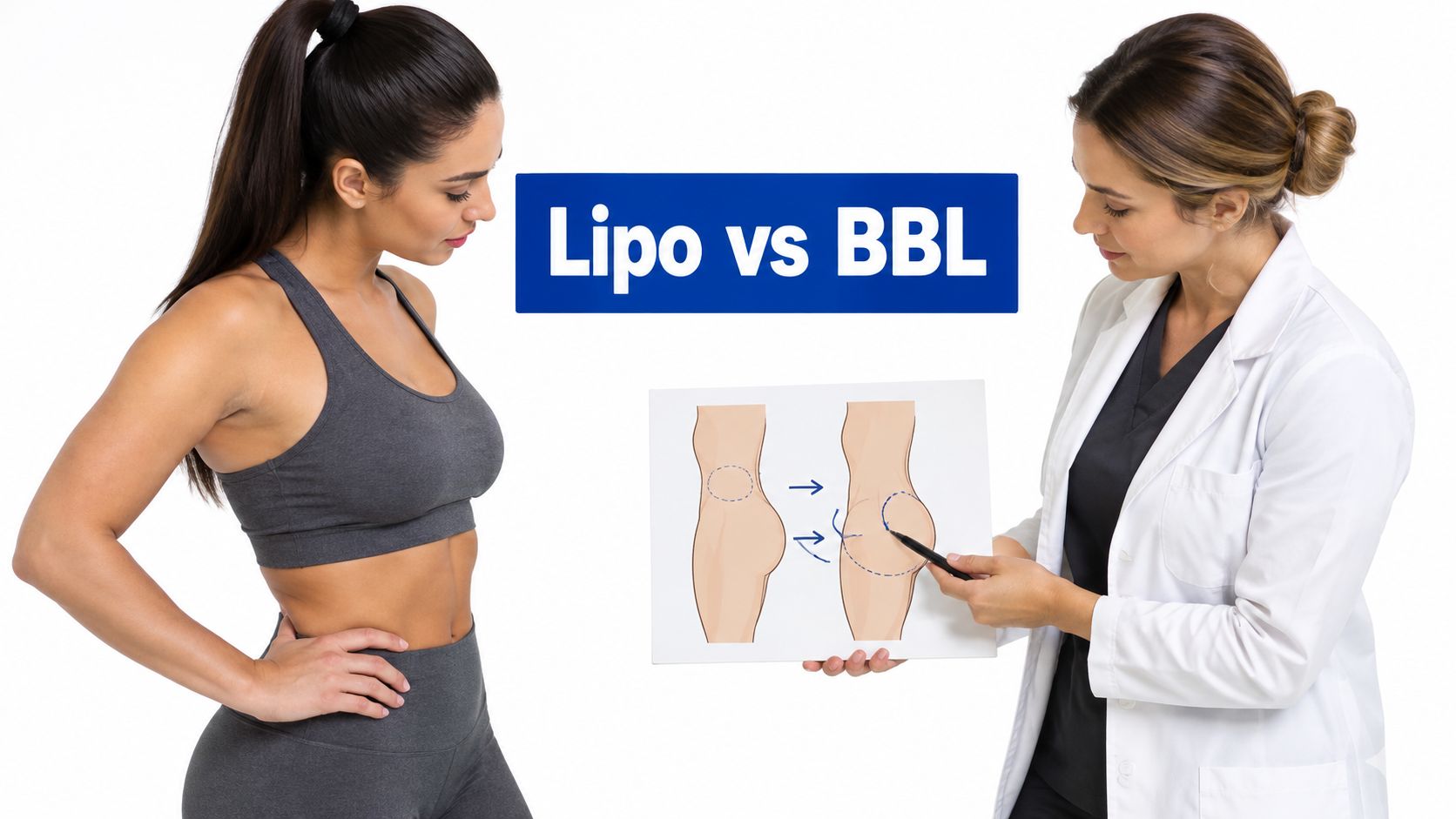
The clinical distinction is straightforward: liposuction removes fat, while BBL combines removal with autologous fat transfer. Autologous means the transferred tissue comes from the patient's own body.
Removal versus removal and placement
A Brazilian butt lift begins with fat harvesting through liposuction. The surgeon then processes the harvested tissue and reinjects suitable fat into the buttocks or hip region to change projection, shape, or selected asymmetries.
That additional placement step changes what the operation must accomplish. The surgeon isn't removing unwanted tissue. The surgeon is also planning where living tissue will be placed and how the recipient region can support it.
The procedure overview on what BBL surgery involves provides additional context for that combination. Despite the name, the defining mechanism is fat transfer, rather than lifting the buttocks.
Different endpoints require different judgments
For liposuction, the assessment centers on the treated donor areas. The important questions concern remaining fullness, contour smoothness, and symmetry.
For BBL, those questions still matter, but they're no longer sufficient:
- Graft retention: How much of the transferred tissue remains after healing?
- Recipient anatomy: Does the planned placement respect the tissue's blood supply and anatomical limits?
- Shape and balance: Does the healed augmentation match the intended proportions?
These distinctions are described in a review of autologous fat-transfer outcomes and complications, which also identifies donor-site deformity as a recognized problem after harvesting.
A smooth abdomen and a well-shaped buttock are separate outcomes. Calling the combined procedure “body sculpting” doesn't remove the need to evaluate each one independently.
Side-by-Side Comparison at a Glance
Liposuction vs BBL at a glance
| Criterion | Liposuction | Brazilian Butt Lift |
|---|---|---|
| Procedure goal | Reduce localized fullness and refine contour | Add buttock or hip shape while contouring donor areas |
| Primary technique | Cannula-based fat removal | Fat harvesting, processing, and reinjection |
| Anesthesia setting | Local-anesthesia or general-anesthesia approaches, depending on the plan | Awake local-anesthesia or general-anesthesia approaches, depending on suitability |
| Treatment areas | Selected areas with unwanted subcutaneous fat | Donor areas plus the buttocks or hip region |
| Recovery time | Individualized to treatment extent and healing | Individualized, with additional graft-protection requirements |
| Major risks | Bleeding, fluid shifts, clot-related complications, and contour problems | Harvesting risks plus recipient-site and fat-injection risks |
| Candidacy drivers | Defined contour goals, tissue quality, and medical suitability | Those considerations plus sufficient donor fat and appropriate recipient anatomy |
| Expected longevity | Discuss maintenance and weight changes rather than a guaranteed duration | Retained volume must be assessed after healing; enlargement isn't fully predictable |
Which rows should drive the conversation?
Candidacy comes before preference. Liposuction planning requires an assessment of skin quality because removing fullness doesn't answer what the overlying skin will look like afterward. BBL planning adds another constraint: the surgeon needs enough usable donor tissue without sacrificing the contour of the areas being harvested.
The recovery row deserves more attention than a generic return-to-work estimate. Someone with a seated job, a long commute, or limited help at home needs an individualized plan, particularly when protecting grafted areas is part of recovery. A procedure that fits your aesthetic goal but not your postoperative reality may not be the right choice at that time.
Don't compare recovery by asking only when you can leave the house. Ask what you'll be allowed to do once you get there.
Risk also changes with the extent of surgery. Professional liposuction guidance identifies increasing aspirate volume and additional treatment sites as important safety considerations, including concerns about bleeding, fluid shifts, and thromboembolism. A limited treatment and an extensive multi-area operation shouldn't be treated as equivalent just because both are called liposuction.
Finally, the longevity row shouldn't become a promise. Ask what the surgeon expects to remain stable, what may change during healing, and what circumstances would prompt reassessment. The useful comparison is the complete treatment plan, not the procedure label in isolation.
Why BBL Is Really a Two-Stage Decision
A technically successful harvest doesn't guarantee a satisfactory BBL. The donor areas can look balanced while the patient remains disappointed with the buttock result. That's why consent should address donor-area success and recipient-area success separately.
Consider a hypothetical patient whose waist contour heals as planned. She likes how her abdomen and flanks look, but her buttocks appear less full than she expected. The operation hasn't produced a single, uniformly satisfactory outcome, even if the liposuction portion met its goal.
The result isn't fixed on the operating table
Transferred fat doesn't all remain. Some is reabsorbed during healing, and complete BBL recovery can take up to six months. Early fullness therefore shouldn't be treated as a guaranteed final volume.
The practical consequence is uncertainty, not automatic failure. The surgeon and patient need to allow appropriate healing before deciding whether the retained shape meets the original objective.
That discussion should include more than size. A patient may be concerned about unevenness, a contour transition, or a result that feels disproportionate despite adequate retained volume.
What happens if I like my donor-area contour but lose too much buttock volume?
That question should be answered before surgery, not introduced only after disappointment.
Revision deserves its own discussion
A further procedure may involve additional grafting, correction, or staged reassessment. None should be presented as an effortless touch-up. The surgeon must reconsider the remaining donor tissue, recipient anatomy, and whether another operation is justified.
Surgical fat-transfer guidance describes reabsorption, fat necrosis, and fat embolism among the issues patients should understand. Fat necrosis refers to transferred fat that doesn't survive; fat embolism is a different and potentially life-threatening complication.
Before proceeding, clarify:
- Assessment timing: When will the surgeon judge retained volume and symmetry?
- Revision thresholds: Which concerns warrant observation, and which might justify treatment?
- Remaining options: Would enough appropriate donor tissue remain for another transfer?
The direct recommendation is to accept a BBL only if you can accept its retention uncertainty. Don't agree to it based on an assurance of precise, permanent enlargement.
Where the Real Safety Difference Lives
The meaningful safety comparison involves technique, anatomy, and postoperative behavior, not just liposuction versus BBL. Both operations carry surgical risks, but fat transfer introduces an additional hazard that requires specific safeguards.
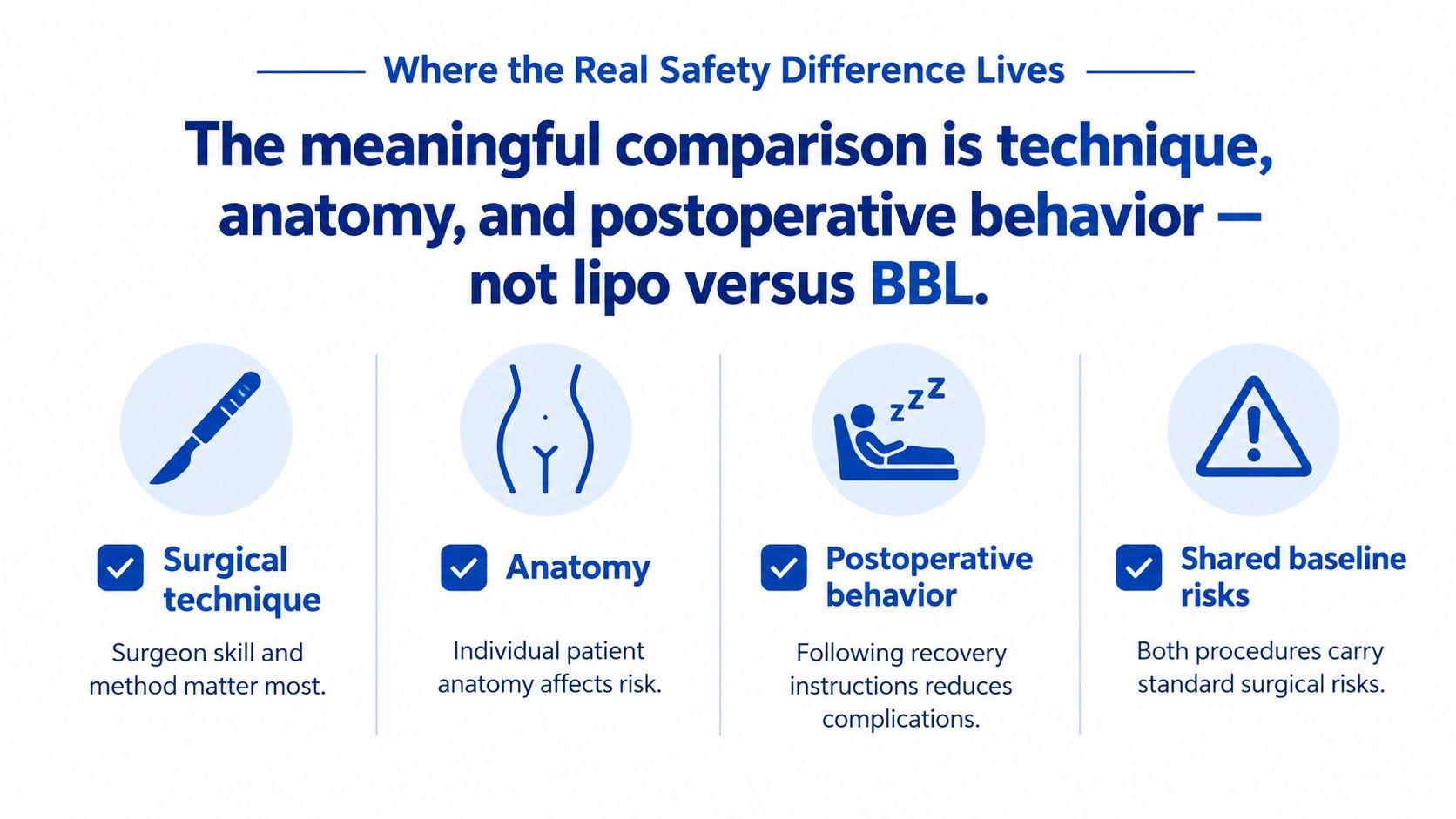
Both procedures can involve bruising, infection, bleeding, contour irregularity, and clot-related complications. BBL adds the danger of injected fat entering vessels near the buttocks and traveling to the lungs. Professional patient guidance explains why avoiding the gluteal muscle is central to reducing pulmonary fat-embolism risk.
Injection depth is a critical distinction
A published review reported a 4% complication rate for subcutaneous grafting, compared with 28.7% when injections involved the intramuscular plane, in the evidence it examined (review of buttock fat-grafting complications). Those figures aren't a personal risk calculator, but they demonstrate why placement depth cannot be treated as a minor technical preference.
Current gluteal fat-grafting safety guidance supports subcutaneous-only placement above the gluteal fascia, real-time ultrasound to confirm cannula position, and a relatively large, stiff single-hole cannula greater than 4.1 mm, along with controlled injection technique.
The corresponding safeguards include:
- Above-muscle placement: Fat remains in the subcutaneous layer, not inside the muscle.
- Direct visualization: Ultrasound confirms where the cannula is during injection.
- Tip control: The surgeon maintains three-dimensional awareness and avoids downward angulation.
- Moving injection: Fat is delivered while the cannula moves, rather than as a stationary high-pressure bolus.
Evaluate the protocol, not the reassurance
Historical and updated BBL risk estimates reflect different techniques and practice conditions. A professional review of gluteal lipofilling safety explains the shift toward safer injection-plane standards and ultrasound guidance. A favorable statistic from one setting doesn't establish the safety of another surgeon's practice.
Use the discussion of safe fat transfer to the buttocks to prepare questions, then request the actual protocol planned for you.
An awake patient still needs these safeguards. Being able to speak during surgery doesn't tell anyone where the cannula tip is.
Awake and Office-Based Approaches
Awake describes the anesthesia approach, not a different category of anatomy. An awake procedure uses local anesthesia while the patient remains awake, rather than general anesthesia. An office-based procedure also changes the treatment setting, which makes facility readiness and patient selection part of the decision.
The awake liposuction and fat-transfer approach includes PRECISION SCULPT laser liposculpting and the Awake Butt Lift. The former addresses localized contouring; the latter incorporates transfer to the buttocks or hip region.

What changes in practice
PRECISION SCULPT treatment areas include the arms, chin and neck, abdomen, flanks, thighs, and calves. In the Beverly Hills, CA office-based setting, many patients avoid general anesthesia and IV lines. Defined postoperative protocols can include custom head and neck wrapping after contouring in those regions.
Those details describe the care pathway. They don't establish that every patient, treatment area, or combination of procedures belongs in an office.
The practical differences to discuss are specific:
- Anesthesia: What will you feel, how will comfort be monitored, and what happens if the planned approach isn't sufficient?
- Facility: What monitoring, emergency equipment, staffing, and transfer arrangements are available?
- Recovery experience: What assistance will you need immediately afterward, and who provides follow-up?
What must remain unchanged
Cannula-based removal still requires careful contour planning. When fat transfer is included, tissue processing and recipient-site planning still require surgical judgment. The injection safeguards described earlier remain relevant regardless of whether general anesthesia is used.
Avoiding general anesthesia may align with your preferences, but preference alone doesn't establish medical suitability. Nor does an office location make an extensive plan automatically appropriate.
Ask the surgeon to explain why the proposed setting fits your health, treatment extent, and ability to tolerate the procedure. A useful answer connects those factors to a specific plan rather than relying on the word “awake” as reassurance.
Matching the Procedure to the Goal
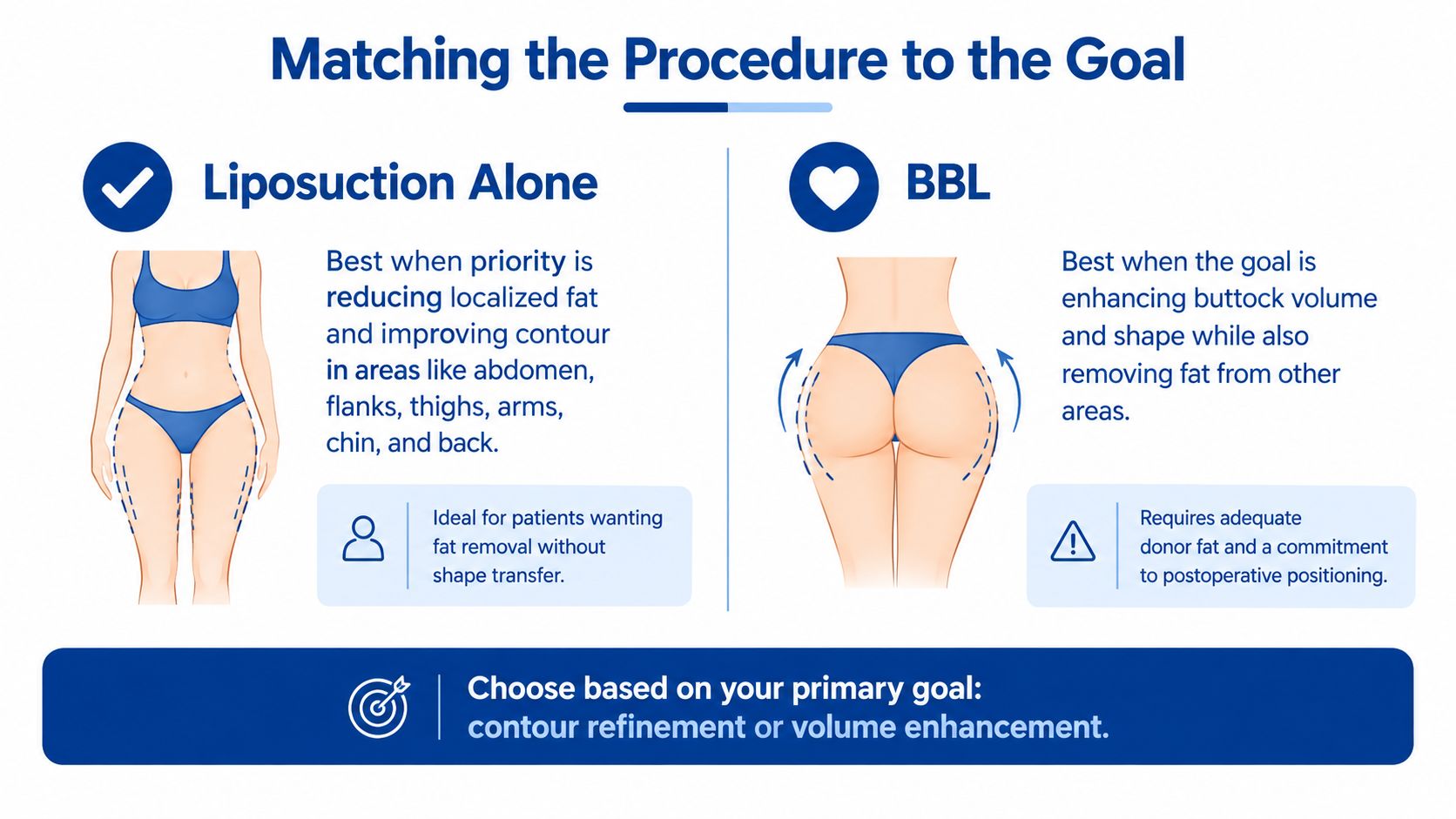
Choose liposuction alone when your actual objective is removal, not augmentation. If you want less abdominal fullness, slimmer flanks, or more refined arms or thighs without adding volume elsewhere, don't add fat transfer because harvested fat is available.
A BBL is the more relevant discussion when you specifically want buttock projection, hip-dip correction, or a change in gluteal proportions. That discussion remains conditional on anatomy and the retention trade-offs already described. Wanting a larger change doesn't make a larger operation appropriate.
Use your daily life as a candidacy test
Bring more than inspiration photos. Explain your work routine, usual sitting time, exercise habits, weight changes, smoking status, and the help available at home. Ask the surgeon how each factor changes the recommendation.
Skin quality also needs a frank discussion. If loose skin is a major part of what bothers you, insist on an explanation of what fat removal can and cannot accomplish in your case. Don't accept a contouring plan that leaves your main concern unanswered.
For BBL, willingness to follow positioning instructions matters to the practical decision. If your schedule won't allow you to avoid prolonged buttock pressure during early healing, resolve that conflict before scheduling surgery.
Decision rule: Choose the smallest surgical plan that adequately addresses your stated goal, not the largest transformation you could request.
Avoiding general anesthesia is a preference, not clearance
Awake options give patients who prioritize local anesthesia another approach to discuss. They don't make someone an appropriate surgical candidate when the underlying medical or anatomical concerns remain unresolved.
Ask for a recommendation in plain language: What specific feature will change, what won't change, and which part of the result is least predictable? Then ask whether the same objective could be met without transfer.
A good consultation may end with liposuction, BBL, a staged plan, or no operation. The defensible choice is the one whose expected benefit justifies its particular burdens for you.
Consult Checklist and Practical Next Steps
Bring these questions to the consultation and request clear answers:
- Placement: For BBL, is fat placed only above the muscle?
- Visualization: Is ultrasound used continuously during injection?
- Technique: What cannula size and injection method are planned?
- Emergencies: Who manages a complication, and what's the transfer plan?
- Positioning: How long must direct sitting be avoided?
- Revision: What's the policy if retention is lower than expected?
For household preparation, DME Superstore's tips for recovering at home can complement, not replace, your surgeon's instructions.
Liposuction removes and reshapes fat. BBL also processes and reinjects it, adding recipient-site safety, retention, and revision considerations. Choose according to your anatomy, goals, and tolerance for those specific trade-offs, not the more dramatic procedure name.
Ideal Face & Body offers awake, office-based contouring with PRECISION SCULPT and the Awake Butt Lift in Beverly Hills, CA. Visit to arrange a consultation focused on whether donor-area contouring alone addresses your goals or whether fat transfer warrants the additional obligations, and bring the safety checklist with you.