“Tiny, hidden scars” is the usual promise about thigh liposuction. It leaves out an important distinction: a small opening doesn't guarantee a flat, pale, unnoticeable mark. Depending on incision placement, cannula movement, how much fat is removed around the access point, and your healing biology, a scar can become indented, raised, wider, or darker.
Most thigh liposuction scars are small access-site marks, not long incisions. But it's more useful to understand what can influence their appearance than to assume they'll disappear. Here's what the marks may look and feel like, how they change as they heal, and what to ask your surgeon before treatment.
Table of Contents
- Why Thigh Liposuction Scars Deserve a Real Conversation
- What Thigh Liposuction Incisions Actually Look Like
- The Healing Timeline You Should Expect
- What Really Controls How Visible the Scar Becomes
- How Awake Office-Based Techniques Reduce Scar Risk
- Liposuction Entry Scars vs Thigh Lift Scars
- Treatment Options for Scars That Do Not Settle
- Realistic Expectations and Questions for Your Surgeon
Why Thigh Liposuction Scars Deserve a Real Conversation
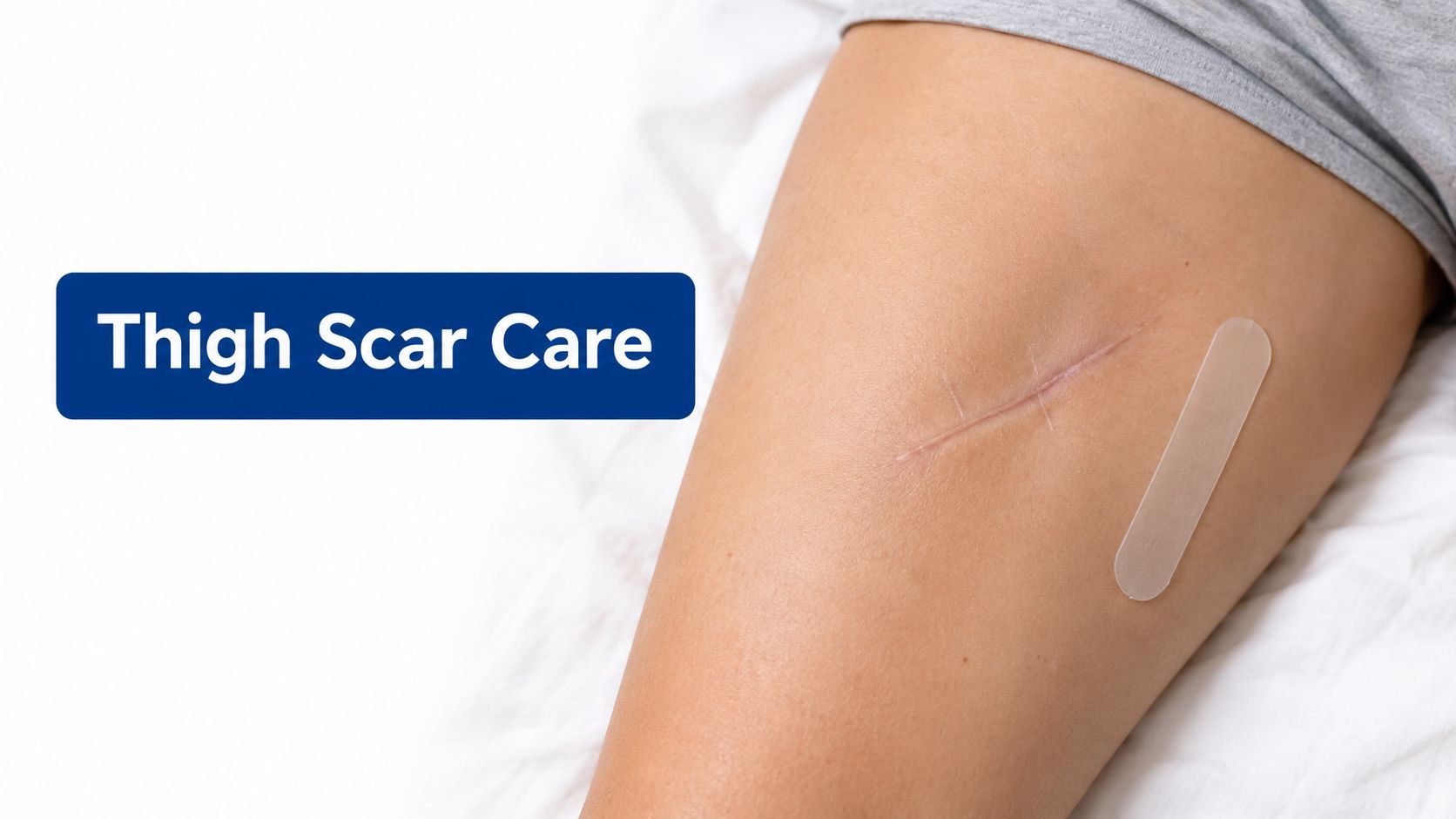
A small incision is a starting point, not a promise of an invisible scar. Cannula-entry incisions for liposuction have historically measured about 0.5–1.2 cm, and surgeons choose their placement to hide marks in natural creases or less noticeable areas. Even so, a small entry point can heal with an indentation, raised tissue, or darker pigmentation if the skin or tissue around it is injured or responds strongly during healing. A clinical review of unfavorable liposuction outcomes describes visible or depressed scars associated with poor placement or excessive suction near the entry point.
It helps to separate the size of the original opening from the quality of the final scar. A mark can be small in diameter but noticeable because it's darker than the surrounding skin or pulls inward. Another may be slightly raised or firm before it gradually softens. Those changes don't automatically mean something has gone wrong, but they do deserve attention if they worsen rather than settle.
Practical rule: Look at the incision and the surrounding contour. A scar can affect appearance through color, texture, or a small indentation, even when the opening itself was tiny.
Historical accounts also help clarify why “thigh scars” can mean very different things. Older excisional thigh-lift techniques could leave long, depressed, sometimes wide scars, while cannula-based liposuction generally creates limited access scars. A historical clinical review describes this difference and notes that small stab incisions often heal well.
Before deciding whether a scar-related claim applies to you, confirm which procedure is being discussed. Isolated thigh liposuction and a thigh lift don't leave the same pattern of scars or involve the same wound-healing demands.
What Thigh Liposuction Incisions Actually Look Like
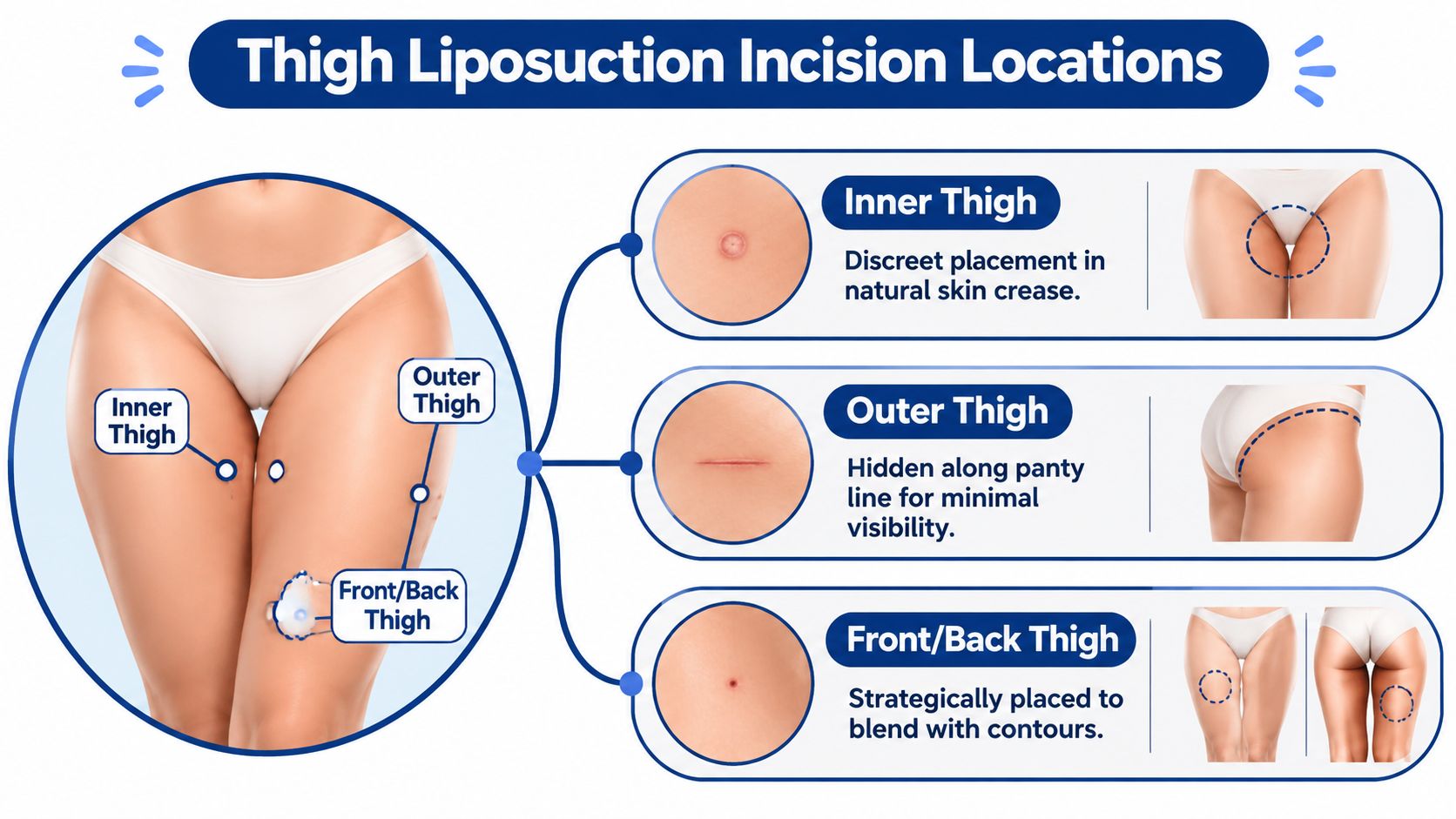
A liposuction access incision is an opening in the skin that lets the surgeon insert a cannula, the slender tube used to move through the fatty layer. These entry points are small, but they aren't absent. The American Society of Plastic Surgeons describes typical access incisions of about 2–3 millimeters in diameter and says surgeons commonly use approximately 3–5 incisions for each treated area. The exact number and placement vary with the area being treated. Its overview of liposuction incisions also explains that multiple access points let the surgeon reach different zones and blend the borders of treatment.
Location and access
A surgeon may choose natural creases or less exposed borders to make access marks less conspicuous. For example, some entry points can be placed near the groin crease or beneath the buttocks crease, while others may sit along a less noticeable part of the thigh. The right plan depends on which areas need treatment and how the surgeon can reach them safely.
The cannula passes through each opening, so the skin around a port experiences movement and friction. If a surgeon makes the incision too small for the cannula, repeated movement can abrade the edge rather than protect it. The port can also be stressed by repeated passes through one opening. With laser or other energy-assisted techniques, the device and its movement around the access point need careful control as well.
A liposuction access scar is different from a thigh-lift scar. Liposuction uses small entry sites for a cannula; a thigh lift removes skin and requires longer incisions. The distinction matters because descriptions of one procedure's scars shouldn't be treated as a promise about the other.
The Healing Timeline You Should Expect
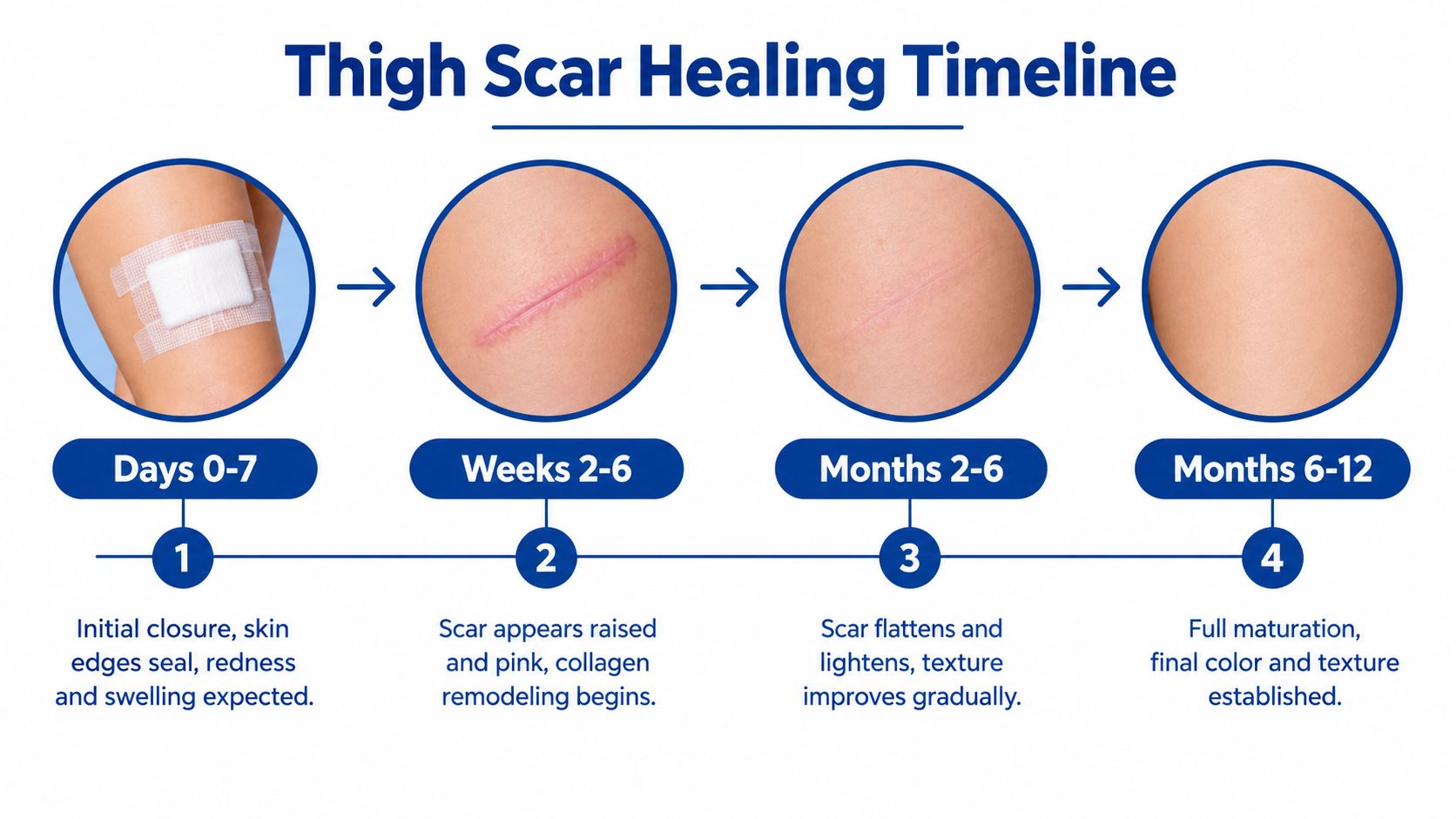
The skin can close before the scar has settled. Early closure, changes in swelling, and scar maturation are different stages, so a mark that looks pink or feels firm soon after surgery doesn't necessarily show its final appearance.
Closure first, maturation later
During the early healing period, the incision edges begin to close. If stitches are used, they may be removed after about one week, unless they're dissolvable, according to NHS guidance on liposuction recovery. Redness, bruising, swelling, and altered sensation can still be present after the skin has sealed. The treated area may take up to six months to settle, so judging the final scar too early can be misleading.
Over the following months, a scar may change in color, firmness, and texture. Mild early redness or a slightly raised feel doesn't by itself tell you whether the scar will remain prominent. A one-month mark may look and feel different later, but a change that keeps progressing deserves medical review rather than guesswork.
Numbness commonly improves over 6–8 weeks, and gentle exercise may begin around 3–4 weeks. Strenuous activity is generally avoided for 10–12 weeks, depending on the surgeon's instructions. These are recovery guidelines, not a schedule to follow without checking your own care plan.
Early appearance is only one snapshot. Keep follow-up appointments and ask your surgeon to assess changes over time, especially if the scar is becoming more raised, painful, or discolored.
What Really Controls How Visible the Scar Becomes
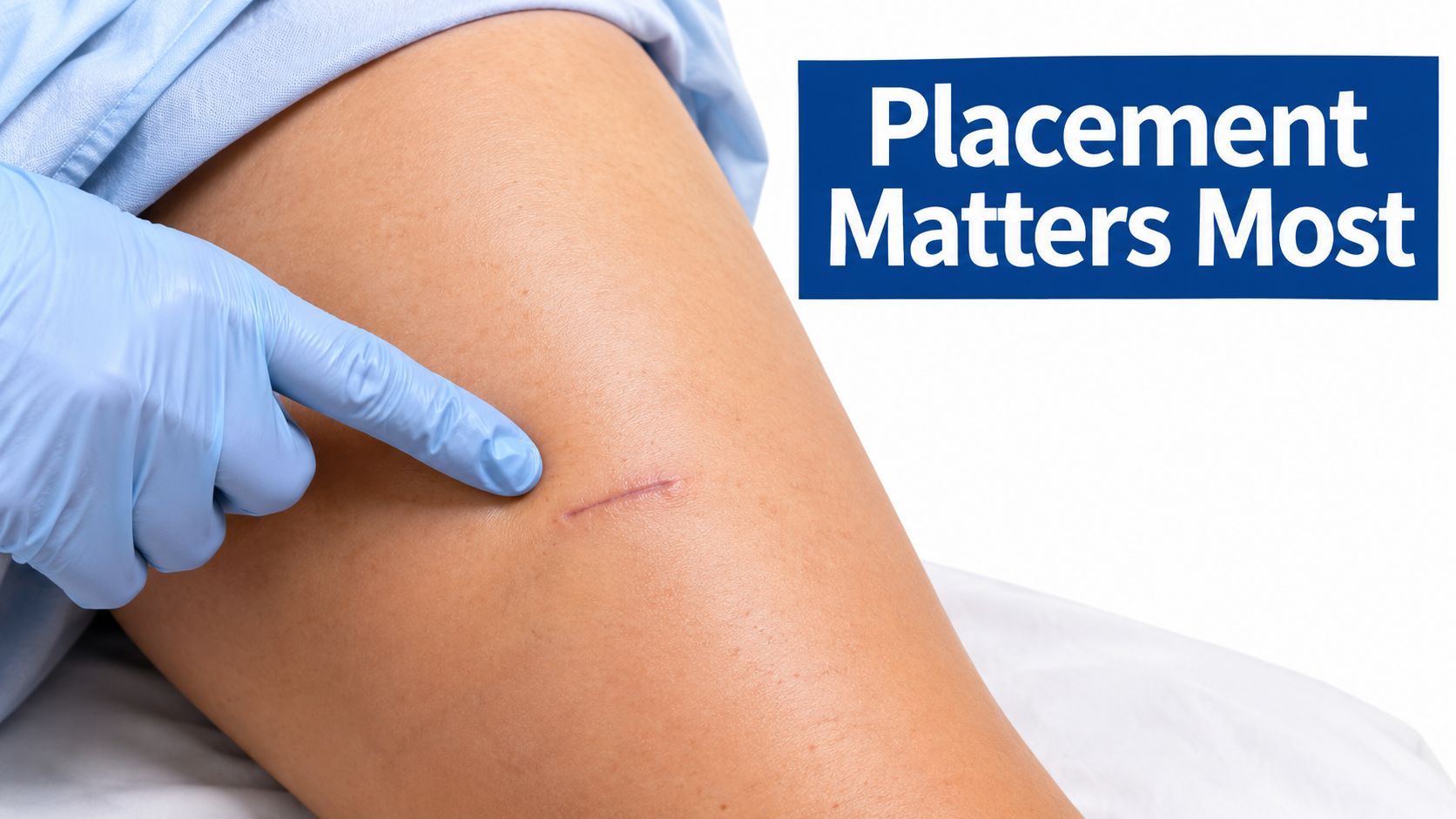
A small incision does not guarantee an invisible scar. Visibility depends on where the opening sits, how the cannula moves through it, how much fat is removed close to the access point, and how your skin heals. These factors work together, much like several brushstrokes shaping one final line.
Port mechanics and contour
An access point in an exposed area may be easier to see. Repeated cannula passes can irritate or injure the opening. Removing too much fat right beside it may pull the skin inward, leaving a tethered or indented mark. Bruising and inflammation can also trigger post-inflammatory hyperpigmentation, making the area darker than nearby skin. A depressed or discolored scar calls for a different assessment from a raised one.
Your healing biology matters too. Tell your surgeon if you or close family members have a history of keloids or other raised scars. Darker skin may be more prone to post-inflammatory darkening, but this does not mean a visible complication is inevitable. This history can help guide access-point placement, tissue handling, and follow-up.
Friction, pigment, and healing biology
One review reported hypertrophic scarring in 1.3% of its liposuction series. That figure describes the cases in that review, not your personal risk or the rate at every practice. Raised scars may be managed with silicone sheets, pressure therapy, or corticosteroid injections; re-excision may be considered in selected cases. Each option addresses scar tissue differently, so your clinician should assess the mark before recommending treatment.
Sun exposure while a scar matures can affect its pigmentation. Ask your clinician how to protect the area, and follow your post-liposuction care instructions. For general background on how skin injury and pigment changes can shape a scar, read this guide to skin burn recovery and scar care. Burn care is not a substitute for instructions specific to liposuction.
How Awake Office-Based Techniques Reduce Scar Risk
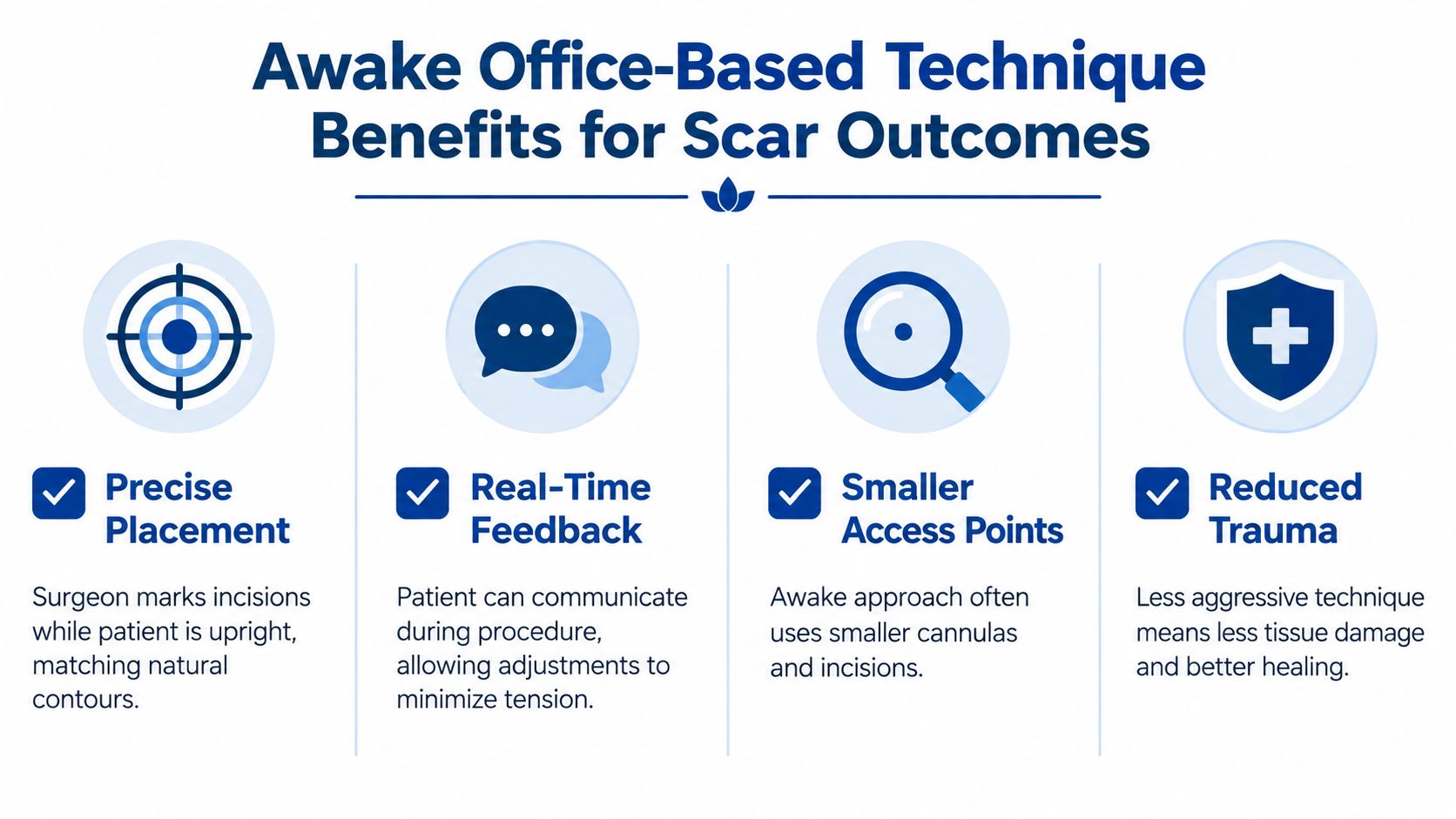
An awake, office-based setting can allow a surgeon and patient to communicate during treatment, but it doesn't guarantee a particular scar result. What matters is the plan and how the surgeon manages each access point: where it sits, whether the opening accommodates the cannula, and how carefully the cannula moves through it.
What to discuss before treatment
Ask whether the surgeon uses port-site protectors. A 2024 peer-reviewed study reported that use of these protectors was associated with a reduction in steroid injections for hypertrophic scars from 9 cases to 1 (p = 0.005). The authors recommended protectors approximately 40 mm long, with about 30 mm of depth to shield skin and subcutaneous tissue. The study on port-site protectors supports asking how the practice protects access points from friction; it doesn't mean every patient will have the same outcome.
You can also ask how the surgeon will minimize repeated passes through one opening and blend treatment near the access site. If energy-assisted devices are planned, ask how the surgeon controls their movement near the incision. For patients having awake surgery, communication may help the team consider positioning and symmetry during the procedure. Ideal Face & Body's guide to awake liposuction describes its awake approach; discuss whether that setting and plan are appropriate for your case.
Your role in early healing
Follow the practice's wound-care instructions rather than starting massage or scar products on your own. Compression garments may be prescribed to reduce swelling and support healing, often through approximately week four unless the surgeon gives different directions. The American Society of Plastic Surgeons' recovery guidance discusses compression and healing after liposuction.
- Protect the incision: Don't rub, twist, or massage a wound that hasn't fully healed.
- Limit sun exposure: Ask how to cover or protect maturing scars to reduce darkening.
- Use silicone only with clearance: Start only once the wound is fully epithelialized and your clinician approves.
- Report concerning changes: Fever, increasing pain, bleeding, swelling, burning around the wound, or increased fluid leakage warrants medical advice.
Liposuction Entry Scars vs Thigh Lift Scars
The phrase “thigh scars” can describe two very different things. Isolated liposuction leaves small entry-point marks where the cannula passes through the skin. A medial thigh lift, also called thighplasty, removes skin and uses longer incisions, often along the groin or inner thigh. It generally carries a greater wound-healing burden than isolated liposuction.
| Procedure | Typical scar pattern | What creates the mark |
|---|---|---|
| Thigh liposuction | Small access-point scars | Cannula entry sites |
| Thigh lift or thighplasty | Longer incisions along the groin or thigh | Skin removal and wound closure |
A systematic review of liposuction-assisted medial thighplasty included 19 studies and 1,113 patients. It reported an overall complication rate of 36.75% with liposuction-assisted treatment versus 70.68% without it, and noted that shorter scars can support faster healing and reduce complications associated with prolonged immobilization. These figures concern combined thighplasty procedures, not routine isolated thigh liposuction, so they shouldn't be used to estimate the scar risk of liposuction alone.
If a consultation discusses “thigh contouring,” ask whether it means liposuction, skin removal, or a combination. Information about thigh-lift surgery can help you understand why the procedure name matters when evaluating scar expectations.
Treatment Options for Scars That Do Not Settle
A scar that stays raised, dark, indented, or uncomfortable deserves assessment. The right treatment depends on the change: a raised scar is a different problem from pigment change or a shallow indentation, so one cream or procedure will not address every case.
Match treatment to the scar
For an early raised scar, a clinician may suggest silicone gel sheets or pressure therapy. If an examination confirms hypertrophic scarring, intralesional corticosteroids may be considered. These options target raised tissue; they do not correct every change in color or contour.
A persistent difference in color or texture may lead a clinician to discuss laser or another energy-based treatment, based on the scar and your skin. A widened or tethered mark may be suitable for selective surgical revision. The closure technique matters: reducing tension on the wound can help limit recurrence. In selected cases, liposuction beside the scar can reduce tissue volume and ease tension as the wound closes.
Don't wait for worsening
Options for abnormal liposuction scars include silicone sheets, pressure therapy, corticosteroid injections, and, in selected cases, surgical removal and closure. These treatments address different features, so have a qualified clinician examine the scar before choosing an approach. Appearance alone may not show what is causing the change.
Ideal Face & Body offers scar revision procedures that may include laser resurfacing, surgical excision, microneedling, chemical peels, or steroid injections, depending on clinical evaluation. Read this guide to scar-healing treatments and discuss whether an assessment fits your particular mark.
Realistic Expectations and Questions for Your Surgeon
You can't predict a scar's final appearance from incision size alone. Ask your surgeon to explain the access plan and how the team will protect the skin around each opening. A clear answer should address your anatomy and healing history, not just offer reassurance that the marks will be hidden.
Bring these questions to your consultation:
- Where will the access points go? Ask how the placement relates to natural creases, clothing, and the areas being treated.
- How many openings do you expect to use? Ask why that number fits your treatment plan.
- What cannula size and port protection will you use? Discuss how the incision will accommodate the instrument and how repeated friction will be limited.
- How will you avoid over-suctioning near the entry site? Ask how the surgeon plans to blend the treated area without creating a depression.
- What changes should prompt a call? Get the practice's specific instructions for follow-up and wound concerns.
Seek prompt evaluation if a scar widens, drains, thickens progressively, becomes increasingly painful or itchy, or darkens rather than gradually lightening. Fever, increasing swelling, bleeding, or fluid leakage also warrants contact with your care team. Don't wait for a mark to become severe before asking for an assessment.
Ideal Face & Body offers awake, office-based liposuction and scar revision options that may be considered after an individual evaluation. If you're weighing thigh contouring or concerned about an existing access scar, visit Ideal Face & Body to request a consultation and discuss a plan matched to your healing history.