In the FDA breast implant performance report, about 20 to 40 percent of augmentation patients had a reoperation within 8 to 10 years. They are not lifetime devices. That makes the 10-year rule misleading: timing is driven by complications, imaging findings and personal goals, so monitoring matters more than booking surgery by date. If you are asking how often breast implants need replacing, start with implant type, surgery history and symptoms, then use examination and imaging to choose between watchful follow-up, revision or removal.
Table of Contents
- What the Numbers Say About Replacement Rates
- Why Implants Have No Fixed Replacement Date
- Signs That Point to Replacement or Revision
- Monitoring Schedule for Silent Rupture
- Replacement Options and Where to Get Help
- Questions and Records for Your Consultation
What the Numbers Say About Replacement Rates
No fixed year applies to everyone. The U.S. Food and Drug Administration doesn't recommend routine replacement at 10 years, because some implants stay functional longer and others need earlier attention. The younger part of that statement matters just as much. Trouble at year 4 shouldn't wait until year 10.
The FDA breast implant performance report states that across FDA core studies, approximately 20 to 40% of augmentation patients and 40 to 70% of reconstruction patients underwent some form of reoperation during the first 8 to 10 years. In that FDA reviewed silicone gel data, as many as 20% of primary augmentation patients had implants removed within 8 to 10 years, while as many as 50% of reconstruction patients required removal within 10 years.
Reoperation and Removal Rates by Patient Group
| Patient group | Any reoperation by 8-10 years | Removal by 8-10 years | Rupture at 10 years |
|---|---|---|---|
| Primary augmentation | 20-40% (FDA core studies) | Up to 20% | 9.5% (one 10-year cohort) |
| Primary reconstruction | 40-70% (FDA core studies) | Up to 50% | 27.2% (one 10-year cohort) |
| Revision augmentation | 47.3% (10-year FDA dataset) | Counted within reoperation in that dataset | 8.5-13.0% range across FDA datasets |
| Revision reconstruction | 48.5% (10-year FDA dataset) | Counted within reoperation in that dataset | 8.5-13.0% range across FDA datasets |
Read each row as a share of patients who had an event by that point, not as your personal deadline. Primary augmentation means a first cosmetic procedure. Reconstruction means rebuilding the breast, often after cancer treatment, and it carries a different starting point for tissue and risk. Revision means operating on a breast that already has an implant, so scar tissue and prior pocket changes are already present.
Practical rule: Find your group first, then treat the rate as a planning signal for follow-up, not as a scheduled replacement date.
A reoperation also doesn't always mean the device failed. Reasons can include capsular contracture, asymmetry, malposition, a patient requested size or style change, rupture, and breast related medical issues. A woman who chooses a smaller implant for comfort and a woman treated for painful tightening both appear in reoperation counts, although their reasons are very different.
Write down your implant type, surgery date, and whether your operation was augmentation, reconstruction or revision. Bring those three details to a monitoring conversation, because they determine which row is relevant to you and whether imaging should be due now.
Why Implants Have No Fixed Replacement Date
Think of an implant more like brake pads than a light bulb. Brake pads wear at different speeds depending on use and conditions, so a mechanic inspects thickness instead of replacing them on a birthday. A light bulb, by contrast, gives people a false image of a simple on or off lifespan.

The FDA guide to things to consider before getting breast implants classifies implants as non-lifetime devices and explains that the probability of rupture, capsular contracture, malposition, asymmetry, pain, or other complications increases with implant age, but individual implant longevity cannot be predicted. That uncertainty isn't evasive language. It's the honest limit of what anyone can know for a single implant.
The Capsule Around Every Implant
Your body forms a thin layer of scar tissue, called a capsule, around every implant. In most cases it stays soft and you don't feel it. If it thickens and tightens, it can squeeze the implant, make the breast feel firm, pull the shape upward, and cause discomfort. Severe forms, described as Grade III to IV capsular contracture, may need an operation, and tightening can return after treatment.
Say one patient reaches year 12 with soft breasts, stable shape and reassuring imaging. She usually needs monitoring, not automatic surgery. Say another patient notices rippling at year 6 and wants a different size because exercise now feels uncomfortable. She may choose revision much earlier, even though her implant hasn't ruptured.
Plan for the possibility of one or more implant related operations over your lifetime without treating any year as guaranteed. If you notice a new change in shape, firmness, size, pain or swelling, get assessed at that point rather than waiting for a milestone.
Signs That Point to Replacement or Revision
The most important warning sign may be one you cannot feel. A silent silicone rupture means the shell has torn while gel stays largely contained, so the breast can look and feel normal while imaging finds the problem.
Risk is not spread evenly across patients. Reoperation and rupture occur far more often after reconstruction than after cosmetic augmentation, which changes how a new symptom gets read. The same firmness in a reconstruction patient justifies a lower threshold for imaging than it would after a routine augmentation.
Warning Signs, What They Look Like and the Usual Response
| Trigger | What it looks like | Usual response |
|---|---|---|
| Silent silicone rupture | No symptoms; found on MRI or ultrasound | Discuss removal or exchange based on gel spread and capsule condition |
| Saline deflation | Visible size or softness change, often within days | Implant removed or replaced; usually obvious on exam |
| Grade III-IV capsular contracture | Firm, distorted or round breast, sometimes painful | Removal with or without replacement; recurrence is possible |
| Malposition or rippling | Implant shifted, visible edges or waves | Revision to reposition or replace the implant |
| Asymmetry | Uneven size, height or position between breasts | Revision on one or both sides |
| Persistent pain or swelling | Ongoing discomfort, tenderness or palpable change | Clinical assessment and imaging when indicated |
| Desired size or style change | Patient wants a different look; implant is sound | Elective exchange or explant |
Don't try to grade firmness on your own. Normal monthly tenderness, a recent workout injury and capsule tightening can feel confusingly similar at first. On exam, a clinician presses and moves each breast to compare the two sides. A tightening capsule tends to make the whole breast firm and rounded and can pull the implant upward, while a saline deflation is usually obvious because size and softness have visibly changed. A silent rupture is the exception: it often produces no exam finding, so a breast that feels normal does not clear the implant. That is why your implant history and imaging, rather than touch alone, decide whether the problem sits in the breast tissue or the device.
An elective exchange is also a legitimate reason for surgery. Your implant can be intact while your goals have changed after pregnancy, weight change, aging or a shift toward a subtler look in clothing.
A sound implant doesn't have to be kept if it no longer fits your body or your preferences.
Act in a specific order when something changes:
- Note the date: Write when firmness, pain, swelling or shape change began.
- Photograph both breasts: Take front and side views in the same light to track change.
- Book assessment: Don't postpone because a routine check isn't due yet.
Monitoring Schedule for Silent Rupture
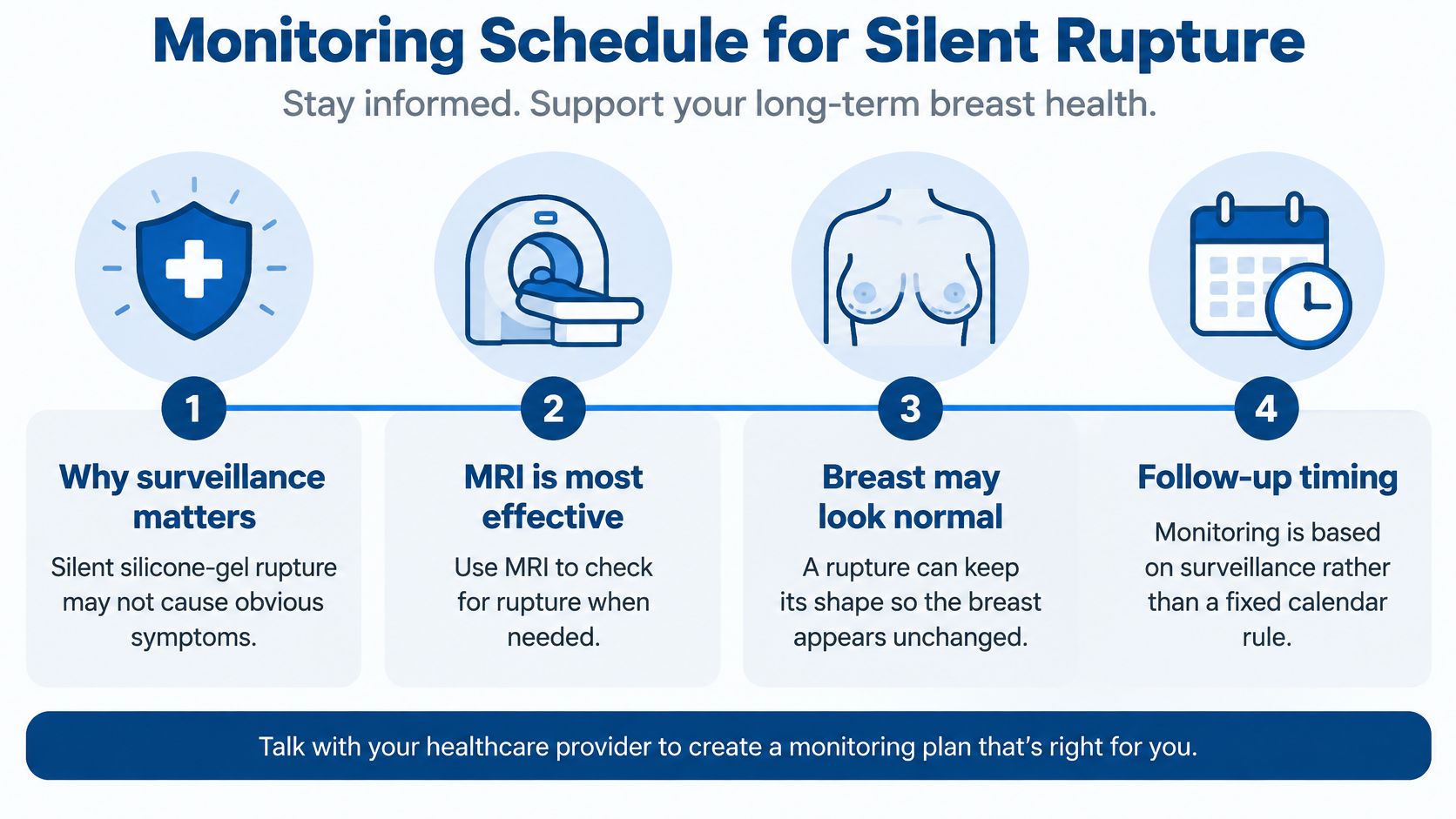
Silicone gel can keep much of its volume after a tear, so a ruptured implant may preserve the breast's external shape. You can't reliably exclude that problem by looking in a mirror or feeling the breast at home. Scheduled imaging fills that gap, and our guide to possible breast implant rupture signs helps separate visible changes from problems that need a scan.
Current FDA labeling recommends a first ultrasound or MRI at 5 to 6 years after implantation, then repeat imaging every 2 to 3 years thereafter. The agency identifies MRI as the most effective test for detecting silent rupture and considers ultrasound an acceptable screening alternative in patients without symptoms.
Imaging and Check Up Timeline After Implantation
| Stage | Timing | Recommended action |
|---|---|---|
| Early years | First 5 years | Routine clinical exam; report new symptoms promptly |
| First surveillance | 5-6 years after implantation | First ultrasound or MRI, especially for silicone-gel implants |
| Ongoing surveillance | Every 2-3 years after the first scan | Repeat imaging if no symptoms are present |
| Symptomatic or equivocal result | Any time after surgery | MRI to check for rupture |
The symptom triggered row overrides the routine rows. If you develop pain, swelling, firmness or a palpable change, or if an ultrasound result is unclear, MRI can be appropriate at any time after surgery. You don't need to wait until the next surveillance interval just because a scan was clear last year.
Screening recommendations have shifted over time, which can confuse patients who received different instructions at surgery. Ask which labeling applies to your device and follow your treating clinician's current plan.
If imaging confirms silicone rupture, the next conversation covers removal or replacement. The plan takes account of gel migration, capsule condition, symptoms, breast tissue changes and your preference. Saline rupture usually behaves differently because the implant deflates as saline is absorbed, making the size loss easier to see.
Keep a simple routine:
- Record key details: Write down implant type, placement if known, and surgery date so any future clinician starts with accurate information.
- Calendar the first scan: Set a reminder for year 5 to 6, then repeat every 2 to 3 years as your clinician directs.
Replacement Options and Where to Get Help
Two patients can book the same consultation and leave with different operations. A ruptured device on imaging leads down one path; a healthy implant and a wish for a different size lead down another. The reason for change selects the operation, so the first question at consultation is which problem the surgery should solve.
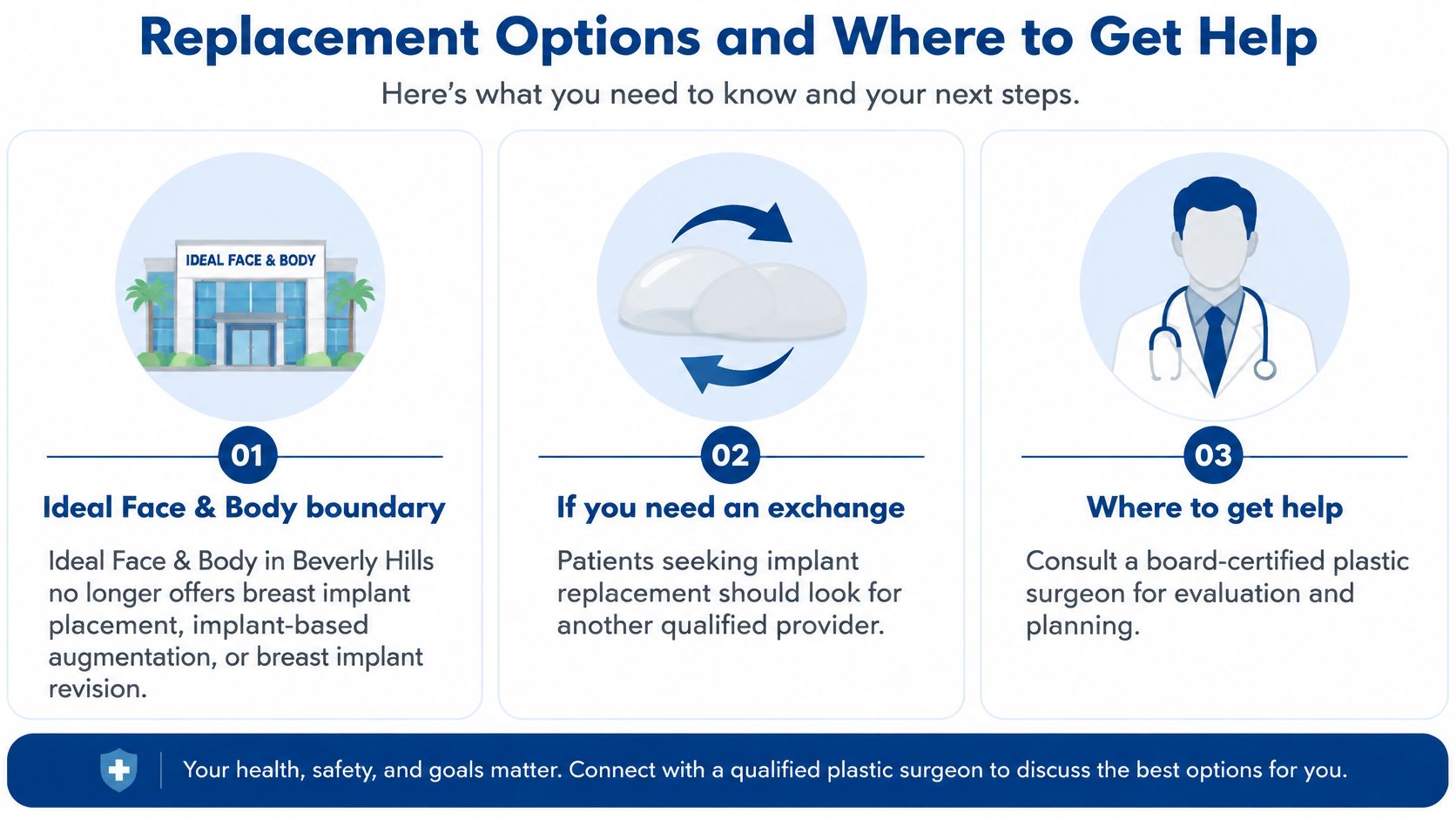
At Ideal Face & Body in Beverly Hills, the breast surgery menu covers both directions: breast augmentation with implants, breast implant revision and explant (breast implant removal) for device-related work, alongside implant-free procedures when the goal is shape rather than a new device. The practice's page on breast implant removal and reconstruction choices walks through how these paths compare.
Common Paths for Replacement or Change
| Approach | Typically chosen when | What it involves |
|---|---|---|
| Implant exchange | Sound implant, patient wants a new size or style | Old implant removed, new implant placed |
| Explant without replacement | Rupture, severe contracture or patient prefers no implant | Implant removed; breast volume is not replaced |
| Capsulectomy with replacement | Recurrent or severe capsular contracture | Scar capsule removed along with the implant |
| Implant-free lift or fat transfer | Shape or volume change without a new implant | Own tissue repositioned or fat injected |
No row is universally better. A ruptured device with a healthy capsule presents a different decision from painful recurrent tightening, and both differ from a purely elective size change. For each option in the table, ask what problem the operation solves, what it cannot solve, and how the breast may look if implant volume comes out without replacement.
For patients whose goal is a change in shape rather than a new device, two implant-free options sit in-house. The Awake Breast Lift is a mastopexy performed in the office under local anesthesia, without general anesthesia, intubation or an IV, that repositions the patient's own tissue for projection and lift. Raise Your Cup uses fat removed from stubborn areas such as the stomach to add volume and reshape the breast without an implant. A consultation with Dr. Justin Yovino can review whether revision surgery, explant or an implant-free approach matches your imaging findings and goals.
Recovery planning works best when it starts before a date is chosen. Arrange driving help, lifting limits and wound checks in advance, and some patients also explore postoperative support from Carevo Home Health Care when extra help at home would make the first days safer.
Questions and Records for Your Consultation
Good records turn a vague worry into a focused consultation. A surgeon can judge age and likely device issues much faster when the paperwork identifies what was placed and when. Start gathering documents before you book, because operative reports can take time to retrieve. Our guide to planning a plastic surgery consultation outlines the appointment process.
Bring these items:
- Implant card and operative report: These identify the device, size, fill and surgery date.
- Imaging reports: Include MRI and ultrasound findings, not just a note that a scan occurred.
- Dated symptom list: Record when pain, firmness, swelling or shape change started.
- Front and side photos: Photograph both breasts in the same light and position for comparison.
If reports arrive as separate scans, PDFWix healthcare document tools can help you organize them into a tidy file to share with each clinician. Keep the originals and check that dates and page order stay clear.
Five Questions Worth Asking
- Which approach do you recommend for my reason for change, and why? Ask how the recommendation would change if imaging were normal.
- How many revision procedures do you perform each year? Regular revision experience matters because scar and pocket problems vary widely.
- How will you address the capsule? Ask what happens if contracture comes back after treatment.
- Which imaging do you want before surgery, and when? A clear answer should match your symptoms and implant type.
- What will follow up look like? Confirm visit timing, activity limits and who to call for swelling or fever.
Write the answers down during the appointment, then compare them across at least two consultations before deciding. Pay attention to whether each surgeon clearly explains uncertainty instead of promising that one operation settles the issue permanently.
Clear rule: New firmness, deflation, pain, swelling or a visible shape change is a reason to book assessment now.
Don't wait for a scheduled date just because it's already on the calendar. An earlier examination may reassure you, change the imaging plan, or identify a problem while more treatment choices remain open.
If you're rethinking implants and want an implant free lift or fat based enhancement, we can review whether the Awake Breast Lift or Raise Your Cup fits your goals at our Beverly Hills, CA practice. Visit Ideal Face & Body to learn about those options and request a consultation.