Can removing neck fat leave you with a sharper jawline, or make loose skin look more obvious? The answer depends on what's creating the fullness. Liposuction can reduce fat beneath the chin, but it can't tighten substantial loose skin or correct every muscle-related contour concern.
The key is to identify whether fat, skin, or the platysma is driving the shape before choosing a procedure. That distinction helps set realistic expectations and avoid treating a concern that liposuction alone can't fix.
Table of Contents
- What Neck Liposuction Removes and Whether It Causes Sagging
- Neck Fat Treatment Options Compared
- Who Is a Good Candidate for Neck Liposuction
- How the Procedure Works, Step by Step
- Recovery Timeline and Expected Results
- Risks and Warning Signs Explained
- Confirm Your Candidacy Before You Book
What Neck Liposuction Removes and Whether It Causes Sagging
Neck liposuction is best suited to fullness caused mainly by fat when the skin still recoils well. It doesn't replace a lift when the skin itself is loose.
Think of the neck as a cushion: fat is the stuffing, skin is the fabric, and the platysma is a thin muscle sheet beneath both. Liposuction removes some of the stuffing through suction. It doesn't tighten the fabric or repair muscle bands.
The fat beneath the chin is called submental fat. The cervicomental angle is the angle where the underside of the chin meets the neck. A sharper angle can make the jawline look more defined, but fat isn't the only factor that shapes it. Platysmal bands are vertical cords that may show when the neck muscle tightens.
The Cleveland Clinic's overview of double-chin surgery distinguishes chin liposuction, which suctions fat beneath the skin, from broader surgery that may also address loose skin. That's the practical difference between liposuction and a neck lift or chin tuck: liposuction targets fat, while a lift may remove loose skin and address other neck structures.
Why fat removal doesn't always mean sagging
Liposuction doesn't remove skin. If the skin is already loose or has limited elasticity, removing the volume beneath it can make that looseness more visible. Age, weight changes, skin quality, muscle behavior, and the existing neck angle all help determine whether the skin will settle smoothly over the smaller contour.
The opposite claim, that fat removal always causes sagging, is too broad. A 2024 review of submental fat treatments notes that treatment can loosen skin that's already lax, while clinical studies of ATX-101, an injectable treatment, found no overall increase in laxity and occasional improvement. Those findings concern an injectable treatment, not liposuction, and they don't guarantee how a particular person's skin will respond.
A surgeon assesses skin recoil first, then platysma behavior, then the cervicomental angle. Moderate-to-severe laxity may call for a face and neck lift rather than liposuction alone. In some cases, removing less fat preserves a smoother, more natural contour than aggressive aspiration. If you're trying to understand when skin and muscle changes may call for a lift, you can learn when to consider a neck lift.
Practical rule: If you can pinch a fold of fat beneath the chin and the skin springs back cleanly after you release it, liposuction may be a reasonable starting point to discuss with a surgeon.
Neck Fat Treatment Options Compared
| Option | What It Targets | Typical Setting | Best Suited For | Main Trade-Off |
|---|---|---|---|---|
| Laser-assisted neck liposuction (PRECISION SCULPT) | Fat beneath the skin | Office, awake under local numbing | Moderate fat over firm skin | Little skin tightening; soreness and swelling for several days |
| Traditional cannula liposuction | Fat beneath the skin | Office or surgical facility, local or general anesthesia | Localized fat with good skin | Results depend heavily on technique and surgeon experience |
| Deoxycholic acid injections (Kybella) | Fat under the chin only | Office, staged injections | Moderate-to-severe fullness under the chin | Several sessions; swelling and bruising; not used for other areas |
| Neck lift or platysmaplasty | Loose skin, platysmal bands and fat | Surgical, sedation level varies | Sagging skin with visible bands | Longer recovery and visible incisions |
| Energy-based skin tightening | Skin laxity, not fat | Office, non-surgical | Mild laxity with modest fat | Gradual change over months; cannot remove fat |
The main difference between the first two options is how the surgeon approaches fat removal, not what the treatment is meant to accomplish. Laser-assisted liposuction uses energy before suction; traditional liposuction removes fat with a cannula. Neither option directly removes excess skin, and the outcome depends on choosing a technique that suits the anatomy and on the surgeon's approach.
Kybella is still a fat treatment, not a skin-tightening treatment. It's delivered in staged office injections to reduce fat beneath the chin, with swelling and bruising possible between treatments. The FDA's deoxycholic acid approval information states that it was approved in 2015 for adults with moderate-to-severe fullness under the chin. At 12 weeks after the final treatment, 13% to 19% of treated patients achieved at least a two-grade improvement on both clinician- and patient-reported rating scales, compared with 3% of placebo recipients.
A lift or platysmaplasty takes a different route by addressing loose skin and muscle bands along with fat. Energy-based tightening sits on the other side of the distinction: it aims to improve mild laxity, but it can't remove fat. For information about treatment of visible neck bands, read about neck-band treatment options.
The right choice comes down to which structure is mainly responsible for the contour. Fat, skin, and platysma problems can look similar in a mirror but may call for different treatments, or a combination.
Who Is a Good Candidate for Neck Liposuction
The amount of fat you can pinch isn't enough to decide whether liposuction is suitable. What matters is where the fat sits, whether the skin can retract, and how the platysma behaves. Someone with a modest amount of superficial fat and elastic skin may be a better candidate than someone with more fat but significant skin laxity or muscle banding.
A technical review of submental liposuction describes the most predictable cases as those where excess volume is mainly in the superficial fat layer above the platysma and the skin has adequate elastic recoil. Fat deeper than the muscle, or fullness linked to the platysma, may require a different plan. The review describes a neck pinch of about 1.5 to 2.0 cm as a commonly favorable range for liposuction-only contouring. That measurement is a clinical guide, not a do-it-yourself test or a guarantee of results.
| Factor | Favors Liposuction | Points Toward Another Option |
|---|---|---|
| Fat location | Fat mainly above the platysma | Deep fullness or fullness linked to the platysma |
| Skin elasticity | Skin snaps back well after a pinch | Loose or crepey skin that stays lax |
| Neck pinch thickness | About 1.5 to 2.0 cm of pinchable fat | Thin folds with little to remove, or unclear pinch |
| Platysmal bands | Absent or mild | Visible bands that aggressive fat removal may make more prominent |
| Weight pattern | Stable for about six to twelve months; BMI within about 30 percent of ideal | Recent large weight swings or BMI far from ideal |
| Medications and history | No blood-thinning medication; no prior neck surgery complications | Anticoagulant or thrombolytic medication, or prior neck surgery |
| Expectations | Realistic about a smoother contour | Expecting a fully restructured jawline |
Reading the candidacy signals
Skin and muscle come before volume. If the skin stays loose after a pinch, taking away more fat can leave a hollowed or older-looking contour. Visible platysmal bands also call for caution because aggressive fat removal may make them stand out more.
A surgeon also considers health and healing. Weight stability, comorbidities, prior neck surgery, medications that affect bleeding, and psychological factors can all change whether the procedure is appropriate. Don't stop or change a prescribed medication on your own; bring a complete medication and supplement list so the surgical team can review it.
The review's 20-patient series reported marked improvement in 19 patients; transient marginal mandibular weakness and a minor wound infection were each reported once and resolved with conservative treatment. Those findings describe that series, not a promise of an individual outcome.
The most suitable candidate isn't the person with the largest fat deposit. It's the person whose anatomy, health, and expectations match the kind of contour change liposuction can realistically deliver.
How the Procedure Works, Step by Step
A neck liposuction plan starts with an examination, not with a target amount of fat to remove. The surgeon needs to understand the contour from different angles and decide whether the fat is accessible without sacrificing a smooth, natural-looking result.
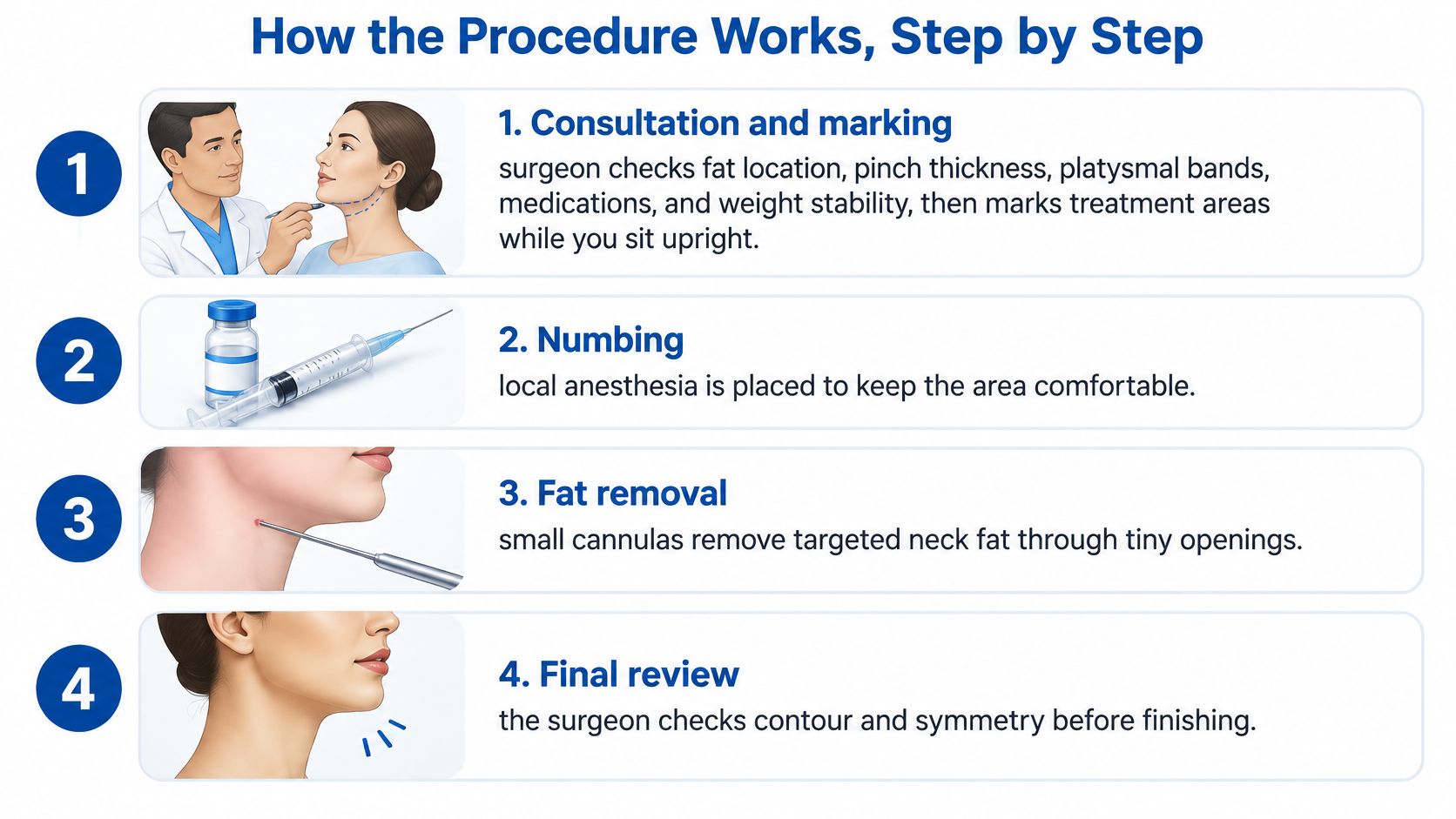
Consultation and marking. The surgeon checks fat location, pinch thickness, platysmal bands, medications, and weight stability. Treatment areas are marked while you sit upright because the neck's shape can look different when you're lying down.
Numbing. Local anesthetic is placed under the chin and along the neck so the area is numb while you're awake; some practices may add light sedation. A 2024 retrospective series of submental liposuction under local anesthesia reported 695 patients treated between October 2020 and August 2022, and the authors described complications as minimal. That series offers context for why awake, office-based treatment is used, but it doesn't establish what's right for every patient.
Small incisions. The surgeon makes a few small openings, often under the chin or near the ears, to admit the cannula. Incision placement depends on the areas being treated and the technique.
Fat loosening. Laser-assisted methods use a laser fiber to warm and loosen fat before suction. Standard cannula methods may use fluid to make fat removal easier.
Aspiration, the key decision point. The surgeon moves the cannula in controlled passes, removing fat evenly and checking symmetry and the jawline as the contour takes shape. Restraint matters: removing more fat isn't automatically better, especially in a thin, delicate neck.
Closure and support. The small openings are closed, and a compression wrap may be placed to support healing and help manage swelling.
Discharge. Many patients go home the same day with written aftercare instructions. The plan should explain garment use, activity guidance, and how to contact the surgical team with concerns.
The volume removed is usually modest. In a 2024 prospective study of radiofrequency-assisted neck liposuction, the 80 patients had an average of 25 mL of fat removed. That finding describes the study's technique and group, not a standard target for every procedure.
Recovery Timeline and Expected Results
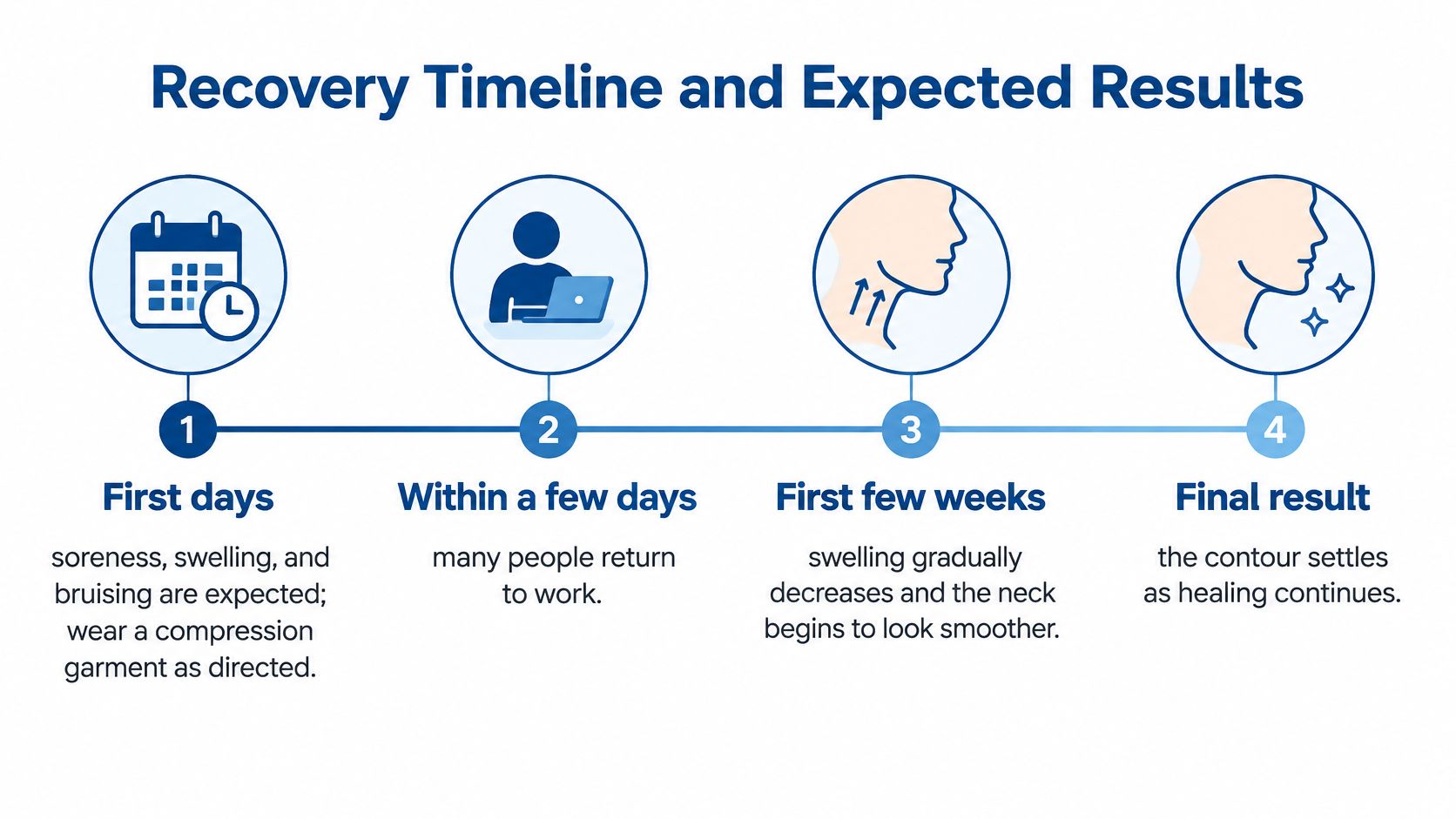
Recovery usually unfolds in stages. A typical patient may feel sore and swollen after treatment, resume work before all swelling has gone, and see the contour continue to settle as healing progresses.
| Timeframe | What to Expect |
|---|---|
| First few days | Soreness, swelling and some bruising; many people return to work within a few days |
| End of first week | Swelling typically begins to decrease |
| Several weeks | Compression garment often recommended to reduce swelling and support healing |
| Up to six weeks | Swelling can persist this long |
| Up to six months | Skin firming may continue after laser-assisted treatment |
The American Society of Plastic Surgeons' liposuction preparation guidance notes that swelling typically starts to decrease by the end of the first week, while it can persist for as long as six weeks. Compression garments may be recommended for several weeks to reduce swelling and support healing. Follow your surgeon's instructions for how and when to wear the garment rather than adjusting it based on how the neck looks on a particular day.
How the result takes shape
Early swelling can hide the contour change or make one side appear different from the other. The result should be judged after swelling has settled, not on the day of the procedure. With laser-assisted treatment, skin firming may continue for up to six months, so the final look develops gradually.
The expected change is a smoother, more defined line beneath the chin. How much definition appears depends on the original fat distribution and skin quality. Fat removal won't restore lost skin elasticity, so a sharper contour isn't guaranteed if loose skin is the main concern. You can review what recovery from neck liposuction may involve.
One preparation step directly affects healing: stop smoking before surgery according to your clinician's instructions. Smoking can impair blood flow, interfere with wound healing, and increase infection risk.
Risks and Warning Signs Explained
The principal safety concern is hematoma, bleeding beneath the skin. A hematoma can progress and compromise tissue viability, so rapidly increasing swelling, tightness, or pain shouldn't be treated as a routine post-op question. Contact the surgeon immediately or seek emergency care.
A scoping review of submental liposuction complications also reported submental depression, edema, hypertrophic scarring, scar contracture, transient facial-nerve paralysis, cervical dystonia, and rare cervical necrotizing fasciitis. A separate 2024 systematic review and meta-analysis covering 29,368 liposuction patients reported an overall complication rate of 2.62%, as summarized by Allure's overview of jawline liposuction. That figure covers liposuction broadly, not neck procedures alone, so it shouldn't be read as a neck-specific risk estimate.
| Symptom | What It May Indicate | What to Do |
|---|---|---|
| Rapid swelling, tightness or pain in the neck | Possible bleeding under the skin (hematoma) | Contact the surgeon immediately or seek emergency care |
| Trouble swallowing or breathing | Serious swelling affecting the airway | Call emergency services now |
| Spreading redness, fever or drainage | Possible infection | Call the surgeon the same day |
| Lopsided or hollow area after swelling settles | Uneven aspiration or contour irregularity | Schedule a follow-up review with the surgeon |
| Numbness or weakness at the mouth corner or jaw | Temporary nerve irritation | Report at the next visit; often resolves on its own |
| Firm, ropey skin or visible neck bands | Skin laxity or platysmal bands not addressed | Discuss a combined or different treatment |
Uneven aspiration or excessive removal of superficial fat can create depressions and asymmetry, even when the total amount removed is modest. That's why the surgeon checks the contour and symmetry while working, rather than relying only on how much fat has been removed.
Trouble breathing or swallowing, rapidly increasing swelling, or fever needs immediate medical attention. Don't wait for the next routine follow-up if one of those warning signs appears.
Confirm Your Candidacy Before You Book
A focused consultation should establish whether the fullness comes mainly from fat, skin, muscle, or a combination. Bring information that helps the surgeon assess both your anatomy and your healing considerations:
- Medication and supplement list: Include prescriptions, over-the-counter products, and supplements, especially anything that may affect bleeding.
- Neck history: Note prior surgery and any complications or changes since treatment.
- Weight history: Bring a rough record of your weight over the past year.
- Your goals: Be clear about the change you want, such as less fullness under the chin or a more defined neck-to-jaw transition.
Ask the surgeon four direct questions: Is fat, skin, or the platysma the main cause of my contour concern? Which treatment option fits my anatomy? Would a combined procedure or skin tightening be more appropriate? What result is realistic, and what follow-up plan should I expect?
Ideal Face & Body offers neck and chin liposuction, and consultations with Dr. Justin Yovino or Dr. Sarah Yovino can cover surgical and non-surgical options, including Morpheus8 for mild face and neck skin laxity. If you ask about fees, they vary by case and are confirmed at consultation.
Book a consultation if fat is the main issue and your skin recoils well; ask about a lift or skin-tightening treatment if it doesn't.
Ideal Face & Body offers chin and neck liposuction and consultations about options for neck fat and skin laxity. Visit Ideal Face & Body to discuss which approach may fit your anatomy and goals.