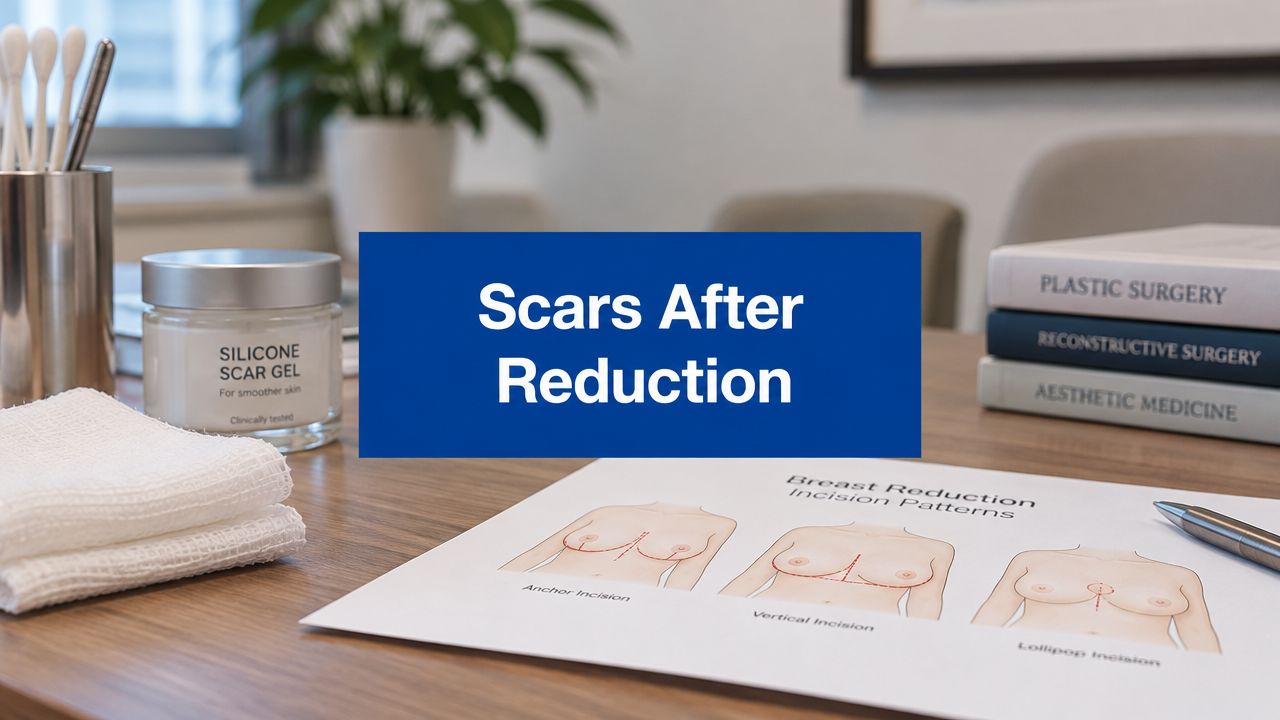
You've looked in the mirror expecting relief after breast reduction, but the incisions catch your eye first. They may be red, firm, uneven in color, or more noticeable than you imagined. That reaction is understandable. A reduction can ease physical discomfort and improve breast shape, yet the reshaping process requires incisions, and those incisions leave permanent marks.
The important distinction is that a visible scar isn't automatically evidence of a poor result. Your breast is healing in three dimensions, with skin, connective tissue, blood vessels, and collagen adjusting to a new shape. Good nutrition and general health also support recovery, as discussed in this guide to maximizing surgery outcomes through good health and nutrition.
Table of Contents
- Navigating the Reality of Post-Surgical Scars
- Common Incision Patterns and Scar Locations
- The Biological Timeline of Scar Maturation
- Factors That Influence Your Scarring Outcome
- Evidence-Based Strategies for Scar Prevention and Care
- Managing Complications and Considering Revision
Navigating the Reality of Post-Surgical Scars
The first time you see your breasts after surgery, your attention may go straight to the incision lines. A patient who hoped to feel lighter and more comfortable can instead feel anxious about the redness around the areola, the vertical line beneath it, or the horizontal line hidden in the breast fold. That emotional response doesn't mean you regret the operation. It means you're looking at a wound before the body has had time to finish repairing it.
Breast reduction scars are the visible record of a deeper change. Your surgeon has removed tissue, repositioned the nipple and areola when needed, reshaped the remaining breast, and then brought the skin together around that new framework. The scar is the seam where the body has closed the surgical opening. Like a repaired seam in fabric, it may look prominent before it settles into the surrounding material.

What permanence really means
Surgical scars usually don't vanish. They mature. Early tissue can be pink, purple, raised, tight, itchy, or darker or lighter than nearby skin. Over time, the collagen fibers become more organized, the scar softens, and pigment differences often become less obvious.
The Cleveland Clinic's overview of breast reduction scars describes a typical progression. At about 6 weeks, scars are often red to purple and slightly raised. At 6 months, they may still look lighter or darker than the surrounding skin. By 1 year, they usually begin blending more with natural skin tone, although they don't disappear completely.
A scar that looks disappointing early may simply be a scar that's still biologically active.
That timeline matters because patients often judge the final result too soon. A scar isn't a photograph taken at surgery. It's an evolving strip of collagen and pigment that may continue changing for many months.
Common Incision Patterns and Scar Locations
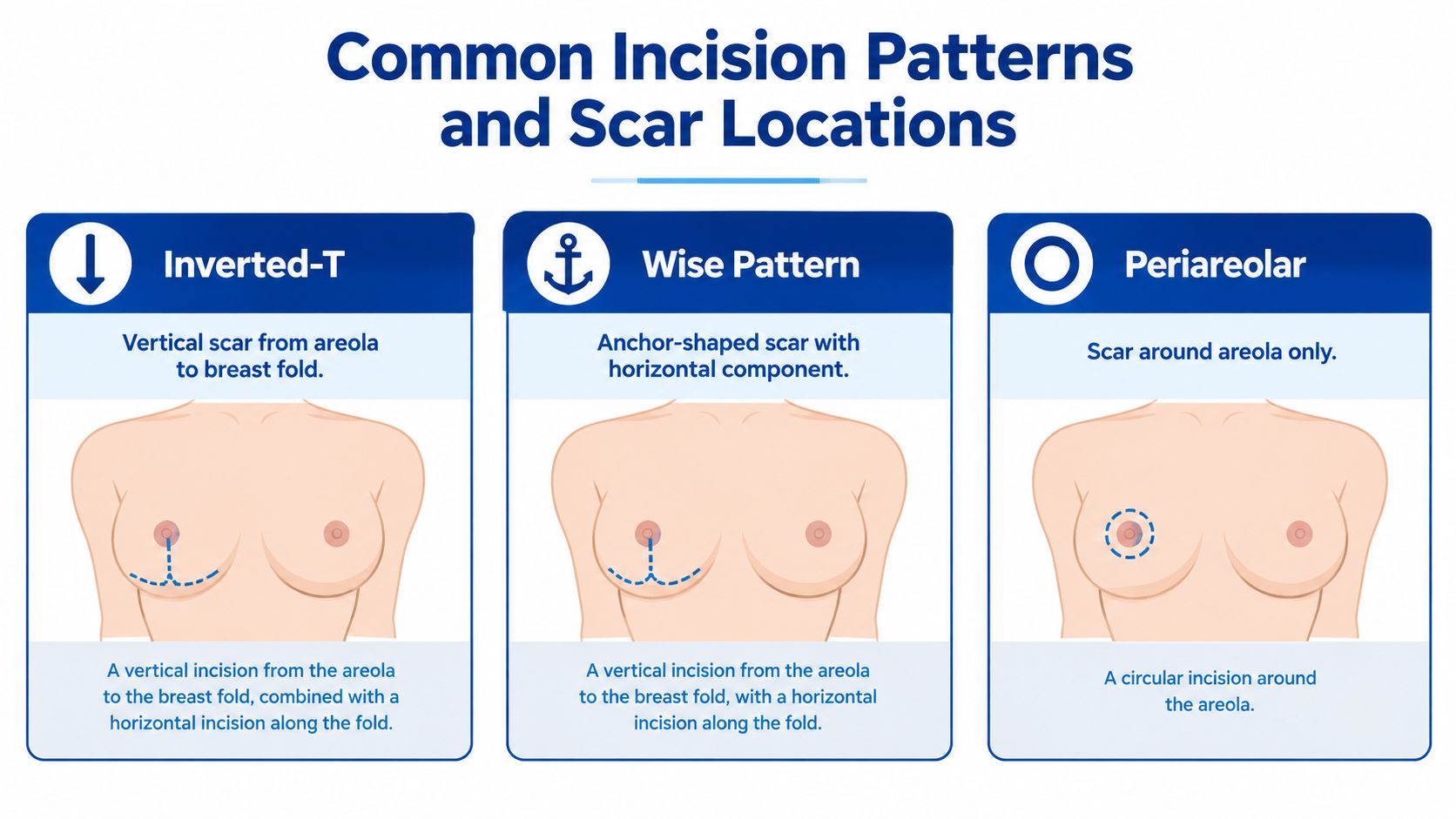
The scar map depends on the amount of tissue removed, the degree of lifting required, your breast shape, and the skin's ability to accommodate the new contour. Three patterns are commonly discussed: anchor, lollipop, and periareolar.
The anchor pattern
The anchor incision, also called an inverted-T or Wise-pattern incision, has three connected parts:
- Around the areola: A circular incision follows the border between the areola and surrounding breast skin.
- Vertically downward: A line travels from the lower edge of the areola toward the breast crease.
- Along the fold: A horizontal line follows the inframammary fold beneath the breast.
This pattern creates the greatest amount of visible incision among the three, but it also gives the surgeon substantial control over excess skin and breast shape. It's often selected when a larger reduction or more extensive reshaping requires skin to be removed in more than one direction.
The horizontal segment can be especially important emotionally. Patient research found that 65% were dissatisfied with their scars even though 86% were highly satisfied with their breast reduction, and the horizontal component bothered most patients who identified one “worst” scar area (patient-reported breast reduction outcomes). That finding shows why scar discussions should identify specific segments rather than treating the scar as one uniform line.
The lollipop pattern
The lollipop, or vertical, incision circles the areola and continues straight down toward the breast fold. It doesn't include the horizontal fold incision. This can reduce the number of scar directions, but it may not provide enough skin control for every breast shape or reduction.
A vertical scar can also become the segment a patient notices most. In the same patient-focused research, the vertical component was commonly singled out when people were asked which scar they'd want removed. The “shorter” pattern isn't automatically the better choice. The right pattern is the one that allows the breast to be shaped safely and proportionately.
The periareolar pattern
The periareolar, or donut, incision runs around the areola only. It leaves no vertical or horizontal line, which can sound appealing, but its use is more limited. It may suit selected cases involving a smaller reduction or modest lift, where the skin and breast tissue can adapt without requiring additional incisions.
Before surgery, ask your surgeon to draw the expected scar pattern on a diagram or explain it directly on your anatomy. Understanding where each line will sit helps you distinguish a normal pattern from a wound problem after surgery. More detail about the operation itself is available in this explanation of how breast reduction works.
The Biological Timeline of Scar Maturation
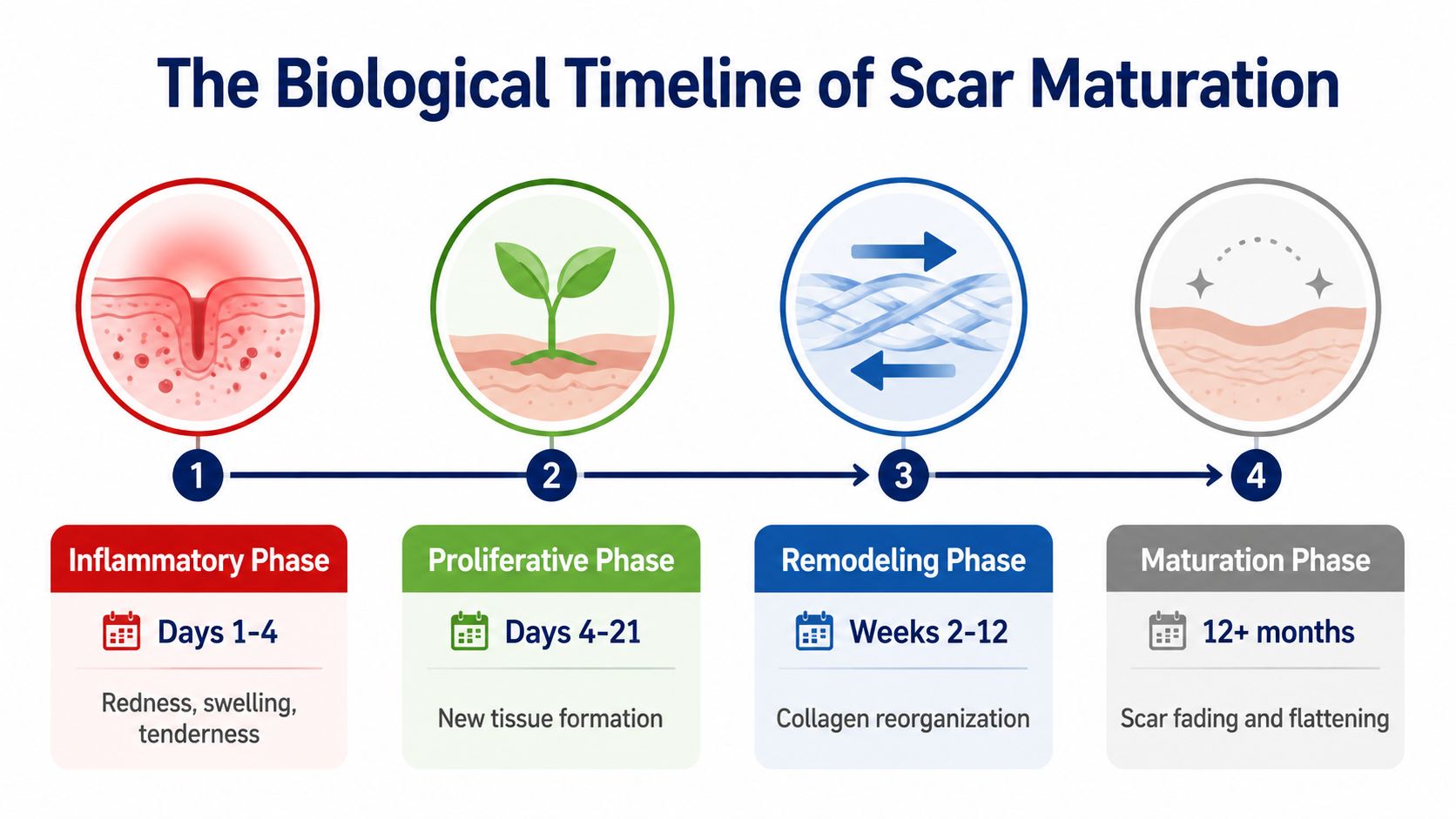
Scar healing is less like turning off a switch and more like rebuilding a road. First, the body closes the damaged area. Then it lays down a temporary structure. Finally, it reorganizes that structure so the tissue becomes stronger, flatter, and less conspicuous.
Early inflammation
Immediately after surgery, blood vessels widen and immune cells move into the area. Redness, swelling, warmth, and tenderness are part of this response. The body is clearing damaged material and protecting the wound while it begins repair.
This phase is why early redness shouldn't be judged as the final scar. The skin is still reacting to surgical injury, and the incision may feel firm or uneven.
New tissue formation
Next, the body builds a temporary repair matrix. New blood vessels and connective tissue support the closing wound, while collagen production increases. The scar can look thicker or darker before it starts to soften.
This is also when tension matters. The breast moves with walking, sleeping, dressing, and arm activity. Pulling across a healing incision can encourage a line to widen or become more noticeable.
Remodeling
During remodeling, collagen fibers are gradually broken down and reorganized. This is the long middle chapter of healing. The scar may flatten, change texture, and shift in color as collagen turnover continues and pigment normalizes.
The process is why a scar that looks “bad” at three months can look substantially calmer later. It doesn't mean every scar will become invisible, but it does mean early appearance has limited power to predict the mature result.
Maturation
Breast reduction scars commonly continue fading and flattening for about 12 to 18 months (scar healing patterns and maturation). A major surgical society also notes that scars generally fade over about 12 months, while complete healing may take 6 to 12 months or longer (postoperative breast reduction expectations).
Think of the first months as construction and the later months as finishing work. Your body isn't just fading a mark. It's repeatedly adjusting the collagen architecture underneath the skin.
Factors That Influence Your Scarring Outcome
Two patients can receive similar incisions and develop very different scars. One may form a thin, pale line. Another may develop a darker, firmer, or wider area despite careful care. That variation reflects both biology you can't change and healing conditions you can influence.
Your baseline biology
Genetics affect how aggressively your body produces collagen. A personal or family tendency toward hypertrophic scars or keloids deserves discussion before surgery. Skin pigmentation also affects how easily a scar becomes darker or lighter than nearby tissue.
Age, skin elasticity, breast size, and the amount of reshaping required influence how much tension reaches each incision. The geometry matters too. A line in the fold may experience different movement and moisture than a vertical line beneath the areola.
Wound healing and general health
Delayed wound healing is identified as the most common unfavorable outcome after reduction mammoplasty in a peer-reviewed review (review of reduction mammoplasty complications). Infection or wound breakdown can stretch or thicken a scar, and UK surgical guidance notes that such scars may take up to two years to settle.
Smoking can reduce oxygen delivery to healing tissue, while poor nutrition can make it harder for the body to build and maintain new tissue. Follow your surgical team's instructions about activity, wound protection, bathing, support garments, and follow-up visits. Don't add products or supplements because they're marketed for scars.
What the broader data suggest
Large outcomes data involving 2,142 breast reductions reported discernible scars in 14.5% of cases and reoperation specifically for scars in 6.7% (large breast reduction outcomes analysis). The same source associated BMI of 35 or higher with greater overall complication risk, including wounds and infection.
Those figures shouldn't be used to predict your individual result. They do show that scarring belongs on a spectrum. A visible scar, a delayed-healing wound, a raised scar, and a scar requiring revision are different clinical situations.
Evidence-Based Strategies for Scar Prevention and Care
Scar care begins with wound safety, not with the most expensive-looking cream. During the early period, the incision must be fully closed and covered according to your surgeon's instructions. Applying products to an open or incompletely sealed wound can interfere with the skin barrier.
Start with closure
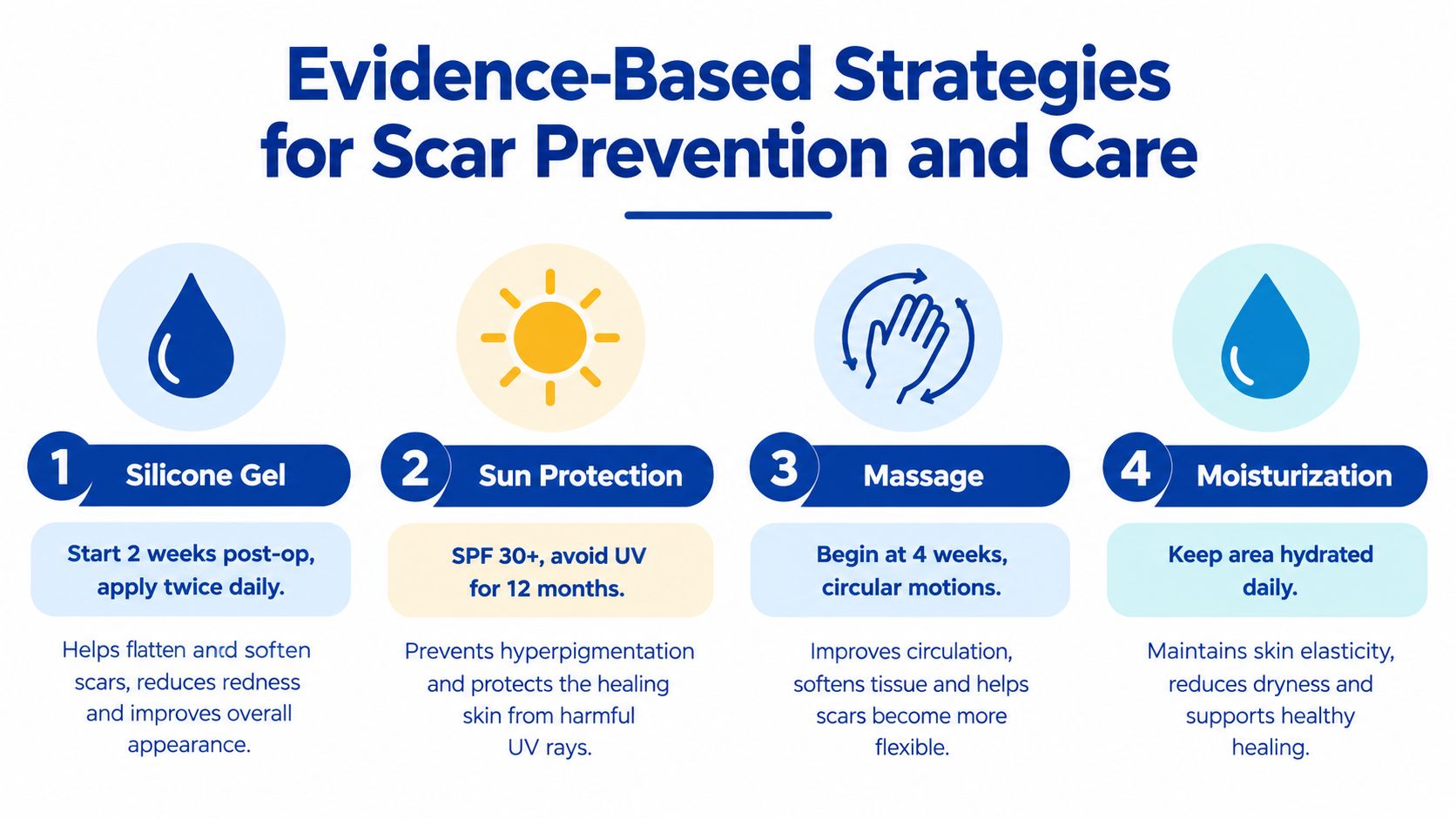
Once the incision is fully epithelialized, silicone is the best-supported first-line option for preventing hypertrophic scarring. The relevant review recommends beginning when the incision is fully closed, typically around 2 weeks after surgery (evidence on preventing postoperative scar hypertrophy).
Silicone gel or silicone sheeting helps maintain a protective, hydrated surface over the scar. Use the format and schedule your surgical team recommends, and keep the routine consistent rather than switching products repeatedly.
Separate evidence from popular advice
The same review found no supported routine benefit for preventing scar hypertrophy from micropore tape, massage, local pressure, Contractubex, 5% imiquimod, or vitamin E. That doesn't mean every surgeon will prohibit these approaches in every situation. It means they shouldn't replace silicone or careful wound management.
Massage also shouldn't begin over a tender, open, draining, or fragile incision. Ask for clearance before manipulating the area. Sun protection is sensible when scars may be exposed, because ultraviolet light can deepen pigment differences during healing. For a plain-language explanation of pigment changes after inflammation, see what causes hyperpigmentation.
Keep the routine uncomplicated
A practical scar-care plan usually has four parts:
- Protect the incision: Reduce rubbing, pulling, and avoidable tension.
- Use silicone after closure: Apply gel or sheeting consistently once the wound is fully epithelialized.
- Watch color and texture: Note gradual changes without expecting week-to-week perfection.
- Attend follow-up visits: Your surgeon can identify early thickening, separation, infection, or excessive tension.
Ideal Face & Body describes detailed scar-care guidance and the use of silicone gel or sheets for breast reduction recovery. You can also review this broader guide to scar-healing treatments before discussing options with your clinician.
Managing Complications and Considering Revision
A normal scar can be red, firm, itchy, or uneven while it matures. A complication is more likely when the scar becomes progressively raised, extends beyond the original incision, widens substantially, or follows a wound problem such as infection or breakdown.
A hypertrophic scar stays within the boundaries of the original incision but may become thick and rope-like. A keloid grows beyond those boundaries. The distinction matters because the treatment plan depends on the scar's behavior, your history, and whether the wound is still changing.
When evaluation is appropriate
Contact your surgical team promptly if you notice increasing redness, spreading warmth, drainage, fever, worsening pain, or separation of the incision. These signs concern the wound itself, not merely its appearance. Early assessment can prevent a healing problem from becoming a larger scar problem.
For a raised or persistent scar, clinicians may consider silicone, corticosteroid injections, laser-based treatment, pressure approaches, or surgical revision. Revision removes or reduces the scar but creates a new wound, so it's usually considered after the tissue has had enough time to mature, unless a specific complication requires earlier intervention.
The question isn't only “How visible is the scar?” It's also “Is the scar stable, symptomatic, and inside the original wound boundary?”
Scar dissatisfaction can exist separately from overall surgical satisfaction. The patient research cited earlier found a marked gap between satisfaction with the breast reduction and satisfaction with the scars. That doesn't invalidate the concern. It means your breast shape, comfort, symptoms, and scar appearance are separate parts of the outcome and should be assessed separately.
Practical recovery extends beyond the incision itself. Guidance on home care after hospital discharge can help families think through support, observation, and safe recovery routines, while your surgical team remains the authority for breast-specific instructions.
If your scars remain raised, painful, widened, or emotionally distressing as they mature, schedule an evaluation with Dr. Sarah Yovino or Dr. Justin Yovino. Ideal Face & Body offers breast reduction consultations, postoperative scar guidance, and assessment of persistent scar concerns, with recommendations based on the wound's stage and your individual anatomy.
Ideal Face & Body provides awake breast reduction and related breast-surgery consultations in Beverly Hills, CA, including individualized incision planning and silicone-based scar-care guidance. Visit Ideal Face & Body to discuss your expected scar pattern, healing timeline, and whether a persistent scar needs clinical evaluation.