Are you choosing a neck treatment before you know whether the problem is muscle, skin, fat, or the structure underneath? That's the gap behind many disappointing results: two necks can look similar in a photograph but need very different treatment.
Neck bands treatment starts with identifying the tissue causing the visible change. A muscle-relaxing injection may soften cords that appear with expression, but it won't remove excess skin or fat. Understanding that distinction helps you ask better questions and avoid booking a procedure that can't address your main concern.
Table of Contents
- Neck Band Treatment Options at a Glance
- Neck Bands Versus Skin, Fat and Laxity
- Botulinum Toxin for Dynamic Neck Bands
- How Long Neck Band Results Last
- Energy Devices, Threads and Laser Liposuction
- Surgical Neck Lifts and Platysmaplasty
- Pre and Post Care for Neck Band Treatment
- Choose the Right Neck Band Option and Get Answers
Neck Band Treatment Options at a Glance
Neck bands are treated by matching the option to the tissue causing them, not by choosing a product first. The routes below run broadly from less invasive treatment to surgery, although their suitability matters more than their position in the table.
Read the main-target column before the timing column. Injections relax muscle, filler-based approaches address selected skin creases, and contouring removes fat. A neck lift can address loose tissue that those treatments leave behind.
Neck band treatment options compared
| Option | Main target | Setting | Visible change begins |
|---|---|---|---|
| Botulinum toxin | Vertical bands that show when you clench or speak | Office injections, no incisions | About one to two weeks |
| Dermal filler with mesotherapy | Horizontal neck lines and skin quality | Office injections, no incisions | Gradually as the treated skin settles |
| Energy devices | Mild laxity and skin texture | Office sessions, no surgical incisions | Gradually as tissue remodels |
| PDO thread lift | Mild laxity along the jawline and neck | Office, local anesthesia | Initial support, then gradual tissue response |
| PRECISION SCULPT laser liposuction | Fat under the chin and along the neck | Office, awake under local anesthesia | As early swelling subsides |
| Mini neck lift | Mild laxity and loose skin | Outpatient surgery | After swelling settles |
| Standard neck lift | Moderate laxity, excess skin and bands | Outpatient surgery | Progressively through postoperative healing |
| Platysmaplasty | Separated platysma muscle causing bands | Usually added to a neck lift | Progressively through postoperative healing |
Visible change isn't the same as a finished result. An injectable result develops as the medicine takes effect, while surgical contours remain obscured by swelling during healing. Don't compare an early postoperative photograph with a settled injection result.
For broader background on everyday neck care, Solawave's tips for reducing turkey neck can help you distinguish supportive habits from procedures that change deeper tissue. Home care belongs alongside a treatment plan, not in place of an anatomical assessment.
Ideal Face & Body in Beverly Hills, CA, offers PRECISION SCULPT laser liposuction for the chin, neck and jawline, plus mini and standard neck lifts. Many procedures are performed awake under local anesthesia, but whether your neck lift can be performed awake requires confirmation at consultation.
Shortlist the rows that resemble your concern. Then check whether what you're seeing is a muscle cord, a skin fold, or fullness beneath the skin.
Neck Bands Versus Skin, Fat and Laxity
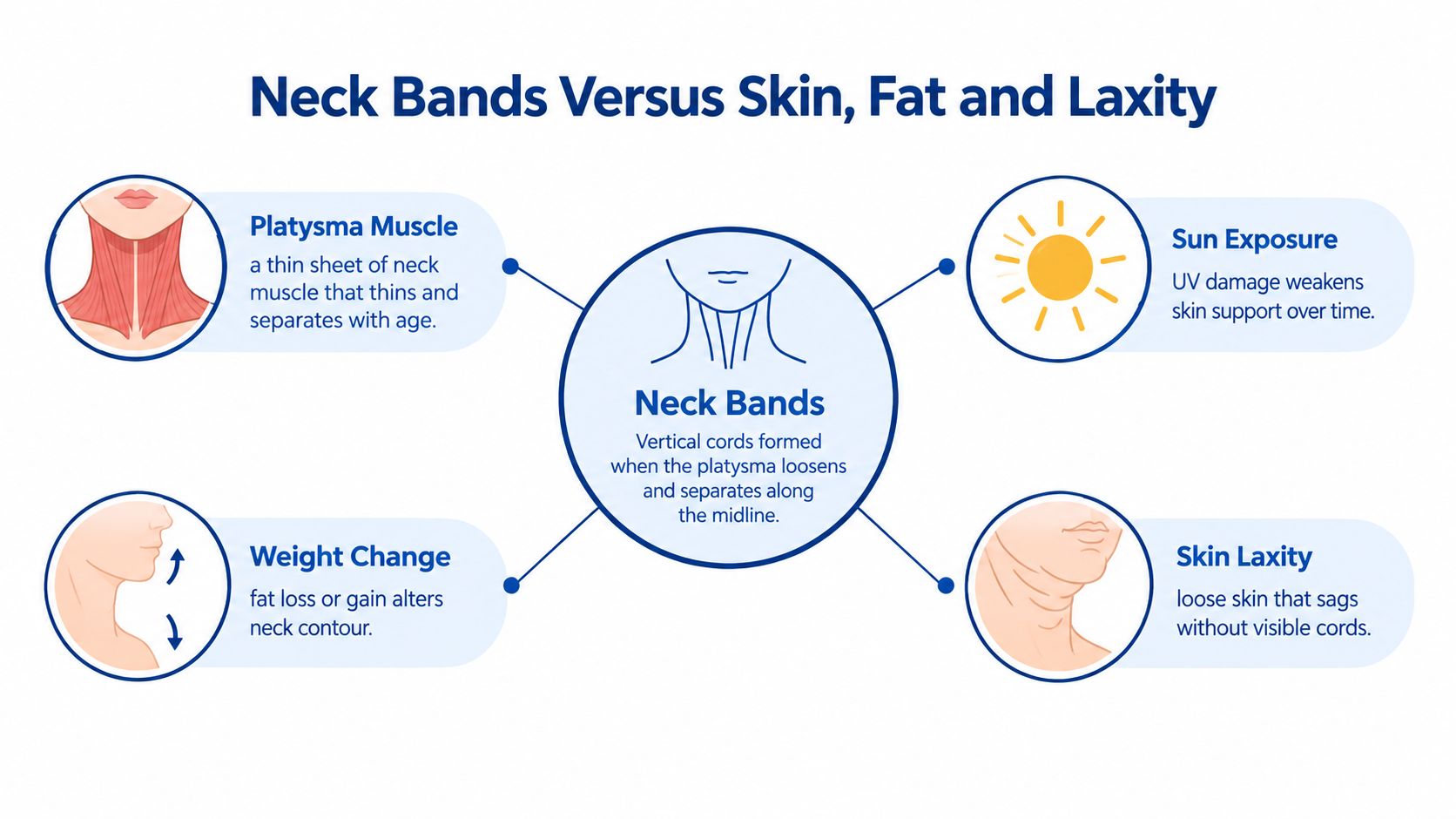
The same vertical line can start in muscle, skin, fat, or structure, and each layer answers to a different tool. Neck bands are vertical cords formed by the platysma, a thin sheet of neck muscle whose edges can become more prominent as the muscle and surrounding support change. Age-related laxity can reveal those edges, particularly when you tense your neck.
The platysma works like an elastic sling under the skin: when its edges turn outward or drift apart, cords show during contraction. Sun exposure changes the overlying skin, weight change shifts contour, and repeated forward-head posture can deepen creasing. Each factor acts on a different layer, so the fix has to match the cause.
Check movement before choosing treatment
Look straight ahead in a mirror and gently clench your teeth, then relax your face completely. Next, tilt your head back comfortably, without straining, and notice whether you see cords, folds, horizontal creases, or a pocket of fullness.
Head position changes how normal tissue looks, and a photograph cannot reliably separate superficial fat from deeper anatomy. Use these observations to describe your concern, and let an examination confirm the cause.
Visible signs and the tissue behind them
| Visible sign | Tissue behind it | Fitting first step |
|---|---|---|
| Vertical cords that appear when you clench or speak | Platysma muscle contraction | Injectable assessment |
| Bands that stay visible with a relaxed face | Muscle separation and laxity | Surgical assessment |
| Loose skin hanging under the jaw | Skin laxity and excess skin | Neck lift evaluation |
| Fullness under the chin with firm skin | Submental fat | Laser liposuction consultation |
| Fine horizontal lines across the neck | Skin creasing and texture | Filler or resurfacing review |
| Rounded bulge at the base of the neck | Possible dorsocervical fat pad | Medical assessment, then contouring consultation if appropriate |
A 2021 randomized study published in Clinical, Cosmetic and Investigational Dermatology found that hyaluronic-acid compound filling plus mesotherapy improved moderate-to-severe horizontal neck lines more than botulinum toxin across follow-ups through 10 months. That finding applies to horizontal lines; separated muscle edges need a different assessment.
A neck can hold a vertical cord and a horizontal crease at once. Relaxing the cord may soften movement-related banding while the crease stays visible. A remaining crease can signal a second layer rather than a failed injection.
A weak chin can also make the neck angle appear less defined without being a neck-band problem. Likewise, a new or enlarging lump at the back of the neck deserves medical evaluation before cosmetic contouring.
Practical rule: Treating the wrong layer can leave your main concern unchanged. Use the mirror check to prepare questions, and let examination choose the layer.
Botulinum Toxin for Dynamic Neck Bands
Of the layers that can create visible neck banding, botulinum toxin targets only one: muscle. It blocks the nerve signal that tells a treated muscle to contract, so when selected platysma fibers relax, movement-related bands can soften and the neck may look less tense. The goal is enough relaxation to smooth the band while the neck still turns, speaks and swallows normally.
An injector needs to understand how the platysma interacts with nearby muscles involved in facial expression and neck function. Placement matters as much as the choice of medicine.

What happens during an appointment
- Assess the neck upright. The clinician observes your neck at rest and during contraction so gravity and movement reveal the treatment pattern.
- Identify the medial platysma border. The injector distinguishes the prominent muscle edge from surrounding tissue rather than treating every visible line alike.
- Place small aliquots along the selected band. Superficial, anatomically targeted placement aims to treat the intended muscle while limiting unwanted effects in the muscles around it.
- Review the developing result. Follow-up allows the clinician to assess symmetry, remaining activity and any functional symptoms before considering adjustment.
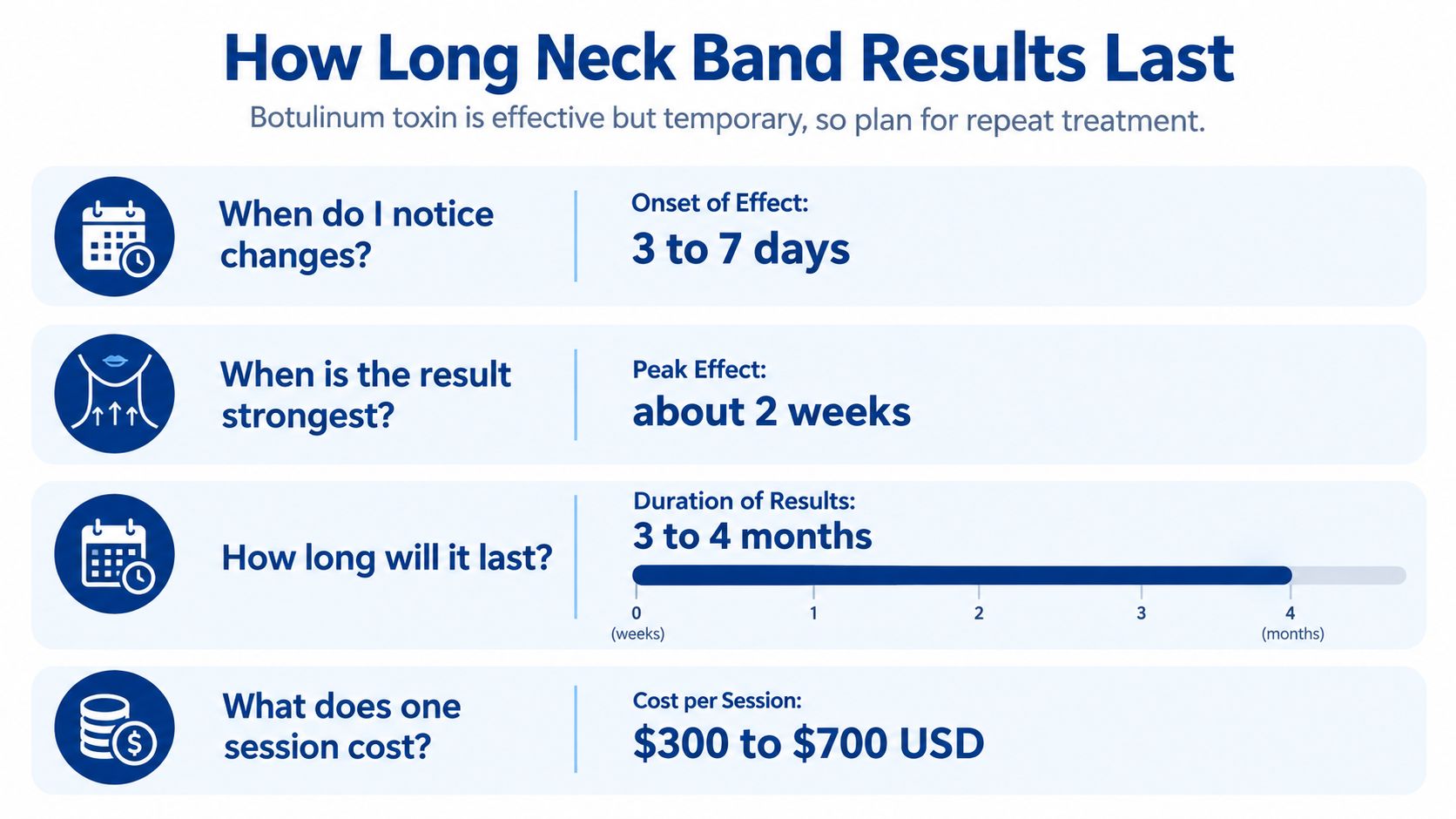
For mild banding without substantial loose skin, StatPearls' discussion of platysmaplasty describes approximately 10–30 units per side, with effects developing over one to two weeks and lasting about three to four months. Your injector selects the actual dose and sites after examining your platysma, so figures like these describe the clinical range, and your plan comes from the exam.
Approval and product selection
In October 2024, BOTOX Cosmetic received FDA approval for temporary improvement of moderate-to-severe vertical platysma bands in adults, supported by two phase III trials, with labeled doses of 26, 31 or 36 units, according to the approval announcement. That approval is specific to the product and indication; it doesn't automatically extend to every neurotoxin.
Ideal Face & Body offers Botox, Dysport, Xeomin, Jeuveau and Letybo, and physician injector Sarah Yovino, MD, performs injectable treatments at the practice. Units aren't interchangeable between formulations, so comparing treatment by unit count alone is misleading.
If you're unfamiliar with neuromodulators, XO's clinician-led guidance on wrinkle treatments offers background for discussing assessment and expectations. Your neck-specific plan still requires an examination.
Bands visible at rest may retain a treatable dynamic component. Injections alone shouldn't be expected to correct substantial skin excess or structural separation, since those belong to different layers, and a responsible assessment includes explaining what will remain untreated.
How Long Neck Band Results Last
How long should you expect neck-band improvement to last? The answer depends on what is being measured: a clinician's rating, a patient's assessment, or whether another treatment is needed. These outcomes describe different parts of the result.
Durability and safety numbers from recent studies
The first, second and final rows summarize a 2019 systematic review in Aesthetic Surgery Journal, which included 78 patients. The review reported complications in 15.4%, or 12 of 78 patients, with none requiring additional intervention.
| Measure | Timepoint | Reported result | Context |
|---|---|---|---|
| At least one-point improvement | About 14 days | 93.7% of patients | 2019 systematic review of 78 patients |
| Maintained one-point improvement | About 84 days | 84% of patients | Same 2019 systematic review |
| At least one-grade improvement | Day 14 | 76.7% versus 21.2% placebo | 2025 randomized study |
| At least two-grade improvement | Day 14 | 41.0% versus 2.2% placebo | 2025 randomized study |
| Sustained response | Three months | 86% | Earlier prospective study |
| Repeat treatment needed | Follow-up period | 13 of 78 patients | 2019 systematic review: 10 bands unchanged and 3 compensatory bands |
The clinical evidence on platysma-band treatment also describes neck weakness in 4.34% and hematoma in 8.7% of patients in an incobotulinumtoxinA study summarized by a review (Aesthetic Surgery Journal).
Read the timepoint, not just the percentage
An early-response figure shows how often patients improved soon after treatment. A later assessment shows whether improvement remained; a placebo-controlled result helps distinguish the treatment effect from changes seen without active medication.
The prospective study's reported response fell between its early and three-month assessments. That illustrates why timing matters, but results from different studies should not be combined into a single prediction for your neck.
Repeat treatment may also require a fresh assessment rather than a simple copy of the original plan. Unchanged bands and newly prominent compensatory bands can call for a review of the underlying anatomy, placement and treatment goals.
DaxibotulinumtoxinA remains investigational for this application. A registered trial described in the same clinical evidence tests 15 or 20 units per band, with assessment at three months. A trial plan does not establish how long routine treatment will last.
For maintenance planning, the practice's guide to Botox upkeep and regular sessions can help you prepare follow-up questions. Let changes in the bands and a clinician's assessment guide the timing, rather than relying on a calendar reminder.
Energy Devices, Threads and Laser Liposuction
Between injectables and a surgical lift sit three options, each acting on a different tissue layer: energy devices target skin response, threads provide limited support, and liposuction removes fat. Match the option to the layer causing your banding before comparing how invasive each one feels.
Skin treatments and limited support
Energy devices deliver controlled heat to encourage tissue remodeling. The clearest candidate is a patient with mildly crepey or slack skin and no visible muscle cords: surface texture can improve while the underlying anatomy stays unchanged.
Ideal Face & Body lists Morpheus8 and Venus Viva among its resurfacing offerings. Response develops gradually, sometimes across a series of sessions, and suits selected texture concerns and mild laxity better than strong muscle cords. Device settings must account for the neck's skin thickness and healing characteristics.
PDO threads are dissolvable sutures placed beneath the skin to provide modest support. They cannot reproduce surgical removal of loose skin or repair separated muscle.
Potential concerns include dimpling, asymmetry, palpable or visible threads, and infection. The evidence base is thinner than for surgical correction, so ask how the clinician would manage an unsatisfactory contour before you agree to placement.
For an additional explanation of treatment selection, Skinsation Aesthetics Inc.'s discussion of non-surgical options for a softened jawline can help frame questions about skin laxity versus under-chin fullness.
Fat removal and its limits
With PRECISION SCULPT laser liposuction, laser energy helps disrupt fat before a small cannula removes it. The practice performs this treatment awake under local anesthesia and uses a custom head and neck wrap afterward.
The practice's explanation of laser liposuction for the neck describes this contouring route. It can refine the neck angle when superficial fat is the main concern. Skin that hangs or folds still needs a surgical evaluation.
- Firm skin over fullness: Discuss whether fat reduction would improve the contour.
- Hanging or folding skin: Ask whether a lift is necessary instead of relying on tightening alone.
- Mixed findings: Request a plan that explains each treatment's contribution.
If folds remain obvious when you comfortably tilt your head back, an in-person skin-excess assessment tells you more than choosing a device from photographs.
Surgical Neck Lifts and Platysmaplasty
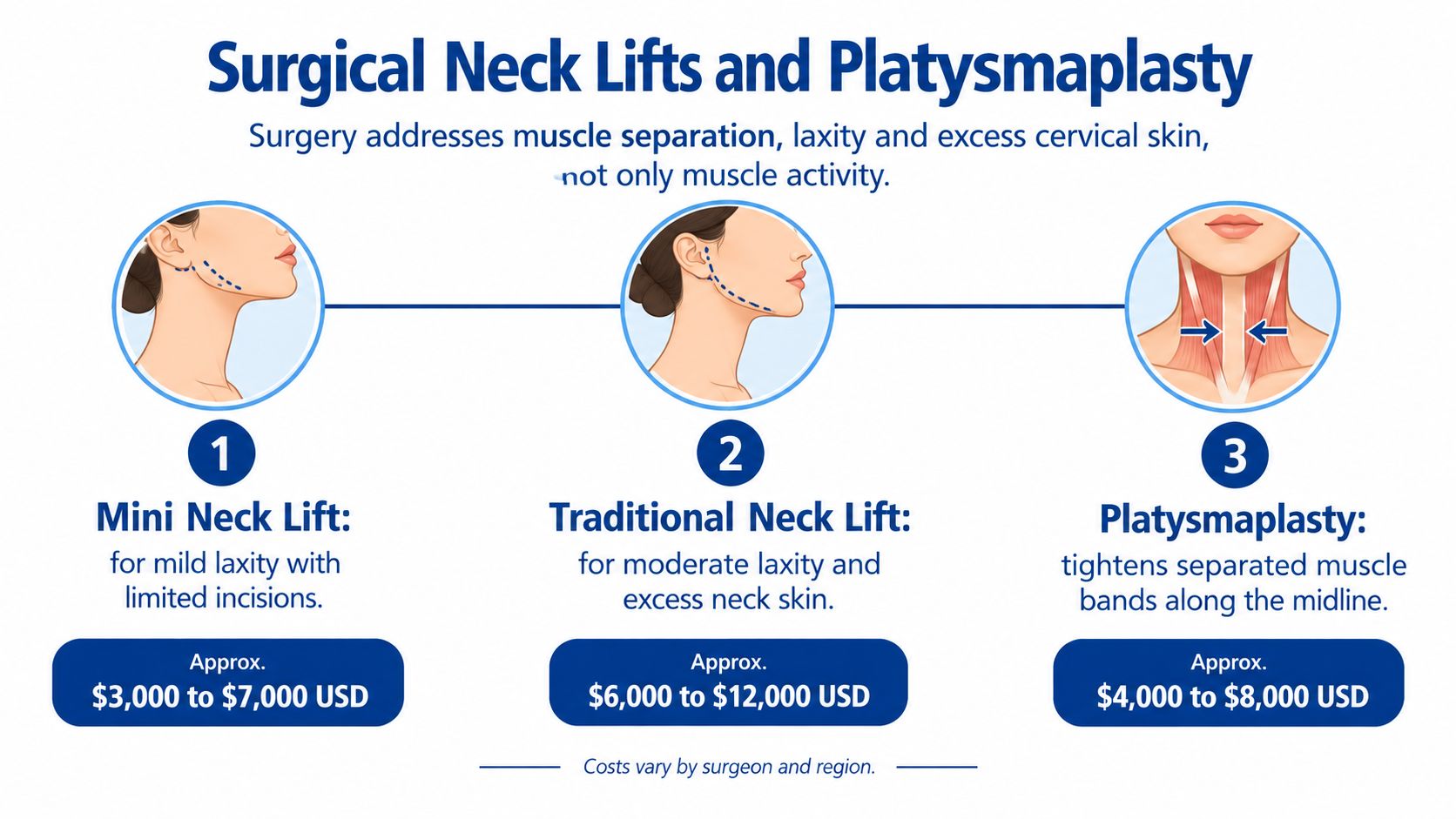
Surgery addresses muscle separation, laxity and excess cervical skin, rather than only reducing muscle activity. Its value is structural: the surgeon can reposition, remove or repair tissue that an injection cannot.
A mini neck lift generally suits limited laxity with favorable skin elasticity. A standard neck lift addresses more extensive loose skin and contour changes, while platysmaplasty treats the platysma itself, often during a neck lift. The names aren't standardized enough to replace a discussion of exactly what the surgeon will do.
What surgical evidence can tell you
A prospective single-blind study of 80 patients examined complete platysma transection from the medial to lateral edge after undermining, maintaining at least a 3 cm gap between muscle edges and adding a low horizontal division for hammock-like support; no band recurrence was reported in that group. This describes a particular technique, not the required method for every neck.
A 2024 systematic review and pooled analysis covering 12 studies and 2,106 patients reported a 1.4% pooled recurrence rate for platysma bands. Pooled results can inform counseling, but they don't guarantee an individual outcome.
A separate simplified platysma-band technique study followed 25 female patients for one year, with residual banding in one patient treated after bruising and edema resolved. Residual banding means a band remains after treatment; recurrence means banding returns after an initial correction.
Surgical neck options by fit, downtime and trade-off
| Surgical option | Best fit | Typical downtime | Main trade-off |
|---|---|---|---|
| Mini neck lift | Mild laxity with good skin elasticity | Return after wound review and surgeon clearance | Limited correction of deep bands |
| Standard neck lift | Moderate laxity, jowling and excess skin | Plan time away from public-facing work and strenuous activity | Longer incisions and prolonged swelling |
| Platysmaplasty during a neck lift | Vertical bands from separated muscle | Follow the recovery restrictions for the combined operation | Bruising, swelling and muscle-related recovery |
Before surgery, the examination should document submental fat, skin recoil, platysma separation and the mandibular border. Repairing muscle alone can leave unwanted fullness, while removing fat alone can expose laxity.
The practice's overview of platysma muscle tightening provides context for discussing a muscle-focused procedure. Ask whether the proposed technique includes approximation, selective division, skin redraping, or a combination.
Counseling should cover asymmetry, residual or recurrent bands, contour irregularity, hematoma, sensory changes and temporary lower-face weakness. Choose the operation for the anatomy it addresses, not the smallest-sounding procedure name.
Pre and Post Care for Neck Band Treatment
Preparation and aftercare depend on which layer was treated. An injection into the platysma carries a short recovery, while a lift that rearranges muscle and skin requires a longer one. What stays constant is accurate disclosure: your clinician needs to know what you take, how you heal and whether you have any swallowing, breathing or muscle problems before treatment.
Never stop a prescribed blood thinner on your own. The treating clinician and prescribing professional should agree on any medication change.
Before your appointment
- Share your complete medication list. Include aspirin, ibuprofen, fish oil, vitamin E, prescriptions and nonprescription products.
- Confirm medication instructions. Ask which medicines or supplements need adjustment and who will authorize the change.
- Stop smoking and nicotine as directed. Nicotine impairs healing, so this matters most before surgery.
- Discuss alcohol restrictions. Follow the practice's instructions before and after treatment rather than assuming a small amount is harmless.
- Disclose cold sores and skin infections. A history of cold sores can affect preventive planning before resurfacing.
- Arrange transport and help. If sedation is planned, organize a responsible driver and someone to assist afterward.
- Take baseline photographs. Capture your neck relaxed, gently clenched and comfortably tilted back using consistent lighting.
After injections
Stay upright for the rest of the day so the product settles where it was placed. Avoid rubbing or massaging the front or sides of the neck unless the treating clinician specifically instructs you otherwise, because pressure can shift the product toward muscles it was not meant to reach. Skip tight collars and long stretches of looking down at a phone for the first day; repeated neck flexion squeezes the treated bands. Wait for your injector's clearance before returning to strenuous exercise or anything that strains the neck.
- Let the result develop: Don't seek immediate additional treatment for early asymmetry.
- Record unexpected symptoms: Note when they started and contact the practice.
- Attend the review: Uneven effects need an examination before any adjustment.
After contouring or a lift
Keep your head raised when resting, and sleep on two pillows or a wedge for at least the first week so the chin does not press toward the chest. Wear the prescribed head and neck wrap exactly as directed. Don't tighten it yourself to force swelling down; added pressure on healing tissue can do more harm than the swelling itself.
Use cold compresses only with the surgeon's approval, without placing ice directly on healing skin. Avoid heavy lifting, bending and strenuous exercise until cleared, and protect healing skin and incisions from sun exposure.
Contact the practice the same day for rapidly increasing swelling, fever or severe pain.
Your discharge instructions should include an after-hours contact route. Save it before leaving the office, and make sure your helper knows where to find it.
Choose the Right Neck Band Option and Get Answers
If your only concern is cords that appear when you clench, start with an injectable assessment. If bands remain visible at rest alongside loose skin, ask for a surgical evaluation that considers both skin and platysma repair.
Combined concerns usually need a staged or combined plan. For example, someone with under-chin fat and prominent muscle edges needs an explanation of which procedure changes each feature. A single treatment that works on only one layer will leave the other concern visible.
When a surgical opinion is useful
Consider a surgical consultation when you have persistent resting bands, hanging skin beneath the jaw, or an injection result that never addressed your main concern. A short-lived injection response deserves review, though it does not automatically mean surgery is necessary.
New swallowing problems, breathing difficulty or worsening weakness call for prompt medical assessment. Comparing aesthetic options can wait for a routine appointment.
Bring these questions:
- Which tissue is responsible? Ask the clinician to show you the muscle, skin, fat or structural contribution.
- What result is realistic? Clarify what should improve, what will remain and how durability will be assessed.
- What will recovery and maintenance involve? Discuss restrictions, review visits and the circumstances that would justify retreatment.
- What if surgery isn't suitable? Ask for a realistic alternative, including the option of not treating.
Common questions before booking
Can injections and a lift be combined?
Usually, they can be incorporated into a staged or combined plan. Timing should be chosen by the treating clinicians so healing and muscle assessment are not unnecessarily complicated.
Are the results permanent?
Durability differs by approach, and the earlier section on how long neck band results last explains what to expect from each.
Can a neck lift be done awake?
Sometimes. Anatomy, procedure extent, medical history and comfort requirements determine whether local anesthesia is appropriate, and that must be confirmed at consultation.
Who should I consult?
A clinician able to examine muscle, skin and fat layers in person and qualified to discuss both injectable and surgical options. At Ideal Face & Body, that assessment can cover injectables, PRECISION SCULPT contouring and surgical lifting in one visit.
Arrange a consultation and bring your baseline neck photographs, your medication list and a clear description of the single change that matters most to you.
Ideal Face & Body offers physician-led injectables, PRECISION SCULPT neck contouring, and neck lifts with platysma treatment when appropriate. Visit Ideal Face & Body to arrange a consultation and find out which tissue layer needs treatment before committing to a procedure.