You may be eating well, exercising consistently, and maintaining a stable weight, yet still notice a soft fold beneath your chin whenever you turn sideways in the mirror. Genetics, pregnancy-related changes, aging, or the natural shape of your jaw can make the neck look heavier than the rest of the face. That frustration is understandable, but the right solution depends on what creates the fullness. Is it fat, loose skin, neck muscle banding, limited chin projection, or a combination?
Double chin lipo can be highly effective for the right anatomy. It can also disappoint when a surgeon removes fat from a neck that primarily needs skin tightening or structural support. The most important decision isn't choosing the newest device. It's identifying the patient who will benefit from targeted fat removal, then choosing a technique that matches the tissue.
Table of Contents
- What Double Chin Lipo Actually Does
- How the Procedure Works Step by Step
- Who Makes a Good Candidate and Who Doesn't
- PRECISION SCULPT and Other Chin Lipo Options
- What Happens on Procedure Day
- Real Risks and Possible Complications
- Recovery Timeline and When Results Show
- Common Questions Before You Commit
What Double Chin Lipo Actually Does
Double chin lipo, also called submental liposuction, removes localized fat beneath the chin through small access points. A surgeon places a fine cannula into the subcutaneous fat layer and removes carefully selected deposits, rather than treating the procedure as a form of general weight loss. The goal is a cleaner transition between the chin, jaw, and neck.
Patients commonly seek treatment because the cervicomental angle, the line where the underside of the chin meets the neck, looks soft or rounded. A persistent pocket of fullness can hide the jawline even when the rest of the body is relatively lean. Liposuction can reduce that pocket and improve profile definition, but it can't change every structure that contributes to a double chin.
Fat is only one part of the diagnosis
Liposuction works best when the main problem is soft, pinchable submental fat and the overlying skin can retract. It doesn't remove loose skin, tighten a significantly separated platysma muscle, or advance a recessed chin. If the chin sits farther back than the surrounding facial structure, fat removal alone may leave the profile under-supported.
The same distinction matters with age. Skin gradually loses elasticity, and some patients develop visible platysmal bands or vertical neck laxity. In that setting, removing fat may improve fullness but leave sagging behind. A neck lift, muscle repair, skin-tightening treatment, chin augmentation, or a combination may be more appropriate.
Practical rule: The operation should follow the diagnosis. A surgeon who evaluates fat, skin, muscle, and chin projection separately is less likely to promise a result that liposuction alone can't deliver.
The published evidence also calls for realistic expectations. A 2022 scoping review screened 539 articles but found only 4 studies that met its inclusion criteria, demonstrating that the formal literature on submental liposuction remains limited despite the procedure's long history. Those included cases were predominantly female, with an 8:1 female-to-male ratio and a mean age of 55.77 years, according to the 2022 review of submental liposuction evidence. The procedure has a clinical track record, but it isn't a substitute for individualized examination.
How the Procedure Works Step by Step
The quality of a neck contour depends on how carefully the surgeon reads the tissue before suction begins. I prefer to evaluate the patient upright because gravity reveals asymmetries, jawline interruptions, and the true distribution of fat more clearly than a flat operating position.
Marking and preparation
The surgeon marks the submental pocket, jawline, and any jowl fullness while the patient is standing. Small access points are usually placed beneath the chin and, when needed, behind the earlobes. These locations allow the cannula to approach the fat from more than one direction while keeping the entry sites discreet.
A tumescent solution is then infiltrated into the subcutaneous layer. It numbs the tissue, reduces bleeding, and firms the fat compartment so the cannula can move through it with better control. The fluid also creates separation between tissue planes, which helps the surgeon sculpt rather than empty the area.
The liposuction itself uses a fine cannula and controlled passes. The surgeon works across the central submental pocket, then evaluates the transition toward the jaw and jowls. The objective isn't to remove every possible bit of fat. Over-removal can create hollows, visible irregularities, or an aged appearance.
Energy-assisted refinement
Some protocols add laser energy or ultrasound assistance to loosen fibrous fat and encourage modest contraction of the overlying skin. These tools can be useful in selected patients, but energy doesn't turn poor skin elasticity into the skin of a younger patient. The surgeon still has to judge how much tissue to remove and how much tightening the anatomy can realistically provide.
For patients considering an awake laser approach, how laser liposuction is performed can help explain the role of energy before suction. The surgeon checks symmetry with the patient upright whenever possible, closes the small access points, and applies compression to support the healing contour.
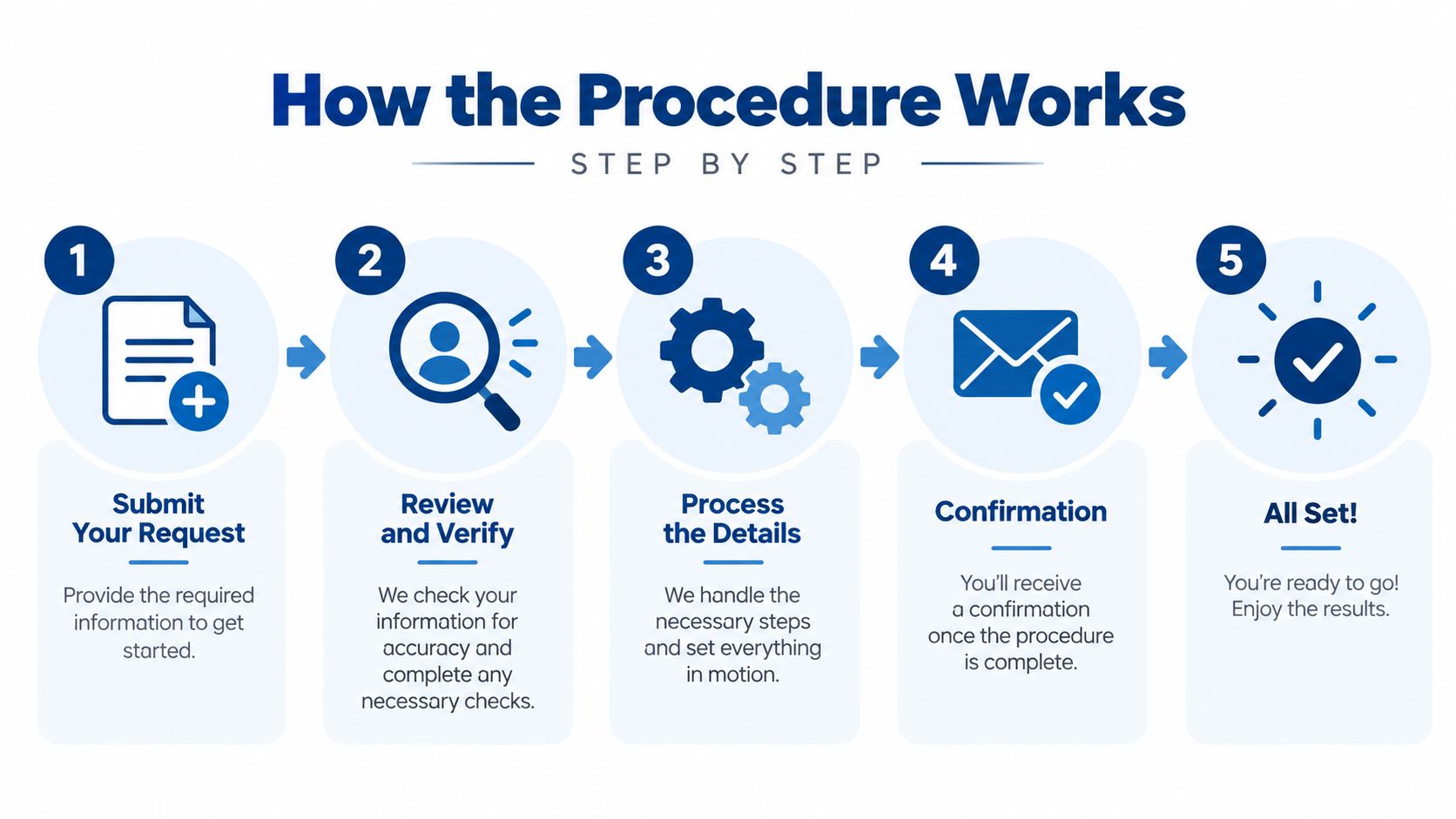
Awake local anesthesia suits this area because the surgeon can communicate with the patient while assessing comfort, movement, and symmetry. It can also avoid the recovery demands associated with deeper anesthesia for appropriately selected cases.
Who Makes a Good Candidate and Who Doesn't
Consider two people with the same complaint, a soft double chin in photographs. One may have a compact fat pocket and firm skin. The other may have little excess fat but loose skin, platysmal banding, and a chin that sits back. Their treatment plans shouldn't be identical.
A favorable profile
A strong candidate generally has:
- Localized fullness: The fat sits mainly beneath the chin rather than throughout the neck.
- Useful skin elasticity: The skin can contract around the reduced volume.
- Stable body weight: The patient isn't treating liposuction as a weight-loss procedure.
- Sound expectations: The goal is a sharper contour, not a completely different face.
- Good health habits: Smoking, poor wound healing, and uncontrolled medical issues can alter risk and recovery.
Age by itself doesn't decide candidacy. A younger patient can have poor elasticity from genetics, sun exposure, or major weight loss, while an older patient may still have adequate skin quality for lipo alone. The examination matters more than the birth date.
When lipo alone is the wrong tool
Significant laxity can require a neck lift or another tightening strategy. Prominent platysmal bands may call for muscle treatment. A recessed chin can make the neck look full because the jaw lacks projection, in which case filler or an implant may contribute more to the profile than further fat removal.
Smoking deserves a direct conversation because it can impair healing and increase surgical risk. Prior weight loss and sun damage can also reduce the skin's ability to retract. These factors don't always make treatment impossible, but they can shift the recommendation away from isolated liposuction.
| Feature | Good Candidate | Poor Candidate |
|---|---|---|
| Main concern | Isolated, soft submental fat | Loose skin, banding, or structural fullness |
| Skin quality | Elastic enough to contract | Thin, lax, or heavily sun-damaged |
| Chin structure | Adequate projection | Recessed chin that needs support |
| Expectations | Wants contour refinement | Expects weight loss or a surgical lift |
| Planning | Accepts gradual healing | Wants an immediate final result |
The wrong candidate often doesn't develop a complication. The more common problem is an underwhelming result. Fat reduction may be technically sound, yet the neck still looks loose because the original diagnosis was incomplete.
PRECISION SCULPT and Other Chin Lipo Options
Technique should follow the patient, not the device. Fat texture, skin recoil, treatment volume, and anesthesia preferences all affect the choice. No technology can correct poor marking or excessive suction. Historical practice patterns have favored conventional liposuction for submental and jowl fat reduction, with radiofrequency and laser liposuction used less often, according to the systematic review record. Those patterns describe how procedures have been performed, not which method suits every neck.
How the options differ
PRECISION SCULPT is an awake, office-based protocol using local tumescent anesthesia and a diode laser fiber. The laser assists with fat liquefaction and dermal heating, while suction removes the treated fat. It can suit patients with modest-to-moderate localized fullness, reasonable skin elasticity, and a preference for an office-based recovery. Ideal Face & Body describes its PRECISION SCULPT laser liposculpting approach for contouring the chin, neck, and jawline.
Traditional suction-assisted liposuction removes fat mechanically through a cannula. Its main advantage is direct tactile feedback during sculpting, and it can address a broader fat pattern. The anesthesia setting and recovery plan depend on the treatment area and planned volume.
VASER-assisted liposuction uses ultrasound energy to help treat fibrous or dense fat. That may improve access in selected tissue, but it does not replace conservative contouring or careful judgment. Radiofrequency- or plasma-assisted approaches aim to encourage tissue contraction. They may help when laxity is limited, but they cannot reproduce a surgical neck lift when excess skin is substantial.
| Technique | Anesthesia | Energy Source | Skin Tightening Effect | Best For |
|---|---|---|---|---|
| Awake laser lipo | Local tumescent | Diode laser | Modest contraction | Selected patients with localized fat and elastic skin |
| Traditional lipo | Local anesthesia, sedation, or another setting based on the plan | Mechanical suction | Depends mainly on skin recoil | Direct removal of submental fat |
| VASER-assisted lipo | Setting varies by treatment plan | Ultrasound | Limited to modest tissue response | Fibrous or dense fat |
| Energy-assisted tightening | Setting varies | Radiofrequency or plasma energy | Helps selected laxity, not a surgical lift | Refinement when skin laxity is limited |
Injections and cooling-based treatments may suit small, superficial deposits, but they require patience and careful selection. Moderate or large fat deposits generally benefit more from direct surgical removal when the goal is a clearer contour change. The deciding question remains whether the patient has removable fat with enough skin recoil to show the result.
What Happens on Procedure Day
Awake submental liposuction is more straightforward than many patients expect, but preparation still matters. You arrive after following the office's medication and eating instructions, complete photographs, and meet with the team to confirm the plan.
The first important step happens standing up. The surgeon marks the chin, neck, jawline, and any asymmetry while gravity shows how the tissue naturally hangs. Those markings guide the cannula and help prevent treating the neck as if it were a flat, perfectly symmetrical surface.
During treatment
Local tumescent anesthetic, typically lidocaine with epinephrine diluted in saline, enters through a tiny access point beneath the chin. Patients usually notice pressure and fullness as the fluid spreads. That sensation can last about five minutes, after which the area becomes numb.
A small cannula delivers laser energy when the selected protocol calls for it, helping liquefy fat and encourage dermal contraction. Gentle cannula passes then remove the fat. Most patients feel tugging, vibration, or movement rather than sharp pain, and the surgeon can pause to reinforce anesthesia if needed.
A second contour check identifies asymmetry before closure. The access point may be closed with a single suture or supported with a Steri-Strip, followed by a compression chin strap. Published technique descriptions also discuss compression and head wrapping as postoperative measures intended to limit swelling and stabilize soft tissue, as described in this technical overview of submental liposuction.
Total chair time is typically 60 to 90 minutes. You should arrange a driver in advance, even if you leave alert and feel comfortable walking out. The garment is applied before discharge, and the office provides instructions for sleeping position, medication, activity, and warning signs.
Real Risks and Possible Complications
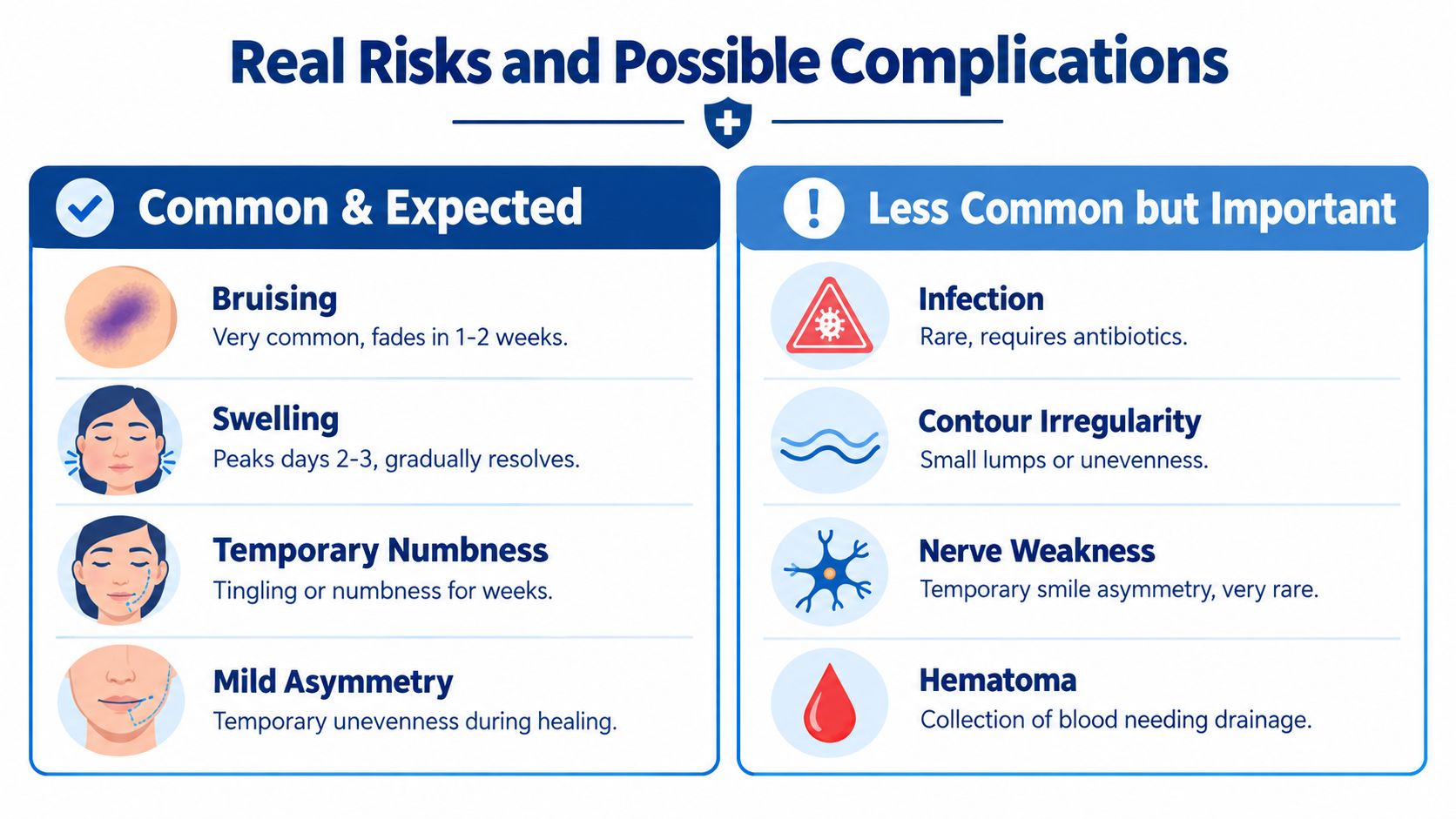
A smooth procedure does not mean a risk-free one. Bruising, swelling, temporary numbness, tightness, and early unevenness commonly occur during healing. The neck can look worse before it improves because swelling rarely resolves at the same pace on both sides.
Published evidence describes a range of complications after submental liposuction. Reported problems are often minor and manageable in an outpatient setting, but the literature also includes uncommon serious events. Those figures describe groups of patients, not a personal prediction. Your risk changes with skin quality, fat distribution, technique, energy use, medical history, and aftercare.
Problems that require discussion
Potential issues include:
- Contour irregularity: Lumps, depressions, or uneven transitions may appear as tissues heal and can sometimes persist.
- Hematoma or seroma: Blood or fluid may collect beneath the skin and occasionally requires drainage.
- Infection: Uncommon, but treatment may require antibiotics or additional care.
- Numbness: Sensory changes often improve, while persistent numbness warrants assessment.
- Skin injury: Excessive energy can cause burns, and aggressive suction can compromise the skin.
- Scarring or pigment change: Entry sites may heal with unfavorable texture or discoloration.
- Nerve weakness: Injury to the marginal mandibular nerve can affect lower-lip movement. Rare reports also describe temporary facial nerve paralysis and other serious complications.
The complication spectrum includes submental depression, edema, hypertrophic scarring, scar contracture, cervical necrotizing fasciitis, cervicofacial dystonia, and transient facial nerve paralysis. These outcomes are uncommon, but they explain why careful marking, conservative fat removal, sterile technique, controlled energy settings, and structured aftercare matter. Loose skin and prominent platysmal banding also affect the risk-benefit decision. Removing fat alone cannot reliably tighten significantly lax skin or correct every neck contour problem.
Minor asymmetry during the first six to eight weeks can reflect different rates of swelling and firmness on each side. Contact the office immediately for rapidly expanding swelling, fever, worsening redness, or sudden asymmetric firmness. Those findings can indicate infection or a hematoma and should not wait for a routine follow-up.
Recovery Timeline and When Results Show
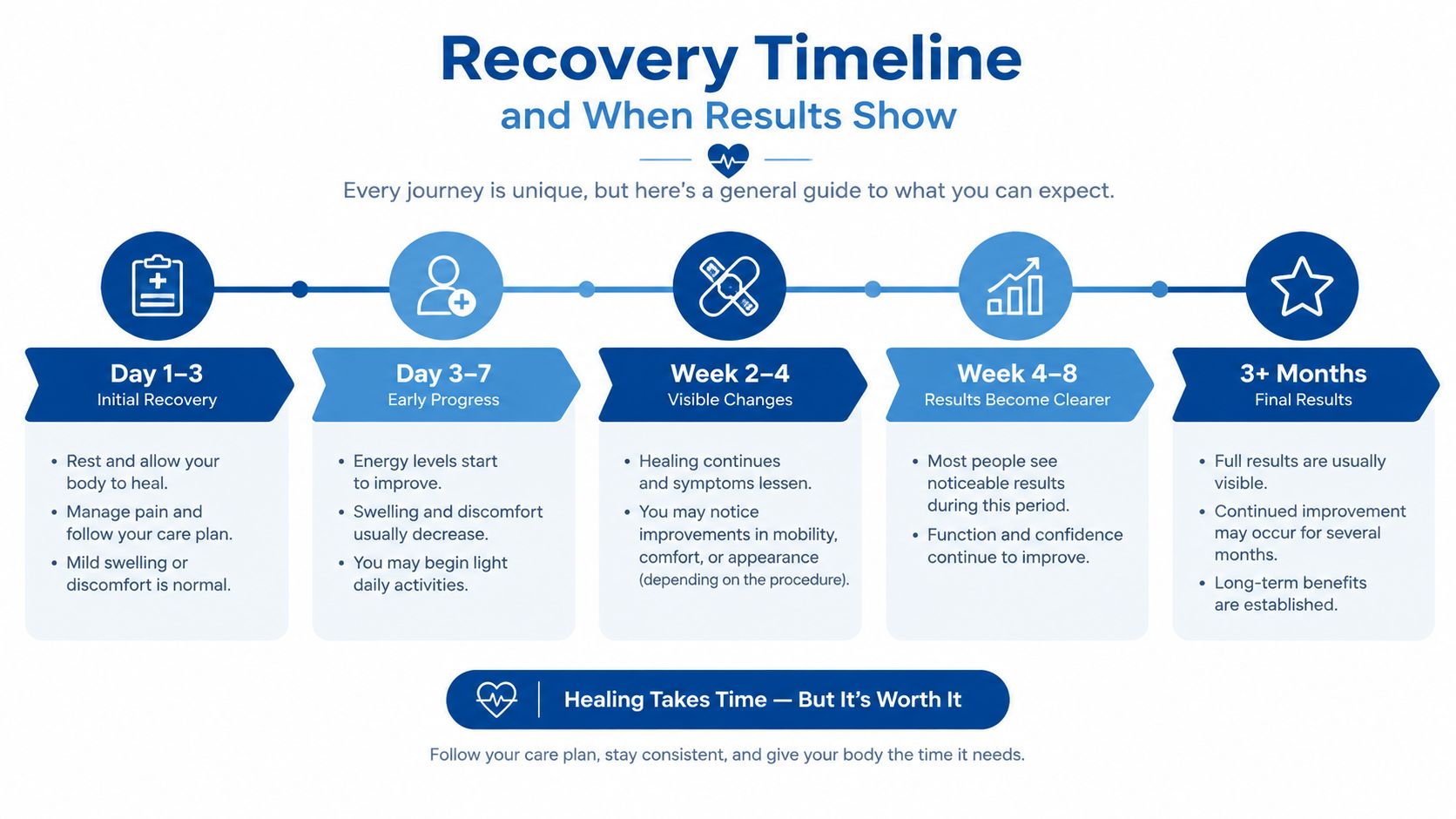
Recovery is a gradual change in tissue behavior, not a reveal that happens when the garment comes off. The early profile reflects swelling, fluid shifts, and inflammation. The later profile reflects skin retraction and internal remodeling.
The early phase
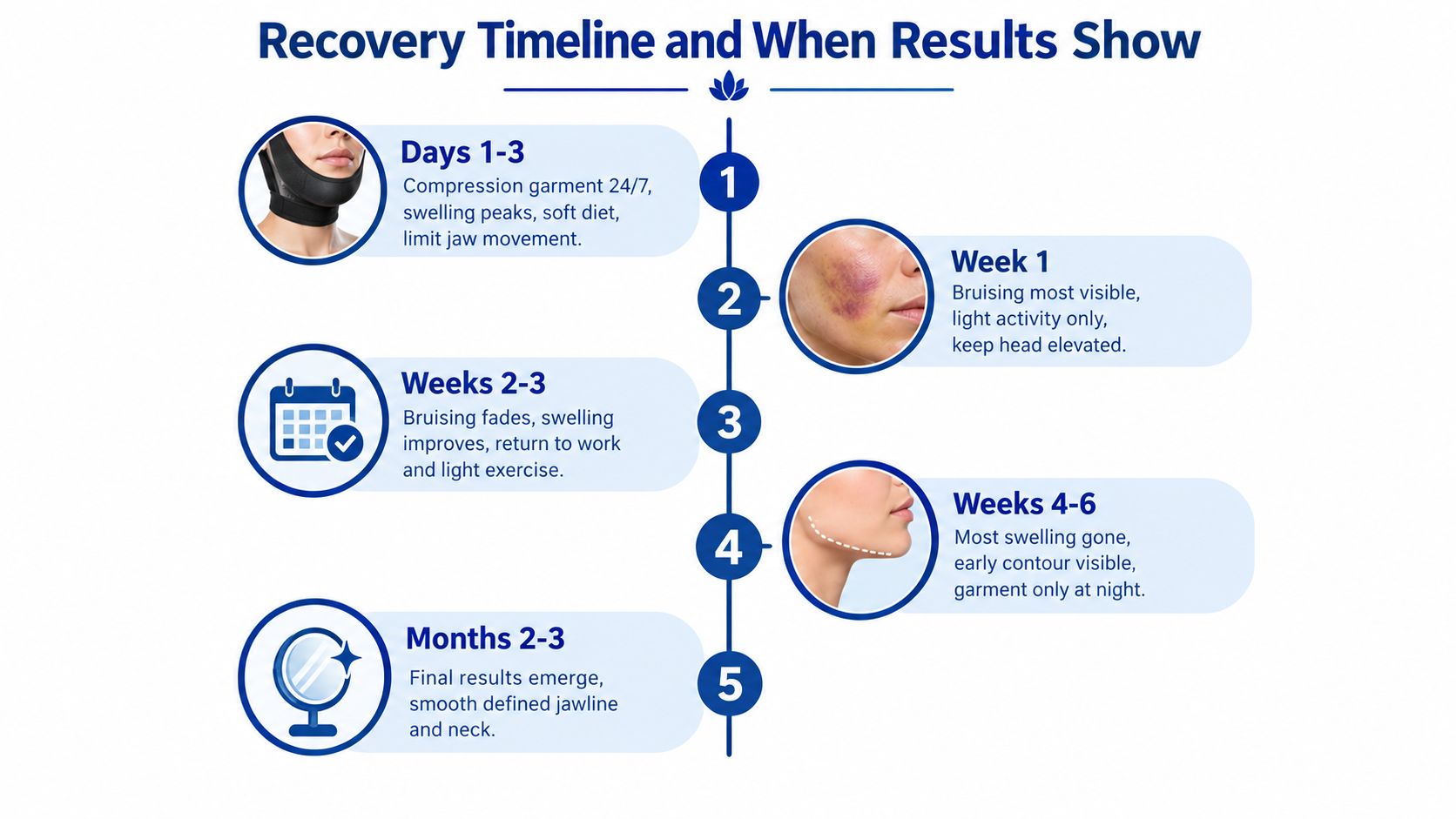
During days one through three, compression supports the treated area while swelling often reaches its highest point. A soft diet and limited jaw movement can make the first days more comfortable. Keep your head propped up and follow the prescribed instructions rather than adding massage or pressure on your own.
By week one, bruising is usually most visible but begins to fade. Many patients can return to desk-based work when they feel comfortable, though social recovery varies. If the surgeon used non-dissolving sutures, removal occurs according to the office's healing assessment.
During weeks two and three, visible bruising generally improves and swelling becomes less distracting. The neck may still feel firm or numb. That firmness reflects healing and doesn't automatically mean the surgeon left fat behind.
What patients often misread: Early lumps and tightness can be part of normal healing. The correct response is scheduled follow-up, not aggressive self-treatment.
Refinement takes longer
At weeks four through six, much of the obvious swelling has resolved, but residual firmness and subtle unevenness may remain. Light exercise is resumed only after clearance. The jawline starts to look more intentional, although the contour is still changing.
The American Society of Plastic Surgeons describes visible contour changes in the first week, much of the swelling resolving by four to six weeks, and collagen remodeling continuing for several months, with the most refined result around three months, as summarized in the recovery guidance for neck liposuction. Final assessment may take longer when skin laxity, extensive treatment, or uneven healing is present. Revision decisions should wait until the tissue has stabilized unless a concerning symptom requires earlier evaluation.
Common Questions Before You Commit
Will the result last?
Removed fat cells don't return as the same localized deposit, but the remaining fat cells can enlarge with substantial weight gain. Aging also continues after surgery, and skin may loosen over time. Stable weight and realistic expectations help preserve the contour, but no procedure stops the facial aging process.
What will the scar look like?
Access points are small and placed in discreet locations, commonly beneath the chin and sometimes behind the earlobes. Most scars become difficult to notice as they mature, though healing varies with genetics, skin tone, sun exposure, smoking, and aftercare. Ask to see healed examples from patients with similar skin characteristics.
Can it be combined with another procedure?
Yes, when the anatomy calls for it. A neck lift can address excess skin or muscle laxity, while a facelift may be considered when lower-face jowling and neck aging occur together. Energy-based tightening can sometimes refine a result, but it doesn't replace removal of substantial excess skin. A recessed chin may benefit from filler or an implant rather than more liposuction.
What determines the fee?
Fees vary with the surgeon's experience, anesthesia plan, facility, treatment area, energy-assisted technology, and whether another procedure is performed at the same time. Financing availability also varies by practice. A consultation should provide a written plan rather than a vague package recommendation.
What happens after surgery?
The first postoperative visit checks the access sites, swelling, skin quality, sensation, and contour. The surgeon may adjust compression instructions or activity restrictions based on what the tissue shows. Touch-ups should be considered only after adequate healing, except when a symptom requires prompt treatment.
The most useful consultation questions are specific:
- Ask about case volume: How frequently does the surgeon perform submental liposuction?
- Ask about diagnosis: Is the fullness caused by fat, skin, muscle, chin projection, or a combination?
- Ask about technique: Why is the recommended cannula, energy source, and anesthesia plan appropriate?
- Ask about complications: How does the office handle hematoma, infection, irregularity, or nerve weakness?
- Ask about timing: When will the surgeon judge the final contour, and what would justify a revision?
Bring reference photographs that show the profile you prefer, but don't expect a surgeon to reproduce another person's anatomy. Book an in-person consultation and ask directly about the surgeon's submental liposuction volume per year. The best decision will come from matching the procedure to your tissue, not from selecting a device by name.
Ideal Face & Body offers awake, office-based chin and neck contouring, including PRECISION SCULPT laser liposuction when localized fat and skin quality make that approach appropriate. Visit Ideal Face & Body to request a consultation and discuss whether double chin lipo, tightening, or a combined plan fits your anatomy.