
You're standing in the consultation room, you've already decided you want your chest fixed, and now you're staring at a confusing menu of options. Liposuction, excision, combination surgery, skin resection, free nipple grafting, awake surgery. The names sound technical, but the primary question is simpler: which operation will best give you a flatter chest with the least chance of a weird contour, a visible crater, or scars you'll regret later.
Gynecomastia surgery types aren't interchangeable. The best choice depends on whether your chest is mostly fat, mostly firm gland, mixed tissue, or loose skin that won't retract on its own. That's why two men can search for the same procedure and end up needing very different operations, with very different long-term trade-offs.
Table of Contents
- Why Gynecomastia Surgery Types Matter for Your Results
- Understanding Fat Versus Glandular Tissue in Male Chests
- The Major Gynecomastia Surgery Types Explained
- How Severity Grade and Skin Quality Determine Your Procedure
- Awake Gynecomastia Surgery and PRECISION SCULPT Technology
- Recovery Expectations and Scar Management by Procedure Type
- Making Your Decision and Preparing for Consultation
Why Gynecomastia Surgery Types Matter for Your Results
A man can walk into a consult convinced he needs “lipo,” then learn that liposuction alone won't touch the dense tissue sitting under the nipple. Another patient wants the gland removed aggressively, then later finds out the wrong plan can leave a hollow, over-scooped chest that looks unnatural in a T-shirt.
That's why procedure type matters more than the label on the problem. The operation has to match the anatomy in front of you, not the name you saw online.
The scale of this surgery in the U.S. also matters. The American Society of Plastic Surgeons reported 23,831 male breast reduction procedures in 2023, up from 22,900 in 2022, a 4.1% year-over-year increase in its cosmetic procedures dataset for men (ASPS statistics). That volume shows gynecomastia correction is a standard part of aesthetic surgery practice, not a fringe operation.
Practical rule: the “best” gynecomastia surgery type is the one that removes the right tissue without creating a new contour problem.
The long-term result is shaped by three things, the amount of fat, the amount of gland, and the amount of extra skin. If a surgeon uses a technique that's too limited, you can be left with residual fullness. If the approach is too aggressive for your anatomy, you can trade fullness for a crater-like depression or a scar pattern that's more visible than you expected.
That's also why surgery is usually considered after the problem has persisted. A 2019 standard-of-care review stated that if gynecomastia continues for more than 6 to 12 months despite medication, surgical correction should be considered (peer-reviewed review). By that point, the decision is less about hoping the chest will change on its own and more about choosing the right operation for the tissue that's there.
Understanding Fat Versus Glandular Tissue in Male Chests
The simplest way to think about a male chest is this, fat behaves like soft padding, gland behaves like a firm disk behind the nipple. They can occur separately or together, and that difference drives the entire operation.
Fat behaves differently from gland
Fatty tissue is diffuse and compressible. It tends to spread across the chest, and it usually responds to suction-based removal because it can be removed through a cannula. Glandular tissue is denser, more fibrous, and centered more tightly beneath the areola, which is why it doesn't behave like ordinary body fat.
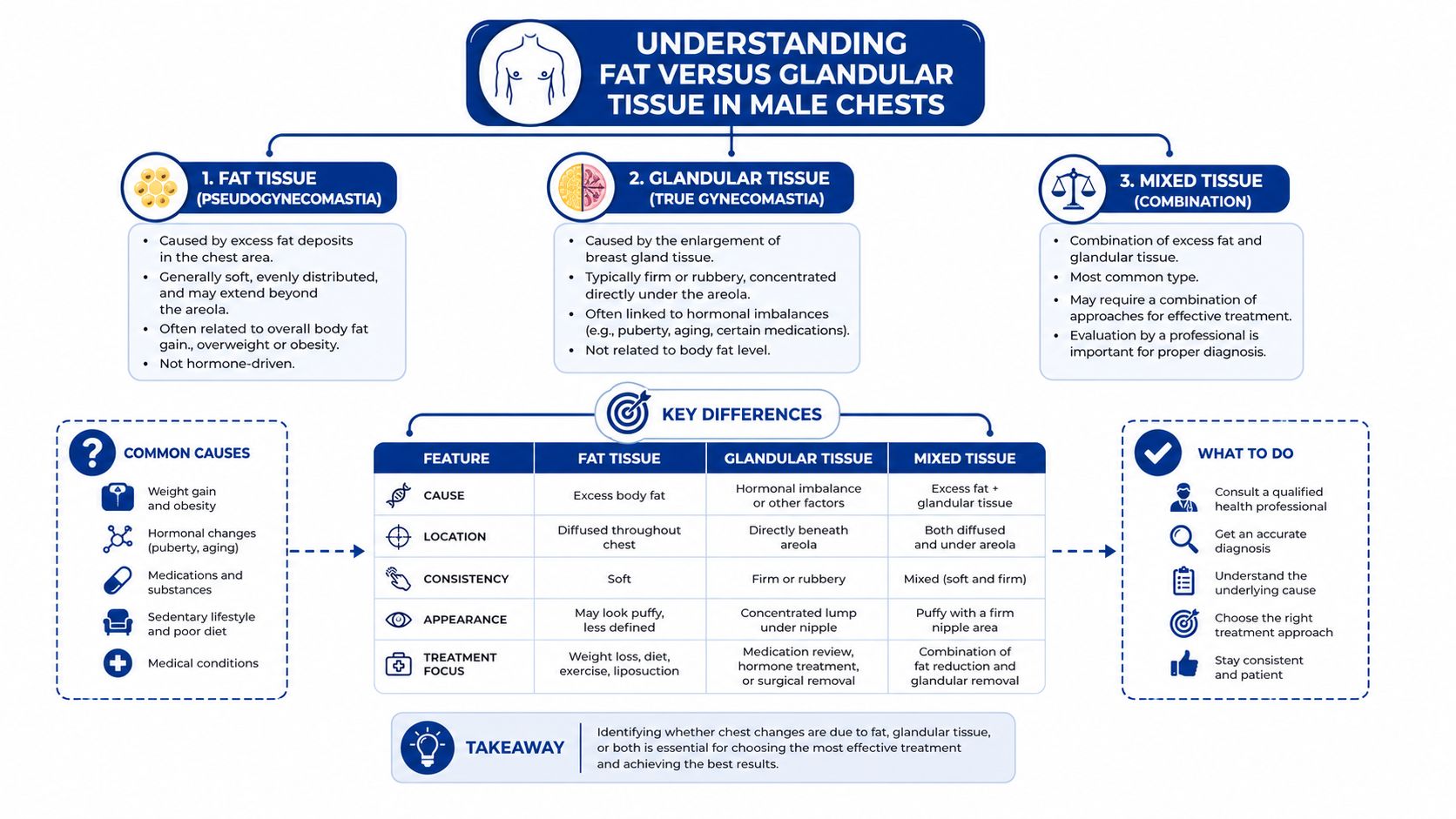
If the enlargement is mostly fat, liposuction may be enough. Stanford's gynecomastia guidance describes suction-assisted liposuction as the favored approach for mild-to-moderate cases dominated by fatty tissue, while direct excision is reserved for a larger glandular component or skin laxity.
True gynecomastia and pseudogynecomastia are not the same
Pseudogynecomastia means the fullness is mainly fat. True gynecomastia includes glandular tissue, often with fat mixed in. That distinction matters because liposuction can remove fat, but it doesn't reliably break up the firm gland that causes the classic puffy nipple look.
A good consultation should tell you what is actually under the nipple, not just what the chest looks like in clothes.
Clinical summaries of gynecomastia surgery also describe this mechanical split clearly, liposuction removes fatty tissue through a cannula, while excision removes glandular tissue and can also address excess skin or nipple position when needed (clinical summary). This is why the same chest can be treated with different methods: the surgeon is matching the tool to the tissue, not following a one-size-fits-all script.
The Major Gynecomastia Surgery Types Explained
A man comes in hoping for a flatter chest, but the key question is what shape he wants after healing. The major gynecomastia surgery types differ in what they remove, how they handle the skin envelope, and how the chest tends to age over time. The goal is not just a smaller chest. It is a chest that still looks smooth, masculine, and proportional once swelling settles and the tissues have healed.
Liposuction-only approaches
Liposuction-only surgery is the cleanest option for a chest that is mostly fatty. Small access points and a thin cannula let the surgeon remove soft tissue with limited scar burden. The trade-off is straightforward. If a firm gland sits under the nipple, liposuction alone will not fully flatten that area, and the nipple can still look puffy even when the chest is smaller.
Direct excision
Direct excision means the surgeon removes glandular tissue through an incision, often placed along the edge of the areola. This is the right tool when the tissue is firm, fibrous, or does not suction well. It gives more direct control over the problem tissue, but the scar is more noticeable than a tiny lipo port, and overly aggressive removal can leave a hollow or crater deformity under the nipple.
That contour problem matters because a chest can be technically smaller and still look operated on. The nipple should sit on a natural mound, not on a sunken patch.
Combination surgery
Combination surgery is common when fat and gland are both present. Liposuction shapes the broader chest, while excision removes the stubborn core behind the nipple. In practice, this often gives the most balanced contour because each method handles a different part of the problem. The judgment call is how much to remove. If too much tissue is taken, the chest can look flat in a way that reads as scooped instead of naturally masculine.
Skin resection and free nipple grafting
Severe cases, especially when the skin has stretched or the enlargement has been present for a long time, may need skin removal. In the most extreme situations, surgeons may use a free nipple graft to reposition the nipple-areolar complex. These procedures can correct major laxity and restore a tighter outline, but they also increase scar burden and can reduce the subtle, natural look of the nipple.
| Surgery Type | Best For | Incision Pattern | Contour Trade-Offs |
|---|---|---|---|
| Liposuction-only | Fat-dominant enlargement | Small access points | Least visible scars, but residual gland can remain |
| Direct excision | Firm glandular tissue | Often along the areolar border | Better gland removal, higher risk of over-scooping if too aggressive |
| Combination surgery | Mixed fat and gland | Lipo ports plus areolar incision | Balanced correction, requires careful tissue judgment |
| Skin resection | Loose skin or major enlargement | More extensive incisions | Better tightening, more visible scar burden |
| Free nipple grafting | Massive cases with major skin excess | Larger resection pattern | Strong correction, but the most invasive scar and nipple trade-offs |
A peer-reviewed review of gynecomastia operations describes modern techniques as a graded, anatomy-based spectrum rather than a single universal operation (review). That is the right framework. The chest determines the method, and the long-term result depends on matching the operation to the tissue, the skin, and the amount of contour control needed.
How Severity Grade and Skin Quality Determine Your Procedure
A chest can look similar from the outside and still need a different operation. One man has tight skin that contracts well after tissue removal. Another has stretched skin that will not retract enough, even if the fat and gland are addressed cleanly. That difference changes the plan, and it changes the final contour.
Skin is often the deciding factor
After tissue is removed, the skin has to settle around the new chest shape. If the skin still has good elasticity, the result can tighten into a natural outline. If it does not, the chest may look empty, loose, or flattened in a way that feels worse than the original enlargement.
The literature makes that point plainly. A peer-reviewed review of gynecomastia surgery describes skin excess, skin elasticity, skin resection, and free nipple grafting as part of the decision-making process in severe cases and in patients with major skin laxity (peer-reviewed review). That is the part many summaries skip, yet it is often what decides whether the chest will look smooth or over-corrected.
The same grade can lead to different plans
A man with mild-to-moderate enlargement and good skin quality may do well with liposuction plus gland excision. Another man with the same general severity grade, but looser skin or a longer history of enlargement, may need a more extensive approach to avoid leftover laxity or an irregular contour. Age, weight history, and the balance of fat versus firm gland all affect that judgment.
Long-term shape matters more than a simple procedure name.
Practical rule: do not ask for a named technique first, ask what your skin will do after the tissue is removed.
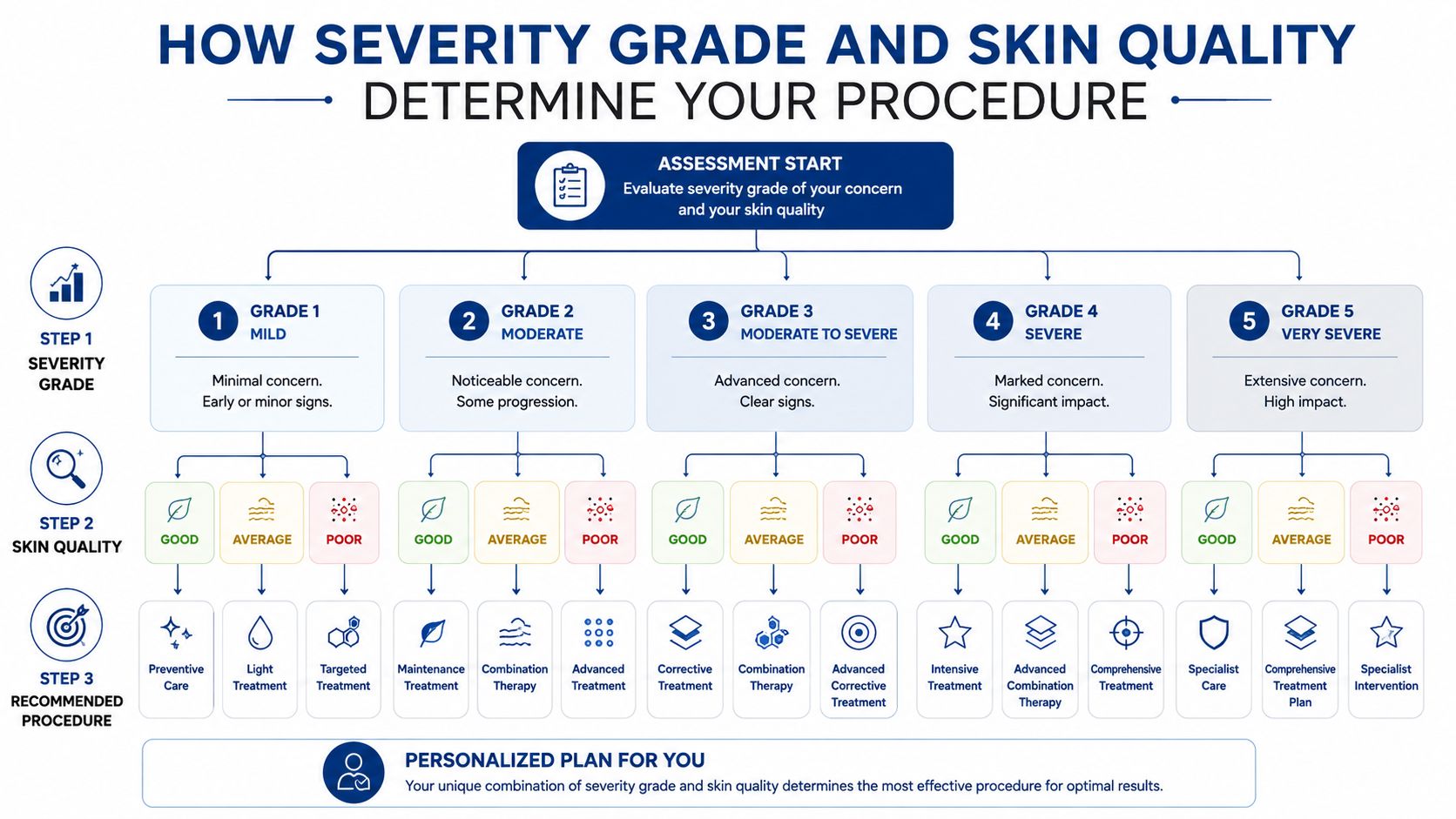
That is why a grade-based plan should be anatomy-driven from the start. If the chest has enough elasticity, a less invasive operation may give a cleaner result with less scar burden. If the skin is already stretched, the surgeon may need to accept a bigger incision pattern to avoid a lingering sag or a cratered appearance after the gland is removed.
A careful consultation for gynecomastia surgery in Los Angeles should address that trade-off directly. Once enlargement is stable and surgery is appropriate, the right plan is the one that matches the chest in front of the surgeon, not the one that sounds simplest on paper. The result should still look natural after swelling fades, with contour, scar placement, and skin behavior all considered together.
A standard-of-care review on persistent gynecomastia supports that anatomy-first approach (standard-of-care review).
Awake Gynecomastia Surgery and PRECISION SCULPT Technology
Some men want correction but don't want the recovery feel of a bigger anesthetic event. That's where an awake, local-anesthesia model fits, especially when the case is limited enough to be handled safely in an office-based setting.
At Ideal Face & Body, that approach is tied to awake surgery under local anesthesia and the use of PRECISION SCULPT laser liposculpting for selected body-contouring cases. For gynecomastia, that combination can be useful when the chest has enough fatty component to benefit from laser-assisted contouring and when the patient is a good candidate for local anesthesia rather than general anesthesia.
The patient experience is different. You're not asleep and waking up disoriented, you're monitored while local anesthetic numbs the area, and the surgery is built around keeping the procedure focused and efficient. For some men, that's a meaningful advantage because they want to avoid the broader recovery burden that can come with deeper sedation.
The place to use technology like this is selective, not automatic. Laser liposculpting can help when the chest has stubborn fat and the surgeon wants added contour refinement, but it doesn't replace excision when firm glandular tissue is the main issue. Technology should sharpen the plan, not substitute for anatomy-based judgment.
A better device doesn't fix a wrong operation plan. It only improves the result when the underlying procedure type fits the chest.
For men who want a more detailed overview of this office-based treatment model, the consultation information on gynecomastia surgery in Beverly Hills gives a practical look at how the awake approach is discussed in real patient planning. The key point is still the same, local anesthesia changes the experience, but it doesn't change the need to match the operation to the tissue.
Recovery Expectations and Scar Management by Procedure Type
Recovery is where expectations get tested. Men usually notice their chest is flatter right away, but they also notice swelling, firmness, and the fact that the final contour takes time to settle.
What recovery looks like by procedure
Liposuction-only cases usually have the simplest aftercare because the incisions are small and the tissue trauma is more limited. Combination cases and excision cases tend to feel more involved because the chest has both suctioned areas and direct tissue removal. Skin resection cases are the most demanding, because the surgeon has had to do more work to solve the skin problem, not just the gland problem.
Scar placement depends on the procedure. Small lipo access points usually fade well. Periareolar incisions, when used, tend to blend into the edge of the areola more naturally than larger skin-resection scars, but even a discreet incision still needs time and good scar care to mature.
What patients should plan for
- Compression garment use: This is used to support the new contour and help swelling settle.
- Activity limits: Heavy lifting and chest-straining exercise usually need to wait until the surgeon clears them.
- Swelling and firmness: These are normal early, and they can temporarily blur the final shape.
- Contour patience: The chest usually looks better before it looks finished.
A clinical recovery summary notes that many men return to work or light activities within five to seven days, while more strenuous exercise is often delayed for four to six weeks, and the swelling continues to settle for months before the final result is clear. That timeline is a useful reference point, but the exact pace depends on how much was removed and whether skin work was done.

If you want a more detailed recovery breakdown for planning purposes, the patient guide on gynecomastia surgery recovery is a practical place to compare the experience of smaller-access surgery with more extensive correction. The main point is simple, the more skin and gland work the operation requires, the more you should expect scar management and swelling control to matter.
Making Your Decision and Preparing for Consultation
The best decision starts with anatomy, not marketing language. If you already know your chest is mostly fat, mostly gland, or a mix with loose skin, the consultation becomes much more useful and you avoid being sold a generic answer that does not fit your body.
A small, fat-dominant chest may respond well to limited contouring. A firmer gland-dominant chest often needs direct excision to avoid leaving a stubborn central mound behind. Loose skin changes the discussion again, because the primary issue becomes how to reduce fullness without creating an empty or sagging look.
What to ask in consultation
- Tissue assessment: Ask what part of the problem is fat versus gland, and how that changes the plan.
- Contour outcome: Ask how the chest should look months later, not just right after surgery.
- Scar burden: Ask where each scar will sit and what trade-off comes with that incision pattern.
- Skin behavior: Ask whether your skin is likely to retract or whether resection is more realistic.
- Over-resection risk: Ask how the surgeon avoids a crater deformity or an overly flat look.
Scar placement matters more than many men expect. A smaller incision can mean less visible scarring, but it can also limit access and make contour control harder in denser tissue. A larger incision may give better control of gland removal and skin tailoring, yet it leaves a more noticeable scar and requires more scar management afterward.
What to review before agreeing
Look at before-and-after photos that resemble your own chest shape, not just dramatic transformations. A man with loose skin needs a different visual reference than a man with a small, fat-dominant chest. If the gallery does not show cases similar to yours, that is a warning sign.
If cost is part of your decision, ask for a clear breakdown before you agree to anything. The page on gynecomastia surgery cost with insurance is a useful starting point for understanding how coverage and out-of-pocket planning may affect your choice of procedure.
Conservative treatment can still be appropriate in some cases, especially when the cause may be reversible. A clinical review notes tamoxifen 20 mg daily for up to 3 months, with regression seen in up to 80% of patients in randomized and non-randomized trials, and it also notes that physiologic gynecomastia can resolve on its own (clinical review). But when enlargement is persistent, surgery is usually the more predictable path.

If you are deciding between operation types, the best next step is a consultation that focuses on tissue composition, skin quality, and scar trade-offs rather than buzzwords. Ideal Face & Body offers awake, office-based chest contouring for men who want an anatomy-driven plan, and you can learn more by visiting Ideal Face & Body.